
Table 1.
| ST-ELEVATION MYOCARDIAL INFARCTION (STEMI) |
The American College of Cardiology, American Heart Association, European Society of Cardiology, and World Heart Federation committee established the following electrocardiogram (ECG) criteria for STEMI:
|
A new left bundle branch block is considered a STEMI equivalent. Patients with a pre-existing left bundle branch block can be further evaluated using Scarbossa's criteria:
|
| NON–ST-ELEVATION MYOCARDIAL INFARCTION (NSTEMI) |
| NSTEMI is diagnosed in patients who have symptoms consistent with acute cardiogenic shock and troponin elevation but without ECG changes consistent with STEMI. Unstable angina and NSTEMI differ primarily in the presence or absence of detectable troponin leak. Myocardial injury is expected at troponin levels exceeding the 99th percentile upper reference limit, which is specified for each individual assay. Specific cutoffs can be found in manufacturers' package inserts, in peer-reviewed publications, and on the International Federation of Clinical Chemistry and Laboratory Medicine website. |
Table 2.
Recent clinical trials evaluating treatment options in cardiogenic shock. IABP: intra-aortic balloon pump; PCI: percutaneous coronary intervention; RRT: renal replacement therapy; SHOCK: Should we Emergently Revascularize Occluded Coronaries for Cardiogenic Shock trial; IABP-SHOCK II: Intra-Aortic Balloon Pump Support for Myocardial Infarction with Cardiogenic Shock trial; IMPRESS: Impella Versus IABP Reduces Mortality in STEMI Patients Treated with Primary PCI in Severe Cardiogenic Shock trial; CULPRIT SHOCK: Culprit Lesion-Only PCI Versus Multivessel PCI in Cardiogenic Shock trial; DCSI: Detroit Cardiogenic Shock Initiative
| TRIAL | YEAR | PATIENTS | PATIENT POPULATION | TREATMENT ARMS | PRIMARY END POINT(S) | RESULTS |
|---|---|---|---|---|---|---|
| SHOCK | 1999 | 302 | Shock due to left ventricular failure complicating myocardial infarction | Emergency revascularization or initial medical stabilization | 30-day all-cause mortality | No significant difference in mortality between treatment groups (46.7% vs 56.0%; P = .11) |
| IABP – SHOCK II | 2012 | 600 | Shock complicating acute myocardial infarction | Intra-aortic balloon counterpulsation or no intra-aortic balloon counterpulsation | 30-day all-cause mortality | No significant difference in mortality between treatment groups (39.7% vs 41.3%; P = .69) |
| IMPRESS | 2016 | 48 | Severe shock complicating acute myocardial infarction | Impella CP or intra-aortic balloon pump | 30-day all-cause mortality | No significant different in mortality between Impella CP and IABP (46% vs 50%, P = .96) |
| CULPRIT SHOCK | 2017 | 706 | Shock presenting with multivessel disease and acute myocardial infarction | Culprit-lesion-only PCI or immediate multivessel PCI | 30-day mortality and renal failure requiring RRT | Culprit-lesion-only PCI was associated with slightly decreased risk of mortality (OR: 0.84, P = .03) compared to multivessel PCI, but the risk of RRT did not differ (OR: 0.71, P = .07) |
| DCSI | 2018 | 41 | Acute myocardial infarction complicated by cardiogenic shock | Single treatment arm of invasive hemodynamic monitoring and rapid initiation of non-IABP MCS | Survival to explant and change in CPO | Survival to explant was 85% vs 51% in historical controls (P < .001), and post-procedure CPO increased 67% compared to pre-procedure CPO (P < .001) |
Table 3.
| CLASS | CARDIAC INDEX (MM/MIN) | PCWP (MM HG) | MORTALITY (%) |
|---|---|---|---|
| I | > 2 | < 18 | 3 |
| II | > 2 | > 18 | 9 |
| III | < 2 | < 18 | 23 |
| IV | < 2 | > 18 | 51 |
| I | > 2 | < 18 | 3 |
| II | > 2 | > 18 | 9 |
| III | < 2 | < 18 | 23 |
| IV | < 2 | > 18 | 51 |
Table 4.
The Society for Cardiovascular Angiography and Interventions classification scheme.13 CS: cardiogenic shock; JVP: jugular venous pressure; SBP: systolic blood pressure; CVP: central venous pressure; PA sat: pulmonary artery saturation; BNP: brain natriuretic peptide; MAP: mean arterial pressure; PCWP: pulmonary capillary wedge pressure; RAP: right atrial pressure; PAPI: pulmonary artery pulsatility index; GFR: glomerular filtration rate; LFT: liver function test; CPR: cardiopulmonary resuscitation; ECMO: extracorporeal membrane oxygenation; BiPaP: bilevel positive airway pressure
| STAGE | DESCRIPTION | PHYSICAL EXAM/BEDSIDE FINDINGS | BIOCHEMICAL MARKERS | HEMODYNAMICS |
|---|---|---|---|---|
| A At risk | Patient is not currently experiencing signs or symptoms of CS but is at risk for its development. Patient may have large acute myocardial infarction or prior infarction and/or acute on chronic heart failure symptoms. |
|
| Normotensive (SBP ⩾ 100 mm Hg or normal) If hemodynamics done:
|
| B Beginning CS | Patient has clinical evidence of relative hypotension or tachycardia without hypoperfusion. |
|
| SBP < 90 mm Hg or MAP < 60 mm Hg or > 30 mm Hg drop from baseline Pulse ≥ 100 If hemodynamics done:
|
| C Classic CS | Patient manifests with hypoperfusion that requires intervention (inotrope, pressor, or mechanical support, including ECMO) beyond volume resuscitation to restore perfusion. These patients typically present with relative hypotension. | May include:
| May include:
| May include: SBP < 90 mm Hg or MAP < 60 mm Hg or > 30 mm Hg drop from baseline and drugs/device used to maintain BP above these targets Hemodynamics:
|
| D Deteriorating/doom | Patient is similar to category C but is getting worse and failing to respond to initial interventions. | Any of stage C | Any of Stage C and: deteriorating | Any of Stage C and: requiring multiple pressors or addition of mechanical circulatory support devices to maintain perfusion |
| E Extremis | Patient is experiencing cardiac arrest with ongoing CPR and/or ECMO, being supported by multiple interventions. |
| “Trying to die” CPR (A-modifier) pH ⩽ 7.2 Lactate ⩾ 5 mmol/L |
|
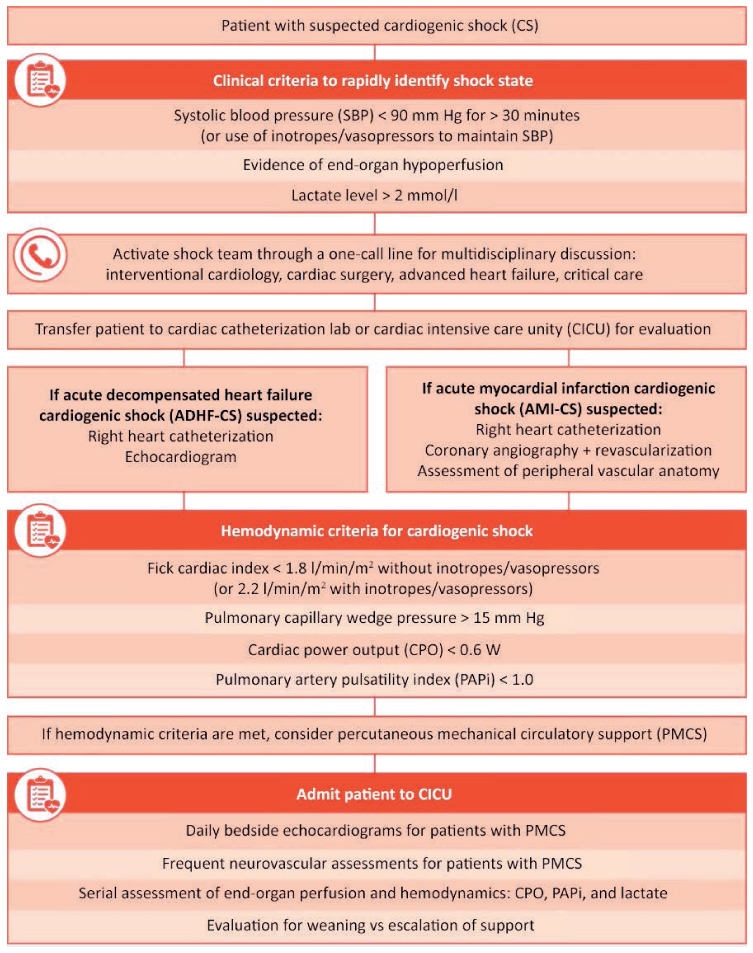
Figure 1.
Cardiogenic Shock Algorithm developed by the INOVA Heart and Vascular Institute. Republished with permission of Elsevier Science & Technology Journals, from Standardized Team-Based Care for Cardiogenic Shock, Tehrani et al., 73(13), 2019.17