
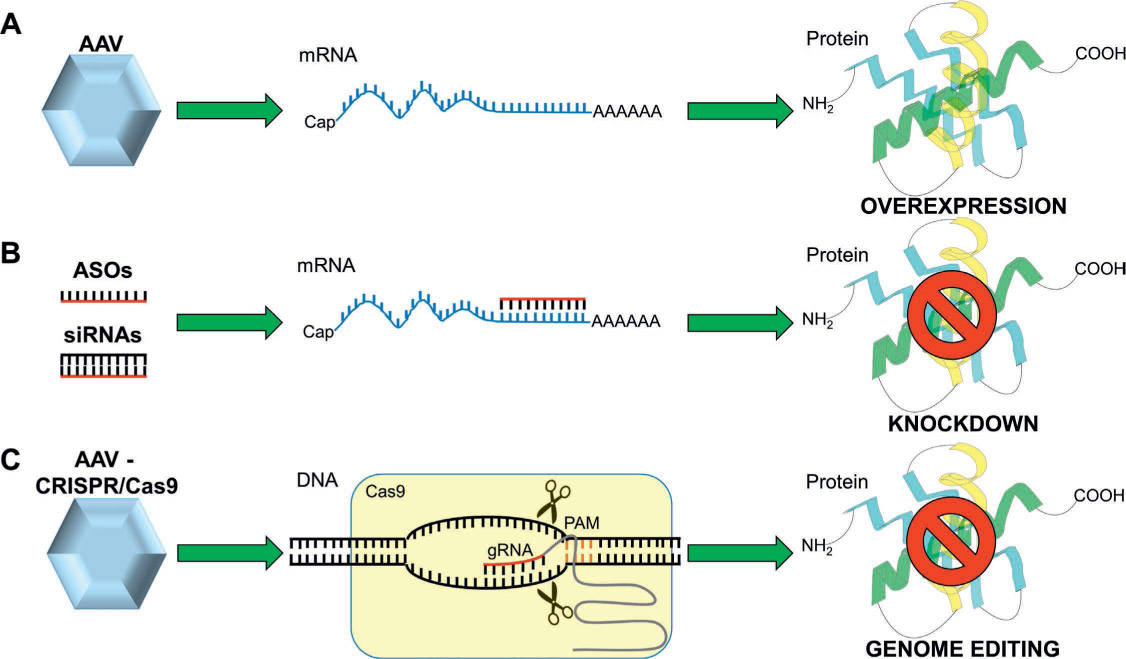
Figure 1.
Gene delivery technologies in lipid research and therapies. (A) AAV vectors are commonly used for overexpressing proteins. (B) ASOs and siRNAs are synthetic nucleic acids engineered to hybridize with a target mRNA or pre-mRNA to induce its degradation and silencing. (C) AAV vectors are also used for delivering the CRISPR/Cas9 genome editing system. A gRNA guides the Cas9 nuclease to a complementary genomic site in proximity to a Protospacer Adjacent Motif (PAM). Cas9 induces a DSB causing indel mutations, which can be used to permanently inactivate or knock out the target gene. AAV: adeno-associated virus; ASO: antisense oligonucleotides; siRNAs: small interfering RNAs; CRISPR/Cas9: Clustered Regularly Interspaced Short Palindromic Repeats; gRNA: guide RNA
Table 1.
Summary of gene transfer technologies. AAV: adeno-associated virus; ASO: antisense oligonucleotides; siRNAs: small interfering RNAs; CRISPR/Cas9: Clustered Regularly Interspaced Short Palindromic Repeats; NHEJ: nonhomologous end-joining
| APPROACH | TECHNOLOGY | STRENGTHS | WEAKNESSES | POTENTIAL THERAPEUTIC TARGETS |
|---|---|---|---|---|
| Overexpression | AAV | Safe for use in humans Nonreplicating Low risk of insertional mutagenesis Noncytotoxic, modest immune response Efficient transduction of dividing and nondividing cells Strong and sustained transgene expression for months to years | Limited packaging capacity ~4.9 kb Artificial expression cassettes do not preserve endogenous regulation High frequency of neutralizing antibodies to AAV capsids in humans T-cell responses to capsid managed with immunosuppression | Pursued LPL LDLR Possible LCAT APOE APOC2 APOA1 LIPA LIPC LDLRAP1 GPIHBP1 |
| Knockdown | ASOs | Efficient knockdown by RNAse H recruitment or translation blocking Splicing modulation by targeting pre-mRNA Chemically modified for improved liver uptake Efficient long-term silencing with weekly or biweekly administration Subcutaneous injection | Chemical modifications needed to increase nuclease resistance and half-life Possibility of sequence-related off-targets Potential class effects depending on modifications Mild skin reactions | Pursued APOB APOC3 ANGPTL3 LPA Possible PCSK9 |
| siRNA | Efficient knockdown by RNAi machinery Long-term silencing can be achieved Chemically modified for direct liver uptake Can also be effective at lower doses via lipid nanoparticle delivery | Possibility of sequence-related off-targets Potential class effects depending on modifications Some formulations require intravenous injection | Pursued PCSK9 Possible APOB APOC3 ANGPTL3 LPA | |
| Genome editing | CRISPR/Cas9 | Ease of design and customization High NHEJ-mediated editing efficiency Multiplex genome editing capacity Correct gene dosage Preservation of regulatory elements One-time treatment Permanent correction to patient's own DNA | Potential off-target activity that requires careful testing Potential unintended consequences at the DSB site (i.e., large insertions/deletions) Low efficiency of HDR-mediated gene correction (restricted to dividing cells) Potential immune response against Cas9-expressing cells | Possible APOB APOC3 ANGPTL3 PCSK9 LPA |