
ADENO-ASSOCIATED VIRAL VECTOR OVEREXPRESSION
Viral overexpression is a common approach for investigating candidate genes in lipid and atherosclerosis research.1,2 This is also the underlying principle of additive gene therapy, which seeks to restore activity of a dysfunctional gene by adding an artificial transgene (Figure 1). Adeno-associated viruses (AAVs) are small, nonenveloped, nonintegrating, single-stranded DNA viruses that can package up to 4.9 kb of exogenous DNA.3 Upon delivery, recombinant AAV genomes are converted to double-stranded intermediate and circularize to form episomes, which are maintained extrachromosomally in the nucleus. Relative to adenoviral vectors, AAVs elicit a far milder immune response, allowing for stable transgene expression for months to years.4 Recombinant AAVs can be cross-packaged with capsids from many naturally occurring serotypes or engineered variants, allowing the researcher to restrict or broaden tissue distribution.3 Most AAV capsids have a high liver tropism, making them ideal for delivery to this organ. Thus far, AAV vectors have been used safely in humans in more than 120 clinical gene therapy trials. The first AAV-based gene therapy products were approved for use in humans in 2012 (Europe) and another in 2017 (United States).5,6
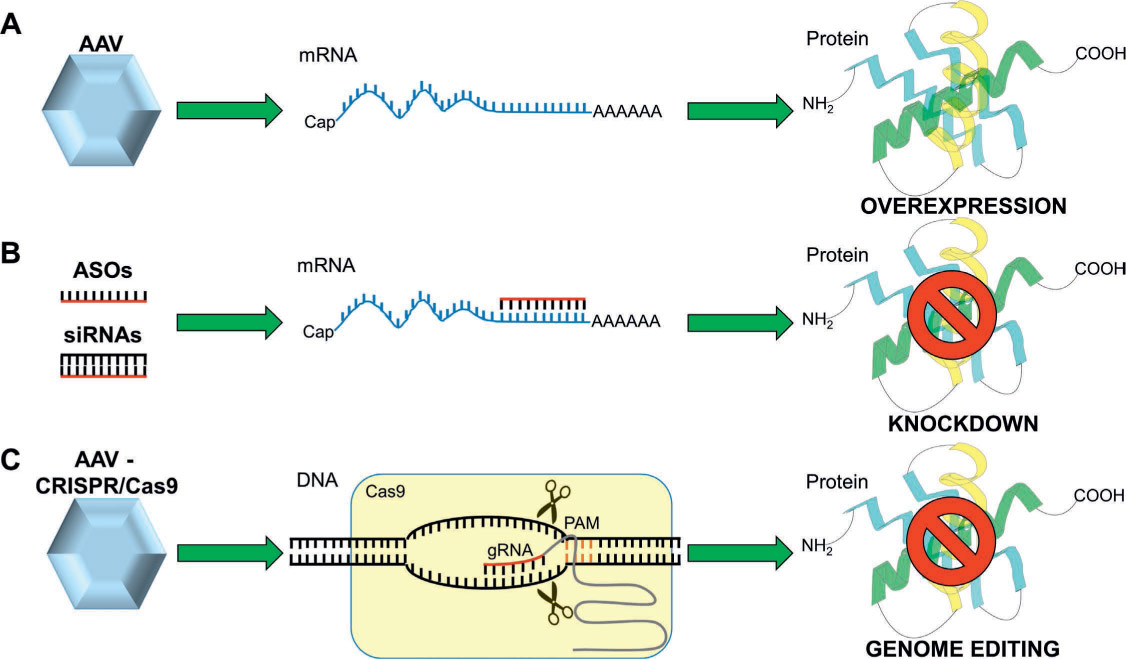
Figure 1.
Gene delivery technologies in lipid research and therapies. (A) AAV vectors are commonly used for overexpressing proteins. (B) ASOs and siRNAs are synthetic nucleic acids engineered to hybridize with a target mRNA or pre-mRNA to induce its degradation and silencing. (C) AAV vectors are also used for delivering the CRISPR/Cas9 genome editing system. A gRNA guides the Cas9 nuclease to a complementary genomic site in proximity to a Protospacer Adjacent Motif (PAM). Cas9 induces a DSB causing indel mutations, which can be used to permanently inactivate or knock out the target gene. AAV: adeno-associated virus; ASO: antisense oligonucleotides; siRNAs: small interfering RNAs; CRISPR/Cas9: Clustered Regularly Interspaced Short Palindromic Repeats; gRNA: guide RNA
AAV vectors based on serotype 8 (AAV8) primarily target the liver in mice and have become a mainstay of lipid research. They have been used to overexpress numerous proteins in lipid metabolism, including apolipoproteins, lipases, lipid transfer proteins, lipoprotein receptors, signaling proteins, and several enzymes in lipid synthesis. Delivery of Cre recombinase with AAV8 is rapidly gaining popularity and is viewed by many as superior to albumincre for generating liver-specific knockouts.7 A noteworthy example of the power of liver-directed overexpression involves the use of AAVPCSK9 to induce atherosclerosis. Proprotein convertase subtilisin kexin 9 (PCSK9) is secreted by the liver and promotes degradation of the low-density lipoprotein receptor (LDLR) by preventing recycling to the cell surface.8 Several groups have demonstrated that AAV-based overexpression of PCSK9 gain-of-function variants can be used to model atherosclerosis in mice.1,9 This approach can greatly simplify atherosclerosis studies by avoiding the need to cross mice to Ldlr or Apoe knockout backgrounds.
AAV vectors are also the leading technology in tissue-directed gene therapy for lipid disorders. Lipoprotein lipase is a key enzyme in the catabolism of chylomicrons that hydrolyzes triglycerides (TG). Lipoprotein lipase (LPL) deficiency is a rare inherited disease characterized by the accumulation of chylomicrons in plasma, severe hypertriglyceridemia, and episodes of life-threatening pancreatitis. Glybera (uniQure N.V.) is an AAV1 vector designed for direct intramuscular delivery of the human gain-of-function LPL gene variant S447X.10 Clinical trials demonstrated that Glybera was associated with a lower incidence of pancreatitis in patients with LPL deficiency.5,11 This was the first gene replacement therapy to receive regulatory approval in Europe in 2012. However, since Glybera is locally injected and targets only a small proportion of skeletal muscle in the body, it provides limited restoration of LPL activity. This product was recently withdrawn from the market because of inadequate long-term efficacy and lack of commercial viability. Nonetheless, this was a major step forward for AAV vectors, demonstrating safety in humans and a clear path for regulatory approval.
Familial hypercholesterolemia (FH) is an autosomal-dominant disease characterized by high plasma LDL levels and premature cardiovascular disease (CVD).12 It is most frequently caused by loss-of-function mutations in the LDLR gene, resulting in impaired clearance of apolipoprotein B (apoB)-containing lipoproteins. Functional replacement of LDLR has long been a desired treatment strategy for patients with homozygous FH (HoFH).13 The first clinical trial of FH gene therapy involved ex vivo retroviral LDLR transduction of hepatocytes from patients with HoFH, followed by reimplantation of the cells.14 However, engraftment of the hepatocytes was inefficient and without significant lipid improvements, discouraging further follow-up. Since then, multiple preclinical studies have been performed using an AAV8 vector with the liver-specific thyroxine-binding globulin promoter to express the human LDLR cDNA. These studies demonstrated efficient hepatocyte transduction, sustained LDL lowering, and protection from atherosclerosis,15–17 thus providing the scientific and regulatory support for a phase 1/2 clinical trial in humans that is currently in progress, with results expected in 2019.13
ANTISENSE OLIGONUCLEOTIDES AND SMALL INTERFERING RNAS
Antisense oligonucleotides (ASOs) and small interfering RNAs (siRNAs) are synthetic nucleic acids that are commonly used for silencing gene expression in the liver (Figure 1).18 ASOs are short, single-stranded DNA sequences (20–30 oligonucleotides) engineered to hybridize with a target mRNA or pre-mRNA.18 The ASO-mRNA annealing results in the recruitment of a ribonuclease (RNase H) that cleaves the targeted mRNA, leading to its degradation.19 Small interfering RNAs are short, double-stranded RNA sequences (21–23 oligonucleotides) that cause sequence-specific degradation of mRNA through the RNA interference (RNAi) process.18 ASOs have been used extensively by lipid researchers to probe basic biology. Several chemical modifications of ASOs and siRNAs exist that can both improve their stability as well as specific delivery.20 In particular, polyethylene glycol (PEG)-coated lipid nanoparticles and trivalent N-acetylgalactosamine conjugates are respectively used for enhancing the delivery and uptake of oligonucleotide therapeutics to the liver, minimizing off-tissue effects.20,21 These two technologies have also been used for preclinical knockdown of several proteins involved in lipoprotein metabolism, including apoB100, apoCIII, angiopoietin-like 3 (ANGPTL3), lipoprotein(a), and PCSK9. However, all oligonucleotide therapies require careful evaluation of possible off-tissue effects as well as potential adverse events arising from sequence-related off-target silencing and immune activation.
Familial hypercholesterolemia has been aggressively pursued as a candidate for mRNA silencing therapeutics. The proposed mechanisms of cholesterol lowering generally involve inhibition of very low-density lipoprotein (VLDL) production or promotion of LDL clearance by the liver. Mipomersen is an ASO that inhibits the synthesis of apoB100 and is approved as an adjunctive therapy for HoFH.10,22 ApoB100 is the major structural component of VLDL, intermediate-density lipoprotein, and LDL, and its expression is critical for the normal export of TG from the liver.23 In a phase 3 study in patients with HoFH, mipomersen showed significant reductions of LDL-C, non-HDL cholesterol, and apoB lipoproteins.24 In addition, long-term mipomersen treatment has been associated with reduced cardiovascular events in FH patients.25 To date, the use of mipomersen in the United States is only available through the U.S. Food and Drug Administration's (FDA) Risk Evaluation and Mitigation Strategy drug safety program because of the potential for liver toxicity, which may involve on-target effects of apoB inhibition on hepatic fat content.
Inhibition of PCSK9 with monoclonal antibodies has been extremely successful, particularly in the setting of heterozygous FH. Therefore, it is not surprising that several RNA silencing drugs targeting PCSK9 have been pursued. ALN-PCSsc is an siRNA investigational agent that targets PCSK9 and is the only siRNA currently in clinical trials for lipid-related disorders. In a phase 2 clinical study, patients with high baseline LDL-C levels who received ALN-PCSsc demonstrated a significant decrease of plasma circulating PCSK9 and LDL-C levels at 240 days of follow-up.26 These positive results led to phase 2 and 3 clinical studies that are now in progress.27–31
Triglycerides are emerging as an important independent risk factor for CVD, and no currently available drugs substantially reduce this lipid class. ApoCIII is a liver-expressed secreted glycoprotein that binds to apoB-containing lipoproteins. It has been shown to inhibit LPL hydrolysis in vitro32 and interferes with receptor-mediated clearance of TG-rich lipoproteins by the liver.33 Elevated apoCIII levels are a risk factor for CVD, and loss-of-function variants are associated with reduced risk of coronary heart disease.34 Volanesorsen is an ASO that showed dose-dependent and prolonged reduction of circulating apoCIII and TG in multiple preclinical models and in a phase 1 trial.35 Recently, volanesorsen has been reported to reduce TG, abdominal pain, and pancreatitis attacks in patients with familial chylomicronemia syndrome within a phase 3 study.36 This drug was considered by the FDA in September 2018 but was not approved, possibly due to concerns about the risk of thrombocytopenia.
Another promising target for TG lowering is ANGPTL3, a liver-derived secreted protein that raises plasma lipids by inhibiting LPL and preventing hepatic uptake of apoB lipoproteins.37,38 Loss-of-function mutations in the human ANGPTL3 gene have been associated with low plasma LDL-C and TG.39 AKCEAANGPTL3-LRx is an ASO agent targeting ANGPTL3 that was developed to treat HoFH and severe dyslipidemias. Data from a recent phase 1 trial showed that AKCEA-ANGPTL3-LRx strongly reduced plasma levels of circulating ANGPTL3 protein, TG, LDL, VLDL, apoB, and apoCIII after 6 weeks of treatment, without serious adverse events.40 Several phase 2 clinical trials in patients with high TG levels are currently in progress.41–44
GENOME EDITING
The Clustered Regularly Interspaced Short Palindromic Repeats (CRISPR)/Cas9 genome editing system is derived from a naturally occurring immune system in bacteria.45 This technology consists of an RNA-guided nuclease (Cas9) and a 20- to 23-nucleotide synthetic guide RNA (gRNA) that hybridizes to a complementary target sequence in genomic DNA (Figure 1). Cas9 induces a double-strand break (DSB) that can then be repaired by nonhomologous end-joining (NHEJ) or homology-directed repair (HDR). As the dominant repair pathway in mammalian cells, NHEJ results in insertions and/or deletions of nucleotides (referred as “indels”) that can be used to knock out genes. The HDR pathway uses a DNA template to repair DSB through homologous recombination and is active only in dividing cells. By providing an exogenous donor template with homology to the genome, it may eventually be possible to use CRISPR/Cas9 to correct pathogenic mutations in patients. The theoretical advantage of genome editing over other methods is the ability to make precise, permanent changes at the DNA level with a single delivery.
One of the first in vivo applications of CRISPR/Cas9 involved the somatic disruption of the Pcsk9 gene in mice. The authors used an adenoviral vector to deliver Streptococcus pyogenes (Sp) Cas9 and a gRNA targeting Pcsk9 to the liver,46 which resulted in a high-rate of NHEJ-derived indels and significant reductions in circulating PCSK9 and plasma cholesterol.A subsequent study by Ran et al. used AAV to deliver Staphylococcus aureus (Sa) Cas9 and a gRNA targeting Pcsk9.47 The authors achieved sustained reductions of PCSK9 protein and plasma cholesterol with the advantage of using a clinically relevant AAV vector for delivery. Jarrett et al. showed that AAV delivery of guide RNAs to the Cas9-transgenic mice could efficiently disrupt the Ldlr and Apob genes.48 Liver-directed editing of Ldlr resulted in severe hypercholesterolemia and atherosclerosis that could be rescued with concomitant deletion of Apob. However, CRISPR-mediated deletion of Apob produced a microvesicular steatosis, highlighting the risk of inhibiting VLDL secretion from the liver as a therapeutic strategy. In follow-up work, the authors generated an all-in-one vector to disrupt the Ldlr gene using the SaCas9 nuclease.49 They showed that a single injection of AAV-CRISPR could produce severe hypercholesterolemia and atherosclerosis that was comparable to AAV-PCSK9 overexpression. These studies show that AAV delivery of CRISPR/Cas9 is an attractive alternative to RNA silencing for loss-of-function studies. Preexisting immunity to SpCas9 has recently been found in humans,50 and it is likely that this will also be the case for SaCas9. Therefore, the targeting specificity as well as immune responses to these bacterially derived nucleases will both be important considerations for therapeutic genome editing applications. Recently, the CRISPR/Cas9 system has been modified by adding a cytosine deaminase domain to catalytically inactive Cas9. This “dead” Cas9 becomes a base editor that can catalyze deamination of cytosine to uracil without generating DSB.51 Uracil is ultimately converted into thymine, thus enabling either the correction of specific mutations or the generation of premature stop codons. Chadwick et al. used adenoviral vectors encoding base editor 3 (BE3) and a gRNA targeting Angptl3 to introduce loss-of-function mutations into Angptl3 genes in the liver.52 The authors reported a 35% base editing efficiency of Angptl3, resulting in significant lowering of plasma ANGPLT3, TG, and cholesterol levels. Recently, base editing has been efficiently used for performing in utero gene editing of the liver, where the tyrosine catabolic pathway was used to confer a selective advantage to base-edited hepatocytes.53 Base editing is innovative because it could allow precise repair of genes in both dividing and nondividing cells, and it avoids potential genotoxicity and insertional mutagenesis that may occur with DSB by CRISPR/Cas9. However, all base editing systems are very large and present significant delivery challenges using AAV vectors. In addition, off-target base editing could in theory be gRNA-independent and therefore more difficult to predict and detect.
In principle, almost any gene that is a candidate for inhibition by RNA silencing could also be therapeutically targeted for permanent deletion with CRISPR/Cas9 or base editing. More precise repair of disease-causing lipid genes must contend with the requirement of active cell division for homology directed repair, which is a major issue for post-mitotic tissues such as liver. In addition, there are numerous challenges to be addressed with regard to delivery, editing efficiency, specificity of genome editing, unwanted side effects of genome editing, and persistent expression of the editing enzymes themselves. Nonetheless, the concept of permanently correcting lipid disorders by modifying the patient's own DNA is inherently exciting and will undoubtedly usher in a new era of precision medicine.
CONCLUSIONS
Gene transfer technologies are a critical component of lipid research in model organisms (Table 1). Adeno-associated viral vectors are a well-established tool for overexpressing genes, particularly in the liver, in order to study lipid metabolism and physiology. RNA knockdown with ASOs and siRNA has been useful for somatic knockdown of genes in the liver, in many cases bypassing the need for new knockout animals. The emerging field of somatic genome editing with CRISPR/Cas9 provides a useful alternative to RNA knockdown approaches for loss-of-function studies. In addition, these tools are not proprietary and should be accessible to most laboratories competent in basic molecular biology techniques. These same technologies could be harnessed for gene therapy of lipid disorders. Some gene therapy products have already been approved for clinical use, such as Glybera for the treatment of LPL deficiency and Mipomersen for HoFH. Other products in clinical development are showing promising efficacy and tolerability in patients. However, the withdrawal of Glybera and the potential hepatic side effects of mipomersen encourage further optimization of gene therapy products with regard to efficiency and safety as well as consideration of biological mechanisms.
Table 1.
Summary of gene transfer technologies. AAV: adeno-associated virus; ASO: antisense oligonucleotides; siRNAs: small interfering RNAs; CRISPR/Cas9: Clustered Regularly Interspaced Short Palindromic Repeats; NHEJ: nonhomologous end-joining
| APPROACH | TECHNOLOGY | STRENGTHS | WEAKNESSES | POTENTIAL THERAPEUTIC TARGETS |
|---|---|---|---|---|
| Overexpression | AAV | Safe for use in humans Nonreplicating Low risk of insertional mutagenesis Noncytotoxic, modest immune response Efficient transduction of dividing and nondividing cells Strong and sustained transgene expression for months to years | Limited packaging capacity ~4.9 kb Artificial expression cassettes do not preserve endogenous regulation High frequency of neutralizing antibodies to AAV capsids in humans T-cell responses to capsid managed with immunosuppression | Pursued LPL LDLR Possible LCAT APOE APOC2 APOA1 LIPA LIPC LDLRAP1 GPIHBP1 |
| Knockdown | ASOs | Efficient knockdown by RNAse H recruitment or translation blocking Splicing modulation by targeting pre-mRNA Chemically modified for improved liver uptake Efficient long-term silencing with weekly or biweekly administration Subcutaneous injection | Chemical modifications needed to increase nuclease resistance and half-life Possibility of sequence-related off-targets Potential class effects depending on modifications Mild skin reactions | Pursued APOB APOC3 ANGPTL3 LPA Possible PCSK9 |
| siRNA | Efficient knockdown by RNAi machinery Long-term silencing can be achieved Chemically modified for direct liver uptake Can also be effective at lower doses via lipid nanoparticle delivery | Possibility of sequence-related off-targets Potential class effects depending on modifications Some formulations require intravenous injection | Pursued PCSK9 Possible APOB APOC3 ANGPTL3 LPA | |
| Genome editing | CRISPR/Cas9 | Ease of design and customization High NHEJ-mediated editing efficiency Multiplex genome editing capacity Correct gene dosage Preservation of regulatory elements One-time treatment Permanent correction to patient's own DNA | Potential off-target activity that requires careful testing Potential unintended consequences at the DSB site (i.e., large insertions/deletions) Low efficiency of HDR-mediated gene correction (restricted to dividing cells) Potential immune response against Cas9-expressing cells | Possible APOB APOC3 ANGPTL3 PCSK9 LPA |
Although very promising, the long-term efficacy and safety of AAV gene therapy is still being established in humans. There are additional concerns regarding off-target effects of siRNA, ASOs, and CRISPR/Cas9, which has a target specificity based on Watson-Crick base pairing. Improvements in targeting design and off-target prediction, as well as the development of more sensitive sequencing technologies, will help improve the precision of these gene therapy products. Gene transfer technologies have already made invaluable contributions to our understanding of lipid metabolism and physiology. Despite several important challenges, gene therapy represents one of the most promising therapeutic approaches for correction of lipid disorders and CVD risk reduction.
KEY POINTS
Gene transfer technologies are versatile tools for investigating lipid metabolism and physiology and have tremendous potential to treat lipid disorders.
Adeno-associated viral vectors are widely used for overexpressing genes in the liver and are the leading vector for liver-directed gene therapy in humans.
Antisense oligonucleotides and small interfering RNAs are synthetic oligonucleotides that can efficiently silence genes involved in lipoprotein metabolism and cardiovascular disease.
Somatic genome editing with CRISPR/Cas9 is a promising approach for selectively inactivating or correcting genes in the liver.
Notes
[1] Conflict of Interest Disclosure: The authors have completed and submitted the Methodist DeBakey Cardiovascular Journal Conflict of Interest Statement and none were reported.