
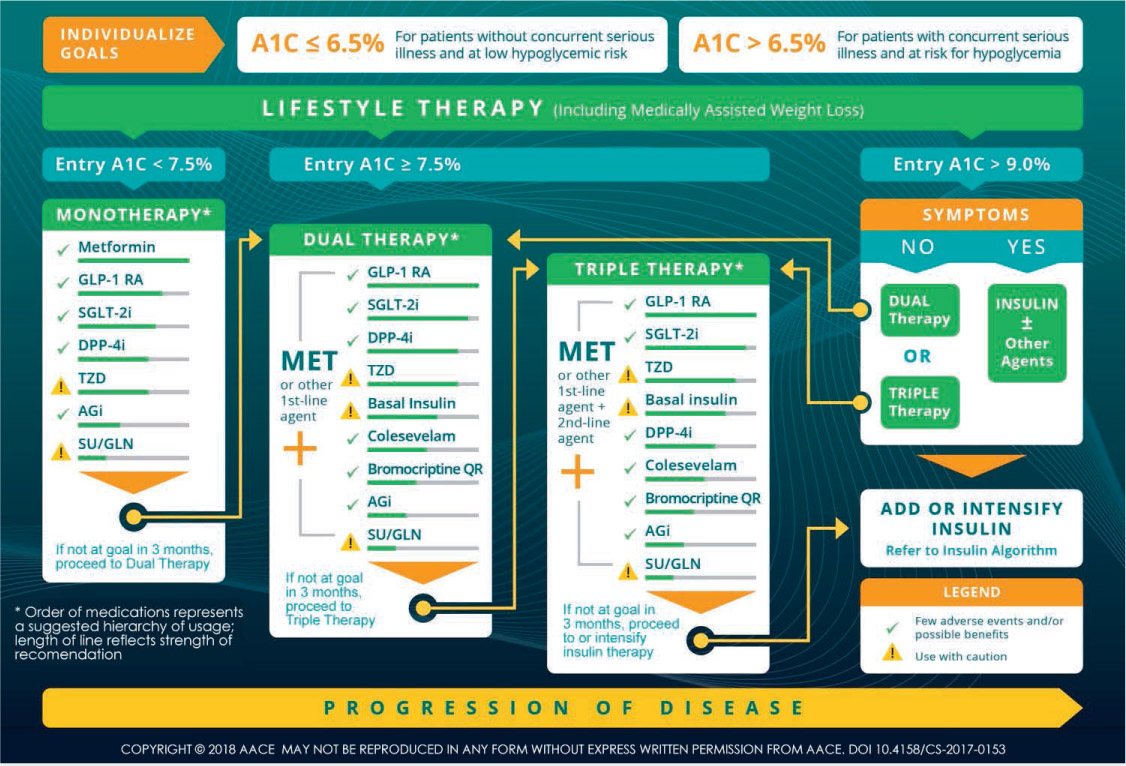
Figure 1.
2018 AACE/ACE glycemic control algorithm. Reprinted with permission from American Association of Clinical Endocrinologists © 2018. Endocr Pract. 2018;24:90–120. AACE: American Association of Clinical Endocrinologists; ACE: American College of Endocrinology
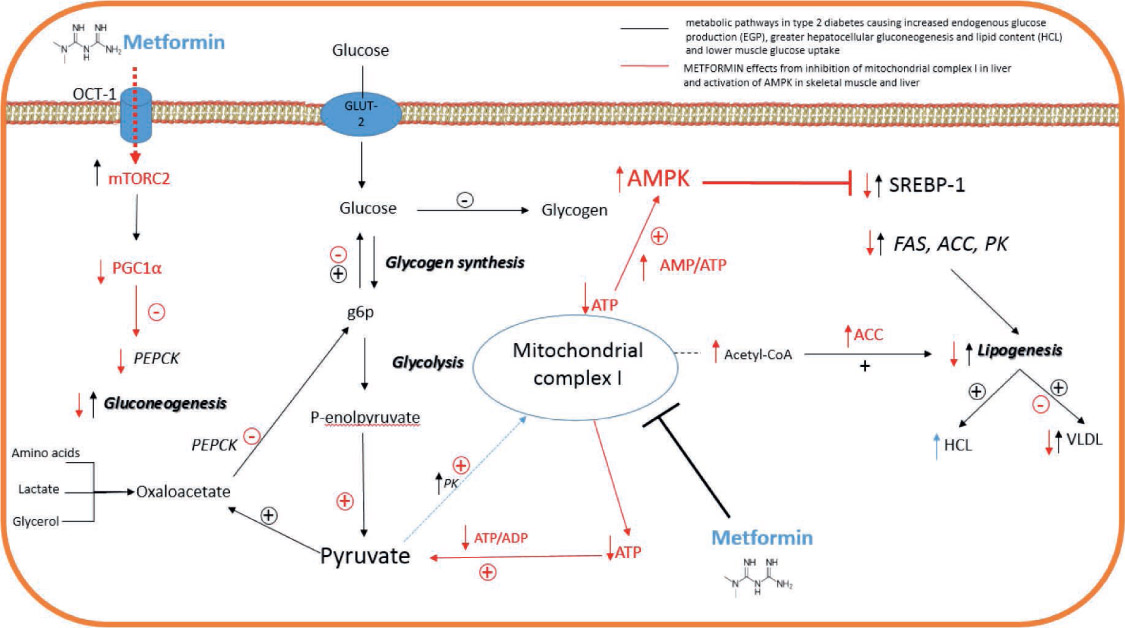
Figure 2.
Metformin effect on glycogen synthesis and inhibition of gluconeogenesis at the hepatocellular level. It inhibits mitochondrial complex I, which decreases ATP/ADP ratio, thereby enhancing pyruvate-kinase, and inhibits gluconeogenesis. The increase in AMP/ATP ratio and AMP-activated protein kinase (AMPK) switches from ATP-consuming anabolic to ATP-generating catabolic pathways. This decreases expression and activities of ACC and SREBP-1 with down regulation of lipogenic enzymes (e.g., FAS) and increases pyruvate kinase activity, reducing hepatic VLDL. Metformin-induced suppression of gluconeogenesis is mediated by liver kinase B1 (LKB1), which phosphorylates AMPK and, via mammalian target-of-rapamycin C2 (mTORC2), reduces PPARγ coactivator 1α (PGC1α), which regulates phosphoenolpyruvate carboxykinase (PEPCK), in turn reducing glycogen production. ACC: acyl-CoA synthetase; HCL: hepatocellular lipid content; G6P: glucose-6-phosphate; FAS: fatty acyl-CoA synthetase; PK: pyruvate kinase; PPAR: peroxisome proliferator-activated receptor; SREBP: sterol regulatory element-binding protein; TG: triglyceride; VLDL: very-low-density lipoprotein
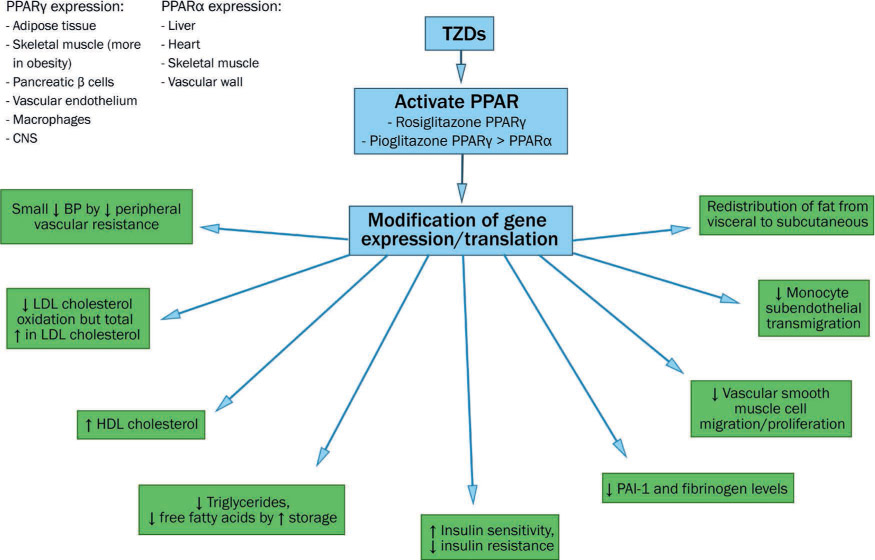
Figure 3.
Cardiovascular effects of thiazolidinediones. TZDs: thiazolidinediones; PPAR: peroxisome proliferator-activated receptor; BP: blood pressure; LDL: low-density lipoprotein; HDL: high-density lipoprotein; PAI-1: plasminogen activator inhibitor-1; CNS: central nervous system
Table 1.
Antidiabetic agents and their CV effects. * MACE: major adverse cardiac events; CKD: chronic kidney disease; TG: triglyceride; LDL: low-density lipoprotein; HDL: high-density lipoprotein; GI: gastrointestinal: CHF: chronic heart failure; CHO: carbohydrate; CV: cardiovascular
| DRUG CLASS (DRUGS AVAILABLE) | MECHANISM OF ACTION | CLINICAL EFFECTS | SIDE EFFECTS | CARDIOVASCULAR EFFECTS |
|---|---|---|---|---|
| Biguanides (Metformin) | Reduce hepatic gluconeogenesis by inhibiting mitochondrial respiratory-chain complex 1 | Reduce HbA1C 1–2%; increase insulin sensitivity; slight weight loss; improve LDL-C; neutral effect on blood pressure | GI; contraindicated in patients with CKD with eGFR < 30; use caution in patients with eGFR < 45 and in hypoxic states | Reduce MACE as an add-on agent; benefit of monotherapy in prediabetes and early diabetes |
| Sulfonylureas (chlorpropamid, glyburide, glipizide, glimepiride) | Bind sulfonylurea receptor and block potassium ATP channels, increasing insulin secretion | Reduce HbA1c by 1–1.5%; neutral on lipids; slight increase in weight and blood pressure | Hypoglycemia; weight gain | Blunted ischemic preconditioning with glipizide or glyburide; no clear evidence of risk or benefit |
| Thiazolidinediones (rosiglitazone, pioglitazone) | Bind peroxisome-proliferator-activated receptor gamma, causing a downstream effect of decreasing insulin resistance | Reduce HbA1c by 1–1.5%; pioglitazone lowers TG, LDL particle concentration, LDL particle size, and increases HDL | Edema, CHF risk increases with this class of medications; rosiglitazone risk > pioglitazone; increased fracture risk | Reduced aggregate CV end points with pioglitazone |
| Alpha glucosidase inhibitors (acarbose, miglitol) | Competitively inhibit intestinal alpha glucosidase, blunting intestinal CHO metabolism | Reduce HbA1c by 0.8%; weight reduction by 1 kg vs placebo; diminish postprandial hyperglycemia; slow the progression from prediabetes to T2DM | GI side effects including diarrhea and flatulence; low risk of causing hypoglycemia; should be avoided in patients with renal insufficiency | No reduction in composite MACE end points vs placebo; no clear evidence of risk or benefit |
| DPP4 Inhibitors (sitagliptin, saxagliptin, linagliptin, alogliptin) | Inhibit breakdown of dipeptidyl peptidase 4 enzyme; increase endogenous incretin hormones (GLP1 and GIP) | Reduce HbA1c by 0.5%–0.8%; weight neutral; low risk of causing hypoglycemia; can be used in renal insufficiency | GI side effects including diarrhea, abdominal pain, and rarely pancreatitis | No reduction in composite MACE end points vs placebo FDA recommends discontinuation of alogliptin and saxagliptin in patients who develop heart failure |
| Amylin mimetics (pramlintide) | Simulate endogenous amylin hormone; slow gastric emptying; induce early satiety; blunt pancreatic glucagon secretion | Reduce HbA1c by 0.3%–1.0%; weight loss 0.5 kg–1.8 kg vs placebo; low risk of causing hypoglycemia; can be used in renal insufficiency | GI side effects including nausea and abdominal pain | No reduction in composite MACE end points; no clear evidence of risk or benefit |
| Insulin and Insulin analogs | Mimic the effects of endogenous insulin | Reduce HbA1c 1.5–3.5%; neutral on blood pressure; decrease total cholesterol, LDL cholesterol, triglycerides | Hypoglycemia; weight gain | No positive or negative effect on CV outcomes |