
OVERVIEW OF DEEP VEIN THROMBOSIS
Deep vein thrombosis (DVT) is a common disease that most often affects the lower extremities and can result in pulmonary embolism (PE).1 Together, DVT and PE constitute venous thromboembolism (VTE). Between 375,000 and 425,000 people develop VTE each year, resulting in significant morbidity, death, and an annual cost of up to $8 billion.1 The risk of developing DVT increases with age, active cancer, hospitalization, major surgery, and critical illness.2–5 Accurate, timely diagnosis of VTE is critical because the condition can be fatal; however, anticoagulation carries hemorrhage risk and high costs and should not be administered indiscriminately.
The most common sequela of DVT is post-thrombotic syndrome (PTS), occurring in approximately 40% of patients presenting with a DVT.6 Patients with this condition develop pain, heaviness, swelling, and occasionally ulceration of the affected limb. Post-thrombotic syndrome is characterized by fibrotic injury due to thrombosis-induced inflammation; this results in a thickened and noncompliant vein wall with valvular reflux and often mechanical obstruction that in turn leads to venous hypertension.7,8 The concept of mechanical obstruction has been coined the “open vein hypothesis,” and although major efforts have been made to alleviate the obstruction through invasive means, there have been only modest gains.9,10
In 2008, the Acting Surgeon General issued a call to action to prevent VTE by promoting research and new clinical therapies.11 Despite this attention, several challenges still remain, particularly with regard to venous thrombus (VT) resolution and PTS. Major diagnostic and therapeutic gaps include identification of a simple, rapid, low-cost blood test with high sensitivity and specificity to identify patients with acute DVT and those at risk of developing PTS; development of agents that promote DVT resolution without the bleeding risks associated with anticoagulation; and an oral or intravenous medication that prevents PTS. Whereas the therapeutic gold standard is based on human drug and device trials, most first efforts rely on murine models.
The purpose of this review is three-fold: (1) to briefly discuss commonly used murine models of DVT, (2) to review several novel biomarkers that may have a role in the pathophysiology of DVT and PTS, and (3) to review potential pharmacologic targets for the treatment of PTS.
MURINE EXPERIMENTAL MODELS OF DVT
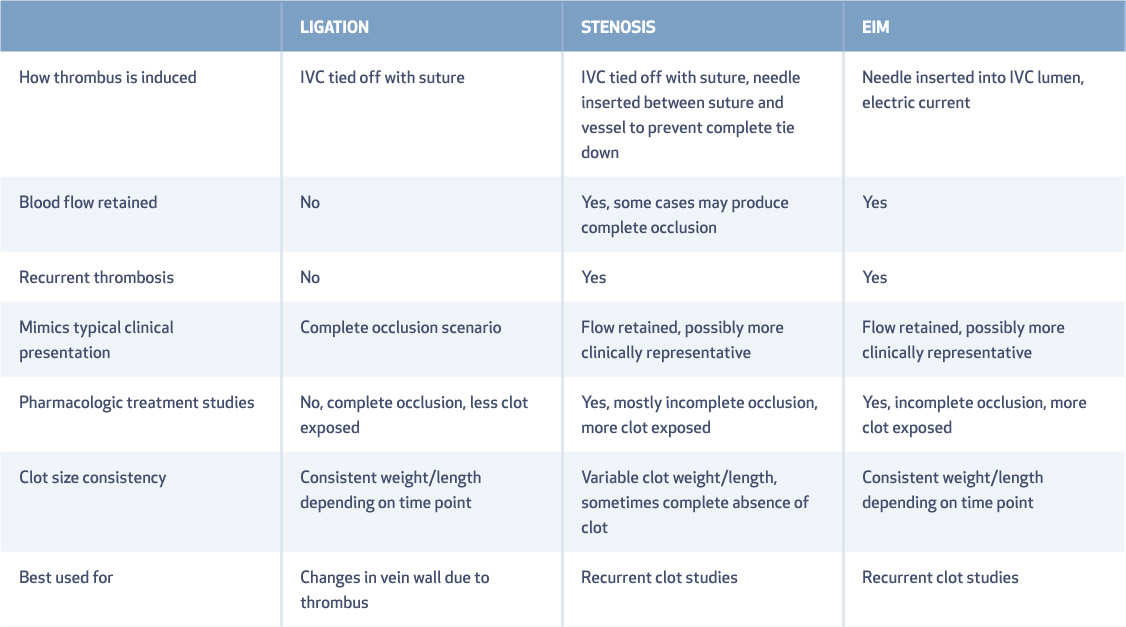
Although they have the same limitations associated with any animal models of disease, murine models provide a relatively consistent way to investigate DVT and PTS. They provide tissue to investigate basic biologic changes associated with VT as well as post-VT vein wall and thrombus changes. Large vein thrombosis does not occur spontaneously in rodents; therefore, several different models have been developed with variations in blood stasis and endothelial injury to stimulate thrombosis (Table 1).
Table 1.
Summary of aspects of murine models used to study deep vein thrombosis and how they affect vasculature. EIM: electrolytic injury model; IVC: inferior vena cava
Inferior Vena Cava Ligation Model
This model uses ligation of the infrarenal inferior vena cava (IVC) to cause total blood stasis.12 Studies in rats suggest that after IVC ligation, a combination of stasis-induced vein wall injury with enhanced tissue factor expression in endothelial cells and leukocytes produce thrombosis.13 This widely used model has provided reproducible thrombus weights beginning at 3 hours and extending to 42 days.12 It has also been valuable in studying interactions between the vein wall and thrombus during the progression from acute to chronic inflammation and remodeling of the vein wall. Disadvantages include the lack of blood flow to test new agents and the inability of the IVC to reopen because of the ligature.
IVC Stenosis Model
This model was initially developed to study early acute thrombosis in a thrombus with morphology similar to the ligation model, although this one permits perithrombus blood flow. The IVC stenosis model narrows the IVC approximately 95% just below the renal veins.14 A disadvantage of this model is the large variation in the size and incidence of VT. Depending on the timing of the IVC harvest, about 50% of animals show no evidence of thrombus, whereas in others the vein is completely occluded.
Electrolytic IVC Injury Model
An alternative to the stenosis model, the electrolytic model was first described by Cooley et al. after they used electrolysis to generate VT in a murine femoral vein.15,16 However, the small size of this vessel and thrombus limits the sample size for molecular analysis. A small area of endothelial denudation observed at the needle entry point contributes to thrombus formation, and a laminar thrombus is formed while maintaining a flow channel. Thrombus weights remain consistent with acceptable standard deviations to detect differences in experimental groups from 6 hours to 14 days post injury.12,17
Brief Pathophysiology of Experimental VT
Although the clotting cascade and its factors are well studied and accepted, several other factors play a role in DVT, as determined by the aforementioned VT models. Formation and early resolution of VT is characterized by the influx of neutrophils (PMNs), which promote coagulation by inhibiting anticoagulant factors and releasing neutrophil extracellular traps (NETs) in a process called NETosis.18,19 NETs act as a scaffold for thrombi to adhere to activated platelets and endothelial cells.20 They also allow for the deposition of proteins such as fibrinogen and von Willebrand factor, which further promote thrombogenesis.20
As is characteristic of a sterile inflammatory process, late VT resolution is mediated by monocytes/macrophages that facilitate collagen and matrix remodeling, in part through matrix metalloproteinases (MMPs).21 Several other mechanisms are involved with VT resolution and vein wall injury, including inflammatory chemokines, cytokines, and plasminogen activators and inhibitors.22 Other factors include upregulation of vein wall adhesion molecules such as P- and E-selectin (sel) and also intracellular adhesion molecule-1 (ICAM-1), which mediates the interaction of the vein wall with circulating leukocytes and platelets.23
The P- and E-selectins are involved in the venous thrombogenic process (Figure 1). P-sel is the primary adhesion molecule mediating the initial inflammatory response and plays a key role in chronic inflammation. It is present in the platelet alpha granules and endothelial cell Weibel-Palade bodies and is translocated to the plasma membrane.24 The main receptor for P-sel is PSGL-Ig. E-sel is a glycoprotein expressed on activated endothelium that facilitates thrombosis, directly modulating PMN and monocyte activity. Furthermore, E-sel has also been identified as an important regulator of thrombus formation and fibrin content in a murine VT model.25,26 To further evaluate the role of selectins in the thromboinflammatory response, Myers et al. studied a murine model in which either P-sel, E-sel, or both had been genetically deleted. They found that deletion of E-sel and combined P/E-sel was associated with decreased thrombosis, whereas the inflammatory response in the vein wall was most inhibited in the combined P/E-sel and P-sel groups.25
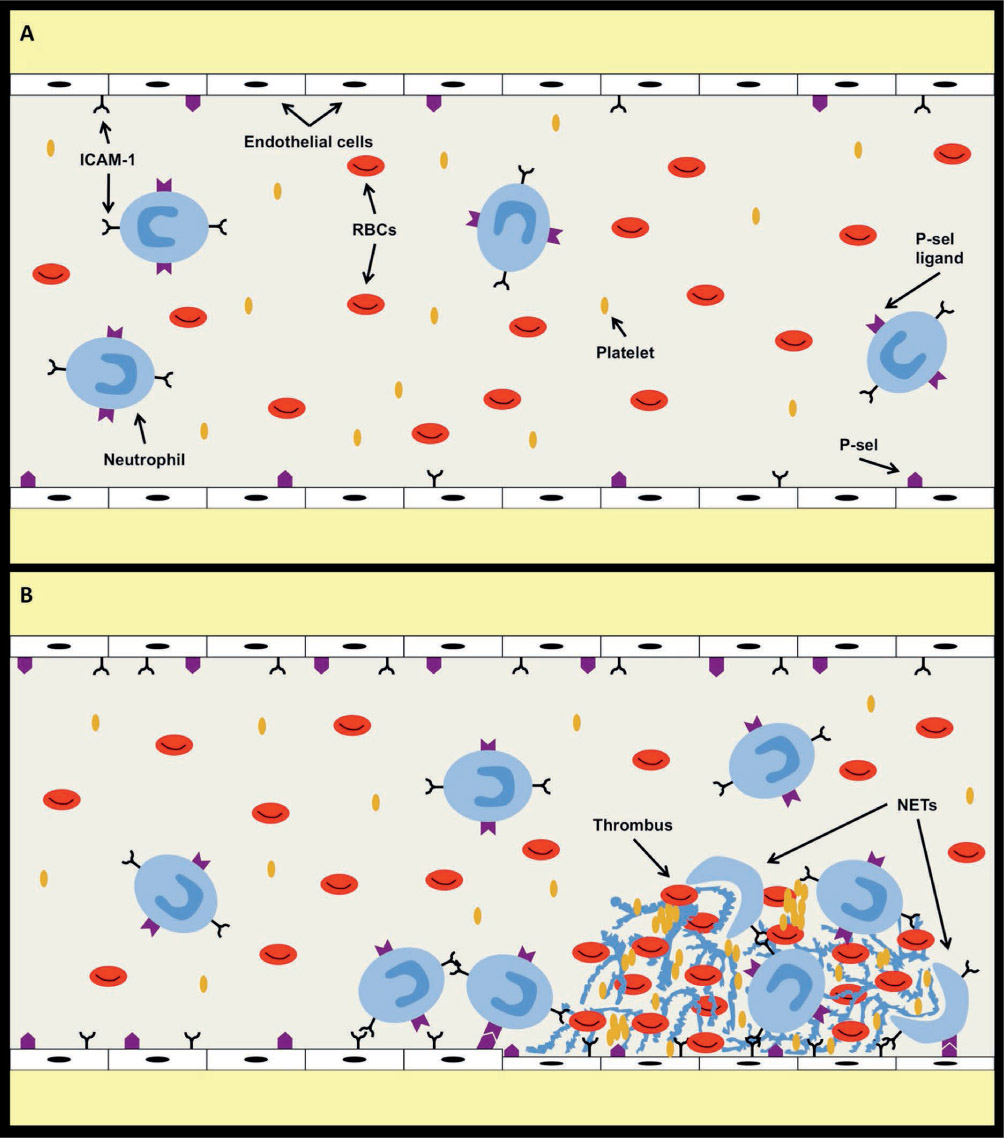
Figure 1.
Illustration of the interaction between the vessel wall, ICAM-1, P-selectin, neutrophils, NETs, red blood cells, platelets, and thrombus formation. (A) Normal blood flow before thrombotic event. No NET formation or upregulation of ICAM-1 and P-selectin. (B) Thrombus formation with NETs providing scaffolding. Upregulation of ICAM-1 and P-selectin present as well as increased presence of neutrophils in response to thrombus. ICAM-1: intracellular adhesion molecule-1; NETs: neutrophil extracellular traps; RBCs: red blood cells
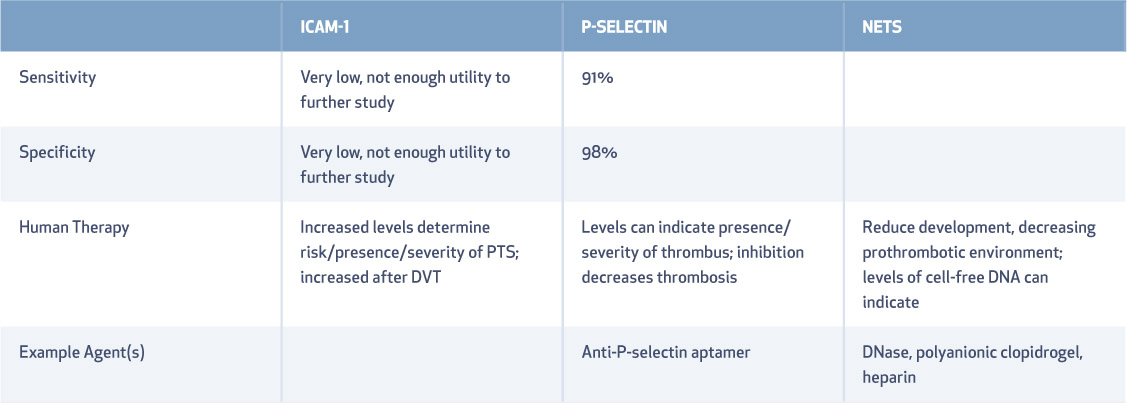
Several potential biomarkers have been identified within this context, including intercellular adhesion molecule 1 (ICAM-1), P-sel, and NETs (Table 2).
Table 2.
Comparison of sensitivity, specificity, potential human therapeutic strategies, and potential example agents of thrombosis treatment for ICAM-1, P-selectin, and NETs. ICAM-1: intracellular adhesion molecule-1; NETs: neutrophil extracellular traps; PTS: post-thrombotic syndrome; DVT: deep vein thrombosis
POTENTIAL BIOMARKERS FOR VENOUS THROMBOEMBOLISM AND POST-THROMBOTIC SYNDROME
Currently Used Biomarkers
Although useful to rule out the diagnosis of VTE, the use of D-dimer as a biomarker is not as useful to “rule in” the diagnosis since its sensitivity is as high as 98%, whereas its specificity hovers around 60%.27 The use of D-dimer is well accepted for increasing the pre-test probability if positive; thus it is sensitive but not specific. Another currently used biomarker is factor VIII, the elevation of which may be useful for predicting recurrent DVT.28
ICAM-1
ICAM-1 mediates attachment of leukocytes to endothelial cells, allowing the leukocytes to migrate into the tissue during an immune response (Figure 1).29 Serum levels of ICAM-1 may reflect local endothelial and leukocyte activation.30 Experimentally, ICAM-1 has been shown to be mechanistically involved in small vessel thrombosis and large vessel VT in the setting of sepsis in mice.31,32 Several studies evaluating ICAM-1 in the setting of acute DVT found that it lacked the sensitivity or specificity to warrant further investigation.33–35 However, soluble ICAM-1 (sICAM-1) may reflect the severity of PTS.36 In the BioSOX trial that evaluated several inflammatory markers in over 600 patients post thrombosis, elevated sICAM-1 was associated with a risk of developing PTS.36 This was consistent with a previously published study confirming the association of sICAM-1 with development of PTS in 307 patients.37 In both studies, PTS was defined as a Villalta score of ≥ 5 (moderate severity). Further validation is required to determine if sICAM-1 is a sensitive and specific biomarker to improve prediction of moderate to severe PTS.
P-Selectin
In humans, elevated levels of soluble P-sel (sP-sel) are common in DVT and VTE.35 Using sP-sel as a biomarker may increase the positive predictive value (as defined by a positive duplex ultrasound) in patients with a possible DVT or when diagnostic imaging methods are not available (such as at night in many emergency rooms). A study evaluating the use of sP-sel combined with a Wells risk prediction score for diagnosing VTE showed a sensitivity of 91% (low sP-sel and low Wells score to rule out the diagnosis) and a specificity of 98% (high sP-sel and high Wells score to rule in the diagnosis), suggesting this combination may be able to rule in the diagnosis of DVT.27 Thus, the highest sensitivity and specificity may be a combination of sP-sel, a high-sensitivity D-dimer, and the Wells score.38
NETs and Their Metabolites
NETs can be detected in humans by elevated levels of “cell-free” DNA in circulation,39 suggesting potential use of this NET byproduct as a biomarker for diagnosing VTE. However, no studies to date have evaluated NETs or NET byproducts as a biomarker for diagnosing acute DVT.
NEW HORIZONS OF VTE TREATMENT
Although recent trials have not supported active thrombus removal with pharmacomechanical thrombolysis, further study is likely and will not be discussed herein. Major advances have been made using direct oral anticoagulants, but the risk of bleeding remains. The most promising new avenues for preventing pathologic clotting are inhibition of factor XI, P/E-sel, and NETs.
Factor XI
Factor XI has procoagulant effects but is not required for hemostasis.40 Although it lacks functionality as a biomarker for DVT, factor XI has definite therapeutic potential. It promotes thrombosis through the contact pathway, which occurs when blood comes in contact with an artificial or negatively charged substance, as part of the intrinsic pathway. Epidemiological studies in a population deficient for factor XI consistently found a significantly lower incidence of DVT when compared to the control population.41 In a clinical trial of orthopedic surgery prophylaxis, inhibition of factor XI reduced the risk of developing VTE complications post surgery when compared to enoxaparin but did not cause a significant increase in the risk of bleeding.40 These studies suggest that inhibition of factor XI decreases VTE as effectively as current anticoagulants but without bleeding risk. Strategies to target factor XI include antisense oligonucleotides, aptamers (single-stranded oligonucleotides that bind to specific molecules), antibodies, small molecules, and polyanion antagonists.42
Selectin Inhibition
Although not yet tested in large human trials, P-sel inhibition effectively treats established VT in a primate model of iliofemoral VT formation. Two days after thrombus development, baboons were treated with recombinant P-sel glycoprotein ligand-Ig (rPSGL-Ig, 4 mg/kg), low-molecular-weight heparin (LMWH), or saline; treatment continued once weekly (rPSGL-Ig) or daily (LMWH, saline) based on drug half-life assessment.43 The percent spontaneous vein reopening increased significantly in the proximal iliac vein in animals treated with rPSGL-Ig and LMWH compared with controls. We have seen the same treatment effect with an aptamer against P-sel that blocks the P-sel:PSGL-1 interaction,44 with improved vein recanalization compared to an aptamer against von Willebrand factor and LMWH, when measured 21 days after thrombogenesis.
Patients homozygous for the S128R E-sel allele, which codes for a more active E-sel, have an increased risk for recurrence of VT.45 Endotoxin-induced, tissue-factor–mediated coagulation is enhanced in humans carrying the S128R E-sel allele,46 highlighting the importance of E-sel in VT. We have recently demonstrated that an inhibitor of E-sel treats both murine and human DVT,47 with essentially no or very limited bleeding potential; this suggests that E-sel may be an excellent target for ongoing VTE trials.
NETs
Directly reducing NET formation may offer a safer alternative to anticoagulation treatment by decreasing a prothrombotic factor without compromising hemostasis (Figure 1). Exogenous DNAse has been successful in decreasing VT in animal studies as well as inhibiting the primary NET enzyme called peptidyl arginine deiminase 4.48 Although more research is needed, some therapies used to treat VTE, including treatments such as polyanionic heparin and clopidogrel, also affect NETs.49
POST-THROMBOTIC SYNDROME
The primary sequela of DVT is PTS, leading to pain and discomfort in the affected extremity due to venous hypertension. Experimental data has suggested several potential therapeutic avenues that warrant further investigation given the disappointing fact that no medical or surgical therapies currently exist.
Toll-Like Receptor 9
Toll-like receptor 9 (TLR9) is an important host innate immune response receptor that may drive leukocyte promotion of thrombus resolution.50 A study using mice with genetically deleted TLR9 showed a larger thrombus size, suggesting the importance of TLR9 in facilitating thrombus resolution.50 This role of TLR9 points to its potential diagnostic capability in a clinical setting, with a small pilot study showing that patients with lower levels of TLR9 are predisposed to persistent vein wall thickening after a DVT.51 An appealing aspect of this target is the use of an ODN TLR9 agonist (an aptamer) to decrease early VT experimentally in mice,52 which may translate to humans.
Matrix Metalloproteinases-2 and -9
Matrix MMP-2 and -9 are common proteinases that help degrade and remodel the extracellular matrix (ECM) of vessels,21 including degradation of elastin and collagen, and contribute to cellular movement through the ECM.53 These proteinases are found in the vein wall during thrombus resolution, likely originating from monocytes and the vein wall, with MMP-9 activity peaking early post thrombosis and MMP-2 active during late thrombus resolution.54,55 MMP-9 has been evaluated in one human trial but was not elevated post DVT.35 Data from mice genetically deficient in MMP-2 and MMP-9 showed decreased vein wall injury and preservation of vessel function post thrombus.56 Although systemic inhibition would likely not be as appealing, targeting an inhibitor localized to the thrombosed vein may hold promise.
Plasminogen Activator Inhibitor-1
Plasminogen activator inhibitor-1 (PAI-1) is a protein found in humans that inhibits protease tissue plasminogen activator (tPA) and urokinase-type plasminogen activator (uPA).57 Genetic deletion of PAI-1 in mice results in dramatically improved VT resolution but at the expense of a fibrotic vein wall.58 Mice that overexpress PAI-1 have large residual thrombi but a relatively preserved vein wall.59 The beneficial effects of PAI-1 overexpression are probably related to the vitronectin-binding domain of PAI-1 that limits the attachment of profibrotic monocytes/macrophages to the vein wall. A unique approach to rapidly resolving thrombi while preventing vein wall injury would be to inhibit the protease function of PAI-1 while allowing the vitronectin-binding domain to function, which at this point is only experimental.
Interleukin-6 Inhibition
Interleukin-6 (IL-6) is a prototypical inflammatory cytokine that is elevated in many disease conditions. It may contribute to thrombus formation by indirectly activating the extrinsic pathway of coagulation,60 although its role is likely multifactorial. Elevated levels of IL-6 or genetic polymorphism may reflect endothelial dysfunction61 and may correlate with the severity of DVT.36 Experimental data has shown smaller VT and decreased vein wall fibrosis in mice undergoing neutralization of IL-6, suggesting IL-6 as a potential mechanism in the development of PTS.62 The IL-6 signaling axis is a clinical target in rheumatoid arthritis, and the drug tocilizumab is efficacious in reducing inflammation and symptoms.63
CONCLUSION
Much research on DVT is needed, particularly research focusing on biomarkers for more precision therapy, nonanticoagulant therapy, and PTS. Murine models, with all their inherent limitations, provide the best avenue for developing new knowledge relating to these areas. The prospects closest to human translation are the use of sP-sel as a biomarker for incident VTE, factor XI and E-sel inhibition for therapy, and anti-IL-6 pathway for PTS prevention.
KEY POINTS
Venous thromboembolism (VTE) is common and is associated with significant morbidity and mortality.
The primary therapy for VTE is medical. Better diagnostic and predictive markers are needed, with several potentially on the horizon for human translation.
Post-thrombotic syndrome (PTS) has no good preventative therapy, and recent aggressive endoluminal and compression interventions have not shown significant benefit.
More study of PTS is needed, but antifibrotic approaches may be most applicable.
Notes
[1] Conflict of Interest Disclosure: The authors have completed and submitted the Methodist DeBakey Cardiovascular Journal Conflict of Interest Statement and none were reported.