
INTRODUCTION
Ventricular arrhythmias are a known cause for sudden cardiac death and are responsible for an estimated 60% of all non–hospital-related cardiovascular deaths.1 In many cases, treatment with antiarrhythmic medications and catheter ablation are successful in abating recurrences in ventricular arrhythmias and preventing sudden cardiac death with the use of implantable cardioverter defibrillator (ICD). However, 30% to 49% of adult patients experience recurrences at high-volume centers that treat ventricular arrhythmias.2, 3, 4
The sympathetic system is well known for increasing myocardial oxygen demand through the release of catecholamines, which results in increased heart rate and contractility in the normal heart. In certain cardiac pathological states (heart failure and long QT syndrome), sympathetic stimulation increases the risk for arrhythmias.5 Predictably, blockade of the sympathetic nervous system with β-blockers or by surgical means has been shown to decrease ventricular arrhythmia events.6 Surgical denervation can be further subdivided into cardiac and renal modalities, with significantly more data available regarding cardiac sympathetic denervation.
Surgical autonomic modulation with cardiac sympathectomy was recommended in the well-regarded 2017 American Heart Association (AHA), American College of Cardiology (ACC), and Heart Rhythm Society (HRS) guideline regarding management for ventricular arrhythmias for medically refractory ventricular fibrillation storm, long QT syndrome, and catecholaminergic polymorphic VT, with the last two indications pertaining mostly to the pediatric patient population.7 Despite current recommendations, surgical sympathetic denervation appears underutilized likely due to lack of access to the procedure, concerns regarding procedure risks, and apprehension about lack of efficacy for ventricular arrhythmia indications, especially with currently available modern catheter ablation techniques. However, interest in surgical cardiac sympathetic denervation has resurged, especially for patients with refractory ventricular arrhythmias on maximally tolerated pharmacologic therapy and catheter ablation procedures. Additional literature exists regarding the use of surgical cardiac sympathetic denervation for other ventricular arrhythmia indications such as ischemic and nonischemic cardiomyopathy outside of the current recommendation describing potential benefit.8 Furthermore, the 2017 guideline does not address recommended surgical techniques for cardiac sympathetic denervation nor the surgical risks for operative treatment. The purpose of this systematic review is to address the deficiency in knowledge regarding surgical cardiac sympathetic denervation to assist in decision making regarding the application of surgical autonomic modulation.
METHODS
We conducted a literature search for randomized controlled trials (RCTs), case reports, case series, and meta-analyses regarding surgical sympathetic denervation for ventricular arrhythmias. Inclusion criteria consisted of adult patient population (mean population age ≥ 18), surgical denervation studies, reports on cardiac events after the procedure, and description of surgical techniques. Exclusion criteria were articles without original data or about pediatric patient populations, non-English language articles, and articles outside the timeline of catheter ablation techniques (defined as those published in the last 20 years). The primary outcome evaluated was percentage of ICD shock- and transplant-free survival after cardiac sympathetic denervation. Secondary outcomes were percentage free from ICD shock, mortality, and transplantation and complications related to cardiac sympathetic denervation. The search was conducted on the MEDLINE/PubMed and Cochrane Library databases using the key words “sympathectomy, ventricular, arrhythmia” without limitations. The references for the selected articles were evaluated for relevant studies and included the appropriate inclusion and exclusion criteria. Data extracted from each article includes reference details (first author’s last name, year of publication, journal), study type, number of patients, mean age of the studied patient population, disease indications for denervation (type of ventricular arrhythmia), surgical technique used, length of follow-up, procedure-related complications, and effect of surgical cardiac denervation on ventricular arrhythmias (focusing on ICD shock-free post procedure, mortality, and heart transplant). If mean age or mean follow-up with standard deviation was not presented in the original study, the mean and standard deviation was calculated when data granularity was available to make the data more uniform. Data from each article was further extracted as data granularity permitted for further analysis regarding surgical cardiac denervation indications, surgical techniques, and complications. Statistical analysis was performed using GraphPad PRISM software. Chi-square analysis was used to calculate P values using P < .05 to determine statistical significance.
RESULTS
The search identified 329 articles, of which 46 were selected and 283 were excluded based on title and abstract. Of the 46 full-text articles, 12 were for pediatric patient populations and therefore excluded. Another 12 were excluded for multifactorial reasons that included lack of specific data for surgical cardiac denervation, articles published before the year 2000, and two articles for having included the same data in other articles. The study selection process is summarized in Figure 1. The remaining 21 articles were selected for analysis. There were 275 patients evaluated who underwent surgical cardiac sympathetic denervation (SCSD).9 Study results are summarized in Table 1 , which details the main results of each paper, number of patients free from ICD shock after surgical cardiac denervation, patient mortality, and those who underwent heart transplantation.8, 9, 10, 11, 12, 13, 14, 15, 16, 17, 18, 19, 20, 21, 22, 23, 24, 25, 26, 27, 28, 29
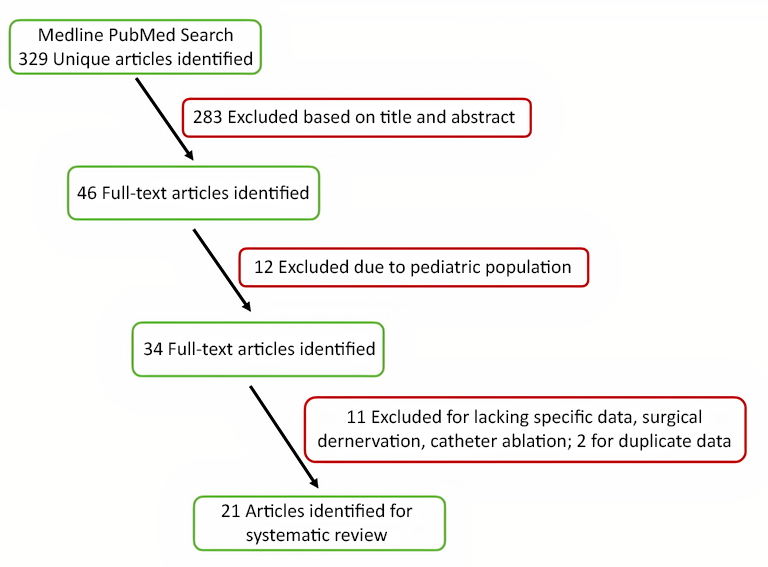
Figure 1
Flow chart for article selection.
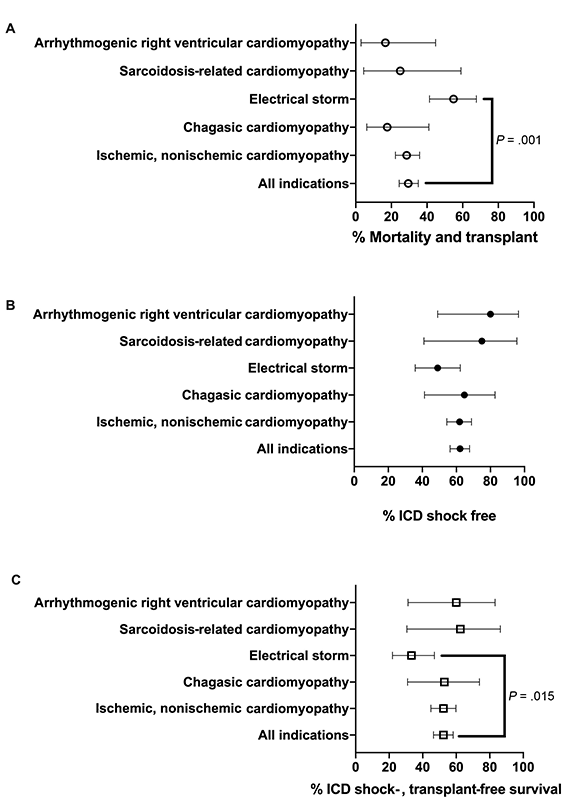
Figure 2
Graph comparing various cardiac sympathectomy indications for (A) % mortality and transplantation, (B) % ICD shock-free events, and (C) % ICD shock- and transplant-free survival with error bars indicating 95% confidence intervals. The P value represents comparison of the surgical modality to all bilateral surgical cardiac sympathetic denervation. The asterisk indicates values reaching statistical significance or P < .05. ICD: implantable cardioverter defibrillator
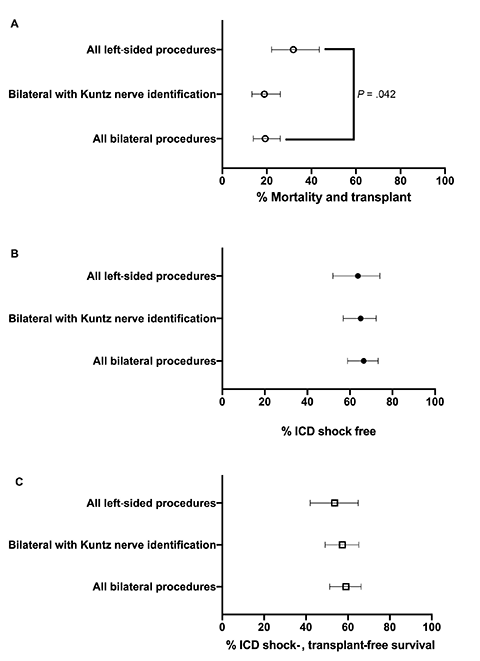
Figure 3
Graph comparing various cardiac sympathectomy surgical modalities for (A) % mortality and transplantation, (B) % ICD shock-free survival, and (C) % ICD shock- and transplant-free survival with error bars indicating 95% confidence intervals. The P value represents comparison of the surgical modality to all bilateral surgical cardiac sympathetic denervation. The asterisk indicates values reaching statistical significance or P < .05. ICD: implantable cardioverter defibrillator
Table 1.
Summary of articles used in the literature review.
In the overall SCSD study population, 52.4% of patients were alive, free from all ICD shocks, and without heart transplantation at a mean follow-up of 1.38 years. Furthermore, 52.4% of those with ischemic and nonischemic cardiomyopathy were free of ICD shock, mortality, or transplantation at a mean follow-up of 0.91 years, as were 52.9% with Chagasic cardiomyopathy (mean follow-up 0.75 years), 33.3% with electrical storm (mean follow- up 0.85 years), 62.5% with cardiac sarcoidosis (mean follow- up 1.13 years), and 80% with arrhythmogenic right ventricular (RV) cardiomyopathy (mean follow-up 1.57 years). The P value reached statistical significance for patients undergoing SCSD for electrical storm at P = .015 for % ICD shock- and transplant-free survival. The outcomes based on surgical indications are summarized in Table 2 .
Table 2.
Outcomes for the surgical cardiac sympathetic denervation disease indications comparing various ventricular arrhythmia indications to the overall pooled disease indications. The P value represents comparison of the surgical indication to all indications. The asterisk indicates values reaching statistical significance or P < .05.
Patients who underwent bilateral thoracoscopic denervation procedures had a 59% ICD shock- and transplant-free survival. Patients undergoing bilateral thoracoscopic denervation with identification of Kuntz nerve exploration had a 57.3% ICD shock- and transplant-free survival. Patients undergoing left- sided thoracoscopic denervation procedures had a 53.6% ICD shock- and transplant-free survival. The P values were calculated comparing bilateral thoracoscopic denervation against bilateral thoracoscopic denervation with Kuntz nerve exploration and left-sided thoracoscopic procedures. The P value did not reach statistical significance regarding ICD shock- and transplant-free survival. Figure 3 shows the surgical and transplant and ICD shock-event-free comparisons for mortality and transplant and ICD shock-event-free and transplant-free survival. Outcomes for SCSD surgical modality are summarized in Table 3 .
Table 3.
Summary of the outcomes comparing various surgical modalities for cardiac sympathetic denervation. The P value represents comparison of the surgical modality to all bilateral surgical cardiac sympathetic denervation. The asterisk indicates values reaching statistical significance or P < .05.
Pneumothorax was the most common complication reported at 5.5%, followed by Horner’s syndrome 4.3%, and hemothorax 1.97%. Vein injury, neuropathic pain, cellulitis, upper extremity anhidrosis, compensatory hyperhidrosis, worsening heart failure, mortality, pneumonia, nausea/vomiting, and surgery-related urinary tract infection were rare complications, reported at less than 1%. Table 4 summarizes surgical complications from SCSD.
Table 4.
Reported complications after surgical cardiac sympathetic denervation.
DISCUSSION
Systematic review of the literature has identified the use of multiple indications in the adult population, including ischemic, nonischemic, Chagasic, sarcoidosis, arrhythmogenic RV cardiomyopathies, and electrical storm. Among adults with recurrent VT refractory to maximal medical and catheter ablation therapy, 52.4% were alive and free of ICD shocks and heart transplantation at a mean follow-up of 1.38 years after undergoing left or bilateral SCSD. Both surgical modalities appear to improve the % ICD shock-free rate and look to be generally safe, with only one mortality reported that was directly linked to the SCSD procedure.
Surgical sympathetic cardiac denervation is a class 1 recommendation for long QT syndrome and catecholaminergic polymorphic VT in the 2017 AHA/ACC/HRS guideline regarding management for ventricular arrhythmias refractory to tolerated maximum beta-blocker dosage, with much of the evidence coming from pediatric studies. Ventricular tachycardia or fibrillation storm refractory to medications and catheter ablation is a class IIb recommendation for cardiac sympathetic denervation.7 Less established are the other disease indications that are
more common to the adult population, with studies limited to retrospective review, case series, and case presentations. No RCTs in the adult literature at this time were identified to clarify the benefits of surgical cardiac sympathetic denervation in this patient cohort. A 2020 meta-analysis by Murtaza et al. compared ventricular arrhythmia recurrence among studies with a pooled nonrecurrence rate of 60% with significantly reduced ICD shocks in patients who underwent surgical cardiac denervation, which was similar to our systematic review of adult patients who had an ICD shock-free rate of 62.2%.30 The mortality and heart transplantation rate for patients with ventricular arrhythmias or electrical storm refractory to medications and catheter ablation was 29.5%, with a mean follow-up of 1.38 years; this favorably compares to a 32.2% mortality rate in multicenter analysis of all patients undergoing catheter ablation for VT with a mean follow-up at 3 years given that the patient population in our review was refractory to medical and catheter ablation.31
Due to the nature of the data presented in many review articles, mortality and transplant were indistinguishable in many cases. There were no statistically significant differences regarding associated mortality and transplantation, ICD shock-free events, and ICD shock- and transplant-free survival for disease indications other than that patients experiencing electrical storm having ≥ 3 sustained episodes of ventricular arrhythmias or appropriate ICD shocks within 24 hours after treatment.7
Surgical denervation for electrical storm had the highest associated mortality and heart transplantation percentage and lowest ICD shock- and transplant-free survival, which was a statistically significant difference compared to the pooled outcome in Figure 2.
Given the nature of disease regarding patients who experienced electrical storm, this was not a surprising finding. However, there were no control-group comparisons in the studies identified for this patient cohort, and patients with electrical storm are known to occasionally spontaneously resolve. Therefore, RCTs targeting patients with electrical storm appear necessary to further assess the value of surgical cardiac denervation for this patient cohort. Cardiac surgical denervation for ischemic, nonischemic, Chagasic, sarcoidosis, and arrhythmogenic RV cardiomyopathy did not appear to be contraindicated for the disease states that were evaluated; however, caution is advised due to the low number of patients evaluated in certain disease states.
In our review, surgical cardiac denervation in the era of catheter ablation was dominated by thoracoscopic procedures, and there are several explanations that could explain this trend. In the adult population, there is ample intrathoracic space to perform thoracoscopic procedures compared to pediatric patients. Thoracoscopy is a minimally invasive surgical technique that may be better tolerated compared to an open approach. Several variations to the thoracoscopic approach were used, with the most common being bilateral or left thoracoscopic inferior half stellectomy, T2 through T4 ganglionectomy. When comparing bilateral to left thoracoscopic cardiac sympathetic denervation, there was a statistically higher associated mortality and transplantation for patients who underwent the left thoracoscopic procedure. Regarding ICD shock-free and ICD shock- and transplant-free survival, no statistical difference was identified.
In evaluating studies that included bilateral and left-sided procedures, the general surgical approach was to perform the left side followed by the right side, with right side aborted if the patient had difficulties during the procedure. This surgical approach has likely confounded the data regarding the associated mortality percentage in favor of the bilateral approach, although there appears to be some evidence towards better outcomes with the bilateral approach for adult patients with ischemic and nonischemic cardiomyopathy.8 Further studies are necessary to clarify patient selection for the left or bilateral cardiac sympathetic denervation surgical modality.
Failure to respond to sympathectomy may be linked to surgical technique, and several studies have discussed the possibility of the nerve of Kuntz, collateral nerves that bypass the sympathetic trunk from the second to the first intercostal nerve, to be a possible culprit.9 Marhold et al. found that open techniques were able to detect the nerve of Kuntz more frequently than thoracoscopic techniques when applied to fresh human cadavers.32 However, that study was performed in 2008, and thoracoscopic camera technology has advanced significantly since then. In addition, computer-aided surgical technology has improved the visualization with 3-dimensional cameras and wristed instruments that have greatly improved dexterity for the thoracoscopic approach. These factors may improve the success rates for surgical cardiac sympathectomy.
Regarding complications related to SCSD, pneumothorax was the most common, with the majority of affected patients treated with thoracostomy tube alone. Horner’s syndrome was a major concern in most studies, but the majority of patients reportedly recovered in the ensuing months after the procedure. Compensatory hyperhidrosis was reported more commonly in the pediatric literature for patients undergoing cardiac sympathetic denervation. Compensatory hyperhidrosis is a common problem in patients with hyperhidrosis undergoing thoracoscopic sympathectomy. One possible explanation for lower-than- expected compensatory hyperhidrosis is that these patients have a physiologic status and sympathetic autonomic nervous system more prone to developing compensatory hyperhidrosis. Another possible explanation could be the difference in the operative technique, where the sympathetic nerve is divided at rib levels and not resected along with the ganglion. Surgical management techniques have recently been published regarding ganglionectomy for treatment of compensatory hyperhidrosis.33 However, underreporting is likely given the nature of the studies, and further investigation is needed to clarify the associated complications for cardiac sympathetic denervation.
Randomized controlled trials are needed to better understand the role of SCSD in treating refractory ventricular arrhythmias and the true complication rate. One RCT that should be nearing completion is the Left Cardiac Sympathetic Denervation (LCSD) for Cardiomyopathy Feasibility Pilot Study, which should assist in clarifying the role of left cardiac sympathetic denervation in ischemic and nonischemic cardiomyopathy. Another trial that is scheduled to begin in the near future is the Cardiac Sympathetic Denervation for Prevention of Ventricular Tachyarrhythmias (PREVENT VT), which could shed light on the role of bilateral SCSD in treatment VT.
CONCLUSION
Surgical cardiac sympathetic denervation for adult patients who have symptomatic ventricular arrhythmias refractory to medications and catheter ablations appear appropriate and safe with proper patient education regarding possible postoperative complications. There are still uncertainties regarding patient selection and a bilateral versus left-sided surgical approach to successfully reduce sustained ventricular arrhythmias. Further data from RCTs are warranted to better delineate the risks and benefits of surgical autonomic modulation and clarify the roles of bilateral versus left-sided procedures.
KEY POINTS
Surgical cardiac sympathetic denervation appears to be a useful adjunct in patients who have refractory ventricular tachycardia events maximally treated with medications and catheter ablation procedures.
Ischemic, nonischemic, Chagasic, sarcoidosis, arrhythmogenic right ventricular cardiomyopathies do not appear to be contraindications for surgical cardiac sympathetic denervation.
Thoracoscopic techniques for surgical cardiac sympathetic denervation were safe with minimal reported complications.
Conflict of Interest Disclosure:
The authors have completed and submitted the Methodist DeBakey Cardiovascular Journal Conflict of Interest Statement and none were reported.