
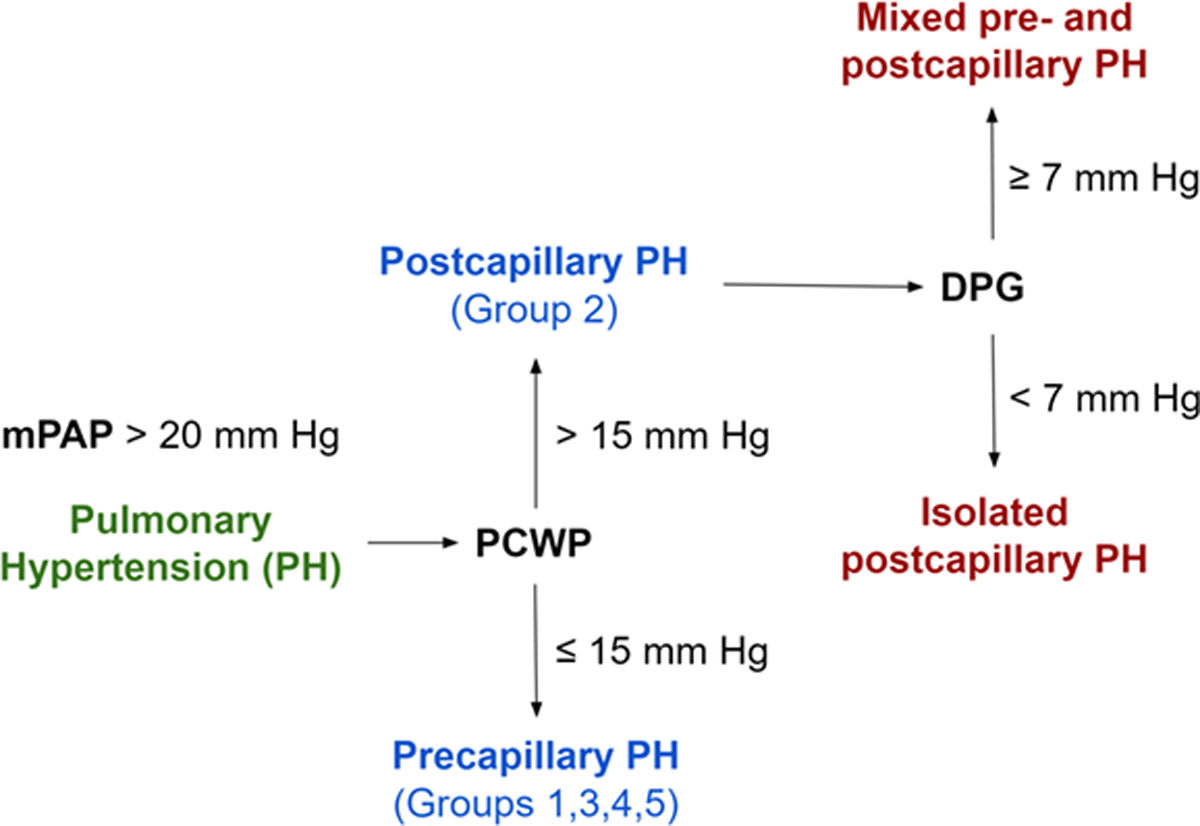
Figure 1
Hemodynamic definitions of pulmonary hypertension (PH), including PH with left heart disease.
Table 1
Hemodynamic profiles of pulmonary hypertension (PH). mPAP: mean pulmonary artery pressure; PCWP: pulmonary capillary wedge pressure; PVR: pulmonary vascular resistance; PAH: pulmonary arterial hypertension; DPG: diastolic pulmonary gradient; WU: Wood units.
| DEFINITION | HEMODYNAMIC CHARACTERISTICS | CLINICAL GROUPS |
|---|---|---|
| PH | mPAP > 20 mm Hg | All groups |
| Precapillary PH | mPAP > 20 mm Hg PCWP ≤ 15 mm Hg PVR ≥ 3 WU | PAH (group 1) Due to lung disease and/or hypoxia (group 2) Chronic thromboembolic disease (Group 4) Unclear and/or multifactorial (group 5) |
| Postcapillary PH | mPAP > 20 mm Hg mPCWP > 15 mm Hg PVR < 3 WU | Due to left heart disease (group
4) Unclear and/or multifactorial (group 5) |
| Isolated postcapillary PH | mPAP > 20 mm Hg PCWP > 15 mm Hg DPG < 7 mm Hg* PVR ≤ 3 WU | |
| Mixed pre- and postcapillary PH | mPAP > 20 mm Hg PCWP > 15 mm Hg DPG ≥ 7 mm Hg* PVR ≥ 3 WU |
[i] *Not part of 6th World Symposium on Pulmonary Hypertension Definitions.4
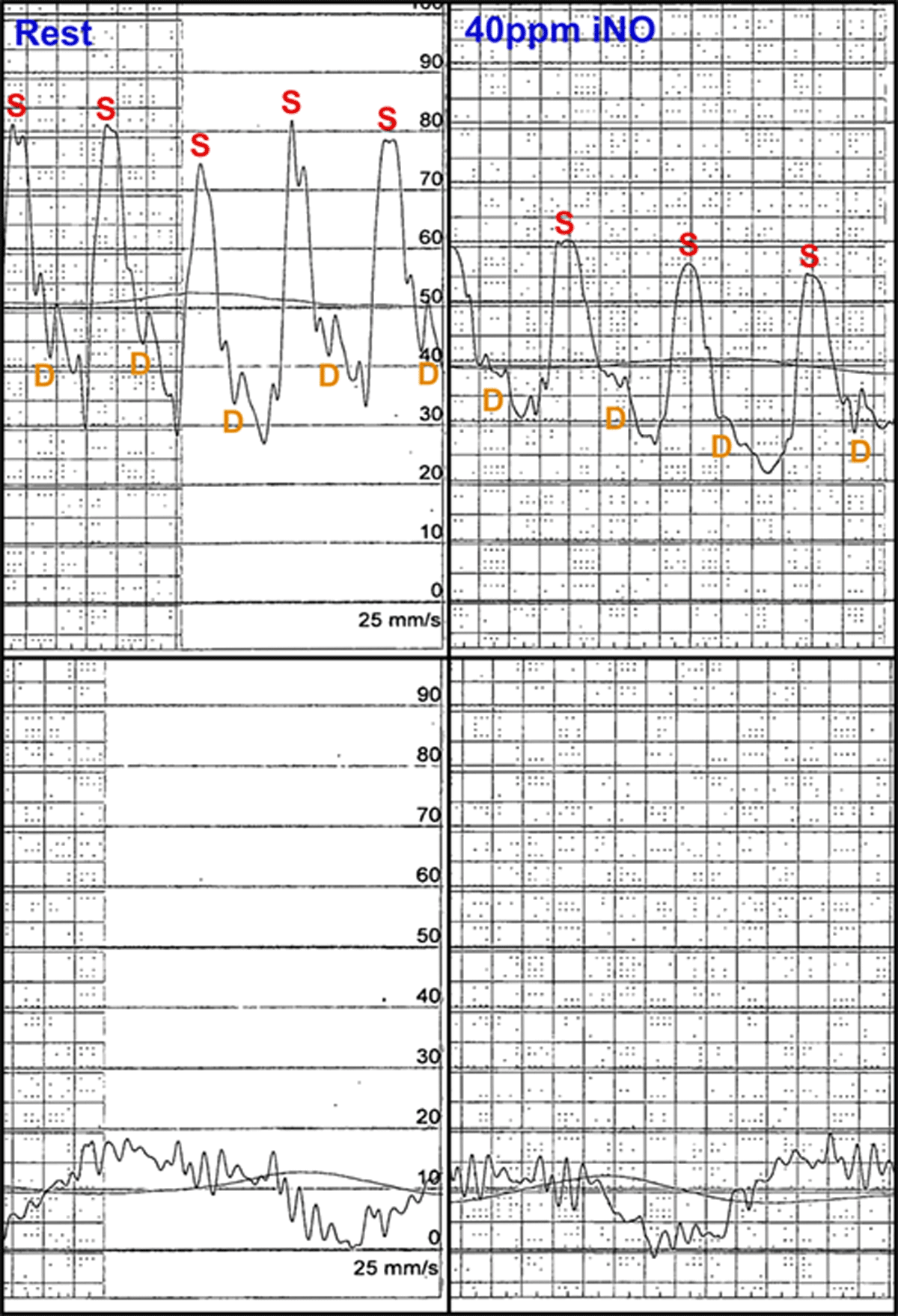
Figure 2
Hemodynamic tracings of pulmonary arterial hypertension with a positive vasoreactivity test using inhaled nitric oxide (see Table 2).
Table 2
An example of a positive vasoreactivity test for pulmonary arterial hypertension. Hemodynamic measurements at rest are consistent with severe pulmonary arterial hypertension. Positive vasoreactivity test with 40 ppm inhaled nitric oxide demonstrating an absolute decrease in mean pulmonary artery pressure (mPAP) by 13 mm Hg and a final mPAP of 37 mm Hg. Pulmonary vascular resistance (PVR) improved from 9 Wood units (WU) to 5 WU. See Figure 2 for hemodynamic tracings. The patient was treated with high-dose nifedipine with significant and sustained improvement in her PVR and symptoms. PA: pulmonary artery; PCWP: pulmonary capillary wedge pressure; TPG: transpulmonary gradient; CO/CI: cardiac output/cardiac index.
| PA (mm Hg) | PCWP (mm Hg) | TPG (mm Hg) | PVR (WU) | CO/CI (thermodilution) | |
|---|---|---|---|---|---|
| Rest | 82/34 (50) | 10 | 40 | 9 | 4.7/2.4 |
| Nitric oxide 40 ppm for 5 minutes | 58/27 (37) | 11 | 26 | 5 | 5.1/2.6 |
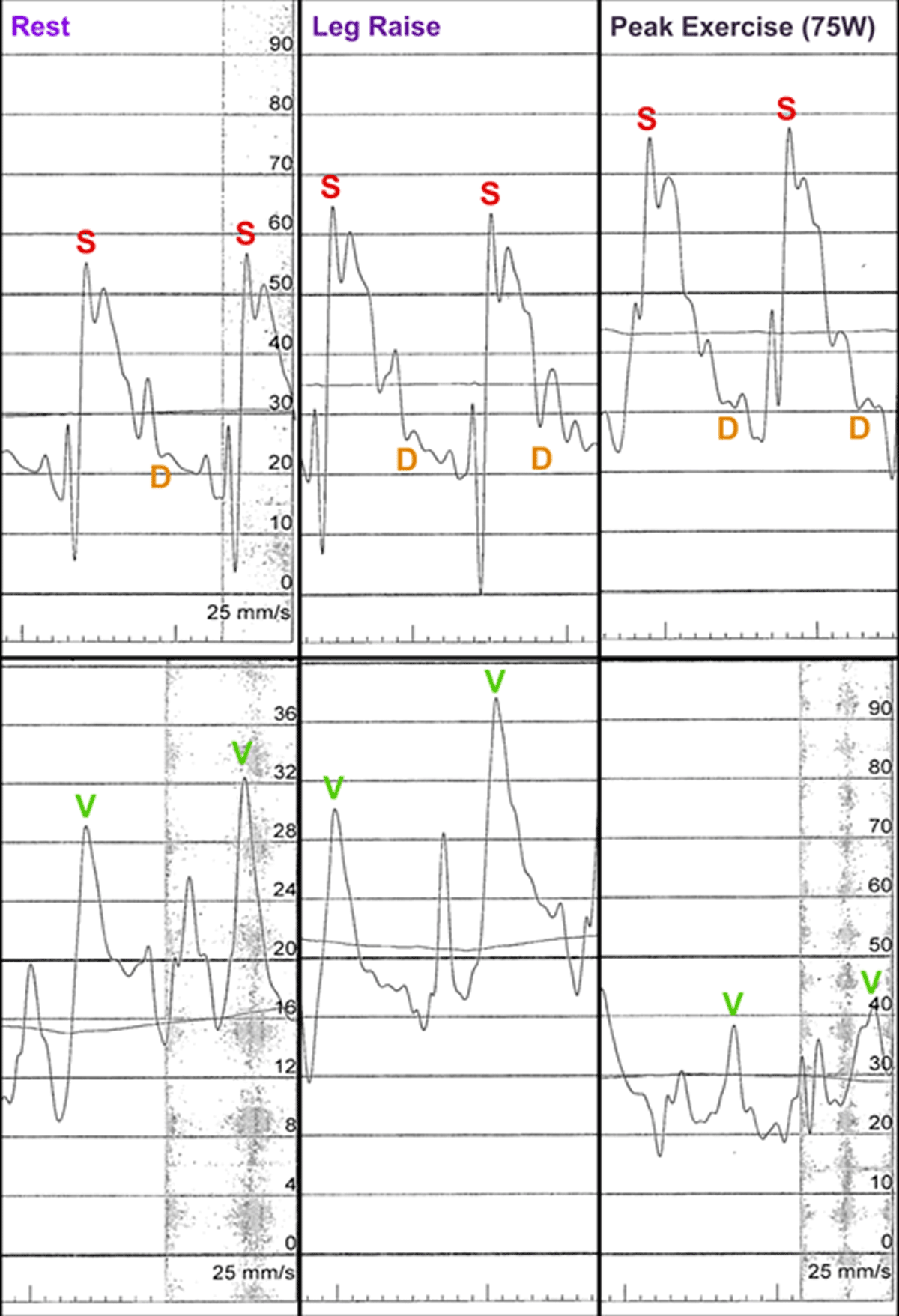
Figure 3
Hemodynamic tracings of World Health Organization group 2 pulmonary hypertension due to occult heart failure with preserved ejection fraction (HFpEF) that was unmasked with exercise (see Table 3).
Table 3
An example of World Health Organization (WHO) group 2 pulmonary hypertension (PH) due to occult heart failure with preserved ejection fraction (HFpEF) that was unmasked with exercise (exercise- induced HFpEF). Hemodynamics at rest suggest mildly elevated left-sided filling pressures and mild pulmonary hypertension (PH) with preserved cardiac index (CI). With passive leg raise, mean pulmonary artery pressure (mPAP) and pulmonary capillary wedge pressure (PCWP) increase significantly, consistent with group 2 PH. With supine bicycle exercise, at peak exercise (75 watts), hemodynamics confirmed severe WHO group 2 PH with an mPAP of 45 mm Hg and PCWP of 30 mm Hg with a transpulmonary gradient (TPG) of 15 mm Hg and a diastolic pulmonary gradient (DPG) of 0 mm Hg. See Figure 3 for hemodynamic tracings. The patient was treated with diuretics and spironolactone with significant and sustained improvement in her dyspnea. PA: pulmonary artery; PVR: pulmonary vascular resistance; CO/CI: cardiac output/cardiac index.
| PA (mm Hg) | PCWP (mm Hg) | TPG/DPG (mm Hg) | PVR (WU) | CO/CI (THERMODILUTION) | |
|---|---|---|---|---|---|
| Rest | 54/20 (31) | 14 | 17/6 | 3 | 5.3/2.9 |
| Passive leg raise | 62/24 (37) | 20 | 17/4 | – | |
| Peak exercise (75 watts) | 75/30 (45) | 30 (v wave 40) | 15/0 | 2 | 7.8/4.4 |