
Introduction
People with disabilities (PwD) and older adults constitute approximately 15% of the global population (Disability, 2025). Although they share similar travel needs and desires with non-disabled individuals, they often face additional barriers and challenges when participating in tourism activities (Yau et al. 2004). These challenges may also result from temporary or age-related limitations (Daniels et al. 2005, Dattilo 2017). Consequently, increasing attention has been paid to making everyday activities, recreation, and tourism more accessible and inclusive for all groups, including not only people with visible disabilities but also those experiencing temporary difficulties. As a result, tourism is gradually becoming more accessible to groups that were previously excluded from such opportunities (Darcy et al. 2020). Despite the fact that PwD constitute a significant proportion of the world’s population and therefore represent an important group of potential tourists, research on the frequency and structure of their travel is still not conducted systematically in many countries. Moreover, there is no methodologically consistent research framework regarding PwD tourism within the European Union and other regions, which makes cross-country comparisons difficult (Office of the Government Plenipotentiary for Disabled People, 2025). Various reports provide data on tourism among PwD in different countries. For instance, in the United States, research on the opinions and travel patterns of PwD, as well as their caregivers and companions, was conducted by MMGY Global. Based on a survey of 2789 respondents, the study found that PwD take leisure trips at nearly the same frequency as those without mobility issues, averaging 3.4 trips in the past 12 months. Moreover, almost all respondents (96%) reported experiencing accommodation problems during their travels, while 86% faced flight-related difficulties, and 79% encountered challenges with local transport (Portrait of travelers…, 2022). Meanwhile, in Australia, the report Travellers with accessibility needs in Australia (2024) primarily provides percentage data on tourism for PwD in relation to the travel patterns of non-disabled tourists. In this report it was shown that tourists with accessibility needs took a total of 18.5 million trips, including 12.6 million domestic day trips and 5.9 million domestic overnight trips. Travellers with accessibility needs accounted for 23% of all domestic trips, while other travellers made up the remaining 77%. The average length of overnight stays for this group was 3.6 nights.
European reports also rely on different methodological assumptions, analytical approaches, and data presentation methods. For example, in Poland, the report Tourist activity of persons with disabilities (2019) was based on a study conducted among a sample of 1721 PwD aged 15 and over. The findings indicated that 84% of all trips taken by respondents in the past 12 months were domestic. More than half (56%) of these trips lasted between two and four days, while longer trips of at least five days accounted for 44% of all responses. Meanwhile, a study on the travel habits of PwD in Hungary, conducted by Gonda (2021) in 2019, found that 36% of respondents had not travelled in the past five years, 13% had travelled once, 21% twice, 6% three times, and 24% more than three times. In contrast, in Italy, the accessibility services portal Cityfriend reports that PwD are increasingly taking more than one trip per year, with an average stay of 10 days (Cityfriend, 2025).
The fragmentation of national approaches creates the need for studies with a broader, international perspective, allowing for a deeper analysis and understanding of both contemporary preferences and the limitations of tourist travel for PwD. The presented research results cover the PwD community primarily in four European countries: Croatia, Hungary, Poland, and Romania, as well as Germany, the Netherlands, Austria, and Slovakia. The study was conducted on a sample of 1175 PwD between 2023 and 2024, based on a standardised research methodology within a project funded by the Erasmus+ programme. The analyses focused on several issues related to the participation, preferences, and limitations of PwD in tourist travel, taking into account different types of disabilities. The aim of this approach is to explain the specific characteristics of tourist travel among people with various types of disabilities from a broader, international perspective. Furthermore, presenting the research results in national languages from several non-English-speaking European countries enables the inclusion of the opinions of PwD communities from these regions in a wider international discussion.
Theoretical background and review of the literature
Many factors, both endogenous and exogenous, influence consumer decisions, including travel choices. For PwD, these factors may differ, although the core stages of the travel process remain the same. Yau et al. (2004) identified five stages in this process: personal, re-connection, tourism analysis, physical journey, and experimentation and reflection. Unlike non-disabled tourists, individuals with disabilities cannot always compensate for deficiencies in tourist offerings (Israeli 2002). Therefore, accessibility and the location of accommodations play a particularly important role in their travel decisions (Darcy 2002).
These internal and external determinants of tourist behaviour can also be interpreted through the theory of variety-seeking behaviour. ‘Variety-seeking behaviour’ is defined as a phenomenon in which consumers’ choices fluctuate over time among various acceptable alternatives (McAlister, Pessemier 1982). The variables influencing consumer behaviour can be grouped into intrinsic, or direct variation, and extrinsic, or derived variation. Intrinsic variation is explained by the search for optimal stimulation, curiosity, novelty, and complexity and variety-seeking behaviour is a good example of this type of variation. Extrinsic variation, on the other hand, means that consumers may switch brands because of external motivations, such as preferences among family members, situational changes, changes in taste, and various constraints (McAlister 1982, McAlister, Pessemier 1982, Givon 1984, Legohérel et al. 2015).
Research on accessible tourism primarily examines exogenous (external) factors influencing travel decisions, particularly accommodation, transport, and information (Liu et al. 2023). Accommodation availability is a key determinant (Lyu 2017), with Darcy (2010) identifying 55 criteria that PwD consider when selecting lodging and how hotel systems communicate with them. Understanding their accommodation experiences is essential for developing appropriate offers (Chen 2004, Tantawy et al. 2005, Gröschl 2007, Ozturk et al. 2008, Poria et al. 2011), while ensuring the availability of properly equipped, accessible rooms remains a major challenge (Darcy 2004). Transport is another critical factor as it is fundamental to tourism but often poses significant barriers for PwD (Poria et al. 2010, Malagas et al. 2023). Financial constraints further complicate travel accessibility, with Shaw and Coles (2004) highlighting their complexity and impact.
Beyond physical accessibility, the availability of clear and inclusive information is crucial throughout the travel process (Cavinato, Cuckovich 1992). Ray and Ryder (2003) found that people with mobility impairments rely primarily on word-of-mouth, the Internet, and travel guides for information. Similarly, Buhalis and Michopoulou (2011) identified three key requirements for accessible tourism: an inclusive built environment, comprehensive accessibility information, and accessible online content. As technology evolves, web accessibility has become increasingly important (Domínguez Vila et al. 2020). Researchers emphasise the need for tailored communication strategies to accommodate different disabilities, such as visual (Mills et al. 2008) and hearing impairments (Zajadacz 2014), as a format suitable for one group may not be effective for another (Darcy 2010, Valverde et al. 2024).
Endogenous factors, particularly psychological dimensions of the tourism experience, have been less extensively explored in the literature. Zhang et al. (2019a) examined the motivations of PwD, viewing travel as a personal challenge. They argued that the tourism industry should focus on intrinsic motivations and satisfaction from perceived travel competence, rather than on less-autonomous needs. Cole et al. (2019) also discussed the importance of motivation in travel decisions. Zhang et al. (2019b) identified self-determined motivations as key factors that enable PwD to travel. Travel allows them to escape being ‘objects of care’, redefine themselves, and build self-confidence (Blichfeldt, Nicolaisen 2011). The degree of disability and independence influence how a trip is planned and undertaken (Burnett, Bender-Baker 2001, Darcy 2002). Additionally, social engagement, self-development, and life enjoyment are crucial motivations (Kastenholz et al. 2015), with tourism providing opportunities for personal growth (Eichhorn et al. 2013).
Exploring travel motivations and preferences of PwD
Travel motivations for PwD are influenced by individual needs, preferences, abilities, and external accessibility. Moura et al. (2023) identified key travel motivations for PwD, such as pleasure, knowledge acquisition, well-being, and personal development. Allan (2015) further categorised these into intrinsic factors, including escape, relaxation, pleasure, and learning, as well as extrinsic factors like social, cultural, and recreational benefits. Leisure and recreation often serve as primary travel goals for PwD (Shaw, Coles 2004, Özcan et al. 2021). Many PwD also prefer to travel with a companion (Özcan et al. 2021), and various associations and institutions are vital in planning and decision-making (Blichfeldt, Nicolaisen 2011).
PwD also travel for health or medical purposes (Bauer 2018) or for rehabilitation holidays to enhance their well-being (Al-Rashaida et al. 2018). Travel provides an opportunity to manage stress (Moura et al. 2018) and connect with nature (Bergier et al. 2010, Chikuta et al. 2017, Bianchi et al. 2020, Wall-Reinius et al. 2023). Quintana and Ortuzar (2018) emphasised the importance of leisure and active recreation for both PwD and non-disabled youth. For families with children with disabilities, improving physical health is the primary travel motivation, with outdoor activities being the most valued (Kim, Lehto 2013).
Various organisations, such as PwD associations, are often key in guiding individuals through the travel planning process (Blichfeldt, Nicolaisen 2011). Interviews done by Eusébio et al. (2024) reveal that the planning stage is a key step in the whole process of organising a trip. To make it successful, obtaining reliable information about the destination’s accessibility is critical, particularly regarding accommodation and transport, both of which must be adapted to the person’s disability. Teixeira et al. (2021) point out that the information provided should also be accessible to PwD. Regarding tourist offers, research by Gonda (2021) shows that PwD prefer to participate in programmes available to all (61.1%) rather than those exclusively designed for them (19.1%) or integrative programmes (19.8%). Their primary interests include cultural (60.2%), nature-friendly (55.6%), and sightseeing (50.4%) activities.
Factors limiting travel for PwD: Challenges during tourist trips (secondary data)
Travel decisions made by PwD are heavily influenced by the accessibility of tourist facilities, transport, and information. The main barriers that PwD encounter include insufficient or unreliable information, poor communication, inaccessible infrastructure (such as buildings and attractions), limited transport options, and inaccessible sightseeing activities. These obstacles disrupt the overall travel experience and prevent the accessibility chain from functioning properly (Domínguez Vila et al. 2020). In addition to physical accessibility challenges, there are several individual factors that also play a significant role in limiting travel opportunities.
Age is one of the factors that significantly impacts travel, especially for those travelling alone. As people age, their ability to engage in outdoor activities tends to decrease. Brumbaugh (2018) reports that fewer than 10% of individuals under the age of 50 experience travel-limiting disabilities, but this number rises to 18.4% by age 70 and over 31.9% by age 80. This observation is supported by data from Corran et al. (2018), which show that only 15% of people aged 50–59 did not travel, compared to 44% of those aged 80 and over. Sweeney (2004) also found that older adults (65+) with disabilities leave home less frequently, averaging four days per week, while younger disabled individuals (aged 25–64) leave home an average of 5.1 days per week, and those under 25 leave home an average of 5.6 days per week.
Gender is another factor that influences travel habits. Research by Shen et al. (2023) indicates that women with disabilities are generally less likely to travel than men. Additionally, Iudici et al. (2017) emphasise that women with disabilities are at a greater risk of facing sexual assault in transit environments, which can further deter them from travelling.
Social status also plays a crucial role in travel opportunities. According to Casas (2007), younger individuals, those living in smaller households and those with a driver’s license, stable employment, and urban living arrangements, are more likely to have access to travel opportunities. Furthermore, willingness to travel longer distances increases travel possibilities. Higher social status, often linked to higher income levels, is also associated with more frequent travel. McGuckin and Fucci (2017) found that households in the highest income group make 80% more trips annually compared to those in the lowest income group.
Family size also impacts the likelihood of travel. Páez and Farber (2012) observed that single parents are more likely to engage in activities like visiting friends, while married individuals with children tend to participate less in events such as museum visits or park trips. This may be due to the social interactions already present within the household. However, Ermagun et al. (2016) found that PwD from larger or extended families tend to make more leisure, shopping, or entertainment trips.
The severity of a disability is another important factor affecting travel. Páez and Farber (2012) suggest that while more severe disabilities decrease the likelihood of visiting friends, they are associated with a 17.4% increase in the desire for leisure activities. Therefore, the degree of disability not only impacts the frequency of travel but also affects the types of activities that are sought after by PwD. Travelling in a context primarily designed for non-disabled individuals presents unique challenges for PwD. According to Yau et al. (2004), the difficulties faced by PwD are not solely related to the lack of user-friendly infrastructure. The nature of these difficulties is much more complex. The severity of a disability itself can create challenges. For example, Smith (1987) highlights how the type of disability directly impacts barriers such as health-related issues, physical and psychiatric dependency, which complicate travel. These challenges often require additional assistance (Schmöcker et al. 2008), which can lead to extra costs. Luther (2013) notes that holidays can be financially prohibitive for PwD, with additional costs ranging from 30% to 200%, and even higher for individuals with more severe disabilities (Burnett, Bender-Baker 2001, Darcy 2002).
PwD often encounter unpleasant treatment from other travellers and service providers, such as train, bus, or airline employees. Poria et al. (2010) revealed that blind travellers and those using wheelchairs face physical and social challenges during flights. For wheelchair users, these difficulties can result in humiliation and physical suffering. PwD also experience challenges related to finding accessible tourism accommodations. Daniels et al. (2005) observed that PwD struggle with both locating suitable accommodations and facing unprepared hotel staff who are not equipped to meet their needs. Travel personnel and tourism site managers who lack comprehensive training and information are often ill-prepared to assist individuals with disabilities.
Conceptual framework and research issues
The research was conducted as part of the international project entitled “The development of the innovative educational method of ACCESSIBLE tourism in Central Europe”, implemented under the Erasmus+ programme from 2023 to 2025 in Poland, Hungary, Croatia, and Romania. The survey referred to respondents’ experiences from 2022. The first stage of the project focused on identifying the needs and limitations associated with tourism participation among PwD from an international perspective. This article presents selected results from this stage.
The main aim of the study is to identify the preferences and barriers in tourism travel among PwD in an international context, addressing an existing knowledge gap through standardised cross-country findings. Beyond its cognitive value, the results may contribute to the development of research methodology and its international application, as well as support practical solutions in accessible tourism.
The study was conducted in four countries using the respective national languages. To ensure methodological consistency and comparability of the collected data, a standardised research questionnaire was developed and unified through translation into English; consequently, the research tool was ultimately used in five languages. The primary objective of the analyses presented in the article was not to compare respondents by nationality or country of residence. Instead, the study intentionally focused on the core research issue, namely the type of disability and its relationship to tourism-related barriers and preferences. This approach, based on responses collected from participants representing the same types of disabilities across several countries, makes it possible to identify more universal patterns of experiences associated with disability rather than country-specific conditions. As a result, the analysis places greater emphasis on the nature of barriers encountered by tourists with disabilities, as well as on their travel preferences, while reducing the influence of socio-economic and policy-related contexts characteristic of a single country.
Methodology
The research methodology was based on the principles of induction, which allows for the aggregation and synthesis of data. The research process involved several key stages (Fig. 1.), which included multiple translations of content from national languages into English and from English into national languages: Polish (PL), Croatian (CR), Hungarian (HU), and Romanian (RO).
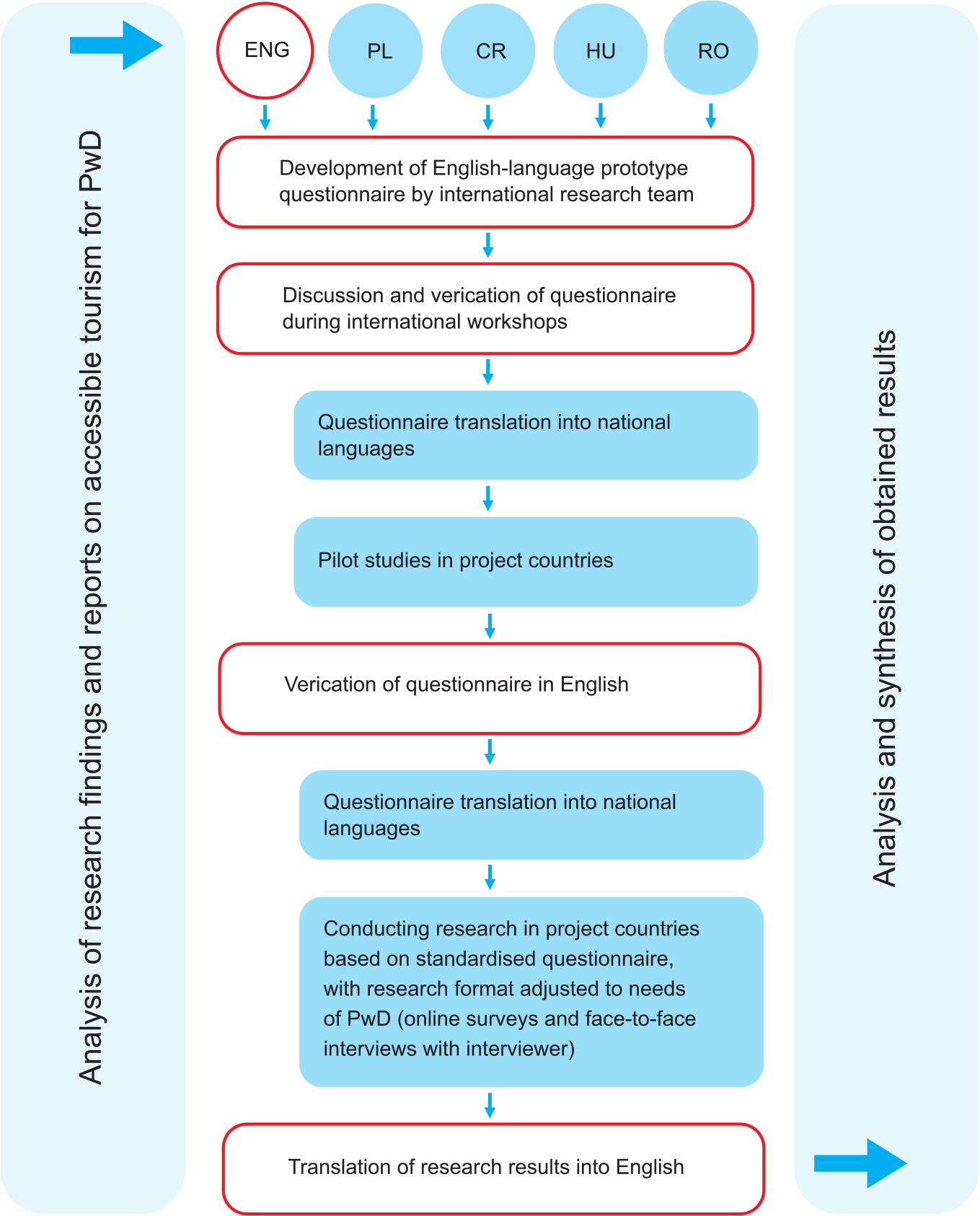
Fig. 1.
Stages of research.
Data collection and analysis
The research was conducted simultaneously in Poland, Hungary, Croatia, and Romania using a standardised questionnaire translated into national languages. Data were collected through both direct and online interviews between October 2023 and January 2024, resulting in 1175 correctly completed forms. The research results were translated into English for synthesis. To facilitate further international comparisons of research results presented in reports and statistical summaries, the obtained results were expressed as a percentage unit of measurement, with the sample size of 1175 individuals as the basis for calculations. For the questions regarding:
1) factors that prevent respondents from travelling as tourists, and
2) difficulties encountered during tourist trips, a 7-point Likert scale was used, where 1 means: ‘I never encounter this problem’, and 7 means: ‘I encounter this problem very often’.
The percentage distribution of responses was categorised as follows:
A. 1–3 points – positive value (+)
B. 4 points – neutral value (0)
C. 5–7 points – negative value (–)
Indicator: Σ = A + C
The adopted assumptions were intended to simplify the interpretation of the respondents’ perceptions regarding the frequency of experienced barriers. The 7-point Likert scale allows for capturing different levels of intensity and provides greater sensitivity than shorter scales. Values from 1 to 3 were classified as positive (+), as they indicate that a given problem occurs rarely or very rarely and therefore does not significantly limit participation. The midpoint value of 4 was treated as neutral (0), representing neither the presence nor the absence of a clear problem. Values from 5 to 7 were categorised as negative (–), as they reflect frequent or very frequent occurrence of barriers that may substantially affect tourist activity and travel experiences. This categorisation enabled a clearer distinction between low, moderate, and high levels of perceived diffculties.
The obtained results, presented in Tables 4–5, are on a scale from –100 to 100 points. Interpretation of the indicator: The lower the value, the greater the problem. Negative values indicate the extent to which respondents perceived a given issue as a challenge.
The analysis was conducted based on the complete database from four countries, focusing on categories related to different types of disabilities.
Characteristics of respondents
Respondents came from different European countries (Poland, Germany, the Netherlands, Croatia, Hungary, Austria, Slovakia, Romania) and represented various types of disabilities and degrees of independence in tourist travel (Table 1). The most frequently represented groups were individuals with mobility impairments (31%) and multiple disabilities (27%). These individuals also most often indicated the need for assistance when undertaking travel (the percentage of respondents was analysed separately in each group with a specific type of disability: mobility impairment 78%; multiple disability 56%). Relatively often, the need for support was also reported by individuals with visual impairments (sight 75%).
Table. 1.
Types of disabilities represented in the study sample and the need for assistance during a tourist trip.
| Disability type | Sample proportion (%) n = 1175 | Use of assistance during travel (%) |
|---|---|---|
| Temporary | 5 | 34 |
| Obstacle/age | 5 | 24 |
| Sight | 10 | 75 |
| Hearing | 5 | 51 |
| Mobility | 31 | 78 |
| Multiple | 27 | 56 |
| Intellectual | 6 | 15 |
| Speech | 2 | 11 |
| ASD | 5 | 25 |
| Psychosocial | 1 | 17 |
| Other | 3 | 23 |
Research results
Travelling for recreational and tourist purposes
Declarations of participation in tourist and leisure trips vary depending on the type of disability (Table 2). Almost a quarter (22%) of people with multiple disabilities do not undertake such journeys, and a similar situation applies to elderly people (18%) and people with psychosocial disabilities (17%). Among those who confirmed taking such trips, the need for assistance is greatest among respondents with intellectual disabilities (73%), visual impairments (59%), mobility impairments and ASD (both 58%). Conversely, individuals with speech disabilities (76%), hearing impairments, and those with age-related obstacles (both 70%) demonstrated the greatest independence in undertaking tourist and leisure travel.
Frequency of tourist trips
Data from the year preceding the study (2022) indicate that a significant group of PwD did not take a tourist trip even once throughout the year, especially regarding international travel (Table 3). Respondents who did not travel abroad most often represented psychosocial disabilities (83%), intellectual disabilities (77%), multiple disabilities (63%), ASD (59%), mobility impairments (57%), visual impairments, and older age (both 56%). Among older individuals, a considerable proportion also did not take domestic trips (21%). Participation in domestic trips was significantly higher. More than three such trips were declared by 71% of individuals in the ‘other’ category, 68% of individuals with visual impairments, 64% of individuals with temporary disabilities, and 61% of individuals with hearing impairments.
Table 3.
Frequency of tourist trips (data in %).
| Disability type | Not once | Once | Twice | Three times | More than three times | A/D |
|---|---|---|---|---|---|---|
| Temporary | 38 | 8 | 23 | 2 | 30 | A |
| 6 | 9 | 9 | 11 | 64 | D | |
| Obstacle/age | 56 | 16 | 20 | 8 | 9 | A |
| 21 | 12 | 15 | 7 | 45 | D | |
| Sight | 56 | 15 | 9 | 10 | 9 | A |
| 7 | 7 | 12 | 6 | 68 | D | |
| Hearing | 51 | 20 | 14 | 4 | 12 | A |
| 2 | 10 | 16 | 12 | 61 | D | |
| Mobility | 57 | 16 | 13 | 5 | 8 | A |
| 9 | 10 | 13 | 12 | 56 | D | |
| Multiple | 63 | 10 | 12 | 9 | 6 | A |
| 10 | 10 | 10 | 19 | 60 | D | |
| Intellectual | 77 | 12 | 2 | 3 | 7 | A |
| 7 | 19 | 15 | 8 | 51 | D | |
| Speech | 34 | 14 | 24 | 7 | 21 | A |
| 3 | 7 | 10 | 24 | 55 | D | |
| ASD | 59 | 24 | 10 | 5 | 2 | A |
| 14 | 19 | 8 | 14 | 46 | D | |
| Psychosocial | 83 | 8 | 8 | 0 | 0 | A |
| 0 | 17 | 8 | 17 | 58 | D | |
| Other | 48 | 29 | 13 | 6 | 3 | A |
| 3 | 6 | 10 | 10 | 71 | D |
Factors which keep respondents from travelling as a tourist
The factors which keep respondents from undertaking tourist trips were analysed separately for each group based on the type of disability, using a 7-point Likert scale. The data presented in Table 4 with positive values indicate the absence of such difficulties, while negative values show their presence. The numerical index values range from −100 to 100 points. In all the studied groups, the majority of responses confirmed that respondents enjoy travelling for tourism purposes. The least confirmation came from individuals with psychosocial disabilities (18 points on the –100 to 100 scale) and ASD (39 points on the –100 to 100 scale).
Table 4.
Factors which keep respondents from travelling as a tourist (data in the scale from –100 to 100 pt.).
| Disability type | I do not like travelling | Lack of time | Lack of money | Lack of company | Lack of language skills | Lack of assisting person | I am afraid of new situations | Travelling there and back is problematic | I am afraid that accessibility is not up to promises and/or my needs | My health condition does not allow travelling | Previous bad experiences | I can have travel experiences at home, using internet and technology |
|---|---|---|---|---|---|---|---|---|---|---|---|---|
| Temporary | 53 | 35 | 38 | 33 | 49 | 33 | 51 | 34 | 34 | 32 | 68 | 56 |
| Obstacle/age | 53 | 73 | 27 | 28 | –6 | 35 | 25 | 33 | 52 | 37 | 61 | 47 |
| Sight | 52 | 36 | 8 | 5 | 30 | 26 | 26 | 33 | 32 | 49 | 49 | 47 |
| Hearing | 75 | 11 | 22 | 35 | 2 | 51 | 33 | 53 | 49 | 75 | 53 | 42 |
| Mobility | 71 | 41 | 2 | 34 | 45 | 26 | 51 | 16 | 0 | 48 | 47 | 55 |
| Multiple | 64 | 52 | 2 | 11 | 9 | 33 | 26 | 16 | 7 | 36 | 42 | 56 |
| Intellectual | 78 | 58 | –15 | 23 | –32 | 21 | 13 | 32 | 57 | 55 | 72 | 50 |
| Speech | 52 | –17 | 17 | –42 | 0 | 62 | 29 | 45 | 27 | 31 | 17 | 48 |
| ASD | 39 | 45 | –15 | –7 | 15 | 5 | –35 | –4 | 30 | 59 | 35 | 61 |
| Psychosocial | 18 | 10 | –37 | –18 | –18 | 37 | 37 | 19 | 9 | 8 | 0 | 28 |
| Other | 62 | 50 | 9 | 30 | 33 | 68 | 45 | 60 | 57 | 63 | 73 | 49 |
The research results showed that the most common factors preventing respondents from undertaking tourist trips relate to issues such as lack of: company, money, language skills, fear of new situations, and lack of time. Regarding types of disabilities, it can be stated that individuals with psychosocial disabilities experienced the greatest difficulties, especially in the areas of lack of money (–37 points), lack of company (–18 points), and language skills (–18 points on the –100 to 100 scale), ASD – especially in terms of fear of new situations (–35 points), lack of money (–15 points), and company (–7 points on the –100 to 100 scale), speech disabilities – lack of company (–42 points) and time (–17 points on the –100 to 100 scale), and intellectual disabilities – lack of language skills (–32), and money (–15 points on the –100 to 100 scale). Lack of language skills is also evident among older individuals (–6 points on the –100 to 100 scale).
Difficulties encountered during tourist trips
Given the types of disability, individuals with mobility impairments reported the most difficulties with tourist trips in all categories studied except catering, particularly with regard to transport (–23 points), the possibility of engaging in sports activities (–12 points), a lack of reliable information on accessibility (–19 points), visiting attractions (–10 points), and accommodation (–12 points on the –100 to 100 scale). Those with multiple and psychosocial disabilities reported the second highest number of difficulties. Respondents with psychosocial disabilities reported difficulties with sports activities and visiting attractions (both –10 points on the –100 to 100 scale) and those with multiply disabilities particularly with the use of transport (–9 points), lack of reliable information on real accessibility (–5 points), and visiting attractions (–1 point on the –100 to 100 scale). For individuals with visual impairments and psychosocial disabilities, the responses regarding difficulties or their absence in catering services were balanced (0 points on the –100 to 100 scale) (Table 5).
Table 5.
Difficulties encountered during tourist trips (data in the scale from −100 to 100 pt.).
| Disability type | Use of transport | Use of accommodation | Use of catering facility | Sport activities | Visiting attractions | Lack of reliable information on real accessibility |
|---|---|---|---|---|---|---|
| Temporary | 51 | 58 | 58 | 46 | 59 | 43 |
| Obstacle/age | 38 | 66 | 61 | 37 | 53 | 43 |
| Sight | 4 | 15 | 0 | 20 | 15 | 10 |
| Hearing | 63 | 53 | 53 | 62 | 40 | 25 |
| Mobility | –23 | –12 | 26 | –12 | –10 | –19 |
| Multiple | –9 | 13 | 19 | 2 | –1 | –5 |
| Intellectual | 24 | 19 | 25 | 9 | 19 | 14 |
| Speech | 17 | 21 | 38 | 45 | 38 | 39 |
| ASD | 25 | 24 | 27 | 39 | 36 | 7 |
| Psychosocial | 37 | 0 | 0 | –10 | –10 | 55 |
| Other | 47 | 62 | 60 | 63 | 59 | 27 |
Conclusions
The study, using a unified methodology across several European countries with 1175 participants, focused on the specific limitations and preferences in tourist travel for individuals with various types of disabilities. This approach enabled the identification of both exogenic and endogenic factors affecting travel behaviour while minimising the influence of local social policies or socioeconomic conditions. The analysis revealed significant differences in the hierarchy of barriers limiting travel. Endogenic factors, which most strongly hinder the decision to travel, include a lack of company, financial constraints, language barriers, fear of new situations, and lack of time. These factors have a particularly strong impact on individuals with psychosocial disabilities (financial barrier: –37 points), people on the autism spectrum (fear of the new: –35 points), and those with speech disabilities, for whom the greatest obstacle is a lack of company (–42 points). The impact of these barriers is reflected in low travel activity; for instance, in 2022, as many as 83% of individuals with psychosocial disabilities and 77% with intellectual disabilities did not undertake a single international trip.
Exogenic factors, such as problems with transport, access to tourist information, accommodation, and sightseeing, are reported as significant obstacles primarily by individuals with mobility impairments, followed by those with multiple and psychosocial disabilities. The specificity of these limitations is that while endogenic factors often prevent the initial decision to travel, exogenic factors generate difficulties experienced during the trip itself. Notably, catering services were identified as the least problematic area, achieving a neutral core (0 points) among individuals with visual impairments and psychosocial disabilities.
These findings indicate an urgent need to establish a support system at the place of residence to assist in travel preparation and decision-making. This is especially crucial for individuals with multiple disabilities, 22% of whom do not participate in any tourist activities. Simultaneously, eliminating infrastructural barriers at destinations is essential. Travel preferences are closely linked to the expectation of assistance; the highest demand for a support person was reported by individuals with intellectual disabilities (73%), visual impairments (59%), and mobility impairments or ASD (both 58%). On the other hand, individuals with speech disabilities (76%) and hearing impairments (70%) demonstrated the highest level of independence in organising their travels. The study conclusions highlight the necessity for further research into accessible tourism, with a specific focus on the diversity of barriers at every stage of the travel process. Future studies should focus on evaluating the effectiveness of specific mechanisms, such as travel assistants or digital accessibility tools, particularly for groups most vulnerable to exclusion, where barriers like language difficulties (e.g., –32 points for individuals with intellectual disabilities) or financial limitations significantly restrict long-term participation in tourism.
Limitations of the conclusions
The conclusions are based on a sample drawn from several European countries using a unified methodology which helps improve comparability but may still limit the generalisability of the findings to non-European contexts or countries with significantly different socio-economic and policy environments. Although the study aimed to minimise the influence of national differences, such factors cannot be fully excluded. The results rely on self-reported data from participants with different types of disabilities, which may introduce subjective bias in the assessment of barriers and preferences. Additionally, grouping diverse disability types may oversimplify the heterogeneity within each category. The study distinguishes between endogenic and exogenic factors; the cross-sectional design does not allow for causal inferences or analysis of how these barriers may change over time or across different travel contexts.
Acknowledgements
The research was conducted as part of the international Erasmus Plus project entitled “The development of the innovative educational method of ACCESSIBLE tourism in Central Europe” under the registration number KA220-HED-7498581E.
Notes
[6] Financial disclosure Declaration of generative AI and Ai-assisted technologies in the writing process
During the preparation of this work the author(s) have used NO Generative AI or AI-assisted technologies.
[7] Contributed by Declaration of competing interest
None.
[8] Contributed by Authors’ contributions
AZ: conceptualisation, development of the theoretical and methodological framework, investigation, formal analysis, data synthesis, formulation of conclusions and recommendations; MS, PS, TG: literature review, investigation, and editing.
Appendix A
Supplementary data
Supplementary data to this article can be found in the book: Zajadacz A. (ed.), 2025. Accessible tourism: Insights form across Europe. Determinants and Development Plans of Tourism, Vol. 24. Bogucki Wydawnictwo Naukowe, Poznań.