
Introduction
Enterprises play a key role in stimulating the development and economic restructuring of border regions. These areas – despite their often peripheral location – have strategic advantages that enable the internationalisation of economic activity, stemming from, among other things, proximity to foreign markets, opportunities for cultural exchange and the use of cross-border business networks (Loures et al. 2019). The multidimensionality of the issue has attracted the attention of many researchers (Makkonen, Leik 2020). The growing interest in cross-borderism is part of a broader stream of research on so-called regional entrepreneurship and internationalisation in the periphery. However, the literature still mainly focuses on Western European areas, North America or large firms from developed economies, e.g., German-Czech, Finnish-Swedish, East German, US-Mexican and US-Canada regions (Keupp, Gassmann 2009, Michna, Kmieciak 2016, Jones 2018, Makkonen, Leick 2020).
Less attention has been paid to the border regions of Central and Eastern Europe (CEE), which function at the interface of different political and economic systems and at the same time constitute the external borders of the European Union and the Schengen area. These borderlands are not only state borders, but also institutional, cultural and economic barriers and bridges. Poland’s eastern border with Russia, Belarus, Ukraine, Lithuania and Slovakia is a particularly relevant example. This region is characterised by a relatively low level of economic development, strong differences in border types (EU vs. non-EU, Schengen vs. non-Schengen) and the existence of strong geopolitical tensions.
Despite the available research on internationalisation (Jones et al. 2011, Wach 2021, Koprivnjak, Popovič 2024), the mechanisms and determinants of cross-border activity by micro, small and medium-sized enterprises (SMEs) located in such areas are still insufficiently recognised. Analyses to date rarely cover diverse types of borders and do not include spatial data to analyse geographical proximity and agglomeration effects (Dunning 1998, Mundambi 2008). Meanwhile, empirical studies indicate that access to market knowledge and networks significantly influences firms’ internationalisation decisions, especially in the context of uncertainty and institutional barriers (Ibeh, Kasem 2011, Sullivan, Marvel 2011, Martín et al. 2022, Huremović et al. 2024). Also, the effects of firm concentration (spillovers) and knowledge sharing within regional innovation systems are becoming increasingly important in analyses of spatial entrepreneurship (Asheim, Gertler 2005, Fernhaber et al. 2009, Bathelt, Cohendet 2014, Juhász et al. 2024).
Although the empirical data used in this study were collected in 2019, the analysis remains highly relevant in the light of the subsequent deterioration of political relations in the region, including the war in Ukraine, sanctions against Russia and Belarus and migration crises (Bock-Schappelwein, Huber 2022, Białowąs et al. 2024, Sinani, Zilja 2025). At the same time, it should be emphasised that 2019 preceded both the COVID-19 pandemic and the later escalation of geopolitical tensions. This makes the period particularly suitable for examining the determinants of cross-border activity under conditions of still relatively high border permeability. Knowledge of how and why companies engage in cross-border activities can provide a foundation for the creation of effective policies supporting the development of border areas (Interreg Europe Policy Learning Platform 2021, Pámer et al. 2024).
Therefore, the paper aims to identify the factors influencing the involvement of companies located along Poland’s eastern border in cross-border activities. This issue is particularly important in the context of CEE, where cross-border economic cooperation developed relatively late because of the late 1980s and early 1990s political transformations. In Poland, this type of activity is also a relatively new area of research that has been developing since the 1990s. It was only the geopolitical changes of the late 1980s and early 1990s that created conditions for business cooperation in border areas (Zabielska et al. 2021).
The study was based on survey data collected among 338 companies, located in four border regions (Warmińsko-Mazurskie, Podlaskie, Lubelskie, Podkarpackie), combined with geolocalisation and regional data. The paper uses logit models to estimate the impact of variables such as the level of market knowledge, the presence of other firms in the cross-border market, geographical proximity, innovation and characteristics of the local environment. The research was carried out in 2019, between July and September, and was funded by a statutory grant as part of a research project entitled ‘Determinants of entrepreneurship in the border regions of Eastern Poland’.
The study makes three main theoretical contributions to the international literature on SME internationalisation and entrepreneurship in peripheral border regions (Welch, Luostarinen 1988, Calof, Beamish 1995, Jones et al. 2011, Koprivnjak, Popovič 2024). First, it extends the Uppsala model by demonstrating that, in border settings, experiential learning is closely intertwined with spatial proximity and localised knowledge spillovers. Second, by incorporating the CAGE framework, it reveals that cross-border activity is shaped not only by firm-level capabilities, but also by differences in geographical and institutional distance across neighbouring markets. Third, by focusing on the EU’s eastern external border, the article adds evidence from a border context that remains underrepresented in the literature, where firms operate under conditions of peripheral location, uneven market accessibility, and heightened geopolitical sensitivity.
Business activities in cross-border markets: A literature review
Increasing competition is forcing companies to continuously adapt to changing conditions in cross-border markets. This can be understood as a process that manifests itself in all types of economic activity (e.g., exporting) of firms abroad or as a model for investing in foreign markets to exploit competitive advantages (Piercy 1981, Welch, Luostarinen 1988, Calof, Beamish 1995, Oviatt, McDougall 2005, Mtigwe 2006, Ibeh, Kasem 2011). It should be noted that the above interpretation applies primarily to the activities of large, well-established companies in foreign partner markets. For SMEs, cross-border expansion is often incidental and based on relational resources, as confirmed, among others, by the research of Michna and Kmieciak (2016).
Cross-border cooperation (CBC) can be understood as a key policy instrument and governance mechanism aimed at fostering territorial integration through the effective utilisation of opportunities inherent to border regions (Van Houtum 2000, Knippschild 2011, Interreg Europe Policy Learning Platform 2021, Pámer et al. 2024). It encompasses both formalised and informal modes of collaboration designed to address shared territorial challenges (Zumbusch, Scherer 2015). These forms of cooperation often evolve from previously established cross-border interactions and networks, gradually giving rise to more structured governance arrangements involving a diverse range of stakeholders (Terlouw 2012, Cappellano, Makkonen 2020). As a long-term and dynamic process, CBC requires a sufficient level of institutional stability and predictability, which is ensured by the underlying governance frameworks (Zumbusch, Scherer 2015). The effectiveness of these frameworks is, in turn, shaped by the character and configuration of interactions among participating actors (Krätke 1999, Blatter 2004, Fricke 2015).
Cross-border activities are part of a broader context of internationalisation understood, among other things, as a process of diverse economic, social and cultural activities that create local networks (Lisowska 2015, Łukaniszyn-Domaszewska et al. 2023). The increasing scale of production is an argument for conducting various forms of cross-border activities (Zahra, George 2002, Kuivalainen et al. 2012, Sienkiewicz 2024).
For the purposes of this study, internationalisation is understood as the broader process through which firms become involved in economic activities beyond the domestic market. Foreign activity refers to any form of such involvement in external markets, regardless of destination. Cross-border activity is treated here as a narrower category, referring specifically to firm engagement in the market of the neighbouring country located across the nearest state border. Accordingly, cross-border activity is conceptualised as a territorially bounded form of internationalisation, shaped not only by general firm-level capabilities but also by proximity, border permeability and market-specific institutional conditions.
In addition, cross-border market activities provide the opportunity to learn about different business cultures, adapt to local industries and markets, and facilitate the discovery of new market niches and the establishment of valuable partnerships (Sullivan, Marvel 2011, Mammadov, Wald 2025). Businesses can receive both financial support in the form of de minimis aid from public funds and substantive support in the form of advice from government agencies and chambers of commerce and industry (Interreg Europe Policy Learning Platform 2021, Pámer et al. 2024).
As recent research (Urban et al. 2023) presents, for SMEs in CEE regions, access to market knowledge and institutional support remains limited, which significantly reduces their willingness to engage in cross-border activities (Puchalska et al. 2025, Virglerova et al. 2025). Baranowska-Prokop and Sikora (2023) furthermore emphasise the importance of organisational learning as a condition for successful foreign expansion, which remains particularly important for firms from peripheral areas. Similar conclusions are drawn in studies linking SME internationalisation with resources, digital transformation and institutional constraints (Chen et al. 2024, Śledziewska, Włoch 2024, Kumari et al. 2025).
The benefits are achieved by companies with varying degrees of involvement (sophistication) in the ‘cross-border’ area. Taking into account the specificity of national borders, these include (Wach 2021): export/import of products and services, cooperative long-term economic ties with a cross-border partner (so-called licences) and independent cross-border economic activity in the border market.
The present analysis is based primarily on the Uppsala internationalisation model and its transnational variant in order to explain firms’ motivations for engaging in cross-border markets (Johanson, Vahlne 2009). This approach views cross-border activity through the lens of three interrelated elements: (1) the interaction between acquiring knowledge of the neighbouring market and operating in that market, (2) the gradual increase in resource commitment, and (3) the importance of locational proximity and existing links with other firms already operating in the cross-border or foreign market. In the classical interpretation of the model, the initial stage of expansion refers to irregular activities, such as exporting or importing, followed by more regular sales through agents and local partners, licensing agreements or the establishment of a sales subsidiary, and finally by the establishment of a local production facility (Welch, Luostarinen 1988, Vahlne, Johanson 2017).
At the same time, in order to capture more fully the specificity of the cross-border relationships under consideration, the analysis also refers to the CAGE framework, which emphasises the importance of cultural, administrative, geographical and economic distance between markets (Ghemawat 2001). In the case of firms operating in border regions, limited geographical distance, institutional similarities and relatively lower market-entry costs may be of particular importance, thus encouraging firms to engage in CBC. This reasoning is also consistent with location-based approaches to international business and competitiveness, which stress the role of place, institutional context and geographically embedded advantages (Porter 1990, Dunning 1998, Yeung 2002).
In addition, the Born Global or International New Venture perspective is considered. According to this approach, some firms may engage in international activity at an earlier stage of development and in a less sequential manner than the classical Uppsala model assumes (Oviatt, McDougall 1994, Thai, Chong 2008). This perspective acknowledges that firms develop cross-border linkages not only gradually, but also on the basis of existing capabilities, network relationships and the ability to rapidly exploit market opportunities (Jones et al. 2011, Koprivnjak, Popocič 2024).
From this perspective, a firm’s presence in the cross-border market is determined by a range of factors which Daszkiewicz (2016) divides into motives, which trigger expansion and conditions, relating both to the external environment and to the internal potential of the enterprise. In the business environment, knowledge has become a key resource for companies seeking to gain a competitive advantage. Huremović et al. (2024) point out that SMEs learn about expansion opportunities through production networks and relationships with partners, which significantly increases their ability to overcome information barriers. It is necessary to define the purpose and direction of the enterprise, manage its present and shape its future in foreign markets. This plays a key role in effective communication, informed decision-making and increased productivity. It influences decisions on expansion into new markets (Gorynia 2007, Martin et al. 2022). However, it requires multiple forms of obtaining it (Fernhaber et al. 2009, Sulivan, Marvel 2011). Whether knowledge is generated in local communities or global networks is widely debated in economic geography and international business (Beugelsdijk et al. 2010, Cantwell 2014, Dicken 2014, Jones 2018, Thrassou et al. 2020). In this context, internationalisation is understood as organisational learning and knowledge development (Eriksson et al. 2000, Vahlne, Johanson 2017). Several configurations of knowledge influence on firms’ internationalisation processes have been analysed in the literature (Fletcher, Harris 2012, Hilmersson 2014). These range from forms of knowledge specific to new international ventures (Park et al. 2015) to smaller resources required for continuous internationalisation (Schwens, Kabst 2009). Firms use a few types of knowledge (technological, market and internationalisation) acquired from different sources in the internationalisation process (e.g., Voudouris et al. 2011, Deligianni et al. 2015, Weerawardena et al. 2017).
Studies of internationalising firms from developing economies indicate that they face serious knowledge gaps (Yamakawa et al. 2008, Ibeh, Kasen 2011, Nguyen et al. 2013, Kumari et al. 2025). Companies often need access to knowledge sources in their home country due to a hostile and/or poorly functioning domestic market, biased state-owned enterprises, government censorship of foreign information, limited access to information centres and high costs of expertise. Access to sources of internationalisation knowledge at home requires the development of networks (Yeung 2002, Zhu et al. 2006). If the cost of acquiring knowledge at home outweighs the cost of seeking it abroad, firms may look for ‘successful institutions’ abroad by participating in international industry exhibitions (Boisot, Meyer 2008). Under conditions of limited access to formal sources of innovation, it is informal interactions and local knowledge exchange that provide the key stimulus for the development of firms’ international competence. Knowledge of foreign (cross-border) markets plays a key role in the internationalisation process. As firms grow, they increase their exposure and are willing to take risks to expand beyond their country of origin. However, while many researchers have looked at the issue of the importance of access to knowledge in the internationalisation process of companies in general, recent studies also stress the role of digital channels, cross-border e-commerce and managerial capabilities in reducing knowledge barriers (Bargoni et al. 2024, Mammadov, Wald 2025, Zhu 2026). Therefore, the first hypothesis is formulated in the following way:
H1: A sound knowledge of the economic realities of a neighbouring country influences a company’s presence in a cross-border market.
Despite advances in technology, geographical proximity remains one of the most effective methods for exchanging knowledge and doing business (World Bank 1999, Knoben, Oerlemans 2006, Makkonen, Leick 2020). The proximity paradigm seeks to define how (and to what extent) it participates in shaping relationships (Boschma 2005). Such a broad approach stems from the fact that geographical proximity alone cannot generate interactions between actors, let alone generate synergies. It only creates the conditions for a concentration of companies that are not necessarily directly linked to each other (Torre, Rallet 2005). On the other hand, geographical proximity favours location effects (Lagendijk, Lorentzen 2007). According to the analysis of Juhász et al. (2024), the spatial proximity of firms related through skills favours their co-location. This means that knowledge and geographical proximity are mutually reinforcing. The concentration of firms in a particular region stimulates the spread of limited knowledge, enables the pooling of specialised labour and facilitates the interaction between inputs and outputs (Asheim, Gertler 2005, Storper 2013, Bathelt, Cohendet 2014, Nazarczuk et al. 2020a).
The concept of knowledge transfer suggests that firms benefit from the knowledge of other firms through informal interactions and emphasises the importance of geographical proximity for knowledge transfer. Although this mainly refers to technological knowledge. Fernhaber et al. (2009) showed that spillover effects also apply to international knowledge. Their study shows that locating a new venture in the vicinity of firms with foreign presence results in its absorption by new entrants. Similar mechanisms are also confirmed by Wilkinson and Arcaute (2023), analysing the geographical extent of knowledge transfer using the example of patent citations in the UK. They point out that knowledge spillover effects are clearly local and limited by the distance of everyday interactions. In this sense, the internationalisation of firms may be shaped by localised knowledge externalities, cluster-based learning and the spatial organisation of innovation (Saxenian 1994, Tallman et al. 2004, Alcácer, Chung 2007, Mudambi 2008).
By penetrating foreign markets, firms can help reduce the cost of entry for other potential exporters (Nazarczuk et al. 2020b). This can be achieved by sharing learning effects or establishing trade links (Aitken et al. 1997). Additionally, the uncertainty of starting a business abroad can be reduced and other firms may be encouraged to follow similar paths (Chang, Park 2005). According to Gullien (2002), companies entering foreign markets tend to imitate companies whose experience, history or location is relevant to their situation. In cross-border areas, the issue of proximity is most often considered in the context of CBC and regional innovation systems (Lundquist, Trippl 2013, Makkonen, Leick 2020, Korhonen et al. 2021). However, there is a lack of research into its impact on the presence of companies from border areas in the market of a neighbouring country.
Furthermore, the literature on international business suggests that the benefits derived from spatial proximity may not be uniform across different geographical directions. The effectiveness of knowledge spillovers and imitation effects is often moderated by the specific institutional, cultural and economic characteristics of the target market (Yeung 2002, Meyer et al. 2009, Berry et al. 2010). Consequently, the ‘border effect’ may vary significantly depending on the unique bilateral relations and market integration levels between the home region and specific neighbouring countries. Therefore, we formulate the following hypotheses:
H2: The concentration of cross-border active firms within a municipality exerts a positive spillover effect, enhancing the entry probability of local firms into neighbouring markets.
H3: The stimulus provided by cross-border concentration is context-dependent, with its marginal effect on internationalisation being significantly stronger in specific neighbouring economies compared to the baseline market.
Materials and methods
Dataset
Survey-based research was conducted to evaluate the role of particular factors that affect CBC between firms located in Poland in the cross-border belt and their counterparts from neighbouring countries. The analysis of CBC was carried out based on factors that drive the overall globalisation of economic activity, against which the results of the cross-border study were benchmarked. The firms participating in the study were drawn from an extensive corporate database covering more than two million entities. The most important criterion for restricting the sampling frame was its location – close to the eastern border no further than 70 km from the border of five countries: the Russian Federation (Kaliningrad Oblast), Lithuania, Belarus, Ukraine and Slovakia (Fig. 1). Given that the population size of non-financial enterprises in the four provinces of Eastern Poland was known and stood at 297,000 entities (Statistics Poland, 2019), the planned minimum sample size was estimated using the formula for a finite population. A confidence level of 95% and a margin of error of 5% were adopted. To achieve the minimum sample size, a questionnaire was sent to 400 enterprises in 2019. Notably, 90% of the surveys were conducted via telephone interviews and 10% via an online survey. Ultimately, 338 questionnaires meeting the completeness criteria were obtained and selected for further statistical analysis. The dataset, therefore, represented various types of borders in terms of their openness, crossing times, bureaucracy, etc., as it included two EU countries and three non-EU countries.
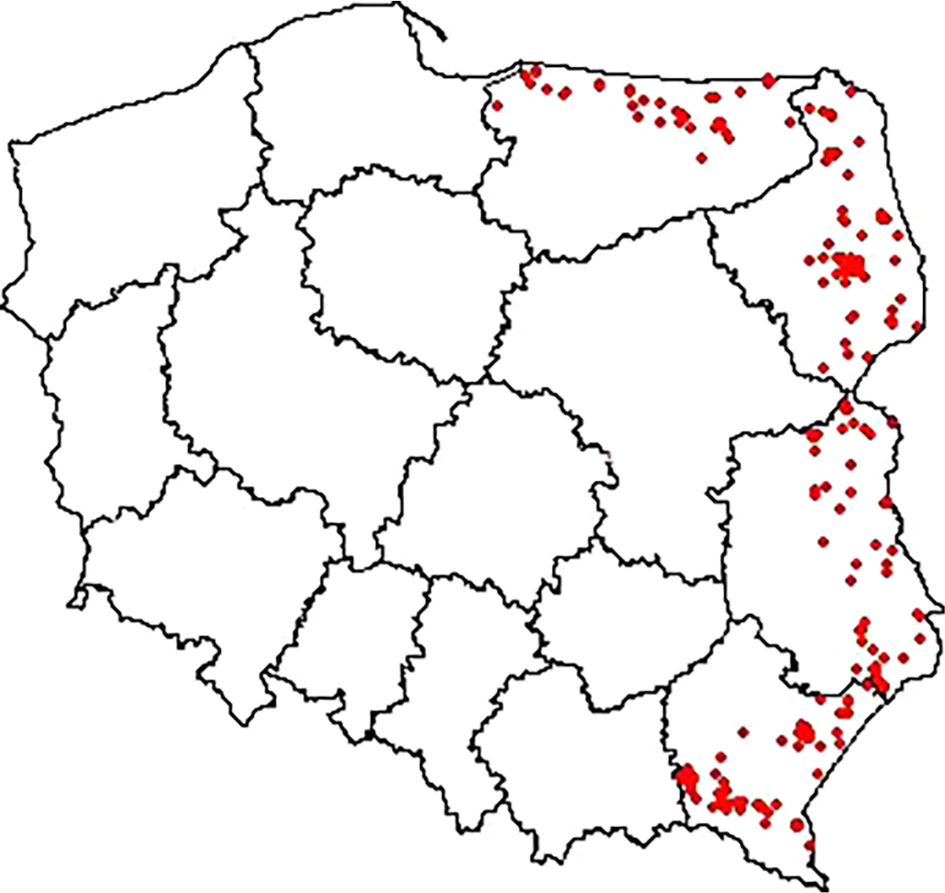
Fig. 1.
Location of firms from the research sample.
The choice of the easternmost Polish border stemmed from the very similar levels of economic development of the four regions located there (in 2024, estimated GDP per capita amounted to 55% – 61% of the EU-27 average and 70.6% – 77.7% of the Polish average), as well as from the similar economic environments and problems faced by firms operating there. As indicated by the Polish Ministry of Development Funds and Regional Policy (2026), these areas are characterised by low transport accessibility, deteriorating public infrastructure, worsening investment conditions, declining productivity of local economies and an outflow of young, educated and entrepreneurial people. These weaknesses have deep historical roots. Between 1945 and 1989, the regions were kept in an extensive agricultural model or made dependent on state-owned industrial monostructures (State Agricultural Farms in Warmińsko-Mazurskie Province, smallholder farming without industrialisation in Podlaskie and Lubelskie Provinces and a defence industry integrated into the Soviet military cooperation network in Podkarpackie Province). The post-1989 systemic transformation failed to fully overcome these structural barriers, as evidenced by the persistently lowest entrepreneurship rates in Poland (in 2024, the number of SMEs per 10,000 inhabitants ranged from 1037 in Podkarpackie to 1113 in Warmińsko-Mazurskie, against a national average of 1414) and a low level of foreign direct investment (FDI) per working-age resident (Podkarpackie – 41.2% of the national average; Warmińsko-Mazurskie – 17.4%; Lubelskie – 17.1%; Podlaskie – 11.7%). In response to these challenges, the regions of the EU’s eastern border have been covered by additional cohesion policy instruments – from pre-accession PHARE CBC programmes, through successive editions of the Operational Programme Eastern Poland (2007–2013, 2014–2020), to the current European Funds for Eastern Poland 2021-2027.
The firms were located in four eastern regions of Poland (from the north). Warmińsko-Mazurskie (59), Podlaskie (95), Lubelskie (66), Podkarpackie (118), which have the closest border with Russia (59), Lithuania (20), Belarus (105), Ukraine (78) and Slovakia (76). It should be noted that the administrative borders of regions, in most cases, do not overlap the state/political borders of countries.
The structural composition of the 338 surveyed firms is predominantly characterised by micro (39.94%) and small enterprises (41.13%), while medium-sized entities account for the remaining 18.93% of the sample. Regarding sectoral distribution, the secondary sector represents the largest portion at 56.51%, followed by the tertiary sector at 39.94%, with the primary sector constituting a marginal 3.55% of the total observations. Within the secondary sector, manufacturing (35.50% of the total sample) and construction (18.05%) constitute the primary subsegments, while the tertiary sector is dominated by real estate and professional services (15.68%), followed by transport and hospitality (8.88%) and trade (7.69%).
Estimation approach
The choice of the logit estimator is motivated by the binary nature of the dependent variable, which captures whether a firm is engaged in at least one form of cross-border activity or not. This modelling strategy is widely used in empirical studies on SME internationalisation and foreign market entry, where the key analytical objective is to explain the probability of participation rather than the intensity of activity. In the present study, this approach is particularly suitable because the main research interest lies in identifying the firm-level, spatial and contextual determinants of entry into neighbouring markets. The combination of survey-based firm characteristics, geolocation data and municipality-level indicators makes it possible to analyse these determinants jointly and to account for both microeconomic and territorial dimensions of cross-border engagement.
To identify the factors stimulating internationalisation and cross-border activity, the study employs a series of econometric models estimating the probability that a firm engages in at least one of the following forms of activity abroad: (i) exports or imports, (ii) establishment of subsidiaries or affiliates abroad, (iii) sourcing workers, (iv) participation in trade fairs, (v) implementation of promotional activities abroad, (vi) acquisition or sale of licences abroad and (vii) joint ventures with a partner. In line with this distinction, the empirical analysis differentiates between general foreign activity and cross-border activity in the neighbouring market. The former refers to any form of firms’ engagement in foreign markets, regardless of destination, whereas the latter is treated as a narrower category referring specifically to activity undertaken in the market of the neighbouring country across the nearest border. Although the broad operational definition of internationalisation – based on satisfying at least one of the seven criteria – may affect the overall participation rates observed in the sample, the present study is primarily concerned with the econometric identification of the determinants of cross-border activity rather than with providing descriptive point estimates for the wider population. Of the 338 firms, 191 entities (56.5%) were involved in some form of foreign activity; however, only 140 firms (41.4%) undertook some form of cross-border activity. This may indicate the lower importance of eastern, as compared with other – presumably western – directions of firms’ internationalisation, which is broadly consistent with Poland’s geographical structure of exports. The survey-based data were subsequently merged with firms’ financial data (despite frequent missing values) and their GPS coordinates, which made it possible to calculate distances both to national borders and to other firms active in foreign and cross-border markets. The location data also enabled the inclusion of variables reflecting the local economic environment at municipality level.
The independent variables include firm-specific factors (obtained through the survey questionnaire), geography-related factors (minimum distance to other firms active in foreign or cross-border markets) and regional factors (the concentration of firms active in a cross-border market). A complete list of variables and their descriptive statistics is provided in Table 1. Particular emphasis is placed on the knowledge variable (know), which reflects respondents’ self-assessment of their familiarity with cross-border market conditions. This indicator is binary, where a value of 1 represents ‘very high’ or ‘high’ levels of self-reported expertise.
Table 1.
The list of descriptive statistics used in the study.
| Variable | Description | N | Mean | Std. Dev. | Min | Max |
|---|---|---|---|---|---|---|
| fn_act | Firms with cross-border activity (dummy) | 338 | 0.414 | 0.493 | 0 | 1 |
| f_act | Firms active in foreign markets (dummy) | 338 | 0.565 | 0.496 | 0 | 1 |
| lemp | Firm’s employment (ln) | 338 | 2.503 | 1.461 | 0 | 6.461 |
| know | Great knowledge of cross-border market (dummy) | 338 | 0.302 | 0.460 | 0 | 1 |
| coop | Cooperants already present in cross-border market (dummy) | 338 | 0.130 | 0.337 | 0 | 1 |
| innov_i | Introduced innovations at international level (dummy) | 338 | 0.062 | 0.242 | 0 | 1 |
| lm_fn_act | No. of firms active in cross-border market in municipality (ln) | 338 | –0.590 | 3.218 | –6.908 | 2.08 |
| ldist_fn_act | Distance to te nearest firm active in cross-border market (ln) | 338 | –3.520 | 5.112 | –10.937 | 4.463 |
Model specifications are compared on the basis of goodness of fit, the area under a ROC curve (hereafter AUC), Akaike Information Criterion (AIC) and Bayesian Information Criterion (BIC), as well as the percentage of correctly classified cases. All estimations present odds ratios with robust standard errors. The general form of the estimated models is the following:
where P represents the probability of outcome Y (firm being active in a cross-border market), X represents the set of control variables, β denotes the estimated coefficients, G is the logistic link function, and e is the mathematical constant used to transform the linear combination into a probability.To ensure the robustness of the results, some of the estimates were re-estimated for a second dependent variable, representing firms’ general internationalisation (irrespective of cross-border activity), and the results were compared with the baseline estimates in terms of their stability (available upon request). Additionally, the study also evaluated whether incorporating regional fixed-effects and sectoral dummies based on the Pavitt classification would enhance the model’s fit.
Incorporating revised Pavitt’s technology taxonomy (Bogliacino, Pianta 2016) as fixed effects allows the model to account for unobservable industry heterogeneity and ensure that the observed impact of innovation and knowledge on firms’ internationalisation is not merely a result of the specific industrial structure of the sample under study. Following the revised Pavitt taxonomy, economic sectors are classified into four distinct categories according to their technological advancement and innovation sources: science-based, specialised suppliers, scale and information-intensive, supplier-dominated. Finally, the Wald test was employed to verify the joint statistical significance of the country-specific, sector-specific and regional fixed effects and their interaction terms, providing additional support for their inclusion in the model.
Results
According to the survey data, cross-border activity is of a lesser probability (41.4%) than general foreign activity (56.5%) in firms operating in the border belt of Poland (Table 2). The observation may be in line with worse economic conditions, bureaucracy, tariffs and signifcantly higher time of border crossing for the majority of countries bordering Poland from the north-east and mostly the east direction, which are non-EU countries. The structure of cross-border activity is quite similar to the overall foreign activity of questioned firms. Most entities operate in a foreign market through exports or imports in either case. To a slightly lesser extent, firms undertake various promotional activities (participated in fairs or other industry events, conducted the promotion of investment areas, advertised themselves) or acquired/sourced licences, but the greatest difficulty was observed in generating their own foreign direct investment (FDI) on a cross-border or (in general) foreign markets.
Table 2.
The scale and types of foreign and cross-border activity (% of total surveyed firms).
| Type of activity | No | Yes | % |
|---|---|---|---|
| Overall cross-border activity | 198 | 140 | 41.4 |
| – foreign trade | 227 | 111 | 32.8 |
| – subsidiaries/affiliates | 322 | 16 | 4.7 |
| – exchange employees | 303 | 35 | 10.4 |
| – promotional activity/licenses | 271 | 67 | 19.8 |
| – other | 309 | 29 | 8.6 |
| Overall foreign activity | 147 | 191 | 56.5 |
| – foreign trade | 170 | 168 | 49.7 |
| – subsidiaries/affiliates | 318 | 20 | 5.9 |
| – exchange employees | 297 | 41 | 12.1 |
| – promotional activity/licenses | 223 | 115 | 34.0 |
| – other | 288 | 50 | 14.8 |
Since the dataset encompasses firms residing close to different countries, having various economic regimes, regulations, sectoral structures and needs, the study analyses if there are major differences in cross-border activity. The highest levels of cross-border activity were observed in firms located near Belarus (BY), Slovakia (SK) and Ukraine (UA), while the lowest levels were seen in firms located near Russia (RU) and Lithuania (LT) (Table 3). In the latter case, due to the relatively short border length among the analysed countries, the number of associated firms was also lower.
Table 3.
Firms active in a cross-border market by the cross-border country (percentage).
| Description/closest border | RU | LT | BY | UA | SK |
|---|---|---|---|---|---|
| Overall cross-border activity (%) | 33.9 | 30.0 | 49.5 | 38.5 | 42.1 |
| – foreign trade | 25.4 | 20.0 | 36.2 | 32.1 | 38.2 |
| – subsidiaries/affiliates | 1.7 | 0.0 | 6.7 | 3.8 | 6.6 |
| – exchange employees | 8.5 | 10.0 | 13.3 | 10.3 | 7.9 |
| – promotional activity/licenses | 14.3 | 0.0 | 31.4 | 15.4 | 19.7 |
| – other | 5.1 | 0.0 | 13.3 | 6.4 | 9.2 |
| N | 59 | 20 | 105 | 78 | 76 |
Despite some country-specific differences in the overall level of cross-border activity, the structure of different types of participation by firms in a cross-border market is very similar. An exception to this rule was the case of Lithuania, where not all forms of cross-border activity are present (possibly due to a lower number of observations or other unobserved factors). As for the rest of the directions, the relative importance of particular types of cross-border activity falls mostly into the trends observed for the whole population of firms, irrespective of their location. However, in the case of Belarus, the ratios are signifcantly higher, as the total percentage of firms having any form of CBC with this country is also higher. The difference is most noticeable in the case of promotional activities, which were twice as high.
Table 4 presents the results of the econometric inquiry into the determinants of CBC, which, in the following estimations, identify factors affecting the probability of a frm being active in a foreign market of a country with which it has the closest border. Generally, firms employing a higher number of workers have a higher probability of being present in a cross-border market (Table 4, estimation 1). In the absence of data on total assets, the number of employees might be a good proxy of firm size.
Table 4.
Determinants of cross-border cooperation.
| Variables | (1) fn_act | (2) fn_act | (3) fn_act | (4) fn_act | (5) fn_act | (6) fn_act | (7) fn_act |
|---|---|---|---|---|---|---|---|
| lemp | 1.371*** | 1.326*** | 1.309*** | 1.313*** | 1.321*** | 1.305*** | 1.314*** |
| –0.083 | –0.089 | –0.093 | –0.094 | –0.096 | –0.095 | –0.096 | |
| know | 1.855** | 1.981** | 2.000** | 2.059** | 2.057** | 2.077** | |
| –0.256 | –0.282 | –0.284 | –0.293 | –0.295 | –0.294 | ||
| coop | 2.735*** | 2.650*** | 2.678*** | 2.370** | 2.417** | 2.421** | |
| –0.346 | –0.376 | –0.382 | –0.392 | –0.392 | –0.398 | ||
| innov_i | 2.234 | 2.036 | 2.004 | 1.837 | 1.9 | 1.904 | |
| –0.514 | –0.568 | –0.584 | –0.61 | –0.641 | –0.641 | ||
| lm_fn_act | 1.461*** | 1.471*** | 1.490*** | 1.272*** | 1.267*** | ||
| –0.037 | –0.039 | –0.041 | –0.066 | –0.066 | |||
| Belarus | 2.809 | 1.611 | 2.32 | ||||
| –0.655 | –0.328 | –0.656 | |||||
| Lithuania | 1.586 | 0.969 | 1.455 | ||||
| –0.84 | –0.525 | –0.831 | |||||
| Russia | 1.597 | 0.993 | 1.307 | ||||
| –0.677 | –0.394 | –0.678 | |||||
| Ukraine | 2.025 | 1.459 | 1.622 | ||||
| –0.431 | –0.383 | –0.41 | |||||
| Belarus * lm_fn_act | 1.185 | 1.199* | |||||
| –0.107 | –0.108 | ||||||
| Lithuania * lm_fn_act | 1.024 | 1.028 | |||||
| –0.156 | –0.157 | ||||||
| Russia * lm_fn_act | 1.226 | 1.23 | |||||
| –0.131 | –0.132 | ||||||
| Ukraine * lm_fn_act | 1.311** | 1.306** | |||||
| –0.109 | –0.109 | ||||||
| Constant | 0.315*** | 0.237*** | 0.241*** | 0.296*** | 0.092*** | 0.150*** | 0.111*** |
| –0.252 | –0.28 | –0.294 | –0.414 | –0.698 | –0.426 | –0.707 | |
| Observations | 338 | 338 | 338 | 338 | 338 | 338 | 338 |
| Sectoral FE | NO | NO | NO | NO | YES | YES | YES |
| Region FE | NO | NO | NO | YES | YES | NO | YES |
| Country FE | NO | NO | NO | NO | YES | YES | YES |
| Pseudo R2 | 0.0357 | 0.0821 | 0.203 | 0.206 | 0.228 | 0.232 | 0.233 |
| LR | 14.59 | 33.19 | 121.7 | 126.4 | 133.1 | 125.1 | 125.4 |
| p | 0.000 | 0.000 | 0.000 | 0.000 | 0.000 | 0.000 | 0.000 |
| AUC | 0.624 | 0.674 | 0.763 | 0.765 | 0.782 | 0.786 | 0.786 |
| AIC | 446.2 | 430.9 | 377.4 | 382.1 | 385.8 | 388.2 | 391.8 |
| BIC | 453.8 | 450.1 | 400.4 | 416.5 | 447 | 457 | 468.2 |
| Corr. class. (%) | 65.38% | 68.05% | 68.34% | 68.64% | 71.30% | 70.41% | 69.53% |
Similarly, comprehensive knowledge of the cross-border market (about competition, level of prices, distribution channels, regulations embracing products and services, transport costs, etc.) is a determinant of cross-border activity. It reduces the level of uncertainty and insufficient knowledge concerned with entering a new market (Table 4, est. 2). In the current dataset, the relationship was not perfectly linear. This factor was only significant in the case of firms evaluating their knowledge as high or very high in particular areas of activity in a foreign cross-border market.
Another way of reducing anxiety with entering a cross-border market is through cooperating entities who are already in such a market (Table 4, est. 2). Thanks to knowledge sharing, exchanging information on distribution channels, the market itself, competition and regulations, they can significantly help new entities to get accustomed to the new operating environment, as well as reduce the ‘sunk costs’ of internationalisation, especially in the case of sharing the same infrastructure.
Contrary to theoretical expectations, international-scale innovation (innov_i) is statistically insignificant across all model specifications (Table 4, est. 2). This suggests that, within the analysed sample, the presumed competitive advantage of highly innovative firms does not significantly increase the probability of engaging in cross-border activity.
Potential knowledge spillovers are more probable when a large number of firms are already in a cross-border market in close vicinity. Therefore, the agglomeration of firms active in a cross-border market facilitates the probability of firms located in a particular municipality being active in a cross-border market (Table 4, est. 3). Due to the limited availability of data, the number of firms operating in cross-border markets was obtained solely from the survey research conducted.
The robustness of these findings is further confirmed by the inclusion of regional, sectoral and country-specific fixed effects (Table 4, est. 4-5). The positive impact of company size, market knowledge and cooperation remains stable, together with the positive effects of cross-border active companies’ concentration. This suggests that the identified stimulants of cross-border activity are not merely a byproduct of sectoral specialisation or broad regional characteristics but represent key drivers of internationalisation within the sampled border regions.
Furthermore, the analysis reveals significant geographic heterogeneity in how agglomeration affects firm-level behaviour. When introducing country-specific fixed effects and interaction terms (Table 4, est. 6–7), the results indicate that the ‘agglomeration effect’ is not uniform across the study area.
With Slovakia as the reference category, the interaction terms for Ukraine and Belarus are positive and statistically significant. This suggests that the stimulus provided by a high concentration of cross-border active firms is notably stronger for these markets. The presence of successful peers in environments characterised by higher institutional distance or market uncertainty likely acts as a source of reduced entry costs and localised knowledge spillovers.
The validity of econometric estimates is supported by the improvement in model diagnostics across the specifications. The AUC increases from 0.624 in the baseline model to 0.786 in the full specification (Table 4, est. 7), indicating a high degree of predictive accuracy. Additionally, the model correctly classifies ca. 70% of cases, further reinforcing the reliability of the identified determinants in explaining the probability of cross-border engagement among SMEs. The use of particular fixed effects is verified by the joint statistical significance of the Wald test.
Furthermore, additional specifications were estimated to test for potential cross-country heterogeneity in the impact of market knowledge (know) and cooperation (coop). However, the interaction terms for these variables consistently failed to reach statistical significance, suggesting that the positive influence of these firm-level drivers on cross-border activity is relatively uniform across the analysed border regions.
The results of the marginal effects analysis confirm that the local concentration of firms operating across borders stimulates the internationalisation of other firms, although the strength of this effect varies significantly across economies (Fig. 2). In countries such as Belarus and Ukraine, a unit increase in the logarithm of concentration raises the probability of a firm’s involvement in a neighbouring market by 7.8 and 7.6 percentage points, respectively.
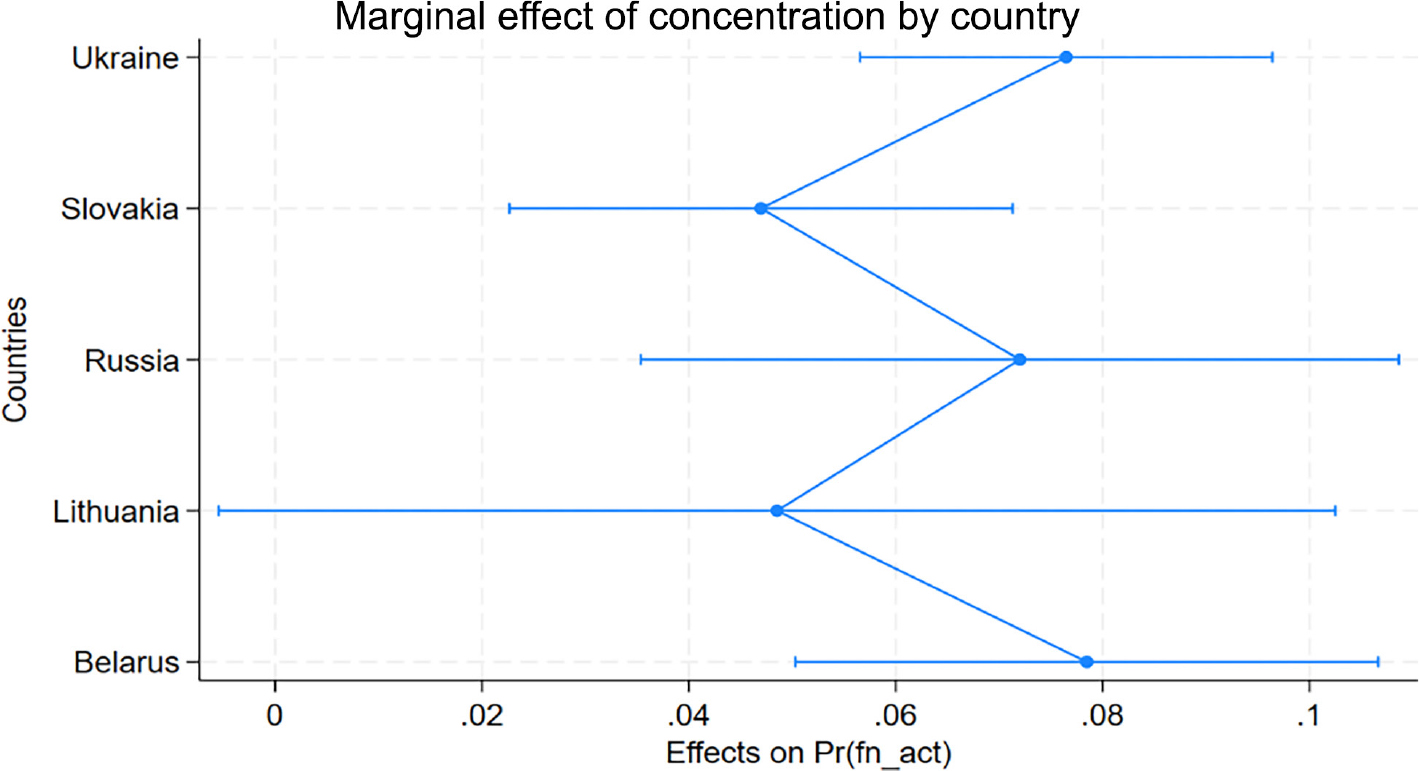
Fig. 2.
Average marginal effects of cross-border firm concentration (lm_fn_act) on the probability of market engagement (fn_act) across neighbouring countries.
These effects are almost twice as strong as in the case of Slovakia (4.7 p.p.), suggesting that local networks and knowledge spillovers play a more critical role in mitigating the risk of entering markets with higher institutional uncertainty. The statistically significant difference in the magnitude of these effects provides direct confirmation of hypothesis H3 regarding the heterogeneity of agglomeration effects depending on the specific characteristics of the neighbouring country.
Discussion and conclusions
The results of this study indicate that cross-border activity among SMEs located along Poland’s eastern border remains limited in both scope and structure, despite the geographical proximity of neighbouring markets. Although more than half of the surveyed firms declared some form of foreign activity, only 41.4% reported a direct presence in neighbouring countries. This finding is consistent with previous research showing that the EU’s external borders constitute a significant institutional barrier constraining the spatial reach and stability of CBC (Dołzbłasz, Raczyk 2024) and with broader literature on border-region fragmentation and proximity-related constraints (Krätke 1999, Cappellano, Makkonen 2020).
The structure of cross-border engagement is strongly dominated by export–import activities, while more advanced forms of internationalisation, such as investments, joint ventures or licensing, remain marginal. This reflects a predominantly transactional model of cross-border relations, in which firms operate at a relatively low level of integration with foreign markets. Such a pattern confirms earlier findings that SMEs, particularly in peripheral and border regions, tend to remain within the initial stages of internationalisation due to structural, institutional and informational constraints (Piercy 1981, Welch, Luostarinen 1988, Oviatt, McDougall 2005, Michna, Kmieciak 2016, Wach 2021, Raczyk, Dołzbłasz 2022, Urban et al. 2023, Virglerova et al. 2025).
From a theoretical perspective, the findings are consistent with the assumptions of the Uppsala model (Johanson, Vahlne 2009), highlighting the role of knowledge and experiential learning in shaping internationalisation processes. This interpretation is also consistent with broader strands of literature on SME internationalisation, emphasising the role of innovation capabilities, cooperation networks and institutional conditions (Calof, Beamish 1995, Jones et al. 2011, Koprivnjak, Popovič 2024). It can also be interpreted in relation to frameworks emphasising cross-country differences, such as the CAGE model, which highlights the role of cultural, administrative, geographical and economic distance in shaping internationalisation decisions. At the same time, location and competitiveness approaches emphasise that firms’ international engagement is embedded in place-specific advantages and institutional environments (Dunning 1998, Yeung 2002).
The empirical analysis identifies two key determinants of cross-border engagement: (1) a high level of knowledge about the neighbouring market and (2) the spatial concentration of firms already active in that market. While these determinants are well established in the literature, the results provide new empirical evidence on how their effects vary across different institutional and spatial contexts of external EU borders. Importantly, the study goes beyond existing research by demonstrating how the interplay between knowledge-based and spatial factors shapes cross-border engagement in highly heterogeneous and geopolitically sensitive border regions. The first factor reduces uncertainty and facilitates adaptation to local conditions (Ibeh, Kasema 2011, Nguyen et al. 2013, Martin et al. 2022, Stoian 2024), while the second reflects localised knowledge spillovers and agglomeration effects (Aitken et al. 1997, Tallman et al. 2004, Alcácer, Chung 2007, Fernhaber et al. 2009). These findings confirm that SMEs’ internationalisation decisions are shaped by a combination of experiential, relational and context-specific knowledge.
The logit estimations provide strong support for the proposed hypotheses, indicating that both subjective market knowledge (H1) and local concentration of internationally active firms (H2) significantly increase the probability of cross-border engagement. At the same time, the marginal effects analysis shows that these relationships are spatially differentiated. The impact of local agglomeration varies depending on the neighbouring market, with stronger effects observed for Ukraine and Belarus compared to Slovakia. This finding also supports H3, confirming that the effect of local cross-border firm concentration is context-dependent and varies across neighbouring markets. This confirms that the determinants of cross-border engagement are not uniform across border segments and should be analysed in a differentiated regional context. It also suggests that knowledge spillovers play a particularly important role in environments characterised by higher institutional distance and uncertainty, which is consistent with the literature on learning externalities and regional embeddedness (Saxenian 1994, Aitken et al. 1997, Smallbone, Welter 2012, Storper 2013, Bai et al. 2024). More broadly, these results underline that internationalisation processes in border regions are strongly conditioned by spatial embeddedness and institutional context.
The findings further indicate that cross-border activity in the EU’s eastern borderlands is structurally heterogeneous and cannot be adequately interpreted using a uniform regional framework. Differences in the intensity and forms of internationalisation reflect variations in institutional accessibility, geopolitical conditions, regulatory environments and border permeability. This supports the argument that border regions should be analysed as internally heterogeneous systems, where local context plays a decisive role in shaping firms’ behaviour (Boschma 2005, Cappellano, Makkonen 2020, Korhonen et al. 2021).
From a methodological perspective, the study contributes by integrating survey data with spatial (GIS-based) and sectoral (Pavitt classification) dimensions, enabling a multidimensional analysis of both firm-level and territorial determinants. In particular, the inclusion of interaction effects between local firm concentration and institutional barriers extends existing approaches to SME internationalisation by explicitly incorporating the spatial-institutional dimension. This study, therefore, contributes to the literature by integrating firm-level determinants with spatial and institutional contexts, offering a more comprehensive explanation of cross-border SME activity in external EU border regions.
The results also have important implications for regional development and spatial policy. They suggest that support for SMEs in border regions should be more targeted, place-based and sensitive to local conditions. In particular, policy interventions should aim to reduce information deficits related to neighbouring markets (e.g., through advisory services, cross-border market intelligence platforms and training modules) and to strengthen local knowledge spillovers (e.g., through mentoring schemes, business networks and cluster initiatives) (Interreg Europe Policy Learning Platform 2021, Pámer et al. 2024). More specifically, the results indicate that policy support should be differentiated spatially. In municipalities characterised by a low concentration of firms engaged in cross-border activity, the absence of local spillover effects constitutes a significant barrier to market entry. In such cases, targeted instruments aimed at initiating first-mover activity (e.g., pilot cross-border partnerships, supported entry programmes) may be particularly effective, particularly for SMEs facing barriers to foreign expansion in peripheral regions (Puchalska et al. 2025, Virglerova et al. 2025).
Furthermore, given that the impact of agglomeration effects is stronger in relation to institutionally more distant markets (such as Ukraine and Belarus), support instruments should be tailored to the specific characteristics of neighbouring countries and explicitly address market-specific institutional barriers. These implications can be interpreted within both the Uppsala framework and the CAGE perspective, highlighting the importance of reducing cultural, administrative, geographical and economic distance between markets. Beyond its regional context, the findings provide insights that may be applicable to other external border regions characterised by institutional asymmetries and geopolitical uncertainty. In particular, the results highlight the importance of spatially embedded knowledge and local interaction mechanisms as critical drivers of internationalisation under constrained conditions (Kumari et al. 2025, Mammadov, Wald 2025, Sinani, Zilja 2025).
At the same time, the results should be interpreted in the context of ongoing geopolitical transformations. The EU’s eastern border is characterised by institutional asymmetries and political instability, which have been intensified by recent developments such as the war in Ukraine, sanctions imposed on Russia and Belarus, and tightening border regimes. These factors significantly affect market accessibility, increase uncertainty and reduce the predictability of cross-border interactions, reinforcing the importance of external context in shaping spatial economic processes (Bock-Schappelwein, Huber 2022, Białowąs et al. 2024, Sinani, Zilja 2025).
Despite its contributions, the study has several limitations. The data were collected in 2019 and do not capture the effects of recent geopolitical changes. In addition, the lack of detailed firm-level financial data limited the inclusion of variables such as productivity, profitability, ownership structure and firm age. Furthermore, the analysis focuses on the extensive margin of internationalisation and does not account for its intensity or duration. These limitations should be taken into account when interpreting the generalisability of the findings. In addition, the structure of the dataset did not allow for fully separate estimations for each neighbouring market, which would further deepen the analysis of regional differentiation. Nevertheless, the observed differences across neighbouring markets provide an important indication that future studies should further examine country-specific mechanisms of cross-border engagement.
Future research should address these limitations by incorporating more recent data and adopting a dynamic perspective. In particular, further studies could examine the impact of geopolitical shocks on cross-border activity, the role of digitalisation in reducing spatial barriers, and comparative analyses across different types of borders (e.g. EU vs. non-EU, Schengen vs. non-Schengen). Additionally, further research on business networks and their spatial embeddedness may provide deeper insights into the sustainability and depth of internationalisation processes. In this regard, future studies should also consider digitalisation, Industry 4.0 readiness and cross-border e-commerce as potential mechanisms changing the spatial logic of SME internationalisation (Bargoni et al. 2024, Śledziewska, Włoch 2024, Zhu 2026).
Acknowledgements
We would like to thank the reviewers for their valuable comments.
Notes
[7] Contributed by Authors’ contributions
IZ: conceptualisation, investigation, methodology, data curation, data acquisition, validation, writing – original draft, writing – review and editing, supervision, project administration; JMN: conceptualisation, investigation, methodology, data curation, validation, visualisation, writing – original draft, writing – review and editing, software, supervision; MW: writing – original draft, writing – review and editing; JZ-S: writing – original draft, writing – review and editing.