
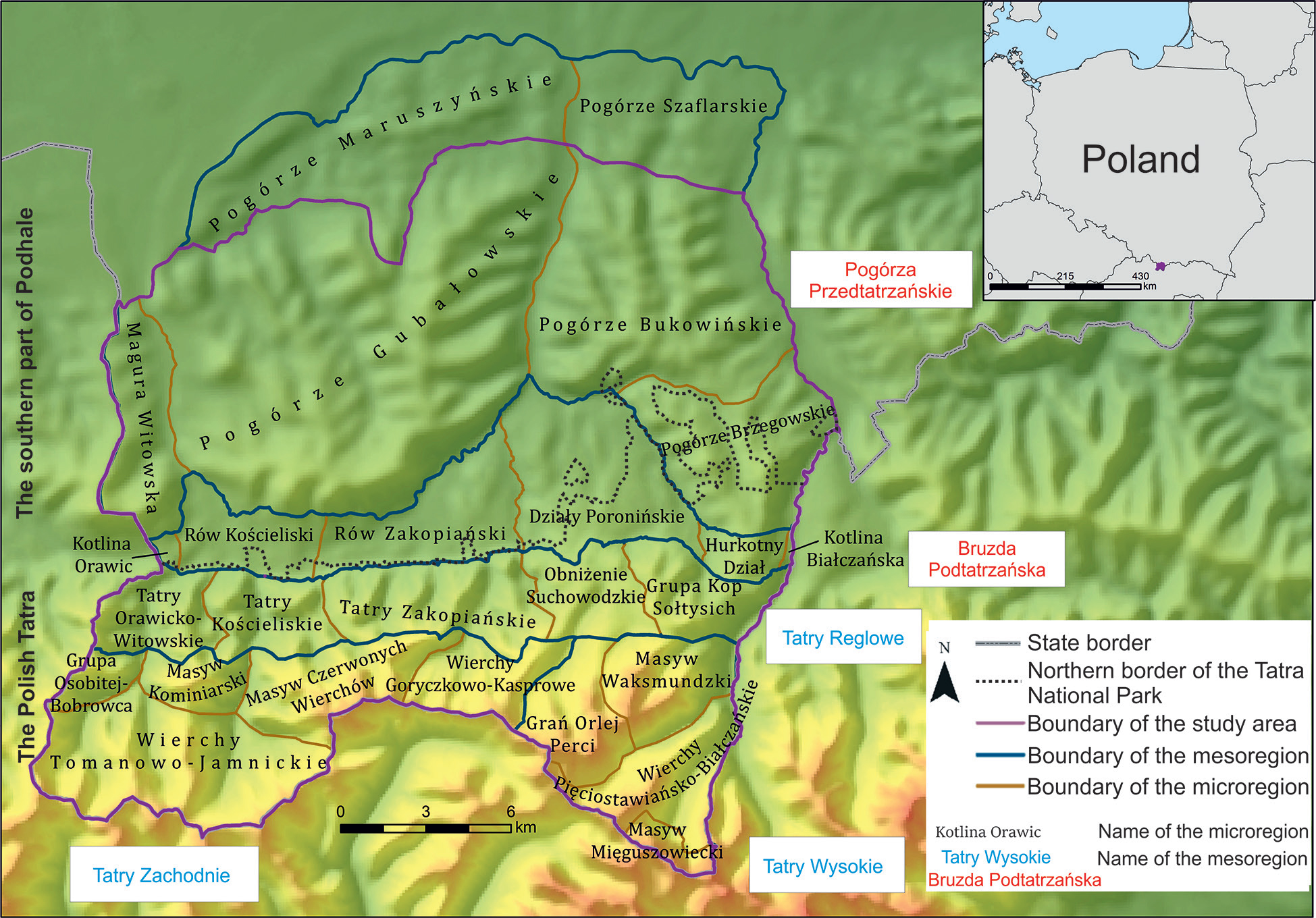
Fig. 1.
Physical–geographical division of the study area (Balon et al. 2015, Krąż, Wójcik 2015, Jodłowski et al. 2021a, b) model: ASTER Global DEM (n.d.)*. In the study, the names of lower-level physiogeographic units (microregions and mesoregions) are provided in Polish. The names commonly known and used in the international literature (Carpathians, Tatra Mountains) are written in English. * ASTER Global DEM is a product of METI and NASA.
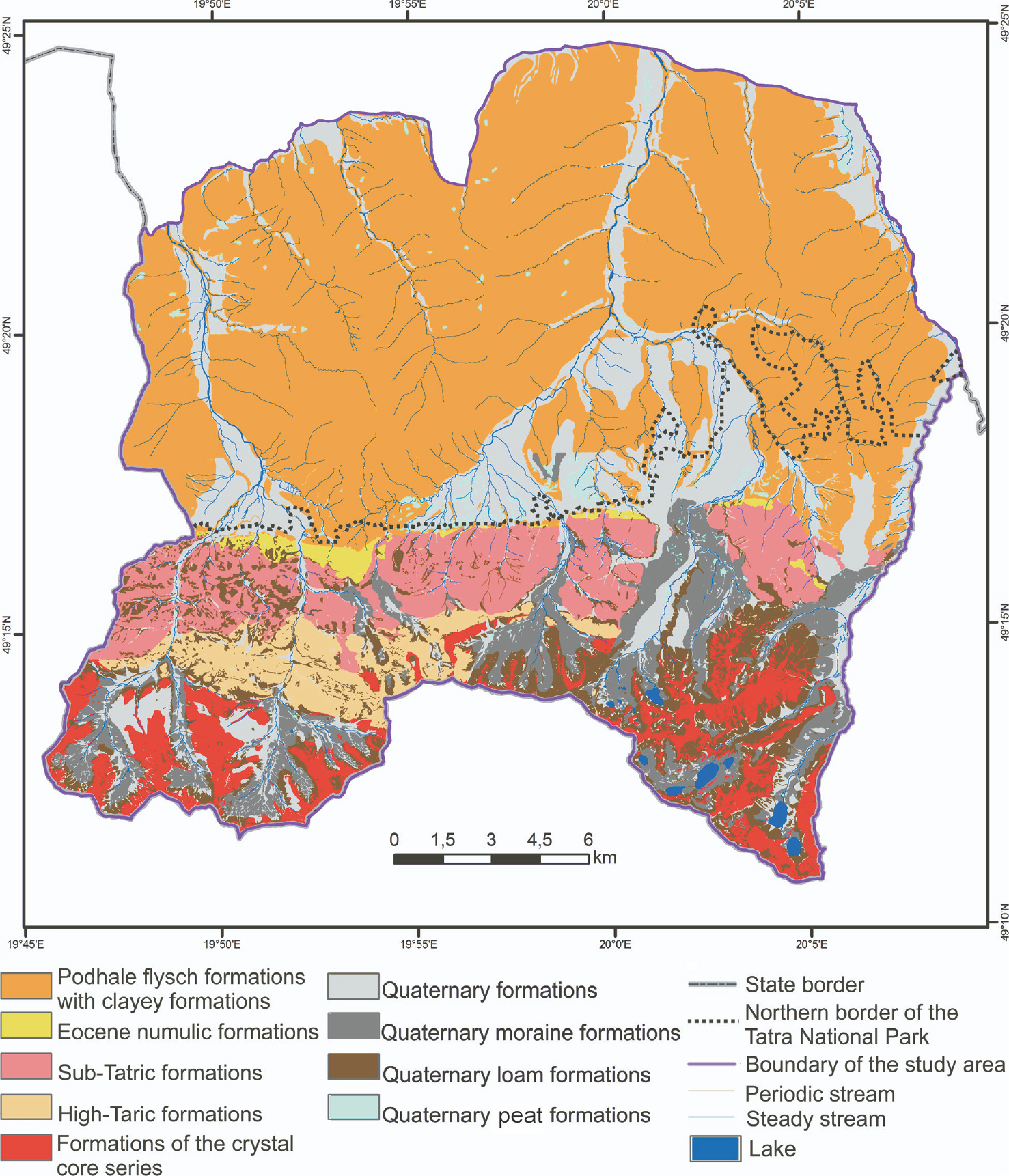
Fig. 2.
Geological structure of the study area based on Guzik, Guzik (1958), Guzik et al. (1958, 1959, 1975), Michalik (1958), Guzik (1959a, b), Michalik, Guzik (1959a, b), Detailed Geological Map of Poland (1975, 1976), Guzik, Jaczynowska (1978), Bac-Moszaszwili et al. (1979), Sokolowski, Jaczynowska (1979a, b, 1980), Jaczynowska (1980) and Małecka (1982).
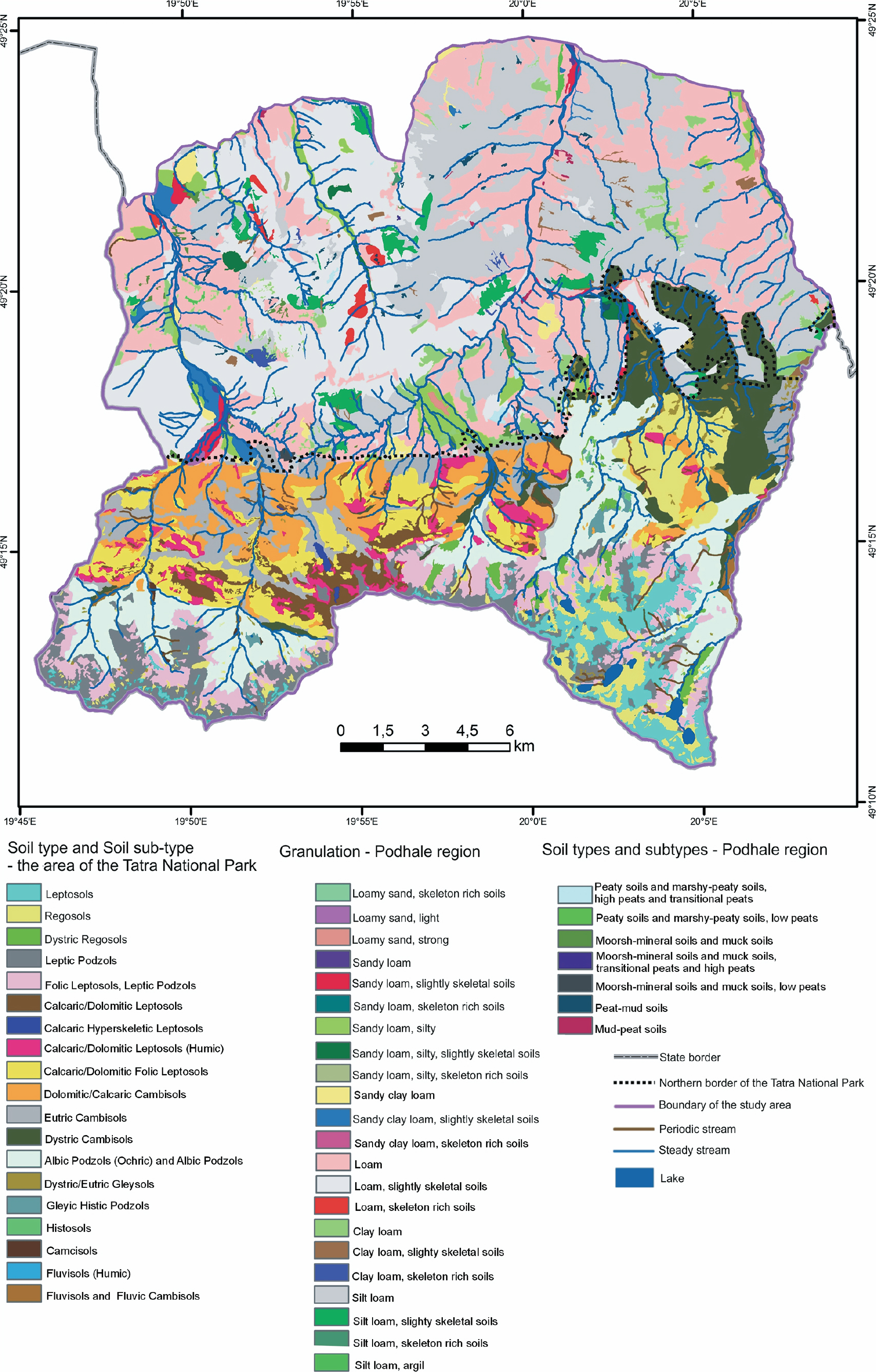
Fig. 3.
Soil cover of the study area based on Soil and Agricultural Map (1963–1980) and Skiba (2002); classification of soil types based on the IUSS Working Group WRB (2022).
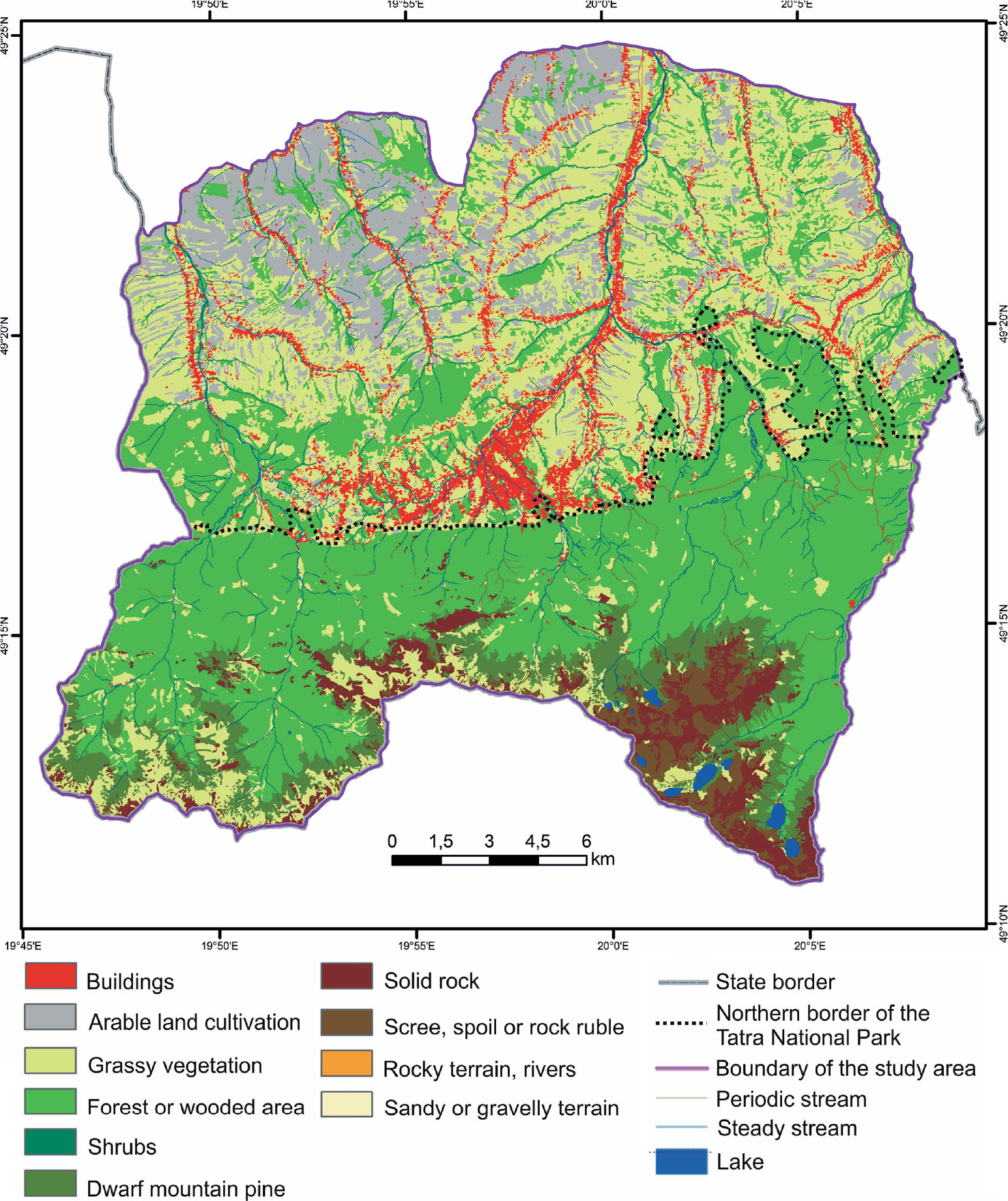
Fig. 4.
Land cover of the study area based on Regulation of the Minister of Internal Affairs and Administration of 17 November 2011 on the database of topographic objects and the database of general geographic objects, as well as standard cartographic studies (2011), Database of Topographical Objects, 1:10,000, (BDOT10k) (GUGiK 2013).
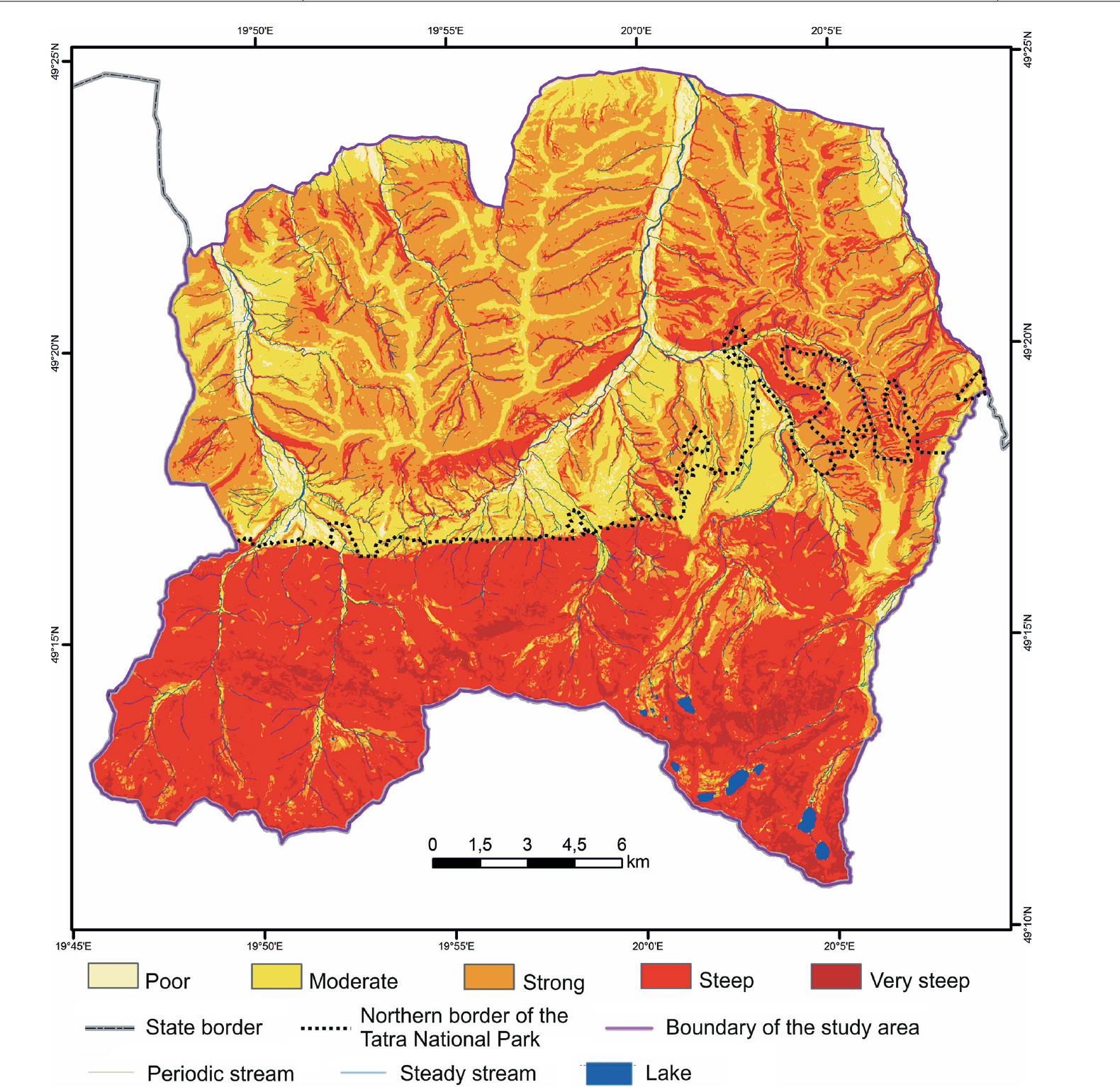
Fig. 5.
Slope gradients in the study area based on Digital Elevation Model (GUGiK 2009).
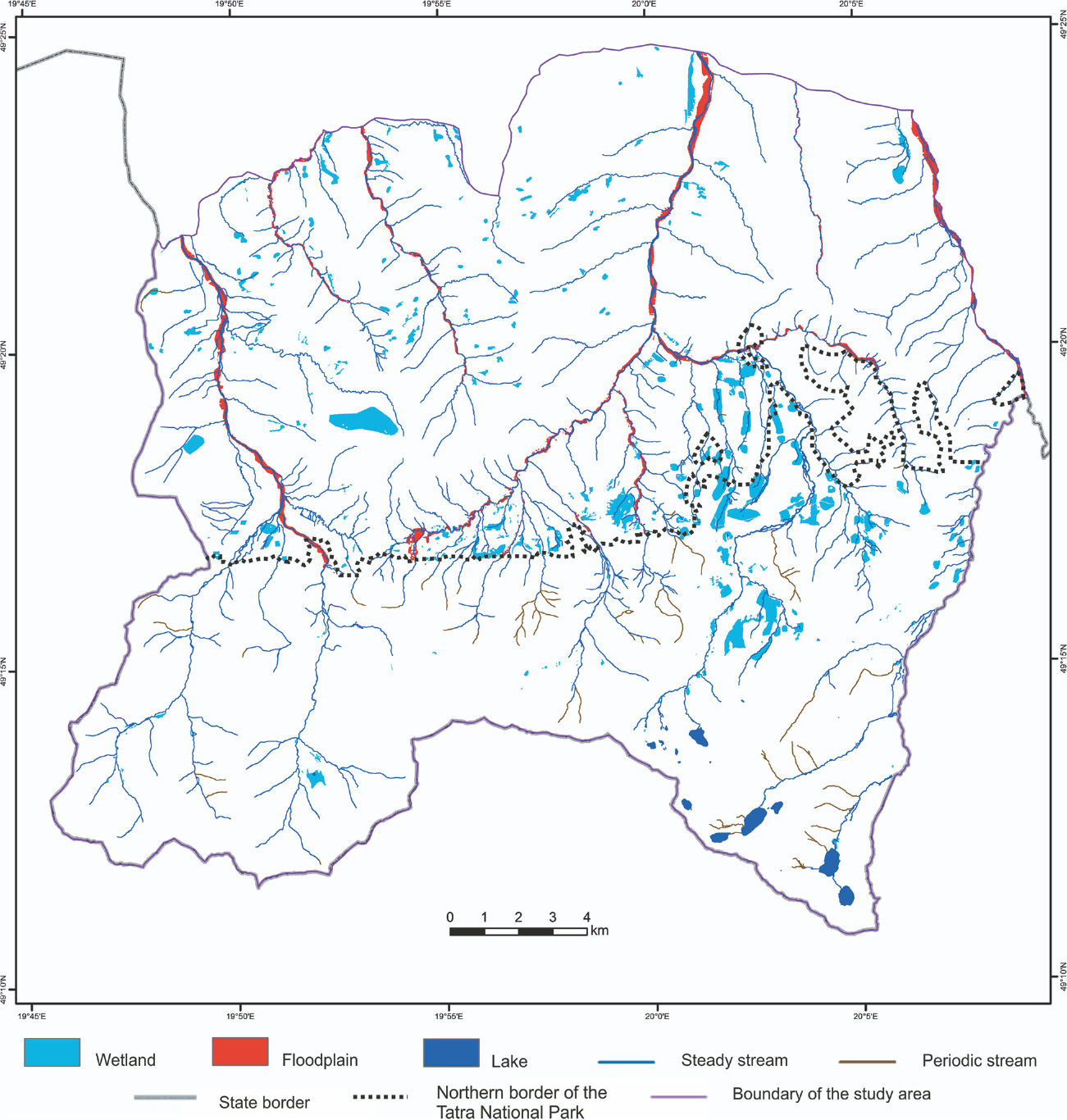
Fig. 6.
Wetlands, permanent, periodic and areas flooded in the study area based on the Hydrographic Map of Poland (2006).
Table 1.
Assessment of infiltration, surface runoff, and evapotranspiration volumes for individual elements of the natural environment (kinds of water circulation: I – infiltration, R – runoff, E – evapotranspiration).
| Elements of the natural environment/data source | Feature | Type of water circulation | ||
|---|---|---|---|---|
| A. Geological structure based on Guzik, Guzik (1958), Guzik et al. (1958, 1959, 1975), Michalik (1958), Guzik (1959a, b), Michalik, Guzik (1959a, b), Detailed Geological Map of Poland (1975, 1976), Guzik, Jaczynowska (1978), Bac-Moszaszwili et al. (1979), Sokołowski, Jaczynowska (1979a, b, 1980), Jaczynowska (1980), Małecka (1982) | Formations | I | R | E |
| Quaternary: debris, scree, rubble, pebbles, sand and gravel, fluvial, fluvial-glacial formations; Quaternary moraine formations | 5 | 1 | 1 | |
| High-Tatric, Eocene numulitic | 4 | 2 | 2 | |
| Sub-Tatric | 3 | 3 | 3 | |
| Podhale flysch, Quaternary loam: loam, loam rubble and mantle rock | 2 | 4 | 4 | |
| Crystal core series | 1 | 5 | 5 | |
| Quaternary: peat, mire, wetland | Without attribution of points, name of hydrotope type: retention marsh | |||
| B. Soil cover – types, subtypes of soils; grain size based on Soil and Agricultural Map (1963–1980) and Skiba (2002) | Regosols; Dystric Regosols; Calcaric Hyperskeletic Leptosols | 5 | 1 | 1 |
| Leptic Podzols; Folic Leptosols, Leptic Podzols; Albic Podzols (Ochric) and Albic Podzols; loamy sand, skeleton-rich soils, moors-mineral soils and muck soils, transitional peats and high peats; moorsh-mineral soils and muck soils, low peats; moorsh-mineral soils and muck soils | 4 | 2 | 2 | |
| Fluvisols (Humic); Fluvisols and Fluvic Cambisols; loamy sand; sandy loam; loam, skeleton-rich soils; sandy clay loam, skeleton-rich soils; sandy loam, silty, skeleton-rich soils; sandy loam, skeleton-rich soils | 3 | 3 | 3 | |
| Calcaric/Dolomitic Leptosols (Humic); Calcaric/Dolomitic Folic Leptosols + Calcaric/Dolomitic Leptosols (Humic); Dolomitic/Calcaric Cambisols; Dystric Cambisols, Eutric Cambisols, Cambisols; clay loam, skeleton-rich soils; silt loam, skeleton-rich soils; silt loam; silt loam, slightly skeletal soils; sandy loam, sandy loam, slightly skeletal soils; sandy loam, silty, sandy loam, silty, slightly skeletal soils; sandy clay loam; sandy clay loam, slightly skeletal soils; loam, loam, slightly skeletal soils | 2 | 4 | 4 | |
| Lithic Leptosols; Calcaric/Dolomitic Leptosols; Dystric/Eutric Gleysols; clay loam; clay loam, slightly skeletal soils; silt loam argil | 1 | 5 | 5 | |
| Peaty soils; peaty soils and marshy-peaty soils, high peats and transitional peats; peaty soils and marshy-peaty soils, low peats; peat-mud soils, mud-peat soils | Without attribution of points, name of hydrotope type: retention marsh | |||
| C. Gradient of slopes based on Digital Elevation Model (GUGiK 2009) and division of slope according to Klimaszewski (2005) | Poor | 5 | 1 | 5 |
| Moderate | 4 | 2 | 4 | |
| Strong | 3 | 3 | 3 | |
| Steep | 2 | 4 | 2 | |
| Very steep | 1 | 5 | 1 | |
| D. Land cover based on Database of Topographical Objects, 1:10,000, (BDOT10k) (GUGiK 2013) class division according to Regulation of the Minister of Internal Affairs and Administration of 17 November 2011 on the database of topographic objects and the database of general geographic objects, as well as standard cartographic studies (2011) | Buildings | Areas excluded from the analysis | ||
| Unused land: scree, spoil, rock rubble; rocky terrain – rivers; sandy or gravelly terrain | 5 | 1 | 1 | |
| Forest or wooded area, dwarf mountain pine, shrubs | 4 | 2 | 5 | |
| Arable land cultivation | 3 | 4 | 3 | |
| Grassy vegetation | 2 | 3 | 4 | |
| Unused land – solid rock | 1 | 5 | 2 | |
| Surface water: steady stream, periodic stream | Name of hydrotope type: trough retention permanent, trough retention periodic | |||
| Lake | Name of the hydrotope type: retention lake | |||
| Additional data Hydrographic Map of Poland (2006) | Wetlands (permanent, trough) | Name of the hydrotope type: retention marsh | ||
| Flooded areas | With the addition of the name of the hydrotope type – flood | |||
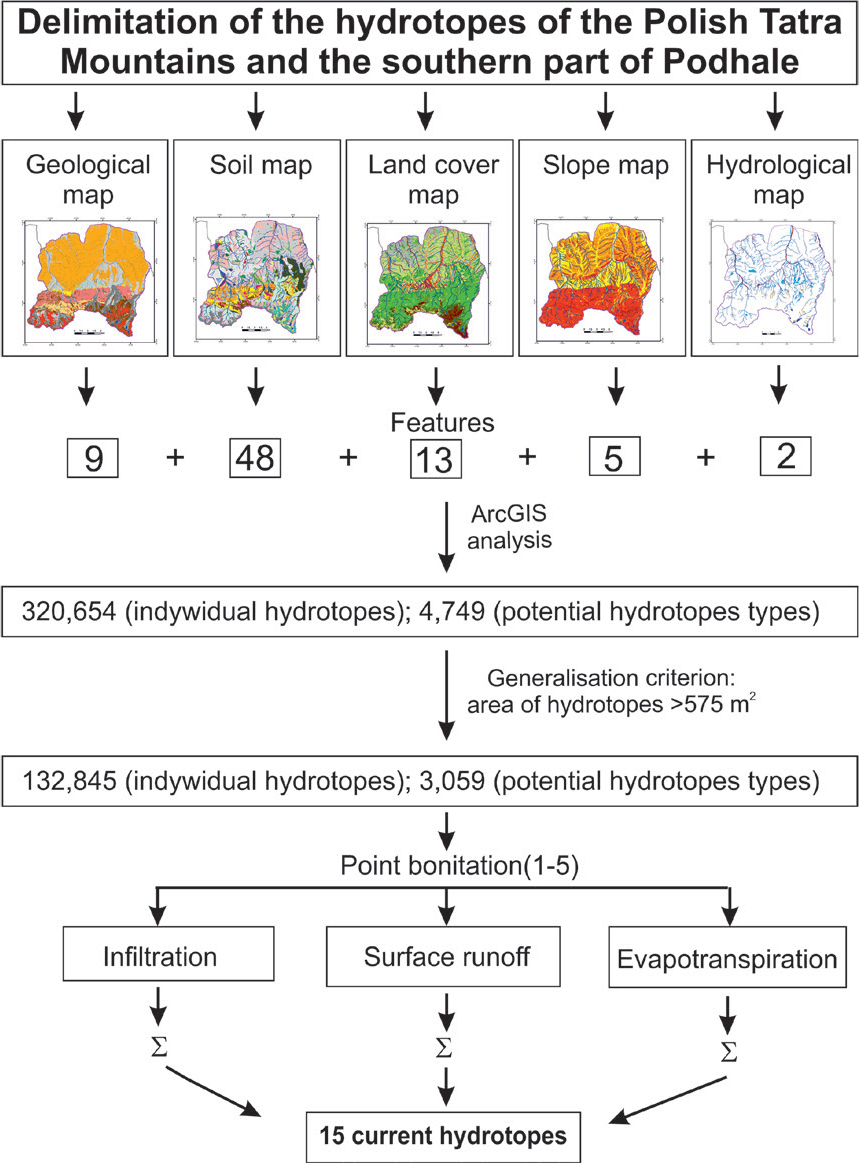
Fig. 7.
Flowchart for the delimitation of hydrotope type.
Table 2.
Number of units, area and proportion of hydrotope types in the entirety of the study area.
| No. | Type of hydrotopes | n | Area [km2] | Share [%] |
|---|---|---|---|---|
| Simple types | ||||
| 1 | Infiltration (I) | 503 | 92.57 | 20.1 |
| 2 | Infiltration flood (If) | 101 | 2.03 | 0.4 |
| 3 | Runoff (R) | 356 | 86.13 | 18.7 |
| 4 | Runoff flood (Rf) | 62 | 0.30 | 0.1 |
| 5 | Evapotranspiration (E) | 562 | 239.71 | 52.0 |
| 6 | Evapotranspiration flood (Ef) | 169 | 2.10 | 0.4 |
| 7 | Retention marsh (RM) | 450 | 12.88 | 2.8 |
| 8 | Retention lake (RL) | 39 | 1.48 | 0.3 |
| 9 | Trough retention permanent (TRperm) | 511 | 5.69 | 1.2 |
| 10 | Trough retention periodic (TRperio) | 148 | 0.27 | 0.1 |
| Composite types | ||||
| 11 | Infiltration-runoff (I-R) | 29 | 0.79 | 0.200 |
| 12 | Infiltration-runoff flood (I-Rf) | 5 | 0.04 | 0.010 |
| 13 | Infiltration-evaporanspiration (I-E) | 87 | 16.26 | 3.500 |
| 14 | Infiltration-evapotranspiration flood (I-Ef) | 35 | 0.91 | 0.200 |
| 15 | Runoff-evapotranspiration (R-E) | 2 | 0.01 | 0.002 |
| Total | 3059 | 461.17 | 100.00 | |
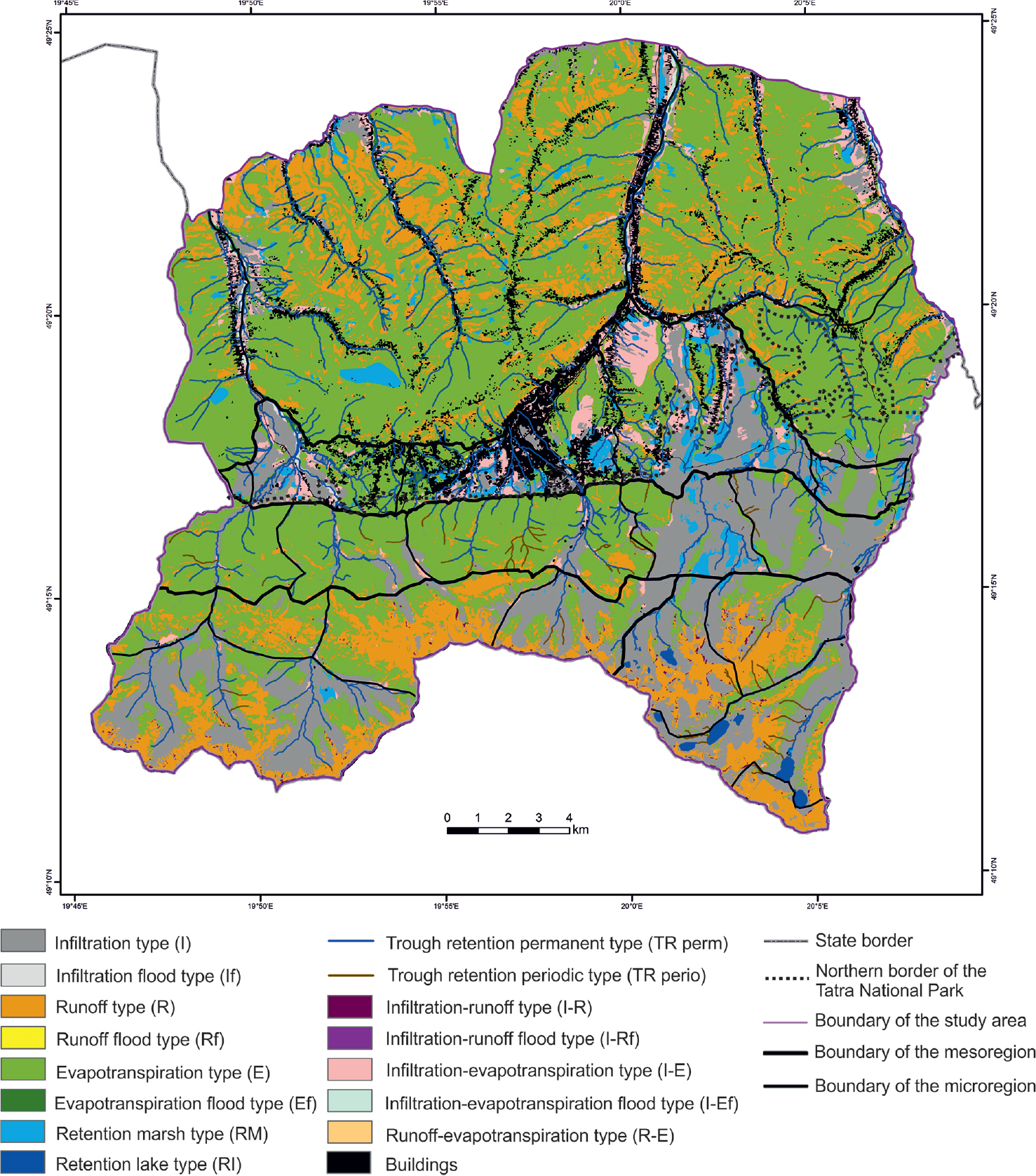
Fig. 8.
Spatial variation of hydrotope types in the study area.
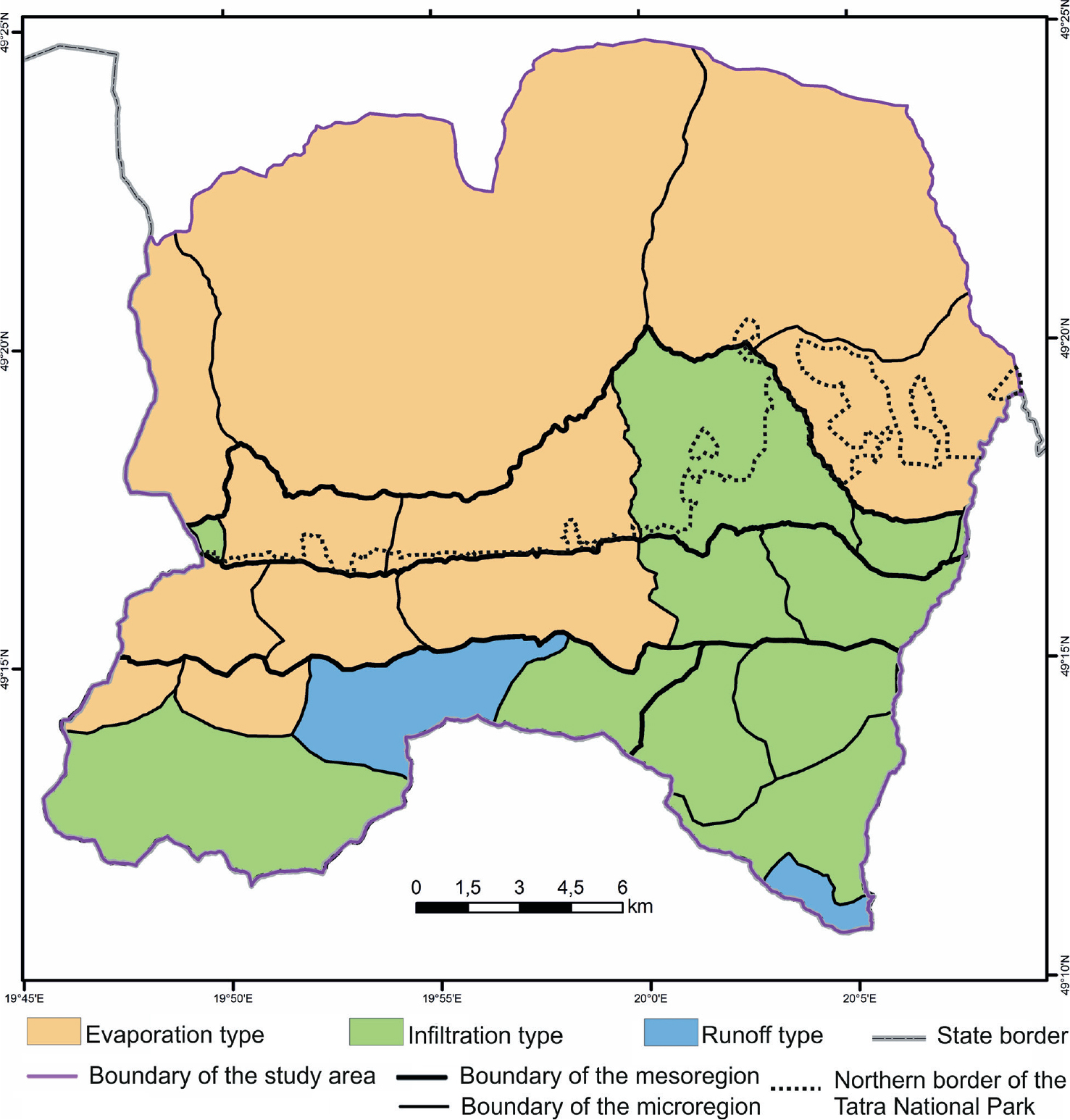
Fig. 9.
Variation in the dominance of hydrotope types in the study area.