
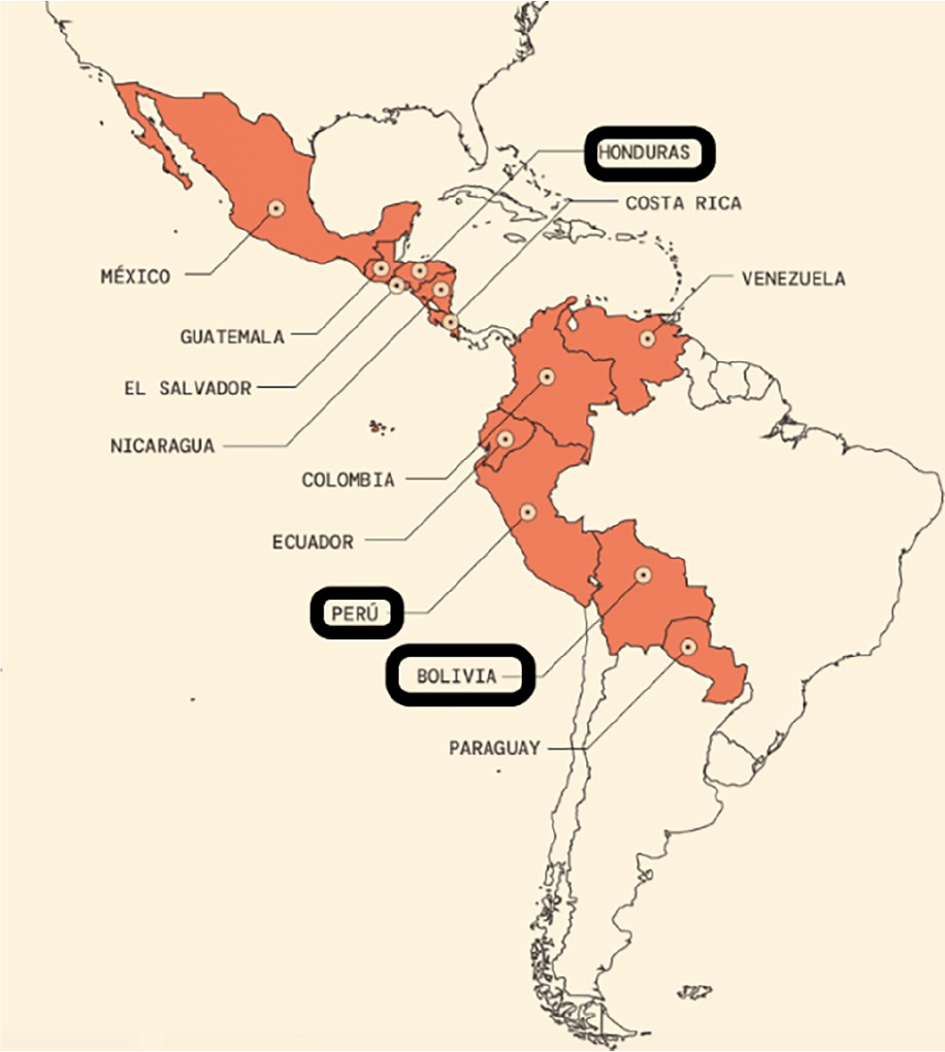
Fig. 1.
Latin American countries where Ayuda en Acción operates (in orange), based on Ayuda en Acción (Aid in Action). Frames indicate the case study locations.
Table 1.
Level of frugality of case studies.
| Cases | Characteristics developed by Frugal Innovation Lab, Santa Clara University | ||||||||||
|---|---|---|---|---|---|---|---|---|---|---|---|
| Resistant | Slight | Mobile skills | Human-centred approach | Simple | New distribution models | Adaptation | Local resources | Green technologies | Affordable | Frugality characteristics score | |
| CASE 1. Retrofitting of fishing boats with solar panels and fish preservation pools (Honduras) | × | × | × | × | × | × | × | × | × | 9/10 | |
| CASE 2. Solar electrified fences for forest conservation (Bolivia) | × | × | × | × | × | × | × | × | × | 9/10 | |
| CASE 3. Temperature control against frost in peach cultivation (Bolivia) | × | × | × | × | × | × | × | × | × | × | 10/10 |
| CASE 4. Use of solar energy for pumping in peach cultivation (Bolivia) | × | × | × | × | × | × | × | × | × | 9/10 | |
| CASE 5. Avocado crop monitoring with satellite imagery (Peru) | × | × | × | × | 4/10 | ||||||
| CASE 6. Early warning system for hydrometeorological hazards (Peru) | × | × | × | × | × | × | 6/10 | ||||
| CASE 7. Water dispensers for beekeeping (Bolivia) | × | × | × | × | × | × | × | × | × | × | 10/10 |
Table 2.
Interviews conducted and the role of interviewees.
| Frugal innovation | Location | Role of interviewee |
|---|---|---|
| CASE 1. Retrofitting of fishing boats with solar panels and fish preservation pools | Santa Fe, Colón, Honduras | Head of Innovation for NGDOs in Spain |
| Project technician in field | ||
| Innovation end-user 1 | ||
| Innovation end-user 2 | ||
| CASE 2. Solar electrified fences for forest conservation | San Pablo de Huacareta, Chuquisaca, Bolivia | Head of Innovation for NGDOs in Spain |
| Technician responsible for NGDO in Bolivia | ||
| Technician responsible for local NGO in field | ||
| Innovation end-user 1 | ||
| CASE 3. Temperature control against frost in peach cultivation | Cotagaita, Potosí, Bolivia | Head of Innovation for NGDOs in Spain |
| Technician responsible for NGDO in Bolivia | ||
| Technician responsible for NGDO for project | ||
| Technician of ACLO Foundation in Potosi (local NGO) | ||
| CASE 4. Use of solar energy for pumping in peach cultivation | Andamarca, Huayllani, and Esmeralda, San Lucas, Potosí, Bolivia | Head of Innovation for NGDOs in Spain |
| Technician responsible for NGDO in Bolivia | ||
| Technician responsible for NGDO for project | ||
| Municipal technician responsible for municipality of San Lucas, department of Potosí | ||
| CASE 5. Avocado crop monitoring with satellite imagery | San Miguel, Cajamarca, Peru | Head of Innovation for NGDOs in Spain |
| Technician responsible for NGDO in Peru | ||
| Engineer Spanish development company | ||
| Consultant/field technician/trainer | ||
| Innovation end-user 1 | ||
| CASE 6. Early warning system for hydro-meteorological hazards | Andahuaylas, Apurimac, Peru | Head of Innovation for NGDOs in Spain |
| Technician responsible for NGDO in Peru | ||
| NGDO Field Project Coordinator | ||
| Risk and disaster management specialist | ||
| CASE 7. Water dispensers for beekeeping | Villa Montes and Yacuiba, Tarija, Bolivia | Project Technician NATIVA Foundation, local NGO |
| Creator of innovation |
Table 3.
Summary of cases: challenges, innovation implemented, level of frugality, and main difficulties in implementation.
| Case | Scope | Innovation | Frugality level | Challenge in implementation |
|---|---|---|---|---|
| Case 1. Retrofitting of fishing boats with solar panels and fish preservation pools (Santa Fe, Colón, Honduras) | To make artisanal fisheries more profitable, fishermen need the catch to reach the coast in good condition. They use ice to keep fish fresh during long days, which limits fishing time to the ice’s duration. Moreover, for boat equipment (lights for night fishing, GPS, sonar, etc.), fishers use car batteries that are later discarded in the sea, causing environmental damage. | This project adopts a traditional African fishing solution in which the fish reaches the coast alive using nets hung over the side of the boat. A container with oxygenated water is inserted in each boat, using seawater circulated by a small motor. Once fish are caught, they are kept alive in the tank until reaching the coast. In addition, solar panels power both the water pump and the onboard equipment. | 9/10 | The onboard live-fish pool does not fully serve its purpose for several reasons: the type of fishing, the depth at which certain fish are caught, and the fish injuring themselves inside the pool. As one user explains, “The bottom fish arrives dead, and the fish that is not bottom fish is already bruised from struggling at the moment of capture and ends up dying in the pool.” |
| Case 2. Solar electrified fences for forest conservation (San Pablo de Huacareta, Chuquisaca, Bolivia) | The forest is an essential resource for local apiculture for two reasons: (1) it provides the necessary flora for bees; (2) it offers ample water resources for the community. The main issue was preventing large animals from entering the area and causing damage. The previous solution was to build wooden fences using timber from the forest, with posts spaced every meter and car batteries used to electrify the wires. | The new fencing design uses fewer posts than before, and solar panels have replaced the car batteries as the power source. | 9/10 | Long-term sensitisation of the local user groups is required to ensure (a) protection of the forest and (b) proper maintenance of the fence system. Field technicians noted that “there is a need to work on empowerment processes with producer organisations to ensure these communities preserve their communal norms.” Additionally, it can be challenging for users to maintain the fence properly due to a lack of training. |
| Case 3. Temperature control against frost in peach cultivation (Cotagaita, Potosí, Bolivia) | Climate change has introduced sudden frosts that significantly damage peach crops by ruining blossoms or fruit, greatly reducing yields. Before this innovation, growers used a bowl of water as an overnight frost alarm: when the water began to freeze, they would alert other farmers to take protective measures. This rudimentary system also helped technicians study which fruit tree varieties could withstand the changing conditions. | A simple device (a datalogger installed in the orchards) now provides an audible alarm when the temperature drops to the freezing point, allowing growers to take immediate action to protect the crop. | 10/10 | There is a dependence on external technicians to identify suitable crop varieties, and end-users showed limited technology uptake due to the lack of a human-centred design in the solution’s conception. Although the device is straight-forward, it does not fully meet frugal innovation (FI) criteria. A more rigorous characterisation would likely rate its frugality at no more than 70%, since it lacks simplicity, human-centred design, and the use of green technologies. |
| Case 4. Use of solar energy for pumping in peach cultivation (San Lucas, Potosí, Bolivia) | High-altitude farming areas suffer from water scarcity, requiring pumps to draw water for irrigation. Previously, farmers had only electric or gasoline pumps, which were costly and environmentally damaging. | The project introduced cost-efficient solar-powered pumps to supply water for irrigation. | 9/10 | The key challenge has been farmers’ distrust of the new system. Many are wary due to exhaustion from prior failed experiments with other pumping systems. Additionally, the variable costs they incurred when pumping water from a distant communal source to individual plots have led to poor adoption of the technology. |
| Case 5. Avocado crop monitoring with satellite imagery (San Miguel, Cajamarca, Peru) | Climate threats (insufficient irrigation, pests, etc.) often cause farmers to lose up to half of their avocado production. Traditionally, farmers would sporadically patrol their fields and apply ad-hoc remedies, which was inefficient. | The project proposed using satellite imagery to provide colour-coded information on the condition of orchards and trees, enabling early detection of issues. | 4/10 | The proposed solution assumed a level of technology access that end-users did not have. Most farmers lacked high-end smartphones or reliable internet, and many (mostly over age 45) were not inclined to adopt new digital tools. Consequently, the pool of potential users shrank from about 70 initially to just 12 in practice. |
| Case 6. Early warning system for hydro-meteorological hazards (Andahuaylas, Apurímac, Peru) | The target communities live along riverbanks in areas prone to flash floods and overflow. Frequent torrential events have caused infrastructure damage and even mass casualties. Previously, no system was in place to warn residents of impending flooding or debris flows. | The project focused on community preparedness by installing loudspeakers in local community centres to broadcast warnings of imminent hazards (essentially serving as a local alarm and community radio system), combined with awareness campaigns and basic training. | 6/10 | The primary challenge was achieving community buy-in for the new technology. While the loudspeaker network functioned as intended, users perceived it as a downgrade compared to more modern solutions (e.g. mobile apps). This perception hindered enthusiasm, and in some cases the community turned to customising other off-the-shelf solutions instead of fully embracing the loudspeaker system. |
| Case 7. Water dispensers for beekeeping (Villa Montes and Yacuiba, Tarija, Bolivia) | In arid climates, low humidity, high temperatures, and scarce fresh water lead to bee mortality and hive abandonment. The project area is an arid zone where communities rely on beekeeping for their livelihood. (By contrast, in more temperate climates, beekeepers provide supplemental feeding to encourage hive growth and prevent bee migration.) | The innovation introduced a black cylinder device that absorbs solar energy to pump pressurised liquid into water dispensers. These dispensers can harvest rainwater and supply water to the bees during periods of extreme heat. | 10/10 | This solution faces cost and distribution challenges, as it was adapted from a recent experiment in another country. Additionally, it requires specialised technicians for operation, given that it is a more advanced system compared to a basic frugal alternative. |
Table 4.
Sources of data.
| Source of data | Description |
|---|---|
| Interviews | one-to-one, semi-structured, in-depth interviews with various actors focusing on the challenges encountered at different implementation phases, perceived positive aspects, and citizen involvement in innovation |
| Technical proposals for innovations | technical specification documents of each of innovations |
| Ex-durante reports | documentation produced by local NGOs or AeA on development over specific periods |
| Ex-post reports | final project implementation documentation with main results and project conclusions |
Table 5.
Projects, frugality scores, and typology of challenges.
| Project | Frugality score | Technical | Environmental or topographical-specific | End-user or technician skills or competency | Mismatch of expectations | Communication | Other challenges |
|---|---|---|---|---|---|---|---|
| CASE 1. Retrofitting of fishing boats with solar panels and fish preservation pools | 9/10 | Yes | Yes | Yes | |||
| CASE 2. Solar electrified fences for forest conservation | 9/10 | Yes | |||||
| CASE 3. Temperature control against frost in peach cultivation | 10/10 | Yes | Yes | Yes | Yes | ||
| CASE 4. Use of solar energy for pumping in peach cultivation | 9/10 | Yes | Yes | Yes | |||
| CASE 5. Avocado crop monitoring with satellite imagery | 4/10 | Yes | Yes | Yes | Yes | Yes | Yes |
| CASE 6. Early warning system for hydro-meteorological hazards | 7/10 | Yes | Yes | Yes | Yes | Yes | |
| CASE 7. Bee drinkers | 10/10 | Yes | Yes | Yes |