
Introduction
Innovation is a cornerstone for fostering economic growth and socio-economic development. The economist Joseph Schumpeter defined innovation as the “carrying out of new combinations” within a process of creative destruction, assuming abundant resources and advanced markets as prerequisites for innovation and development. However, these conditions are often absent in the Global South. For several decades, multilateral organisations such as the United Nations Development Programme, World Bank, United Nations Industrial Development Organization, and International Labour Organization, alongside numerous non-governmental development organisations (NGDOs), have prioritised innovation policies and technology transfers to support development in these regions. These efforts have concurrently yielded significant insights into the challenges of adapting technologies developed in the Global North to the distinct conditions of countries in the Global South. In the past two decades, the concept of frugal innovation has emerged as a possible game-changer to facilitate technological transfer. Frugal innovation is characterised by its orientation towards inclusive and sustainable development and its conception under resource constraints. Numerous authors have differentiated frugal innovation from other innovation models (Bhatti, Ventresca 2013, Rao 2013, Tiwari, Kalogerakis 2016, Fahrudi 2020, Opola et al. 2021) and have presented it as a promising pathway to address the innovation divide between the Global North and South. We use a socio-technical perspective to explain how organisational routines, infrastructures, and actor networks shape the uptake of resource-constrained solutions in NGOs (Williams 2013).
Frugal innovation is characterised as resource-scarce solutions developed and implemented under various constraints—fínancial, technological, or material—that sufficiently address the needs of underserved customers who would otherwise be unable to afford existing products and services (Hossain 2018). Its emergence in resource-constrained contexts has garnered significant attention from NGDOs, which aim to enhance social development and quality of life within their target communities (Fowler 2000). NGDOs highly value the involvement of local communities and emphasise respect for their indigenous knowledge and culture (Gaye, Diallo 1997). Consequently, the core tenets of frugal innovation resonate closely with their operational philosophies. For instance, Ayúdame3D, a Spanish non-governmental organisation (NGO), leverages 3D printing to produce affordable prostheses and other assistive devices across 55 countries, simultaneously fostering local capacity and infrastructure development within the Global South (Ayúdame3D, n.d.).
Frugal innovation appeared to offer a promising solution for mitigating the challenges associated with technology transfer to the Global South, but NGDOs are progressively realising that its implementation can introduce new complexities. It addresses some of the limitations of conventional technologies, while it introduces or perpetuates challenges not typically anticipated from technologies designed under the principles of simplicity, affordability, accessibility, and contextual appropriateness.
This study seeks to understand the tension between the narrative of frugal innovation that has attracted many NGDOs to experiment with it and the challenges of technology dissemination they have observed in the field. The research was guided by two main questions: (1) What challenges do NGDOs encounter when implementing frugal innovations? and (2) Why do these arise in disseminating frugal innovations to developing-country contexts?
Focusing specifically on cases involving Spanish NGDOs, our findings have corroborated that frugal innovation indeed introduces hurdles that are distinct from those encountered with more established technologies. It is important to note that this study did not examine the internal or organisational characteristics of NGDOs, such as their structure or culture. Instead, the research concentrated solely on the field implementation of frugal innovations.
The following sections discuss the theoretical framework – including the notion of frugality, innovation diffusion, and links to sustainability – and the relationship between frugal innovation and NGDO development cooperation projects. The manuscript is structured with a clear methodology section, followed by the presentation and analysis of data, and concludes with implications for practice and further research.
Frugal innovation and development
Concept of frugality in innovation
Frugality as a guiding concept has deep intellectual roots and multiple facets. The term frugal literally means sparing, economical, simple, or thrifty, and it has been discussed by thinkers from Cicero to Adam Smith in the context of prudent use of resources (Jain, Bhaduri 2021). Recent scholarship calls for the integration of a frugality lens throughout the innovation process, emphasising a more human-centred and context-specific approach to technological innovation, as opposed to narrow, criteria-driven definitions. In practical terms, embracing frugality means focusing on what is useful in the actual environment and leveraging local knowledge, intuition, and iterative learning to solve problems. Bhaduri et al. (2018) argue that using a ‘frugality lens’ in policymaking highlights the importance of diagnosing local institutions and appreciating bottom-up solutions. This perspective aligns closely with the aims of development practitioners: it legitimises cross-sectoral, context-specific approaches that value incremental change and the knowledge of end-users on the ground. Frugal innovation, in essence, is not only about low-cost products but also about a process or mindset of innovating under constraints to achieve more inclusive outcomes.
For NGDOs, frugal innovation presents new opportunities to improve the quality of life of marginalised people while operating under tight budgets and infrastructure limitations. Frugal innovation adapts or repurposes low-profile technology because more advanced technologies are often not accessible or affordable to all (Bhatti 2012). As agents of international development cooperation, NGDOs focus on developing countries and are usually more concerned with the effectiveness and results of projects than with high-tech sophistication or aesthetic design. Projects are based on the actual needs of communities and people in developing countries where they are implemented, which means NGDOs must involve community interests and benefits in all project phases. This orientation has become stronger over time. In the past, Spanish development aid was sometimes shrouded in a halo of romanticism and charity; however, since the First Master Plan for Spanish Cooperation (aligned with OECD policies), frameworks have treated development as a professional field focused on effective aid management. This shift, evident since the early 2000s, moved the discourse from talking about ‘aid beneficiaries’ to ‘rightful citizens’, emphasising that citizen participation and community-expressed needs must be prioritised by NGDOs (Meyer 2007: 3; in this article, beneficiaries, citizens, communities and end users are used interchangeably for people meant to benefit from the projects.). At the same time, the Master Plan for Spanish Cooperation determines how organisations experiment, scale, and institutionalise innovative practices (Fuertes-Fuertes, Maset-Llaudes 2007).
These principles of NGDOs align well with the main characteristics of frugal innovation. Basu et al. (2013) differentiate frugal innovation from conventional innovation across four key aspects: first, the underlying motivation for development, which prioritises addressing essential needs over ‘nice-to-have’ features; second, the creation process, where frugal innovation often employs bottom-up, co-creative methodologies, contrasting with the predominantly top-down approach of conventional innovation; third, the central value proposition, which emphasises core functionality and utility rather than the design sophistication or luxury features valued in conventional innovation; and finally, the target environment, focusing on emerging or developing markets and resource-poor settings, as opposed to the globally undifferentiated approach of mainstream innovation. Furthermore, through a comprehensive literature review and expert interviews, Weyrauch and Herstatt (2017) identified three core criteria for recognising frugal innovations: substantial cost reduction, a focus on core functionality, and optimised performance levels. Basu et al. (2013) also enumerate several characteristics frequently exhibited by frugal solutions, as developed by the Frugal Innovation Lab at Santa Clara University. These include robustness, lightweight structure, the use of mobile or portable tools, human-centred design, simplification of features, novel distribution models, adaptation to local context, utilisation of local resources, environmentally friendly (green) technology, and affordability. These characteristics collectively provide a practical checklist for guiding frugal ideation and serve as a reference point in this study for evaluating projects.
Frugal innovation is increasingly being recognised for its alignment with broader sustainability agendas. Many frugal solutions inherently support climate change mitigation and circular economy strategies through their emphasis on resource efficiency and waste minimisation. For instance, frugal innovation promotes extending the lifespan of existing technologies or repurposing materials, leading to significant economic and environmental benefits without requiring major technological breakthroughs. Practically, this could involve utilising renewable energy or recycled materials to address problems at a reduced cost. Consequently, frugal innovation can foster climate resilience in low-income communities – for example, through affordable solar devices or water-saving techniques – and advance circular economy principles by achieving more with fewer resources. The intrinsic frugality in innovation resonates with inclusive, climate-conscious, and circular economy-oriented development, leveraging simplicity and context-specific design to achieve both sustainability and equity.
However, frugal innovations do not automatically guarantee positive outcomes; they can entail new risks or trade-offs. While the majority of studies on frugal innovation highlight its potential in emerging market contexts, some have documented its adverse effects within these same environments (Pansera 2018). For example, Meagher (2018) argued that ostensibly frugal solutions can impose additional financial burdens on already constrained household budgets. McMurray et al. (2019) illustrate that in the pursuit of resource-saving efforts for more affordable solutions, some innovations have compromised quality or safety, thereby exposing users to risk, exacerbating poor labour conditions, or undermining environmental sustainability. Furthermore, Pansera and Martinez (2017) observe that companies seeking new markets occasionally introduce ‘frugal’ innovations in the developing world that subtly transform pre-existing social practices by employing compelling narratives to legitimise these changes and present them as inevitable. In essence, frugal innovations can have complex social impacts, potentially resolving certain problems while concurrently generating new challenges or shifting burdens to users. Nevertheless, critical perspectives predominantly focus on the social effects of frugal innovations on households and users, without yet extensively examining the implementation mechanisms of these innovations.
Spatial diffusion theory and innovation
Classic diffusion theory addresses how innovations spread across space and time. In his seminal work, Diffusion of Innovations, Rogers (1962) defined diffusion as the process by which an innovation is communicated through specific channels over time among members of a social system. Rogers identified five adopter categories – innovators, early adopters, early majority, late majority, and laggards – to distinguish the varying speeds at which different groups embrace new ideas. While Rogers’ framework largely originated from studies in agriculture and consumer markets, its relevance to development interventions is profound: it highlights that communities and regions adopt innovations at different paces, and certain local ‘champions’ can spur adoption. We position frugal innovation within broader debates on sustainable and inclusive innovation, noting complementarities and tensions between the two trajectories (Le Bas 2017).
Complementing Rogers’ framework, geographer Torsten Hägerstrand’s theory of spatial diffusion explicitly incorporates geography and its importance. Hägerstrand (1967) demonstrated that innovations disseminated through a combination of contagious diffusion – spreading to nearby locations via direct contact – and hierarchical diffusion – spreading from central or highly connected nodes to other nodes, often bypassing intermediate areas. In development contexts, contagious diffusion might manifest when neighbouring communities emulate a successful project, while hierarchical diffusion could occur when a central actor, such as a government agency or an international NGO, replicates an innovation across multiple geographically dispersed sites without requiring gradual outward percolation. Rural communities in remote regions, for instance, may experience slower contagious diffusion due to greater isolation, whereas more connected regions might observe faster peer-to-peer dissemination. By integrating insights from both Rogers and Hägerstrand, our analysis approaches these cases with a geographical perspective, considering factors such as distance, communication networks, and the role of local pioneers in shaping the trajectory of frugal innovations.
Extending the analytical framework: Integrating Rogers’ diffusion of innovations
In our case studies, while spatial factors undoubtedly influenced diffusion patterns, the adoption of frugal innovations was also significantly shaped by local stakeholders’ perceptions of their own characteristics. To complement the geographic perspective, this section draws on Rogers’ (2003) Diffusion of Innovations theory to enhance our understanding of adoption dynamics in frugal innovation projects. Evidence from low-resource agricultural settings shows how frugal solutions can align with sustainability goals when embedded in local practices and capabilities (Levänen et al. 2016).
Rogers identified five key attributes that influence the adoption of an innovation: relative advantage, compatibility, complexity, trialability, and observability. These characteristics offer additional explanatory power in understanding why certain innovations are embraced or resisted within specific social systems. Relative advantage refers to the degree to which an innovation is perceived as superior to the idea it supersedes. Compatibility assesses its alignment with existing values, experiences, and needs. Complexity pertains to how difficult the innovation is to understand or use. Trialability relates to the extent to which an innovation can be tested on a limited basis and observability refers to the visibility of its results to others. In the cases analysed, these attributes were examined alongside frugality criteria to interpret variations in adoption across different contexts.
Methodology and research design
This research employs a qualitative methodology to understand the dynamics underpinning social processes. The primary objective is to explore the challenges and enabling factors encountered during the implementation of frugal innovation projects by a Spanish NGDO in Latin America. The research design is inherently exploratory, aligning with questions focused on understanding the conditions that contribute to the success or failure of frugal innovations in real-world development cooperation settings. A multiple case study approach was chosen, as this strategy allows for an in-depth examination of the complex social and technical dynamics within their specific contexts. We relied on established qualitative standards for sampling, coding, triangulation, and saturation to enhance credibility and dependability (Creswell, Poth 2016). While certain sections of this text benefited from language generation support, all arguments, interpretations, and theoretical contributions are entirely original and remain the sole responsibility of the authors.
Selection of case studies
Ayuda en Acción (AeA; Aid in Action) is a Spanish NGDO founded in 1981, whose mission is to combat poverty and inequality by promoting the rights, capabilities, and opportunities of vulnerable populations. The organisation operates in more than 20 countries across Latin America, Africa, and Asia, with a strong regional presence in Latin America, particularly in Honduras, Peru, and Bolivia. Its areas of intervention include education, sustainable livelihoods, climate resilience, and citizen participation, with a transversal emphasis on territorial and social cohesion.
In this study, we examined seven frugal innovation projects implemented by AeA in specific rural territories of Latin America. In Honduras, the project was carried out in the municipality of Santa Fe, in the department of Colón, located in the northern Caribbean coastal region. In Bolivia, the projects spanned across diverse ecological and administrative zones, including Cotagaita (Potosí), San Pablo de Huacareta (Chuquisaca), and San Lucas as well as the municipalities of Villa Montes and Yacuiba (all in the department of Tarija). In Peru, interventions took place in Andahuaylas (Apurímac), a highland area in the southern Andes, and in San Miguel (Cajamarca), situated in the northern Sierra region. These diverse geographies allowed the research to capture a wide range of implementation contexts – from humid tropical lowlands to high-altitude Andean zones – thereby enriching the analysis of territorial factors influencing the success or failure of frugal innovation projects in development cooperation.
Three innovation projects implemented in Honduras, Bolivia, and Peru were selected through discussions with the NGDO and purposive sampling. The selection was guided by two criteria: (1) the perceived frugality of the innovation (based on prior documentation and expert consultation) and (2) geographical variation to capture different implementation environments. All three cases were led by the same NGDO, ensuring comparability while allowing for contextual differences to emerge. The projects addressed different sectors (education, health, and water access), but all shared a focus on resource-constrained innovation and community-centred design. As shown in Figure 1, the selected projects are in three Latin American countries where the NGDO has an ongoing presence. Table 1 further summarises the key characteristics of each case study.
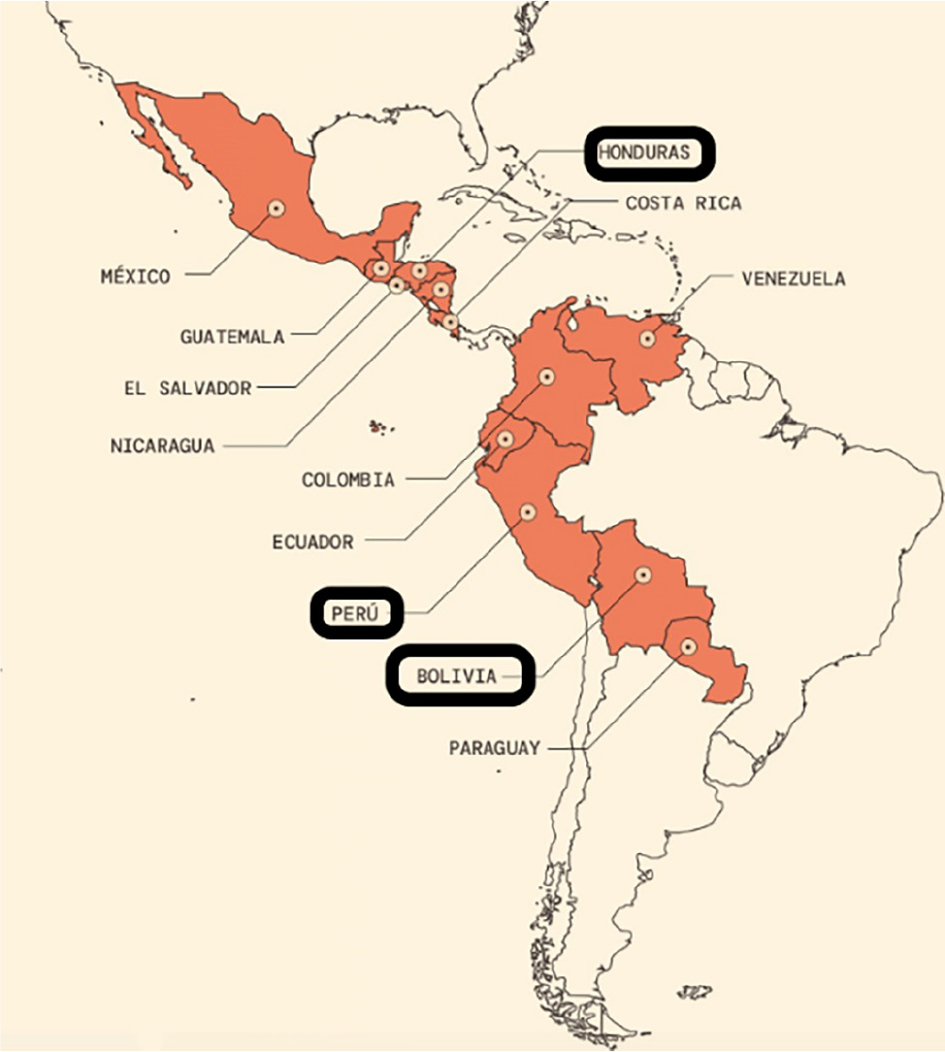
Fig. 1.
Latin American countries where Ayuda en Acción operates (in orange), based on Ayuda en Acción (Aid in Action). Frames indicate the case study locations.
Table 1.
Level of frugality of case studies.
| Cases | Characteristics developed by Frugal Innovation Lab, Santa Clara University | ||||||||||
|---|---|---|---|---|---|---|---|---|---|---|---|
| Resistant | Slight | Mobile skills | Human-centred approach | Simple | New distribution models | Adaptation | Local resources | Green technologies | Affordable | Frugality characteristics score | |
| CASE 1. Retrofitting of fishing boats with solar panels and fish preservation pools (Honduras) | × | × | × | × | × | × | × | × | × | 9/10 | |
| CASE 2. Solar electrified fences for forest conservation (Bolivia) | × | × | × | × | × | × | × | × | × | 9/10 | |
| CASE 3. Temperature control against frost in peach cultivation (Bolivia) | × | × | × | × | × | × | × | × | × | × | 10/10 |
| CASE 4. Use of solar energy for pumping in peach cultivation (Bolivia) | × | × | × | × | × | × | × | × | × | 9/10 | |
| CASE 5. Avocado crop monitoring with satellite imagery (Peru) | × | × | × | × | 4/10 | ||||||
| CASE 6. Early warning system for hydrometeorological hazards (Peru) | × | × | × | × | × | × | 6/10 | ||||
| CASE 7. Water dispensers for beekeeping (Bolivia) | × | × | × | × | × | × | × | × | × | × | 10/10 |
Data collection
We gathered data through 18 semi-structured interviews with a diverse range of stakeholders. These included staff from the NGDO headquarters, field-level implementers, local NGO partners, and end-users. In addition to the interviews, we reviewed internal project documents, such as technical briefs, monitoring reports and meeting records. We also incorporated field notes from direct observations made during implementation and follow-up visits. Interviews ranged from 45 to 90 minutes, were audio-recorded, and transcribed verbatim. We obtained ethical clearance and informed consent prior to data collection. Table 2 provides a list of conducted interviews and participant roles, while Table 3 summarises the cases. Table 4 presents the multiple data sources triangulated to enhance the validity of the findings.
Table 2.
Interviews conducted and the role of interviewees.
| Frugal innovation | Location | Role of interviewee |
|---|---|---|
| CASE 1. Retrofitting of fishing boats with solar panels and fish preservation pools | Santa Fe, Colón, Honduras | Head of Innovation for NGDOs in Spain |
| Project technician in field | ||
| Innovation end-user 1 | ||
| Innovation end-user 2 | ||
| CASE 2. Solar electrified fences for forest conservation | San Pablo de Huacareta, Chuquisaca, Bolivia | Head of Innovation for NGDOs in Spain |
| Technician responsible for NGDO in Bolivia | ||
| Technician responsible for local NGO in field | ||
| Innovation end-user 1 | ||
| CASE 3. Temperature control against frost in peach cultivation | Cotagaita, Potosí, Bolivia | Head of Innovation for NGDOs in Spain |
| Technician responsible for NGDO in Bolivia | ||
| Technician responsible for NGDO for project | ||
| Technician of ACLO Foundation in Potosi (local NGO) | ||
| CASE 4. Use of solar energy for pumping in peach cultivation | Andamarca, Huayllani, and Esmeralda, San Lucas, Potosí, Bolivia | Head of Innovation for NGDOs in Spain |
| Technician responsible for NGDO in Bolivia | ||
| Technician responsible for NGDO for project | ||
| Municipal technician responsible for municipality of San Lucas, department of Potosí | ||
| CASE 5. Avocado crop monitoring with satellite imagery | San Miguel, Cajamarca, Peru | Head of Innovation for NGDOs in Spain |
| Technician responsible for NGDO in Peru | ||
| Engineer Spanish development company | ||
| Consultant/field technician/trainer | ||
| Innovation end-user 1 | ||
| CASE 6. Early warning system for hydro-meteorological hazards | Andahuaylas, Apurimac, Peru | Head of Innovation for NGDOs in Spain |
| Technician responsible for NGDO in Peru | ||
| NGDO Field Project Coordinator | ||
| Risk and disaster management specialist | ||
| CASE 7. Water dispensers for beekeeping | Villa Montes and Yacuiba, Tarija, Bolivia | Project Technician NATIVA Foundation, local NGO |
| Creator of innovation |
Table 3.
Summary of cases: challenges, innovation implemented, level of frugality, and main difficulties in implementation.
| Case | Scope | Innovation | Frugality level | Challenge in implementation |
|---|---|---|---|---|
| Case 1. Retrofitting of fishing boats with solar panels and fish preservation pools (Santa Fe, Colón, Honduras) | To make artisanal fisheries more profitable, fishermen need the catch to reach the coast in good condition. They use ice to keep fish fresh during long days, which limits fishing time to the ice’s duration. Moreover, for boat equipment (lights for night fishing, GPS, sonar, etc.), fishers use car batteries that are later discarded in the sea, causing environmental damage. | This project adopts a traditional African fishing solution in which the fish reaches the coast alive using nets hung over the side of the boat. A container with oxygenated water is inserted in each boat, using seawater circulated by a small motor. Once fish are caught, they are kept alive in the tank until reaching the coast. In addition, solar panels power both the water pump and the onboard equipment. | 9/10 | The onboard live-fish pool does not fully serve its purpose for several reasons: the type of fishing, the depth at which certain fish are caught, and the fish injuring themselves inside the pool. As one user explains, “The bottom fish arrives dead, and the fish that is not bottom fish is already bruised from struggling at the moment of capture and ends up dying in the pool.” |
| Case 2. Solar electrified fences for forest conservation (San Pablo de Huacareta, Chuquisaca, Bolivia) | The forest is an essential resource for local apiculture for two reasons: (1) it provides the necessary flora for bees; (2) it offers ample water resources for the community. The main issue was preventing large animals from entering the area and causing damage. The previous solution was to build wooden fences using timber from the forest, with posts spaced every meter and car batteries used to electrify the wires. | The new fencing design uses fewer posts than before, and solar panels have replaced the car batteries as the power source. | 9/10 | Long-term sensitisation of the local user groups is required to ensure (a) protection of the forest and (b) proper maintenance of the fence system. Field technicians noted that “there is a need to work on empowerment processes with producer organisations to ensure these communities preserve their communal norms.” Additionally, it can be challenging for users to maintain the fence properly due to a lack of training. |
| Case 3. Temperature control against frost in peach cultivation (Cotagaita, Potosí, Bolivia) | Climate change has introduced sudden frosts that significantly damage peach crops by ruining blossoms or fruit, greatly reducing yields. Before this innovation, growers used a bowl of water as an overnight frost alarm: when the water began to freeze, they would alert other farmers to take protective measures. This rudimentary system also helped technicians study which fruit tree varieties could withstand the changing conditions. | A simple device (a datalogger installed in the orchards) now provides an audible alarm when the temperature drops to the freezing point, allowing growers to take immediate action to protect the crop. | 10/10 | There is a dependence on external technicians to identify suitable crop varieties, and end-users showed limited technology uptake due to the lack of a human-centred design in the solution’s conception. Although the device is straight-forward, it does not fully meet frugal innovation (FI) criteria. A more rigorous characterisation would likely rate its frugality at no more than 70%, since it lacks simplicity, human-centred design, and the use of green technologies. |
| Case 4. Use of solar energy for pumping in peach cultivation (San Lucas, Potosí, Bolivia) | High-altitude farming areas suffer from water scarcity, requiring pumps to draw water for irrigation. Previously, farmers had only electric or gasoline pumps, which were costly and environmentally damaging. | The project introduced cost-efficient solar-powered pumps to supply water for irrigation. | 9/10 | The key challenge has been farmers’ distrust of the new system. Many are wary due to exhaustion from prior failed experiments with other pumping systems. Additionally, the variable costs they incurred when pumping water from a distant communal source to individual plots have led to poor adoption of the technology. |
| Case 5. Avocado crop monitoring with satellite imagery (San Miguel, Cajamarca, Peru) | Climate threats (insufficient irrigation, pests, etc.) often cause farmers to lose up to half of their avocado production. Traditionally, farmers would sporadically patrol their fields and apply ad-hoc remedies, which was inefficient. | The project proposed using satellite imagery to provide colour-coded information on the condition of orchards and trees, enabling early detection of issues. | 4/10 | The proposed solution assumed a level of technology access that end-users did not have. Most farmers lacked high-end smartphones or reliable internet, and many (mostly over age 45) were not inclined to adopt new digital tools. Consequently, the pool of potential users shrank from about 70 initially to just 12 in practice. |
| Case 6. Early warning system for hydro-meteorological hazards (Andahuaylas, Apurímac, Peru) | The target communities live along riverbanks in areas prone to flash floods and overflow. Frequent torrential events have caused infrastructure damage and even mass casualties. Previously, no system was in place to warn residents of impending flooding or debris flows. | The project focused on community preparedness by installing loudspeakers in local community centres to broadcast warnings of imminent hazards (essentially serving as a local alarm and community radio system), combined with awareness campaigns and basic training. | 6/10 | The primary challenge was achieving community buy-in for the new technology. While the loudspeaker network functioned as intended, users perceived it as a downgrade compared to more modern solutions (e.g. mobile apps). This perception hindered enthusiasm, and in some cases the community turned to customising other off-the-shelf solutions instead of fully embracing the loudspeaker system. |
| Case 7. Water dispensers for beekeeping (Villa Montes and Yacuiba, Tarija, Bolivia) | In arid climates, low humidity, high temperatures, and scarce fresh water lead to bee mortality and hive abandonment. The project area is an arid zone where communities rely on beekeeping for their livelihood. (By contrast, in more temperate climates, beekeepers provide supplemental feeding to encourage hive growth and prevent bee migration.) | The innovation introduced a black cylinder device that absorbs solar energy to pump pressurised liquid into water dispensers. These dispensers can harvest rainwater and supply water to the bees during periods of extreme heat. | 10/10 | This solution faces cost and distribution challenges, as it was adapted from a recent experiment in another country. Additionally, it requires specialised technicians for operation, given that it is a more advanced system compared to a basic frugal alternative. |
Table 4.
Sources of data.
| Source of data | Description |
|---|---|
| Interviews | one-to-one, semi-structured, in-depth interviews with various actors focusing on the challenges encountered at different implementation phases, perceived positive aspects, and citizen involvement in innovation |
| Technical proposals for innovations | technical specification documents of each of innovations |
| Ex-durante reports | documentation produced by local NGOs or AeA on development over specific periods |
| Ex-post reports | final project implementation documentation with main results and project conclusions |
Data analysis
We conducted thematic analysis using both inductive and deductive coding approaches. Initial codes were developed directly from the interview transcripts to capture emergent themes related to implementation challenges, contextual factors, and perceptions of the innovations. These emergent themes were then organised using two primary analytical frameworks.
First, we applied the frugal innovation attributes framework (Weyrauch, Herstatt 2017) to assess the degree of frugality for each project, based on criteria of cost-reduction, functionality, and optimised performance. Table 1 presents the frugality levels assigned to each project. Second, we applied Everett Rogers’ (2003) innovation adoption attributes – relative advantage, compatibility, complexity, trialability, and observability – to interpret how different actors perceived these innovations and how these perceptions influenced their adoption and diffusion.
Integrating these two frameworks allowed for a layered understanding of how design attributes interact with implementation dynamics. Tables 3 and 5, respectively, summarise the contextualised implementation challenges and the typology of barriers encountered across projects. We used NVivo (v.14). Lumivero, Denver, CO, USA, to organise and analyse the data. Quality assurance procedures for qualitative research were applied systematically across data collection and analysis (Hancock et al. 2003). We traced outcome trajectories and learning loops by combining stakeholder accounts with iterative reflection on change pathways (Douthwaite et al. 2001).
Table 5.
Projects, frugality scores, and typology of challenges.
| Project | Frugality score | Technical | Environmental or topographical-specific | End-user or technician skills or competency | Mismatch of expectations | Communication | Other challenges |
|---|---|---|---|---|---|---|---|
| CASE 1. Retrofitting of fishing boats with solar panels and fish preservation pools | 9/10 | Yes | Yes | Yes | |||
| CASE 2. Solar electrified fences for forest conservation | 9/10 | Yes | |||||
| CASE 3. Temperature control against frost in peach cultivation | 10/10 | Yes | Yes | Yes | Yes | ||
| CASE 4. Use of solar energy for pumping in peach cultivation | 9/10 | Yes | Yes | Yes | |||
| CASE 5. Avocado crop monitoring with satellite imagery | 4/10 | Yes | Yes | Yes | Yes | Yes | Yes |
| CASE 6. Early warning system for hydro-meteorological hazards | 7/10 | Yes | Yes | Yes | Yes | Yes | |
| CASE 7. Bee drinkers | 10/10 | Yes | Yes | Yes |
Implementation challenges of frugal innovation projects
Our cross-case analysis revealed several prevalent implementation challenges. Based on the interviews’ transcripts, we categorised them as technical issues, human capacity issues, environmental issues, expectation mismatches, and communication issues. Technical challenges and human capacity issues affected both end-users and technicians and were the most common, observed in six out of seven projects.
A striking technical challenge across several projects was the misalignment between the complexity of innovation design and the skill level of its intended users. Theoretically, frugal innovations should be simple and intuitive enough for individuals with minimal training. However, some innovations appeared to be designed for technical specialists rather than lay end-users, thereby undermining the principle of simplicity. This misalignment led to long-term sustainability issues, as end-users became dependent on external technical support, a contradiction of the objective of frugality. Household-level energy interventions show how adoption hinges on cultural fit, perceived reliability, and affordability, beyond pure technical performance (Berrueta et al. 2017).
Nevertheless, primary data confirmed that NGDO managers initially held optimistic views regarding the characteristics of frugal innovation, aligned with the narrative of the concept. However, they relegated community involvement to the later project phases, primarily the rollout or socialisation of the solution. End-users were largely excluded from the early ideation and design stages, which are key steps in frugal innovation. In at least five out of seven projects, we observed low initial end-user acceptance, likely linked to an inadequate application of human-centred design principles. This finding reinforces the notion that early end-user involvement could lead to simpler, more intuitive designs.
Another recurring technical challenge was the insufficient assessment of local resources and infrastructure. For instance, in projects relying on advanced mobile applications (Cases 3, 5 and 6), it became evident during implementation that many target communities lacked smartphones or reliable internet access. In response, some projects were adapted by providing community leaders with appropriate devices (Case 5) or by shifting to low-tech solutions, such as loudspeakers, for information dissemination (Case 1).
Local supply chain and maintenance capacity also posed challenges, as parts and devices were not sufficiently adaptable to local conditions. In one hydro-meteorological warning system (Case 6), critical components required international importation, leading to repair delays and an increased risk of system failure. This clearly deviated from the intended robustness and local resource utilisation. Environmental challenges were also observed, particularly in solar energy projects (Cases 1, 2, 4 and 6). Instances of insufficient protection for solar panels in extreme weather conditions highlighted the need for better environmental adaptation during the design phase. We observe institutional arrangements and value-chain interfaces that either enable or stall frugal uptake, aligning with evidence on inclusive agrifood chains (Vellema et al. 2023).
Human capacity issues emerged as end-users and local technicians required more training than initially anticipated. Although training programmes were implemented, some projects experienced a decline in user motivation over time (Cases 1, 3 and 5), suggesting that end-users did not fully perceive the value of the innovations.
Expectation mismatches among stakeholders were less problematic than anticipated; however, occasional communication gaps between the NGDO’s technical team and local communities were noted, which sometimes led to delays or misunderstandings regarding changes in project design.
Risks of the implementation of frugal innovations
Our findings underscore that while frugal innovation simplifies technology and improves accessibility, it may also introduce specific risks, especially when design processes lack sufficient scientific or engineering review. In such cases, challenges related to durability, maintenance, or environmental suitability may not be detected until the project is already in use. Rao (2018) emphasises that scientific input is essential to ensuring functional reliability in frugal solutions. Without it, even well-intentioned designs may result in hidden costs or technical failures that undermine long-term sustainability. Conversely, imposing excessive structure or formal processes in resource-constrained settings can lead to mismanagement, as highlighted by Coccia (2023) and Laprie (1995). Our observations indicate that a crucial balance between flexibility and rigour is necessary. Over-complicating a solution in the name of safety may undermine its simplicity, a foundational aspect of frugal innovation. Tradeoffs between robustness, cost, and performance require explicit design principles so that ‘goodenough’ solutions remain safe and effective (Sorensen, McBean 2015).
Another significant risk lies in the insufficient integration of community involvement. While our case studies claimed to follow participatory approaches, the lack of early and open user engagement in the design phase often resulted in innovations that did not fully match local needs. This necessitated costly, ad hoc adjustments or led to user disengagement. A further risk is the absence of a comparative assessment of alternatives. In many instances, projects did not consider or test alternative solutions, which could have provided a benchmark to ensure that the chosen innovation was indeed the most frugal and context-appropriate option.
Conclusions
This study sheds light on the underexplored barriers to implementing frugal innovations in the context of international development cooperation. Drawing on a multi-case study from Latin America, it identifies how institutional misalignments, limited local ownership, and insufficient consideration of users’ embedded practices can hinder implementation – even when innovations are technically frugal. The analytical contribution of this research lies in bridging two complementary perspectives: frugality as a design and resource constraint principle, and diffusion theory as a lens to understand adoption.
While frugal innovations are often praised for their simplicity and low-cost nature, these attributes alone do not guarantee success. As demonstrated through Rogers’ (2003) five adoption attributes, perceived compatibility, relative advantage, and observability play critical roles in determining whether an innovation will be embraced or resisted. By integrating Rogers’ diffusion theory with the frugality framework (Weyrauch, Herstatt 2017), we observe that these attributes manifest themselves differently in frugal innovations. While trialability is often enhanced by low cost, complexity may increase when technical support is needed, and observability may be reduced if benefits are not immediately visible – highlighting the need for context-sensitive, user-centred design. The study offers a more nuanced understanding of how innovations travel and transform across contexts. The findings echo recent scholarship suggesting that frugal innovations must be not only technically efficient but also socially intelligible and contextually aligned (Kapoor et al. 2015, Oturakci 2020). This dual analysis strengthens the conceptual contribution of the study by showing how frugality and diffusion logics intersect, especially in development cooperation settings where social, institutional, and infrastructural factors shape implementation outcomes (Kapoor et al. 2015, Oturakci 2020).
Considering frugal innovations among Spanish NGDOs, spatial diffusion plays a notable role. The cases in this study involve projects implemented in different countries by the same NGDO, which exemplifies planned hierarchical diffusion. Here, the Spain-based NGO acts as an innovation broker, intentionally transferring a solution to various locales. Rather than the innovation spreading organically from one village to the next, the NGDO introduces it almost simultaneously in multiple regions, leveraging its organisational network. Classifying the regions of implementation in Rogers’ adopter terms, Honduras, Bolivia, and Peru (the countries in our cases) can be seen as early adopters within the context of frugal innovation in the Spanish cooperation network. Understanding how these innovations scale beyond their initial pilot sites is critical for long-term impact. For instance, some frugal innovations were highly compatible with local practices, reinforcing their uptake. Similarly, their simplicity often reduced perceived complexity and enhanced trialability.
Future research and limitations
Future research could build on these insights by developing tools to assess the diffusion-readiness of frugal innovations or by conducting longitudinal studies that trace the evolution of adoption processes in real time. In practice, development actors should be encouraged to embed diffusion-sensitive diagnostics early in project design and to invest in participatory processes that enhance compatibility and observability. These steps could significantly increase the chances that frugal innovations move beyond pilots and generate sustainable impact.
Our study would have benefited from including other NGDOs to expand generalisability and unveil whether these findings stand in other organisations. Future research should therefore encompass a broader range of organisations and contexts.
Another limitation concerns the economic analysis of the innovations. While our study assumed an innovation was frugal if it met certain design criteria, further research should incorporate longitudinal economic assessments and real market testing to validate long-term affordability.
Additionally, our study did not quantitatively assess how these innovations diffused beyond the pilot communities. Future research should examine the wider diffusion process, possibly using social network analysis, to understand how frugal innovations spread over time.
Finally, exploring the interplay between frugal innovation, climate change adaptation, and circular economy strategies offers a promising avenue for future work. Longitudinal studies in these areas could further clarify the role of frugal innovations in promoting sustainable development.
Reflections on better implementation of frugal innovation projects
Based on our findings and the frugal innovation literature, we offer the following practical recommendations for improving the implementation of the mentioned projects in development contexts:
– Engage end-users from the ideation stage: Involve community members early in the process to incorporate their insights and traditional knowledge into the design.
– Prioritise simplicity in design: Critically review each solution to ensure it is intuitive and requires minimal training, thereby enhancing long-term sustainability.
– Minimise dependency on external technicians: Build local capacity by training community champions and designing modular solutions that locals can maintain.
– Leverage and promote green technologies: Integrate renewable energy and eco-friendly materials to address both environmental challenges and cost constraints.
– Collaborate with local institutions: Partner with local governments and community organisations to secure maintenance support and facilitate the diffusion of innovations.
In summary, while frugal innovations hold great promise in resource-constrained settings, their success hinges on a deep contextual understanding, genuine community participation, and adaptability to local conditions.
Acknowledgements
We are grateful to the experts and practitioners from Spanish NGDOs who generously shared their time and insights during interviews and document reviews. We also thank the anonymous reviewers for their constructive comments, which substantially improved the manuscript. Any remaining errors are our own.
Notes
[2] Conflicts of interest Conflicts of interest
The authors declare no conflicts of interest.
[3] Contributed by Authors’ contributions
BDR: conceptualisation (lead), methodology (lead), investigation (lead), formal analysis (lead), data curation (lead), visualisation (lead), writing – original draft (lead), project administration (lead); CB: conceptualisation (supporting), resources (supporting), validation (equal), writing – review & editing (equal), supervision (equal); GG: conceptualisation (supporting), methodology (supporting), validation (equal), writing – review & editing (equal), supervision (lead). All authors read and approved the final manuscript.