
Table 1.
New tourism products developed and offered to tourists (attractions, itineraries, services) (since 16 March 2020, the beginning of the pandemic).
| New tourism products and services | |
|---|---|
| Most popular (more than 10 percent mentions in TICs’ answers) | Others (less than 10 per cent mentions in TICs’ answers) |
|
|
Table 2.
Application of technological and non-technological innovations (since 16 March 2020, the beginning of the pandemic), calculated from positive answers (total of 40).
| Expressed opinion | Number of mentions in answers (units) | Proportion of answers (%) |
|---|---|---|
| Application of technological or non-technological innovations | 40 | 80.0 |
| Technological or non-technological innovations were not applied | 9 | 18.0 |
| Answers were not provided | 1 | 2.0 |
| Total | 50 | 100.0 |
| Technological or non-technological innovations mentioned (counted from positive answers, n = 40) | ||
| Developed and improved website | 11 | 27.5 |
| Digitalised information and routes, creation of virtual and interactive tours | 9 | 22.5 |
| New or improved mobile applications (APPS) | 9 | 22.5 |
| Information terminals, interactive boards | 6 | 15.0 |
| Non-technological innovations | 5 | 12.5 |
| Transfer to virtual trainings, conferences, video broadcasts, communication with visitors (e.g., via Zoom, Teams) | 5 | 12.5 |
| New and/or improved online store | 4 | 10.0 |
| Contactless payment for goods and services, vending machines, scanners (e.g., scanning tickets using QR codes) | 3 | 7.5 |
| Others (individual and region-specific innovations) | 3 | 7.5 |
| Audio guides | 2 | 5.0 |
| Presence on social networks (e.g., Facebook, TikTok) | 2 | 5.0 |
| New and/or improved online movies and games | 2 | 5.0 |
| Interactive and 3D games (e.g., virtual reality with 3D glasses, interactive game walls) | 2 | 5.0 |
Table 3.
Virtual (digital) products and services indicated as the most relevant for tourists.
| Expressed opinion | Number of mentions in answers (units) | Proportion of answers (%) |
|---|---|---|
| Digital routes, virtual tours, virtual guides | 15 | 30.0 |
| User-friendly websites (easy to find tourism information) | 11 | 22.0 |
| Video review films and photos that promote and attract tourists | 8 | 16.0 |
| Mobile applications (APPS) | 6 | 12.0 |
| Others (individual and region-specific products and services) | 6 | 12.0 |
| Answers were not provided | 6 | 12.0 |
| Digital/interactive maps | 5 | 10.0 |
| Electronic services (shops, payments, reservations, etc.) | 4 | 8.0 |
| Games (virtual/digital) for computer, phone | 4 | 8.0 |
| Interactive boards, apps, links | 3 | 6.0 |
| Possibility of planning trip/route | 2 | 4.0 |
| Virtual reality (3D glasses) | 2 | 4.0 |
| No opinion | 2 | 4.0 |
Table 4.
Technological/non-technological innovations planned to be applied in the future, calculated from positive answers (total of 32).
| Expressed opinion | Number of mentions in answers (units) | Proportion of answers (%) |
|---|---|---|
| Technological/non-technological innovations planned to be applied in future (3 TICs did not specify which ones) | 32 | 64.0 |
| No plans to apply technological/non-technological innovations in future | 3 | 6.0 |
| No opinion | 12 | 24.0 |
| Answers were not provided | 3 | 6.0 |
| Total | 50 | 100.0 |
| Future technological or non-technological innovations mentioned (counted from positive answers, n=32) | ||
| Information terminals, interactive boards/objects | 10 | 31.3 |
| Digitised routes, virtual tours | 8 | 25.0 |
| Others (individual and region-specific products and services) | 8 | 25.0 |
| Virtual reality equipment (3D glasses) | 4 | 12.5 |
| Non-technological innovations | 4 | 12.5 |
| Mobile applications (APPS) | 3 | 9.4 |
| New and/or improved website | 3 | 9.4 |
| Audio guides | 3 | 9.4 |
| New and/or improved online movies and games | 3 | 9.4 |
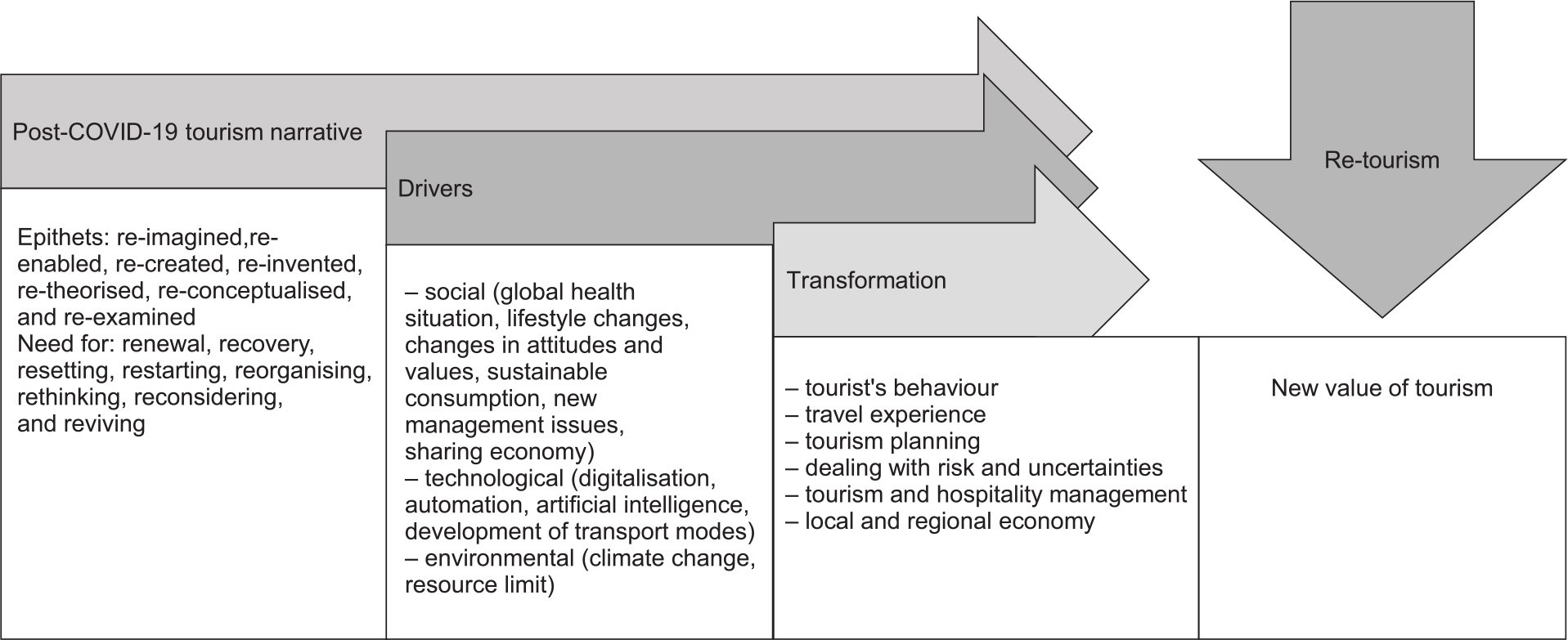
Fig. 1.
Re-tourism concept. Source: Liutikas (2023).