
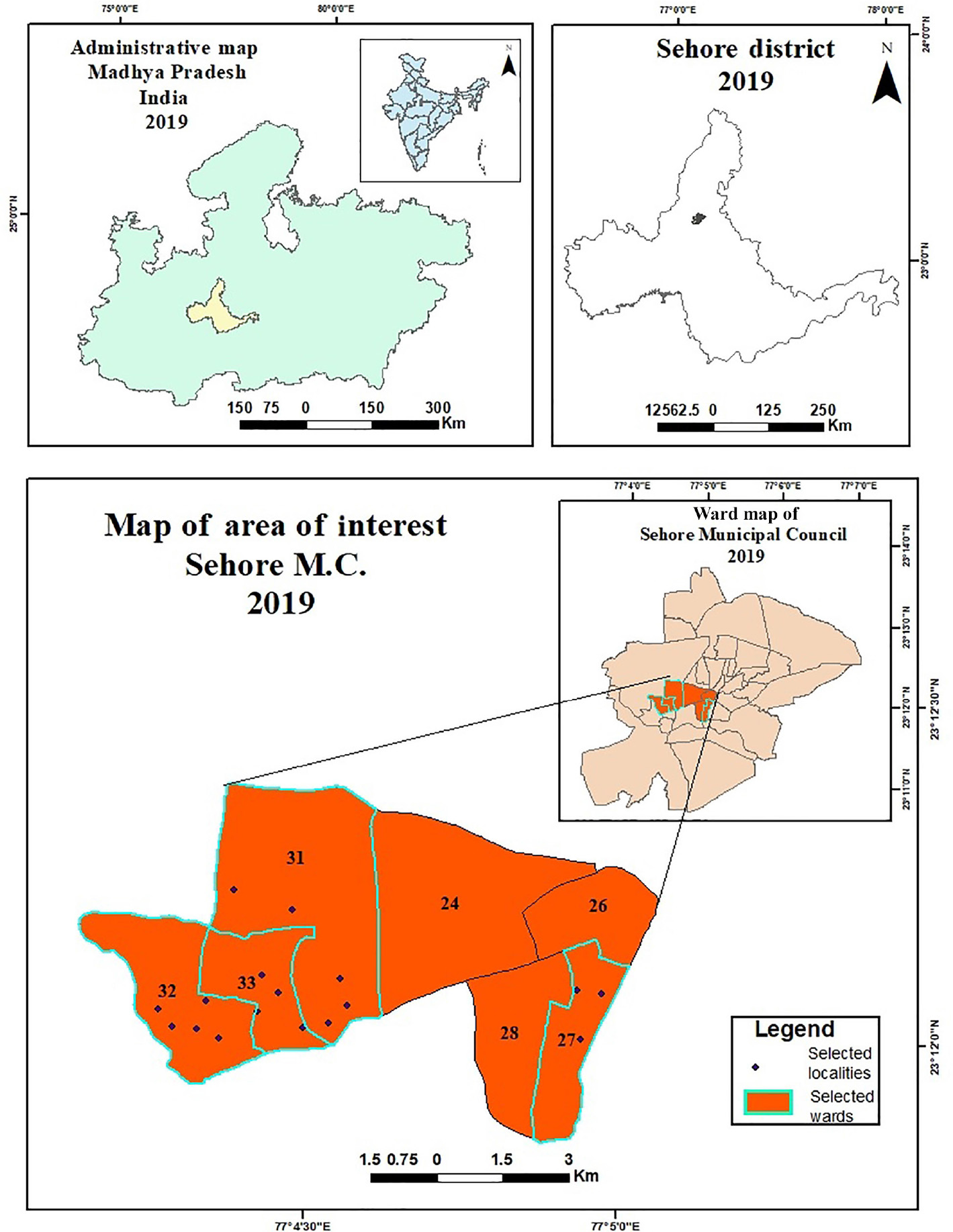
Fig. 1.
Location map of the study area, Sehore M.C., Madhya Pradesh.
Source: own compilation.
Table 1.
List of indicators for the female-based Urban Poverty Index.
| No. | Domain | Indicator |
|---|---|---|
| 1 | Economic poverty | 1. % of non-working females |
| 2. % of females earning less than average income of females | ||
| 3. % of female workers in unorganised sector1 | ||
| 4. % of females as unpaid family workers | ||
| 5. % of female workers as non-regular earners | ||
| 6. % of females in hazardous jobs | ||
| 7. % of females with work-related ailments | ||
| 8. % of females working under compassion | ||
| 9. % of females with no job security | ||
| 10. % of females with no or low job satisfaction | ||
| 11. % of females with no or conditional social acceptance | ||
| 2 | Educational poverty | 1. % of illiterate women |
| 2. % of females having education below graduation | ||
| 3. % of females without technical/vocational training | ||
| 3 | Social poverty | 1. % of females having no freedom to visit market place alone |
| 2. % of females having no freedom to visit health facility alone | ||
| 3. % of females having no control over personal income | ||
| 4. % of females having no exposure to media | ||
| 4 | Health poverty | 1. % of females not having normal BMI2 |
| 2. % of females never consuming milk, pulses/beans and green vegetables | ||
| 3. % of females having no access to Anganwadi3 | ||
| 4. % of females having no access to health services | ||
| 5. % of females having no awareness of common ailments | ||
| 5 | Lack of decision making power at household level | 1. % of females with decision deficit on major household purchasing |
| 2. % of females with decision deficit on education/expense of children | ||
| 3. % of females having no decision on purchasing medical treatment | ||
| 4. % of females having no decision on purchasing daily food items | ||
| 6 | Lack of time for relaxation | 1. % of females spending more than four hours on unpaid domestic chores |
| 2. % of female workers working more than average working hours for women | ||
| 3. % of females whose work is not shared by others within the household |
11 Unorganised sector refers to the unregulated informal sector of the economy in India and lacks organisational structure. A vast majority of workers work in the unorganised sector.
Table 2.
Ratio index.
| n | 1 | 2 | 3 | 4 | 5 | 6 | 7 | 8 | 9 | 10 |
|---|---|---|---|---|---|---|---|---|---|---|
| RI | 0.00 | 0.00 | 0.58 | 0.90 | 1.12 | 1.24 | 1.32 | 1.41 | 1.46 | 1.49 |
1 Random inconsistency indices for n = 10 (Saaty 1980).
Table 3.
Normalised matrix.
| 0.40 | 0.59 | 0.35 | 0.34 | 0.27 | 0.18 |
| 0.13 | 0.20 | 0.35 | 0.34 | 0.38 | 0.24 |
| 0.13 | 0.07 | 0.12 | 0.11 | 0.16 | 0.18 |
| 0.13 | 0.07 | 0.12 | 0.11 | 0.11 | 0.18 |
| 0.08 | 0.03 | 0.04 | 0.06 | 0.05 | 0.18 |
| 0.13 | 0.05 | 0.04 | 0.04 | 0.02 | 0.06 |
Table 4.
Eigen vector showing the strength of the domains.
| Variable | Eigen vector | Rank |
|---|---|---|
| Economic poverty (18–65 years of age) | 0.354 | 1 |
| Educational poverty (all females >7 years of age) | 0.272 | 2 |
| Social poverty – lack of women empowerment (>18 years of age) | 0.128 | 3 |
| Health poverty (15–49 years of age) | 0.119 | 4 |
| Lack of decision-making power at HH level (>18 years of age) | 0.072 | 5 |
| Lack of time for relaxation (>15 years of age) | 0.056 | 6 |
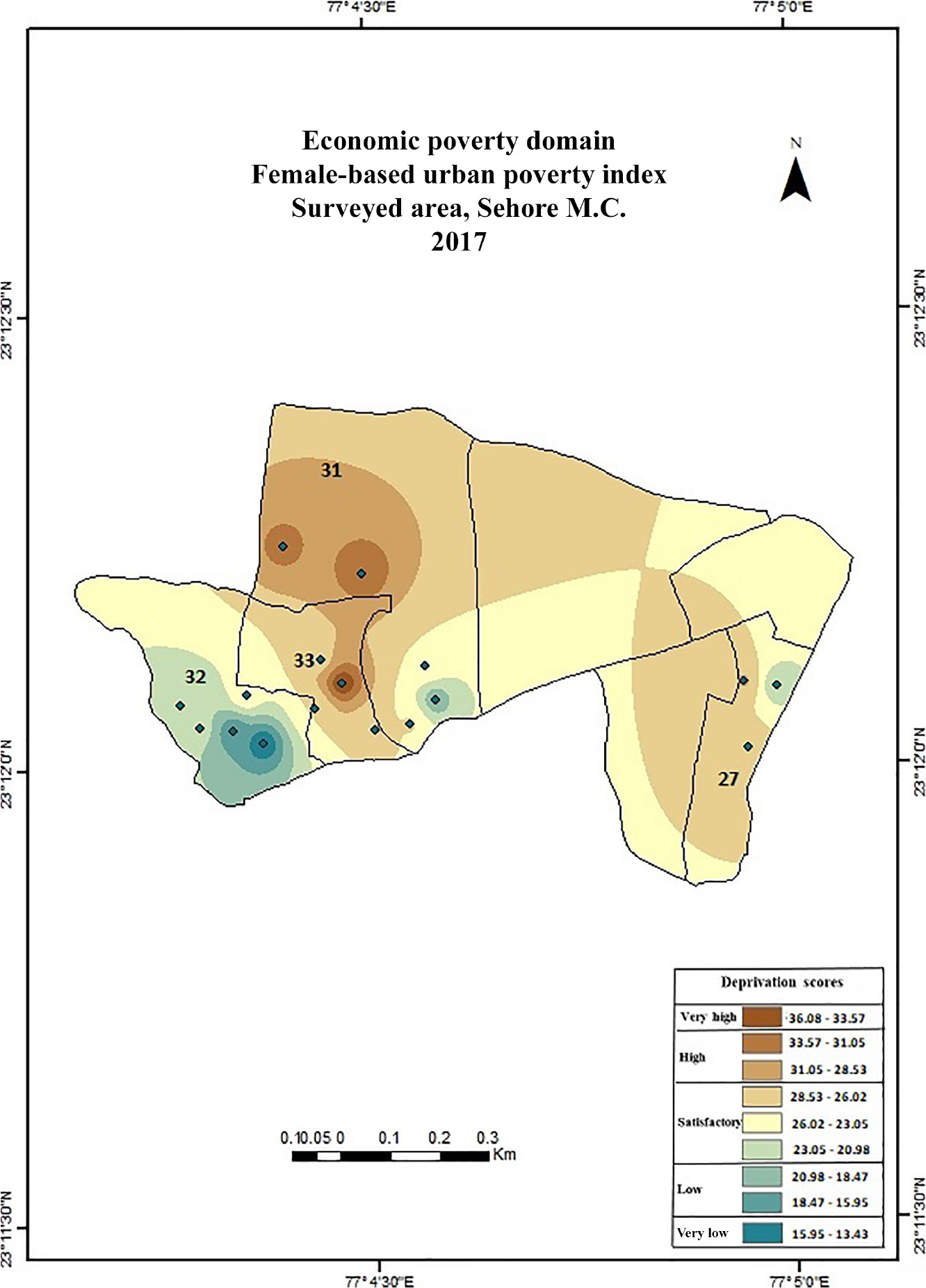
Fig. 2.
Economic poverty domain.
Source: own compilation.
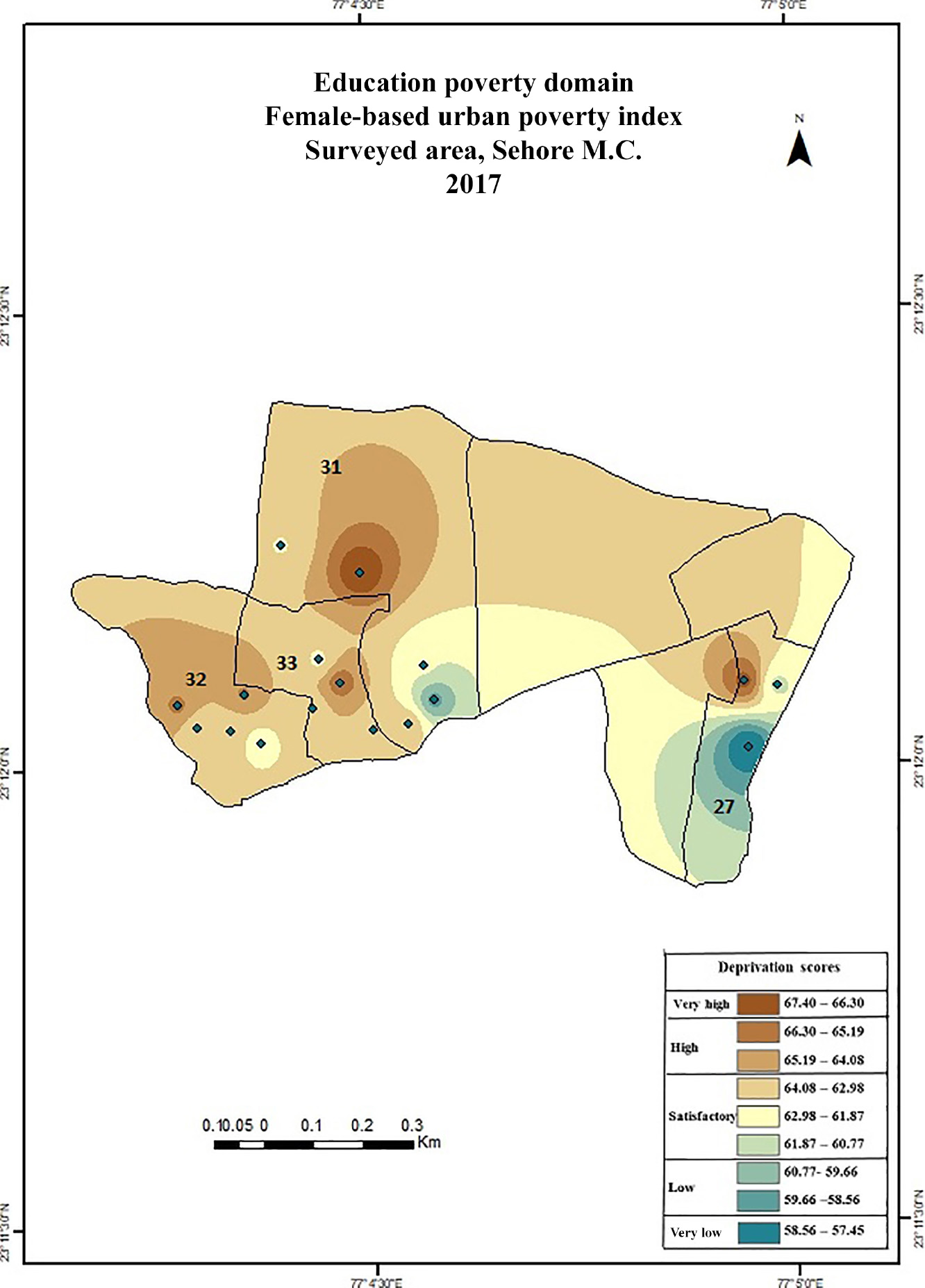
Fig. 3.
Education poverty domain.
Source: own compilation.
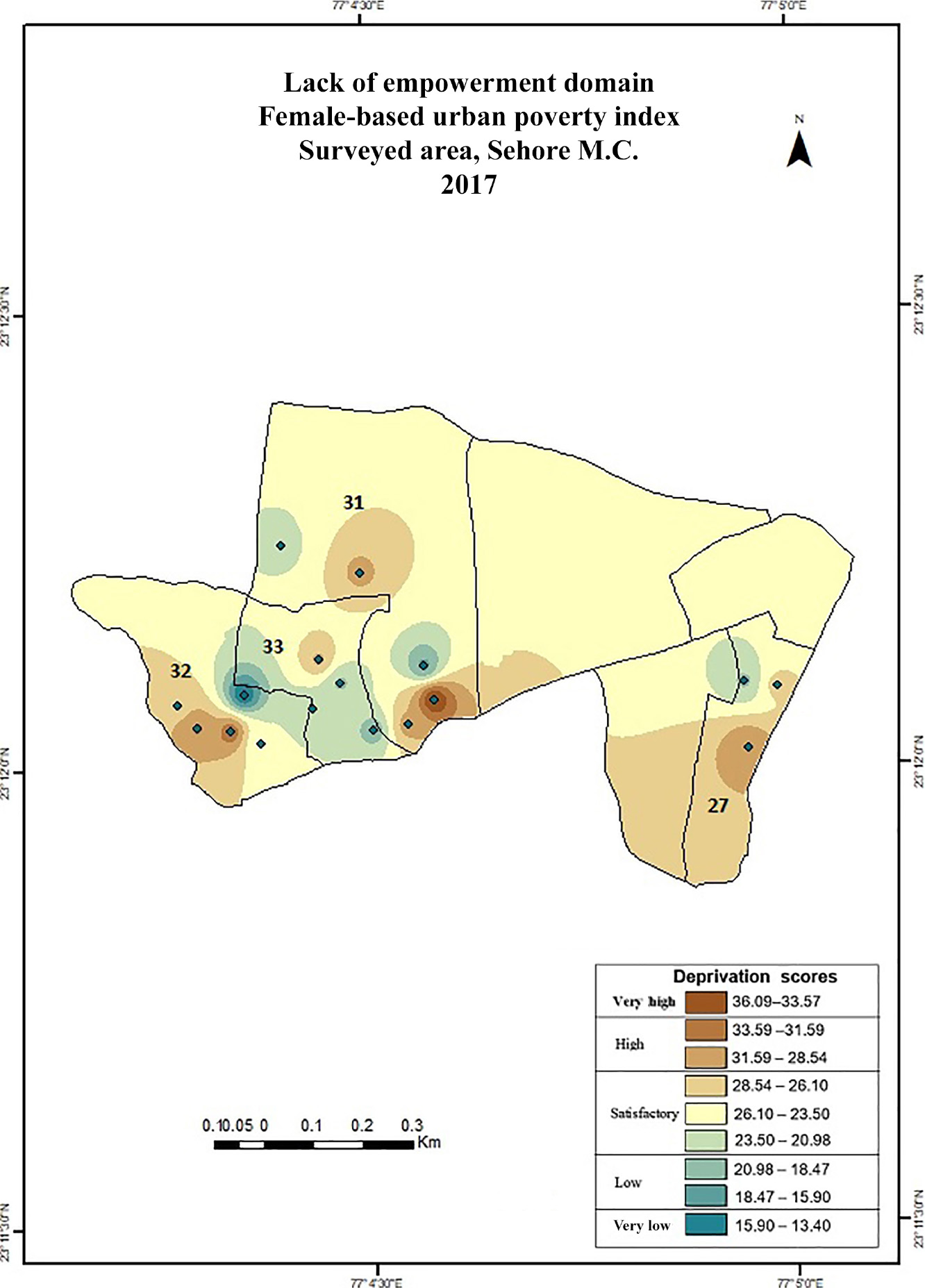
Fig. 4.
Lack of the empowerment domain.
Source: own compilation.
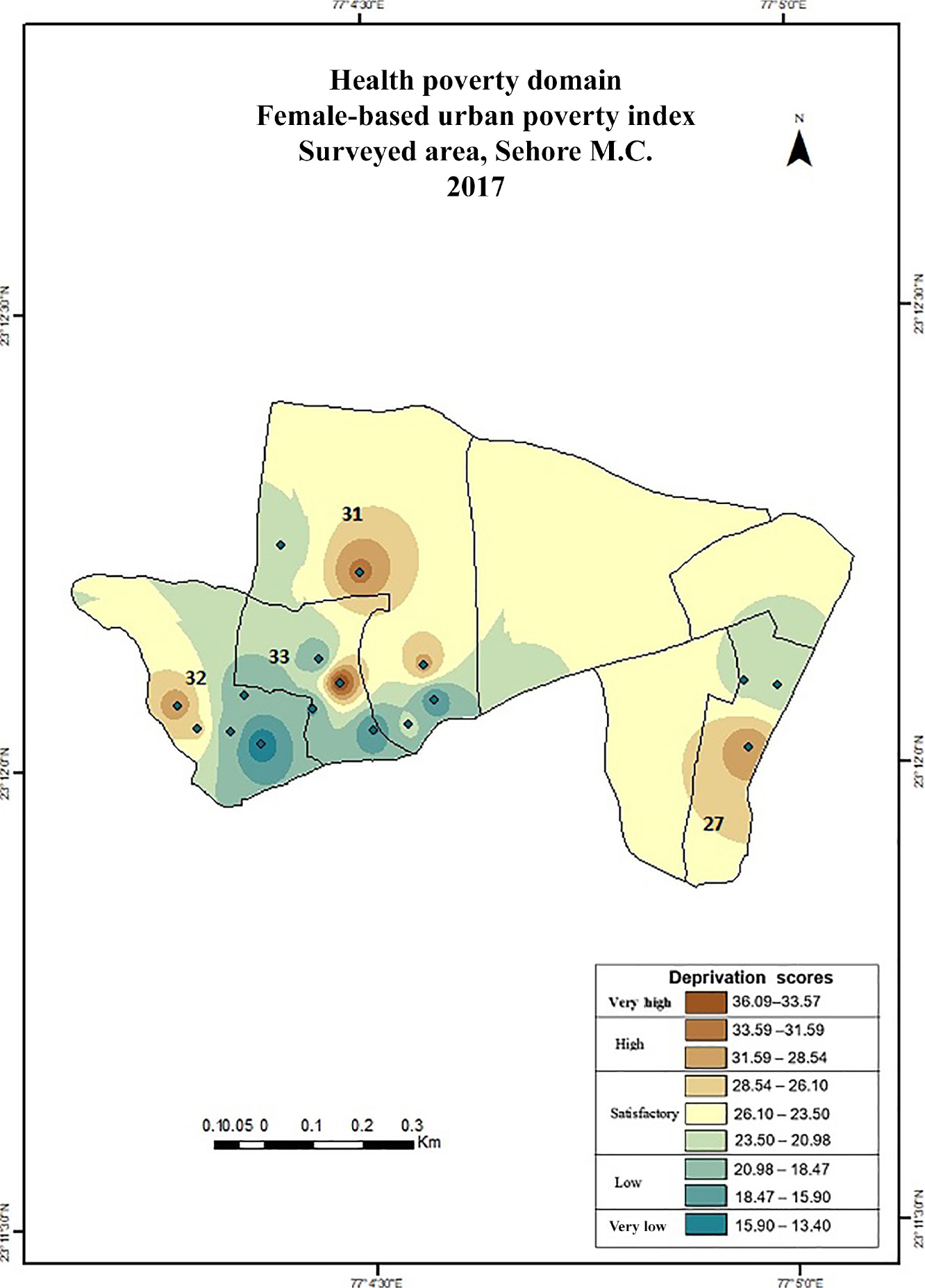
Fig. 5.
Health poverty domain.
Source: own compilation.
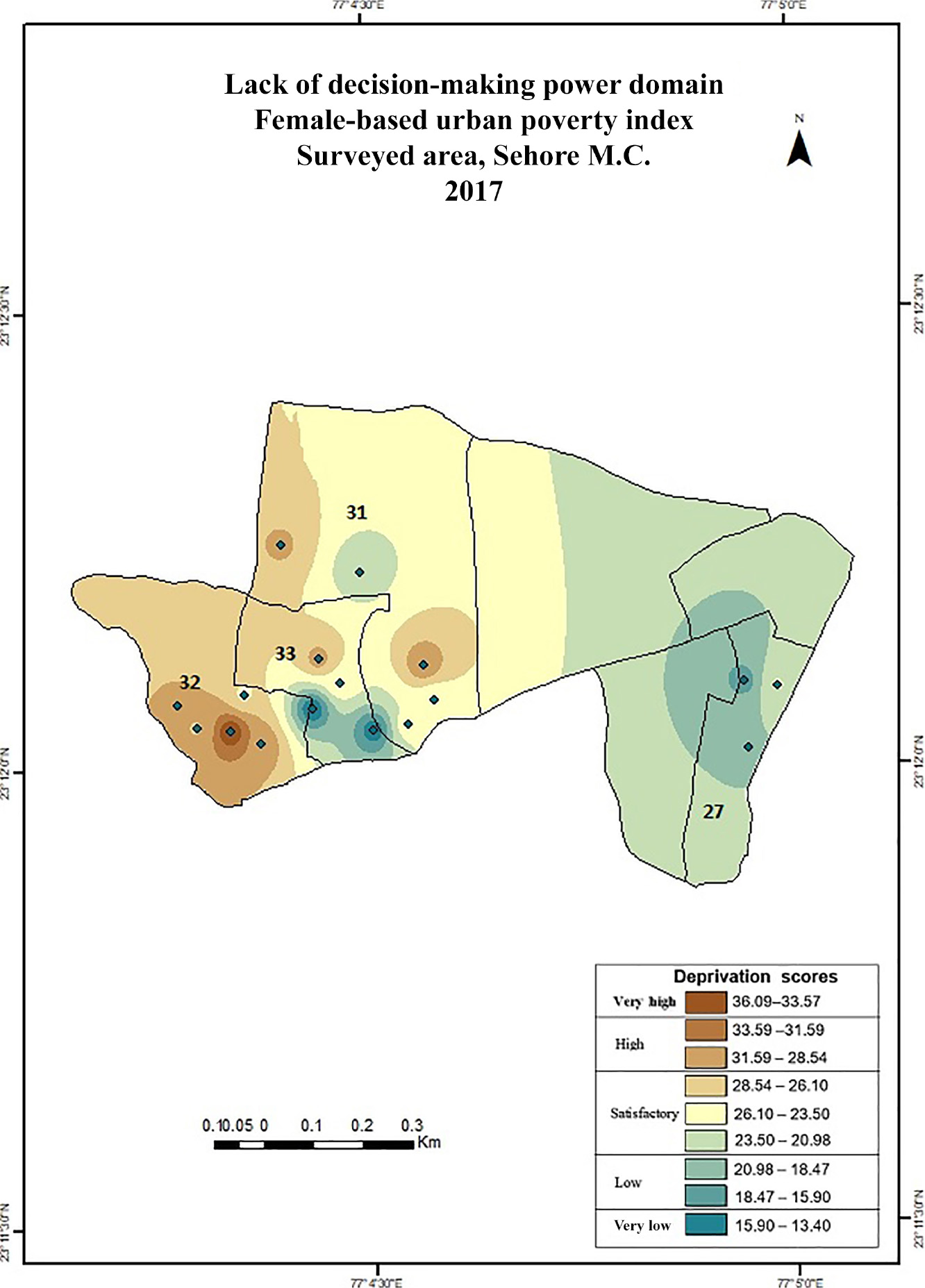
Fig. 6.
Lack of decision-making power domain.
Source: own compilation.
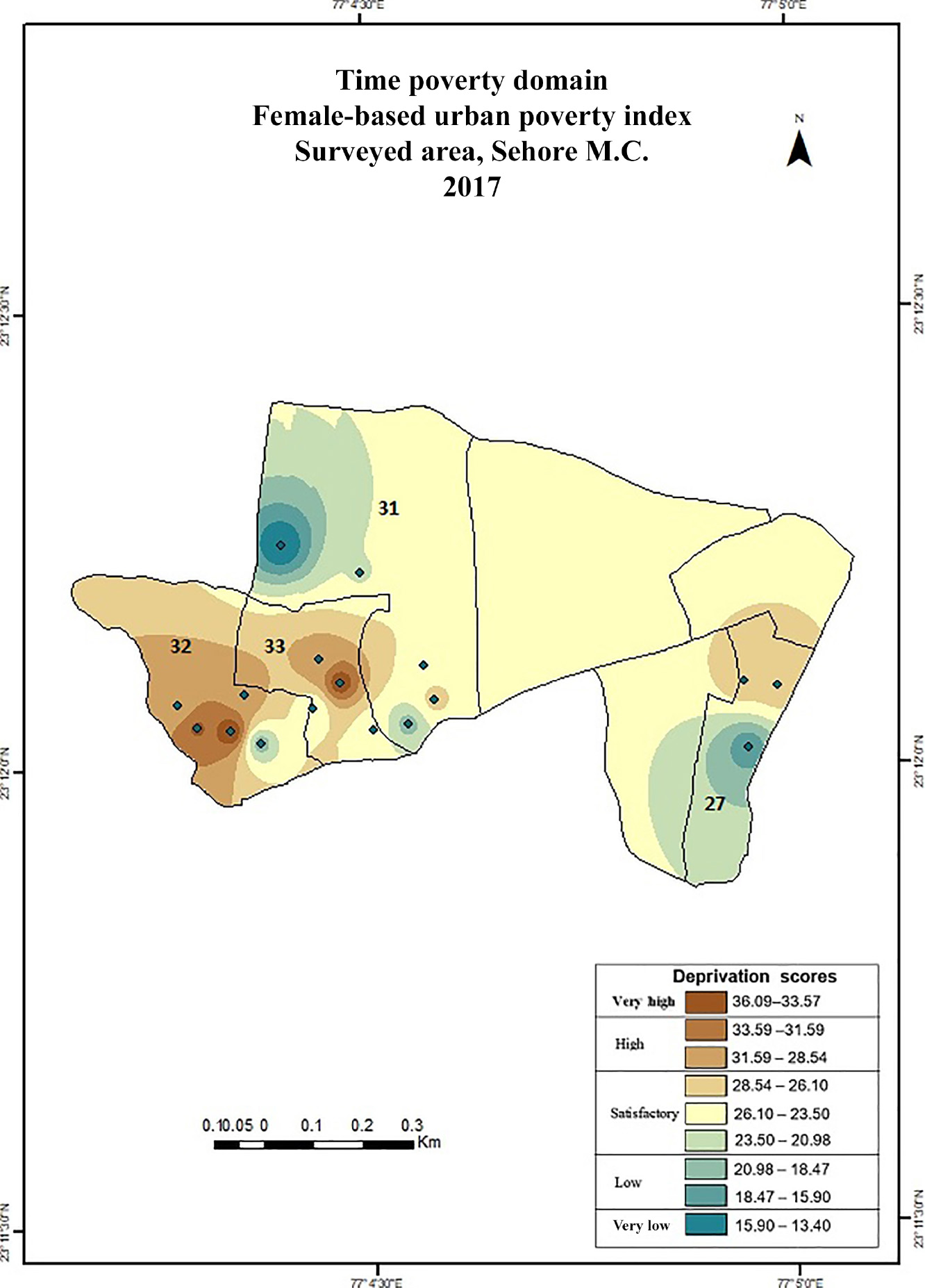
Fig. 7.
Time poverty domain.
Source: own compilation.
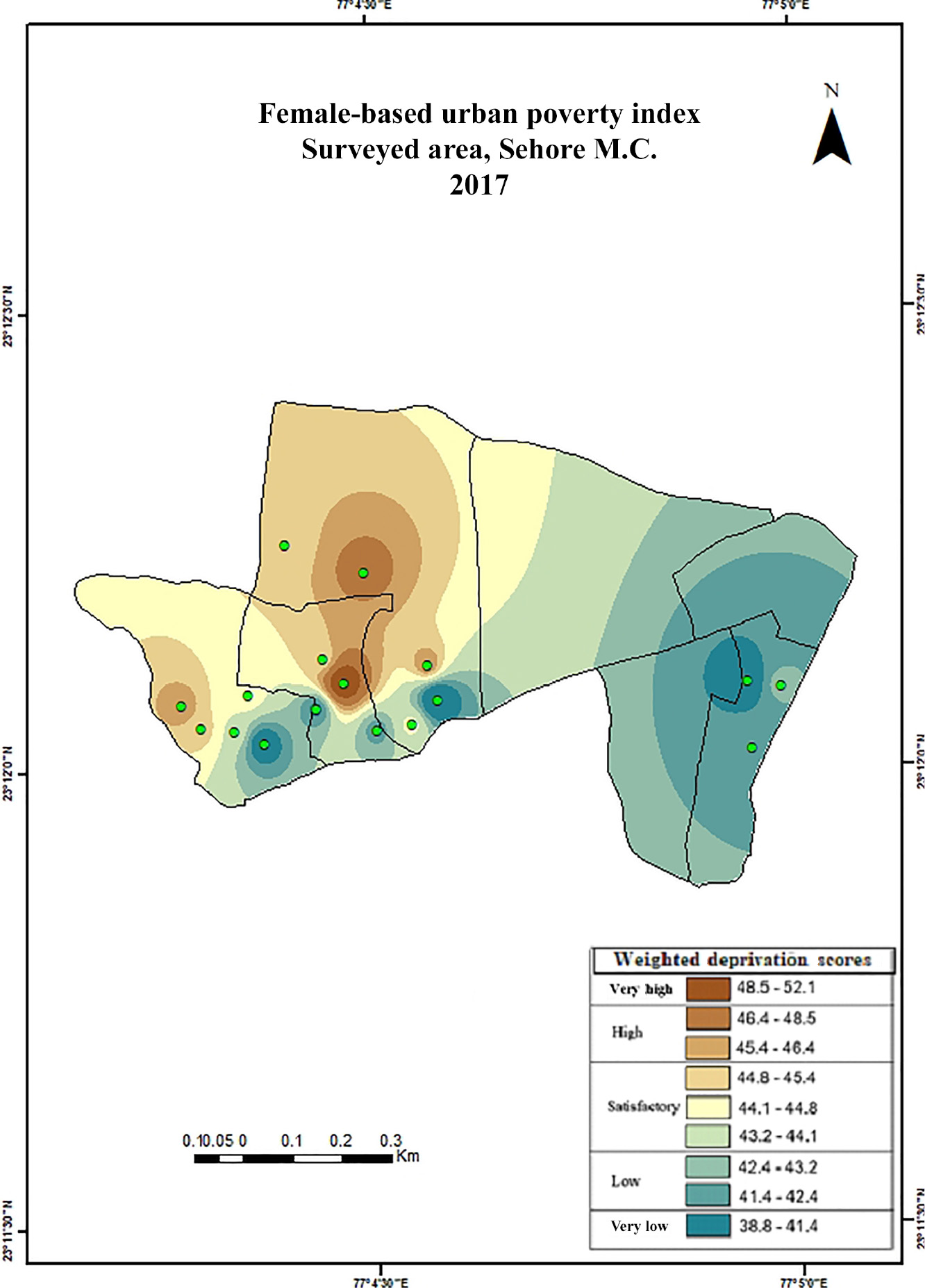
Fig. 8.
Overall weighted deprivation scores, female-based urban poverty index, Sehore M.C.
Source: own compilation.