
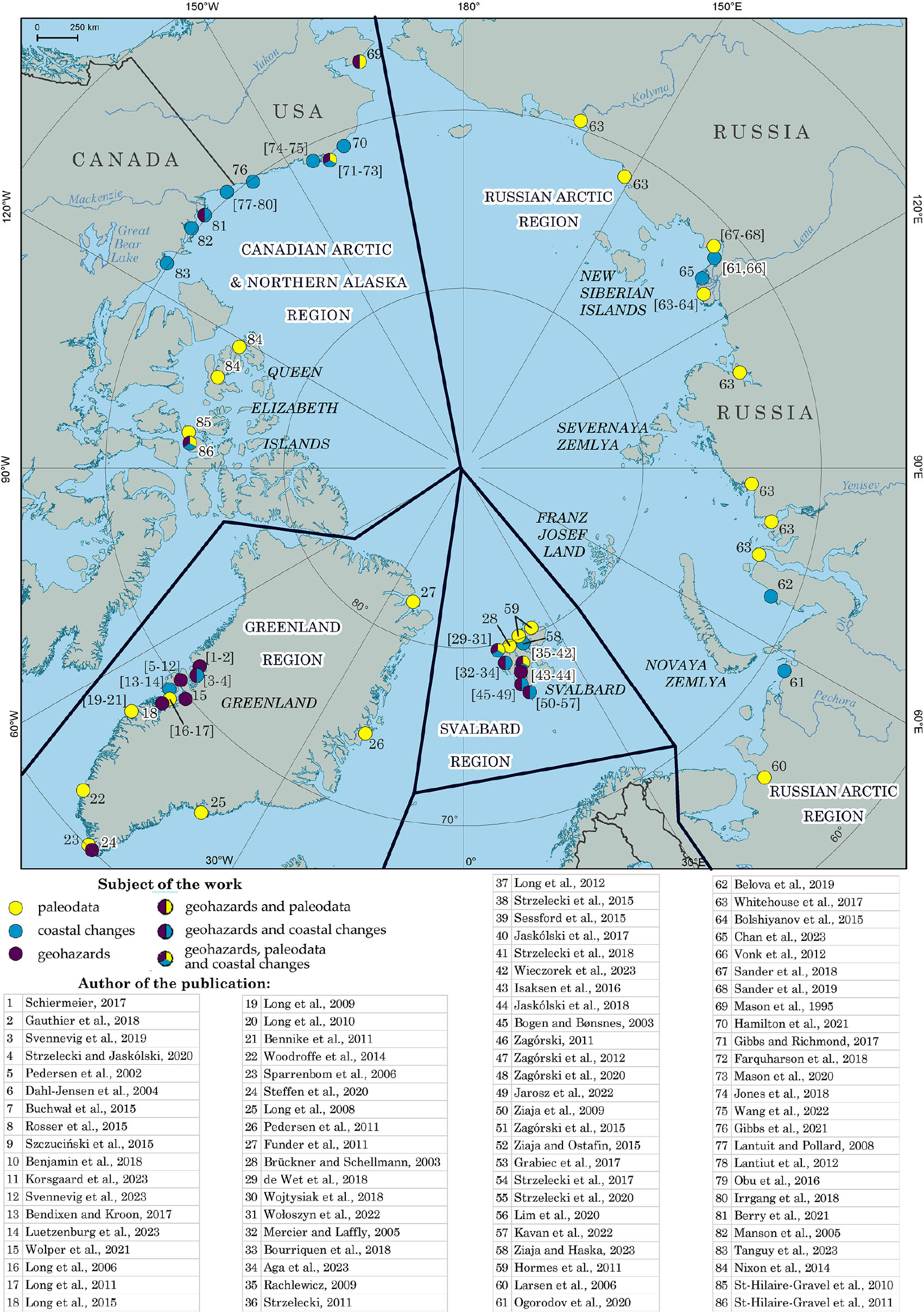
Fig. 1.
Schematic division of the Arctic corresponding to the chapters in the work and relevant publications on the Arctic coastal change research mentioned in this study.
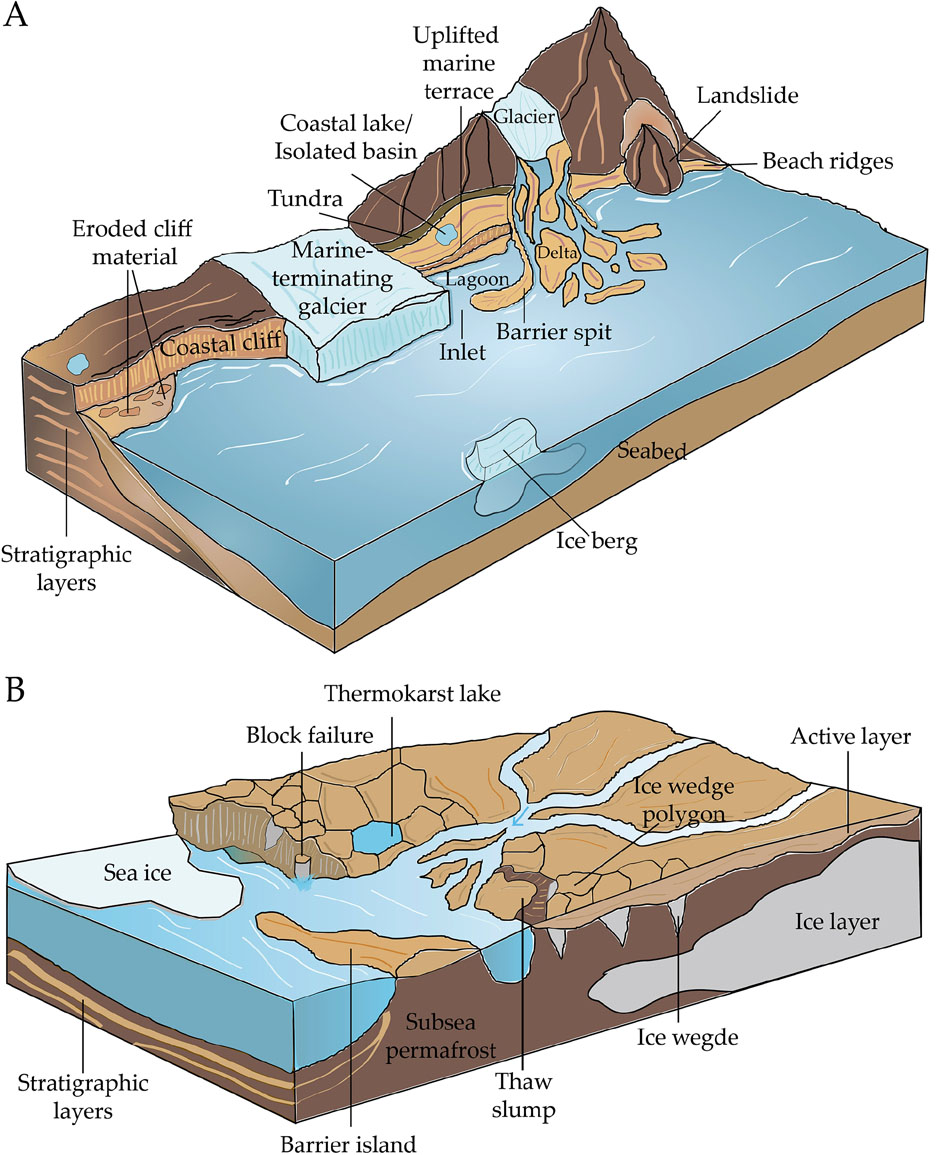
Fig. 2.
Schemes of the Arctic coasts: A – Coast of the still-glaciated part of the Arctic; B – Coast dominated by permafrost (non-glaciated domain).
Table 1.
The average rate of coastline changes in the Arctic since the end of the Little Ice Age, based on recent research.
| Location | Region | Average rate of coastal changes [m a−1] | Publication |
|---|---|---|---|
| Arctic coasts | Arctic | −0.50 | Lantuit et al. (2011) |
| Arctic coasts | Arctic | from −1.00 to −2.00 | Forbes (2011) |
| Siniffik | Greenland | −0.30 | Luetzenburg et al. (2023) |
| Disko Island | Greenland | −1.50 | Bourriquen et al. (2018) |
| Isbjørnhamna | Svalbard | −13.00 | Zagórski et al. (2015) |
| Calypsostranda | Svalbard | −0.19 | Zagórski et al. (2020) |
| Hornsund | Svalbard | −1.90 | Lim et al. (2020) |
| Rekvedbukta | Svalbard | −2.22 | Wołoszyn et al. (2022) |
| West Euroasian | Siberia | −4.00 | Ogorodov et al. (2022) |
| East Asian | Siberia | from −2.00 to −7.00 | Ogorodov et al. (2020) |
| Bykovsky Peninsula | Siberia | −0.59 | Lantuit et al. (2011a) |
| Muostakh Island | Siberia | −20.00 | Vonk et al. (2012) |
| Ozero Mogotoyevo | Siberia | −12.40 | Wang et al. (2022) |
| Northen Alaska | Alaska | −1.40 | Gibbs, Richmond (2017) |
| Drew Point | Alaska | −38.30 | Wang et al. (2022) |
| Cape Krusenstern | Alaska | −0.13 | Farquharson et al. (2018) |
| Cape Espenberg | Alaska | −1.53 | Farquharson et al. (2018) |
| Yukon | Canada | −0.70 | Irrgang et al. (2018) |
| Herschel Island | Canada | −0.68 | Obu et al. (2016) |
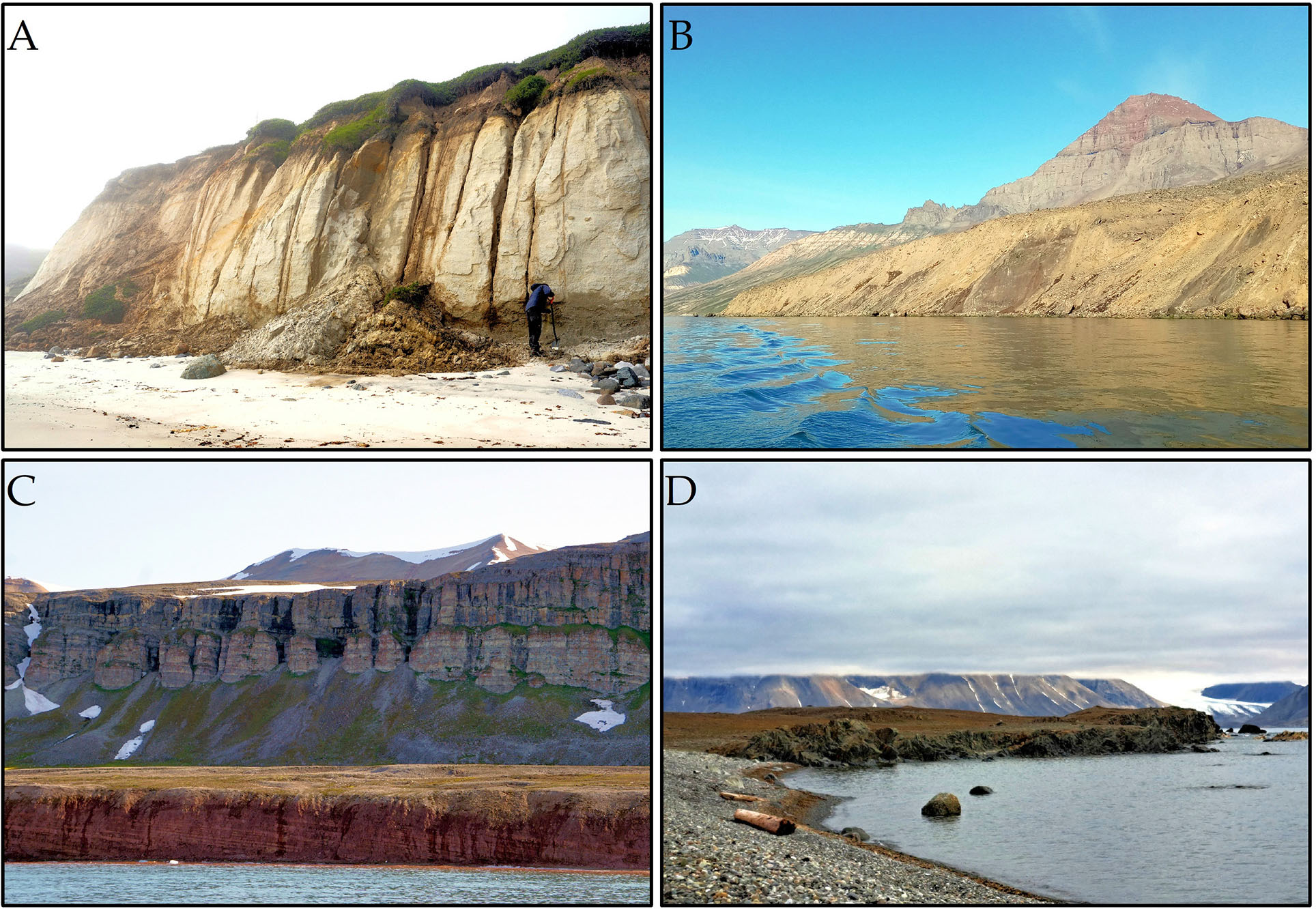
Fig. 3.
Cliff coasts: A – Unconsolidated sedimentary cliff formed in glaciofluvial sediments, southwest Disco Island coast (west Greenland); B – Cliff made of deposits from Paatuut landslide which entered the strait in 2000 and caused a tsunami wave, view from the Vaigat Strait (west Greenland); C – Bedrock cliffs covered with marine deposits, Kongsfjorden (northwest Spitsbergen) views to the southwest; D – Low rocky cliff skerry coast formed in marble, Wilczekodden in Hornsund (Svalbard), view from the west. Photo by M.Kasprzak (A), M.Szczypińska (B), A.Wołoszyn (C), Z.Owczarek (D).
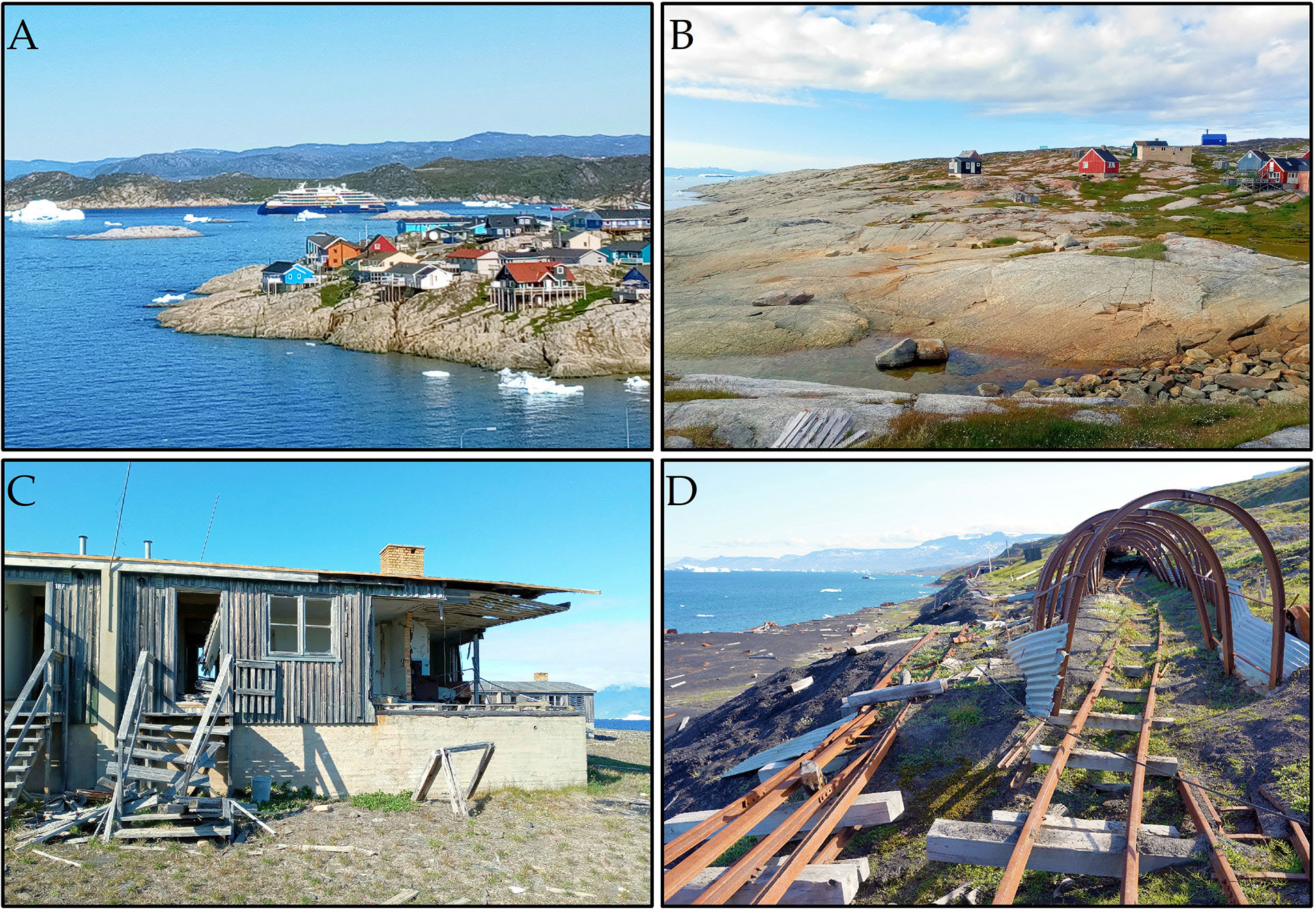
Fig. 4.
Coastal residential buildings in Greenland are exposed to the destructive activity of the sea: A – Ilulissat; B – Oqaatsut. Buildings of Qullissat were destroyed by the tsunami in 2000; C – Damaged residential building; D – Damaged mining infrastructure. Photo by M.Szczypińska (A, B, C), M.Kasprzak (D).
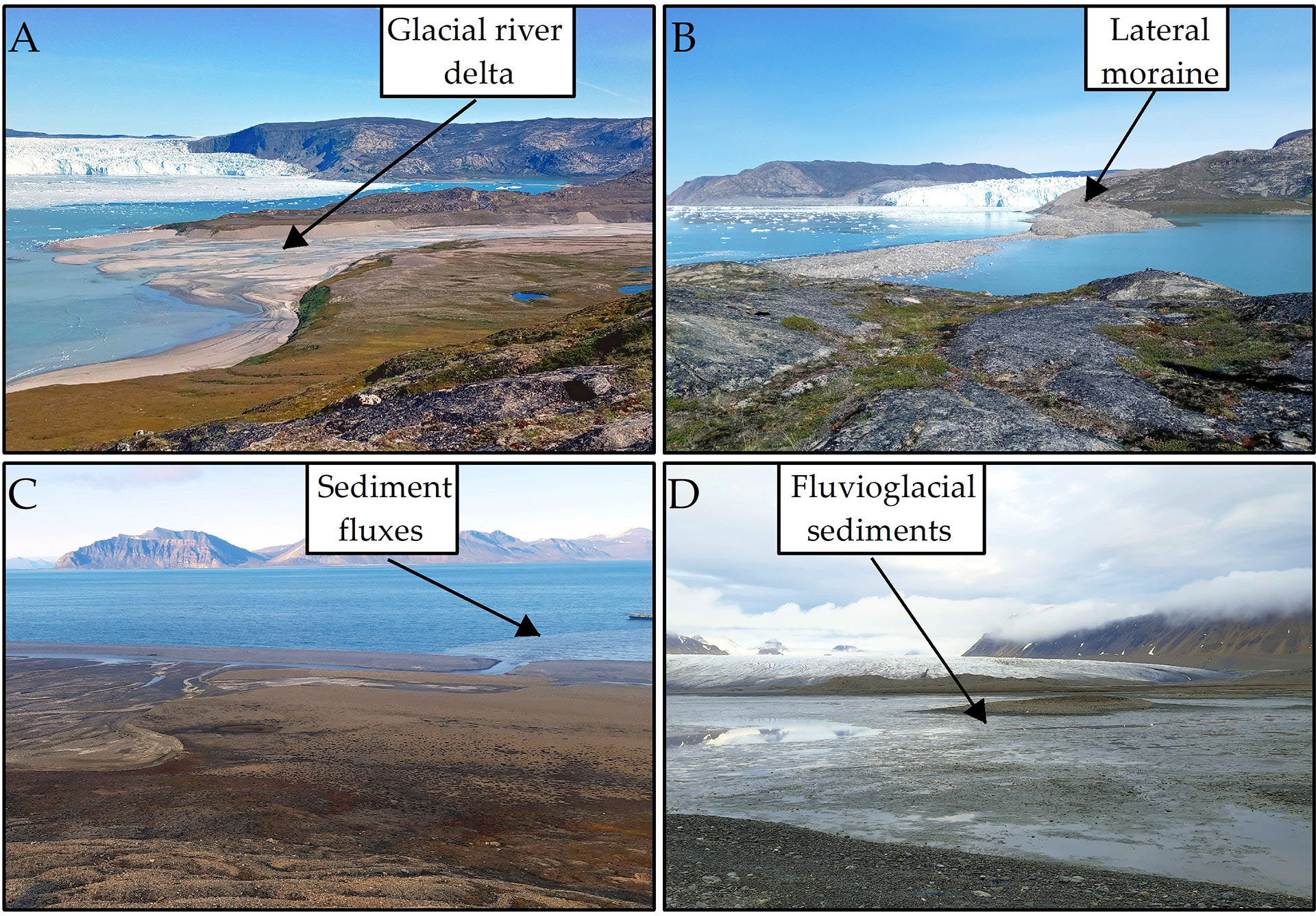
Fig. 5.
Examples of accumulation coastal landforms in the Arctic: A – View of the glacial river delta and marine-terminating glacier Eqip Sermia in the background; B – Lateral moraine of retreating glacier Eqip Sermia separating the lake (previous lagoon) from the open sea; C – Extramarginal outwash of the Scott River with visible sediment fluxes (Calypsostranda, Svalbard); D – Josephbukta Bay with fluvioglacial sediments and Renardbreen Glacier in the background. Photo by M.Szczypińska (A, B), O.Kostrzewa (C, D).
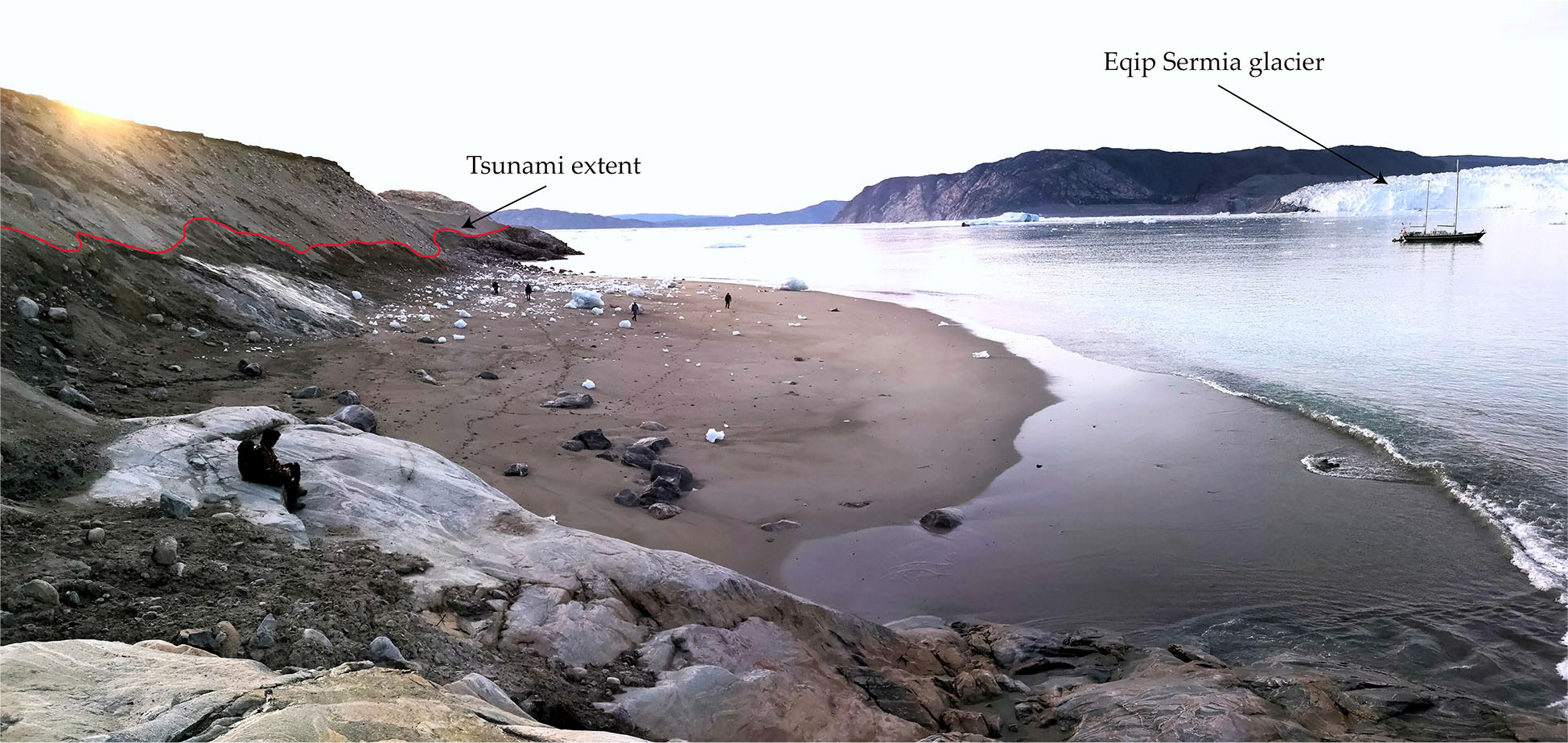
Fig. 6.
The coast opposite the Eqip Sermia glacier affected by a tsunami, which happened due to a calving glacier, was observed on August 8th, 2023. Photo by M.Kasprzak.
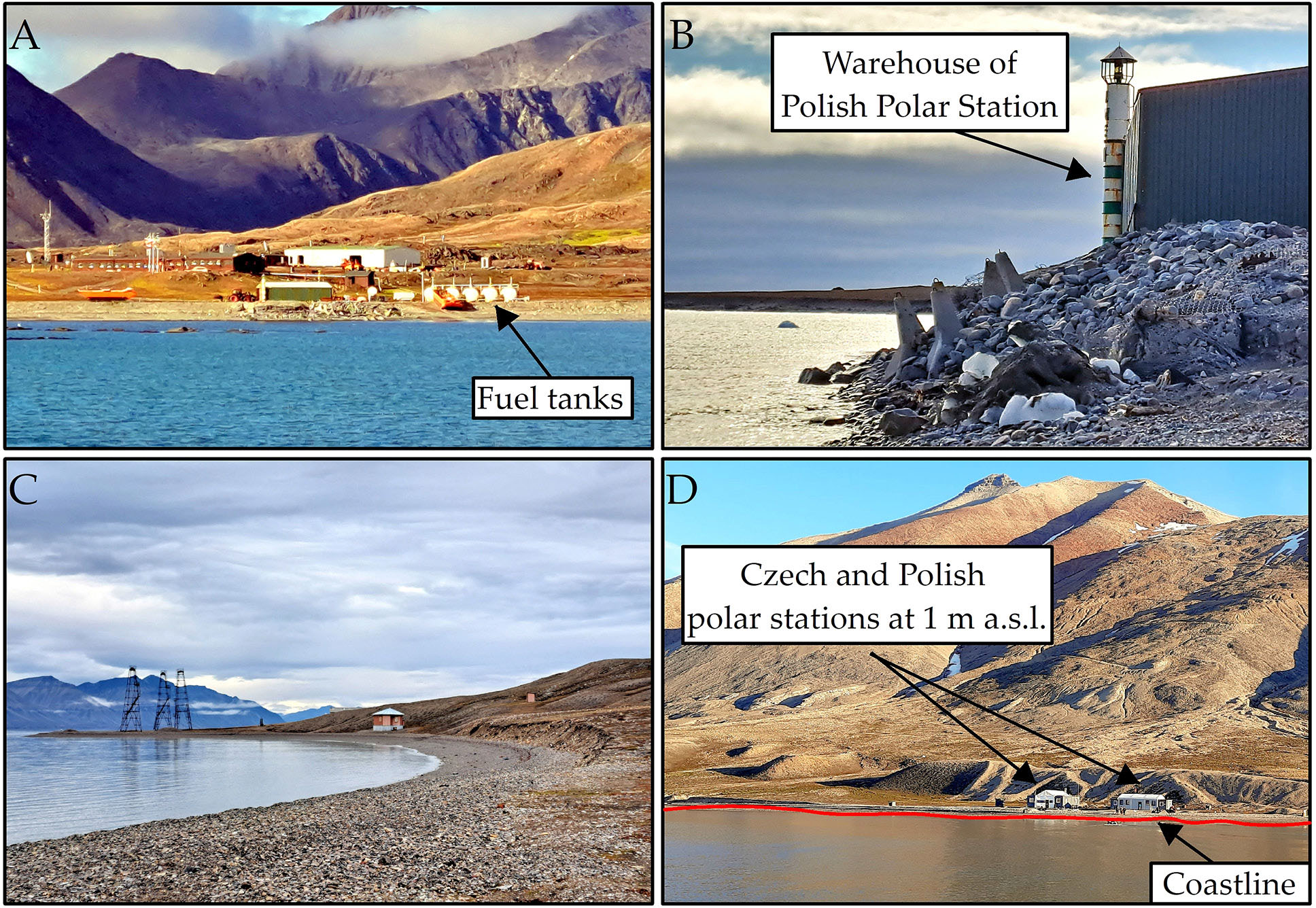
Fig. 7.
Examples of coastal buildings and facilities in Svalbard vulnerable to damage due to their location: A – The Polish Polar Station buildings and facilities on the northern, eroding coast of Hornsund; B – The warehouse of the Polish Polar Station, as a result of long-term erosion of the Hornsund coast, is now on the edge of the land. Its southern wall has already been reinforced several times to prevent damage to the building; C – The remnants of 20th century mining activities are still visible in the landscape of Spitsbergen; D – Polish and Czech polar station buildings located ca. 25–30 m from the coastline at the bottom of Pyramiden Hill. The photo was taken from Petuniabukta Bay. Photo by Z.Owczarek (A, B, C), O.Kostrzewa (D).
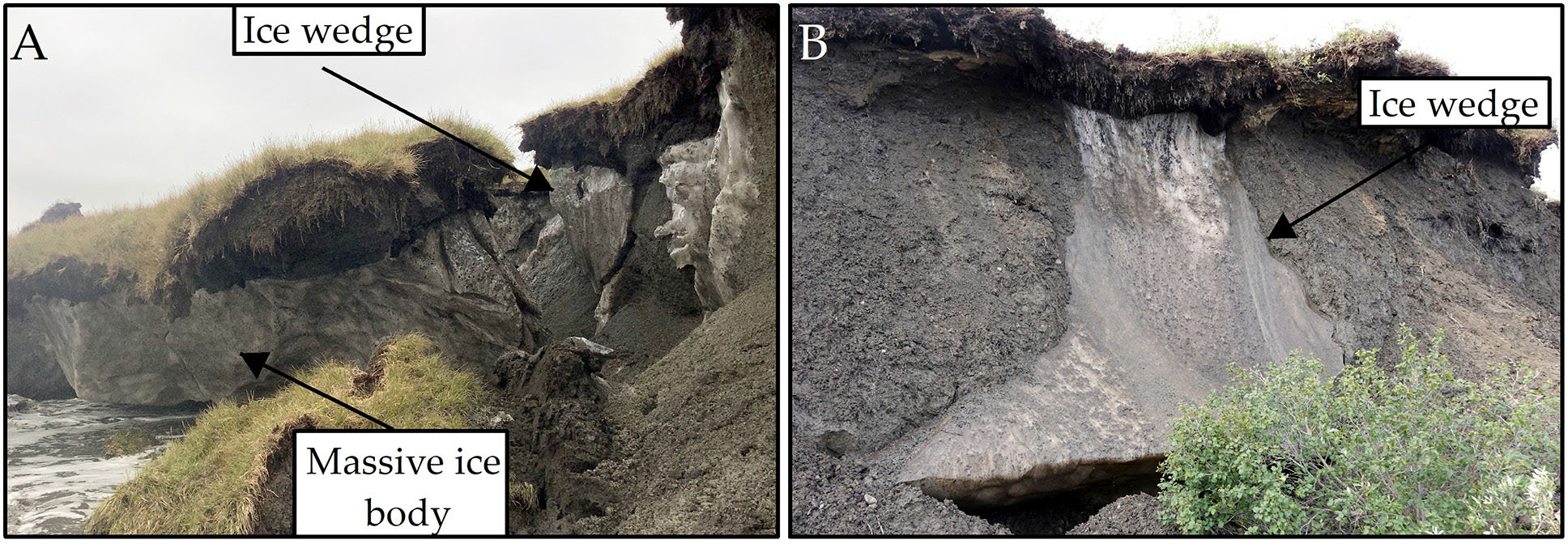
Fig. 8.
Coasts with visible ice wedges and massive ice bodies: A – Alaska; B – Yukon. Photo by L.Farquharson (A), M.Lim (B).
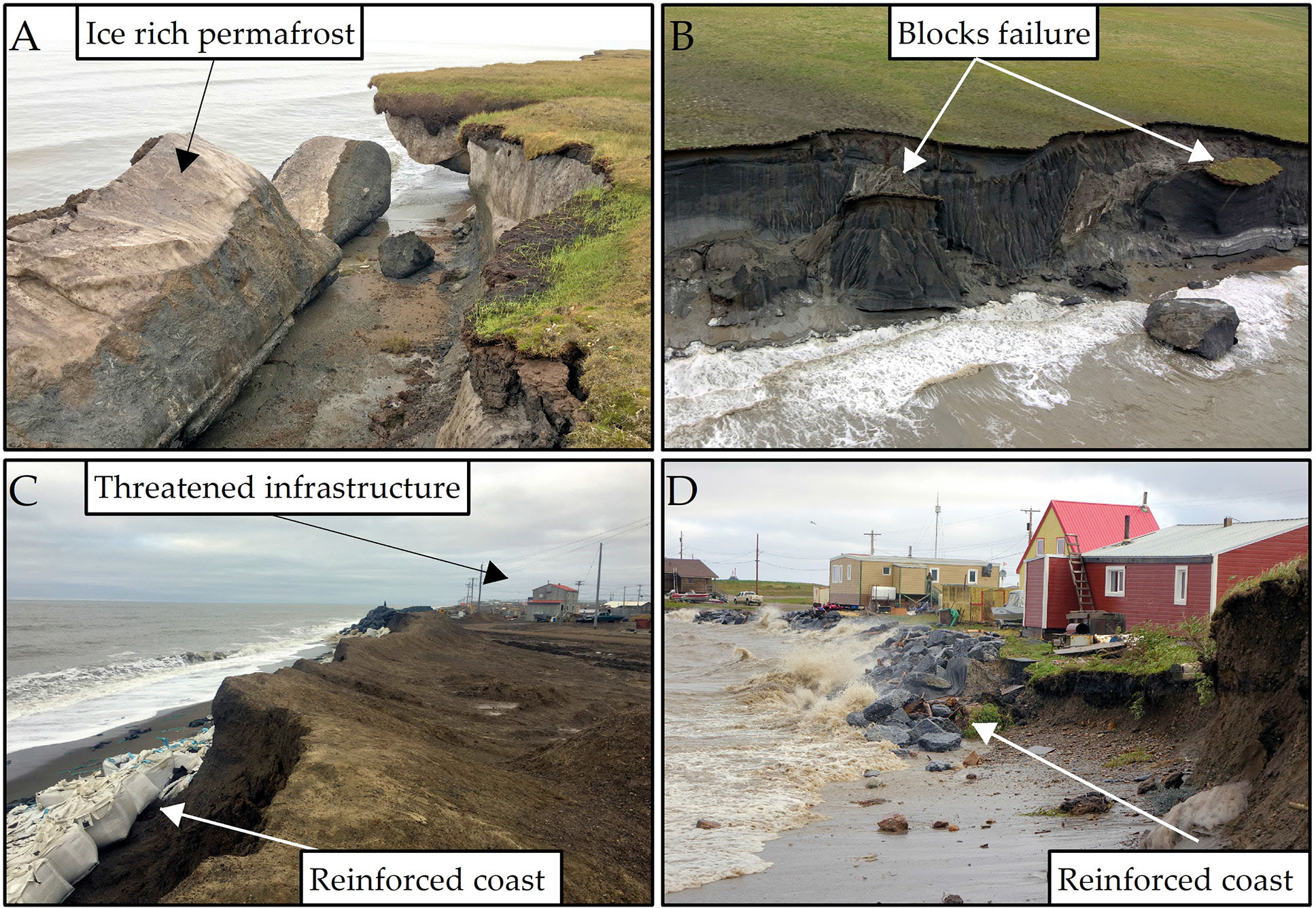
Fig. 9.
Blocks failure caused by thawing permafrost: A – Alaska, B – Yukon. Coastal infrastructure threatened by coastal erosion: C – Alaska, D – Yukon. Nowadays, coastal strengthening can be encountered to slow down erosion processes. Photo by L.Farquharson (A, C), M.Lim (B, D).