
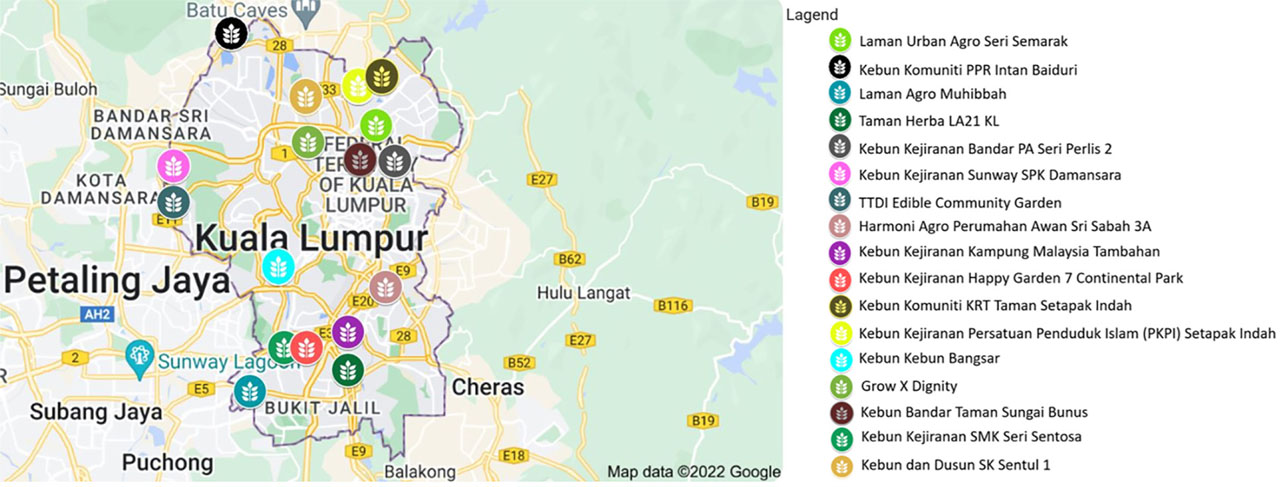
Fig. 1
Map of the locations of all the urban gardens in Kuala Lumpur for the years 2016–2020.
Source: Urus Setia Local Agenda 21 Kuala Lumpur, Dewan Bandaraya Kuala Lumpur, Malaysia.
Table 1
Socio-demographic profile of respondents.
| Characteristics | Frequency | Percentage (%) |
|---|---|---|
| Gender | ||
| Male | 39 | 36.8 |
| Female | 67 | 63.2 |
| Age | ||
| <15 | 5 | 4.7 |
| 15–40 | 43 | 40.6 |
| 41–60 | 51 | 48.1 |
| >60 | 7 | 6.6 |
| Race | ||
| Malay | 83 | 78.3 |
| Chinese | 15 | 14.2 |
| Indian | 4 | 3.8 |
| Others | 4 | 3.8 |
| Educational level | ||
| Primary school | 5 | 4.7 |
| Secondary school | 40 | 37.7 |
| Tertiary school | 61 | 57.5 |
| Other | 0 | 0.0 |
| Number of people in households | ||
| 1–3 | 38 | 35.8 |
| 4–6 | 53 | 50.0 |
| >6 | 15 | 14.2 |
| Household income (RM) | ||
| ≤3,000 | 50 | 47.2 |
| ≤6,275 | 27 | 25.5 |
| ≤13,148 | 29 | 27.4 |
| Experience (years) | ||
| <1 | 26 | 24.5 |
| <3 | 45 | 42.5 |
| <5 | 19 | 17.9 |
| >5 | 16 | 15.1 |
[i] Source: own study.
Table 2
Perspective of practitioners on benefits of urban gardens.
| Statement | Frequency | Percentage (%) |
|---|---|---|
| It is one of the green initiatives by the government to sustain the urban environment. | 104 | 98.1 |
| Building social relationships among farmers | 103 | 97.2 |
| Safe food sources can be produced in the garden. | 101 | 95.3 |
| More nutritional food can be produced from the garden. | 101 | 95.3 |
| Urban people can easily access vegetables and fruits. | 101 | 95.3 |
| Encouraging farmers to do exercise for their health | 198 | 92.5 |
| Urban wastes can be reduced. | 197 | 91.5 |
| People can generate sources of income. | 193 | 87.7 |
| It helps urban poor save their money to buy food sources. | 192 | 86.8 |
| Price of food sources from the garden is cheaper than from the market. | 183 | 78.3 |
[i] Source: own study.
Table 3
Prioritising challenges facing urban gardens.
| Mean | Standard deviation | Priority | |
|---|---|---|---|
| Highly fluctuating weather will affect the yield | 3.76 | 1.06 | 1 |
| Access to available land is a major problem | 3.65 | 1.07 | 2 |
| Financial problems is the main issue | 3.48 | 1.11 | 3 |
| Increased number of pests | 3.48 | 0.89 | 4 |
| Shortage in the number of members to help in managing the garden | 3.47 | 1.07 | 5 |
| Price of pesticide in the market is too high | 3.41 | 1.15 | 6 |
| Flood will damage the yields | 3.40 | 1.18 | 7 |
| Hard to access financial institutions to lend money | 3.40 | 1.03 | 8 |
| Rain will reduce soil fertility | 3.34 | 1.08 | 9 |
| Lack of rain reduces water availability | 3.29 | 1.01 | 10 |
| I am afraid of my produce being stolen | 3.25 | 1.29 | 11 |
| Most of the available land belongs to private owners | 3.19 | 1.08 | 12 |
| Available land is contaminated | 3.09 | 1.09 | 13 |
| Hard to get volunteers to manage the garden | 3.09 | 1.04 | 14 |
| Need to compete for available land with industries | 3.08 | 1.16 | 15 |
| Lack of commitments from communities | 2.99 | 1.02 | 16 |
| Lack of marketing skills | 2.97 | 0.99 | 17 |
| Lack of cold storage | 2.96 | 1.26 | 18 |
| Difficult to access financial resources from the government | 2.90 | 0.98 | 19 |
| Hard to get regular customers | 2.82 | 1.02 | 20 |
| Hard to buy cheap fertiliser near the garden | 2.81 | 1.14 | 21 |
| Hard to find a leader | 2.81 | 1.18 | 22 |
| Hard to access water supply near the garden | 2.80 | 1.23 | 23 |
| Lack of equipment and tools | 2.76 | 1.17 | 24 |
| Price for the produce is too low | 2.70 | 1.03 | 25 |
| Lack of awareness and promotion programmes delivered to urban farmers | 2.67 | 0.95 | 26 |
| Inability and lack of supply of seed | 2.61 | 1.13 | 27 |
| Mostly selling produce to middlemen | 2.49 | 1.16 | 28 |
| Farm is located far from supermarkets | 2.34 | 0.96 | 29 |
| Difficult to get training and consultation from relevant agencies | 2.28 | 0.86 | 30 |
| Difficult to access technical support from authorities or non-governmental organisations to improve knowledge | 2.12 | 0.86 | 31 |
| Hard to access local urban farming information online | 1.95 | 0.79 | 32 |
[i] Source: own study.
Table 4
Technical constraints.
| Constraint | SD freq., % | D freq., % | N freq., % | A freq., % | SA freq., % |
|---|---|---|---|---|---|
| Lack of awareness and promotion programmes delivered to urban farmers | 11 (10.4) | 38 (35.8) | 32 (30.2) | 25 (23.6) | 0 (0.0) |
| Difficult to access technical support from authorities or non-governmental organisations to improve knowledge | 26 (24.5) | 48 (45.3) | 25 (23.6) | 7 (6.6) | 0 (0.0) |
| Difficult to get training and consultation from relevant agencies | 16 (15.1) | 53 (50.0) | 31 (29.2) | 3 (2.8) | 3 (2.8) |
| Hard to access local urban farming information online | 29 (27.4) | 58 (54.7) | 15 (14.2) | 3 (2.8) | 1 (0.9) |
[i] SD – strongly disagree, D – disagree, N – neutral, A – agree, SA – strongly agree
[ii] Source: own study.
Table 5
Resource-related constraints.
| Constraint | SD freq., % | D freq., % | N freq., % | A freq., % | SA freq., % |
|---|---|---|---|---|---|
| Access to available land is a major problem | 6 (5.7) | 12 (11.3) | 13 (12.3) | 57 (53.8) | 18 (17.0) |
| Most of the available land belongs to private owners | 8 (7.5) | 20 (18.9) | 31 (29.2) | 38 (35.8) | 9 (8.5) |
| Need to compete for the available land with industries | 10 (9.4) | 25 (23.6) | 30 (28.3) | 29 (27.4) | 12 (11.3) |
| Available land is contaminated | 9 (8.5) | 23 (21.7) | 31 (29.2) | 35 (33.0) | 8 (7.5) |
| Hard to access water supply near the garden | 14 (13.2) | 38 (35.8) | 21 (19.8) | 21 (19.8) | 12 (11.3) |
| Price of pesticide in the market is too high | 7 (6.6) | 16 (15.1) | 30 (28.3) | 33 (31.1) | 20 (18.9) |
| Hard to buy cheap fertiliser near the garden | 14 (13.2) | 33 (31.1) | 23 (21.7) | 31 (29.2) | 5 (4.7) |
| Inability and lack of supply of seed | 16 (15.1) | 41 (38.7) | 23 (21.7) | 20 (18.9) | 6 (5.7) |
| No access to equipment and tools | 13 (12.3) | 39 (36.8) | 23 (21.7) | 22 (20.8) | 9 (8.5) |
[i] SD – strongly disagree, D – disagree, N – neutral, A – agree, SA – strongly agree
[ii] Source: own study.
Table 6
Economic constraints.
| Constraint | SD freq., % | D freq., % | N freq., % | A freq., % | SA freq., % |
|---|---|---|---|---|---|
| Financial problem is a main issue | 9 (8.5) | 7 (6.6) | 31 (29.2) | 42 (39.6) | 17 (16.0) |
| Difficult to access financial resources from the government | 9 (8.5) | 24 (22.6) | 47 (44.3) | 21 (19.8) | 5 (4.7) |
| Hard to access financial institutions to borrow money | 3 (2.8) | 21 (19.8) | 26 (24.5) | 43 (40.6) | 13 (12.3) |
| Lack of marketing skill | 8 (7.5) | 23 (21.7) | 45 (42.5) | 24 (22.6) | 6 (5.7) |
| Price for the produce is too low | 11 (10.4) | 39 (36.8) | 31 (29.2) | 21 (19.8) | 4 (3.8) |
| Hard to get regular customers | 9 (8.5) | 35 (33.0) | 32 (30.2) | 26 (24.5) | 4 (3.8) |
| Mostly sell produce to middlemen | 22 (20.8) | 38 (35.8) | 26 (24.5) | 12 (11.3) | 8 (7.5) |
| Farm is located far from supermarkets | 21 (19.8) | 41 (38.7) | 33 (31.1) | 9 (8.5) | 2 (1.9) |
| Lack of cold storage | 16 (15.1) | 29 (27.4) | 12 (11.3) | 41 (38.7) | 8 (7.5) |
[i] SD – strongly disagree, D – disagree, N – neutral, A – agree, SA – strongly agree
[ii] Source: own study.
Table 7
Social constraints.
| Constraint | SD freq., % | D freq., % | N freq., % | A freq., % | SA freq., % |
|---|---|---|---|---|---|
| Shortage in the number of members to help in managing the garden | 4 (3.8) | 13 (12.3) | 40 (37.7) | 27 (25.5) | 22 (20.8) |
| Hard to get volunteers to manage the garden | 6 (5.7) | 27 (25.6) | 31 (29.2) | 35 (33.0) | 7 (6.6) |
| Lack of commitment from the public | 10 (9.4) | 23 (21.7) | 33 (31.1) | 38 (35.8) | 2 (1.9) |
| Hard to find a leader | 13 (12.3) | 36 (34.0) | 25 (23.6) | 22 (20.8) | 10 (9.4) |
| I’m afraid of having my produce stolen. | 9 (8.5) | 27 (25.5) | 22 (20.8) | 25 (23.6) | 23 (21.7) |
[i] SD – strongly disagree, D – disagree, N – neutral, A – agree, SA – strongly agree
[ii] Source: own study.
Table 8
Environmental constraints.
| Constraint | SD freq., % | D freq., % | N freq., % | A freq., % | SA freq., % |
|---|---|---|---|---|---|
| Highly fluctuating weather will affect the yield | 4 (3.8) | 8 (7.5) | 26 (24.5) | 39 (36.8) | 29 (27.4) |
| Rain reduces soil fertility | 7 (6.6) | 16 (15.1) | 29 (27.4) | 42 (39.6) | 12 (11.3) |
| Lack of rain reduces water availability | 5 (4.7) | 22 (20.8) | 22 (20.8) | 51 (48.1) | 6 (5.7) |
| Flood will damage the yields | 8 (7.5) | 18 (17.0) | 22 (20.8) | 40 (37.7) | 18 (17.0) |
| Increase in the number of pests | 3 (2.8) | 11 (10.4) | 32 (30.2) | 52 (49.1) | 8 (7.5) |
[i] SD – strongly disagree, D – disagree, N – neutral, A – agree, SA – strongly agree
[ii] Source: own study.
Table 9
Correlation coefficient (r) between the socio-demographic background and the challenges of urban gardens
| Technical | Resource-related | Economical | Social | Environmental | ||
|---|---|---|---|---|---|---|
| Gender | Spearman rho | −0.031 | −0.173 | −0.166 | −0.058 | −0.062 |
| Significance | 0.750 | 0.077 | 0.089 | 0.552 | 0.527 | |
| Age | Spearman rho | −0.031 | −0.131 | −0.103 | −0.164 | −0.410** |
| Significance | 0.753 | 0.179 | 0.294 | 0.193 | 0.0 | |
| Race | Spearman rho | 0.210* | −0.051 | −0.112 | 0.201* | −0.149 |
| Significance | 0.031 | 0.603 | 0.255 | 0.039 | 0.128 | |
| Education level | Spearman rho | 0.225* | 0.041 | −0.088 | 0.021 | −0.097 |
| Significance | 0.021 | 0.674 | 0.370 | 0.830 | 0.323 | |
| Number of people in households | Spearman rho | −0.177 | −0.047 | 0.111 | 0.072 | 0.109 |
| Significance | 0.070 | 0.631 | 0.256 | 0.464 | 0.267 | |
| Monthly household income | Spearman rho | 0.043 | −0.126 | −0.223* | −0.119 | −0.197** |
| Significance | 0.660 | 0.199 | 0.021 | 0.226 | 0.043 | |
| Experience | Spearman rho | −0.143 | 0.018 | −0.003 | −0.052 | −0.002 |
| Significance | 0.143 | 0.857 | 0.979 | 0.594 | 0.981 |