

Table 1.
Comparison of the existing work with HAR
| Ref | Methods | Pros | Cons | Performance measures used |
|---|---|---|---|---|
| [10] | TD-Net | The method was effective in both dimensions, delivering strong performance on extensive datasets. | It failed to address the computational complexity associated with implementation, limiting its practical application in scenarios requiring immediate processing. | Accuracy-79.3% F1-score-64.15% Training time-0.5ms Inference time-0.05ms Params-1.88M GFLOPs-0.028 |
| [11] | CNN-RNN | The DT model enhances the descriptive human action features by integrating the DWT technique. This approach improves the performance of action recognition by leveraging both engineered features and learned ones, thereby harnessing the advantages of both methodologies. | Absence of temporal domain diversity in terms of time scales. | Accuracy-95.68 |
| [12] | CNN-BiLSTM | The approach was intended to seize both short-range and extended dependencies within sequential data, ensuring a comprehensive understanding of temporal relationships across various time scales. | Inability to incorporate contextual information from multiple branches into the model architecture hindered its capability to effectively seize nuanced outlines in the data. | Accuracy-96.37 F1-score-96.31 Training time-53.68 Params-631,014 |
| [13] | HAR transformer | Greater temporal spacing between features in the time series provided enhanced contextual comprehension across extended sequences. | Lack of testing the modified transformer on a prolonged database, preferably integrating diverse sensor data, limited a comprehensive evaluation. | Accuracy-99.2 Precision-99.2 Recall-99 |
| [14] | CNN-LSTM | The recognition accuracy was improved by leveraging user similarity and weighting training data, allowing for a more refined learning process that accounted for individual user characteristics and preferences. | It failed to focus on the advances observed in wearable and phone-based tracking systems. | Accuracy-98.76 Params-634,052 Recall-99.93 |
| [15] | ViCo-MoCo-DL | This method effectively utilizes video encoding and motion estimation techniques, combined with DL, for enhanced HAR. | Absence of evaluation across diverse datasets limits the generalizability of the findings. | Accuracy-97% |
| [16] | CNN-Bi-GRU | This technique leverages DL through CNN and Bi-GRUs for improved HAR performance. | Lack of comprehensive feature selection techniques, theoretically leading to suboptimal performance and increased computational complexity. | Accuracy-93.38 Average time-7.15s |
| [17] | Deep BiLSTM | The utilization of the model improved through transfer-learning-based attribute extraction for dynamic HAR. | Inability to evaluate across diverse datasets, potentially limiting the generalizability of the model’s performance. | Accuracy-99.2% |
| [18] | TransTM | By utilizing a time-streaming multiscale transformer for device-free HAR. | Lack of extensive validation across diverse scenarios, potentially limiting the generalizability of its performance outside controlled environments. | Accuracy-99.1% F1-score-99.1% FLOPs-27.98M Params-1.82M |
| [19] | RNN-LSTM | Its capability to perform DL based HAR directly on edge devices. | Inability to constrain resources in edge environments, potentially limiting the model’s performance or scalability on such platforms. | Accuracy-99.31% Recall-99.09% F1-score-99.06% Time-0.298ms |
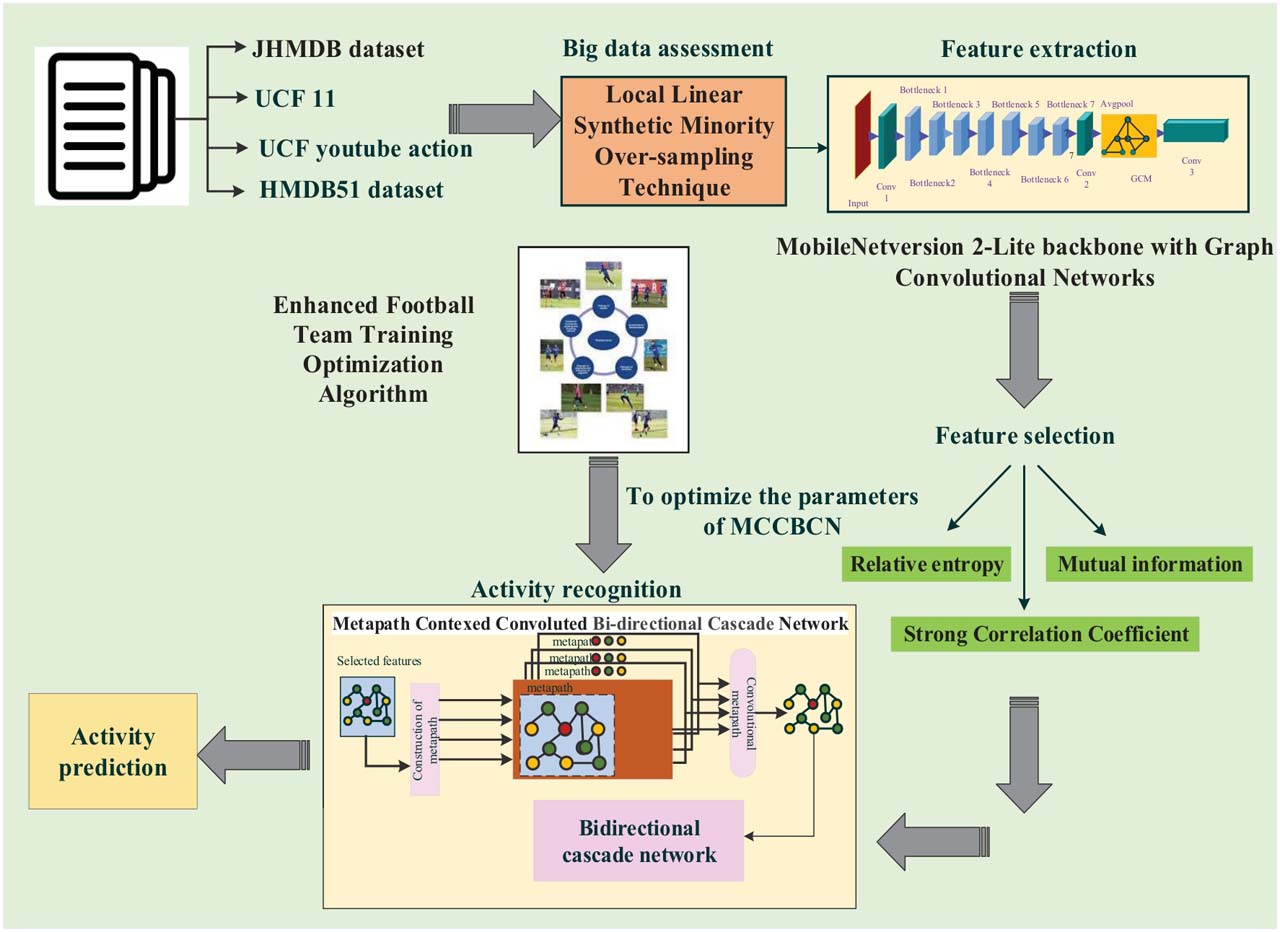
Figure 1.
Workflow of the proposed work
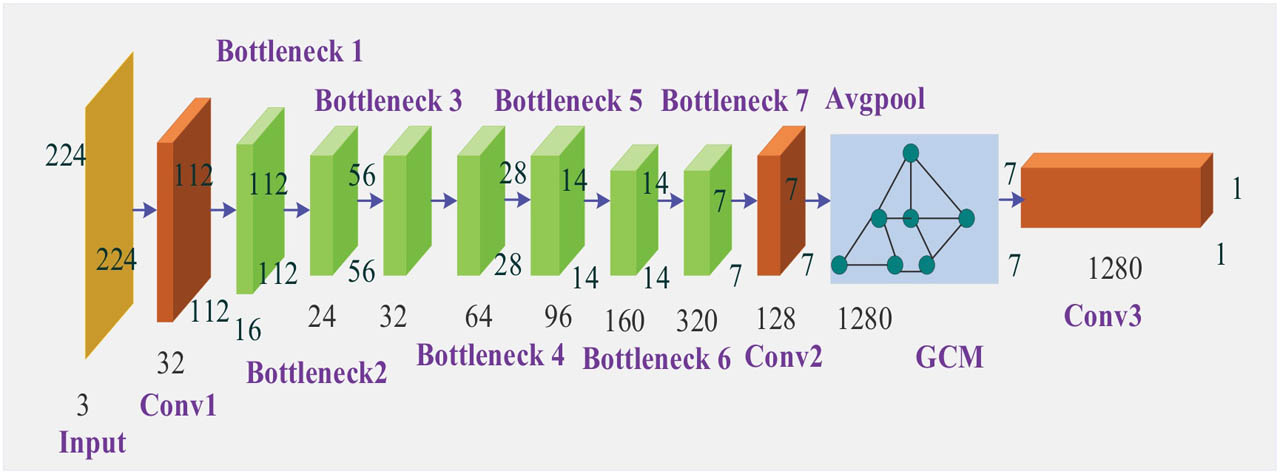
Figure 2.
MobileNetV2 with GCN model
Table 2.
Pseudo code of EFTTO
| Initialize FTTA |
| CLC |
| // Function parameters objectives set |
| Set Maxgen = 500 // Iterations numbers |
| Set npop = 50 // Population size |
| Set Pstudy = 0.2 // Probability of study |
| Set Pcomm = 0.2 // Probability of communication |
| Set Perror = 0.001 // Probability of error |
| // Initialization |
| For I = 1 to Maxgen Do |
| // Initialization loop starts here |
| For each i from 1 to npop Do |
| The fitness value of each football player is calculated, which is expressed in Eqn. (11): |
| End for |
| Find the finest player & the worst player |
| // Collective Training Phase begins |
| Collective training: |
| For every i : 1 ≤ i ≤ nPop do |
| End for |
| Update the players |
| Find the best player |
| Additional individualized training: |
| End for |
| T = T + 1 |
| Exit the while loop |
| Exit the for loop |
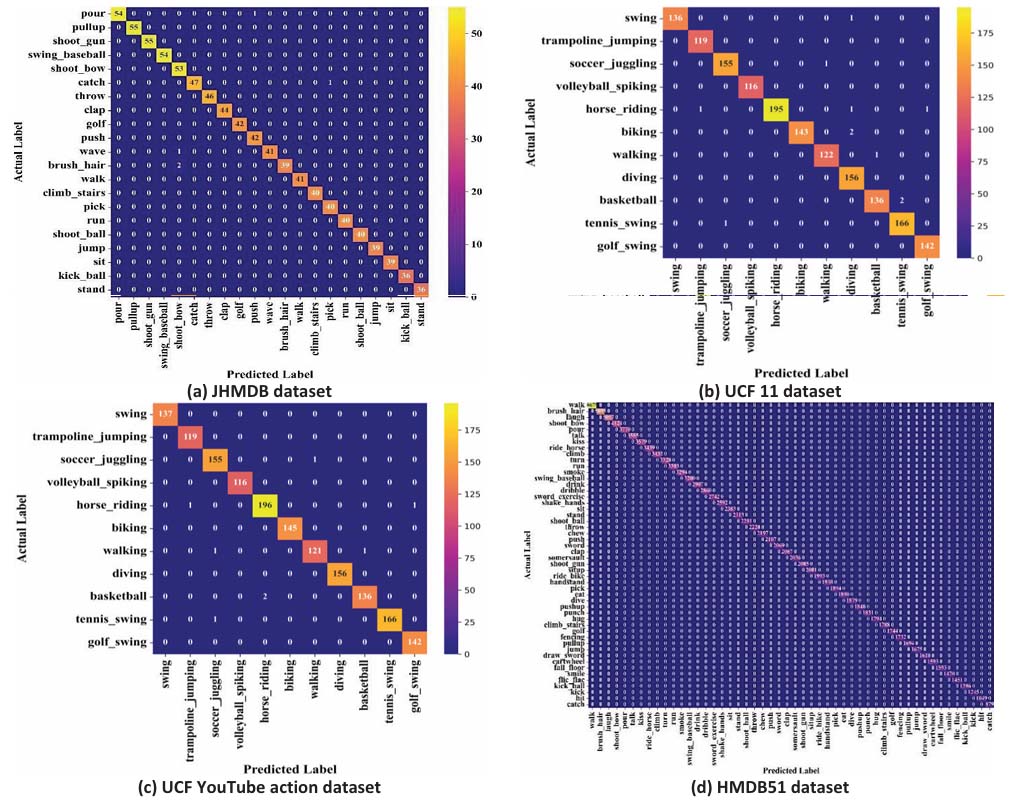
Figure 3.
Confusion matrix of the corresponding datasets
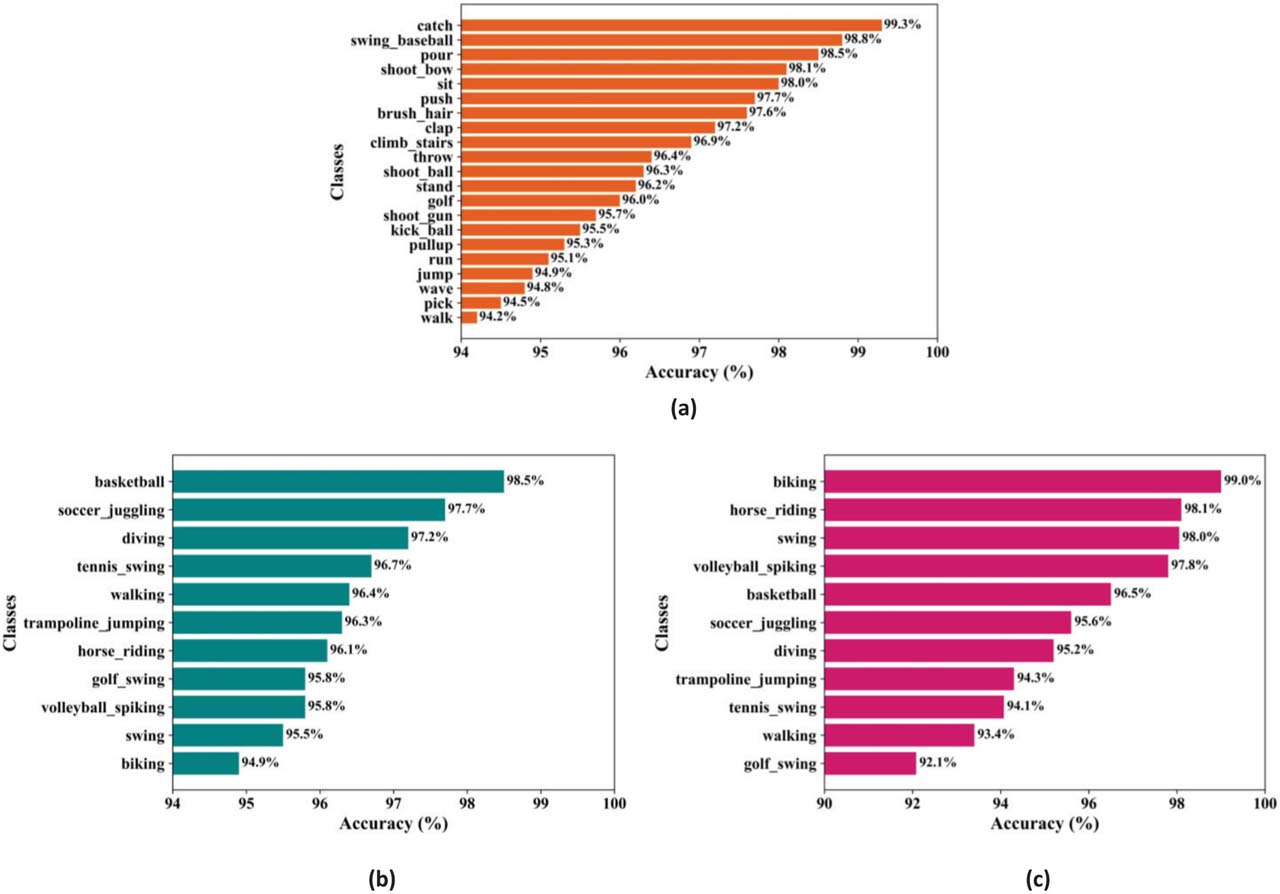
Figure 4.
(a, b and c). Class-wise accuracies of the corresponding datasets
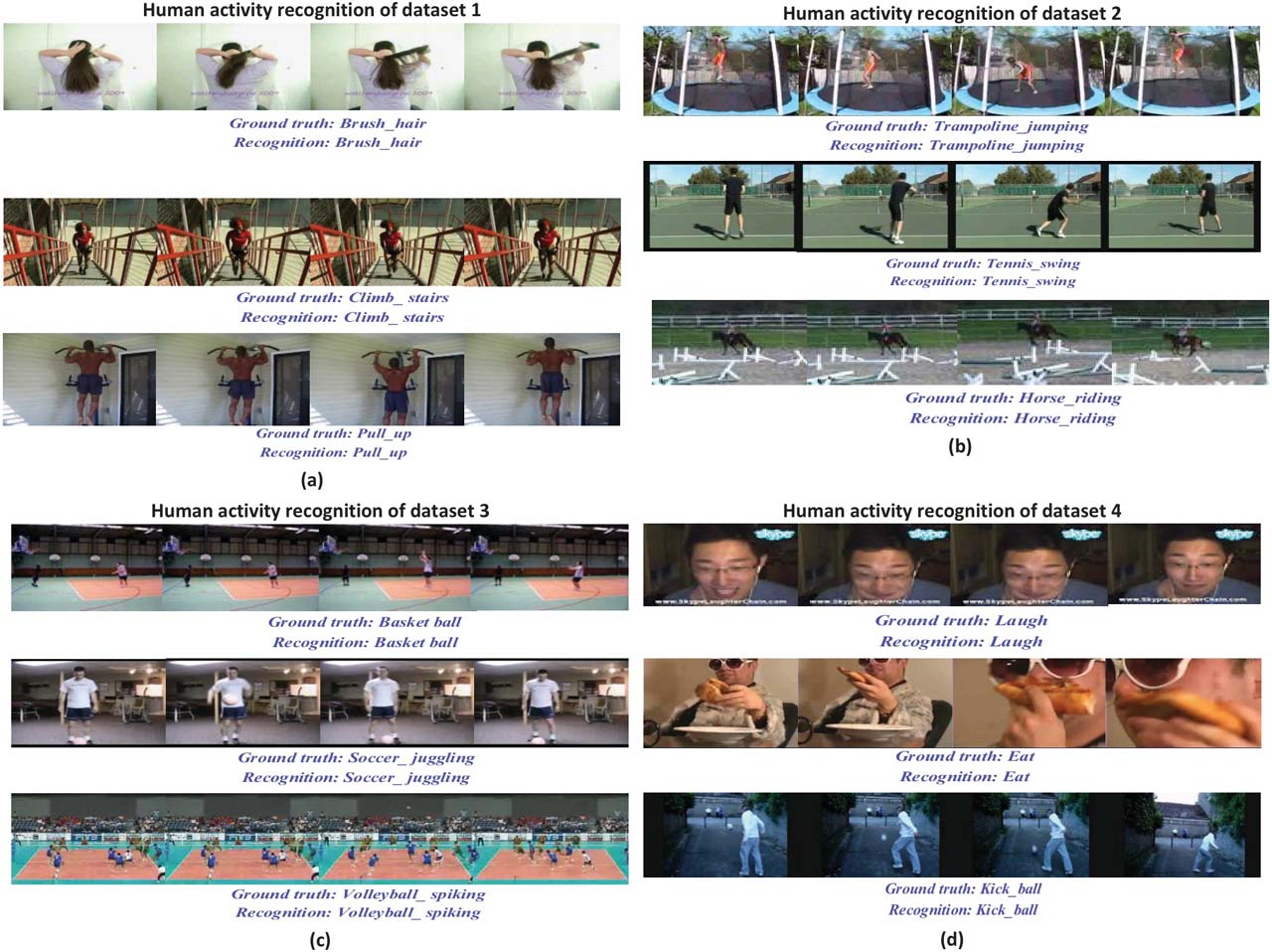
Figure 5.
(a), (b), (c) and (d). Activity recognition outcomes using the proposed method
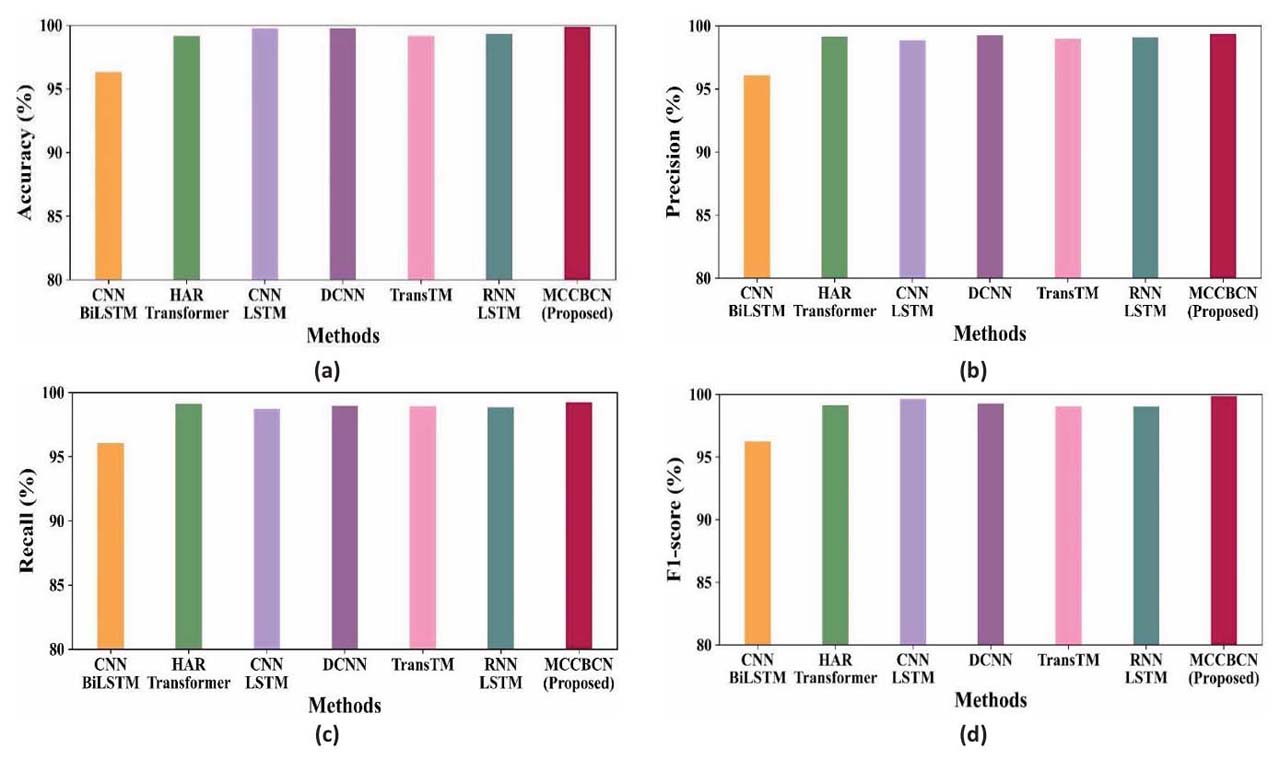
Figure 6.
(a) accuracy, (b) precision, (c) recall, and (d) F1-score on recent HAR techniques
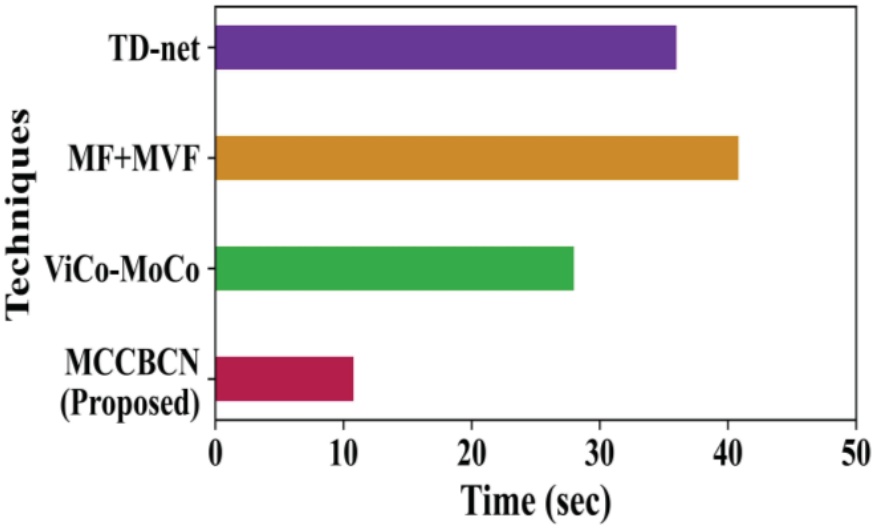
Figure 7.
Time complexity analysis
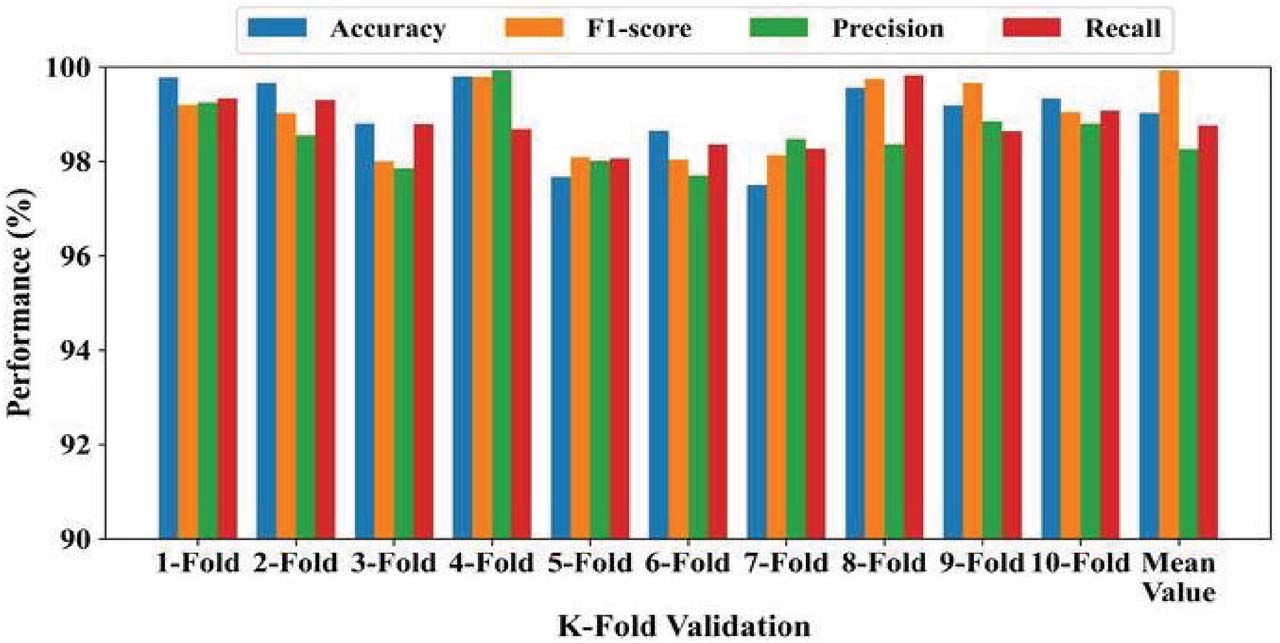
Figure 8.
K-fold validation analysis
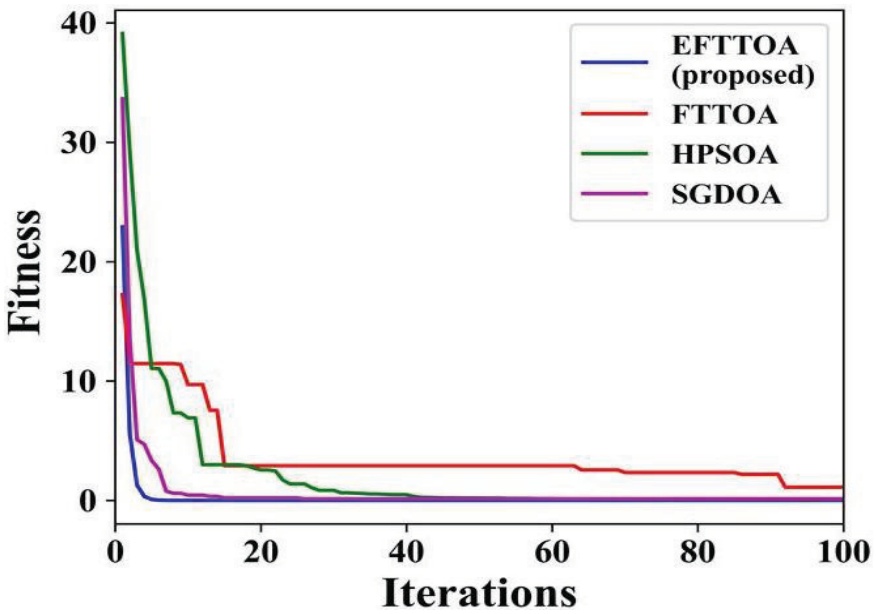
Figure 9.
Fitness curve
Table 5.
Ablation study of the introduced method with their datasets
| Model Configuration | JHMDB Accuracy (%) | UCF 11 Accuracy (%) | UCF YouTube Action Accuracy (%) | HMDB51 Accuracy (%) |
|---|---|---|---|---|
| Full MCCBCN architecture | 99.34 | 99. 39 | 99.42 | 99.45 |
| Without Metapath Context | 85.9 | 86.7 | 85.9 | 85.3 |
| Without Bi-directional Cascade | 89.3 | 86.2 | 87.7 | 88.3 |
| Without EFTTOA Integration | 89.1 | 88.1 | 88.5 | 87.2 |
| Without LSMOST | 88.5 | 85.5 | 86.1 | 87.8 |
| Without MobileNetV2-Lite & GCN Integration | 88.9 | 88.1 | 86.7 | 87.7 |