

Table 1.
Comparison of commonly used semi-supervised methods
| Method | Description | Advantages | Applications |
|---|---|---|---|
| Co-training | Uses multiple models trained on different views of data to iteratively improve predictions | Effective use of unlabeled data, robustness to noisy data | Text categorization, recommender systems |
| Self-training | Iteratively labels unlabeled data using a model trained on labeled data | Simple and intuitive, easy implementation | Text classification, image recognition |
| Tri-training | Extension of Co-training with three classifiers, enhancing model robustness | Improved performance with three different views | Sentiment analysis, social network analysis |
| Label propagation | Propagates labels from labelled to unlabeled instances based on similarity | Utilizes local information effectively, scalable | Community detection, recommendation systems |
| Graph-based methods | Uses graph structure to propagate labels and capture relationships | Captures complex relationships, robust to noise | Social network analysis, recommendation systems |
| Semi-supervised SVM | Applies SVM with labelled and unlabeled data to learn decision boundaries | Utilizes margin maximization, effective for non-linear boundaries | Image recognition, text classification |
| Expectation Maximization | It iteratively estimates the parameters of a probabilistic model with hidden variables | Handles missing data, robust to noise | Clustering, anomaly detection |
| Transudative SVM | SVM variant that learns from both labelled and unlabeled data simultaneously | Utilizes unlabeled data for decision boundary optimization | Classification, pattern recognition |
| Generative Models | Models that generate data based on learned probability distributions | Provides insights into data distribution, scalable with large datasets | Data generation, anomaly detection |
| Semi-supervised Deep Learning | Deep learning models trained with both labelled and unlabeled data | Captures intricate patterns, effective for large-scale data | Natural language processing, image recognition |
Table 2.
Issues and challenges of existing approaches
| Issue/Challenge | Description | References |
|---|---|---|
| Quality of Pseudo-labels | The quality of pseudo-labels, inferred labels assigned to unlabeled data based on model predictions, is pivotal in semi-supervised learning for recommendation systems. Incorrect or noisy pseudo-labels can degrade model performance by introducing bias or inconsistencies. High-quality pseudo-label generation often requires robust methods for handling label noise and uncertainty. Ensuring the quality of pseudo-labels through techniques such as self-training or confidencebased filtering is crucial to improving the effectiveness of recommendation systems. | [23–25] |
| Data Distribution | Ensuring alignment in the distribution of labeled and unlabeled data is essential to prevent bias in models. Differences in data distribution can lead to models that do not generalize well, affecting the accuracy and effectiveness of recommendations across diverse user preferences and item characteristics. | [26,27] |
| Model Overfitting | Preventing overfitting is critical, especially when using ensemble techniques with limited labelled data. Ensemble models, which combine multiple base learners, can potentially memorize noise in the training data, leading to poor generalization on unseen data. Proper regularization and validation strategies are necessary to mitigate this risk. | [28–30] |
| Scalability | Managing computational resources effectively is crucial, particularly with large-scale datasets common in recommendation systems. Ensemble methods can be computationally intensive due to the need to train and integrate multiple models. Scalable implementation and optimization are necessary to ensure efficient processing and deployment in real-world applications. | [31,32] |
| Algorithm Complexity | Implementing and tuning ensemble algorithms requires expertise and computational resources. Ensemble methods involve integrating diverse algorithms or models, each with its own parameters and configurations. Optimizing these parameters and ensuring compatibility across different techniques requires advanced knowledge and careful experimentation. | [33,34] |
| Evaluation Metrics | Developing metrics that accurately assess recommendation quality beyond traditional metrics like MAE and RMSE is challenging. Recommendation systems aim to enhance user satisfaction and engagement, which may not be fully captured by standard metrics. Developing and adopting metrics that align with user preferences and business objectives is essential for comprehensive evaluation. | [35, 36] |
| Robustness to Concept Drift | Adapting models to changes in user preferences or item popularity over time is crucial for maintaining recommendation accuracy. Concept drift occurs when the underlying relationships between users and items evolve, requiring continuous model adaptation. Ensuring robustness to concept drift involves monitoring data changes and updating models accordingly to provide relevant recommendations. | [37, 38] |
| Interpretability | Ensuring transparency in decision-making processes within complex ensemble models is challenging. Ensemble methods often combine diverse models or algorithms, making it difficult to interpret how decisions are made. Enhancing interpretability helps build user trust and facilitates debugging and refinement of recommendation systems. | [39–41] |
| Data Privacy and Security | Addressing privacy concerns when using unlabeled data, especially in sensitive domains, is paramount. Unlabeled data may contain sensitive information about users or items, raising privacy risks if not handled properly. Implementing data anonymization techniques and adhering to privacy regulations are essential to protect user confidentiality and trust. | [42–44] |
Table 3.
Description of the core features of the MovieLens 100K dataset
| Sl. No. | Feature | Data type | Description |
|---|---|---|---|
| 1 | userid | Numeric | User ID |
| 2 | movield | Numeric | Movie ID |
| 3 | rating | Numeric | Rating given by the user |
| 4 | timestamp | Numeric | Timestamp of the rating |
Table 4.
Description of the core features of the FilmTrust dataset
| Sl. No. | Feature | Data type | Description |
|---|---|---|---|
| 1 | userId | Numeric | User ID |
| 2 | itemId | Numeric | Movie ID |
| 3 | rating | Numeric | Rating given by user (0.5-4.0) |
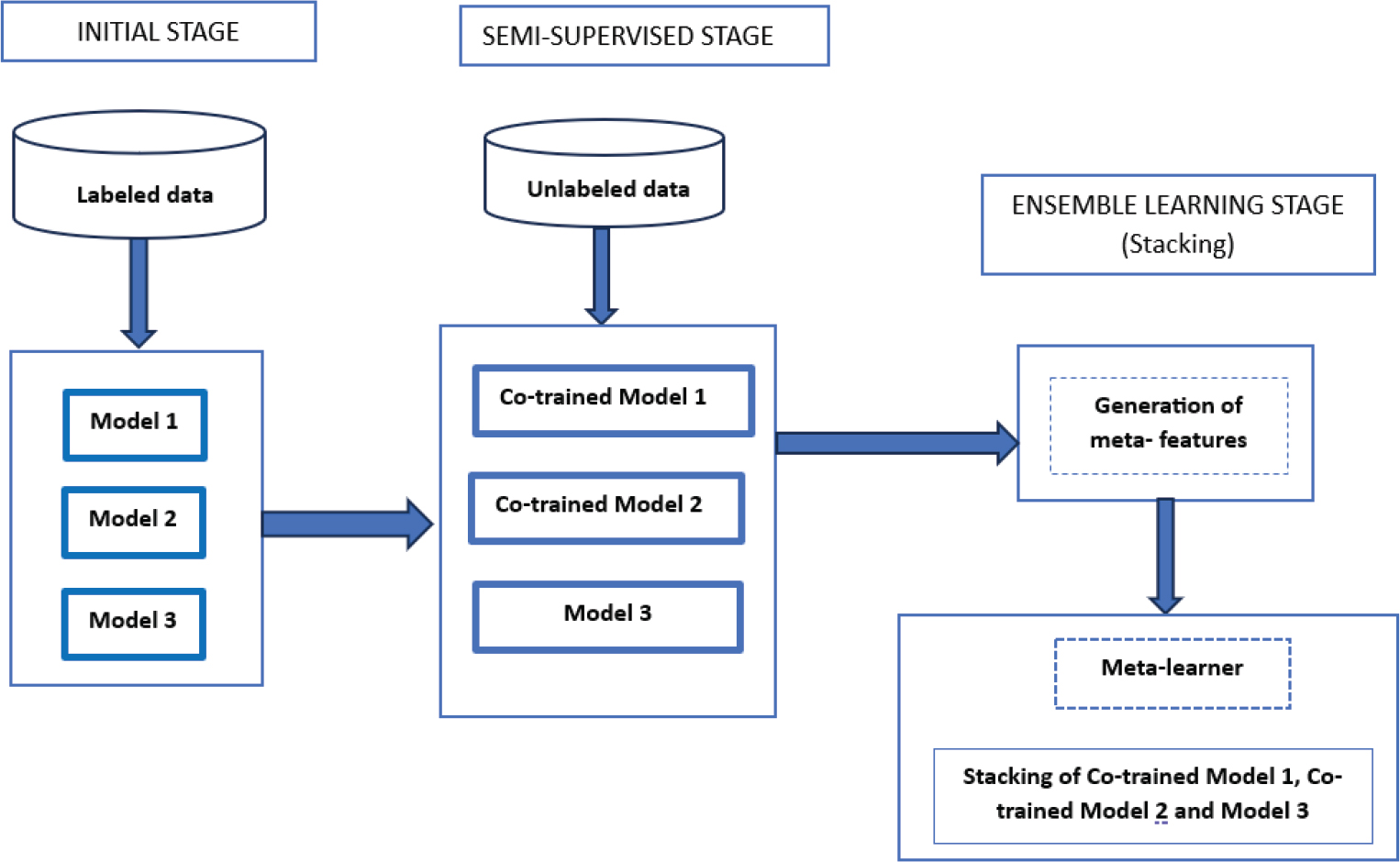
Figure 1.
Flow chart of our proposed CTEL approach
Table 5.
Dataset characteristics, highlighting the dataset’s degree of sparsity for rating prediction tasks
| Dataset | User | Item | Ratings | Density |
|---|---|---|---|---|
| MovieLens 100K | 943 | 1682 | 100,000 | 6.3% |
| FilmTrust | 1508 | 2071 | 35,497 | 1.14% |
Table 6.
Comparison of our proposed CTEL model with collaborative approaches and blending ensemble technique
| Dataset | Metric | U-Col | I-Col | SVD++ | Blending | CTEL |
|---|---|---|---|---|---|---|
| MovieLens | RMSE | 0.99 | 0.95 | 0.90 | 0.89 | 0.83 |
| MSE | 0.98 | 0.91 | 0.81 | 0.79 | 0.70 | |
| MAE | 0.76 | 0.73 | 0.69 | 0.69 | 0.64 | |
| FilmTrust | RMSE | 0.89 | 0.81 | 0.79 | 0.78 | 0.70 |
| MSE | 0.83 | 0.66 | 0.63 | 0.62 | 0.49 | |
| MAE | 0.70 | 0.62 | 0.61 | 0.61 | 0.54 |
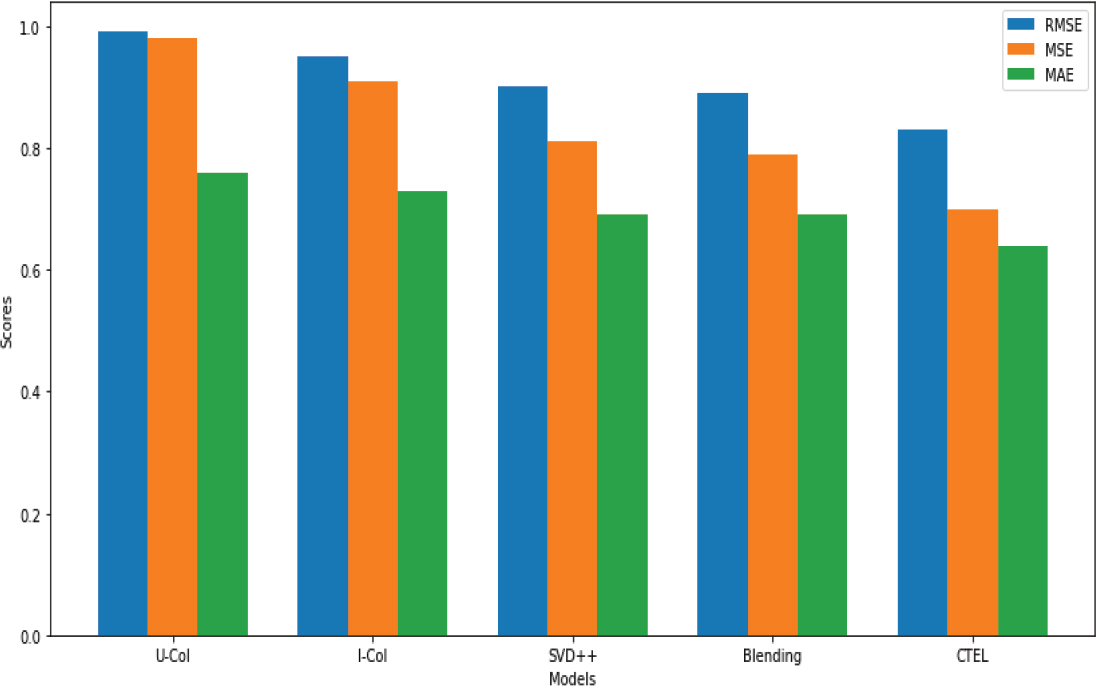
Figure 2.
Comparison of metrics across different models (MovieLens dataset)
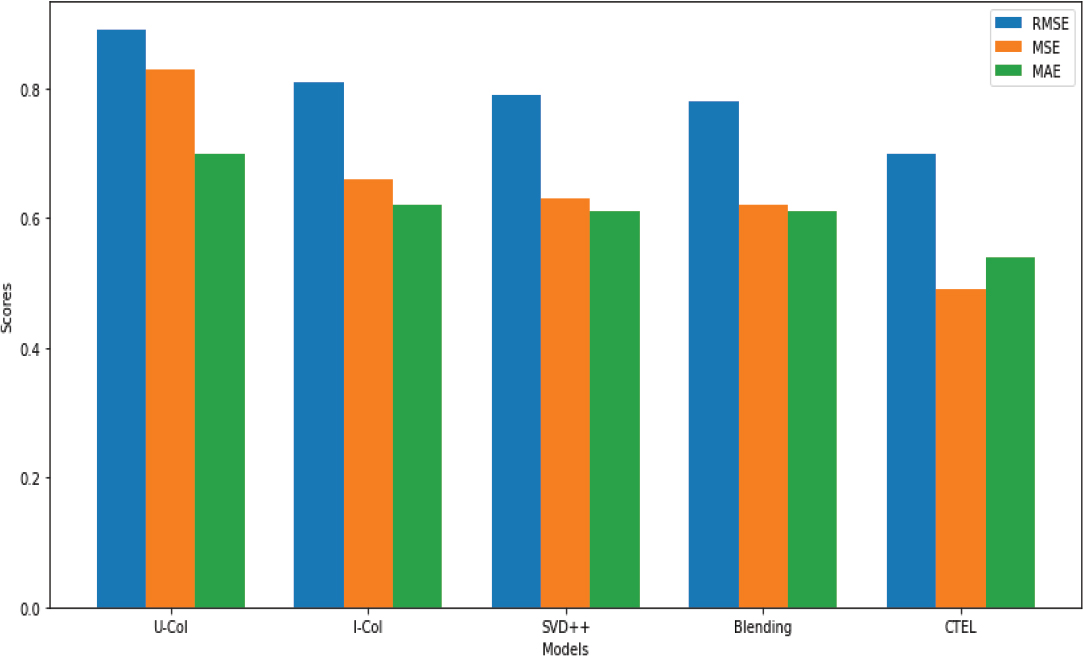
Figure 3.
Comparison of metrics across different models (FilmTrust dataset)