
Figure 1
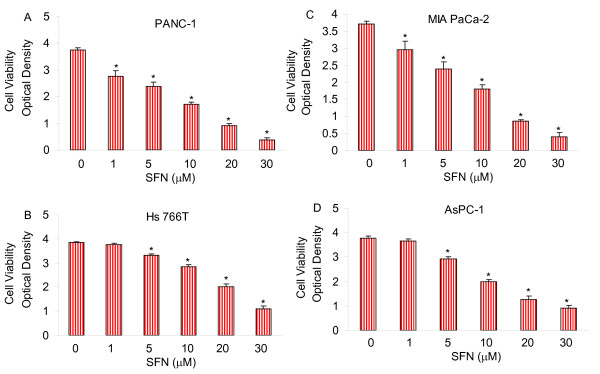
Effect of sulforaphane (SFN) on viability of pancreatic cancer cells. Pancreatic cancer (PANC-1, MIA PaCa-2, Hs766T and AsPC-1) cells were treated with SFN (0-30 μM) for 48 h. Cell viability was measured by XTT assay. Data represent the mean ± S.D. * = significantly different from respective controls, P < 0.05.
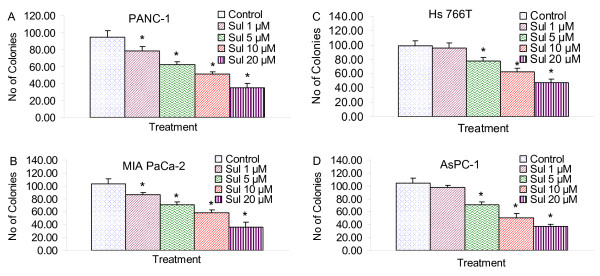
Figure 2
Effect of sulforaphane (SFN) on colony formation. Pancreatic cancer (PANC-1, MIA PaCa-2, Hs766T and AsPC-1) cells were treated with SFN (0-20 μM), and number of colonies were counted. Data represent the mean ± S.D. * = significantly different from respective controls, P < 0.05.
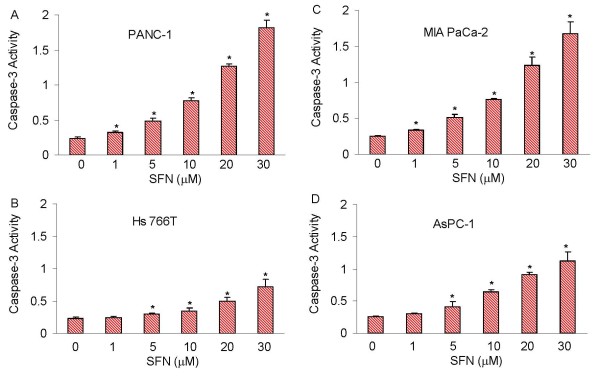
Figure 3
Effect of sulforaphane (SFN) on caspase-3 activity. Pancreatic cancer PANC-1, MIA PaCa-2, Hs 766T and AsPC-1 cells were treated with SFN (0-30 μM) for 12 h and caspase-3 activity was measured as per manufacturer's instructions (EMD Biosciences). Data represent the mean ± S.D. * = significantly different from respective controls, P < 0.05.
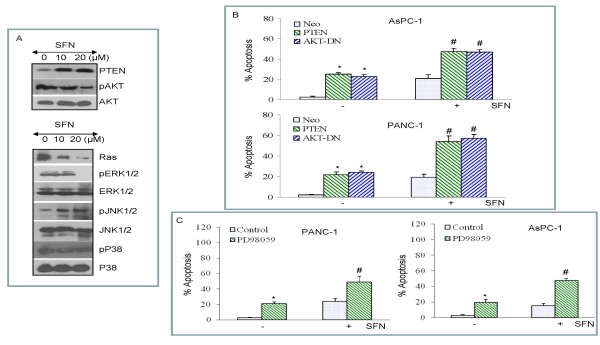
Figure 4
Effects of sulforaphane (SFN) on the expression of PTEN, AKT, and MAP kinases; and the effects of PI3K/AKT and MAPK pathways on SFN-induced apoptosis. (A), PANC-1 cells were treated with or without SFN (0-20 μM) for 24 h. The cells were harvested and the expression of PTEN, phospho-AKT, AKT, Ras, phospho-ERK, ERK, phospho-JNK, JNK, phospho-p38 and p38 was measured by Western blotting. (B), PTEN and dominant negative AKT enhance SFN-induced apoptosis. AsPC-1 and PANC-1 cells were transiently transfected with empty vector (pcDNA3.1), PTEN wild type (PTEN-WT) or dominant negative AKT (AKT-DN) along with pCMV-LacZ vector (as transfection control) for 24 h. After medium replacement, cells were treated with SFN (10 μM) for 48 h and, apoptosis was measured by Live Dead Assay. Data represent the mean ± S.D. *, # = significantly different from respective controls, P < 0.05. (C), MEK inhibitor PD98059 enhances SFN-induced apoptosis. AsPC-1 and PANC-1 cells were pretreated with PD98059 (1 μM) followed by treatment with SFN (10 μM) for 48 h and, apoptosis was measured by Live Dead Assay. Data represent the mean ± S.D. *, # = significantly different from respective controls, P < 0.05.
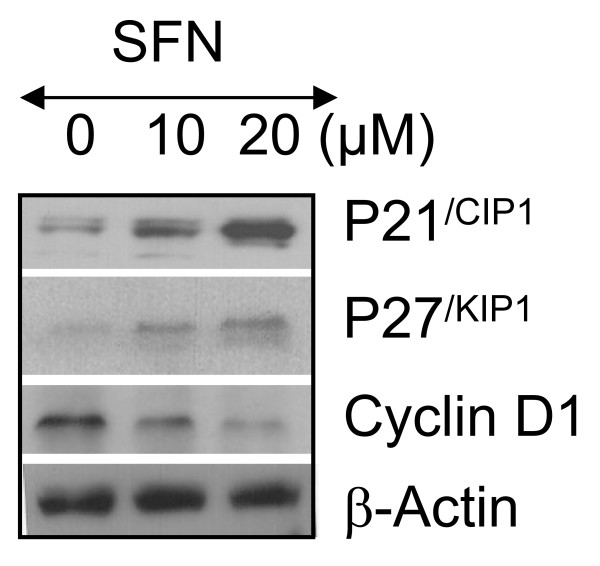
Figure 5
Effects of sulforaphane (SFN) on cell cycle regulatory genes. PANC-1 cells were treated with SFN (0-20 μM) for 24 h. The expression of p21/CIP1, p27/KIP1 and cyclin D1 was measured by Western blotting. Anti β-actin antibody was used as a loading control.
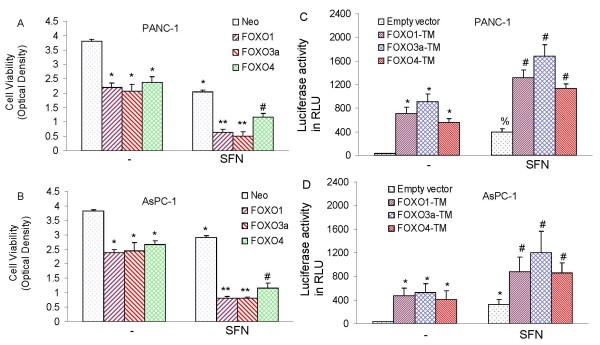
Figure 6
Effects of FOXO transcription factors on cell viability and FOXO transcriptional activity. (A and B), PANC-1 and AsPC-1 cells were transiently transfected with plasmids expressing neo (pcDNA3.1), FOXO1, FOXO3a, or FOXO4 along with pCMV-LacZ vector (as transfection control). After transfection, cells were treated with or without SFN (10 μM) for 48 h, and cell viability was measured by XTT assay. Data represent the mean ± S.D. * = significantly different from respective controls, P < 0.05. (C and D), Phosphorylation deficient mutants of FOXO enhance sulforaphane-induced FOXO transcriptional activity in pancreatic cancer. PANC-1 and AsPC-1 cells were transiently transfected with empty vector or constructs encoding FOXO1-TM, FOXO3a-TM, or FOXO4-TM together with 6X DBE-luciferase for 24 h. After transfection, cells were washed with RPMI, treated with SFN (10 μM) for 24 h, and harvested for firefly/Renilla luciferase assays using the Dual-Luciferase Reporter Assay System (Promega). Luciferase counts were normalized using Renilla luciferase transfection control (pRL-TK; Promega). Data represent the mean ± S.D. * = significantly different from respective controls, P < 0.05.
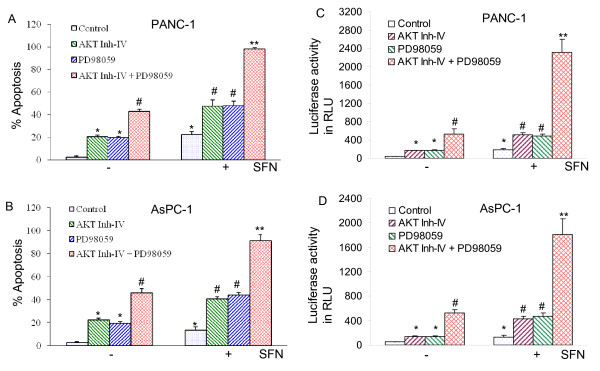
Figure 7
Inhibition of PI3K/AKT and MEK/ERK pathways synergistically/additively enhanced sulforaphane (SFN)-induced apoptosis and FOXO transcriptional activity in pancreatic cancer cells. (A and B), PANC-1 and AsPC-1 cells were pretreated with AKT inhibitor IV (1 μM) and/or MEK1/2 inhibitor PD98059 (10 μM) for 2 h, followed by treatment with SFN (10 μM) or DMSO (control) for 48 h. At the end of incubation period, cells were harvested and apoptosis was measured by TUNEL assay. Data represent mean ± SD. * = significantly different from respective controls, P < 0.05. (C and D), PANC-1 and AsPC-1 cells were transiently transfected with 6X DBE-luciferase construct for 24 h. After transfection, cells were pretreated with AKT inhibitor IV (1 μM) and/or MEK1/2 inhibitor PD98059 (10 μM) for 2 h, followed by treatment with SFN (10 μM) or DMSO (control) for 24 h. Cells were harvested for firefly/Renilla luciferase assays using the Dual-Luciferase Reporter Assay System (Promega). Luciferase counts were normalized using Renilla luciferase transfection control (pRL-TK; Promega). Data represent the mean ± S.D. *, #, ** = significantly different from respective controls, P < 0.05.