
The widespread use of thermal transfer printing, such as dye sublimation printing, for the production of various plastic cards, has resulted in cases where printers and used ribbons are submitted to forensic laboratories. These types of printers may be found in any type of entity that issues cards for uses such as memberships, government programs, student identification, and retail loyalty rewards programs. When more secure documents are required, a thermal transfer printer may be used for personalisation while non-variable graphics are produced by commercial printing processes, such as offset lithography with ultraviolet reactive ink.
Thermal transfer printers may be exploited in the production of forgeries or counterfeit cards of all types. When the intermediate media transfers part of its printing material to the substrate, the used portion retains a negative image of the graphics and text printed. This intermediate media consists of a single use ribbon of one or more colours. Typical spooled ribbons for use in thermal transfer printers have the capacity to print several hundred cards. Ribbons are usually made with a thin, flexible polyester film having one or several dye-based colour panels (1). Additional panels with clear topcoat protection and certain specialised features such as ultraviolet reactive layers may be present. Some ribbons also have black panels for monochrome printing. Magnetic stripes and signature strips are examples of additional specialised features that may be incorporated in ribbons.
Used ribbons presenting hundreds of images on a flexible film base pose several challenges for handling and processing. They were never designed to be rolled flat and viewed after being used for printing. Further complicating any processing is the need to handle this fragile material multiple times to compare macroscopic and microscopic features to questioned cards.
While imaging systems have been developed to facilitate the recording of used printer ribbons (2), the acquisition of such systems may not be possible due to cost, as well as technical reasons including procurement of required parts for manufacturing. As a result, a method for manual preservation and recording of used printer ribbons is needed.
While images on the used ribbon panels are readily visible, there are several factors that should be considered if the intention is to preserve and record them. The ribbon material itself is strong enough to be subjected to the mechanical processes and the heating involved in the printing process. As cards are produced using dye sublimation printing, the used end of the ribbon is aligned and wound tightly on the used spool side, assuming that the printer is functioning properly. At first it may seem that the ribbon could simply be unrolled in sections, photographed with transmitted light, and re-rolled to the unused (supply side) spool. While the ribbon material is strong, it is thin and does tend to be vulnerable to parts folding and twisting. Even if tension in the ribbon can be maintained to reduce unwanted folds and twists, keeping the alignment correct is difficult. Another problem that may be caused by this approach is the degradation of the image caused by repeated rolling and handling. Photography of the used ribbons is not so straightforward due to the technical challenges of achieving uniform illumination along with scaling of the resultant image for comparison to printed cards.
In cases where more detailed examinations are required, cutting the ribbon and keeping it flat offers options for recording without excessive handling. These examinations imply the need for a means of preservation that protects the ribbon from ripping and keeps it flat and visible while accommodating the particular size of the ribbon. These requirements point towards transparent sleeves made of plastic materials. When used ribbons are inspected, the repeating pattern of colour panels, clear coat panels, and other specialised panels forms what will be referred to as a segment. For example, the ribbons for certain Datacard® printers have a pattern of (Y)ellow, (M)agenta, (C)yan, Blac(K), and (T)opcoat (clear), abbreviated as YMCKT (Figure 1). The pattern of YMCKT repeats itself starting with the yellow panel. The size of sleeves required will depend on the dimensions of the ribbon examined. Many ribbons will be compliant with card sizes ID-1 (8.573 cm by 5.398 cm or 3.375 inches by 2.125 inches) (3). As the ribbon configuration will vary, the ribbon segment will have to be measured. For the YMCKT ribbon shown in Figure 1, the length of the segment is 58.42 cm (23.0 inches), with a width of 5.398 cm (2.125 inches). Thus, the transparent sleeve must be at least these dimensions.
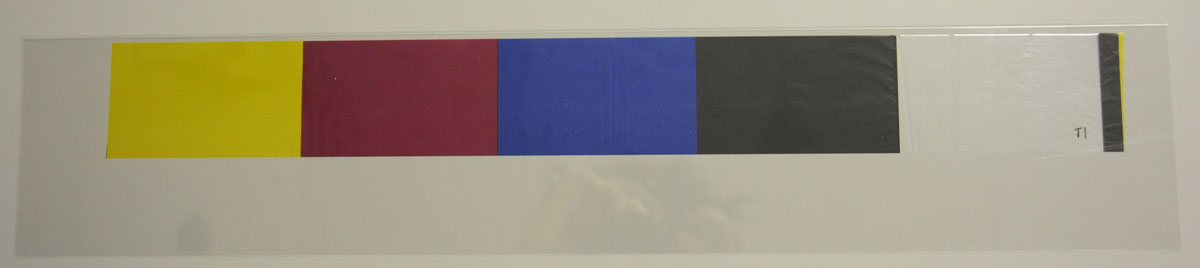
Figure 1
(Y)ellow, (M)agenta, (C)yan, Blac(K), (T)opcoat, (YMCKT) Datacard ribbon segment.
Common transparent sleeves available on the market, such as photographic sleeves, do not usually come in suitable sizes for forensic examination purposes. Even if such sizes were available, the practical aspect of loading the ribbons into the sleeves in an unimpeded way needs to be considered. Photographic sleeves are not typically open on three sides, making loading of the sleeves difficult. Simple tests with plastic protectors demonstrated that a sleeve sealed along the long edge permits easy loading of segments, increasing efficiency and facilitating manipulation of the ribbon.
Polyester is the common term for poly(ethylene-terephthalate) (PET), which is a stable chemical polymer used in many conservation applications. PET is described as stable because it does not appreciably change over time from ongoing chemical reactions, including outgassing of volatile chemicals. The use of custom-made polyester sleeves has provided a means to preserve and record used ribbons. The approach taken considered the suggested practices of archivists and conservationists to reduce potential problems that could arise during and after processing of ribbons (4, 5). The storage of artefacts for conservation by polyester film has been studied in the conservation community (6, 7). Simply taking any plastic to use as a sleeve is ill advised as there may be adverse reactions. These reactions may include chemical reactions with the dyes on the ribbon and/or film used for the ribbon.
Sheets of PET need sufficient thickness to be rigid, and stiffness, to permit handling for imaging and subsequent examinations. In this case, the sheets used were suitable for ID-1 size cards, measuring approximately 0.003 inches or 76 µm thick, with a total thickness of 0.006 inches or 152 µm. If there are ribbon sizes larger than those used for ID-1 cards, then tests may be required to determine if this thickness of sheets is suitable.
Dimensions for the custom-made sleeves were selected to be large enough to easily accommodate the ribbon segments. Larger sleeves also permitted labelling on the extra sleeve space as required for each segment as it was removed from the used spool. Further benefits of polyester sleeves were observed with segments that were damaged from tears. It was possible to align the torn pieces and hold them together, as shown in Figure 2.
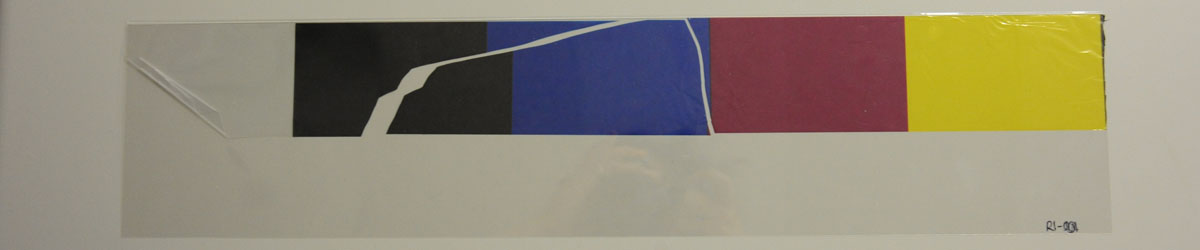
Figure 2
Fracture matching segments of YMCKT ribbon.
The polyester selected must be biaxially oriented, resulting in very clear films and few optical aberrations (8). Biaxially drawn polyester means that the polymer chains are positioned in two directions as the sheet is formed. Any sealing of sleeves with adhesives is to be avoided due to potential degradation of the sleeves, ribbon, and dyes. Conservation suppliers can produce sleeves that are sealed along one edge using ultrasonic welding (Figures 3 and 4), removing the need for any adhesive (9). Ultrasonic welding provides very clean edges and strong bonding of the materials that makes the sleeves easy to load with used ribbons, even while wearing gloves. The resulting ultrasonic weld should not produce an uneven surface with wrinkles or bubbles, colloquially called a ‘caterpillar’ effect (8). This allows the enclosed ribbon to lay flat with minimal distortion and stresses. The sealed sleeves have a slight electrostatic attraction and tend to self-close which helps keep everything secure. No further sealing of the sleeve should be made as this can create microclimates within the encapsulated area that may be unsuitable for preservation (10). While polyester is non-reactive, storing used ribbons for very long periods of time which in this context may mean years or decades, has not been confirmed to be suitable. This may be a subject for future confirmation and studies in conjunction with conservation scientists.
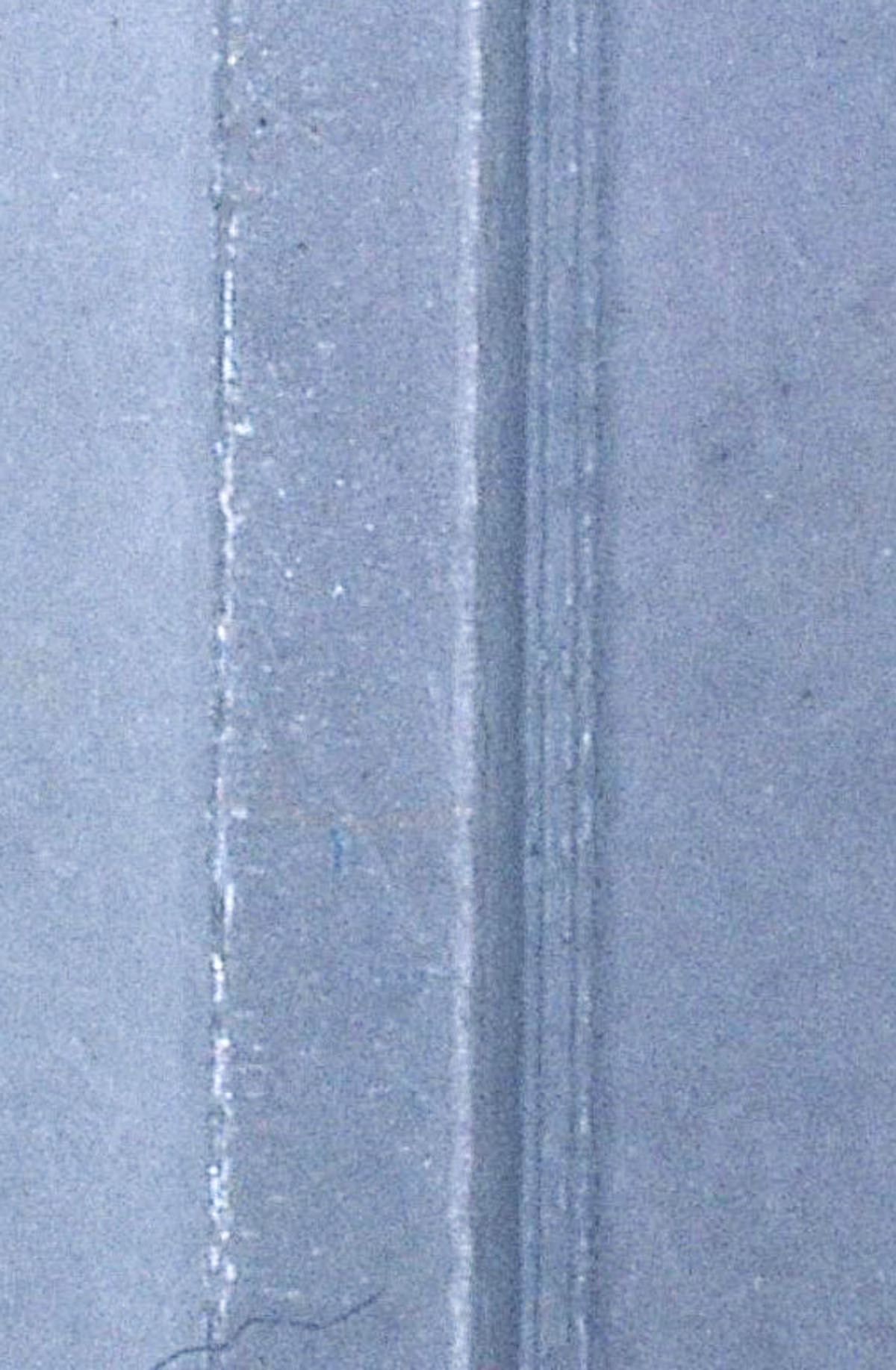
Figure 3
Ultrasonic welding used for sealing long edge of sleeve.
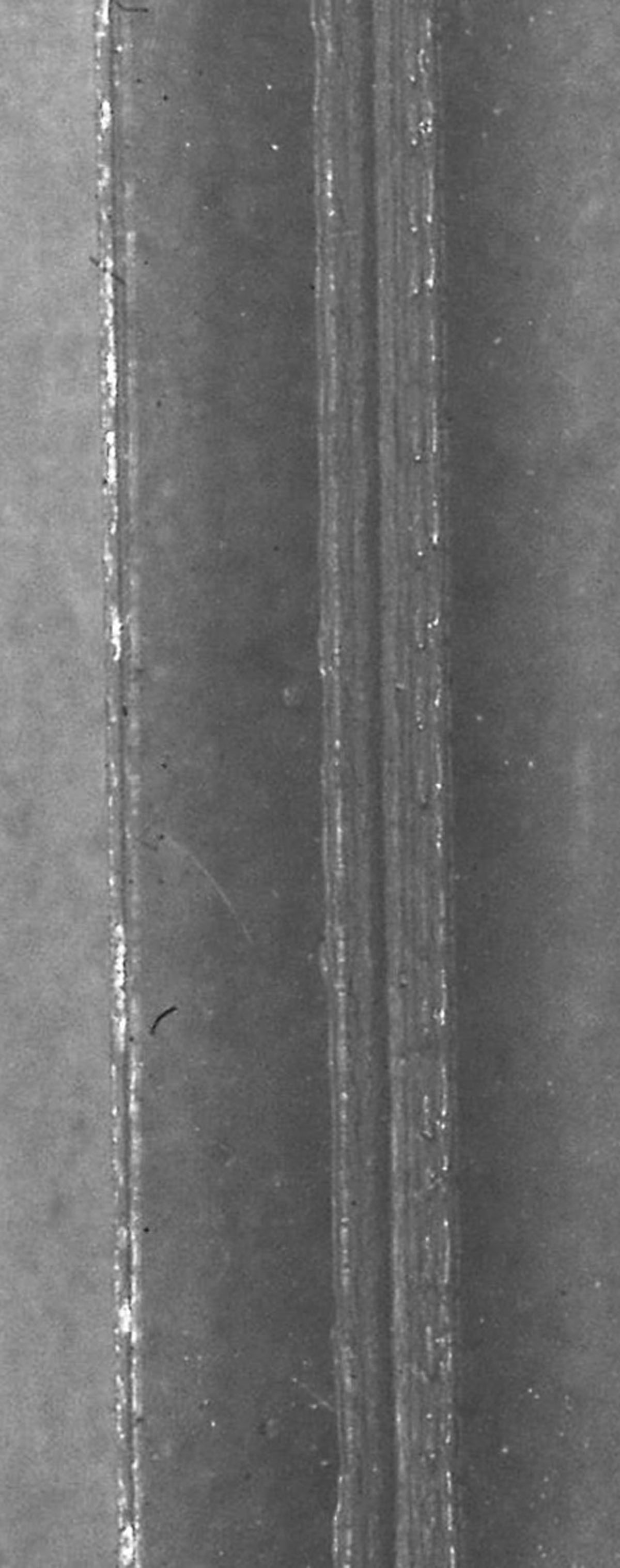
Figure 4
Ultrasonic welding used for sealing long edge of sleeve.
The resulting sleeves with enclosed ribbons were found to be suitable for imaging with a large scanner using transparent mode. Flatbed scanners tend to provide even illumination and offer the advantage of direct one-to-one scale when scanned at 100% size. Tests found that scans of the ribbons at 300 dpi were sufficient to record the printed graphics and text for legibility and for comparison to questioned cards. Scans were produced in 24-bit RGB colour mode (i.e. 8-bits per channel) for multi-colour panel ribbons.
While the concept of a transparent sleeve is apparently simple, this technical note points out factors that should be considered from a conservation viewpoint for optimal results. Features of the transparent sleeves should allow for preservation, imaging, and forensic comparison of the images and text of used thermal printer ribbons.
Competing Interests
The authors have no competing interests to declare. Any mention of trade names is for reference purposes only and does not constitute endorsement by the authors or their affiliations.
Author Contributions
Editorial review was conducted without input from Tobin Tanaka.