
Introduction
What does it mean to have good vision? When considering this question, it becomes apparent that context is needed to really address this question. Some people will say that good vision means to have an “eye for detail”, others will align it to certain activities such as those requiring vision at a distance. In another context, good vision may be thought of being able to observe fine details such as a watchmaker, or a tailor selecting the colours of fabrics to use for suiting, and for pattern comparison task such as those in document examination the detection of differences in shapes is important. All of these also necessitate evaluation of the conditions under which the observations take place.
Visual acuity is often considered whether an observer needs correction via lenses to have “normal” vision, i.e., to have 20/20 or 6/6 vision. Normal vision has been considered to be the ability to discern certain forms at a distance of 20 ft or 6 m. However, there are many other tests for visual ability which are not always considered such as field of vision, depth perception, form recognition and colour deficiency. In this paper the focus will be on visual acuity only, and specifically on myopia.
Essentially myopia is the result of a longer eyeball or an eye lens that has too much focussing power, this results in distant objects coming into focus in front of the retina rather than on the retina. This change in the eyeball shape occurs during the developing years until early adulthood when changes slow their progression or stop until later in life. Overall, there has been an increasing proportion of the population with myopia, this is especially apparent in Southeast and East Asia. In China up to 90% of teenagers have myopia.3 Within the USA the proportion has increased to about 40%.4 Research has suggested that the causes of such an increase may be due to spending more time indoors compared to earlier times, a lack of a diurnal cycle that produces dopamine during the period of eye growth.
Sometimes it may be suggested that persons who require corrective lenses for “normal” vision have a poor visual acuity. In particular, persons who have myopia, which may colloquially be called near-sightedness are not able to see as well as persons who are not myopic. This is not actually the case with regards to the visualisation of fine details as will be explained in the following sections.
Historically when document and fingerprint examiners were drawn from police officers in certain police laboratories the cadre of personnel were already those who had minor, if any, myopia. While this requirement for police officers to have little if any myopia may be operationally desirable for practical policing matters it does not address visual acuity for matters such as document examination. In 1952 an advertisement in Identification News for a document analyst at the US Veterans Administration stated, “… eye deficiencies no greater than 20/40 uncorrected and to recognized normal vision of 20/20 in both eyes, with normal color vision.”5 For latent print examiners in relatively recent times, “One would assume that good eyesight would be a prerequisite for latent print examiners…Sixty-four percent of the agencies questioned do not even require 20/20 vision.”6 Such statements may imply that 20/20, 20/40, and other measurements are the sole determinant for visual ability which is simply not true.
While it is true that the uncorrected myopic eye has less capability to discern distant objects, that is not the case for close objects. By the use of illustrations, the visual system of the myopic eye can be explained.
Basics of Myopia Vision
Reflected or emitted light rays from distant objects arrive at the eye as parallel rays, essentially as if the object was at an infinite distance. For the myopic eye such light rays are focussed in front of the retina instead of on the retina, as shown at Figure 1. Figures 1, 2, 3 adapted from Pedrotti and Pedrotti.7 The result being that distant objects are seen as out of focus, the maximum distance for the myopic eye where objects are in focus is referred to as the myopic far point, as shown at Figure 2.
While the normal eye is able to observe distant objects in focus, as objects get closer to the normal eye there is a limit before they become out of focus. The distance at which near or close objects are in focus is called the near point. The normal eye has a normal near point of about 25 cm, but the myopic near point is less than 25 cm. Objects closer than this will appear out of focus for the normal eye. As shown in the illustration objects will be in focus for the myopic eye when at the myopic near point. This means that the myopic eye can clearly see objects held closer than what the normal eye can achieve, as shown at Figure 3. When the myopia is greater the myopic near point is less meaning that objects can be held closer than for those with less or no myopia.
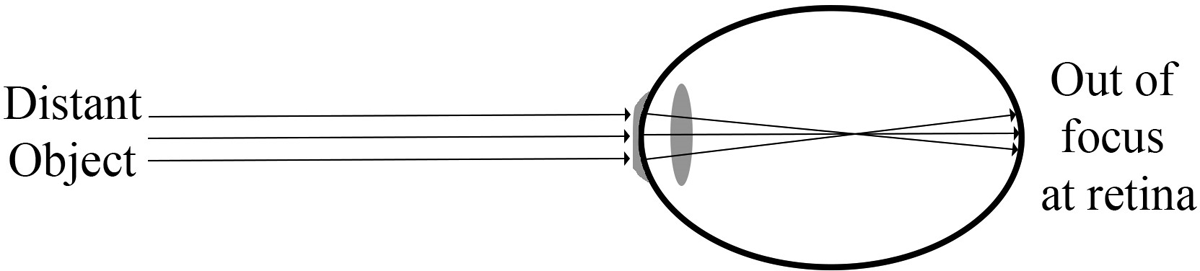
Figure 1
Myopic Eye (focus in front of retina).
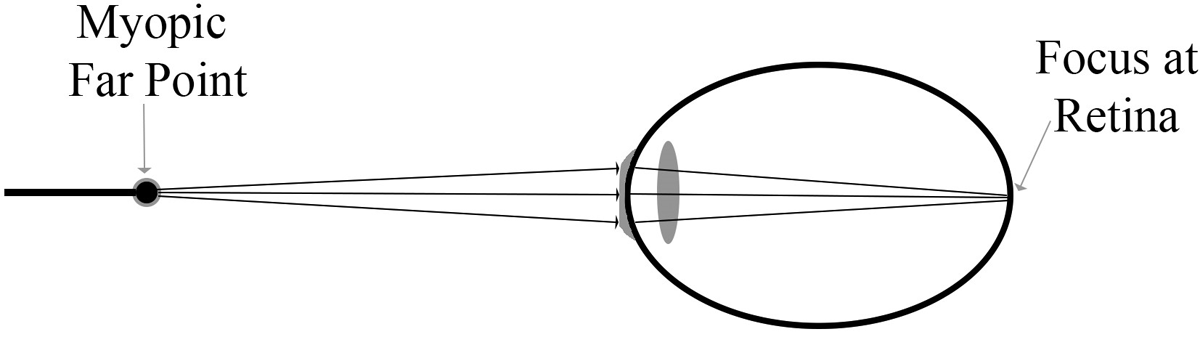
Figure 2
Myopic Far Point (maximum distance from eye for objects to be in focus).
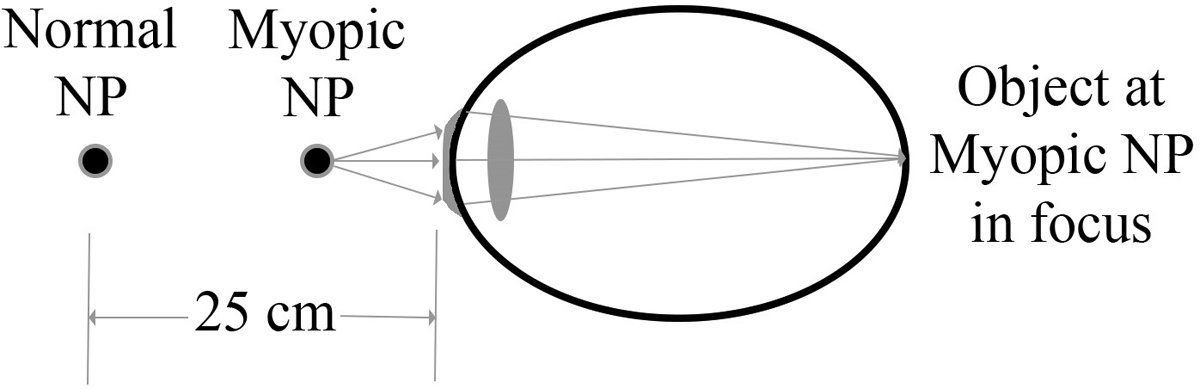
Figure 3
Myopic NP closer to eye than Normal NP.
The result is that the myopic eye can clearly view and discern objects that are closer than what the normal eye can discern. What this means is that certain features that the normal eye needs magnification by microscopes or hand magnifiers may be seen by the myopic eye unaided. As an example, microprinting used in security printing may be visible and decipherable to the myopic eye whereas the normal eye would require some form of magnification.
This means that the uncorrected, myopic eye actually has superior near vision compared to the normal eye. This visual ability applies to features that are small in general including small features in handwriting and signatures.
Eye Charts
Ophthalmologists and optometrists will generally test for visual acuity by using eye charts positioned at a set distance from the patient. This is where the common 20/20, 20/40,… or 6/6, 6/3, … visual acuity measurement arises which is commonly called the Snellen fraction. Snellen eye charts were invented by Hermann Snellen in 1862 and have letter forms referred to as optotypes arranged in rows of decreasing size, as depicted in Figure 4. Each row has the height of the optotypes to correspond to 5 minutes of arc at different distances. For example, in the depicted chart, not to scale, the “E” in the top row is meant to have a height corresponding to 5 minutes of arc when viewed at 200 feet. The next row with the optotypes “FP” is smaller but when viewed at 100 feet they would also subtend 5 minutes of vertical arc. However, the Snellen chart has significant limitations, and this is why in practice other types of charts are used when possible, such as the Bailey-Lovie eye chart.8
The Bailey-Lovie eye chart uses the same number of optotypes for each line. The spacing between optotypes is proportional to the optotype size the result being that higher visual frequencies correspond to the smaller optotypes.9
Other eye charts have been designed with decreasing contrast, for example the Pelli-Robson eye chart, not illustrated in this paper, has the same size optotypes but it is made to test the observer’s ability to detect decreasing contrast.10
NOTE: This depiction of the Snellen eye chart is not to scale and is not meant for eye testing, it is for illustrative purposes only
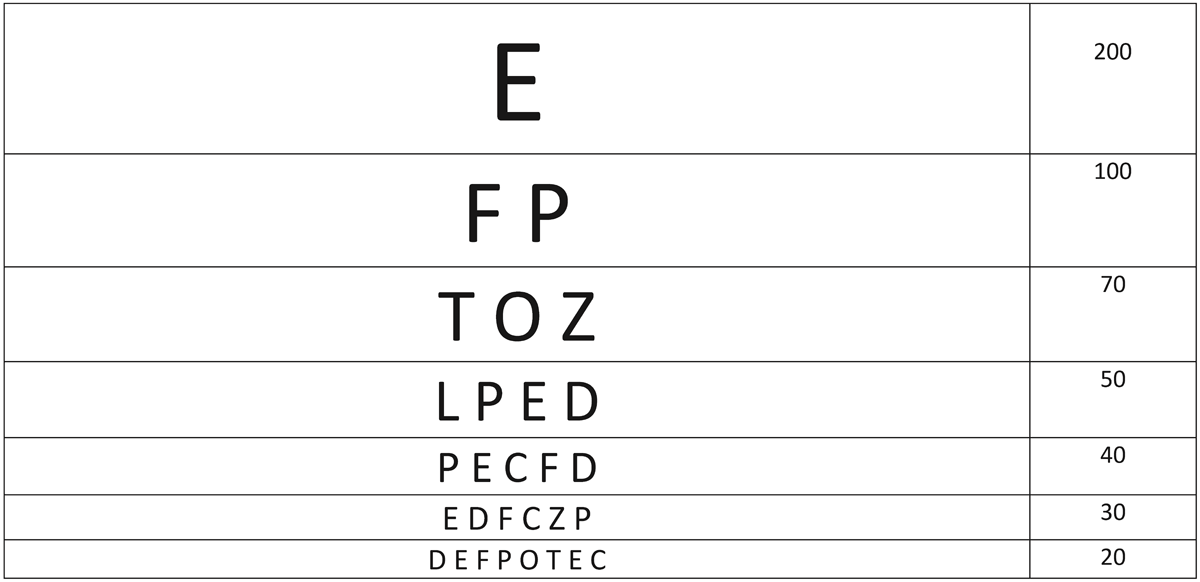
Figure 4
Depiction of Snellen eye chart.
Corrective Lenses
Lenses are used to correct certain vision conditions, in this section a brief description of how this is achieved is provided.11 Correction for myopia is achieved using negative diopter lenses which cause the light to focus properly onto the retina. The use of negative diopter lenses effectively brings distant objects (d0 = ∞) to the myopic eye’s far point (di) and as a result the objects will be in focus.
For example, if we consider a myopic eye that has a far point of 20 cm (0.20 m), and the distance of the corrective lens to the eye is 2.0 cm, the resulting di needs a slight adjustment, then the corrective lens needed is:
In this equation P refers to optical power and D refers to diopters which is how corrective lenses are prescribed. Note that for prescriptions this discussion does not include other information such as corrections for astigmatism which results from an irregular curvature of the eye nor the use of progressive lenses. Progressive lenses are used to adapt for the range of close to distant vision with less correction (closer vision) at the base of lenses progressively getting greater towards the top of lenses (distant vision).
Although the focus of this paper has been on the myopic eye, if the viewer has the condition of hyperopia, colloquially referred to as far sightedness, then the viewer has a near point further away than the normal near point of 25 cm. This will be familiar to anyone who needs to read or discern objects such as reading books by moving them further away from them. For example, if viewing a printed document some people will need to move it further away than what they had to do previously. Hyperopia tends to be less common in the general population, and may be due to age as some viewers will develop this later in life while others may have this at a younger age.
A close object will not focus on the retina but instead behind the retina. Using positive diopter lenses the focus is effectively brought to the retina allowing objects that are close to be in focus. Close objects mean those that are closer than the hyperopic eye’s near point.
For the hyperopic eye the correction will use positive diopter lenses. For example, if we consider that the normal near point as 25 cm, then to correct for the hyperopic eye with a near point of 70 cm and the distance of the corrective lens to the eye is 2.0 cm. The result will be as follows:
Conclusion
In summary, overall statements about 6/6 or 20/20 only address the observer’s ability to resolve higher spatial frequencies for a given distance typically 6 m or 20 feet. In practice most people with myopia have the potential to get their vision corrected by eyeglasses or contact lenses to have “normal” vision. For the unaided, uncorrected myopic eye it is not really a disadvantage in so far as there is actually superior short distance vision, and it is not really a disadvantage as documents are not generally examined at 6 m. Nonetheless, this does not suggest that document examiners who have myopia should examine documents for long periods without glasses or contact lenses as this tends to cause eye fatigue. Although myopia is not necessarily a visual impairment there may be visual pathologies in later life with higher risk of retinal detachment, macular degeneration, cataracts, and glaucoma.12