
Introduction
For centuries, Forensic Document Examiners (FDEs) believe that “Original evidence is the best evidence.” However, it is a known fact that the ideal situations do not always exist, so FDEs are asked to proceed with what is available. In the early 1970s, office copiers posed significant challenges for FDEs, and they found difficulties in forming a definite opinion on identification or elimination of the questioned handwriting sample. In the intervening years, FDEs examined the reproductions generated on seven plain paper office copiers, using a combination of six writing instruments and four paper stocks, and suggested that it is possible to form a definite opinion based on the photocopied document with great caution (Morton, 1989).
Photocopying technology is improving every year, and has reduced the time and increased the efficiency in business, education, or the government community. Consequently, the photocopied document is frequently submitted to Forensic Science Laboratories as secondary evidence for analysis. While examining the photocopied document, FDEs usually formed opinions with a remark that a stronger conclusion may be drawn if the original is received for analysis. Dawson and Lindblom (1998), reported that photocopies produced directly from the original document carry sufficient details required for examination after conducting a study on 72 different genuine and non-genuine signatures. In their study, they concluded that the line quality features can be identified in photocopied documents of average quality. However, FDEs found difficulties in evaluating ink line morphology, when striation patterns and ink gooping were misunderstood as pen lifts, hesitations, and patching on the photocopied document. Furthermore, with subsequent generations of the photocopied document, the overall quality of the photocopied document is degraded, and loses some of the minute details affecting the analysis and findings (Morris, 2000).
Forensic handwriting or signature analysis is based on the assessment of the different writing features like line quality, alignment, slant, letter formation, rhythm, etc., in which line quality is one of the most important features of writing analysis (Kelly and Lindblom, 2006). Line quality is the under which different elements of writing movement reside and even writing authenticity could be indicated by analysis of its line quality (Hilton, 1993; Osborn, 1929). Jasuja, et al. (2018), studied the degradation level of line quality features on five subsequent generations photocopying of the signature samples which revealed that the photocopied document does give problems to FDEs in forming the opinion on the authorship of the handwriting. They also mentioned that the second and third generation of the photocopied document results in degradation and distortion of the line quality features. Thinning in line, widening in line, tooth edges, ragged edges, cluster formation, merging of ink traces along the side of line, and breaks in line at places are the different features reported in the subsequent generation of the photocopied document. This may assist a FDE in determining whether the photocopied document being examined is a higher generation copy, or not.
The current research has been undertaken to evaluate the distortion level in subsequent photocopying generations of signature samples, which were reproduced on a similar type of paper as the original sample printed with a Monochrome Laser Printer.
Materials and Methods
Sample Preparation
2550 genuine signature samples were collected from different official personnel, on seven different types of papers (such as Mint Legal-Size Paper, Stamp Paper, Bond Paper, White Legal-Size Paper, A4 Size Mint Paper, A4 Size White Paper) commonly used for official purposes using four different types of pens (Ball Pen, Gel Pen, Pilot Pen & Fountain Pen) of the different brands (6 Brands of Ball Pen, 6 Brands of Gel Pen, 3 Brands of Pilot Pen & 2 Brands of Fountain Pen). Each sample was subsequently photocopied on the same type of paper. For example, the A4 sample was photocopied on A4 paper and so on to produce five generations of photocopy using Monochrome Laser Printer (Brother DCP- B7535DW Multi-Function Monochrome Laser Printer). The first-generation photocopy (Gen 1) was produced directly from the original signature sample (O) than the first-generation photocopy (Gen 1) was used to generate the second generation of photocopy (Gen 2), a similar process was used to generate the third, fourth, and fifth, generation photocopy (Gen 3, Gen 4, and Gen 5). All the samples were photocopied on a similar type of paper as the original sample without any change in their contrast or magnification. A total of 12750 signatures samples were generated for the analysis of distortion level in the subsequent generation of signature samples.
Sample Analysis
All the original and photocopied samples (O, Gen 1, Gen 2, Gen 3, Gen 4, and Gen 5) were examined manually with the help of magnifying lens and stereo zoom microscope (Model Name – RI-90–03; Magnification – 7x to 45x) having a facility for video projection and Digimizer Software (Trial Version). The different distorting features of original & photocopied signatures were examined under a stereo zoom microscope and Digimizer, further compared with their five subsequent generations of the photocopied document.
Results and Discussion
In this study, the original and subsequent generations of signature samples were examined to study the level of distortion caused due to photocopying process in the form of breakage in line, ink gooping, merging of strokes, retracing, initial and terminal strokes, tremors, pen lifts, and widening in line.
Breakage in Line – An abrupt redirection of the stroke defines the breakage in line, it has been reported by many authors in the photocopied document. In the present study, the continuous original line (original sample) is showing slight breakage in Gen 1 and Gen 2, which was not passed on to Gen 3, Gen 4, and Gen 5 (shown in Fig. 1).
Ink Gooping – An excessive amount of ink on the ball-point pen’s exterior that is transferred to the paper surface while writing. Ink gooping can be clearly visible in Gen 1 and Gen 2, but in further generations, Gen 3, Gen 4, and Gen 5 of photocopy document, the area of the ink gooping got enhanced giving a hesitation or tremor like appearance (shown in Fig. 2).
Merging of Strokes – Merging is the process of combining two or more entities into a single entity. Simply said, merging strokes indicates that two independent strokes have been joined to make a single stroke, which directly affects the forensic examination. The challenge increases when the FDE has to examine the photocopy of the original document, as it might be misinterpreted as ink gooping or retracing or distorted letter (shown in Fig. 3).
Retracing – The portion of a letter in which a downstroke is superimposed upon an upstroke or vice versa. The evidence of retracing can be seen on the original up to Gen 1 and Gen 2, but it cannot be seen in subsequent generations of photocopying and may appear as bead formation in the strokes (shown in Fig. 4).
Initial and Terminal Strokes – An initial stroke is the first stroke of a letter or a word, and a terminal stroke, sometimes known as an end stroke, is the last stroke of a letter or a word. The effect produced on initial and terminal strokes of freely executed writing is indicated by tapering, which is clearly visible in Gen 1 and Gen 2. However, in further generation tapered initial and terminal were converted into blunt strokes, which is observed in Gen 3, Gen 4, and Gen 5 (shown in Fig. 5).
Tremors – It is the lack of smoothness in writing, due to lack of skill, conscious writing act or deliberately controlling the writing instrument while copying or tracing. Tremor is one of the handwriting features, which is observed in simulated and genuine writing, therefore the FDE needs to be very careful while forming the opinion. In simulated writing, tremor is observed at an unusual place whereas, in genuine writing, tremor is observed due to the old age of the writer or the writer suffering from mental disorders, or it could also be seen due to an uneven writing substrate. Up to Gen 5, tremors could be identified, but the thickening of the line in subsequent generations obscured tiny features compared to the original copy.
Pen Lifts – Removal of the writing instrument from the writing surface causes an interruption in the formation of the strokes. Pen lifts are seen in both genuine and simulated writing; however, they can be useful to the Forensic Document Examiner when examining the writing sample. Pen lifts were clearly visible in the original copy when compared to subsequent generations of the photocopied document. However, pen lift can be observed in some cases in Gen 1 and Gen 2 also, but after Gen 2 it is observed as a continuous stroke and may be misinterpreted by other features. As a result, FDEs are advised to exercise greater caution when examining photocopied documents.
Widening in Line – In the subsequent generation of the photocopy, an increase in the line width was found when compared to the original, concealing significant fine details of stroke formations. High contrast or a defective optical system of the photocopier could be the cause of the line widening. The quality of stroke seen in original samples could be identified in Gen 1 and Gen 2, but after Gen 2, strokes are getting wider in the subsequent generation of photocopied documents. These wider strokes are misinterpreted as heavy stroke formation due to hesitation or intentionally controlling the writing instrument, hence it becomes a challenge for a FDE.
Diminishing Spaces between Strokes – Digimizer software was used to measure the diminishing space between the two strokes points in the original and subsequent generation of photocopied documents. It is an image analysis software that allows precise manual measurements as well as automatic object detection with measurements of object characteristics. After thorough analysis using software called Digimizer it was observed that in the original document there is a defined distance between the two stroke points, but with subsequent generation of photocopy, it was found that the distance between the two strokes points was continuously diminishing as compared to the original which leads to a difficulty in identifying the line quality feature of the signature (shown in Fig 9 and Table 1).
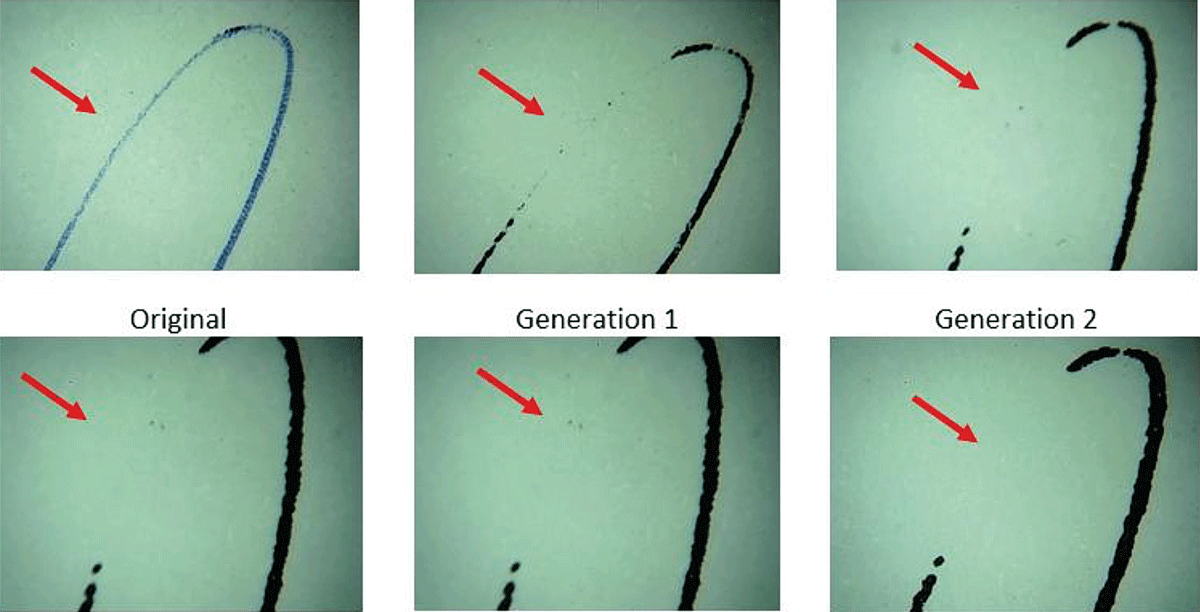
Figure 1
Breakage in Line in Original and Photocopy Generation (Gen 1, Gen 2, Gen 3, Gen 4, and Gen 5).
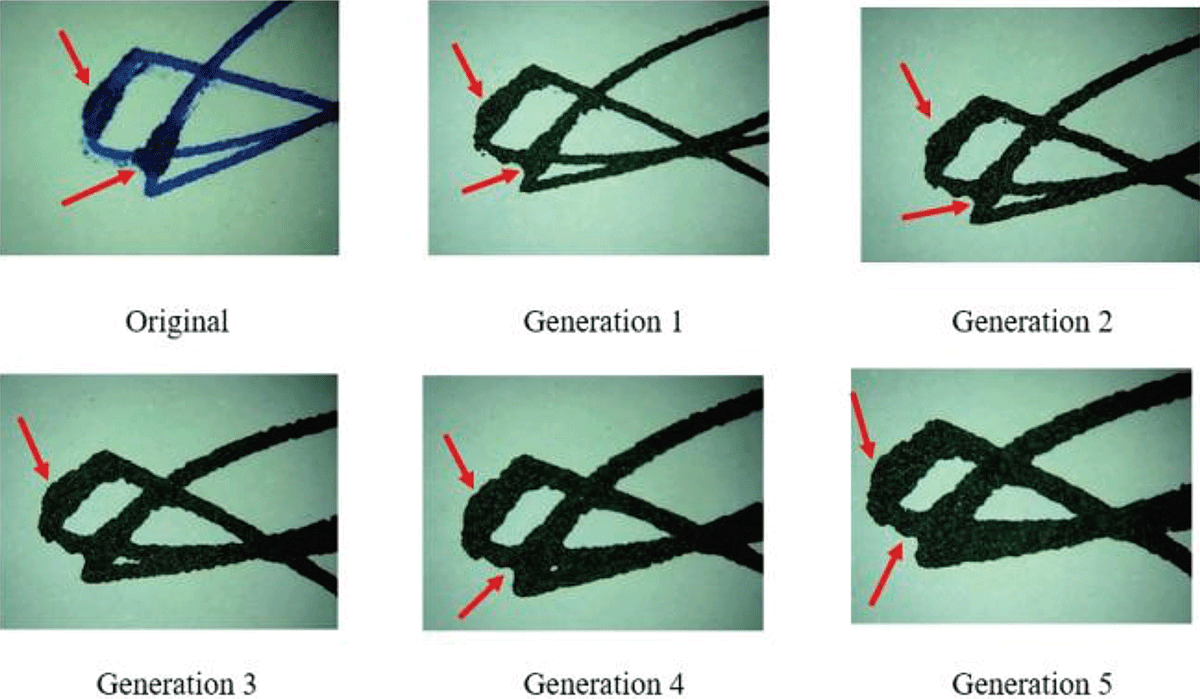
Figure 2
Ink Gooping in Original and Photocopy Generation (Gen 1, Gen 2, Gen 3, Gen 4, and Gen 5).
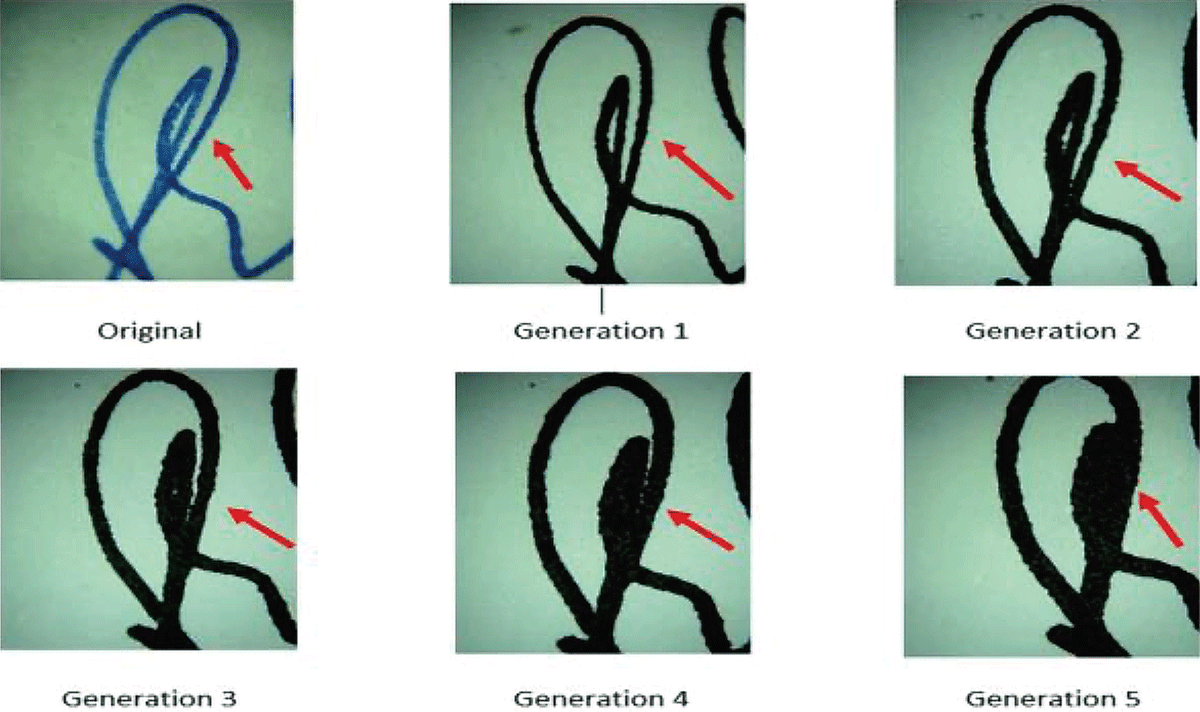
Figure 3
Merging of Strokes in Original and Photocopy Generation (Gen 1, Gen 2, Gen 3, Gen 4, and Gen 5).
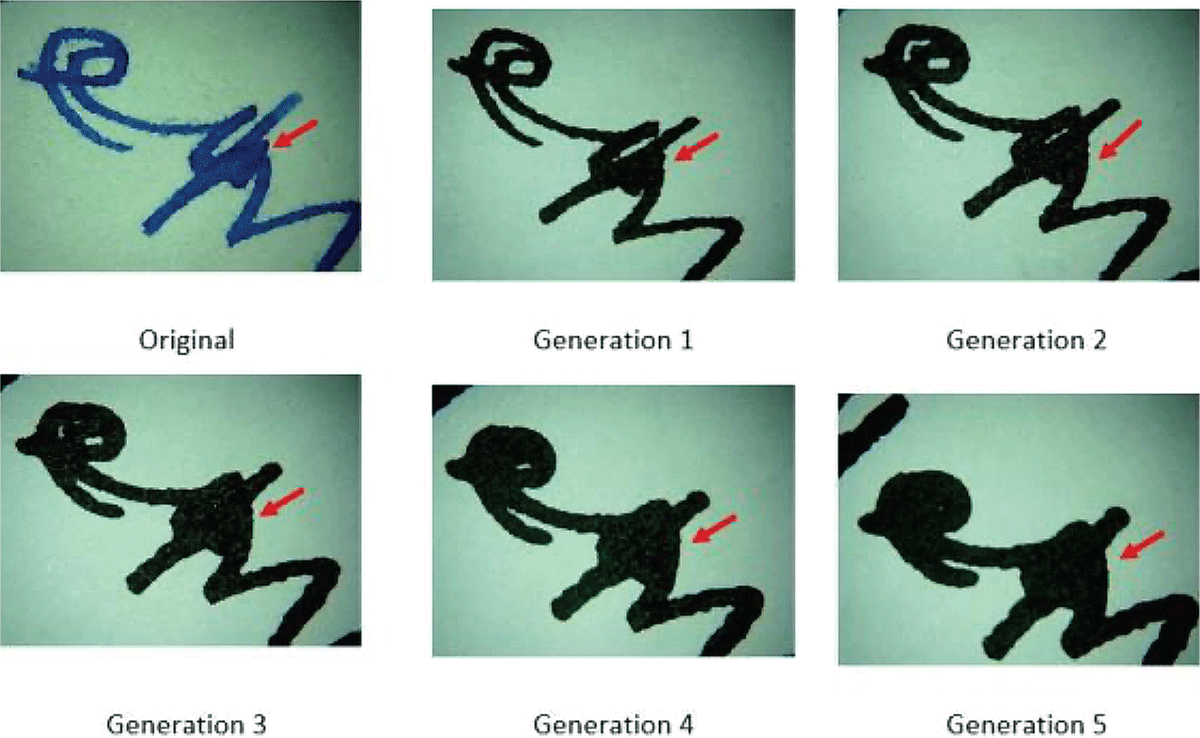
Figure 4
Retracing in Original and Photocopy Generation (Gen 1, Gen 2, Gen 3, Gen 4, and Gen 5).
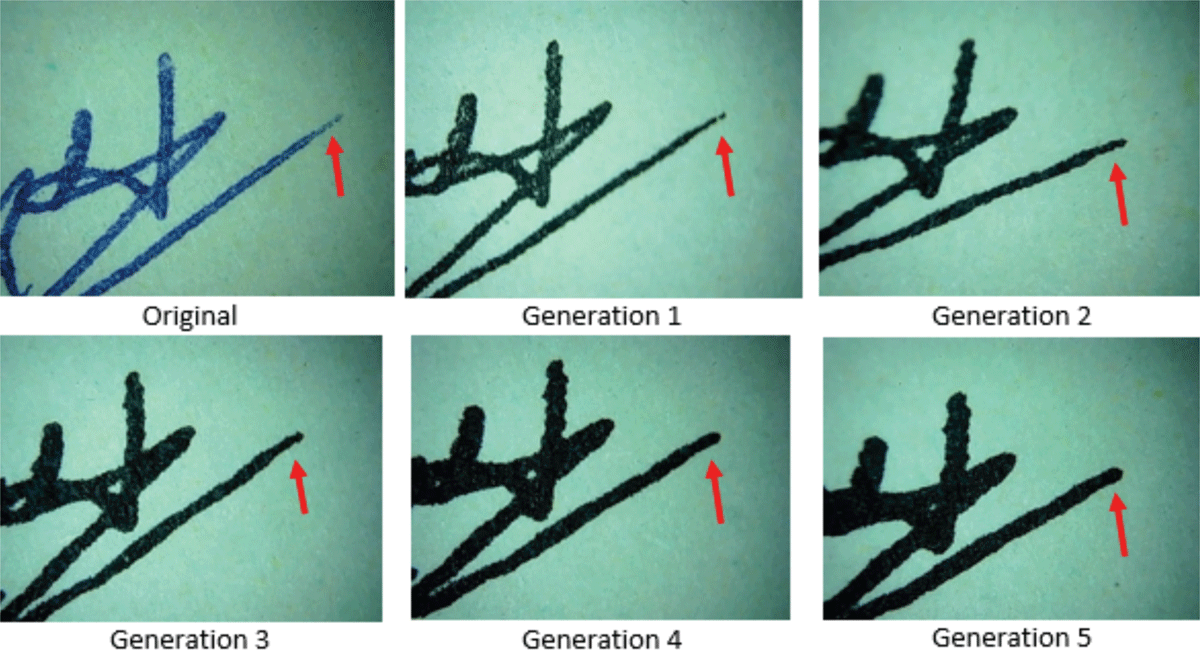
Figure 5
Initial & Terminal Strokes in Original and Photocopy Generation (Gen 1, Gen 2, Gen 3, Gen 4, and Gen 5).
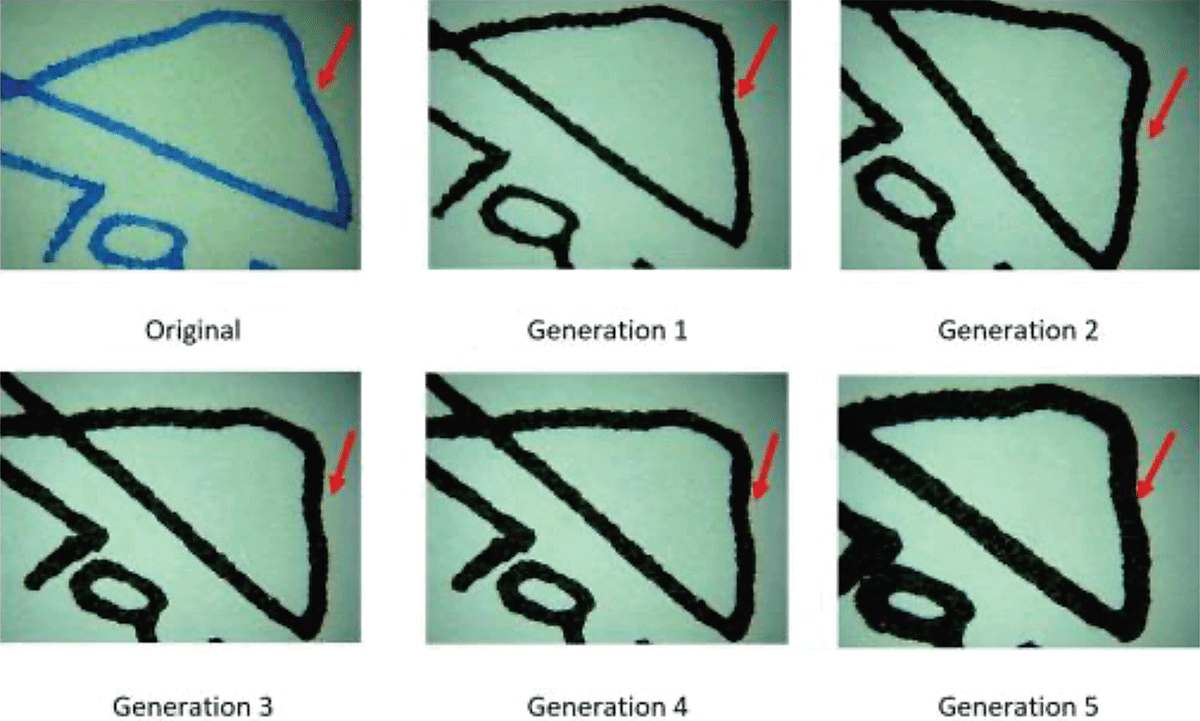
Figure 6
Tremors in Original and Photocopy Generation (Gen 1, Gen 2, Gen 3, Gen 4, and Gen 5).
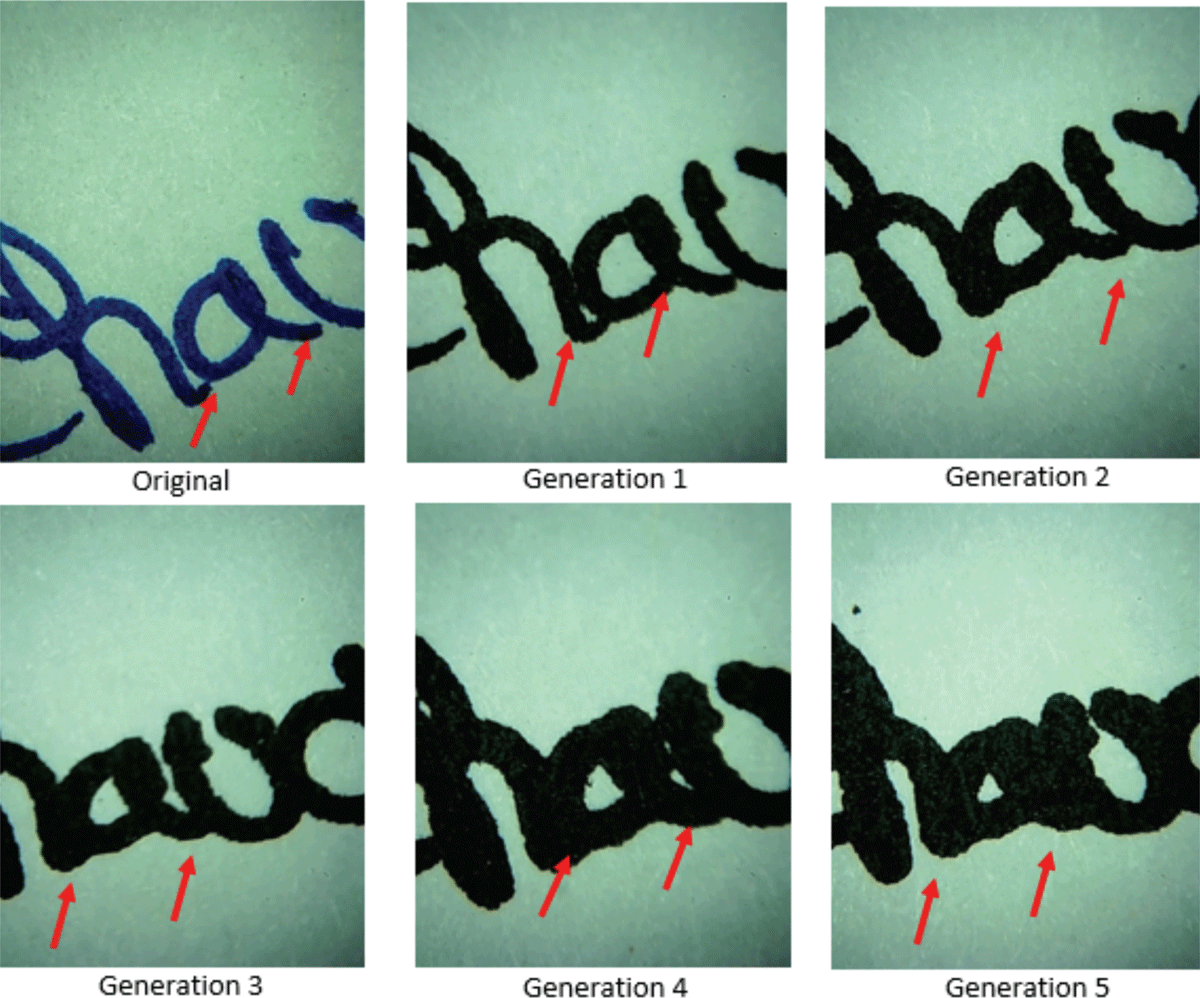
Figure 7
Pen Lifts in Original and Photocopy Generation (Gen 1, Gen 2, Gen 3, Gen 4, and Gen 5).
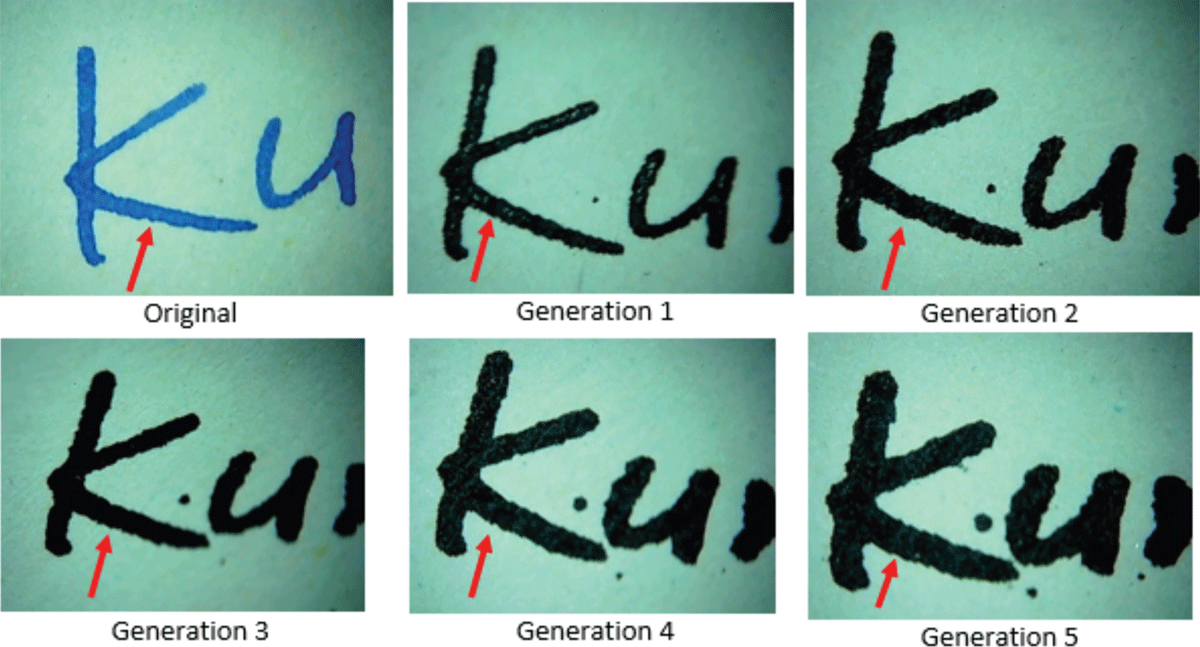
Figure 8
Widening in Line in Original and Photocopy Generation (Gen 1, Gen 2, Gen 3, Gen 4, and Gen 5).
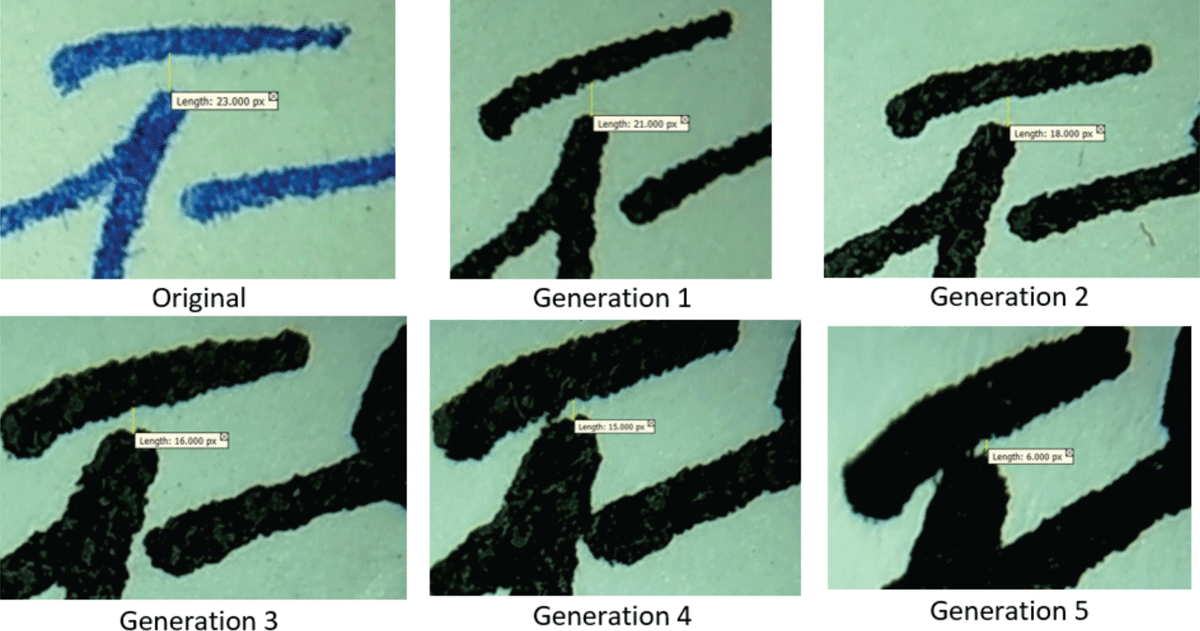
Figure 9
Analysis through Digimizer in Original and Photocopy Generation (Gen 1, Gen 2, Gen 3, Gen 4, and Gen 5).
Table 1
Observation through Digimizer.
| Generations | Length |
|---|---|
| Original | 23.00 px |
| Gen 1 | 21.00 px |
| Gen 2 | 18.00 px |
| Gen 3 | 16.00 px |
| Gen 4 | 15.00 px |
| Gen 5 | 6.00 px |
From the above observations, it has been clear that the effectiveness decreases significantly when a photocopy of the original documents is considered for writing examination, though the poor quality of photocopied documents poses a problem for the FDE. Analysis of individual distorted features leads to the conclusion that these features may have been misinterpreted many times, but this does not conclude that examination on the subsequent generation of photocopies will lead to false results only. As a result, FDEs are advised to analyse each photocopy document on its own merits and demerits, based on the image quality and resolution (Dawson and Lindblom, 1998; Grose, 1999). Pen lifts, pen skipping, and pen patching are a few of the features which are commonly misinterpreted, whereas guidelines are one of the features which cannot be reproduced in photocopied documents (Saini and Singh, 2008). Line quality became harder to interpret as the depth of the ink line into the paper could not be seen (Kelly, 2006). When examining a photocopied document, FDEs must have a high level of understanding, education, knowledge, training, and skill. Even a high-quality photocopier cannot accurately record the exact detailed information of all writing characteristics. Features like watermarks, sequence of crossing strokes, pen lift, pen pressure, pen patching, and line quality cannot be accurately examined by photocopied documents (Gupta, 2018).
When forming an opinion about the authorship of handwriting and signatures from a photocopied document submitted for examination, FDEs face a challenge due to multi-generation photocopies. The study found that line quality features do not pose major issues and can be detected and evaluated on photocopied documents of the second and third generations. However, distortion of line quality features is observed in subsequent generations and is frequently misinterpreted. Thinning in line, widening in line, tooth edges, ragged edges, cluster formation, merging of ink traces along the side of line, and breaks in lines are some features observed in the subsequent generations of a photocopied document. The presence or absence of these features assists the FDE in determining whether the document under examination is a higher generation copy or not (Jasuja et al. 2018). Initial and terminal strokes, ink gooping, striation marks, pen lifts, tremor, retouching, guideline, movement impulses, and other line quality features were not reproduced with enough clarity in subsequent photocopies beyond the second generation; however, they were reproduced well enough in (Gen 1) and (Gen 2) to the extent that they were useful in forensic analysis (Jasuja et al. 2019).
Conclusion
The study reveals that the subsequent generations of photocopies do pose problems for FDEs. Hence, forensic examination of photocopied documents requires a high level of comprehension, education, training, knowledge, and expertise. The current study confirms the findings of previous studies that certain line quality features can be detected and evaluated from the second and third generation of photocopied documents, and that a FDE can form an opinion regarding the authorship of a signature or handwriting based on the nature of the photocopies submitted for examination. Furthermore, it was found that after the second generation, the level of distortion increases, which can result in misinterpretation of the features. As a result, each photocopied document must be evaluated on its own merits and demerits, based on the difference in image quality and resolution. Breakage in line, ink gooping, merging of strokes, retracing, initial and terminal strokes, tremors, pen lifts, widening of line, and diminishing spaces between strokes are a few of the features, which were observed and reported in the subsequent generation photocopied document.
According to the findings of this study, the level of distortion increases with each consecutive generation of the photocopied document. This study’s findings should hopefully be relevant to FDEs when performing a forensic examination on multi-generation photocopied documents. There is enormous scope for innovation and advancement in modern scientific technologies for their application in a more efficient manner to meet the future challenges of cases involving photocopies.
Acknowledgement
First and foremost, praises and thanks to God, the Almighty, for his showers of blessings throughout my research work to complete the research successfully. Research work is accomplished by relentless efforts & proper support and guidance.
I would like to express my deep and sincere gratitude to my research supervisor Dr. M.P Sachdeva (HoD), Department of Anthropology, Delhi University for giving me the opportunity to do research and providing invaluable guidance throughout this research. His vision, sincerity, and motivation have deeply inspired me. Further, I will extend my gratitude to Dr. Ranjeet Kumar Singh, CEO of Sherlock Institute of Forensic Science (SIFS) India for his help, guidance, and valuable suggestions given time to time for the execution of my work. He has taught me the methodology to conduct the research, and so present the research work as clearly as possible. It was a great privilege and honour to work and study under his guidance.
I also express my profound gratitude and regards to Ms. Afreen Tarannum, Senior Scientific Officer of Sherlock Institute of Forensic Science (SIFS) India for her guidance, monitoring, constant encouragement, and suggestions for this dissertation made me complete my work with ease. I would like to give my special thanks to my parents for their love, care, and concern for educating and preparing me for my future. Also, a special thanks to my friends for the keen interest shown to complete this research successfully.