
The literature on handedness in humans is immense and diverse. Psychology, neurology, genetics, sociology, industrial design, anthropology and archaeology are just some of the specialized areas of work which have contributed to that literature. Far from being a comprehensive survey this review can do no more than be a basic introduction that scratches the surface of a huge body of work. Much of the published work on handedness is properly academic, weighty and ballasted with a great deal of statistical testing. The features of interest to document examiners, perhaps no more than “what percentage of a population writes with its left-hand” are not often readily apparent.
Some of the more accessible information has come from industrial designers who need to design systems or artefacts with which human beings can interact safely and efficiently. That aspect of design is often regarded as a specialty in its own right, ergonomics. An early leading light was the American designer Henry Dreyfuss who worked on the interior of the Boeing 707. His publications “Designing for People” in 1955 (1), and “The Measure of Man” in 1960 (2), tell us that circa 1955; 6.6 % of adults in America were left-handed.
Continuing with data about the United States, a candidate for being the largest ever study of left- handedness, in terms of writing with the left hand, came about as a side issue of a study conducted by National Geographic magazine into the sense of smell. This was in 1986. The study was conducted via a “scratch-and-sniff” card distributed with the magazine. That part of the readership which was willing to respond had to indicate what they thought the encapsulated aromas were, and tick boxes to indicate their age, gender and the hand used for writing. Consequently, the participants in that survey were selfselected and came from that section of society interested in the content of National Geographic and sufficiently affluent to subscribe to it. The potential for skewed data is there. However, the quantity of data gathered was enormous: approximately 1,100,000 people responded, providing a high level of confidence in whatever the data showed. One thing shown quite clearly by plotting the proportion of left-handed writers against the year of birth is that, during the time occupied by the lives of those surveyed, the proportion of left-handed writers in that population has increased dramatically, from about 3% of those born prior to 1910 to about 13% of men and 11% of women for those born in 1970 (Figure 1). Of course, at any one time, the writers in a population occupy all age levels so the proportions related to year of birth will not correspond exactly to the overall proportion of left-handers at that time. The data from National Geographic does correspond quite closely with that of Mr. Dreyfuss if we assume that in 1955 his definition of adult was, say, “over 21” or “over 25”.
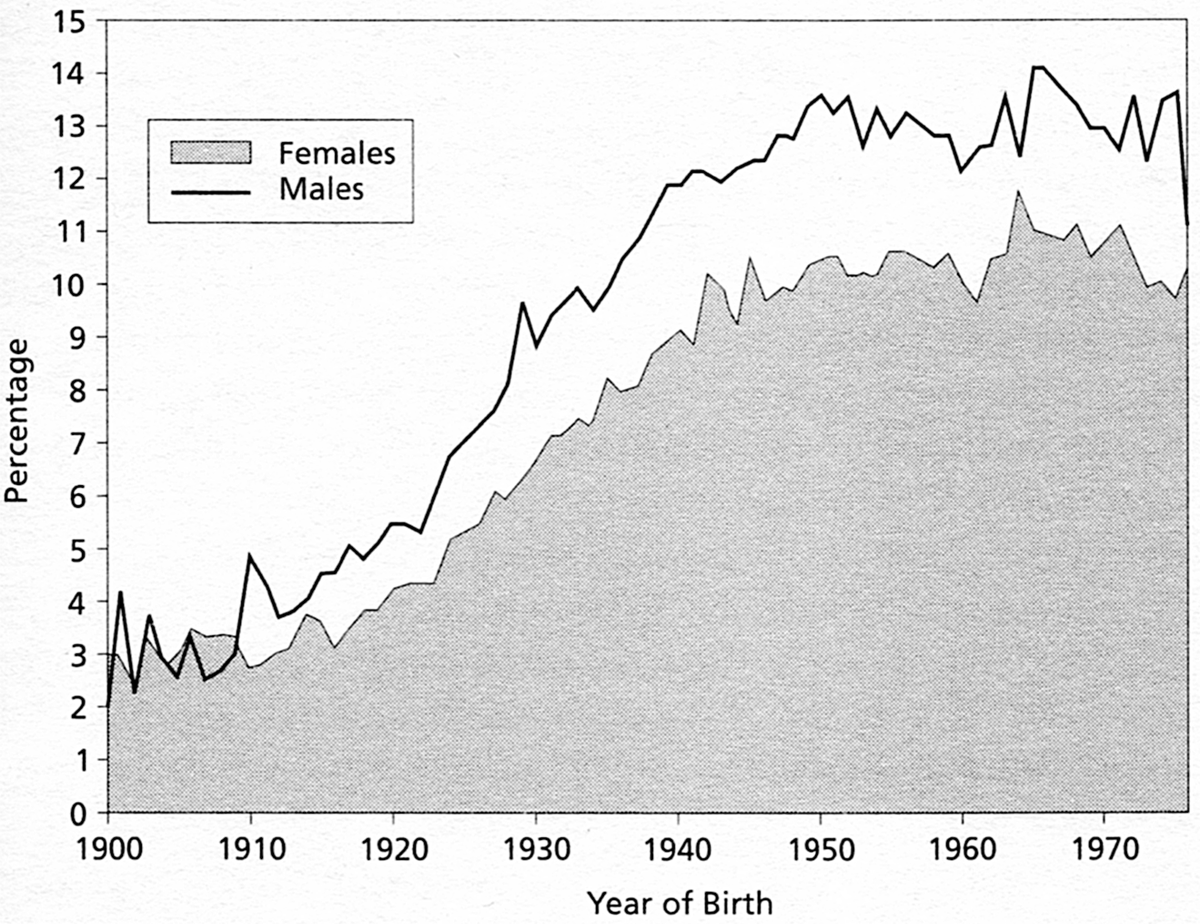
Figure 1
Writing hand plotted against year of birth: after National Geographic.
The proportion of left-handers is not the same in all countries. A series of surveys of handedness was made in several countries by the co-workers Phil Bryden in Canada, Maharaj Singh in India, and Yakahide Ida in Japan. It was later added to by others [3, 4, 5, 6]. Those surveys revealed the following percentages of left-handers by country.
| Canada | 11.5 |
| UK | 11.5 |
| United Arab Emirates | 7.5 |
| India | 5.8 |
| Japan | 4.0 |
| Ivory Coast | 7.9 |
| Sudan | 5.1 |
The percentage reported above for the United Arab Emirates is surprising to some who expect much social pressure against left-handedness in Arabia. However, in Arabic calligraphy, which is a leading art form in that culture, there is no prejudice against writing with the left hand. One of the leading historical practitioners was so proud of his skill that he adopted the working name “the Left-Handed” (7).
The figures produced by different surveys for apparently similar populations often differ by one or two per cent. Chris McManus who contributed to the data tabulated above is currently quoted on a UK based website as saying that some 13 per cent of the UK is left- handed [8]. The devil is in the detail. The geographical location of the population; its ethnicity; its age group; the historical period when the survey was made, all affect the outcome. Another feature that undoubtedly affects the outcome of a survey is the definition of handedness used by the researchers. Some, like National Geographic, have, by design or accident, collected data specifically on the handedness displayed by writing. Others have considered handedness as displayed by a range of activities which, sometimes, does not include writing. The vast bulk of research on handedness is not concerned specifically with the hand used for writing but with what handedness overall might reveal about the organization of the brain, genetic inheritance, or some other feature of the human condition. The usefulness to document examiners of a paper by Raymond and Pontier concerning handedness in no less than 13 countries is somewhat reduced as the criteria for handedness employed in that work is the hand used for throwing and hammering [9].
Similar difficulties are encountered in a determination of handedness in historical and pre- historical times by observing the depiction of handed activities in contemporaneous works of art. A study by Coren and Porac [10] extended back 5000 years before present and involved over 1000 images. On average, over that time and across the cultures observed, about eight per cent of the people portrayed were left-handed.
Various attempts have been made to introduce a measure of overall handedness, not restricted to writing. One such is the Edinburgh Handedness Inventory introduced by O ldfield [11] which records the hand used for a specified list of tasks.
The range of handedness reported by different authors for different populations is very large. For the Kwakiutl Indians of British Columbia, 17 to 22 per cent is reported as “left-handed or ambidextrous for writing” in 1986 [12]. A striking contrast with the 0.5 per cent left-handed reported for school children in the Katanga province of the Congo 22 years earlier in 1964 [14].
The rather idiosyncratically reported data for the Kwakiutl of British Columbia, “left-handed or ambidextrous for writing” appears to set them apart from the generally held view that extremely few people are able to write with each hand with equal facility. Annett [14] states that the ambidextrous with regard to writing are about three per cent of what I presume to be a sample of the UK population. A test of manual skill related to writing ability for each hand has been suggested by Tapley and Bryden [15]. The person undertaking the test simply has to make a dot inside each circle in a printed pattern of circles, as quickly as possible, first with one hand and then with the other (Figure 2). Performance is assessed by measuring the time to complete the pattern with each hand, or by the number of circles dotted by each hand in a fixed time, or by the use of various formulae based on those parameters.
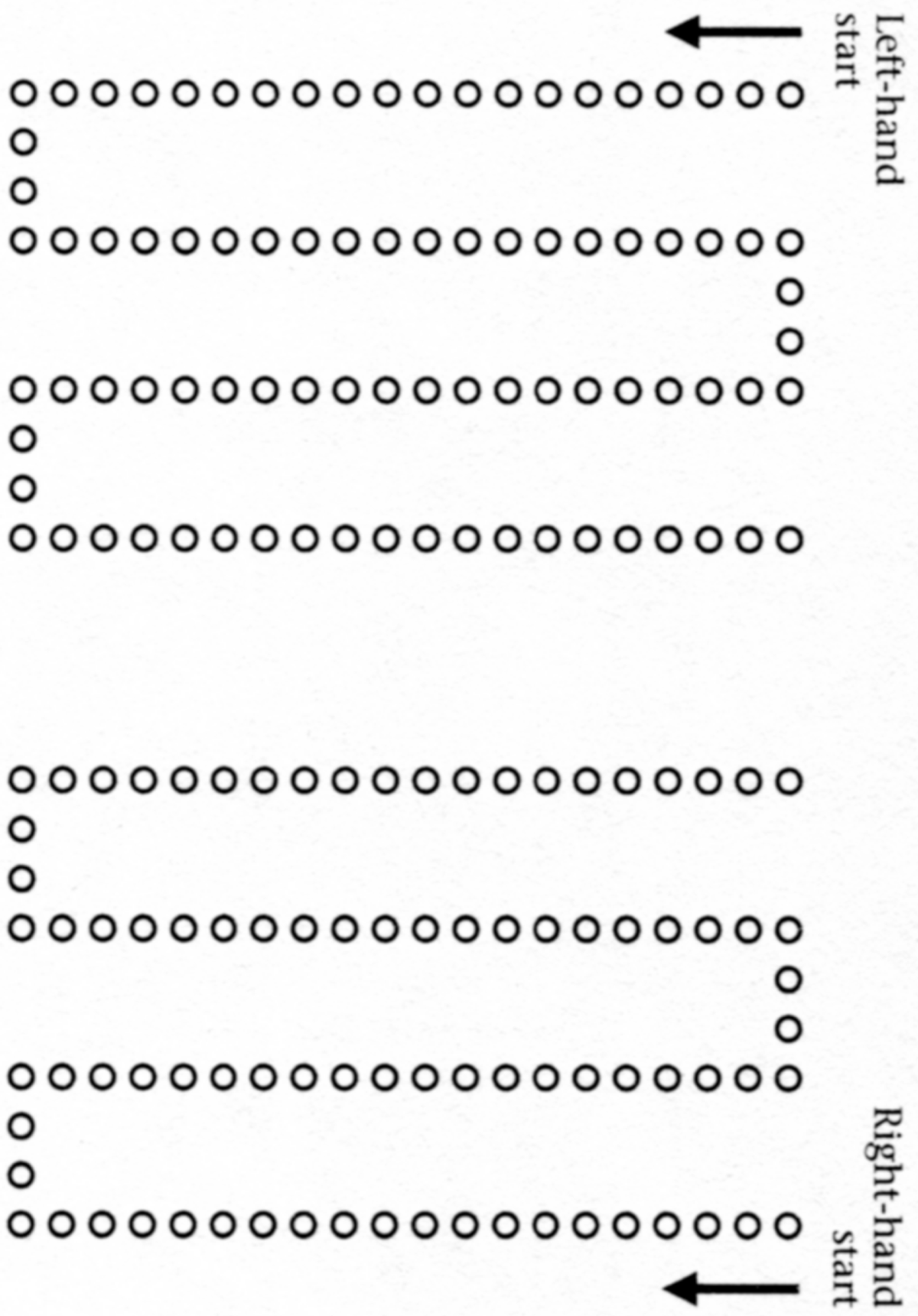
Figure 2
Manual skill test for handedness: after Tapley and Brandon.
This short paper has barely scratched the surface of a huge area of study, one that is complex and, at times, controversial. Those who wish to delve more deeply should be aware that an unending study awaits them. A good general guide is provided by the book “Right Hand, Left Hand” by C. McManus [16].