
Introduction
The Crime of the Century
Sometime between 8:00 p.m. and 10:00 p.m. on the night of March 1, 1932, Charles Lindbergh, Jr., the twenty-month-old son of then-famous aviator Charles Lindbergh and his wife Ann, was kidnapped from the second-floor nursery of their new Hopewell, New Jersey home. The kidnapper left a small, white envelope on a radiator case near the nursery window. It contained a ransom note handwritten in blue ink that read:
“Dear Sir!
Have 50,000$ redy 2500$ in 20$ bills 1500$ in 10$ bills and 1000$ n 5$ bills. After 2–4 days we will inform you were to deliver the Mony. We warn you for making anyding public or for notify the polise the child is in gute care. Indication for all letters are singnature and 3 holds.”1
At the bottom right-hand corner of the sheet of paper was a symbol created with the outlines of two blue-colored interlocking circles, each about one inch in diameter. The areas where the circles intersected contained a solid circle, red in color. Three small holes had been punched into the design.
This design was to be used repeatedly on many of the notes that followed.
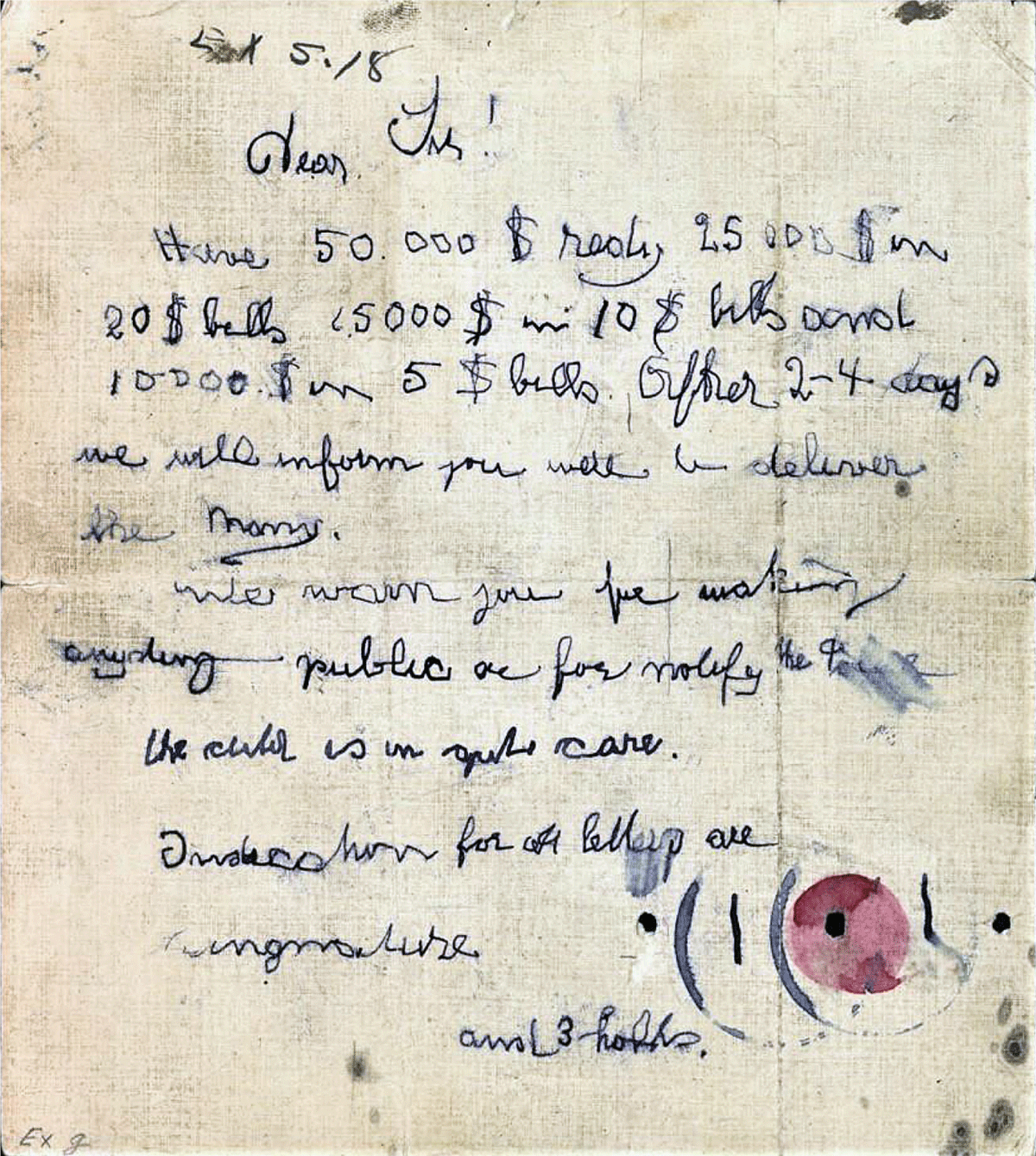
Figure 1
Image of the ransom note left in the baby’s nursery at the time of the kidnapping. Public domain image from FBI.gov website (https://www.fbi.gov/history/famous-cases/lindbergh-kidnapping).
An investigation outside the house revealed a broken, three-piece, homemade extension ladder constructed of wood. The side rails of the ladder’s middle section were split, indicating to some that the ladder may have broken as the kidnapper descended while carrying the baby. There were no blood stains in or about the nursery, nor were there any fingerprints. Investigators also discovered a chisel and large footprints leading away from the house. For unexplained reasons, and inconceivable by today’s crime scene processing standards, these footprints were never measured.2
To make matters worse, word of the kidnapping had been broadcast all over the world by the next morning. Reporters, cameramen, and curious onlookers swarmed over the Lindbergh property, trampling any uncollected evidence that may have remained.
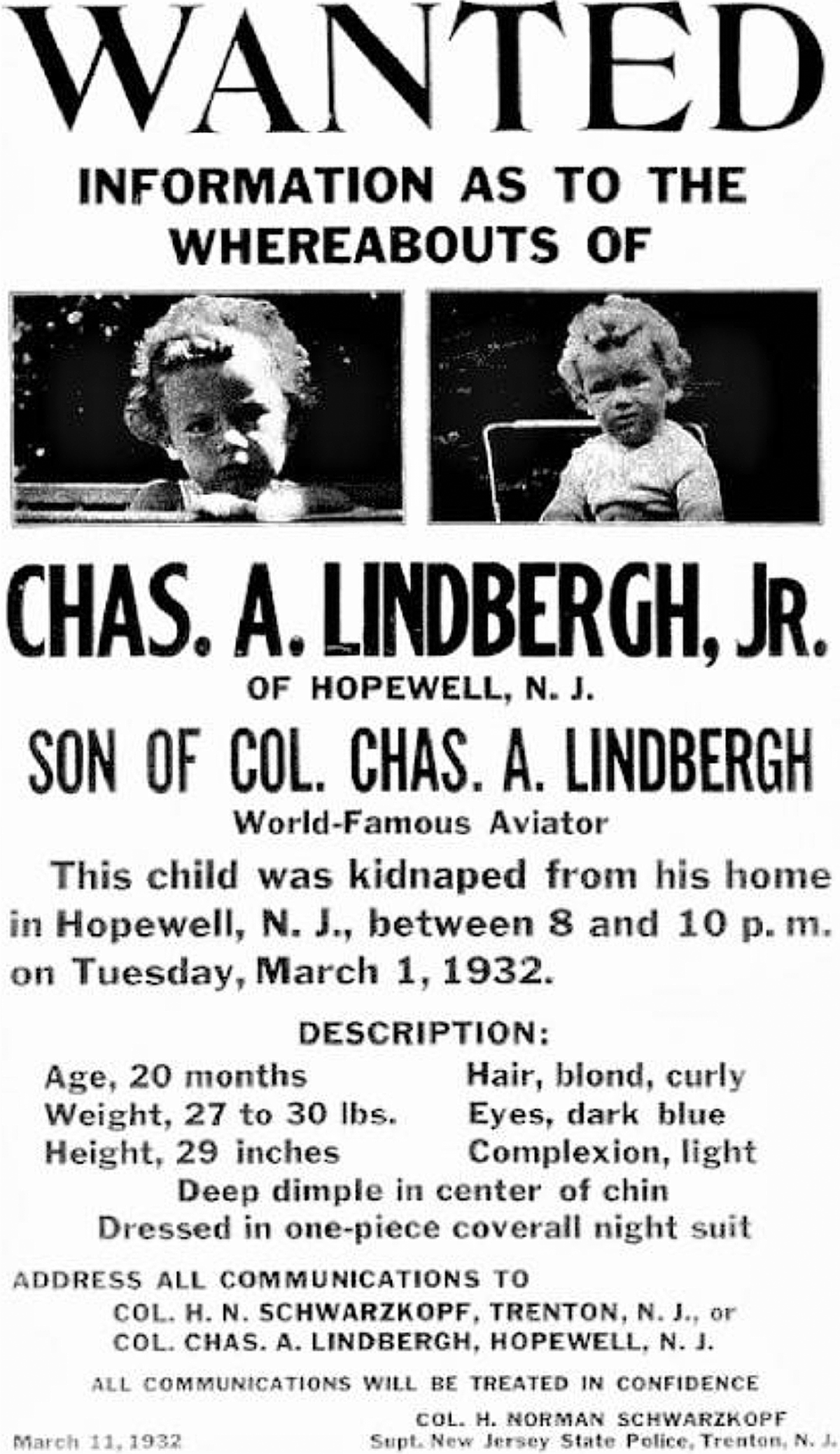
Figure 2
Image of Wanted Poster distributed to public after kidnapping. Public domain image from FBI.gov website (https://www.fbi.gov/history/famous-cases/lindbergh-kidnapping)
Head of the New Jersey State Police at this time was Colonel H. Norman Schwarzkopf, and Charles Lindbergh made it very clear to him that he wanted no police interference in the negotiations between the Lindbergh family and the kidnappers. The Lindberghs quickly broadcast a message to the kidnappers on NBC radio and promised to keep all arrangements made for the safe return of their baby confidential.
On March 5, 1932, the Lindberghs received the first of many communications from the kidnapper since their baby was taken. It was a handwritten note, postmarked from Brooklyn, NY, and the Lindberghs were warned to keep the police “out of ths cace” and the “pappers quiet.” The note further advised “Don’t by afraid about the baby two ladys keeping care of it day and night.”3 Even gangster Al Capone felt sympathy for the Lindberghs, and offered $10,000 for information leading to the return of the child.
On March 8, 1932 a letter appeared in the Bronx Home News from Dr. John Condon, a retired school principal. The somewhat eccentric Dr. Condon had publicly offered himself as a gobetween; promising “to go anywhere, alone, to give the kidnappers the extra money.”4 The next day, Condon received a letter from the kidnapper directing him “After you gets the money from Mr. Lindbergh put them words in the New York American: money is ready. After that we will give you further instructions.”5 The code name concocted for Dr. Condon was “Jafsie,” based on a condensation of his initials J.F.C.6
Lindbergh and Condon met to discuss the response to the note and at this time Lindbergh authorized Condon to place a note in the New York American newspaper as the kidnapper had instructed.7 On March 12, 1932, at 8:30 p.m., a taxi driver rang the doorbell of Condon’s house and handed him a letter which turned out to be from the kidnapper. The letter advised Condon he was to be at a specific location near an empty hot dog stand in “three-quarters of a houer” where he would find another note under a stone.8 Condon arrived and found the note, which advised him to “follow the fence from the cemetery direction to 233rd Street. I will meet you.”9 When Condon arrived at the cemetery, a man with a handkerchief over his nose and mouth motioned to him. When Condon approached, the man asked if Condon had the money. He spoke with a heavy German accent and told Condon his name was John. During this conversation “John” asked Condon, “Would I burn if the package was dead?”10 He then quickly denied the baby was dead and promised to send Condon a token: the baby’s sleeping suit.
A few days later, Dr. Condon received a package containing the gray wool sleeping suit worn by the Lindbergh baby on the night of the kidnapping. Charles Lindbergh, at this point, became extremely anxious and worried. He urged the ransom be paid immediately, even though the baby had not actually been seen. On Tuesday, March 31, 1932 another note received by Condon from “John” demanded that the money be ready by Saturday evening. United States Treasury Agents assisted by assembling the ransom money in gold certificates, after recording their serial numbers and taking samples of string and paper used to tie the bundled money. Officials reasoned the gold certificates would be more easily set apart from other currency as the United States was scheduled to be taken off the gold standard within the following two years, and it would be required that these gold certificates be removed from circulation. The gold certificates were delivered to Condon’s house, and on 7:45 p.m. on Saturday, April 4, 1932 another taxi driver arrived with another note directing Condon to a flower shop, where yet another note would be waiting under a table at that location. Charles Lindbergh, carrying a gun, accompanied Condon to that location, but decided to allow Condon to go to the cemetery alone, as the note directed, to meet the kidnapper. When Condon met again with the man he knew as “John,” he told John he would not hand over the money until told where the baby was. John left and returned in ten minutes with a note he claimed identified the baby’s precise location. Condon then handed John $50,000 in gold certificates in exchange for a note containing directions to a boat where the Lindberghs would find their missing child. The final note read:
“the boy is on Boad Nelly it is a small Boad 28 feet long, two person are on the Boad, the are innocent. you will find the Boad between Horsesneck Beach and gay Head near Elizabeth Island.”11
At dawn the next morning Charles Lindbergh departed in his plane, searching in vain along the Atlantic Coast for a non-existent boat named Nelly.
On May 12, 1932 at 3:15 p.m. a trucker named William Allen stopped along the road at the village of Mount Rose, New Jersey, just two miles from the Lindbergh’s Hopewell home. About seventy- five feet off the road, Allen was able to see a baby’s head and foot protruding from the ground. The hunt for the missing Lindbergh baby was finally over. Findings at the autopsy of the child’s badly decomposed body found cause of death to be a “fractured skull due to external violence.”12 Prosecutors later surmised this skull fracture occurred during a fall the same night as the kidnapping, when the ladder broke as the kidnapped child was being carried down after being taken from his bedroom.
The Investigation and the Evidence
Throughout 1932 and 1933, the police tracked locations where the marked gold certificates paid in the ransom began to surface. The certificates had first begun to appear all over New York City, but then became more concentrated in the mostly German-speaking district of Yorkville in upper Manhattan in New York City. A cashier at the Loews Theater there remembered accepting a gold certificate in November, 1933 from a man who matched Dr. Condon’s description of “cemetery John.” Ten months later, a teller of the Corn Exchange Bank in the Bronx borough of New York City noticed a gold certificate with “4U1341 NY” penciled in the margin of the bill.13 The teller notified investigators, who tracked this certificate to a gas station attendant in upper Manhattan. The attendant recalled the certificate was paid to him by an average-sized man with a German accent, driving a blue Dodge vehicle. The attendant also remembered being suspicious about the certificate, and told police when he remarked to his customer about the rarity of such bills, the customer replied he had about one hundred of such certificates. As the customer was driving away, the suspicious gas station attendant wrote the license plate number of the blue Dodge on the certificate.
The license plate number written on the bill was traced to Bruno Richard Hauptmann, a thirty- five-year-old carpenter living in the Bronx, one of New York City’s five boroughs. On the morning of September 19, 1934, he was arrested. In his possession was a twenty-dollar gold certificate. In his house was found a pair of shoes which had been purchased with a twenty-dollar recorded ransom certificate recovered on September 8, 1934. On the night of September 19, he was identified by the taxi driver (who delivered the fifth ransom note to Dr. Condon) as the person who gave him the handwritten note for delivery to Condon. On September 20, 1934, gold ransom certificates in excess of $13,000 were found in Haputmann’s garage. Shortly after this, he was identified by Dr. Condon as the man who became known to him as “cemetery John.” Further evidence included a smudged, pencil-written phone number found on the trim of a door in Hauptmann’s home, which turned out to be Dr. Condon’s home phone number. Additional evidence was located in the form of a sawed-off piece of floor board in Hauptmann’s attic, later to be connected to the repaired ladder found at the crime scene.
Upon being interviewed, Hauptmann said the money belonged to a deceased German friend named Isidor Fisch. Investigators came to refer to this as the “Fisch Story,” as it was very “fishy” indeed. Hauptmann claimed Fisch had left the box, filled with money, in Hauptmann’s care prior to departing for Germany. When Fisch died, Hauptmann kept the money, which he claimed Fisch had owed to him.14 Additional investigation showed that Hauptmann was a native of Saxony, Germany. He had a criminal record of robbery and had spent time in prison. In July 1923, he stowed away aboard a ship in Bremen, Germany and arrived in New York City on July 13, 1923, when he was immediately deported. He successfully re-entered the United Stated in November, 1923. He married and had a son in 1933. During his illegal stay in New York City from 1923 until 1932, Hauptmann worked as a carpenter. A short while after the kidnapping date, Hauptmann began to trade extensively in stocks and never worked again.
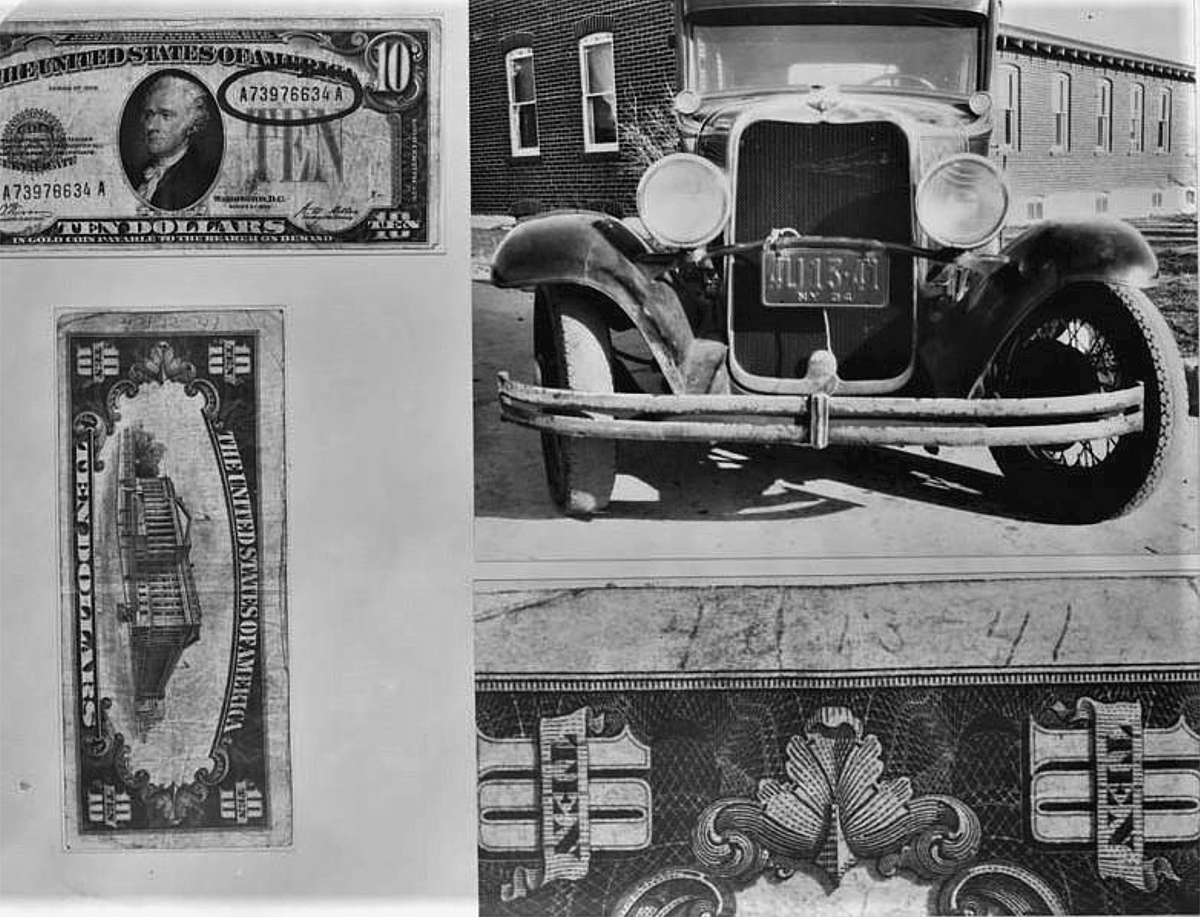
Figure 3
Copy of Evidence Photographs of $10 Gold certificate with Hauptmann’s vehicle License Plate Number, and Hauptmann’s vehicle (from Trial of Bruno Richard Hauptmann for Kidnapping of Charles A. Lindbergh Jr., 1935, Courtesy of New Jersey State Police and New Jersey State Archives.)
Specimens of Hauptmann’s handwriting were obtained and flown to Washington, D.C. where they were initially examined by the FBI Laboratory. A comparison of Hauptmann’s specimen writing with the handwriting on the ransom notes disclosed remarkable similarities in inconspicuous, personal characteristics and writing habits, which resulted in the identification of Hauptmann as the writer of these notes by the handwriting experts of that Laboratory.
In light of the abundance of physical and direct evidence, Hauptmann was indicted in the Supreme Court of New York on charges of extortion on September 26, 1934. Two weeks later, in the Hunterdon County Courthouse in Flemington, New Jersey, twenty-three grand jurors unanimously voted to indict Hauptmann for kidnap and murder. New York agreed to allow extradition of Hauptmann to stand trial in New Jersey. The trial date was set for January 3, 1935.
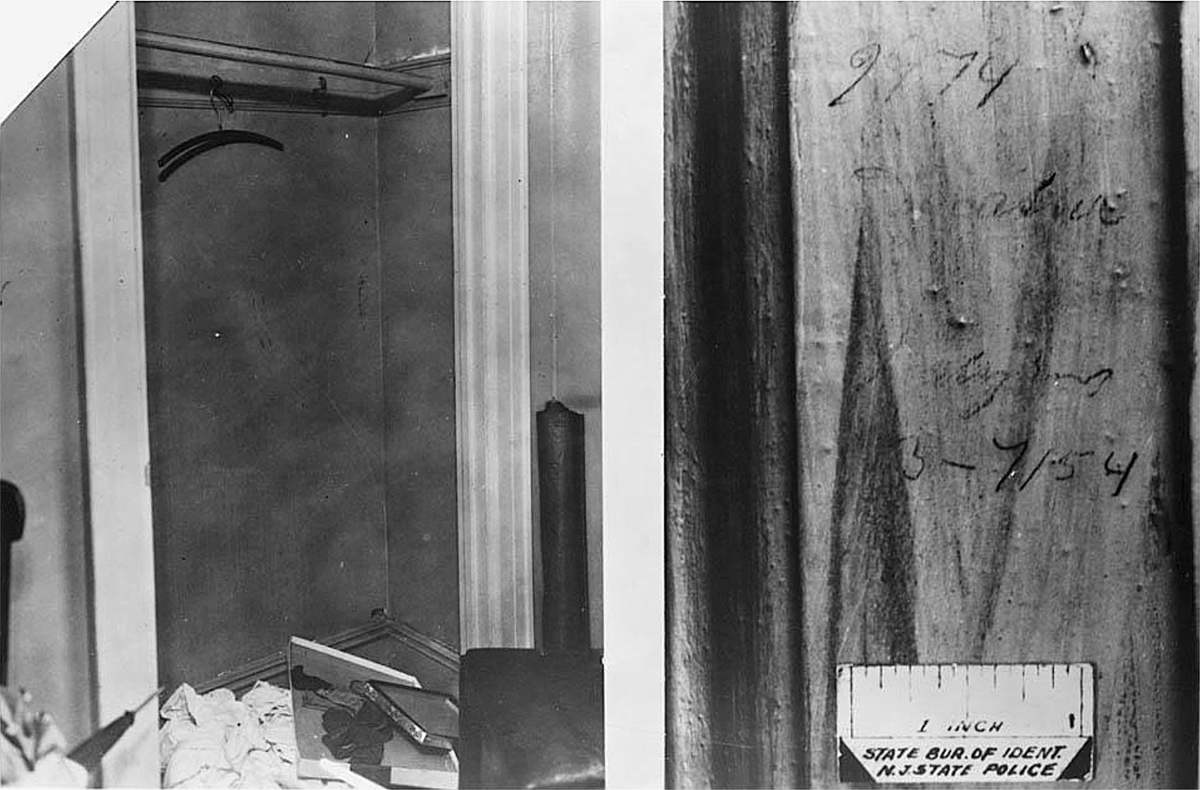
Figure 4
Copy of Evidence Photographs of closet at Hauptmann’s Bronx residence in which address and telephone number of J. F. Condon were found written on wall (from Trial of Bruno Richard Hauptmann for Kidnapping of Charles A. Lindbergh Jr., 1935, Courtesy of New Jersey State Police and New Jersey State Archives.)
The Trial
The case was tried by prosecutor David Wilentz, with Hauptmann’s attorney Edward J. Reilly representing the defense; along with additional defense attorneys C. Lloyd Fisher and Frederick Pope. The well-respected seventy-one-year-old Judge Thomas Trenchard presided. The first witness called was grief-stricken Anne Lindbergh, who was asked to identify the clothing worn by her baby on the night of the kidnapping. She was followed by Charles Lindbergh, who identified the voice he heard in the cemetery as that of Hauptmann. Defense attorney Reilly pursued an unusual line of questioning with Mr. Lindbergh, suggesting the kidnapping was carried out by neighbors, or possibly household servants, or even Dr. Condon himself. Testimony from a housemaid and neighbors followed, as did testimony from the first responders to the crime scene: Corporal Joseph Wolf and Sgt. Frank Kelly. Dr. John Condon, viewed as a most important witness as he was the only one to meet the kidnapper face to face, caused quite a commotion in the courtroom when he identified “John” as being “Bruno Richard Hauptmann.”15
Handwriting testimony began on the eighth day of the trial, beginning with Colonel Norman Schwarzkopf being asked about his collection of the handwriting specimens. In addition to two handwriting specimens produced by Hauptmann voluntarily, the prosecution soon introduced a total of forty-five specimens, including some of the ransom notes, nine automobile registrations in Hauptmann’s handwriting, and a known specimen of Isidor Fisch’s handwriting. Using enlargements of the specimens, a total of eight document examiners told the jury that Hauptmann was the author of the ransom notes.
Defense attorney Reilly later told the press he would produce eight handwriting experts of his own to show Hauptmann was not the author. Only one, however, would eventually take the stand.
The final witness for the prosecution was a wood expert from the United States Forest Service in Madison, Wisconsin named Arthur Koehler.16 Koehler identified the wooden board of the kidnap ladder as having come from a lumber store in the Bronx. Based on the location and shape of the nail holes, as well as the grain of the wood, Koehler stated his conclusion that the board was at one time joined to board found in Hauptmann’s attic. With this last revelation, the prosecution rested.
Document Examiners’ Testimony
Albert S. Osborn, was seventy-four years old when he was called to testify as the prosecution’s first expert handwriting witness. Osborn testified he first examined and photographed the handwritten ransom notes in May, 1932. During the 2 ½ year period that followed, he compared them to the handwriting of over 100 people. After stating his opinion “that the ransom notes were all written by the writer of the various papers signed Richard Hauptmann” he further explained the notes were all connected to each other by many ways not related to handwriting characteristics alone.17 These included use of words, peculiar spelling, references in later letters that referenced information in prior letters. Osborn then added “Most positively, the ransom notes were connected to each other, by a peculiar and ingenious device that appeared in the lower right hand corner,” referring to the holes and colored markings.18 Osborn testified he believed all the holes were punched in the same relation to each other on every letter he examined, and that the letters were further connected to each other in the three following ways: general characteristics, ordinary characteristics, and rare characteristics. In what was quite possibly the most powerful statement of all the document examiners who testified, Osborn concluded the “physical evidence of connection between the admitted writings and the ransom writings and the request writings and ransom notes, the physical connection between these writings, in my opinion is irresistible, unanswerable and overwhelming.”19
Eldrige W. Stein was the second handwriting expert to testify. Stein was sixty-two years old and lived in New Jersey, but worked in New York. He had over 30 years experience in document examination. There were some initial qualifying questions by prosecutor Lanigan, but no true voir dire.
Stein stated the basis for his opinion that Hauptmann was the author of the ransom notes was “based upon numerous similarities, always keeping in mind the differences, because there are some differences.”20 Stein’s testimony focused on the numerous consistently misspelled words in the notes, as well as letter transposition in words like “the” where it was sometimes written “hte.” Interestingly, Stein was the only examiner to make any comment about analyzing the folding of the paper in two of the notes.
Upon his cross examination by attorney C. Lloyd Fisher, Stein very skillfully answered questions put to him. For example, when asked by Fisher if a person giving requested writings while in custody is likely to write self-consciously or unnaturally, Stein replied “That depends whether or not he is guilty or not.”21
John F. Tyrell from Milwaukee, Wisconsin, was the third examiner to testify. He had over 40 years experience in his profession. Again, as with the other examiners, there was no voir dire. Tyrell pointed out a number of similarities in several characteristics in his illustrations of Hauptmann’s known writing and the ransom notes. Upon cross-examination, attorney Frederick Pope asked numerous questions about Tyrell’s training and experience, and then continuously interrupted Tyrell’s answers. As with the other handwriting examiners, cross examination attempted to reinforce Hauptmann may have been deliberately instructed to misspell certain words when the requested specimens were obtained from him. For some unknown reason, Tyrell was the only document examiner who was asked if he did any work as a graphologist.22
Herbert Walter, a questioned document examiner from Chicago with 25 years experience, was next to take the stand. Walter was able to express his opinion that he had identified Bruno Hauptmann as the writer of all of the ransom notes, but was suddenly instructed by prosecutor Lanigan to limit his testimony to one illustration and given a time limit of ten minutes. To this Walter responded “that is rather unusual, to have to rearrange my testimony at a moment’s notice, also somewhat difficult.”23 Walter discussed characteristics such as “i” dots and “t” crossings, as well as slant, size, margins, and natural variation. Upon cross examination by attorney Rosecrans, implications were made by the defense that the ransom notes were really written by someone who imitated Hauptmann’s writing. Walter responded that when taking together all of the ransom notes, this would have been, “In my opinion, impossible.”24 It appears Walter was the only document examiner questioned about the exactness of handwriting identification.
Harry M. Cassidy, from the area of Richmond, Virginia was the next to testify. He worked for the Chesapeake and Ohio Railroad Company and had over 20 years experience as a document examiner. From his testimony, he appears to have had the best sense of humor of all the forensic document examiners who testified. Cassidy also expressed his opinion that the writer of the known standards (Hauptmann) was the same person who wrote the ransom notes. Upon referring to his own charts, Cassidy said “There won’t be a thing that I can show that hasn’t already been shown. I have been in the courtroom part of the time and my evidence has been shot all to pieces, it has been absorbed.”25 Cassidy pointed out the misspellings, but expressed his reluctance to make an identification just based on those alone, due to the importance of the case. Upon crossexamination, attorney Fisher inquired how one sample of Hauptmann’s writing would be sufficient to show consistent misspellings. Cassidy replied “Well, if they had one specimen and all these misspelled words occurred in it, I guess one specimen would be sufficient. One well will make a river if it is big enough.”26 Cassidy’s folksy manner and somewhat humorous responses seemed to frustrate Fisher. Fisher wound down his cross examination saying “Just one or two questions from your test, now Mr. Cassidy, and then I’m all through here – thank God.”27
Wilmer T. Souder, the next examiner to testify, appears to have been the best educated of the group. Souder possessed a Bachelor’s and a Masters degree from the University of Indiana, as well as a Ph.D. in physics from the University of Chicago. He was employed as the chief of the identification laboratory of the Scientific Staff of the National Bureau of Standards, part of the Department of Commerce, where he had worked for nineteen years. Like the others before him, Souder expressed his opinion that the writer of the known writings was the same as the writer of the ransom notes. He presented and discussed characteristics in his two charts without interruption. Upon cross examination by attorney Pope, Souder was interrupted repeatedly when he attempted to answer. In quite a good definition of what constitutes a discrepancy, Souder explained this as “absolute and positive differences which cannot be reconciled.”28 Upon hearing this definition, Pope attempted to get Souder to admit there were differences between the known writing and the ransom notes. Souder tactfully explained some writing was not the same, but he never admitted there were any discrepancies.
Albert D. Osborn, the thirty-eight-year-old son of Albert S. Osborn, had been a questioned document examiner for fifteen years. He testified all ransom notes were written by the same writer. This point had become a particularly important one over the course of the trial, as the defense was trying to make the point that Hauptmann was not the writer of the note found in the nursery, therefore, could only be charged with extortion, not kidnap and murder. Osborn chose to use only one of his charts, the one showing an address on the wrapper of a letter to Condon, comparing observed similarities on the handwriting on the wrapper to a photograph of Hauptmann’s requested writing. In a statement that would never be permissible in today’s court room, Osborn stated “I think [it] is almost enough to show that this is the guilty man.”29 It appears from Mr. Osborn’s testimony, that he was more confrontational in his answers than the other examiners. When asked by the defense whether it was possible that someone had copied Hauptmann’s writing to fabricate the ransom notes, Osborn replied, “I think that is a probability that is so farfetched that it is absolutely ridiculous.”30
Clark Sellers, a document examiner with twenty years of experience from Los Angeles, was the eighth, and final, handwriting expert called by the prosecution. His testimony differed from the other experts only in that he gave very descriptive testimony about the formation of handwriting habits and how these habits are used to identify handwriting. Sellers made his testimony easy for the jury to understand by comparing handwriting identification characteristics to the identification of one’s own automobile from a group of other similar automobiles, and to the recognition of a particular person through certain aspects of their physical appearance. In expressing the strength of his conviction that Hauptmann was the writer of the ransom notes, Sellers stated: “It is, I say, so convincing in my mind, that he might just as well signed his name to each and every one of them.”31 During cross examination by attorney Pope, attempts were made to have Sellers provide an immediate opinion on a document Sellers was seeing in court for the very first time. Sellers eloquently explained he could not do such a thing in fairness to Pope, to the jury, or to the court. The defense rested shortly after this exchange, and there was no redirect examination of Sellers’ testimony.
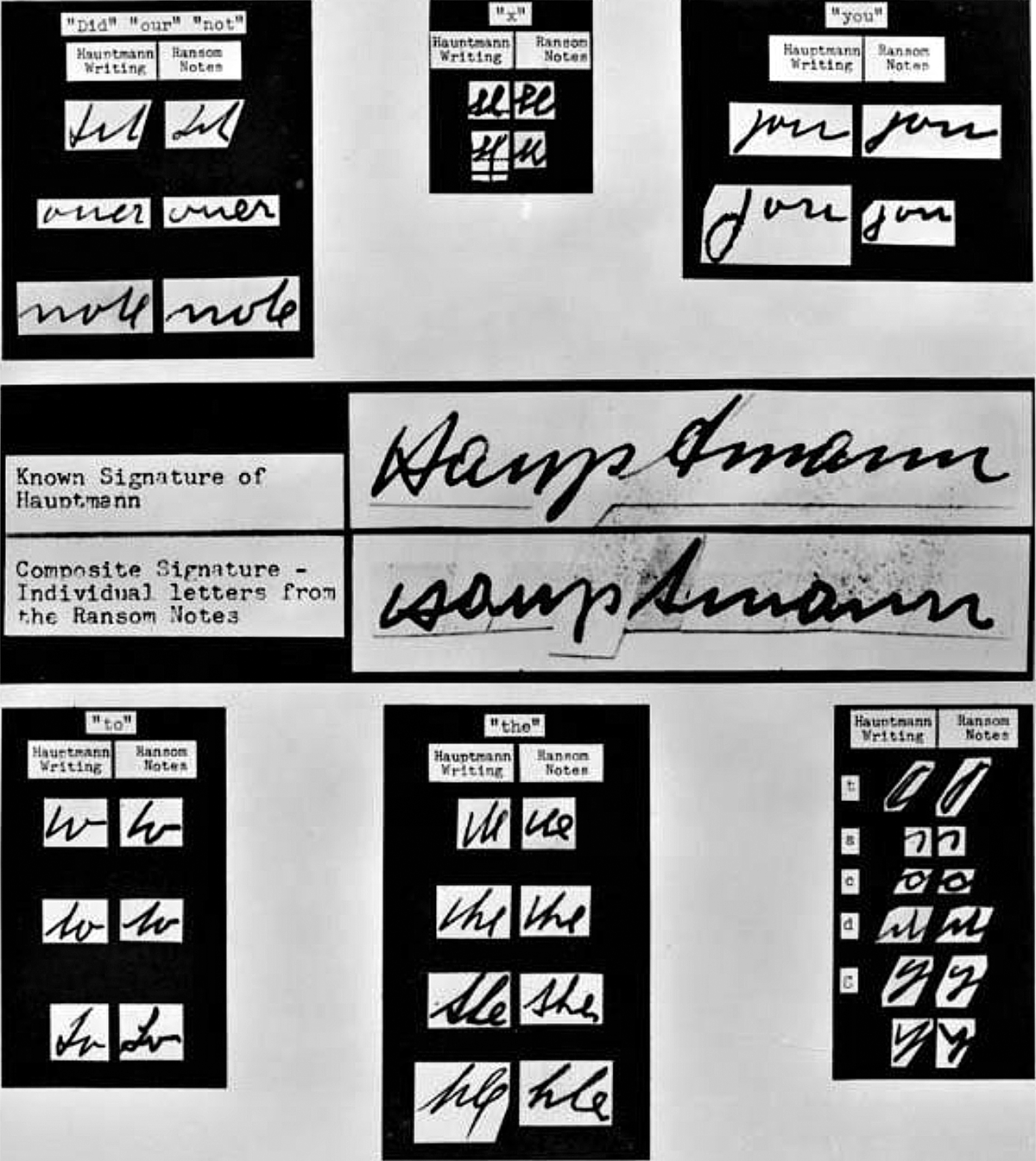
Figure 5
Copy of Evidence Photograph of court exhibit depicting handwriting comparisons prepared by Forensic Document Examiner Clark Sellers (from Trial of Bruno Richard Hauptmann for Kidnapping of Charles A. Lindbergh Jr., 1935, Courtesy of New Jersey State Police and New Jersey State Archives.)
The Wood Expert
Arthur Koehler received his bachelor’s degree in forestry in 1911 from the University of Michigan and obtained a master’s degree from the University of Wisconsin in 1928. He was employed as a wood technologist and identification expert with the Forest Products Laboratory of the U.S. Forest Service in Madison, Wisconsin when his involvement in the case was requested in 1933 by the New Jersey State Police.32 Koehler meticulously reconstructed the number and size of the original pieces of wood used to make the ladder and was able to determine the initial relationship of pieces to one another before the boards were cut. He also discovered unique toolmarks left in the boards by defects in the cutters of Hauptmann’s hand planing machine. He traced the original shipment of wood to the National Lumber and Millwork Company in the Bronx. Most importantly, he connected rail 16 of the ladder used in the kidnapping to the floorboard in Bruno Hauptmann’s attic. Cross examination by the defense did nothing to shake Koehler’s testimony. The connection between the wood evidence, Hauptmann, and the kidnap ladder was irrefutable.
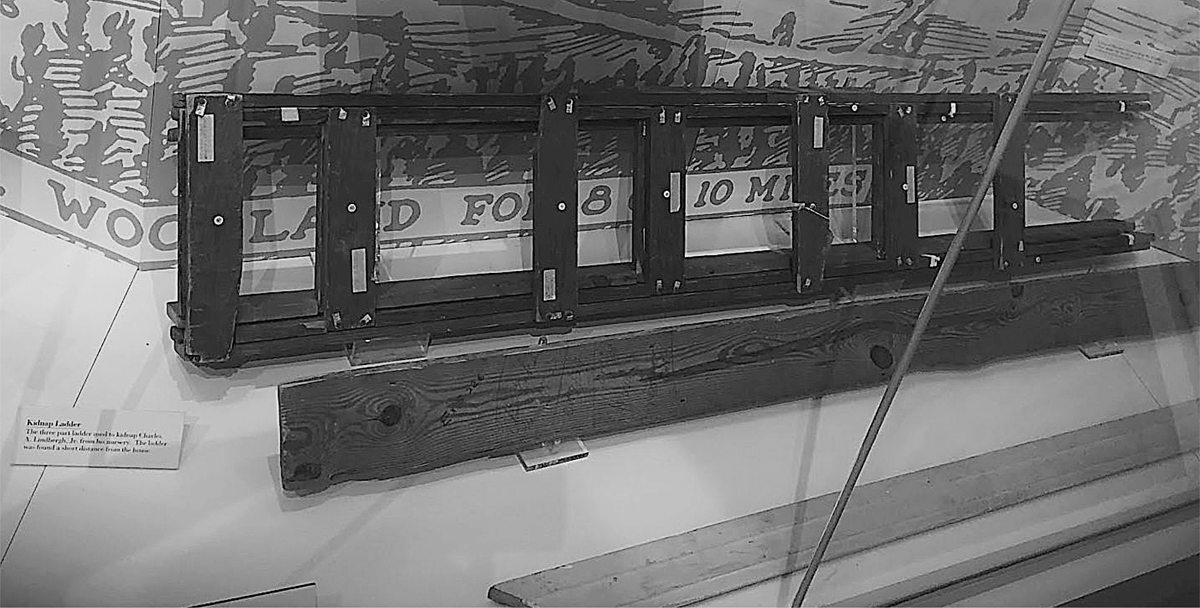
Figure 6
Photograph of ladder used in kidnapping made with wood from Hauptmann’s residence (From items on display at the New Jersey State Police Museum and Learning Center, Trenton, NJ.)
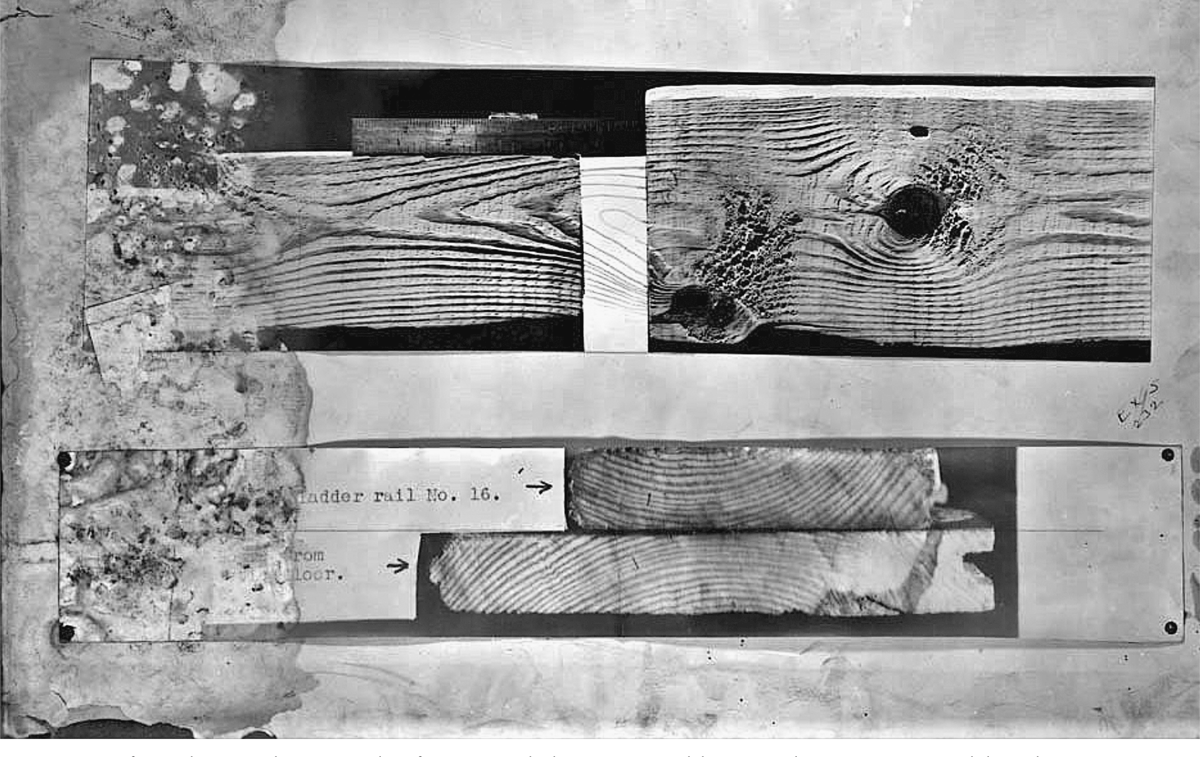
Figure 7
Copy of Evidence Photograph of court exhibit prepared by wood expert A. Koehler showing comparison with Rail 16 of ladder with floor board in Hauptmann’s residence (from Trial of Bruno Richard Hauptmann for Kidnapping of Charles A. Lindbergh Jr., 1935, Courtesy of New Jersey State Police and New Jersey State Archives).
Defense Testimony and Sentencing
It is appropriate at this point to discuss the testimony given by John Trendley, the sole self-proclaimed handwriting expert who testified for the defense. It appears attorney Lanigan devastated Trendley on the witness stand, getting him to admit that on prior cases, he had given the prosecution one opinion and the defense a total opposite opinion about the same signature.33
Defendant Bruno Hauptmann testified in his own behalf, and remained on the stand for two days. He denied any connection to the kidnapping or the ransom notes, and stuck to his story about Isidor Fisch. He denied any connection to the ladder. A parade of alibi witnesses, including Hauptmann’s wife, followed. One by one, their testimony was destroyed upon cross-examination. After the testimony of a total of 162 witnesses within forty-five days, Judge Tranchard sent the jury out to begin deliberations at 11:21 a.m. on February 13, 1934. They reached their decision at 10:28 p.m. the same day. Bruno Hauptmann was found guilty of first-degree murder and condemned to death. Appeals were rejected and attempts to gain a confession proved fruitless. Bruno Hauptmann was electrocuted for his crime at 8:44 p.m. on April 3, 1936.
Conclusion
In 1937, Albert Osborn referred to the Lindbergh case in one of his newly published books saying:
“The almost entire absence of criticism of the verdict in the case no doubt has been due to the fact that the case was so thoroughly illustrated and so fully reported that a nation was convinced of the guilt of the defendant.”34
Little did Osborn know that, years later, the case would become subject to great controversy. Conspiracy theories abounded. After 1983, access to the Lindbergh Archives was made possible through the New Jersey State Police Museum and Learning Center in West Trenton, New Jersey. This stimulated publication of a number of alternative scenarios regarding the case. Allegations of perjury, conspiracies, and theories of numerous possible “real killers” became common place. Persons claiming to be the living, now grown, Lindbergh baby began to surface.35 The theory that Bruno Hauptmann had been sent to his death as an innocent man gained increasing popularity. Books were written and movies were made supporting these theories, and there are those, including Bruno’s wife, Anna, who went to their graves believing in Hauptmann’s innocence.36, 37, 38, 39 By 1989, critics of the science of forensic document examination would write of the case:
“People wanted Hauptmann to be guilty. They wanted to be sure of his guilt, and they were grateful to those who provided the forms of certainty regardless of rationality. Osborn became a kind of public hero, and the validity of “scientific” handwriting identification when practiced by a “competent practitioner” became public knowledge, which, like much public knowledge, turns out to be not so clearly right.”40
Despite the plethora of non-believers, the overwhelming physical evidence fully supports the conclusion that Bruno Richard Hauptmann was connected with the ladder used in the crime, and connected to the large amount of the ransom money found in his possession. His identification by all eight forensic document examiners illustrate Hauptmann alone is the author of every piece of the ransom correspondence.
This case was an important milestone for several reasons. It resulted in the enactment of “the Lindbergh Law,” a Congressional Act making kidnapping a federal crime. It brought to bear the importance of physical evidence and the ability of forensic science to answer questions that eyewitnesses alone cannot. The testimony about the wood evidence in the trial opened the door to botanical evidence being accepted as serious scientific evidence. Finally, the intense news coverage of the trial and the convincing manner in which the ransom notes were shown to have been written by Hauptmann, made the world more aware of the profession of handwriting examination and expertise. Even Hauptmann himself appeared to recognize that the testimony about his handwriting was the most important testimony of the entire trial. When he was visited in his cell in 1936 by his attorney Sam Leibowitz, Hauptmann complained bitterly:
“Dot handwriting is the worstest thing against me.”41
Acknowledgement
The author wishes to thank and acknowledge the late A. Frank Hicks, whose earlier research, presentations, and publication about the Lindbergh case served as inspiration for this paper. Frank’s kindness, good humor, and generosity in the sharing of his knowledge and expertise will be remembered by all who knew him.