
Introduction
Plastic document wallets from nine different sources were used in this study. Some were described by their manufacturers as being made from polypropylene, but that has not been confirmed independently. They were of various ages though none had been used previously. Seven of the nine wallets were described as “50 micron”, but when measured with a micrometer screw gauge, it was found that their thicknesses ranged from 39 to 56 micron. The other two were described as 100 micron, and measured 99 and 101 micron respectively. Most of the wallets had a smooth surface, some had a grained surface texture, or were dimpled. The packaging for some of the document wallets described them as “Copy Safe”, “Print Safe”, “Anti-static”, or “Acid Free”.
All the sheets of paper used in this study came from a newly opened pack of Xerox plain white paper, 80 gsm and A4 size. The ESDA machine employed was one of early manufacture, and had a brass sintered vacuum plate. Charging of the imaging film covering each sheet of paper was achieved by passing the corona unit across it ten times at a height of about 50mm. The electrostatic images were developed using cascade beads, and the same beads were used throughout, but with toner being added when necessary. Each developed toner image was preserved with selfadhesive clear plastic film in the usual way. The ambient humidity and temperature during the use of the ESDA in each exercise were as follows:
| First exercise, sheets from inside the wallets: | 61-59 % RH at 21-22 C. |
| First exercise, back of Test Writing sheet: | 72-67 % RH at 16-18 C. |
| Second exercise, back of Test Writing Sheet: | 66 % RH at 17 C. |
| Third exercise, all paper sheets: | 63-62 % RH at 22-23 C. |
Control slips of paper containing known indentations were included in the image area for each operation of the ESDA, and those indentations imaged clearly.
First Exercise
The arrangement for each document wallet in this experiment is shown in Figure 1.
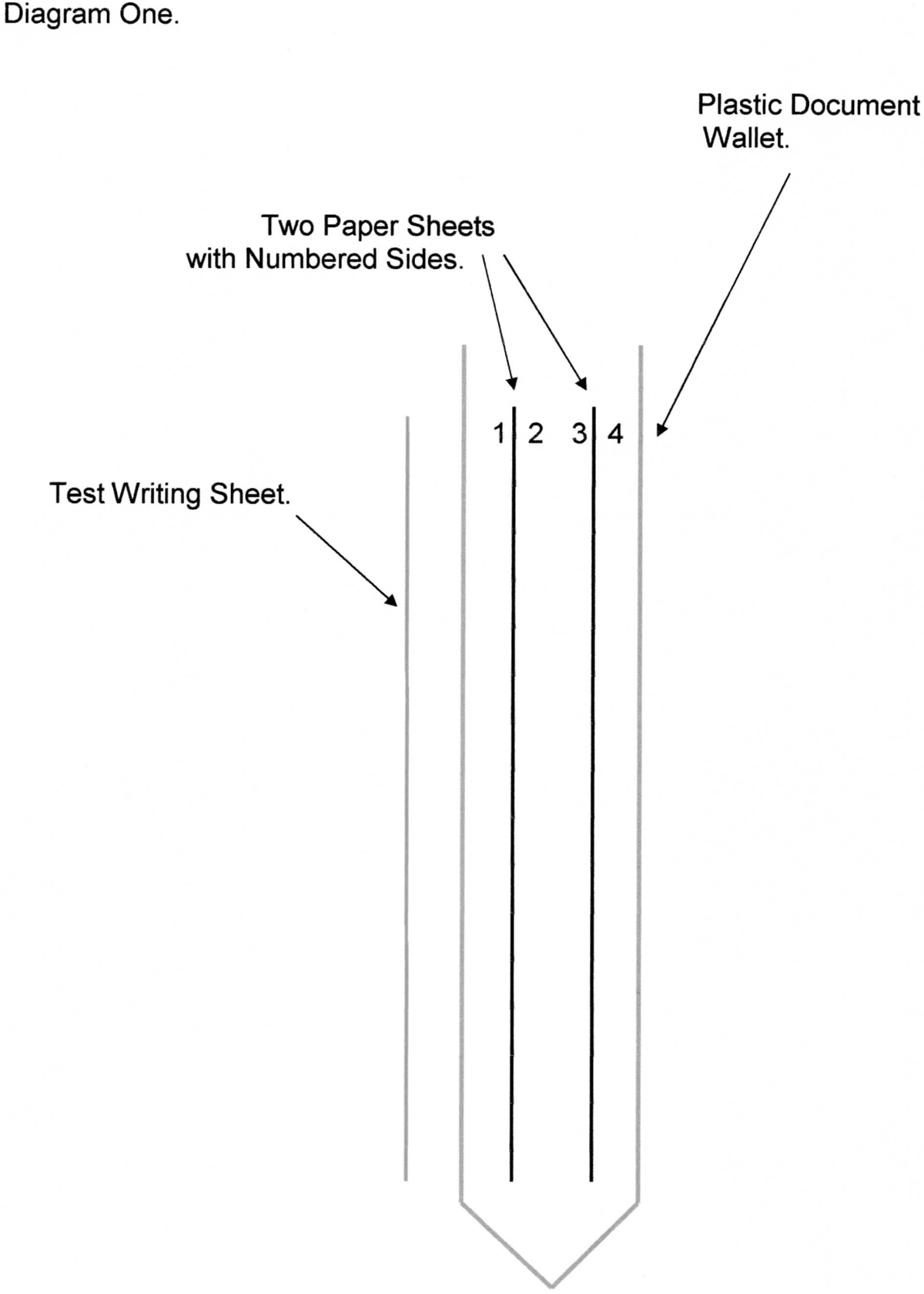
Figure 1.
Arrangement of test sheets for Exercise One.
To generate indentations in underlying materials, writing was made on a “Test Writing Sheet”. This was made from a single sheet of A4 paper ruled into horizontal sections while resting on other paper sheets. Test writing was made on it with a ball-point pen in one section while resting on a wallet. Each of the wallets contained two sheets of paper. For ease of recording, the sides of the two paper sheets in each wallet were labelled as 1, 2, 3, and 4 respectively. The arrangement was such that sides 1 and 4 were in contact with the inside of the wallet, and received indented writing and embossed writing respectively; sides 2 and 3 were in contact with each other, and received embossed writing and indented writing respectively. The indented and the embossed writing was visible by oblique light in sides 1 and 2, but was generally not visible in sides 3 and 4. The two sheets of paper were later removed and examined by ESDA to determine whether any indentations or embossings created by the test writing were detectable. The back of the Test Writing Sheet, which had been in contact with the outside of each wallet for each test writing, was also examined by ESDA.
Results of First Exercise. For the two sheets of paper inside each document wallet all tests produced the same results. The indented and embossed writing on the sides in contact with each other, sides 3 and 2, produced clearly readable electrostatic images. The indented and embossed writing on the sides in contact with the plastic document wallet, sides 1 and 4, did not produce detectable electrostatic images. For the back of the Test Writing Sheet the ESDA result was also unequivocal; the embossed writings made in direct contact with the outsides of the plastic wallets produced clear electrostatic images.
Second Exercise
The formation of an electrostatic image of embossed writings made in contact with the outsides of the document wallets is not consistent with the lack of such images of the embossed writings made in contact with the insides of those document wallets. A potential cause was that the Test Writing Sheet had been stored in a way that differed from that used for the paper sheets inside the wallets. After being used on the outside of the document wallets the test writing sheet had been placed in a plain card folder kept inside a large paper envelope. There is evidence that embossed writing rubbing against another cellulose surface, paper and by extension card, will produce an image detectable by ESDA [2]. In contrast, the sheets from inside the document wallets were kept inside the wallets until examined by ESDA later in the day on which the test writings had been made. Further investigation was undertaken; a second Test Writing Sheet was prepared resting directly on the outside of an empty document wallet and then placed inside that wallet until examined with ESDA some tens of minutes later.
Result of Second Exercise
The embossed writing gave a clear electrostatic image. It appears that storage of the first Test Writing Sheet in contact with card was not relevant to its embossed writing being imaged.
Third Exercise
A third exercise was undertaken with writing made using the arrangement shown in Figure 2. It was the same as that used for the first exercise, but with the addition of two sheets of plain paper placed behind the document wallet to test whether indented or embossed writing was imaged on the first of them. The sides of that first extra sheet were numbered 5 and 6.
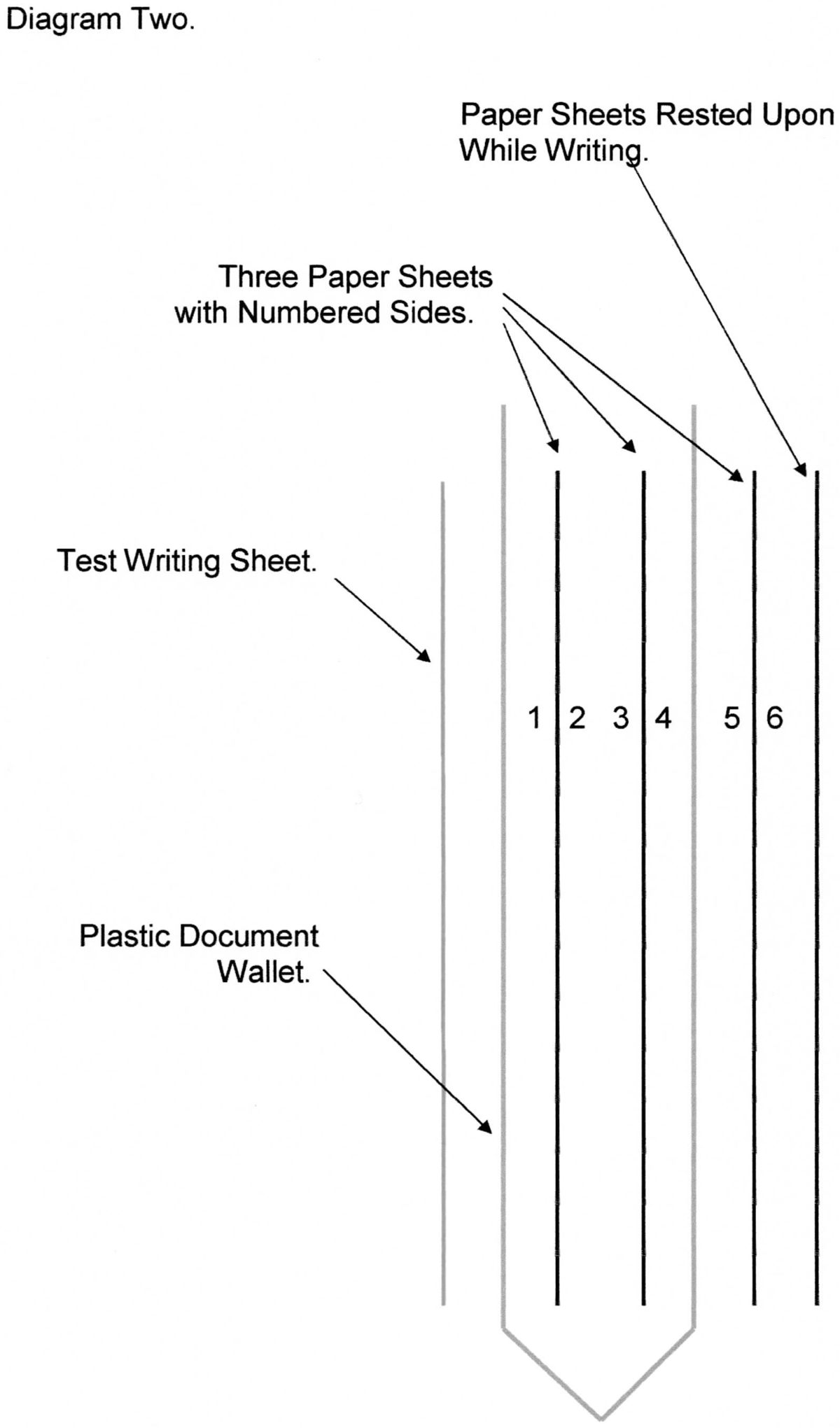
Figure 2.
Arrangement of test sheets for Exercise Three.
Results of Third Exercise
Indented and embossed writing made on the sides in contact with other paper, that is sides 2, 3, and 6, produced clear electrostatic images. The indented writing made in side 1 and the embossed writing made in side 4, each in contact with an inside surface of the document wallet, produced no electrostatic image. The indented writing made in side 5 which is in contact with the outside of the document wallet produced no electrostatic image. The embossed writing of the Test Writing Sheet made in contact with the outside of the document wallet produced a clear electrostatic image.
Summary of Collated Results
Embossed writing created while resting on the outside surfaces of the document wallets always produced electrostatic images. Eleven examples.
Embossed writing created in contact with the inside surfaces of the document wallets did not produce electrostatic images. Ten examples.
Indented writing created in contact with the inside surfaces of the document wallets did not produce electrostatic images. Ten examples.
Indented writing created in contact with the outside surface of a document wallet did not produce an electrostatic image. One example.
Indented writing and embossed writing created in the sides of paper that were in contact with each other inside the document wallets always produced electrostatic images. Twenty examples.
The results are presented also in Table 1.
Table 1.
Summary of results.
| Tabulated Results | ||||
|---|---|---|---|---|
| Wallet | Thickness | Paper Contacts Outside Plastic Surface | Paper Contacts Inside Plastic Surface | Paper-Paper Contact. |
| First Exercise. | ||||
| “A” Polypropylene Smooth | 43 micron | Embossed Writing Imaged | Embossing Not Imaged Indentations Not Imaged | Embossing Imaged Indentations Imaged |
| “B” “Eco” Brand Smooth | 99 micron | Embossed Writing Imaged | Embossing Not Imaged Indentations Not Imaged | Embossing Imaged Indentations Imaged |
| “C”. “Sec” Brand. Polypropylene plus “additive” Slightly Grained | 51 micron | Embossed Writing Imaged | Embossing Not Imaged Indentations Not Imaged | Embossing Imaged Indentations Imaged |
| “D”. Polyropylene Smooth with large Extrusion lines | 43 micron | Embossed Writing Imaged | Embossing Not Imaged Indentations Not Imaged | Embossing Imaged Indentations Imaged |
| Woolworths (Before 2009) Smooth | 39 micron | Embossed Writing Imaged | Embossing Not Imaged Indentations Not Imaged | Embossing Imaged Indentations Imaged |
| W H Smith Acid Free Print Safe Smooth | 40 micron | Embossed Writing Imaged | Embossing Not Imaged Indentations Not Imaged | Embossing Imaged Indentations Imaged |
| Niceday Slightly grained | 56 micron. | Embossed Writing Imaged | Embossing Not Imaged Indentations Not Imaged | Embossing Imaged Indentations Imaged |
| Boots “Esselt” Copy Safe Anti-static Reinforced Polypropylene Made in Denmark Slightly Grained | 101 micron. | Embossed Writing Imaged | Embossing Not Imaged Indentations Not Imaged | Embossing Imaged Indentations Imaged |
| Tesco. Dimpled in Rectangular pattern | 42 micron. | Embossed Writing Imaged | Embossing Not Imaged Indentations Not Imaged | Embossing Imaged Indentations Imaged |
| Second Exercise | ||||
| W H Smith Acid Free Print Safe Smooth | 40 micron. | Embossed Writing Imaged | Not Tested | Not Tested |
| Third Exercise | ||||
| W HSmith Acid Free Print Safe Smooth | 40 micron. | Embossed Writing Imaged | Embossing Not Imaged Indentations Not Imaged | Embossing Imaged Indentations Imaged |
Discussion
The electrostatic detection of the embossed writings made in contact with the outsides of plastic document wallets did not accord with the past experiences of the author and his colleagues. The non-detection by ESDA of indented writings made in a page in contact with the insides and outside of document wallets is wholly in accord with the past experiences of the author and his colleagues.
The results reported here raise some questions. The embossed writing that produced an electrostatic image was overleaf from the original inked writing, and was examined within 24 hours of the writing event. Embossed writing without ink did not produce an electrostatic image. Is the presence of ink, or indeed fresh ink, significant? The earliest experiences of the author concerning polymers and ESDA involved polythene; the exercises reported here involve polypropylene. It has been suggested that early document wallets were made from polyvinylchloride. Does the polymer from which the document wallets are made affect results? Is there some difference between the inside and outside surfaces of some document wallets? Have the insides been treated so that the manufacturers’ claims of “acid free”, “anti-static” and so on are more than mere advertising? Neither thickness nor surface texture appear to have influenced the results. The effect of plastic films on the electrostatic detection of indented and embossed handwriting offers much scope for further work.