
Introduction
In cases where tampering or fabrication is suspected, the stamp impression(s) on the questioned document can be of evidential value if it is a result of “cut-and-paste” manipulation1. “Cut- and-paste” manipulation is typically reproducing a signature or stamp impression on a reference or source document onto another document.
To determine if a stamp impression was “copied” from a reference or source document, the examiner would compare the orientation, features, and defects in the stamp impression on both the questioned and reference documents. When the questioned document has the same printed contents as the reference document, the position of the stamp impression relative to the printed contents on the document (e.g. signatory line) would also be examined.
Studies have been conducted on the features, characteristics and evidential value of stamps and stamp impressions2, 3, 4. In addition, research has also been done on duplicate or reproduced stamp impressions5, 6, including the different means by which stamp impressions can be duplicated. However, the authors of this paper noted that there have been few studies related to the placement and orientation of stamp impressions.
In our previous preliminary studies, “The Evidential Value of the Orientation of Stamp Impressions in Tampered Documents”7 and “The Significance of the Orientation of a Stamp impression”8, we examined the probability of obtaining stamp impressions that had the same orientation. The stamp was circular and had a star ‘★’ as part of its design, similar to the stamp impressions typically encountered in suspected tampering cases.
In the first study, 100 stamp impressions were made in random orientations i.e. the star ‘★’ was not fixed in any particular orientation (Scenario A). Out of a total of 4950 possible matching pairs, only five pairs (0.1%) of stamp impressions were found to have the same orientation.
In the second study, the person making the stamp impressions deliberately oriented the stamp with the star ‘★’ in the 6 o’clock position before making each stamp impression (Scenario B). Of the 4950 possible matching pairs of stamp impressions, 4% were found to have the same orientation. An additional 50 stamp impressions were made with the star ‘★’ in the 11 o’clock position (Scenario C) and of the 1225 possible matching pairs of stamp impressions, 0.8% were found to have the same orientation. The placement of the stamp impressions with respect to the other printed elements on the document was not in the scope of the abovementioned studies.
In this preliminary study, the authors investigated the probability of finding two reproduced stamp impressions with the same placement and orientation from stamp impressions that have been deliberately aligned and orientated in a specific manner. This was done by using template documents with reference points to restrict the placement of the stamp impressions. Factors such as the shape of stamp housing, and the presence of a signatory line were discussed.
Methods and Materials
Stamps
Two stamps with the same design were purchased and used in this study. One was a preinked stamp with a round housing and the other, a self-inking stamp with a square housing. The design of the stamp die bears resemblance to that used in the previous studies; it is circular, with the company name around the inner perimeter of the outer circle and has a star ‘★’ as part of its design. See Figure 1.
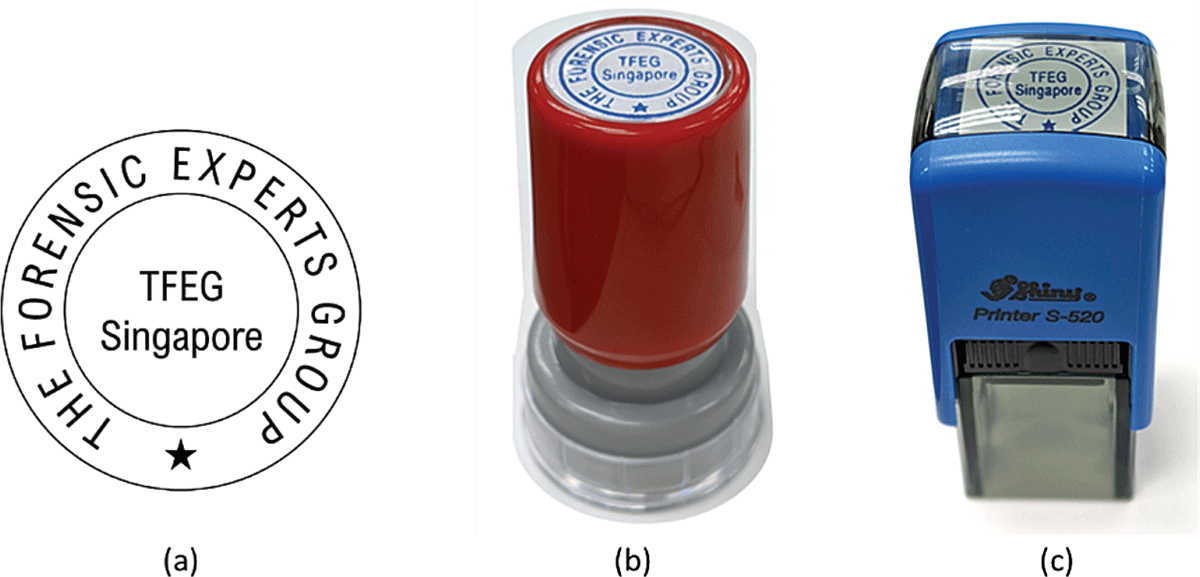
Figure 1.
(a) design of the stamp die (b) pre-inked stamp with round housing (c) self-inking stamp with square housing.
Document templates
Two document templates resembling a company letterhead were created. Each document template bore a company logo, body text and a signature. The difference between the two templates is that one has a signatory line above the signee’s name (Ms. P. Smith) while the other does not. See Figure 2.
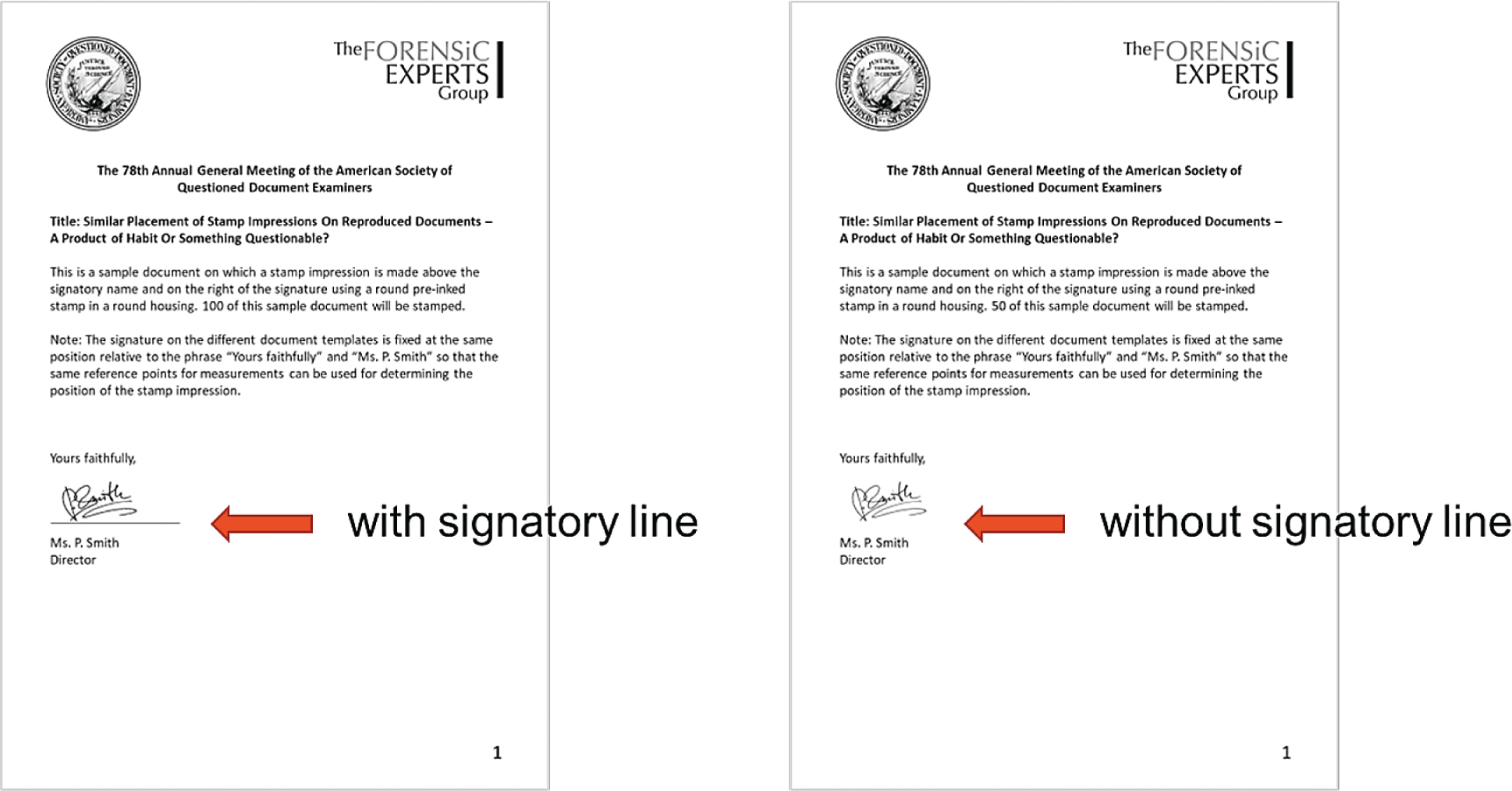
Figure 2.
Document templates.
The templates were printed using an inkjet Epson L655 printer on 80 gsm paper. Four sets of documents containing the stamp impressions were made. Sets 1 and 2 of the stamp impressions were made on the template with the signatory line while Sets 3 and 4 were made on the template without the signatory line. Sets 3 and 4 were produced to determine if the absence of a signatory line as a point of reference had a bearing on the probability of obtaining two stamp impressions with the same placement and orientation. 100 stamp impressions were made for Set 1 and Set 2 each; 50 stamp impressions were made for Set 3 and Set 4 each. Refer to Table 1.
Making stamp impressions
Each stamp impression was made by placing a sheet of the template document on top of a stack of about ten sheets of paper. This ensured that the stamp impressions were all made on the same type of surface. For each set, the stamp impressions were made at a pre-determined orientation and position on each piece of document. About 3 to 5 seconds were spent aligning the stamp housing before each impression was made. In this preliminary study, all the stamp impressions examined in this study were made by one person. The alignment guidelines for each set of stamp impressions are shown in Table 2.
Table 2.
Alignment guidelines for making stamp impressions.
| Alignment guidelines | Example | |
|---|---|---|
| Set 1 | The ‘★’ is at the 6 o’clock position. The left side of the round housing is touching the comma. The bottom of the housing is touching the signatory line. | 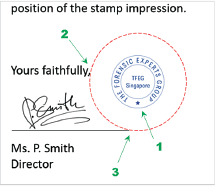 |
| SET 2 | The left edge of the square housing is touching the comma. The bottom of the housing is touching the signatory line. | 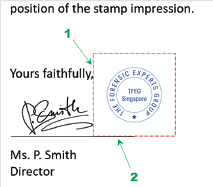 |
| SET 3 | The ‘★’ is at the 6 o’clock position. The left side of the round housing is touching the turning point of the bottom stroke in the signature. | 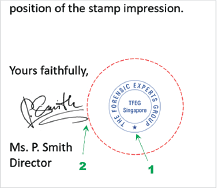 |
| Set 4 | The left edge of the square housing is touching the comma and the turning point in the bottom stroke of the signature. | 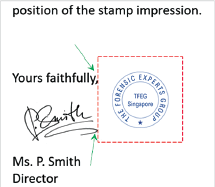 |
Reproduction and measurements
The stamped template documents were scanned at 200 ppi in colour and saved in Portable Document Format (PDF). Following that, the area bearing the stamp impression on each scanned document was captured using the Snapshot function in Adobe Acrobat Reader DC. The captured images were then inserted into Microsoft PowerPoint for measurements. The purpose of the measurements was twofold: to determine the placement and orientation of the stamp impressions.
Two measurements, denoted “X” and “Y” (see Figure 3), were taken to determine the position of each stamp impression relative to printed elements on the template documents. A circular grid was first overlaid onto the stamp impression being measured to ensure uniformity in the measurements’ reference points. For all four sets, the “X” value was the horizontal distance from the comma to the left of the stamp impression. For Sets 1 and 2, the “Y” value was the vertical distance from the signatory line to the bottom of the stamp impression. For Sets 3 and 4 which did not have a signatory line, the “Y” value was measured from the bottom of the last sentence “… position of the stamp impression” to the top of the stamp impression. See Figure 3.
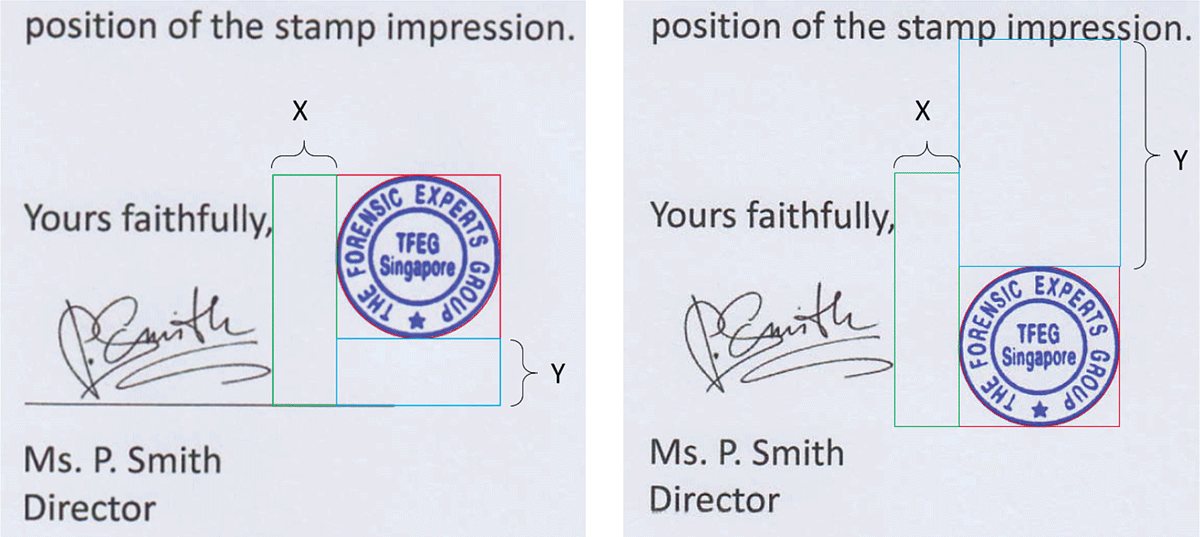
Figure 3.
Reference points for measurement of X and Y values for Sets 1 and 2 (left), and Sets 3 and 4 (right).
The stamp impressions within each set were grouped based on their X and Y values:
Stamp impressions with “X” and “Y” values within +/— 0.01 cm (Match in position within +/— 0.01 cm)
Stamp impressions with the same “X” and “Y” values (Exact match in position)
The orientations of stamp impressions with exact matches for both X and Y values were further examined using another grid, with the ‘*’ as a reference marker. Figure 4 shows two stamp impressions with the same “X” and “Y” values overlaid with the same grid that was made using the top stamp impression as a reference. The grid passes through the middle of the ‘*’ of the top stamp impression but not the bottom stamp impression, indicating that these two stamp impressions do not have the same orientation.
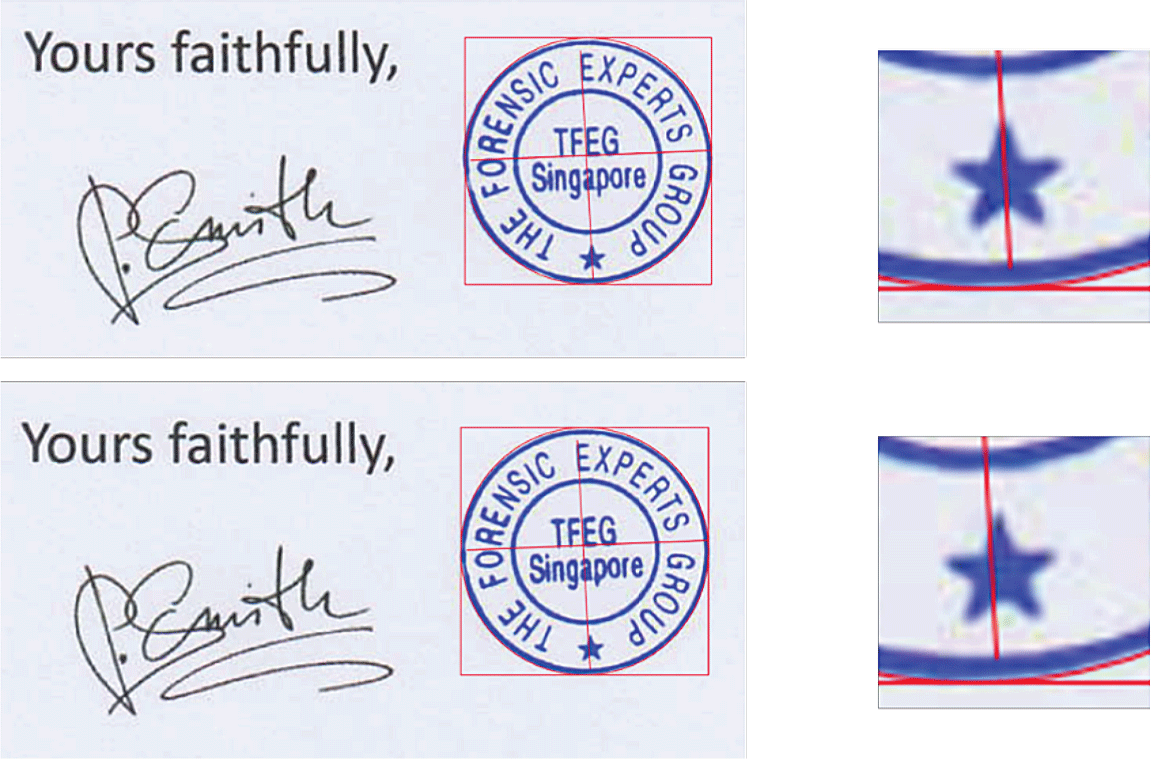
Figure 4.
Two stamp impressions with the same placement but different orientations.
Results and Discussion
The number of pairs of stamp impressions with the same placement and orientations for Set 1 to Set 4 are shown in Table 3. The total number of possible matching pairs (N) is given by nCr (n = 100 and r = 2), giving a total of 4950 possible matching pairs for Sets 1 and 2, and a total of 1225 (n = 50 and r = 2) possible matching pairs for Sets 3 and 4. The percentage of matches (%match) for each scenario was calculated using the formula: [TeX:] \documentclass[10pt]{article} \usepackage{wasysym} \usepackage[substack]{amsmath} \usepackage{amsfonts} \usepackage{amssymb} \usepackage{amsbsy} \usepackage[mathscr]{eucal} \usepackage{mathrsfs} \usepackage{pmc} \usepackage[Euler]{upgreek} \pagestyle{empty} \oddsidemargin -1.0in \begin{document} \[ {m\over N}\times 100\% \] \end{document} , where m is the number of matching pairs. For example, there were 1191 pairs of stamp impressions in Set 1 that had a match in position within +/— 0.01 cm. Using the formula, the percentage match was [TeX:] \documentclass[10pt]{article} \usepackage{wasysym} \usepackage[substack]{amsmath} \usepackage{amsfonts} \usepackage{amssymb} \usepackage{amsbsy} \usepackage[mathscr]{eucal} \usepackage{mathrsfs} \usepackage{pmc} \usepackage[Euler]{upgreek} \pagestyle{empty} \oddsidemargin -1.0in \begin{document} \[ {1191\over 4950}\times 100\% \] \end{document}
Table 3.
Percentage match of relative positioning and orientation of stamp impressions.
| No. of pairs of stamp impressions (%match) | ||||
|---|---|---|---|---|
| SET 1 • | SET 2 ■ | SET 3 • | SET 4 ■ | |
| With signatory line | Without signatory line | |||
| Match in position within +/- 0.01 cm | 1191 (24%) | 958 (19%) | 56 (4.6%) | 70 (5.7%) |
| Exact match in position | 159 (3.2%) | 151 (3.1%) | 12 (0.98%) | 8 (0.65%) |
| Exact match in position & orientation | 12 (0.24%) | 34 (0.69%) | 1 (0.08%) | 2 (0.16%) |
[i] • : Pre-inked stamp with round housing
■: Self-inking stamp with square housing
Stamp impressions with matches in position within +/– 0.01 cm
The % match of stamp impressions in Sets 3 (4.6%) and 4 (5.7%) were much lower than Set 1 (24%) and Set 2 (19%). This is because the signatory line serves as a line of reference for the alignment of the stamp housing along the vertical axis, thus minimising the variation in the “Y” values of the stamp impressions.
Stamp impressions with exact matches in position
The percentage of stamp impressions with the same measurements for both “X” and “Y” values were less than those that matched within a range of +/— 0.01 cm. The percentage of stamp impressions that matched in both “X” and “Y” values were higher for Set 1 (3.2%) and Set 2 (3.1%) than Set 3 (0.98%) and Set 4 (0.65%). Similar to the observations made above, the presence of the signatory line resulted in higher numbers of stamp impressions with exact matches in position for Sets 1 and 2.
Stamp impressions with exact matches in both position and orientation
The percentage of stamp impressions that matched both in position and orientation were 0.24%, 0.69%, 0.08% and 0.16% for Sets 1 to 4, respectively.
Even though Set 1 and Set 2 had similar % match for stamp impressions with the exact positions (3.2% and 3.1%), Set 2 (0.69%) had a higher %match in both position and orientation than Set 1 (0.24%). This was because the straight edge of the square housing served as a guide to align the stamp horizontally on the signatory line, thus reducing the variation in orientation. A similar observation was also made for Set 3 and Set 4.
Square housing vs circular housing
It was found that for Set 1 and Set 3, about 8% (7.5%; 8.2%) of the stamp impressions that matched in position also matched in orientation, while for Set 2 and Set 4, it was about thrice the number i.e. 22.3% and 24.6%. See Table 4. This was calculated using the formula:
Table 4.
Conversion rate of stamp impressions.
| No. of pairs of stamp impressions (%match) | ||||
|---|---|---|---|---|
| SET 1 • | SET 2 ■ | SET 3 • | SET 4 ■ | |
| With signatory line | Without signatory line | |||
| Group A: Exact match in position | 3.2% | 3.1% | 0.98% | 0.65% |
| Group B: Exact match in position & orientation | 0.24% | 0.69% | 0.08% | 0.16% |
| Conversion rate | 7.5% | 22.3% | 8.2% | 24.6% |
Evidently, there is less variation in the orientation of stamp impressions made using the self- inking stamp as the straight edge of the stamp housing allowed for more accurate alignment of the stamp with respect to the printed elements on the template.
Conclusion
Based on the results in this preliminary proof of concept study, the probability of finding two reproduced stamp impressions with the same orientation and placement was found to be lower when there were fewer points of reference e.g. the absence of a signatory line. Even though the person (one of the authors) making the stamp impressions in this study took 3 to 5 seconds to intentionally align and orientate the stamp to ensure consistency in its placement and orientation, the percentage of stamp impressions that had matching relative position and orientation was less than 1%, ranging between 0.08% and 0.69%.
The findings of this pilot study suggest that even when the orientation and placement of a stamp impression is deliberately and carefully controlled, the chances of encountering two stamp impressions with the same placement and orientation is very low. This further suggests the difficulty of achieving the same placement and orientation for two stamp impressions that are made in a “normal”, uncontrolled manner. Hence, multiple stamp impressions encountered in more than one reproduced document that have very similar placement and orientation relative to other printed elements on the document are a red flag signalling to the document examiner to carefully consider whether they were made by “cut-and-paste” manipulations or a chance occurrence.
In view of its practical potential, more representative and comprehensive data will be collected by extending this proof of principle study to a larger group of participants. Further works in this study include: Examining stamp impressions made by more than one person and by individuals whose daily work operations involve making a large number of stamp impressions.