
Introduction
Forensic Document Examiners understand the production of document security features is not a simplistic process. Each feature serves a specific purpose, and, in combination, these features challenge the successful reproduction of documents that contain them. The sophistication of security features continually evolves and they are incorporated into different types documents, depending upon the document’s value level.
One commonly used security feature is the “hidden message” pantograph, sometimes referred to as a “void” or “copy” pantograph. Regardless of the term used, the finely detailed security image serves to differentiate copies from originals.
The hidden word or image is not readily seen on the original document. The security feature only becomes evident when a copy is made. At this time, a latent word or message, such as “void,” “copy,” or “unauthorized copy,” should become visible on the reproduction. However, the security feature is occasionally defeated.
This paper will share research undertaken regarding elements of a pantograph that make it successful as a fraud deterrent and why electrophotography occasionally does not expose the hidden message. Approximately 80% of pantographs are printed using an offset printer, versus 20% that are printed digitally.
The digital process used for printing pantographs is relatively recent, beginning just a few years ago (J. Wu, Chief Technology Officer, Arcis Digital Security, Inc., personal communication, June 28, 2018). However, the digital printing process will not be discussed in this paper, rather the information provided will be limited to offset printing only.
Case Example
A narcotics case involving an unauthorized, photocopied prescription form was submitted for examination to the author. The defendant maintained it was a genuine prescription, provided by her physician. However, the purported “original” prescription form at issuing question was examined and it was quickly determined to be a machine copy, although the “void” warning was not visible. The question arose as to why the pantograph failed.
Methods and Materials of Pantographs
As mentioned previously, document examiners working regularly with secure documents, as well as ink chemists and those working within the security printing industry, are quite familiar with the production of pantographs. However, many other examiners may not fully understand the demanding development process pantographs require. A pantograph design is complex, comprising a well calculated placement of fine dot elements in one halftone component and larger dots or lines within a separate halftone component.
Both components blend into the totality of a subtle background, some pantographs can be quite plain while others may have an intricate, but subdued, pattern. The “void” or other hidden word should remain inconspicuous until copied. The background cannot cause a distraction or interfere with the variable data text printed by the end user.
When viewed under magnification, the working parts of the pantographs become visible. Although the background (or backgrounds having “scalloped” or myriad of other designs) appears to be a solid ink product, it is not. A pantograph is printed with a halftone process, using a concentration of very small elements. The finest dots serve as the “background” for the overall design. Courser dots, or lines, create the hidden word/s (such as “void”), on the page. They are considered the “foreground” printing.
The algorithm developed for the dot placement in both the background and foreground halftone screens effectively blends the two elements together and results in a consistent appearance across the page. The halftone screens must balance to prevent any part of the page from appearing lighter or darker.
The pantograph design, when viewed under magnification, may initially appear to be printed with different inks due to the differences in the halftone dot/line sizes used for the background and foreground images, however, it is not. The same coloration is required to effectively conceal the “void” image within the pantograph and provide a consistent color tone across the page. Dark Pantone Matching System (PMS) inks, such as black or reflux blue, are used (J. Wu, Chief Technology Officer, Arcis Digital Security, Inc., personal communication, June 28, 2018).
An optical illusion occurs when a pantograph page is viewed; the light appearance of the pantograph would seemingly correspond with the use of a light-colored ink. However, during the printing process, a light density screen is used, producing more white space in ratio to the printed dots. In other words, in a defined section, there is a low percentage of dark dots compared to the white space. Pantograph papers made for prescriptions commonly have only 10% of ink on the page, while the remainder is white space. The process used to create pantographs is the same as that used for newspaper images i.e., black ink is used for printing dots on a white background. More dots equate to the darker portion in an image and fewer black dots leave more white space to form gray or white areas.
When the pantograph is photocopied, the copier performs a function the human eye cannot; it differentiates between the finer dots in the background and the heavier dots in the foreground. The foreground image, (“void”), is printed on the copy while the finer dots of the background disappear.
Offset printing resolution used for “void” pantographs is commonly 2400 DPI. At this resolution, it prints a clean image of the remarkably fine dot elements required for security pantograph paper without the need for specialized inks or specialized equipment. This allows the paper to be produced at a reasonably low price (K. Corkery, Arcis Digital Security, Inc., personal communication, June 28, 2018).
In contrast to the superior resolution used in the offset printing process, the common printing resolution of most office and public “self-service” photocopiers is only 600 DPI. This resolution does not allow the photocopiers to replicate the finer details of the visually imperceptible background dots of the pantograph. However, the machine is able to recognize the heavier dot or line patterns in the foreground, allowing the “void” message to be visualized on the copy. When this occurs, the pantograph security features has served its purpose.
Ideally, the anti-copy verbiage would readily appear on a copy, such as the example shown next page in Figure 1.
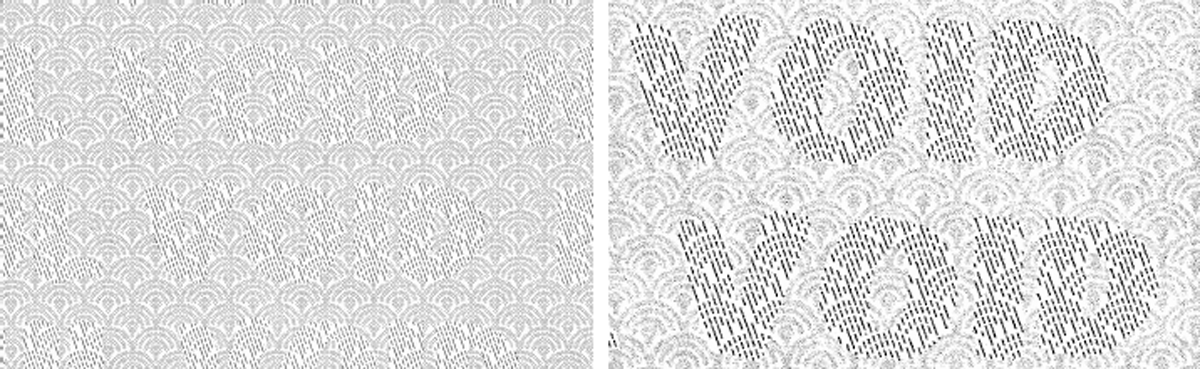
Figure 1
Original Paper. Photocopy of the original.
Hidden words such as “void,” “copy,” or “unauthorized copy” are common. However, the image may be customized at the client’s direction. Examples include other text, images, microprinting of a serial number, the copy machine’s location, etc.
In spite of the increased sophistication of pantograph printing processes, there are times when the hidden message is not reproduced. A significant cause lies with newer model photocopiers. Their better resolution capabilities more easily defeat a “void” pantograph. Additionally, a knowledgeable individual can adjust a newer generation copier manually to prevent the hidden word from appearing on the copied page.
Another, less common, reason for failure is variation in the intensity of the ink flow as a pantograph is printed with an offset press. Depending upon the ink flow, the intensity of the color may vary between production runs, as well as within the same production run.
Additionally, pantographs made with older technology are less likely to be effective with modern copiers and scanners (J. Wu, Chief Technology Officer, Arcis Digital Security, Inc., personal communication, May 24, 2018).
Methods and Materials of This Research
Liimited research was conducted to explore the success or failure of photocopying a “void” pantograph on prescription paper approved by the State of Washington. The paper stock tested was similar to that used in the narcotics case examined by the author. A blank page was copied on 12 different copiers. The density settings were set at three different settings being: default, light and dark. As anticipated, there was a wide range of variation in the resulting exposure of the hidden word “void” on the resulting copies.
The “void” pantograph was considered successful when the copy produced exhibited the “void” image. The results of the limited testing undertaken showed that all but one of the photocopies reproduced the “void” pantograph at the three different density settings. The Xerox model J-A132 failed to reproduce the “void” image when the toner density setting was manually set to the darkest setting. However, the light and default setting produced the “void” image on this machine. A quick visual examination of the fine lines forming the “scallop” background field appeared nearly as detailed as the genuine copy. The small font, surrounding the thermochromic ink image, stating “Approved Under the Revised Code of Washington” was easily read. The blue color tone of the page was not significantly different from the original.
The pantograph copy may be passable for use by a person using their home computer printer to print variable data. However, if a pharmacy employee was attentive and examined the supplemental security features such as the thermochromic ink section, the artificial watermark on the reverse side, or the UV activated fibers, the fact it was a copy would be evident.
The same genuine Rx pantograph was scanned at 300 and 1200 DPI on a multifunction printer. The darker setting on the scanner (Brother MFCJ870 DW) produced an impressive copy at the higher resolution setting, preventing the “void” to appear. Neither scan showed the “void,” but the resolution and coloration was considerably enhanced at the 1200 DPI setting.
From the multiple machines tested, only the Xerox photocopier and the Brother multi-function machine fulfilled their designed purpose by more accurately replicating the original document.
Discussion
Significant improvements have been made in printing technology used for pantographs since the original patent was obtained in 1978.
Offset, flexography, and digital printing platforms are all used, particularly the large offset format, which is a more secure single pass process. One company (Arcis Digital Security) uses three technologies with a single pass print: a digital void pantograph, the printing of the verification grid, and proprietary micro-printing. If the “void” feature fails, the other two will be successful because copier capabilities cannot reproduce the verification grid or print the microprinting on the original (J. Wu interview).
The verification grid is commonly companioned with a void pantograph. The grid is simply a background line design printed with a higher lightness value. The faint grid lines cannot be reproduced by a photocopier, thereby identifying a copy from an original. The verification grid is more reliable than some other security features such as thermochromic inks. This is because the heat-activated ink may give a false positive due to the ink product not being stored properly or being used beyond its shelf life of about six months. (J. Wu interview).
Other transitions continue to be made from the original “big dot, little dot” design to complex algorithms taking into consideration the higher resolution technology in modern photocopiers and scanners. As mentioned before, this paper is related to offset printed pantographs, not those printed digitally. One example proposed in a patent using digital technology shows another instance of printing industry ingenuity.
Here, the design uses several “regions” on a page. Each region would contain one pairing category of a “void” configuration. There may be four pairing categories established for a page having 16 regions. The different categories would be spread among the regions. The intent is for one or more background/foreground categories to become visually prominent at one resolution while other categories would be apparent when copied at a different resolution.
Another innovative offset printed void pantograph is the “NaNOcopy” design (by International Security Products). The microtext of the foreground image is shown in the top photograph in the right column. When copied, the open bowls of the micro letters, numerals, and symbols are filled in and the background field becomes blurred (shown in the bottom photograph.) Photocopiers currently do not have the resolution ability to copy the print of the detailed microtext foreground and background fields.
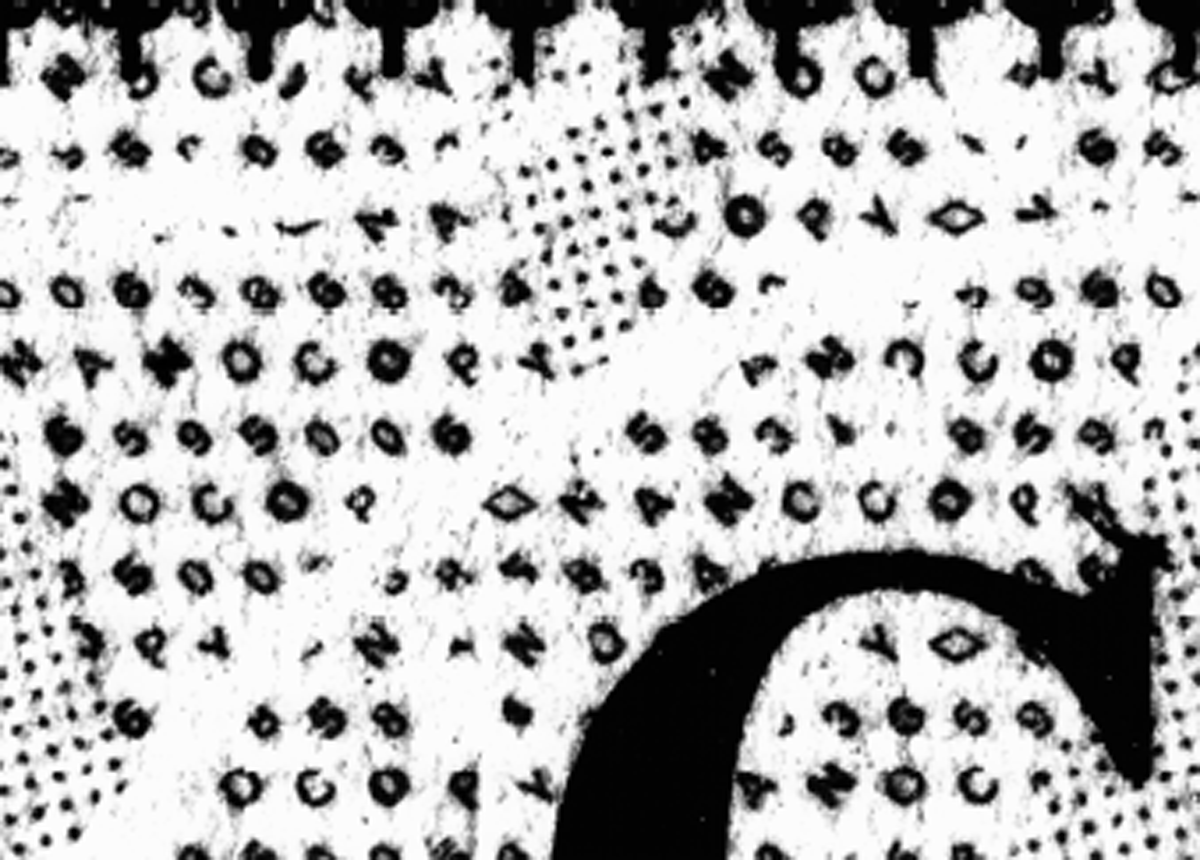
Figure 2A
Enlarged microtext from an original document.
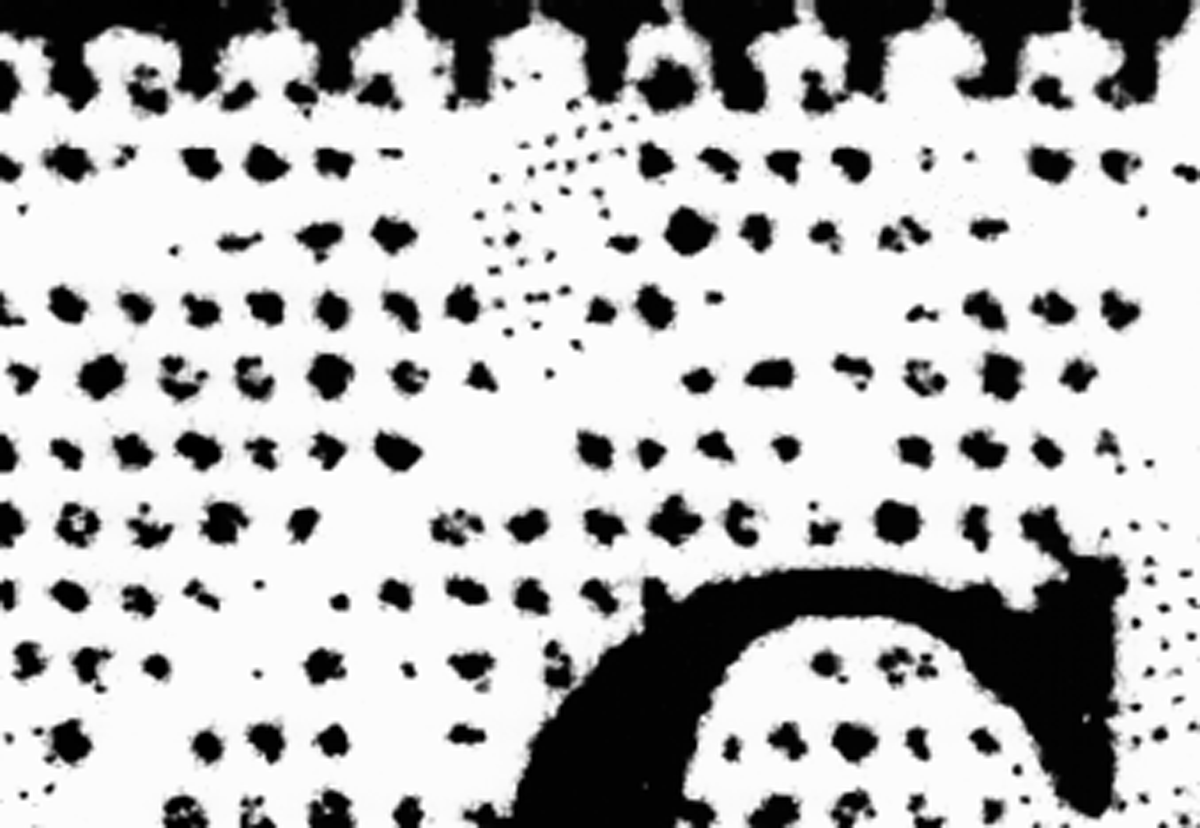
Figure 2B
Machine copy of the same document.
This design allows the embedding of a secure code or algorithm for further verification. A secure code can be customized according to each customer, including a job audit trail that effectively tracks runs for higher security. Regardless of how original pantographs are printed, copies are limited to CYMK printing devices. For example, if the pantograph is printed with a PMS (Pantone Matching System) specific color, a copy will lose the same quality of coloration and a loupe will reveal the CYMK dot pattern. However, most determinations regarding authenticity are made with an initial glance, not magnification, to determine if the “void” or “copy” image is present (N. Phillips, President of International Security Products, Paso Robles, CA. Personal communication, June 7, 2018).
Encoding a document with a pantograph provides an advantage over watermarking. A copy of a watermarked document does not bear the watermark; only the original document does. Because of that, a person has to know the original is watermarked to look for and determine if it is present. No such prior knowledge is required with a pantograph.
Results
Significant efforts continue in the development of security inks. An example of one improvement was to incorporate pigments and/or dyes, enabling the ink to become fixed to the paper. It serves to foil efforts to ‘lift’ text from the paper (J. Wu interview).
One manufacturer of security paper offered a sample packet of their void pantograph stock. The ordered samples contained a statement in their folder professing, “The paper samples in this kit contain the most powerful void pantograph technology available.”
The manufacturer’s assurance of the “hidden words or message” appearing on a scan or copy of their product was not well-founded. One sample, when scanned at 1200 DPI, produced a page with no hint of the “void” pantograph from the original sample sheet. When copied on a commercial photocopier at the 600 DPI default setting, the “void” foreground image was visible.
There are a multitude of pantograph designs available, both licensed and in the public domain. Foreground patterns are essentially limited only by a person’s imagination. Customized designs would obviously require the technical knowledge of a specialized printing company to develop and incorporate them into a foreground pattern with a complementary background.
The various pantograph samples received for this study, as well as those from the narcotics case, had one feature in common: a full color bleed. The presence of a white margin on a prescription form or other secure document should be cause for suspicion for any person responsible for establishing the authenticity of such a document.
Figure 4, on the following page, is an enlarged section of a genuine prescription form. The left side, having an unprintable margin, is a photocopy of the original “full bleed” printed prescription shown on the right side.
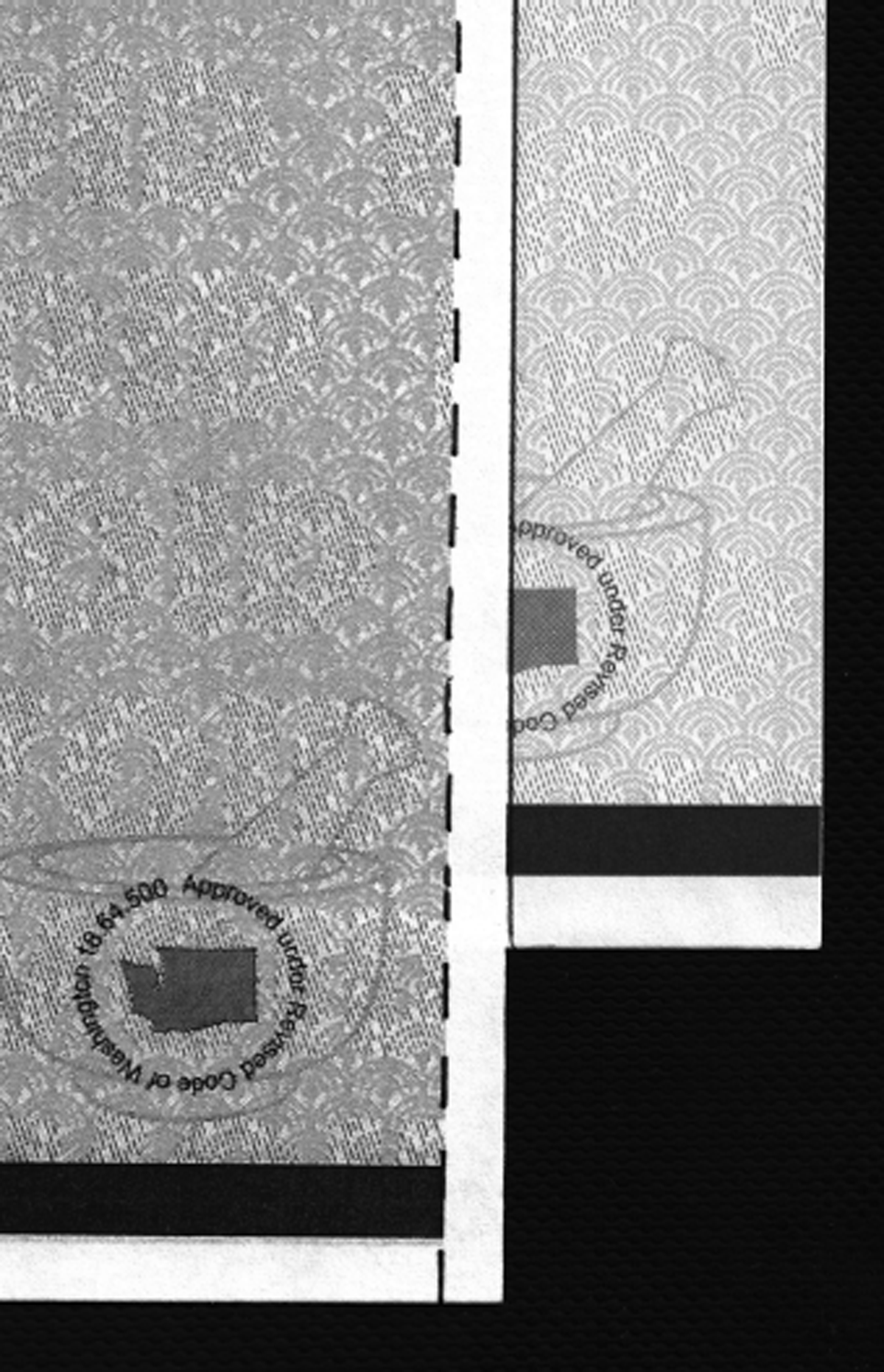
Figure 3
Portions of two pantograph prescription forms. Copy on the left, having a blank margin. The original is on the right. (Photo by the author.)
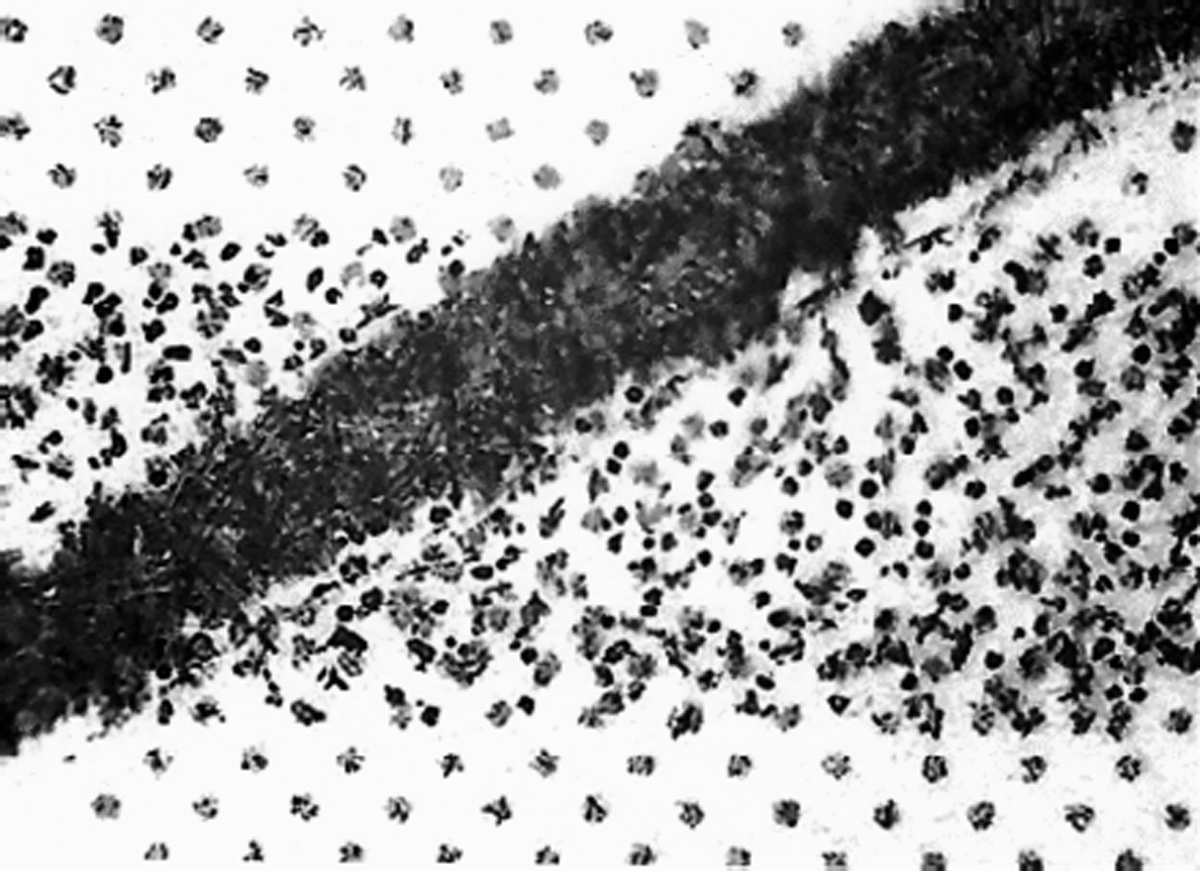
Figure 4
Three different elements: toner, offset printing, and pen ink. (Photo by the author.)
End users responsible for differentiating nonoriginal documents from original documents may not have the luxury of time and equipment for their reviews. However, with a 10x magnifier and some training, evidence of an original pantograph may be quickly noted as well as by the different technologies used for the variable data.
The following photograph is an example, showing an enlarged section from a genuine prescription form. The consistent dotted pattern across the image was part of the offset printed pantograph design. The broad horizontal band of dots formed the signature line and was printed with toner technology at the physician’s office. The dark diagonal line was a stroke of the doctor’s penned signature.
An original prescription form having pen ink (signature), toner technology (signature line) and lithography (pantograph printing).
The image in Figure 4 shows that an examiner can quickly determine the three different elements comprising an original prescription: being toner, offset printing, and pen ink. These different elements may serve as a security feature in their own right. A photocopy of the entire prescription would have the same printing technology (inkjet or toner), across the entire page.
As the technology increases in the printing field, so does the resolution capabilities of the machines being produced. Xerox introduced the Xerox 914, the first commercial photocopy machine for plain paper, in 1959.1 It is unknown what the resolution capability was in the earlier machines. However, of the 12 copiers used for the testing for this paper, the majority had a default setting of 600 DPI.
Conclusion
The focus of this paper was to share basic information regarding the challenge of security printers to produce a void pantograph that is effective against modern photocopiers. However, those intent on fabricating security documents may short-circuit the process of manipulating scanners and photocopy machines by buying genuine pantograph paper. Rather than contributing toward the security of void pantograph paper, there are vendors who offer the stock for purchase over the internet. A ream of void pantograph paper was easily purchased via the internet for use in this paper.
As the owner of a security printing company stated, providing genuine void pantographs for sale without a chain of custody is similar to selling genuine cotton rag paper used for printing currency. Some vendors lack the integrity to sell their product without requiring a vetting process (N. Phillips email - 6/20/18).
There are an impressive number of security features available to a consumer to increase the security of a document, well beyond what a hidden word pantograph offers. However, the additional protection comes with a price. The cost of adding features is commonly dictated by the significance of the document and budgetary considerations.
All security printing firms will recommend layering security features for the increased protection they provide. While some features may fail, others will succeed. However, any security feature is only as good as the person inspecting it. If attention is not given to the feature(s), it is of no value (J. Wu interview).
Notes
Acknowledgements
J. Wu, Chief Technology Officer, Arcis Digital Security, Inc., personal communication, May 24, 2018, June 28, 2018.
K. Corkery, Arcis Digital Security, Inc., personal communication, June 28, 2018.
N. Phillips, President of International Security Products, Paso Robles, CA. personal communication, June 7, 2018, email, June 20, 2018.