
Introduction
Since 2001, the wars in Iraq and Afghanistan have resulted in at least 1,650 American service members with traumatic limb amputations. [1] The year 2016 was the first in which the United States reported zero amputations to active duty service members deployed in war zones. [2][3] The research presented here originally began in 2011 with a focus on wounded warriors. However, in the United States there are approximately 2,000,000 people [4] currently living with limb loss, and an additional 158,000-185,000 Americans undergo amputations every year. [5][6] Considering the current combined numbers of military and civilian amputees in the United States alone, and the fact that the number is expected to double by 2050 [7], this research is probably long past due.
The exact number of people who have lost the use of their dominant hand/arm due to injury or illness is unknown. However, the ratio of upper-extremity amputation to lower-extremity amputation is 1:4. [8] Therefore, it follows that approximately 500,000 of the 2 million US amputees are missing an upper limb.
In addition to amputees, as many as 3 million more people have lost the use of their hand(s), forearm(s), and/or arm(s) due to congenital or injury related impairment or paralysis. [9]
Outside of the military population, the majority of lower extremity amputations are due to illness. [10] However, most upper body amputations are a result of traumatic injuries, such as those caused by motor vehicle accidents, workplace accidents, and power saws. [11] Motor vehicle related amputations more often result in the loss of the left hand/arm [12] while workplace and agricultural related amputations more often result in the loss of the right hand/arm. [13] A significant number of amputations, as well as other types of upper limb traumas, result in the permanent loss of use of the dominant hand. No matter the cause, when a person loses the use of the dominant hand, he or she is forced to perform motor tasks with the non- dominant hand. Between 27-56% of upper-extremity amputees use a prosthetic device. [15] Unfortunately, modern prosthetics cannot provide the fine dexterity that is required for handwriting and therefore, this difficult task is instead most often delegated to the non-dominant hand. [16]
“Hand dominance is the preferential use of one hand over the other for motor tasks.” [17] The motor task most closely associated with handedness is handwriting [18] and it is the highest form of single-handed dexterity achieved for most people. [19][20] Estimates vary slightly, but today as much as 90% of the US population is naturally right-hand dominant. In the United States, and many other countries around the world, the prevalence of right-hand dominance has dropped as the acceptance of left-handedness has increased. As recently as fifty years ago, school children in the US were forced to write with their right hand, even if they showed a preference for their left hand. As the stigma that surrounded left-handers has decreased, the number who report left-hand dominance for writing and other fine motor tasks has increased. [21] Numerous theories exist as to the exact cause of handedness, though we do known that hand dominance is determined inutero. [22] Studies show that fetuses exhibit a preference for one hand over the other and that the in-utero preference strongly correlates to the handedness expressed after birth. [23] There is also a strong inheritance pattern to handedness, suggesting that it may be genetic. McManus reports that handedness may be determined by as many as 40 different gene loci rather than just one. [24]
Over the years, many words have been used to describe the non-dominant hand including awkward hand, off hand, weak hand, subdominant hand, unaccustomed hand, wrong hand, opposite hand, unpracticed hand, unskilled hand, other hand, and non-preferred hand, to name just a few. Because of the strong prevalence of righthandedness, sometimes the non-dominant hand is simply referred to as the left hand, though this is hardly accurate for natural lefties.
Forensic document examiners (FDEs) have long viewed use of the non-dominant hand to be a means of disguising one’s writing to evade detection. In previous studies, Alford reported 6% (8 of 135), Davidson reported 4% (2 of 50), Durina reported 21% (13 of 62), and Harrison reported 5% (1 in 20) of study participants chose to use their non-dominant hand when asked to disguise their writing. [25][26][27][28] But intentional disguise aside, there are other instances in which a person may use his/her non-dominant hand for writing. The temporary or permanent loss of use of the dominant hand due to injury, illness, or amputation requires the transfer of dominant-hand skills to the non-dominant hand. In these instances, use of the non-dominant hand is not a matter of choice, but instead a matter of necessity. So although FDEs have long considered writing with the non-dominant hand to be nothing more than a form of disguise, it may be time to alter that thinking and realize that the writing being examined might not have been produced by a nondominant hand, but rather a new-dominant hand.
Numerous studies support that forensic document examiners can accurately identify the author of a questioned writing no matter whether it is written in manuscript print, cursive script, or uppercase printing. [29][30][31] Studies have also shown that FDEs do so with higher accuracy than do laypeople. [32][33][34][35][36][37][38] However, none of these studies have included non-dominant-hand writing or printing. In general, the typical consensus amongst FDEs is that writing from the dominant hand should not, and potentially cannot, be compared to writing from the non-dominant hand. However, Harrison, Huber & Headrick, Stevens, and Kelly all support that examinations can be performed between dominant and non- dominant-hand writings and conclusions can be rendered. [39][40][41][42]
Dawson and Comeau have previously presented results obtained when left-hand writing was ‘matched’ to right-hand writing. Dawson had twenty right-handed participants handprint the text of the London Letter. Then each participant wrote the same text with his/her left (nondominant) hand. Dawson himself then correctly matched up the samples written by the right (dominant) and left (non-dominant) hand of each participant with an accuracy rate of 100%. [43] Similarly, Comeau asked forty participants to write a paragraph of text once with his/her right hand and once with his/her left hand. Comeau’s participants included six writers who were lefthand dominant and thirty-four writers who were right-hand dominant. Comeau found that eight FDEs were able to correctly match the left-hand dominant writers to their non- dominant writing 80% of the time and the right-hand dominant writers to their non-dominant writing 87% of the time. Both of these studies show that FDEs can not only ‘match up’ the dominant and non-dominant hand writing of an individual, but that they can do it with a fairly high level of accuracy. [44] Unfortunately, neither of the studies truly represents the casework conducted by FDEs. When performing a ‘matching’ exercise, once a pairing is made, that sample is effectively removed from the sample population. With each successive pairing, the size of the sample population is further reduced until there are no samples remaining. So with each pairing, the examiner has fewer and fewer choices, and hence, fewer and fewer opportunities to make an error. In real casework, the sample size and the error potential are never reduced. This study was designed to more closely resemble actual casework performed by forensic document examiners.
The purpose of this study is to determine the accuracy rate of forensic document examiners when comparing handwriting samples written with opposite hands. In other words, can FDEs accurately identify the dominant-hand writing of a person given only a sample of writing produced with their non-dominant hand, and vice versa. Comparisons were performed on printed samples and cursive samples and the accuracy rates and error rates were calculated. A group of laypeople (LP) performed the same comparisons performed by the FDEs and their accuracy and error rates were calculated as well.
Methods and Materials
Writing Material
The London Letter is a paragraph of text that is frequently used by forensic document examiners to collect handwriting samples. The paragraph consists of eighty-five words and contains both uppercase and lowercase versions of each letter of the alphabet, numerals 0-9, and some commonly used abbreviations. [45] In this study, the writers were asked to write the London Letter once with their dominant hand and once with their nondominant hand.
Writing Subjects
Writing samples were collected from forty-three people. Twenty participants provided both printed and cursive samples. Eleven participants provided printed samples only. Twelve participants provided cursive samples only. Each writer provided demographic information about age, sex, handedness, and education.
The writers were between fifteen and sixty years old, with the average age being thirty-seven. Ten men and thirty-three women participated. Thirty-seven of the writers were right-hand dominant and six writers were left-hand dominant. One of the writers was still in high school, four of the writers were still in college, but most of the writers had at least a 4-year college degree. The writing group consisted of students, administrative professionals, teachers, and forensic scientists. The writers did not receive any type of compensation for their time.
FDE Participants
A total of fifteen forensic document examiners participated in this study, including eleven from the United States and four from Australia. Four FDEs had ten or fewer years of experience. Eleven FDEs had more than ten years of experience. All FDE participants have been vetted by the American Society of Forensic Document Examiners and/or the Australasian Society of Forensic Document Examiners. The FDE participants did not receive any compensation for their time.
Laypeople Participants
Nine laypeople participated in the study. All LPs were from the United States. They ranged in age from thirty to seventy-three years old, with the average age of fifty. One LP had some college education, four LPs had college degrees, and four LPs had post-graduate degrees. LP participants spent between 1.5 hours and 12 hours on the project, with the average time being 4.4 hours. The LP participants did not receive any compensation for their time.
Comparisons
Thirty-two pairs of cursive writing and thirtyone pairs of printing were collected from the writers. A pair is one London Letter written with the dominant hand and one London Letter written with the non-dominant hand from the same person. The pairs were sorted into groups that showed strong pictorial similarity. Once the pairs were grouped for similarity, they were arranged into thirty-two mock cases. Each ‘case’ contained one questioned document (Q) and three known specimens (K). Each K was written by a different writer. Cases 1-16 contained handprinted Qs and Ks and cases 17-32 contained cursively written Qs and Ks. Cases 1-8 and 17-24 contained Qs written with the non-dominant hand and Ks written by the dominant hand. Cases 9-16 and 25-32 contained Qs written with the dominant hand and Ks written by the non-dominant hand. The purpose of this study is to determine if writing from a person’s dominant hand can correctly be ‘matched’ to writing from his/her non-dominant hand, therefore all cases were comparisons between dominant-hand writing and non-dominant-hand writing. (Images of “Case 1” can be found in APPENDIX A. Notice the pictorial similarity between the known specimens K1a, K1b, and K1c.)
Each participant was provided with a DVD containing the study information and documents as well as images of the cases for comparison. Participants were given both pdf and 600ppi TIFF images for their comparisons and they were able to decide for themselves to do the comparisons by viewing the images on a computer screen or by printing the images onto paper.
The FDE participants and the LP participants were asked to examine each case and determine which, if any, of the known specimen writers was the writer of the questioned document. (The instructions that were provided to the FDEs and LPs are included in APPENDIX B. Contact information of the author has been redacted.) The participants were required to select from one of eight defined conclusions in determining authorship or non-authorship. These conclusions were based on terminology widely-accepted in the profession of forensic document examination. (APPENDIX C shows the nine levels of confidence used to express conclusions which was provided to the LP participants). These conclusions are based on “Standard Terminology for Expressing Conclusions of Forensic Document Examiners” published by SWGDOC.) [46] For this exercise, neither the FDEs nor the LPs were allowed to provide an opinion of “no conclusion”. The participants recorded their conclusions on the answer sheet which was then submitted via mail or email.
Results
FDE Accuracy and Error Rates
The total number of conclusions rendered by FDEs, including those for cursive writing and handprinting, was 1440 (32 cases x 3 conclusions per case x 15 FDEs). Of the 1440 conclusions rendered, 1303 conclusions (90.49%) were correct and 137 conclusions (9.51%) were incorrect. A correct call required that the writer of the known sample was either correctly identified or correctly eliminated as the writer of the questioned writing. (A ‘correct identification’ included conclusions of identification as well as the qualified conclusions of highly probable did write, probably did write, and indications did write. A ‘correct elimination’ included conclusions of elimination, as well as the qualified conclusions of highly probable did NOT write, probably did NOT write, and indications did NOT write.)
FDEs were more accurate in their conclusions reported on cursive writing than on handprinting. The accuracy rate for cursive comparisons was 93.75%, with 675 correct calls out of 720 calls made. The error rate for cursive comparisons was 6.25%, with 45 incorrect calls of 720 calls made. The accuracy rate for printing comparisons was 87.22%, with 628 correct calls out of 720 calls made. The error rate for printing comparisons was 12.78%, with 92 incorrect calls out of 720 calls made. Table 1 shows the accuracy and error rates for the FDEs.
Laypeople Accuracy and Error Rates
The total number of conclusions rendered by LPs, including those for cursive writing and printing, was 864 (32 cases x 3 conclusions per case x 9 LPs). Of the 864 conclusions rendered, 670 conclusions (77.55%) were correct and 194 conclusions (22.45%) were incorrect. A ‘correct identification’ and a ‘correct elimination’ were determined in the same manner as stated previously.
Like FDEs, the LPs made fewer errors when comparing cursive writing than when comparing handprinting. The accuracy rate for cursive comparisons was 81.02%, with 350 correct calls out of 432 calls made. The error rate for cursive comparisons was 18.98%, with 82 incorrect calls of 432 calls made. The accuracy rate for printing comparisons was 74.07%, with 320 correct calls out of 432 calls made. The error rate for printing comparisons was 25.93%, with 112 incorrect calls out of 432 calls made. Table 2 shows the accuracy and error rates for the Laypeople.
Accuracy and Error Rates of FDEs versus LPs
FDEs were more accurate than LPs when determining authorship and non-authorship for both cursive and printed samples. FDEs were accurate 93.75% of the time when examining cursive samples compared to an accuracy rate of 81.02% for LPs. For printed samples, FDEs were accurate in their conclusions 87.22% of the time compared to 74.07% for the LPs. The accuracy rate for FDEs for all samples, cursive and printing combined, was 90.49% versus 77.55% for the LPs. See Table 3 and Figure 1.
Table 3.
Comparison of Accuracy Rates for FDEs and Laypeople.
| Accuracy % | |
|---|---|
| FDE Cursive | 93.75% |
| LAYPEOPLE Cursive | 81.02% |
| FDE Handprinting | 87.22% |
| LAYPEOPLE Printing | 74.07% |
| FDE Combined | 90.49% |
| LAYPEOPLE Combined | 77.55% |
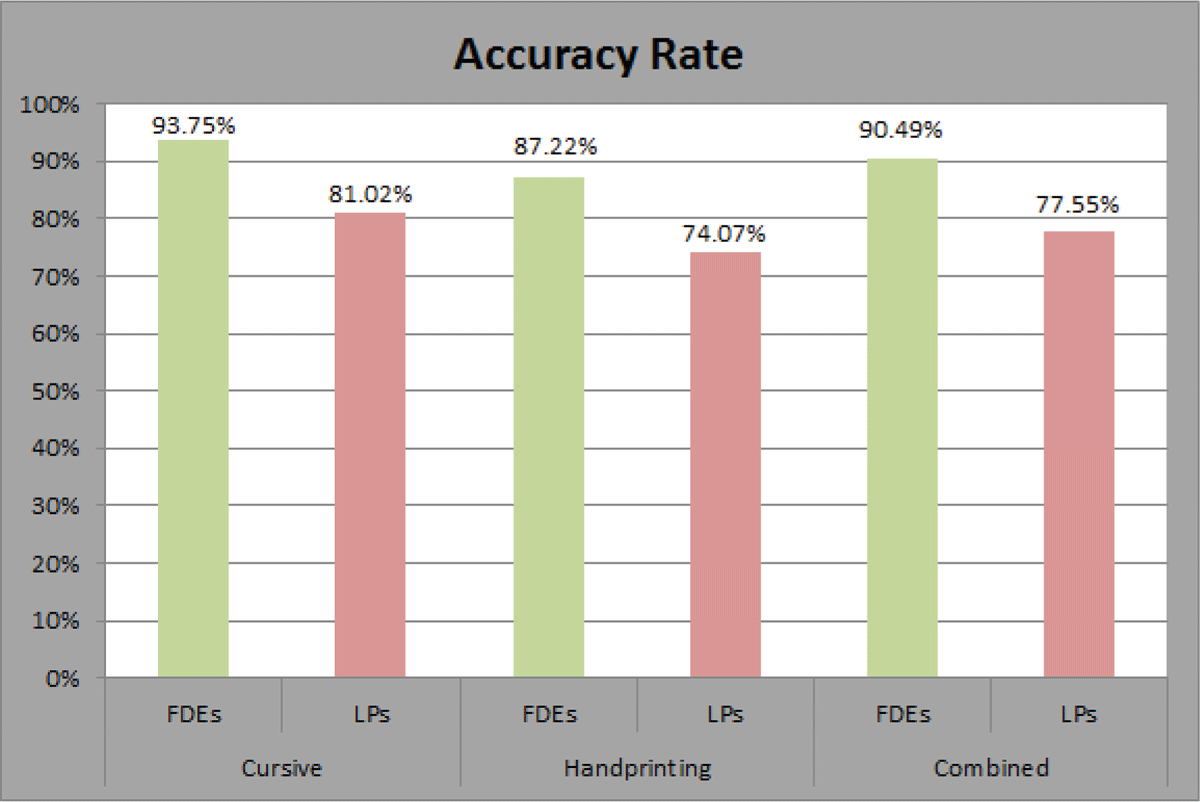
Figure 1.
Comparison of Accuracy Rates for FDEs and Laypeople.
FDEs made far fewer errors than LPs for both cursive and printing examinations. When examining cursive writing samples, LPs made errors 18.98% of the time, however FDEs made errors only 6.25% of the time. Laypeople erred 25.93% of the time on printed sample examinations compared to a 12.78% error rate for FDEs. The total error rate for cursive and printed samples combined was 22.45% for LPs and 9.51% for FDEs. See Table 4 and Figure 2.
Table 4.
Comparison of Error Rates for FDEs and Laypeople.
| Error % | |
|---|---|
| FDE Cursive | 6.25% |
| LAYPEOPLE Cursive | 18.98% |
| FDE Handprinting | 12.78% |
| LAYPEOPLE Printing | 25.93% |
| FDE Combined | 9.51% |
| LAYPEOPLE Combined | 22.45% |
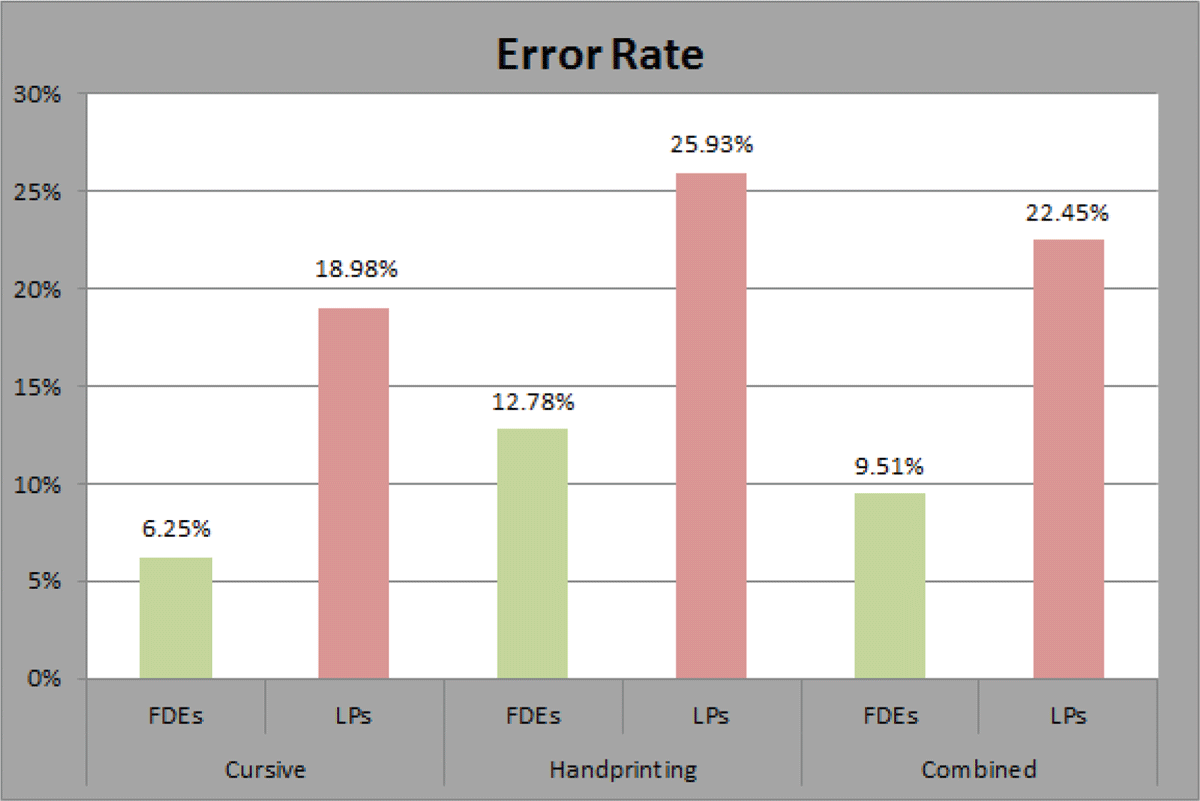
Figure 2.
Comparison of Error Rates for FDEs and Laypeople.
The probability that FDEs and LPs are equally proficient at determining authorship for samples from a writer’s dominant and non-dominant hand was found to be less than 0.0001 overall (ChiSq=41.30; p<0.0001), less than 0.00001 for cursive writing (ChiSq=44.62; p<0.00001), and less than 0.00001 for handprinting (ChiSq=32.03; p<0.00001). The raw scores used to calculate probability can be found in Table 5 and Table 6.
Table 5.
Raw Scores for FDEs.
| FDE Raw Scores | ||||||
|---|---|---|---|---|---|---|
| FDE # | Totals | Cursive Comparisons | Printing Comparisons | |||
| Score out of 96 | % Correct | Score out of 48 | % Correct | Score out of 48 | % Correct | |
| 001 | 84 | 87.50% | 43 | 89.58% | 41 | 85.42% |
| 002 | 89 | 92.71% | 47 | 97.92% | 42 | 87.50% |
| 003 | 94 | 97.92% | 48 | 100.00% | 46 | 95.83% |
| 004 | 91 | 94.79% | 45 | 93.75% | 46 | 95.83% |
| 005 | 92 | 95.83% | 47 | 97.92% | 45 | 93.75% |
| 006 | 92 | 95.83% | 48 | 100.00% | 44 | 91.67% |
| 007 | 85 | 88.54% | 46 | 95.83% | 39 | 81.25% |
| 008 | 85 | 88.54% | 42 | 87.50% | 43 | 89.58% |
| 009 | 80 | 83.33% | 43 | 89.58% | 37 | 77.08% |
| 010 | 82 | 85.42% | 43 | 89.58% | 39 | 81.25% |
| 011 | 73 | 76.04% | 37 | 77.08% | 36 | 75.00% |
| 012 | 89 | 92.71% | 45 | 93.75% | 44 | 91.67% |
| 013 | 91 | 94.79% | 47 | 97.92% | 44 | 91.67% |
| 014 | 84 | 87.50% | 47 | 97.92% | 37 | 77.08% |
| 015 | 92 | 95.83% | 47 | 97.92% | 45 | 93.75% |
Table 6.
Raw Scores for LPs.
| Laypeople Raw Scores | ||||||
|---|---|---|---|---|---|---|
| Layperson # | Totals | Cursive Comparisons | Printing Comparisons | |||
| Score out of 96 | % Correct | Score out of 48 | % Correct | Score out of 48 | % Correct | |
| 001 | 81 | 84.38% | 001 | 43 | 001 | 38 |
| 002 | 59 | 61.46% | 002 | 31 | 002 | 28 |
| 003 | 64 | 66.67% | 003 | 31 | 003 | 33 |
| 004 | 62 | 64.58% | 004 | 34 | 004 | 28 |
| 005 | 79 | 82.29% | 005 | 44 | 005 | 35 |
| 006 | 91 | 94.79% | 006 | 46 | 006 | 45 |
| 007 | 73 | 76.04% | 007 | 37 | 007 | 36 |
| 008 | 77 | 80.21% | 008 | 39 | 008 | 38 |
| 009 | 84 | 87.50% | 009 | 45 | 009 | 39 |
Discussion
This study reinforces that forensic document examiners perform significantly better than laypeople in both cursive and printing comparisons. It also reinforces higher accuracy rates for cursive writing comparisons than for handprinting comparisons. Most importantly, this research provides evidence that FDEs can correctly associate or disassociate both cursive writing and printing from the dominant and non-dominant hand of the same person with a significantly higher degree of accuracy than can laypeople. Even though the questioned and known samples were written with different hands, FDEs were still able to extract enough individualizing features to make accurate determinations about authorship. When there is any possibility that a questioned document was written with the non-dominant hand, it is still important to obtain known specimens from a person’s right and left hand whenever possible. However, the accuracy rates calculated here should help to relieve some of a forensic document examiner’s reluctance to perform handwriting comparisons of this type.
The ‘Problem’ of Being Conservative
In casework and in testing situations, FDEs tend to be more conservative than laypeople. Kam found that laypeople tend to “grossly over-associate” and reported that they erroneously “matched” almost six times as often as FDEs (38.3% for laypeople vs. 6.5% for FDEs). [47] FDEs have the opposite problem in that they often under-associate writers. For this study, the instructions given to FDEs and LPs advised them that, as is true in real casework, the true writer of the questioned document might not always be present in the known specimens. However, they were not told how many, if any, did not have matches. In truth, for four of the thirty-two cases (Case 8, Case 12, Case 20, and Case 30) the true writer of the Q was not included amongst the Ks.
Of the 194 total errors made by LPs, only nine (or 4.6%) were due to under-association (overelimination). Interestingly, five of those nine errors are attribute to Layperson 006 who herself made only five errors total. In other words, all of her errors were due to under-association. Interestingly, Layperson 006 is the roommate and best friend of an FDE, knows quite a bit about forensic document examination, has spoken to her roommate about handwriting examination on numerous occasions, has observed her roommate performing comparisons, and in retrospect should have been removed from the study. However, in the interest of transparency, her scores were retained and reported.
In contrast to LPs, of the 137 errors made by FDEs, eighty-five (or 62%) were due to underassociation (over-elimination). In eighteen of the thirty-two cases, FDE 009 marked all conclusions on the side of elimination, which resulted in fourteen errors. FDE 010 marked all conclusions on the side of elimination for sixteen of the thirty-two cases, resulting in twelve errors. And FDE 011 marked all conclusions on the side of elimination in twenty-three of the thirty-two cases, which resulted in nineteen errors.
When faced with non-dominant-hand writing in a casework situation, many FDEs will render an inconclusive opinion and/or will request that additional known specimen writing be submitted. For this study, the participants were specifically forbidden from rendering an opinion of ‘inconclusive’ and were forced to reach a conclusion on the writing samples provided. This type of ‘forced-call’ study is unlike real casework where an examiner can render an opinion of ‘inconclusive’ if the evidence is lacking in some way. In order to gauge how often inconclusive opinions might have been rendered when comparing dominant to non-dominant hand writings, the answer sheet provided a mechanism for doing this. Boxes placed next to each ‘forced-call’ opinion allowed participants the option of recording those instances where, in real case work, they would have rendered an opinion of ‘inconclusive’. The results were intriguing. Of 864 calls made by LPs, only forty-two (4.9%) of the boxes were marked for ‘inconclusive’. However, of the 1440 calls made by FDEs, 514 (35.7%) of the boxes were marked for ‘inconclusive’. The dramatic difference in the desire to render an inconclusive opinion is additional evidence of the conservative nature of trained FDEs and shows their reluctance to over-associate writing samples.
Study Limitations
This study, like all studies, had certain limitations. The comparisons were done using digital images of writing. Though the images were high quality 600 ppi TIFF images, it is always better to examine original documents. The time commitment required for the examinations turned out to be excessive. With the advantage of hindsight, the number of comparisons required of each participant should have been more limited and will be reduced by at least half for the follow-up study. Though it cannot be said for certain, the configuration of the answer sheet was likely a cause of some errors. For the follow-up study, the answer sheet will be adjusted for more distinction between identification and elimination answers. Finally, this study did not allow for “inconclusive” conclusions and in that way was unlike real casework.
Demographic information about years of experience and country of residence was obtained from the FDEs who participated. However, the sample size of fifteen examiners is too small to calculate whether or not the accuracy/error rate was significantly different for either of these two factors.
Future Studies
The comparisons performed in this study were between samples of natural writing from subjects’ dominant hand and from their unpracticed non-dominant hand. The ultimate purpose of this New-Dominant-Hand research is to determine whether or not FDEs can accurately identify the new-dominant-hand writing of a person who has lost the use of his/her dominant hand/arm due to injury, illness, or amputation. In that case, the writers will have been practicing with their nondominant (new-dominant) hand and their writing will have theoretically improved from its unpracticed condition. The follow-up study to this one will be comparisons of writing from subjects who have been practicing writing with their non-dominant hand for six weeks. It is expected that FDE accuracy rates will be higher and the error rates lower than those reported here.
Additional File
The additional file for this article can be found as follows:
Appendix B
A New-Dominant Hand. URI: https://storage.googleapis.com/jnl-asqde-j-jasqde-files/journals/1/articles/251/6667f158286d6.pdf
Appendix C
9-Point Conclusion Scale. URI: https://storage.googleapis.com/jnl-asqde-j-jasqde-files/journals/1/articles/251/6667f17008151.pdf
Notes
[1] This research is dedicated to all active-duty service members and veterans of the United States Military.
Thank you for your service
Acknowledgments
The author wishes to thank: Dr. Michael Caligiuri for his assistance with the statistical calculations and his never-ending desire to help the FDE community; the staff at the San Diego County Sheriff’s Regional Crime Laboratory for providing the handwriting samples; and the forensic document examiners and laypeople who spent many hours performing the required comparisons and reporting their conclusions.