
Introduction
Handwriting examination and comparison is one of the most common examinations performed by forensic document examiners (FDEs). The process involves a side-by-side comparison of questioned writing to known writing for the purpose of determining authorship. One of the potential problems encountered by FDEs is disguised writing. Disguised writing is that which is produced with the deliberate intent of concealing one’s identity. [3] Writers who intentionally disguise their writing might change the “…slant, letter formation of capital and lower case letters, speed, size, height and length ratios, …use of space, alignment, and use of special characters.” [4] No matter the method employed in an attempt to disguise one’s writing, the desired effect is a change in pictorial appearance so as not to be identified. Writing with the non-dominant hand changes the pictorial appearance of the writing because of the drastically reduced skill level. [5] According to Durina, 21% of the sixty-two writers involved in her disguised signatures study employed use of the non-dominant hand as their method of disguise. [6] FDEs must recognize, however, that writing with the non-dominant hand does not always point to disguise, but rather could be due to amputations, illness, immobility, or other factors. Consider, for a moment, veterans of the Iraq and Afghanistan wars. As of December 31, 2013, there were 1,558 major limb amputations performed on US soldiers.[7] Soldiers whose dominant hand or arm is amputated or otherwise rendered useless due to injury must adjust by teaching their non-dominant hand to perform many of the duties that the dominant hand/arm once performed. Undoubtedly, the most difficult of these tasks is handwriting.
Handwriting is a learned process. It is a “complex interaction of physical and mental processes involving cooperation among your brain’s cognitive, motor, and emotional areas, down through the brain stem and the spinal cord, and out to your hand.” [8] Handwriting uses more muscles and nervous tissues than perhaps any other activity. [9] From the moment a baby is born, she is developing strength and skill in her fingers and hands. At a very young age, children begin picking up and holding objects of different sizes, and performing fine motor skills such as playing with small toys. By just a few years of age, children have begun to hold crayons with which they fill in the pictures in a coloring book and draw pictures of their own. Any observant parent would likely be able to tell you whether her child is right-handed or left-handed long before that child goes off to kindergarten and begins to write. It was previously believed that handedness was something that was developed by the time a child turns three years old. However, research out of Ireland suggests that a person’s dominant hand is determined by ten weeks gestation. [10]
This project is intended to bring awareness to a growing source of handwriting that may appear to be disguised or distorted, to assist FDEs in understanding the process and challenges involved when training the new-dominant hand, and to highlight certain writing features and characteristics that might be observed in the handwriting produced by the new-dominant hand.
Methodology
Until recently, the only functions the author’s non-dominant left hand could successfully perform was holding a purse or flipping a light switch. It certainly was not talented enough to execute any task that requires coordination, dexterity, or fine motor skills such as handwriting. However, with the assistance of a workbook, in a rather short amount of time, she was able to develop writing abilities in her heretofore useless left-side appendage.
A workbook entitled “Handwriting for Heroes” [11] was the inspiration and instructor for this project. As the title suggests, the workbook was designed for war veterans who have had their dominant hand/arm amputated. The sixweek project consisted of twelve daily writing assignments such as repetition of letter combinations, tracing cursive writing outlines, shading in objects with a pencil, and copying sentences. A sampling of the exercises found in the workbook is included in APPENDIX A. The exercises focus on cursive writing “…because cursive writing is easier to learn from a motor and perceptual standpoint. Cursive writing causes less hand strain than printing… [and diminishes the need] for even spaces…” [12] There were also daily “homework” assignments which included using crayons to color in a picture, connect-thedot drawings, fill-in- the-blank writing assignments, drawing shapes, and manipulating small objects such as coins and pen caps. “These types of activities encourage radial digit coordination, separation of radial and ulnar sides of the hand, and wrist extension… which are necessary motor components of handwriting.” [13]
While completing the workbook exercises over the course of the six weeks, the author documented challenges that were encountered, differences that were observed in the hand movement and resulting handwriting, and improvements that can be seen as her non-dominant hand gained strength and flexibility.
Discussion
Week one of the project proved to be the most difficult. The simple act of holding and manipulating the writing instrument was to be the first of many problems. Many different pen holds were tried, none of which felt comfortable or natural. A pen grip was placed on the barrel of the pen to increase the diameter and make it a little easier to grasp. By the second week of writing and several different grips, holding the pen with the non- dominant hand began to feel less awkward. The best grip for the author turned out to be resting the pen on the middle finger while grasping it between the thumb and index finger. This is unlike her right hand (dominant hand) pen hold in which the thumb and middle finger grasp the pen, the index finger rests on top of the pen, and the pen sits on the ring finger. It seemed that the dominant hand pen hold was too difficult in the non-dominant hand because there were too many unwieldy fingers involved.
Weakness and a lack of dexterity in the left hand resulted in a very firm grip on the pen. The tight grip on the pen led to tension in the fingers, hand, wrist, arm, shoulder, and even the neck. It was also noticed that the concentration and determination required to grip the pen with the left hand caused the right hand to become tightly fisted, perhaps in frustration. The author’s entire body was hunched over the table and tensed up with the physical and mental effort. Week by week as strength and dexterity improved, stress in the body decreased and it was possible to write for longer periods of time before fatigue set in.
Along with the dominant right hand being fixed in a permanent fist while writing with the left hand, the author also noticed that much of the time her right hand was moving as if it had a tremor. This was especially noticeable and distracting while shading in shapes with a pencil or crayon. On day three of week one, the homework assignment was to color in three balloons. The “tremor” in the right hand became so distracting that sitting on the dominant hand was the only was to make it stop. It was as if the right hand was trying to help the left hand complete the assignment. Perhaps it was frustrated by the awkward movements being exhibited by its counterpart. This “tremor” continued into week six.
The uncoordinated and awkward movements exhibited by the author’s left hand are to be expected when a ‘righty’ tries to become a ‘lefty’. Aside from the general lack of strength and agility in one’s non-dominant hand, physics dictates that there is a mechanical difference between writing from left-to-right, as is done with the English language, with the right hand as opposed to writing left-to-right with the left hand. When writing with the right hand, the hand/arm is moving away from the body, which is a pulling movement. However, when writing with the left hand, the hand/arm is moving toward the body, which is a pushing movement. [14] Pushing requires different muscles and different muscle movements than pulling. Having to push the pen adds to the effects caused by general weakness and low skill level in the non-dominant hand, including jerky movements in ascending loops, descending loops and circular movements. This also made it difficult to complete a full line of writing without stopping to lift the pen to readjust the hand/ arm. The author had a breakthrough on day five of week two when she was able to slide her hand along while writing rather than having to stop and pick it up. This was a skill that was not consistent, however, even after the full six weeks. At times the non-dominant hand was able to slide along smoothly while other times it was not.
The written product of these efforts suffered in numerous ways. A forward slant was very difficult to execute, but even more difficult was performing any single slant consistently. At the beginning of the project it was not uncommon to find forward slant, vertical slant, and backward slant all in the same word, as is depicted in Figure 1. As the weeks progressed, the consistency of slant increased. The slant present in the non-dominant-hand writing is slightly more vertical than the slant in the dominant-hand writing, which is noticeably forward. The improvement in the non-dominant-hand slant is shown in Figure 2.
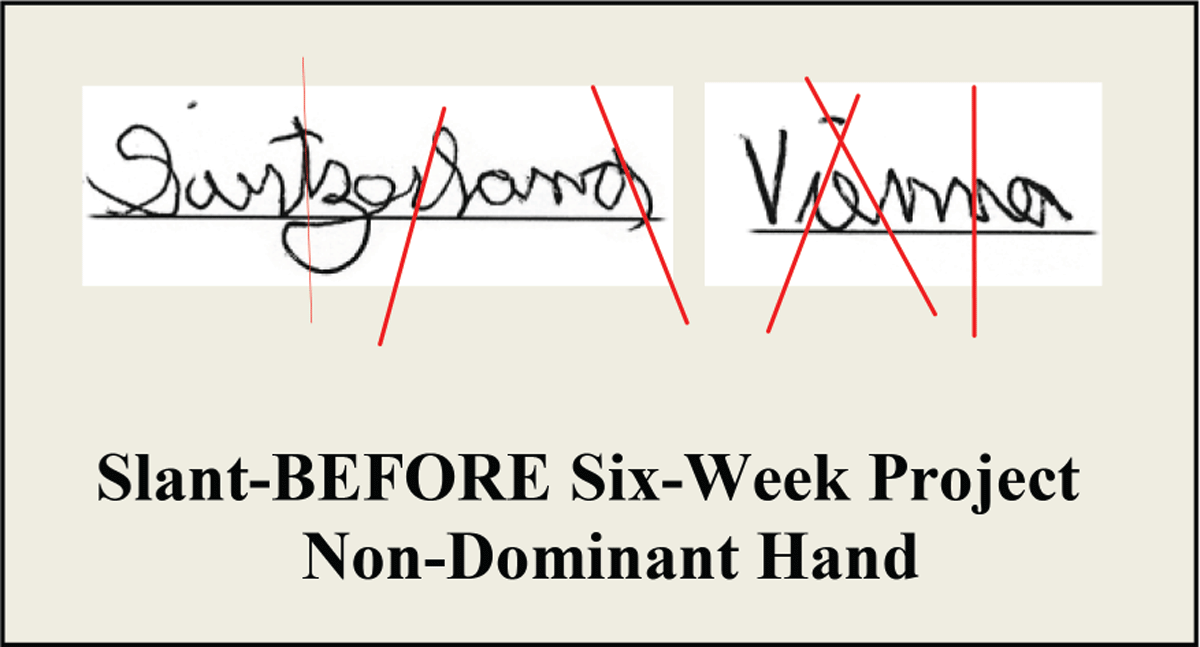
Figure 1.
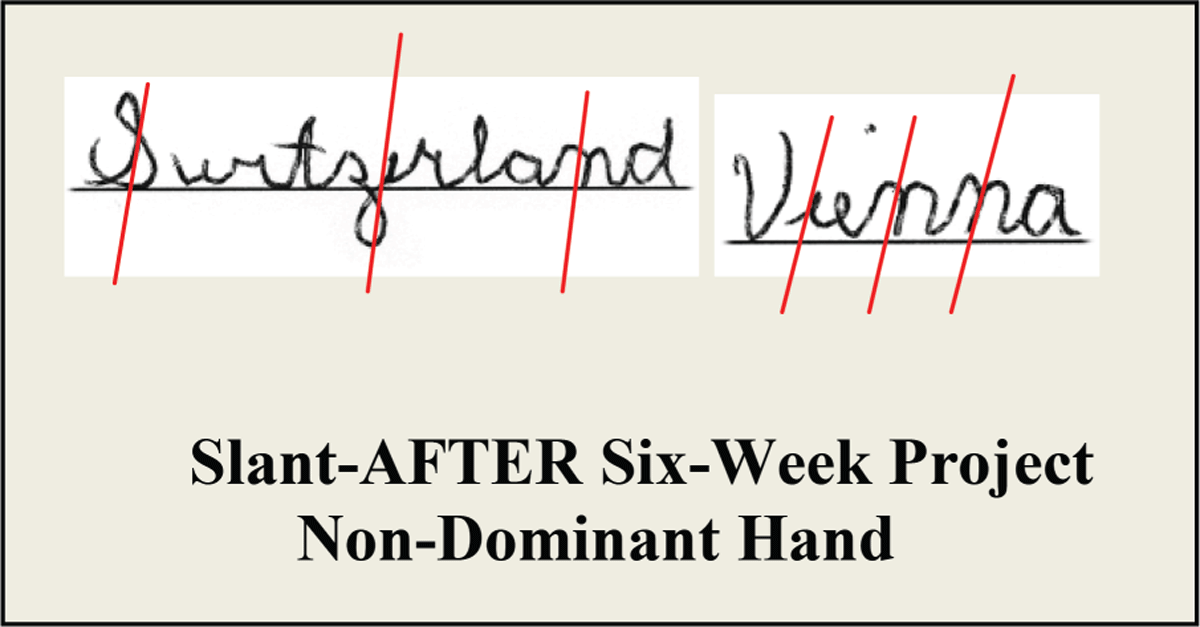
Figure 2.
Letter design also suffered with the non-dominant-hand writing. It was impossible to generate some of the normal letter forms such as ‘H’, ‘W’, ‘F’, ‘Q’, ‘T’, ‘P’, and ‘R’. (See Figure 3.) Certain of these letters proved to be too complex for the non-dominant hand, such as the ‘H’ and ‘Q’. Others, such as the ‘T’ and ‘F’, proved difficult due to the direction of the required movement. The letter ‘W’, which the author normally forms with pointed ends, proved troublesome because of the four separate start/stop movements. By switching to a rounded ‘W’ formation, the four straight movements were reduced to two curved movements.
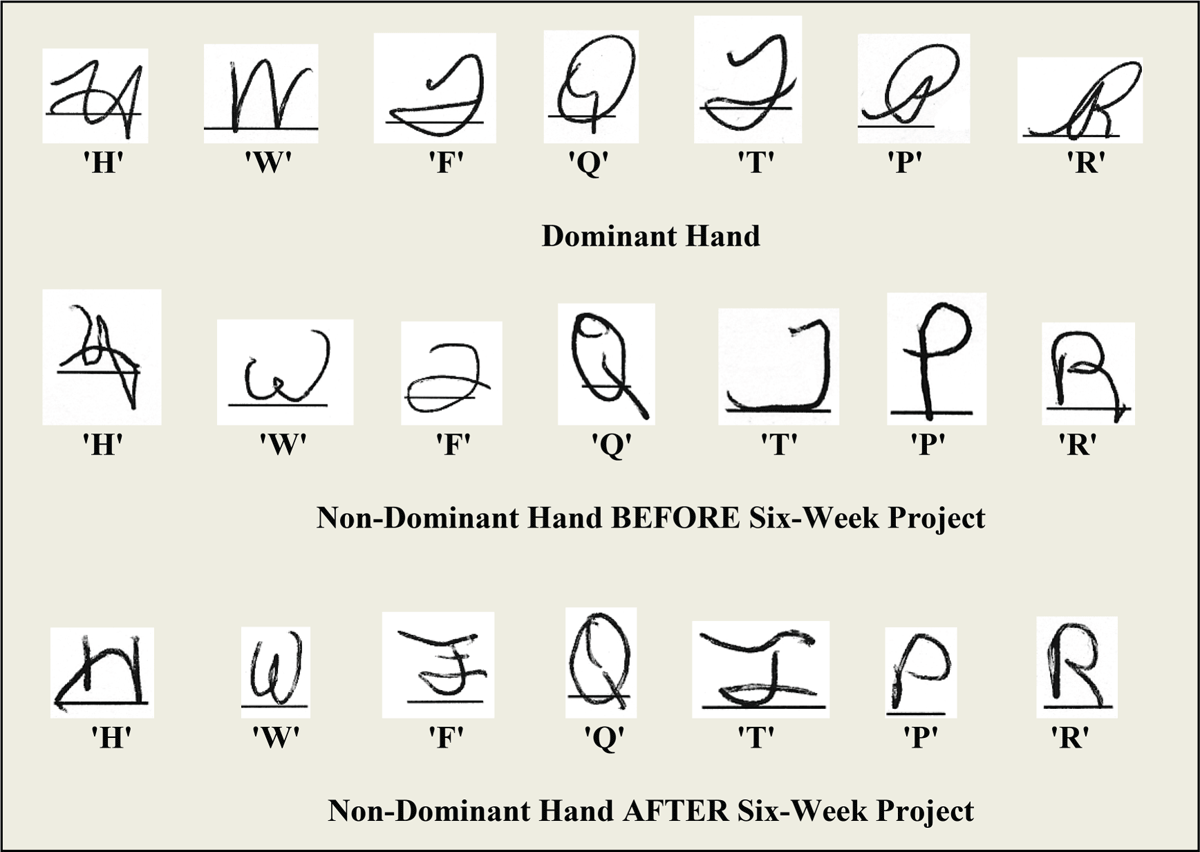
Figure 3.
It was not just uppercase letters that presented a problem. An entirely new method of writing particular lowercase letters was adopted. When the letters ‘a’, ‘d’, and ‘g’ fall at the beginning of a word, the author’s right and left hands use the same movements of execution. However, when those letters fall in a medial or terminal position of a word, the left hand executes them differently than the right. As illustrated in Figure 4, the dominant right hand initiates a counterclockwise movement at the lower left corner of the letter for at least a full rotation before moving into the terminal or connecting stroke to the next letter. This movement was not produced with the left hand. Instead, each letter is formed with an initial stroke that moves up and over in a clockwise direction until it reaches the upper right corner. Then it retraces back down and around in a counter- clockwise direction for one full rotation before continuing on to the terminal stroke. Also problematic was formation of her usual lowercase ‘r’. When the normal formation was attempted, that letter tended to meld with or cause the “extinction” of other letters around it.
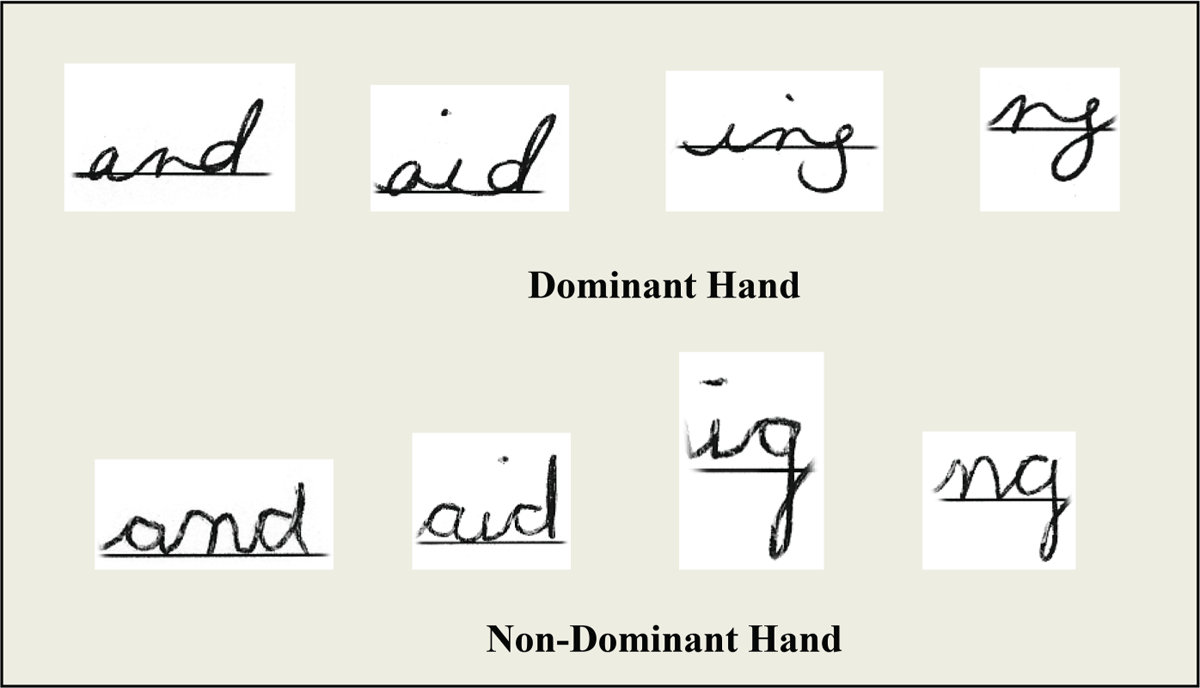
Figure 4.
Retracing was an element that was difficult to produce well. Many of the retraces did not actually re-trace the line as they were supposed to but were located above, below, or next to the original line. This was most likely due to aim and skill level. No matter how much effort was exerted, the lines did not retrace on a regular basis. It did not matter if it was a straight letter retrace such as in the letters ‘t’ or ‘p’, or a curved retrace such as in the letters ‘a’, ‘d’, ‘c’, ‘o’. (See Figure 5.)
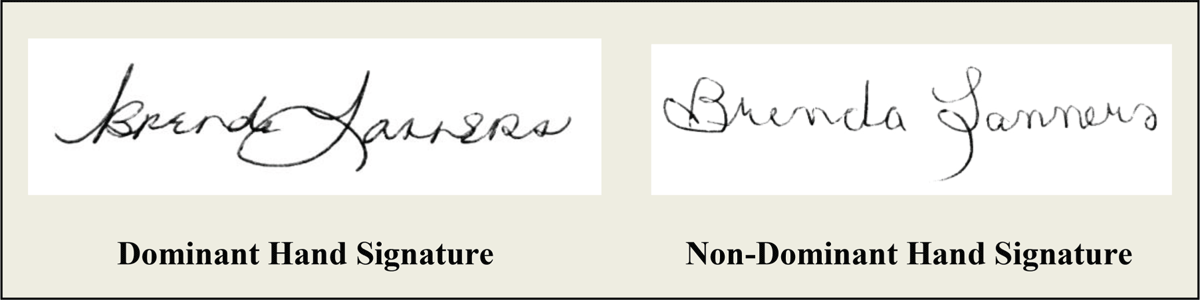
Figure 5.
Ultimately, the writing elements that were found to be the most troublesome were punctuation, t-crossings, and i-dots, all of which require a deft hand and remarkable aim. “Omissions of punctuation marks are frequent in unaccustomed-hand writing.” [15] Commas and quotation marks must be placed “just so” and require small, controlled hand movements. Quotation marks were especially difficult because the second mark usually ended up superimposed on top of the first rather than next to it. Because the second stroke overlapped the first, a third stroke was typically required to complete the mark. Periods and i-dots require placement and pressure, but no movement. Pressure without movement proved to be difficult for the non-dominant hand, so the normally round periods and i-dots became slash marks. Using a liquid ink pen rather than a ballpoint pen would help to reduce the required pressure and somewhat alleviate this problem. Exclamation points and t-crossings require a straight, controlled line quite unlike anything else in cursive writing. Aside from not being able to produce a straight t-crossing or exclamation point, it was much easier, unlike writing with the right hand, to cross the ‘t’s from right to left. This is, of course, typical of left-handed writers. [16]
“Generally speaking, signatures written with the unaccustomed hand closely resemble signatures written with the preferred hand.” [17] While this may be true of some writers, it was completely untrue in the author’s experience! Reproduction of the complex movements needed to write her normal signature with the non- dominant hand proved impossible. Simplification of complex letter forms is typical and takes into account the lack of skill in the non-dominant hand. [18] [19] Aside from perhaps the letter ‘a’ in the last name, Figure 6 clearly shows that there is not a single other letter that follows the normal dominant-hand execution. Speed and fluency, which are indicators of genuine signatures, are also grossly lacking in the left-handed signature. A signature comparison between the dominanthand signature and the non-dominant-hand signature can be found in APPENDIX B.
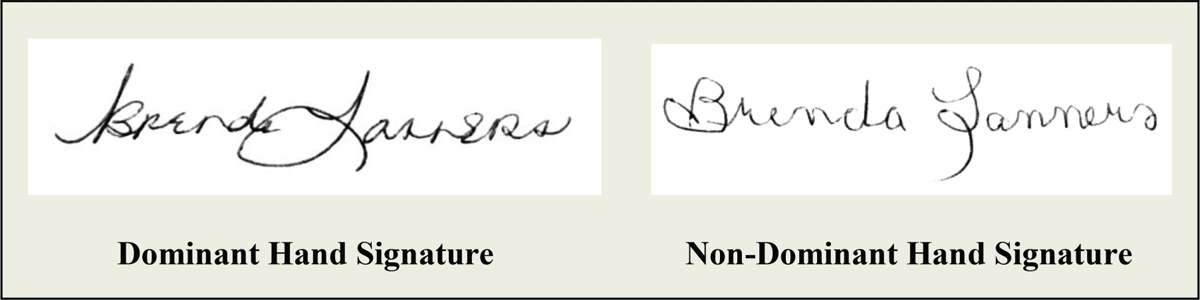
Figure 6.
At the beginning of this six-week project before any practice or training, and again at the end of the project, the author wrote the London Letter with the non-dominant left hand. (See Figure 7 and Figure 8.) There is a remarkable improvement in skill between the two samplings of non-dominant-hand writing. Figure 9 shows the London Letter written with the dominant right hand. Clear differences between the writing of the dominant hand and the non-dominant hand can be seen in slant, letter designs, retracings, beginning strokes, connecting strokes, speed and fluency. A handwriting comparison between the dominant-hand writing and non-dominant-hand writing can be found in APPENDIX C.
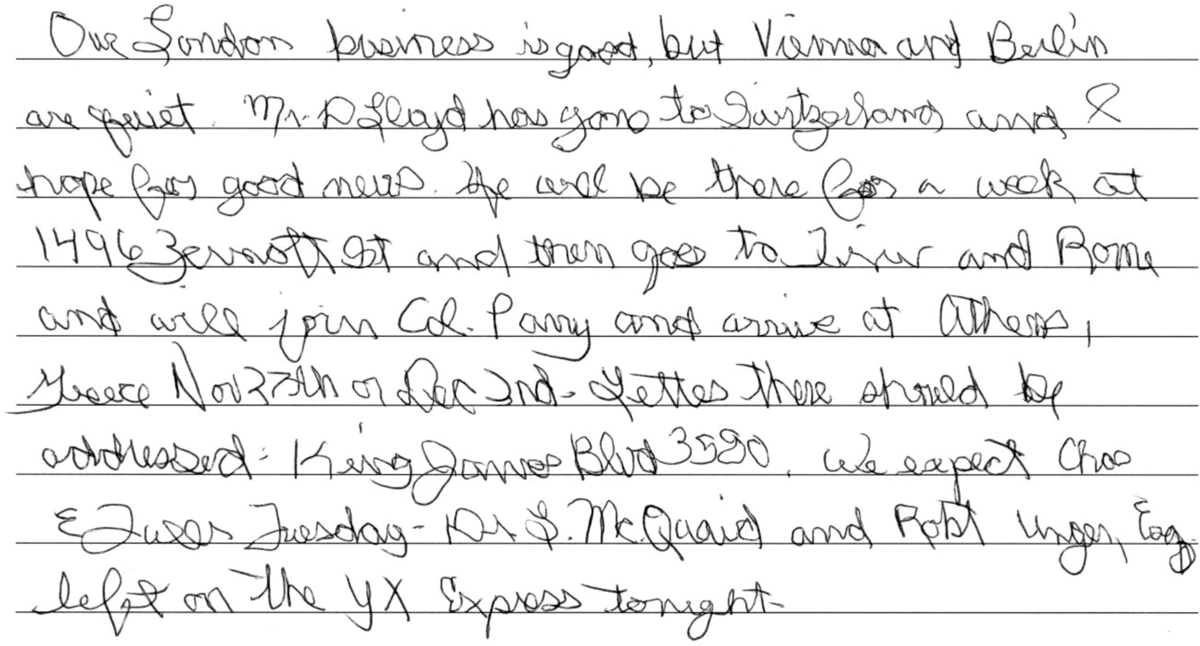
Figure 7.
London Letter written with the non-dominant hand BEFORE the six week project.
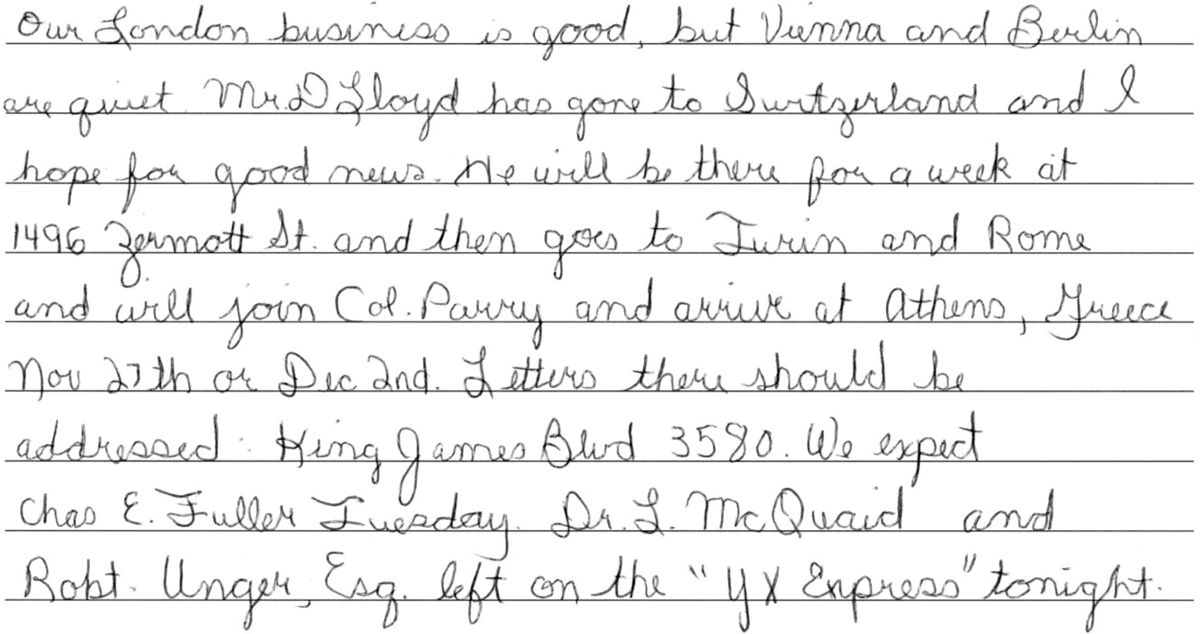
Figure 8.
London Letter written with the non-dominant hand AFTER the six week project.
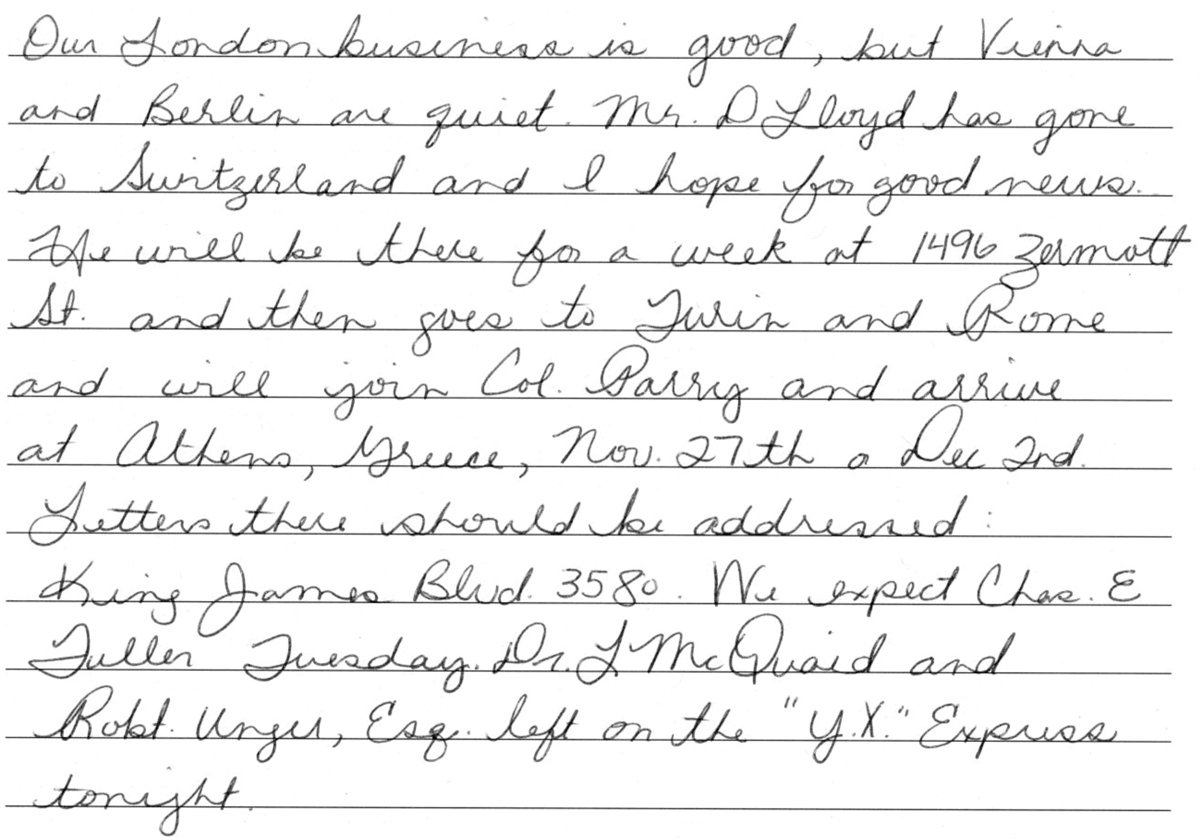
Figure 9.
London Letter written with the dominant hand.
Conclusion
“The processes involved in executing natural handwriting movements are extraordinarily complex and involve multiple brain regions working in concert to bring about coordinated, precisely timed multijoint movements…” [20] It is no surprise then, that these challenges will manifest themselves as unnatural movements in the handwriting produced by the non-dominant hand. FDEs know that use of the non-dominant hand is a method sometimes employed to disguise a person’s writing. [21] [22] However, it must be remembered that those who have lost the use of their dominant hand due to injury, illness, or amputation have no choice but to transform their non-dominant hand into their new-dominant hand. A forced change of dominant hand such as in the case of an Iraq or Afghanistan War veteran may seem of little concern to the FDE. But as of December 31, 2013, there were 1,558 major limb amputations performed on US soldiers. [23] As American troops are still deployed in many areas of the world, the numbers of soldiers with amputated or incapacitated limbs will almost certainly increase. Upper extremity limb amputations and immobility, of course, does not only occur as a result of injury during military service. Soldiers and civilians face the loss of limbs and/or use of limbs due to trauma, burns, peripheral vascular disease, neurological disorders, infections, malignancies, contractures, and congenital deformities. Amputation/loss of use of the dominant upper limb, therefore, is something that may need to be addressed by FDEs when examining handwriting that appears to be disguised by use of the non-dominant hand. It must be understood that the writer may not be attempting to disguise his/ her writing; rather he/she might just be trying to survive and thrive.
The longer a person writes with her non-dominant hand and the more she practices, the better the quality of the writing will be. However, it will likely never appear completely normal and natural, nor will it look exactly like that produced by her dominant hand. This exercise is meant to bring awareness to a growing source of handwriting that may appear to be disguised or distorted, to assist FDEs in understanding the process involved when training the new-dominant hand, and to highlight certain features and characteristics that might be observed in the handwriting produced by the new-dominant hand. As previously noted, differences between the dominanthand writing and non-dominant-hand writing were seen in: slant, letter designs, retracings, beginning strokes, connecting strokes, speed and fluency. Changes to the handwriting, which improved noticeably over the six weeks, were also discussed.
Future Studies
This paper is meant as a pre-cursor and will be followed by extensive research intended to determine whether or not a person’s dominant-hand writing can be correctly associated to their nondominant-hand writing.
Additional File
The additional file for this article can be found as follows:
Appendix A
Sample Writing Exercises. URI: https://storage.googleapis.com/jnl-asqde-j-jasqde-files/journals/1/articles/250/6667f0d32ddcf.pdf
Appendix B
Signature Comparison. URI: https://storage.googleapis.com/jnl-asqde-j-jasqde-files/journals/1/articles/250/6667f0f071f7b.pdf
Appendix C
Handwriting Comparison. URI: https://storage.googleapis.com/jnl-asqde-j-jasqde-files/journals/1/articles/250/6667f10c7a8cf.pdf
Notes
[1] This research is dedicated to all active-duty service members and veterans of the United States Military.
Thank you for your service.