
Introduction
The purpose of this paper is to summarise some of the aspects which document examiners may find useful when assessing philatelic related material submitted for analysis. This primarily is directed at old philatelic material which has a financial premium rather than current counterfeit postage. However, the analysis will be based on similar approaches for example where an item is compared with reference material. It is often helpful to adopt a weight of evidence approach, such that an item is considered from a scientific and personal knowledge basis. While all items should be examined with due diligence, the potential for fraud is clearly high when a postage stamp is worth not just 100 dollars but even a million dollars plus. Thus, the high value of such items will invariably entail more rigorous analysis.
While it is possible to undertake an initial review of a potentially fraudulently used item, often more specialised equipment, access to reference material and historical knowledge can help facilitate an opinion. The value of such opinions will depend on the analysis undertaken and the conclusions. As such, through an itemised audit trail, it should be possible for other document examiners to reach similar conclusions or to suggest further work.
This paper provides examples of the challenges and potential way that the weight of evidence approach can be applied.
Methods and Materials
It might be expected that a Document Examiner is likely to start their assessment from a neutral position, however, the ease that fraudulent material may be produced and its potentially high value should mean that extra vigilance is necessary. Examination of an envelope which has been postally used should be considered to be potentially fraudulent, especially if there is a premium in terms of value. This will include a cancellation on the first day of issue or where a special cancellation is more desirable. The postal rate used and the route taken may add to the challenge of expertising the item.
Most examinations will commence with the recording of what the item appears to be and this should include details of the stamp or stamps, ideally attached to an envelope. It is often helpful to consider both sides of the envelope which could provide further information such as what use or abuse the item or ‘patient’ may have received. Such items will usually have a cancellation or obliteration on the side where the name and address have been given and on the reverse, a receiving mark, so we should have evidence of where the item came from and where it got to. The receiving mark should relate to the address. Access to similar material with a known provenance, reference books and other people with extensive knowledge of e.g. printing techniques, postal systems in different countries and personal experience can be helpful in building a case for or against the item.
The use of a magnifying glass, perforation gauge, water mark detector, paper thickness gauge and digital scanner and microscope are all commonly used items that assist analysis.
Initial study of a used envelope
In 1840 the United Kingdom postal service adopted the Penny Black. The example below is on a Mulready envelope and has a cancellation across the shield and lion of Britannia known as a Maltese Cross. A stamp has also been applied and cancelled with a Maltese Cross (Figure 1). The mark PxL seen at the top of the envelope, would have been made at Liverpool and the envelope shows that it was sent to Hull, a city in the United Kingdom. The stamp has had to be added because of the need to pay a late fee, thus making the item potentially more valuable.
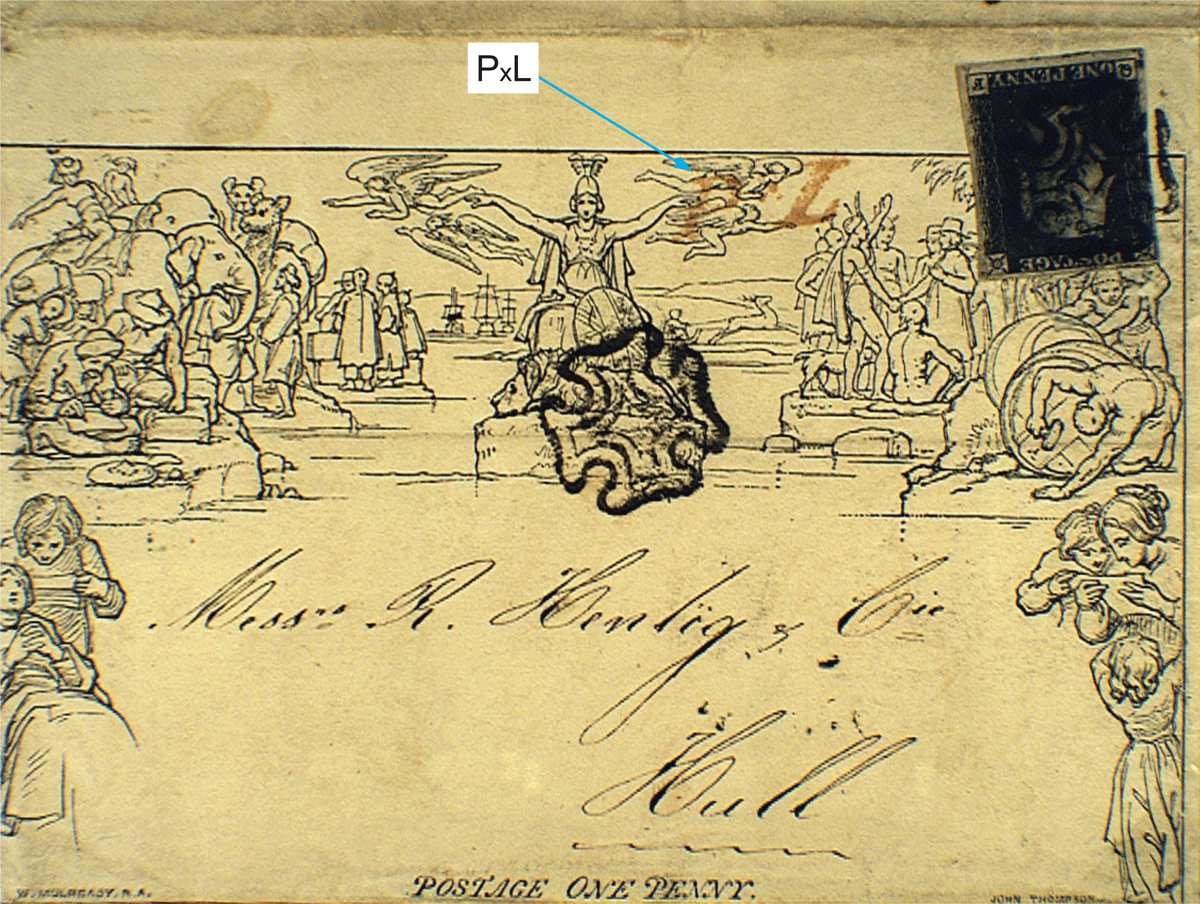
Figure 1
Examination of a used envelope or cover.
Careful examination of the envelope shows that the Penny Black stamp did not originate on the envelope. The reason being that envelopes or ‘covers’ from this period will usually be cancelled by the same person with the same obliterator and ink. The amount of ink and the angle of the impression might be expected to be very similar when applied by the same person at the same time. In this example the two Maltese Crosses are different and hence a fraudulently produced item (Figure 2).
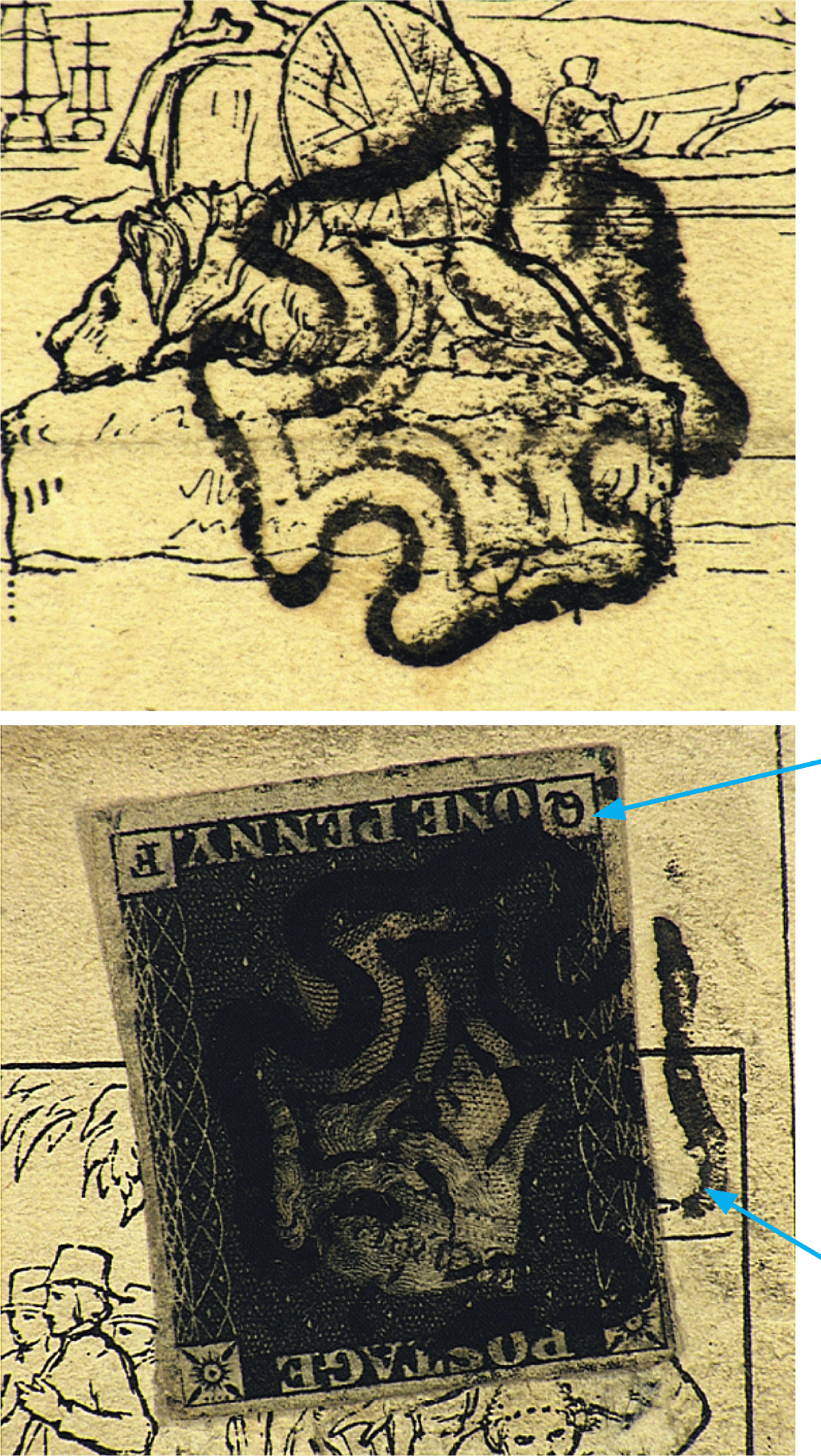
Figure 2
Comparison of the two Maltese Crosses.
It is also possible to test the inks used for the Maltese Crosses using a video spectrometric comparator such as the VSC6000 or VSC8000. The test is needed to compare the colour of the ink from the Maltese Cross in the middle of the envelope with the Maltese Cross on the stamps and on the envelope (Figure 3). This is known as a ‘tied stamp’. Calibration of the equipment and initial analysis is made with a white reference tile, supplied for the purpose to make the tested material comparable with other analysis. Figure 4 shows a Maltese Cross on a stamp with a red cancellation, other colour combinations and mixed inks are also found and may command a premium in terms of potential value.
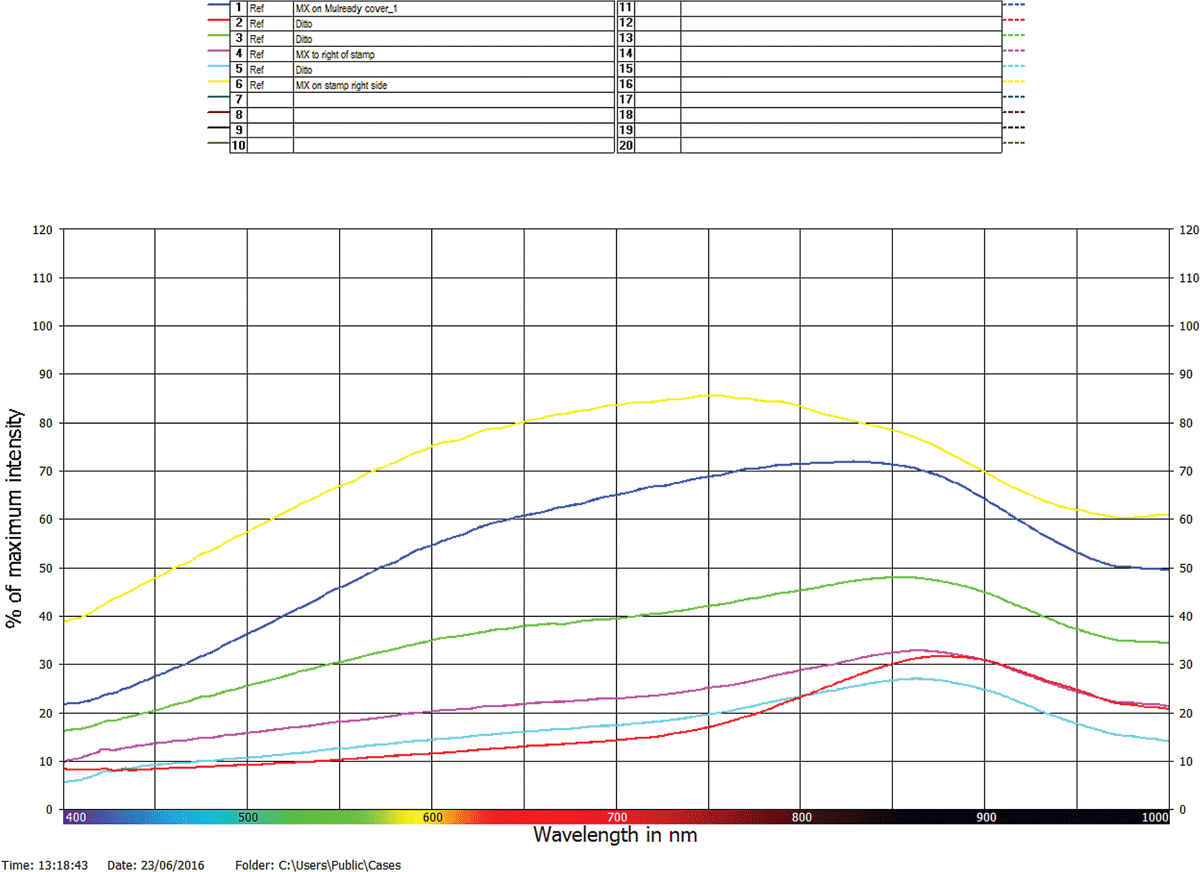
Figure 3
If the cancellation of the stamps was made at the same time, the spectra from each will be the same, assuming that the person using the obliterator used the same ink. However from the spectra in Figure 3, it can be seen that the Maltese Cross traces on the Mulready cover and stamp are different. Hence, indicating fraudulent manipulation.
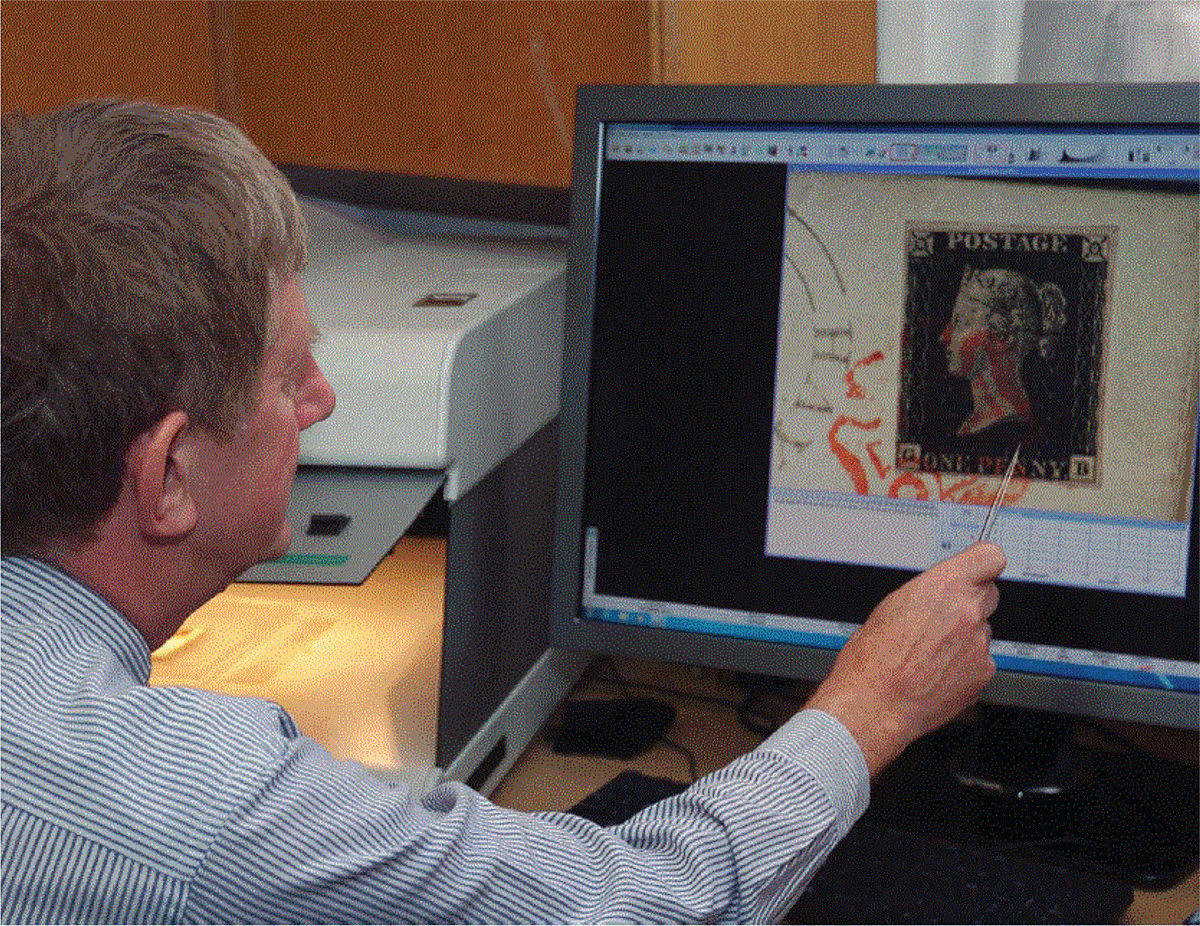
Figure 4
Using a video spectral comparator. The colour of the Maltese Cross was changed from black to red to aid postal authorities to check that the stamp had been used.
The following section considers various aspects of potential fraudulent use to aid the forensic document examiner and others involved with initial analysis of philatelic items.
Removal of a fiscal cancellation from legal documents for example
Examination of items with philatelic interest will also include whether stamps have been added or removed. The postal rate is usually related to distance and weight. Heavy items that would be sent long distances often had high value stamps that would have a premium because of their rare use. To make matters more complex, high value postage stamps may have been used for payments relating to legal documents including licences such as may be issued for guns or property. Often these stamps are cancelled with purple ink with the date and further details in an oval. However, fraudulent use has been reported when chemicals have been used to remove the cancel and then to add a cancel to suggest that the stamp has been used postally. (Shaw and Leonard 2016). The aim of the fraud is to deceive a purchaser into believing genuine use, which invariably attracts a premium in terms of a higher value. The item pretends to have been used through the post.
Detecting Security features
Postal services have always worried about the fraudulent use of stamps. There have been several prosecutions of people who have produced forgeries such as Sperati (British Philatelic Society 1997) or Madame Joseph. (Warboys and West 1994). Examples of security features to deter fraudulent use include the use of different adhesives, a water mark, perforation size, paper with threads inserted, printing of water soluble designs and in step with bank notes, enhanced security from the use of ultraviolet responsive marks and micro-lettering. These can be detected using equipment such as the VSC8000. http://www.fosterfreeman.com/580-vsc8000.html
Changing a used stamp into an unused stamp
Fraudsters will try to remove a cancellation if there is more money to be made from an unused example. This is seen for stamps that have relatively low values having been used. Hence the stamp may be removed from an envelope, treated with chemicals and then regummed. Analysis of such material usually shows that the stamp gum or glue did not originate when the stamp was produced. Philatelists have traditionally used stamp hinges, a small piece of adhesive paper to attach the stamp to a page. Thus, as mounting methods have changed, a premium must be expected for an unmounted unused example. i.e. a stamp that has been kept without a stamp hinge being used.
Adding Overprints
Due to shortages of stamps, postal authorities may use existing stocks with a different value. Such so called ‘over prints’ usually take the form of a black line to cancel one value and have another value added. Some overprints may be accidently duplicated, printed upside down or be misspelt. This has often occurred in times of war when postal supplies are disrupted and local printers had to be employed. All such errors are philatelically interesting and hence, attract a potential premium.
Testing of such items may include analysis of the shape of the letters used for the over-print and the ink used for the cancellation. Postal authorities in Great Britain have usually tendered for the supply of stamps from security printers. This has included Perkins Bacon, De La Rue, Bradbury & Wilkinson, House of Questa and Cartor. Philatelists enjoy identifying printings from different suppliers, some of which may be more difficult to find and hence generate a higher cost to purchase an example. Post Offices would be instructed on forth coming issues of stamps, cancelling procedures and record keeping.
The colour of stamps
It may be reasonable to assume that the colour of a stamp will be consistent during its issue. While this may be taken as a general rule, stamp colour will change e.g. when the printing of a stamp is subject to new supplies of ink or a new security printer has to be used. Testing the colour of stamps can be facilitated by a video spectral comparator.
Adding margins or perforations
Stamps are more valuable if they are in a good condition and stamps where part of the stamp is missing will be worth considerably less. Thus, the fraudster may wish to add a margin to a stamp or to add perforations. Paper used for printing postage stamps may be forensically assessed for the way that the fibres of the paper appear under high magnification e.g. x 300 using a microscope. Analysis of such material will usually include checking whether the stamp responds to the weave of the paper, compared with the rest of the stamp and assessment of the spacing and size of the perforations as well as the relevant watermark.
The role of expertising facilities
Many individuals have extensive knowledge of certain philatelic items, this may mean the printing of certain stamps or the historical context of postal history for a country or countries. Careful examination by experienced philatelists will entail investigation of the submitted material. (Figure 5). Such people may provide certificates of whether an item is as described in catalogues or has been fraudulently adapted. Such fraud may be easy to detect with e.g. a magnifying glass to show abrasion such as might occur when part of a design is removed or the shape of letter characters do not conform to other printed examples. Forensic philately, where more sophisticated techniques may prove helpful is not often undertaken because of the cost of the equipment and the need for technical familiarity. Clearly, no one person can be knowledgeable about postal techniques used over the last 200 years. However, there is a need to collaborate and share information, recognising that the opinions of several people can be helpful in concluding complex cases.
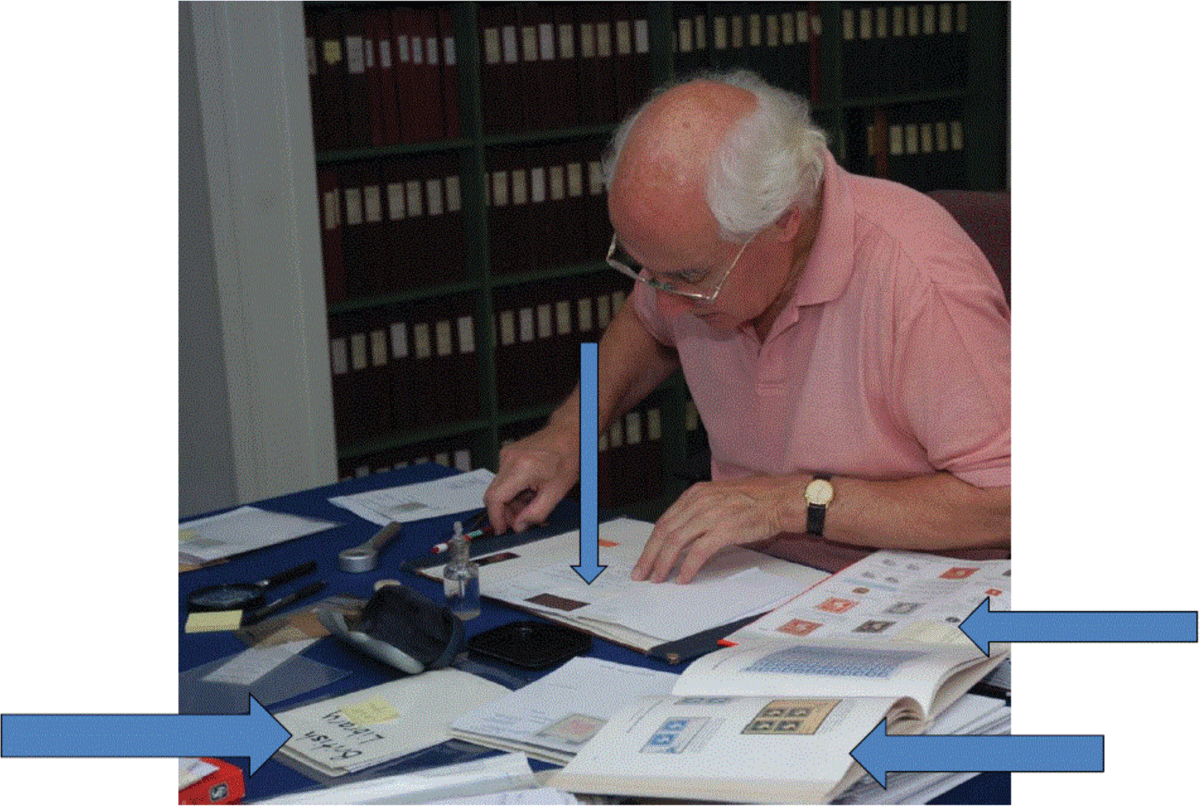
Figure 5
The item under investigation is compared with reference material.
In 1903 the American Philatelic Association Expert Committee was formed and now is known as the American Philatelic Expertizing Service (APEX). In 1945 the Expert Committee of the Philatelic Foundation was formed. The Foundation has certified over 400,000 items. In the UK, the formation of an Expert Committee of the Philatelic Society London was proposed by members in 1894. They became the Royal Philatelic Society in 1906 and over 225,000 items have had certificates by 2017. Further information is available via the American Philatelic Expertizing Service http://stamps.org/stamp-authentication and the Royal Philatelic Society http://www. rpsl.limited/Home.aspx. In Canada, the Vincent Graves Greene Philatelic Research Foundation may be consulted. http://www.greenefoundation.ca/expertizing.htm#fees.
The expertising process is illustrated below, where the item is recorded and compared with reference material (Figure 5).
Discussion
Postage stamps are highly portable and can potentially be worth nothing or many thousands of dollars. Often it is subtle differences in printing that turns a common stamp into potentially a more valuable commodity. However, some can be demonstrated to have been fraudulently produced. (e.g. Leonard and Shaw, 2015a and 2015b), and (Harman 2015)
While an old stamp may be worth more than more recently issued examples, the key factors in determining the value of the item will be based on rarity, condition and demand. There may be a need to consult specialist publications (for example Beecher and Wawrukiewicz 1999), (Gross 2015), (Nissen and McGowan 1998), (Scott 2010), (Stanley Gibbons 2016) and (Williams and Williams 1969) and expertising resources such as (Hellrigl 2004). Philatelic Expertising Committees are likely to have examples of forged material and these can be used to compare with submitted examples. Advice may be obtained from annual publications e.g. Stanley Gibbons 2016 or specialist books that focus on forgeries. (e.g., Tyler 1993).
Conclusions
The potential high value of philatelic items should alert the document examiner to the potential for some form of fraud. Across the world, expertising of such items will often rely on the personal knowledge of individuals. A few organisations offer a service based on the collective opinions, in America, the American Philatelic Expertizing Service and in the UK, the Royal Philatelic Society and the British Philatelic Association. These organisations issue certificates that may guide the document examiner into deciding whether an item is genuine or has been used fraudulently.
For internationally significant items, a collection of certificates from the different committees may offer even greater confidence in the item under investigation.
Notes
[1] The author confirms that the paper is original research and has responsibility for the content.
Acknowledgements
The cover with two Maltese Crosses was kindly donated to the RPSL Fraud collection by Z. Barak. Discussions with Chris Harman, Alan Huggins, Peter Lister, Frank Walton and John Shaw are gratefully acknowledged.