
Introduction
Forensic Document Examiners train for an average of two years during which they learn the basic premises of forensic handwriting examination; one of these basic premises is that the handwriting of an individual may gradually change over time3. “Gradual change of writing” implies that the causes of change are not transitory, such as an illness, or sudden and permanent, such as a debilitating stroke. It is more likely that a gradual change would evolve subtly over time, and typically affect only a few features.
Previous research on this basic premise has been limited to small studies that focused on a single writer’s historical writings, or on the writing of adolescents4. In 1975, Peter Baxter presented the results of his research in which he measured an elderly writer’s surname that had been handwritten on envelopes over a 10-year period. Baxter randomly selected 10 of the available 100 samples, and made 6 different measurements that included the height, length and slope of the name. He found a “degree of consistency (regularity) of a high order, in the writing of one elderly person.” In 1990, Diane Tolliver examined specific features of her own signature from the ages of 6 through 35. In her review of the signatures written between the ages of 18 and 35, Tolliver concluded that “[a]lthough there is a very modest amount of experimentation with letter formations, the main qualities of the signatures are fairly stable. Thus, it appears that graphic maturity has been achieved.”
For the current study, the authors collected normal course of business signatures written by individuals over the entire course of their adult lives. A total of 51 writers was selected based on the specific criteria described herein.
Methods and Materials
The inclusion in this study of each individual’s corpus of signatures was based on the following requirements: the signature collection had to span at least three decades; a representative sample of signatures spanning the time period were available for evaluation; and no known health issues were identified that might impact writing ability or quality (e.g. arm/hand surgeries, blindness).
The authors chose eight handwriting characteristics to evaluate based on characteristics that are commonly examined by forensic document examiners, and the relatively objective nature of these characteristics. A checklist of the eight characteristics accompanied each individual’s corpus of signatures for evaluation. Each characteristic required a Yes/No determination of perceived change over time. The eight characteristics are:
Conspicuous Uppercase Letter Formations
Relative Size of Letters
Relative Height of Letters
Number of Pen Lifts
Conspicuous Lowercase Letter Formations
Attention to Baseline
Line Quality
Overall Slant
The study’s authors are both ABFDE certified forensic document examiners with a combined 48 years of experience. After independently evaluating the signatures of the 51 writers, each examiner then consulted with the other on the checklist results of each writer. Areas of discrepancy were discussed until mutually agreed assessments were reached. Discrepancies between the examiners were infrequent, occurring in approximately 4–5 instances, and primarily involved agreement on the age of onset of deteriorating line quality, and whether a handwriting characteristic constituted actual change, versus variation. It was this latter circumstance that provoked the most discussion and lead to the need to define “gradual change of writing.” Resolving whether a feature would be classified as a change versus a variation was dependent on the sufficiency and representativeness of the writing, a subjective consideration that required discussion and resolution in a few instances.
Consequently, one of the more challenging aspects of this study was defining what is meant by “gradual change.” The authors postulated that “gradual change” does not refer to handwriting variations that come and go over time, or sudden changes caused by illness or injury. “Change” in this context refers to a voluntary, or semivoluntary, modification in one or more writing habits that, once introduced, is then consistently present. Further, the authors agreed that the introduction by the writer of a new characteristic constituted change if the characteristic did not revert back to a previously used formation or habit. A reversion would indicate that the change was actually an intermittent variation that was part of the writer’s overall writing habit. The authors acknowledge that line quality falls outside of the definition of gradual change in that it affects the entire quality of the writing and is not voluntary [3]. Since line quality changes are expected later in life as part of the evolution of an individual’s writing, however, this characteristic was included in the study.
Results
Based on an assessment of the signatures of the 51 writers, the following statistics were calculated for observed change for each of the eight characteristics:
1. Conspicuous uppercase letter formations were usually limited to the first letter of the first and last name, but often included a middle name or initial. The authors found that 24% of the 51 writers changed one or more of these letters over time. (see Fig. 1)
2&3. Relative size and height of letters were found to change in only 7% and 9%, respectively.
4. Pen lift changes, either increased, decreased, or change of location, were noted in 7% of the writers.
5. Conspicuous lowercase letter formations changed in 20% of the writers. (see Fig. 2)
6. Baseline changes were not evident in any of the writings studied. Occasional voluntary (Fig. 2) and involuntary (Fig. 3) variations in baseline were noted, but did not meet the authors’ criteria for habitual change.
7. Line quality change, which occurred in 62% of the writers, was the most common change observed of the eight characteristics evaluated. The average age of line quality change was around 77.5 years. (see Fig 3)
8. Overall slant rarely changed and was evident in only 2 writers.
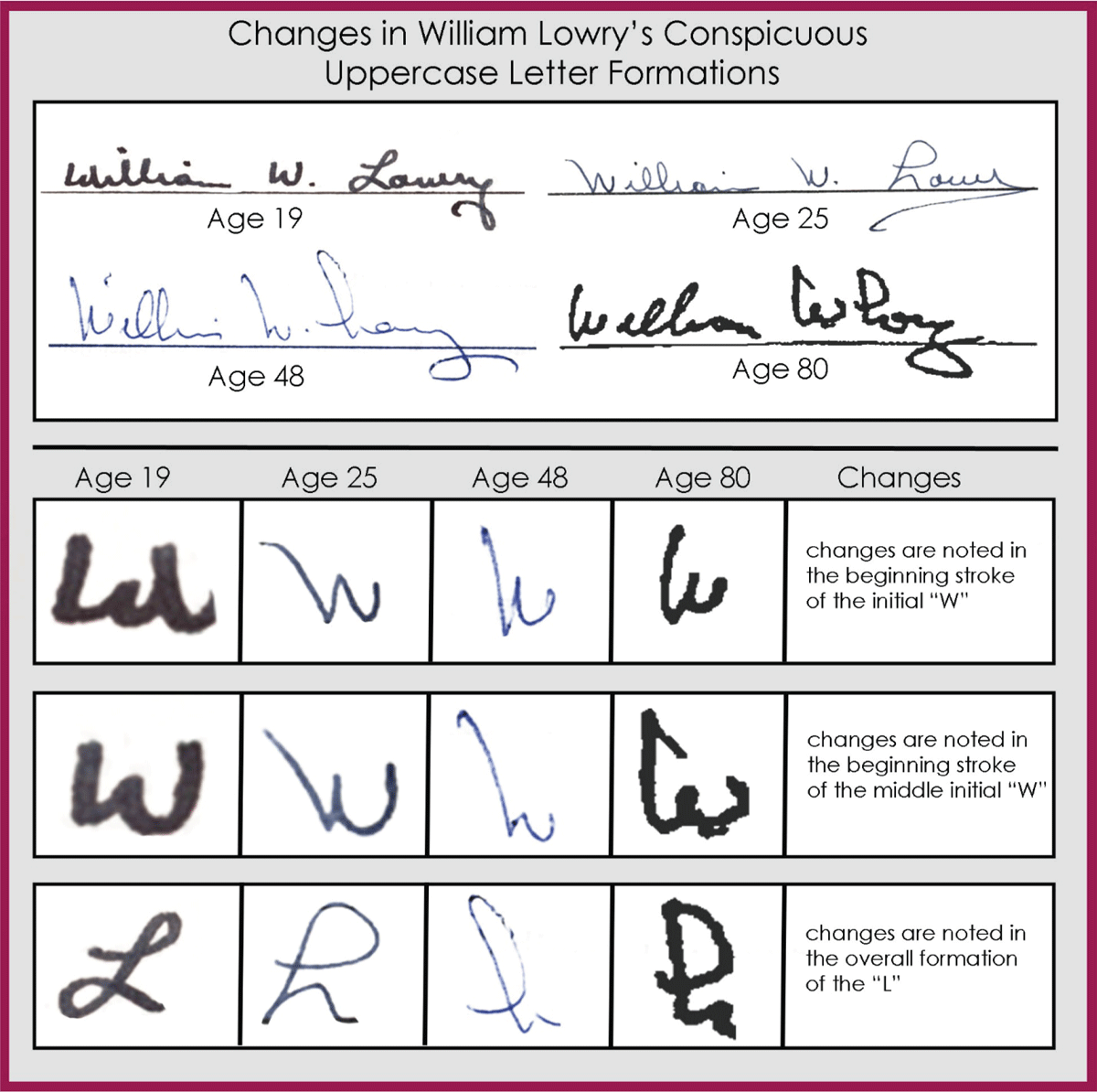
Figure 1
Gradual changes are noted in William Lowry’s uppercase letter formations. Slowly over time, the relative size of the approach stroke to the “W” and overall formation of the “L” begin to change. Once changed, these features remain consistent.
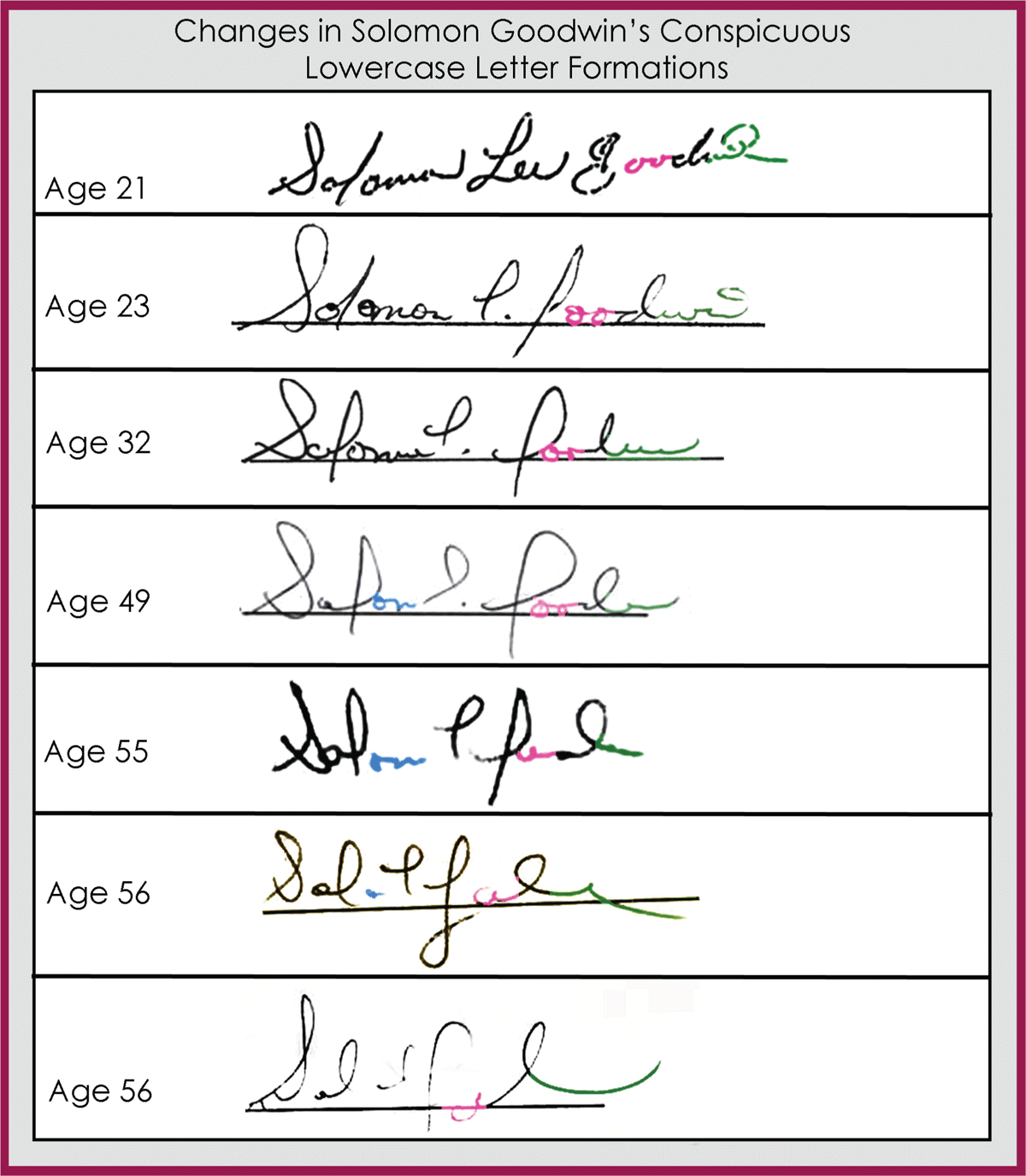
Figure 2
Gradual changes are noted in Solomon Goodwin’s signature, in particular the abbreviated formations of “mon” (blue), “oo” (pink), and “win” (green).
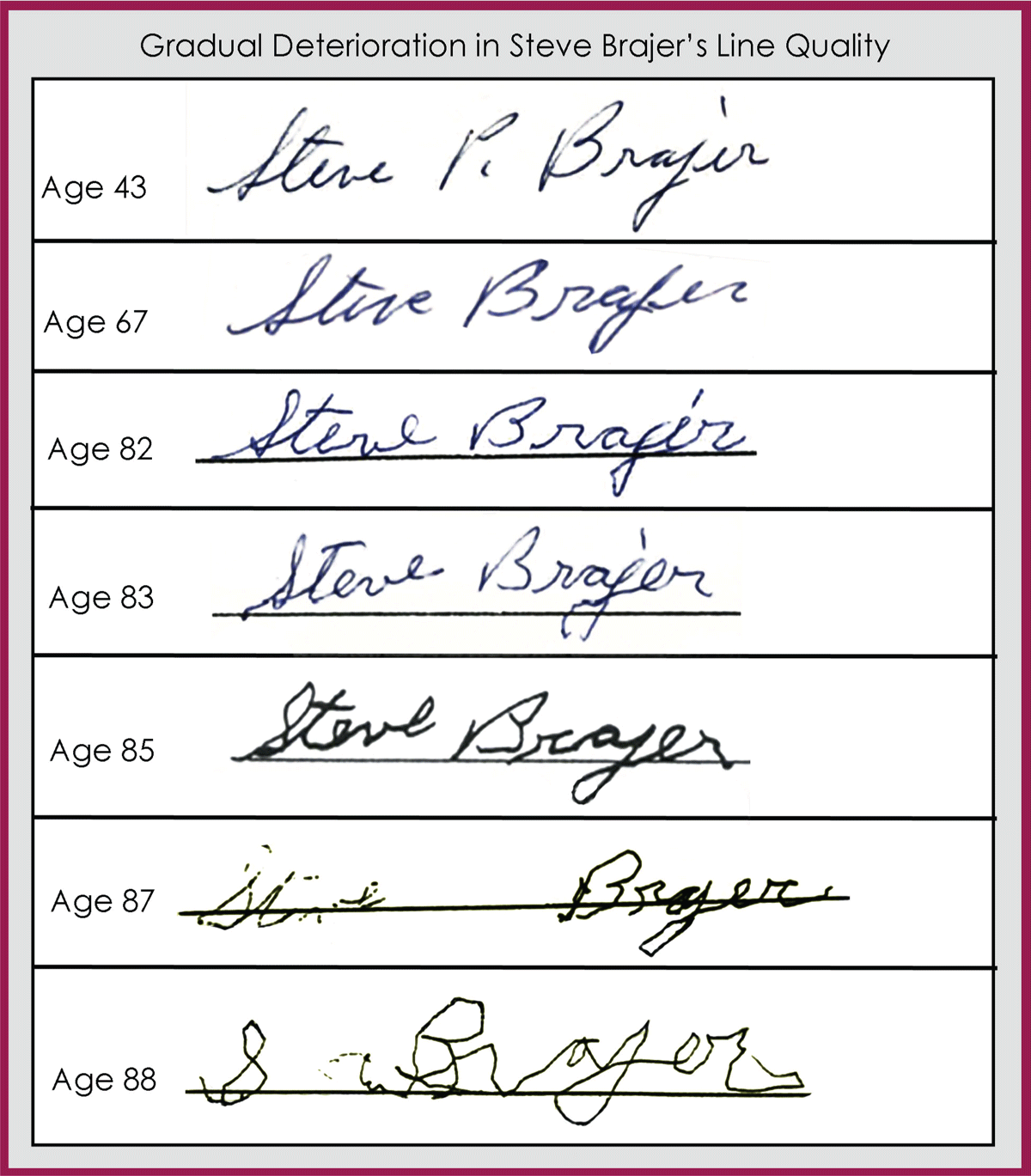
Figure 3
A noticeable deterioration in overall line quality is noted in the signature of Steve Brajer.
Limitations
The authors acknowledge that there are limitations inherent in the writings available for the study. The writing sample size is limited to 51 writers; 50 of the 51 writers are male; time gaps exist between many of the signatures; some of the writings were copies; and the majority of the writers were born between 1920 and 1940. The writers were all deceased, with no obvious/known health issues that would impact their handwriting. The submitted files evaluated for this study contained a range of forms, including administrative (change of address, beneficiary) and health (medical checkups) forms, that had been maintained throughout the writers’ lifetimes.
Conclusions
The results of this research demonstrate that although handwriting (signatures) can gradually change over time, it is more likely that it will not change substantially over time, and if it does, will occur more frequently in the areas of conspicuous upper and lowercase letter formations, and in line quality with advanced age. The core habits of relative size, height, slant, baseline and pen lifts, remain significantly consistent over time.