
Introduction
Handwriting is a complex motor skill that is the combination of sensory, neurological and physiological impulses. Through practice and repetition, writers interject their own individual characteristics into their writings which become a pattern of habitual formations that are repeated from one writing to the next1. Given sufficient quantity and quality of writing to compare, it is able to be demonstrated that no two writers share the same combination of handwriting characteristics. This is known as the principle of individuality, which forms the basis for handwriting analysis2, 3, 4. In practice, forensic document examiners are able to identify or exclude, if possible, a known writer as the source of a piece of questioned writing through comparison and evaluation of class and individual features or habits. Handwriting features that examiners evaluate include, but are not limited to, line quality, rhythm and fluency of the writing, writing variation, pen pressure, writing movement, the size and slope of the writing, pen lifts, the spacing between words and letters, the position of the writing on the baseline, height relationships, and beginning and ending strokes. A writer’s identity cannot be established through a single individual feature in the writing but, rather, it is established through a combination of the significant, unique features between the writings, with no significant differences1, 4, 5.
To support the scientific validity of forensic handwriting examination, a great number of proficiency studies on accuracy rates, in addition to empirical studies on the individuality of handwriting, have been conducted over the years6. It is a mandatory accreditation requirement that laboratories participate in related proficiency testing programmes in order to demonstrate their technical competence in this area of work. Currently, Collaborative Testing Services (CTS) and Skill-Task Training Assessment & Research Inc. (ST2 AR), both based in the United States, offer proficiency testing programmes on handwriting examination and questioned document examination for laboratories around the world. However, the programmes organized so far are for handwriting examination using the Latin alphabet and/or in English only.
As Chinese handwriting is widely used among the large population of ethnic Chinese around the world, the opportunity exists that forensic laboratories would be asked to examine handwriting and signatures written in Chinese even though the examiners might be unfamiliar with the Chinese language and characters. Hence, availability of appropriate proficiency testing programmes becomes more and more important. This does not only allow laboratories to demonstrate their technical competency, but also facilitate their seeking of accreditation on Chinese handwriting examination.
Due to the relative complexity of Chinese characters in comparison with English letters, a comprehensive review on Chinese handwriting examination has been published7. In brief, a Chinese character is made up of one or more basic components called radicals. Each radical is formed by eight basic strokes, namely: vertical, horizontal, angular, slash, saber, hook, tick, and dot [Figure 1]. Despite the presence of standard rules governing the act of writing, very few writers strictly follow these conventions. Rather, as revealed by a collaborative study conducted by the authors’ laboratory and the University of Hong Kong3, a writer tends to develop his/ her own sequence of writing habits. Therefore, the structural relationship of strokes and the sequence in which they are executed are of particular significance for identifying or discriminating authorship in Chinese handwriting examination. In view of the imminent demand, the authors’ laboratory, which is an accredited proficiency testing scheme provider under ISO/IEC 17043, plans to extend the scope of its forensic programme to cover Chinese handwriting and signature examination with the proficiency testing programme GLHK PT 14-01. This programme was kicked off in March 2014. Apart from details of the design and operation of the proficiency testing programme, this paper discusses the feedback and comments received from the participating laboratories with a view to further improve the programme to be run later, as well as for reference by other proficiency testing schemes providers.
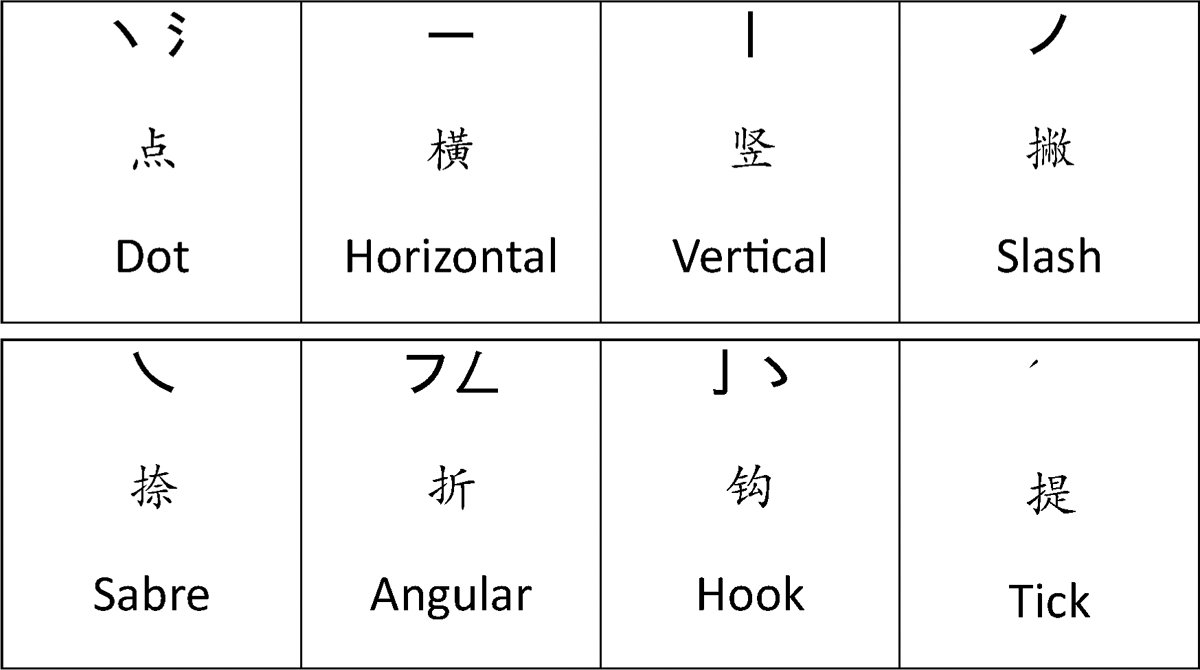
Figure 1.
Eight basic strokes in Chinese Handwriting.
Design of the proficiency testing programme
Proficiency testing involves the use of interlaboratory comparisons to determine the performance of participants for specific tests or measurements and to monitor their continuing performance. Apart from performance evaluation, the purposes of proficiency testing also include identification of problems in laboratories, establishing effectiveness and comparability of test or measurement methods, provision of additional confidence to laboratory customers, and the education of participating laboratories8. To achieve these objectives, the proficiency testing programme has to be conducted with recognized procedures, preferably international standards, The scenario of the case was that Mr. LI Ming’s which were followed, particularly in the design wife (Ms. XIANG Wen) discovered a loan note at and operation of the programme. This proficiency home and asked the borrower Mr. ZHANG Wen testing programme on Chinese handwriting and to repay the loan together with the interest. Howsignature examination was conducted in accor- ever, Mr. ZHANG Wen denied writing the loan dance with ISO/IEC 17043:2010 and the scheme note. On the other hand, Mr. LI Ming admitted to provider has been accredited according to the re- writing the signature “Lee” on the lender sign aquirements of the same standard since 2010. ture of the loan note.
Before commencement of the proficiency testing programme, a special working group was established to coordinate and operate the programme according to the stipulated requirements. To ensure access to necessary technical expertise and experience, members of the working group were all professional staff with years of experience in providing questioned document examination services to law enforcement departments. At the planning stage, an internal proposal was drafted for approval by the committee which is responsible for overseeing the metrology development work in the laboratory. The proposal addressed the objectives, purpose and basic design of the programme for consideration. Among others, the proposal discussed the major sources of error and possible problems, for instance, the clarity and homogeneity of the candidate test items. By making reference to other similar proficiency testing programmes, the working group suggested using photographs bearing the images of the questioned and control handwriting and signatures specimens as the test items. To simulate a police investigation case, a loan note suspected to be forged containing questioned handwriting and signatures was selected as the test item for the programme [Figure 2].
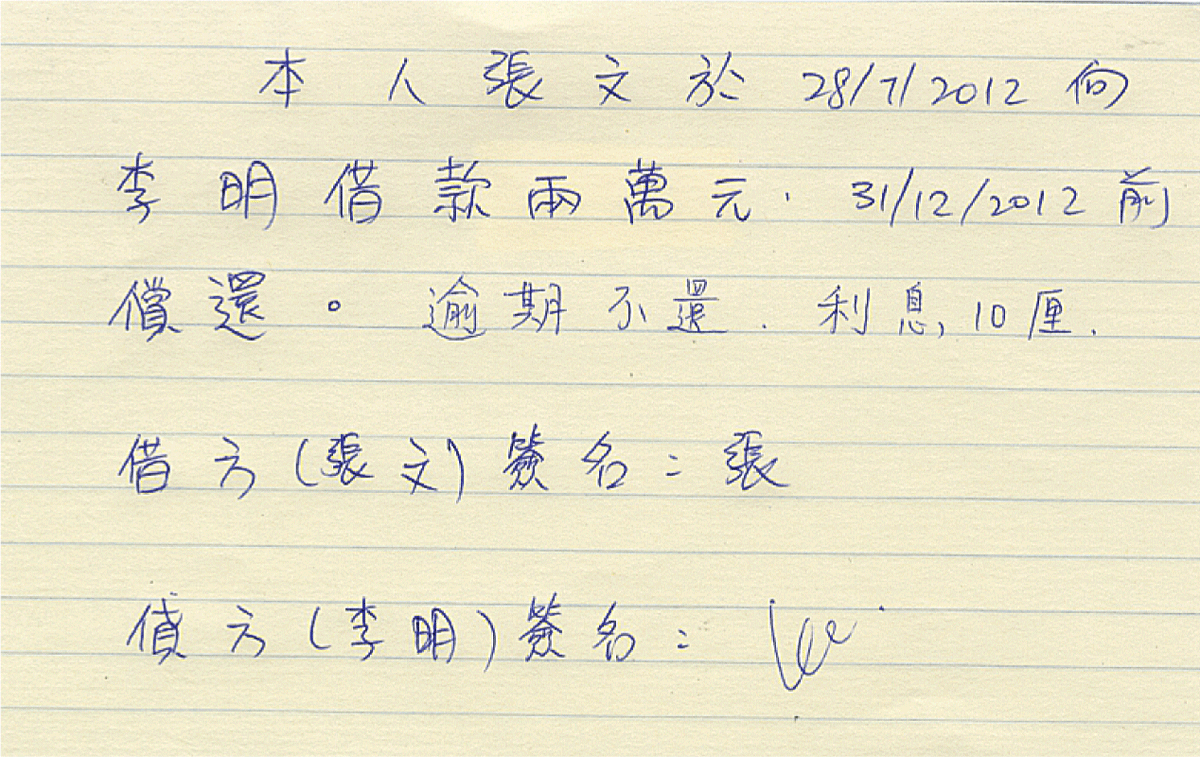
Figure 2.
The questioned Loan Note
The scenario of the case was that Mr. LI Ming’s wife (Ms. XIANG Wen) discovered a loan note at home and asked the borrower Mr. ZHANG Wen to repay the loan together with the interest. However, Mr. ZHANG Wen denied writing the loan note. On the other hand, Mr. LI Ming admitted to writing the signature “Lee” on the lender signature of the loan note.
Several known writing samples of Mr. LI Ming, Ms. XIANG Wen and Mr. ZHANG Wen consisting of both course of business writings and dictated exemplars of the writings on the loan note were provided for the examination.
In our experimental design, we deliberately added an extra sentence “ ” to the main content “
 28/7/2012
  ,” 31/12/2012
  ” by a third person other than the borrower and the lender.
The major challenge of the test was that the participants may not have knowledge in Chinese language and writing. Only one Chinese character “ ” and the numeral “10” were in common on the main content and the extra sentence. The aim was to test if the participants could distinguish the writers of the extra sentence as well as the main content, and identify the authors of the questioned Chinese handwriting and signature.
To facilitate the examination, the English translation of the contents on the loan note was also provided in the result form:
I, ZHANG Wen, borrowed an amount of twenty thousand dollars from LI Ming on 28/7/2012 ( ” 28/7/2012
  ), and agreed to pay back before 31/12/2012 (31/12/2012
  ). If payment was overdue (
 ), an interest of 10% per annum will be incurred (
 ).
).
Borrower (ZHANG Wen) Signature (
 ):
):  (ZHANG)
Lender (LI Ming) Signature ( ) : Lee
To verify if the test items provided were of appropriate quality for comparison purposes, a feasibility study was initiated where independent forensic laboratories were invited to perform the examination of the candidate test items.
Preparation of the test items
Apart from the loan note mentioned above, the test items included nine control handwriting and signature specimens provided by LI Ming (C1), XIANG Wen (C2) and ZHANG Wen (C3) for the identification of authorship of the questioned handwriting and signature. A set of control handwriting and signature specimens provided by LI Ming is shown in Figure 3 which contains the requested control and normal course of business specimens.
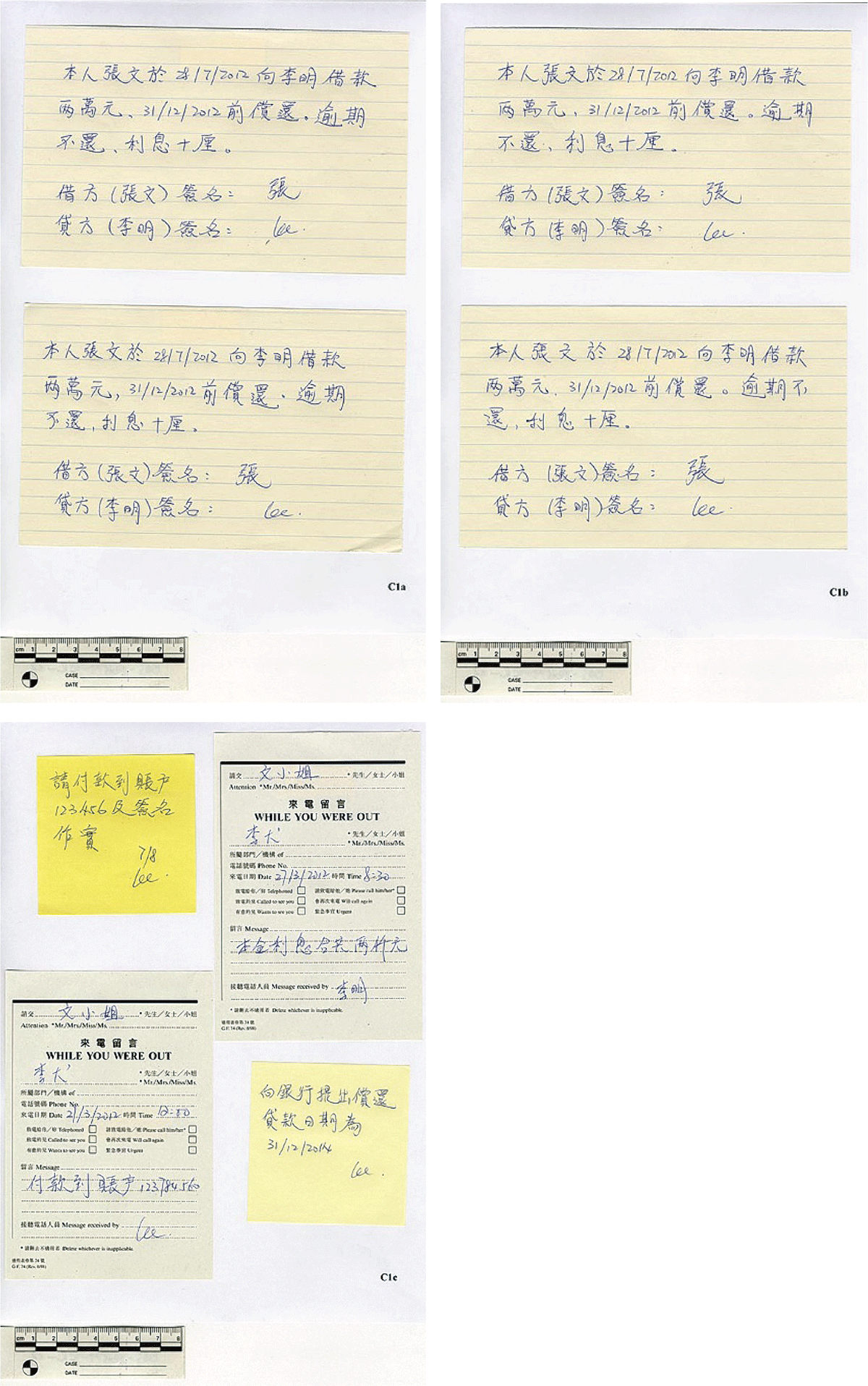
Figure 3.
A set of control handwriting and signature specimens of LI Ming
The main content “ ” 28/7/2012
  , 31/12/2012”, “
 ”, “
”, “ :” and “
 :” was written by ZHANG Wen (C3) and the signature “
 ” pertaining to “
 :” was written by ZHANG Wen (C3). The additional terms of the loan note “
 ” was written by XIANG Wen (C2). The signature “Lee” pertaining to “
 ” was written by LI Ming (C1). The handwriting and signature on the questioned loan note were prepared by dictation. The writers C1, C2 and C3, respectively acted by three officers of the authors’ laboratory, were instructed to write in a moderate written speed without any act of disguise.
For the feasibility study, 10 sets of photographic images of the questioned handwriting and control specimens were developed and separately contained in a plastic zip bag with unique identification. In addition, each photograph inside was separated with a thin sheet of tracing paper to prevent direct contact with each other during storage and transportation. Two sets of test items were sent to two independent forensic laboratories from nearby regions and the results obtained were both agreed with the expected. Another officer of the scheme provider laboratory, who was not involved in the preparation of test items, was asked to examine another set of test items using an accredited in-house method; these results were also consistent9. Although the test items (photographs) were considered to be stable for the purpose of comparison, a preliminary stability study was conducted by keeping the photographs at 4°C and 40°C respectively for 3 days to simulate the drastic conditions that the test items might be exposed to during transportation and storage. The results indicated that no significant changes in the quality and clarity of the images were observed under these conditions.
Upon completion of the feasibility study, another 50 sets of photographic images of the questioned handwriting and control specimens were developed for the interlaboratory comparison. Again, the 50 sets of test items were packed in the same way as those in the feasibility study with unique identification. The homogeneity of the 50 sets of test items was tested by two trained officers who examined if all the sets of photographic images produced were replicates of the original loan note and control specimens and therefore identical to each other. The results indicated that the test items were homogeneous with sufficient clarity and fit for the purpose of comparison.
Operation of the proficiency testing programme
About 30 forensic laboratories or government agencies from different countries, excluding the two involved in the feasibility study, were invited to participate in the proficiency testing programme. 23 laboratories registered for the programme. The test items along with a technical protocol, a sample receipt form and a result form were then issued to each of those laboratories registered for the programme. For reference purposes, the scenario and English translation of the content of the loan note were also provided along with the result form [Figure 4]. All participating laboratories returned the sample receipt forms and replied that the test items were suitable for comparison. One and a half months were given to the participating laboratories to determine the authorship of the questioned Chinese handwriting and signature of the borrower shown on the loan note by comparing against the control handwriting and signature specimens. Five different conclusion wordings as follows were provided in the result form for the participating laboratories to select as their examination results for the authorship of the handwriting and signature of the borrower on the loan note:
Was written by
Was probably written by
Cannot be identified or eliminated
Was probably not written by
Was not written by
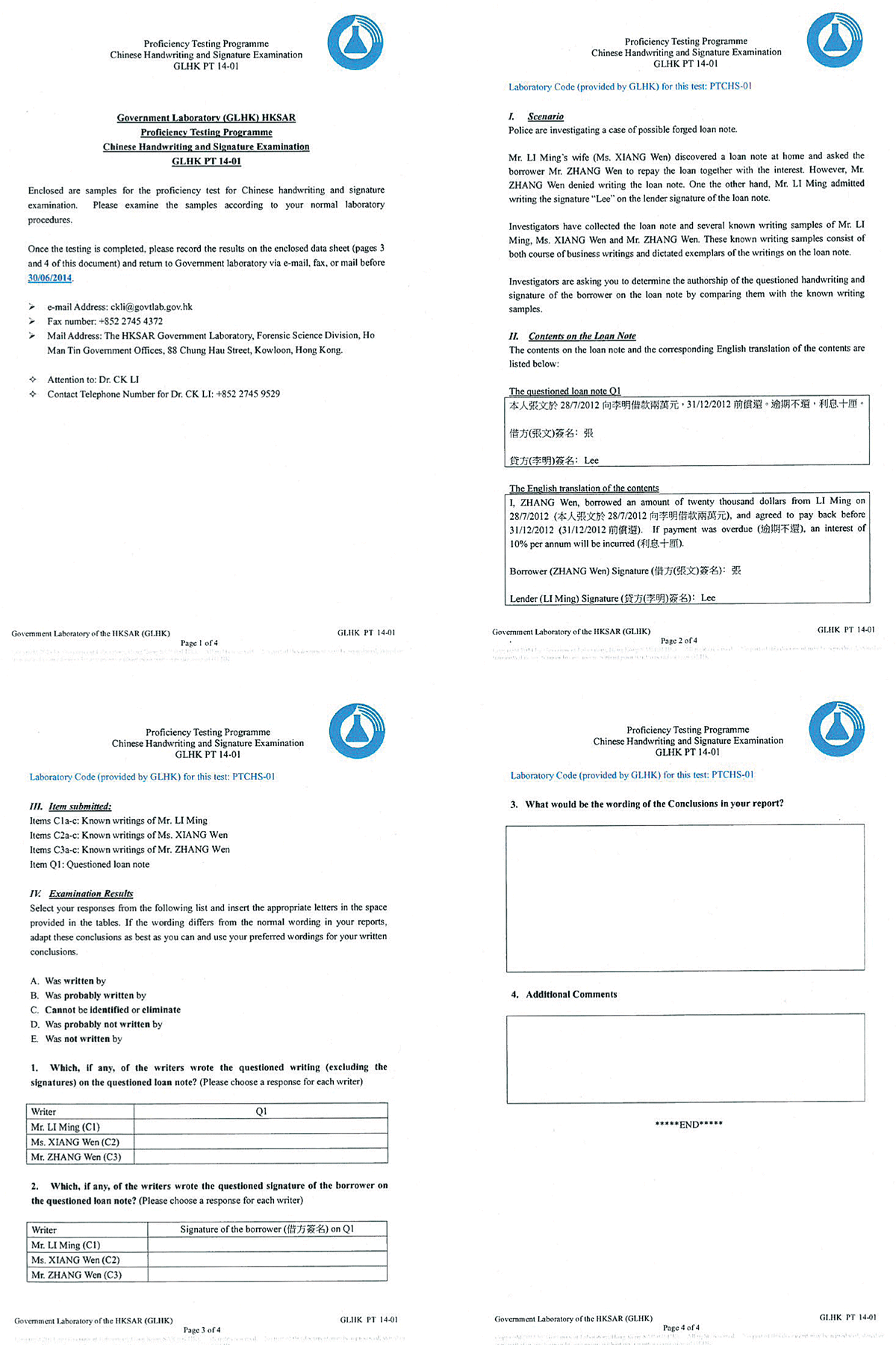
Figure 4.
The result proforma.
The participants were also requested to provide the wording of the conclusion and additional comments if any on the result form.
As mentioned in the technical protocol, the performance evaluation would be based upon if the participating laboratories reported correctly which writer wrote (or probably wrote) the questioned handwriting and signature. The performance would be considered as unsatisfactory if the participating laboratories reported incorrect results. For participating laboratories which reported that no conclusive results could be drawn, their performance would be evaluated by their own upon the release of the “answers” in the programme report afterward. For confidentiality reasons, each participating laboratory was assigned with a unique laboratory code and the laboratory codes were used throughout the programme report.
Results and discussion
A total of 23 forensic laboratories registered for the programme and 19 of them returned their examination results before the submission deadline. Among the registered laboratories, 11 and 5 came from North America and Europe respectively, 1 from Africa and the rest from Southeast Asia, Australia and New Zealand. As noticed, all except one of the registered laboratories came from countries where Chinese is not used as an official language. 18 laboratories were accredited with either ISO 17025 or ASCLD international programme; 16 examiners involved in the programme have more than 15 years of experience. 21 examiners did not know Chinese but 6 of them had experience in handling cases relating Chinese handwriting examination.
Results on the authorship of the main content of the loan note and the signature of borrower reported by the 19 participating laboratories were all satisfactory. 10 participating laboratories offered a definite opinion [was written by ZHENG Wen (C3)] and 9 offered a qualified opinion [was probably written by ZHENG Wen (C3)].
For the authorship of the additional terms of the loan “ ”, results of 15 participating laboratories were satisfactory where 8 participating laboratories offered a definite opinion [was written by XIANG Wen (C2)],7 offered a qualified opinion [was probably written by XIANG Wen (C2)] and 3 reported inconclusive results, while only one gave an unsatisfactory result [was written by ZHENG WEN (C3)].
Participants in this test may have faced the challenge that they were unfamiliar with Chinese language and characters. A number of publications suggests that the use of a translator conversant with the language might prove useful to the examiners10, 11, 12. To facilitate the examination, the English translation of the contents on the loan note and sufficient control specimens for like-with-like comparison were provided in this proficiency testing programme.
The overall performance of the participating laboratories was considered satisfactory. The principles of identification and elimination of authorship described in various textbooks on the examination of English handwriting may also apply in Chinese handwriting examination.
For further improvement and reference purposes, a questionnaire was attached with the final report to collect feedback and comments from the participating laboratories about this programme. Among the returns received, quite a number indicated that the programme was very useful and relevant to their existing work. Also, 80% of the responding participating laboratories recommended that similar proficiency testing programmes be continued. Nevertheless, as remarked by some of the participating laboratories, unfamiliarity with the Chinese language was the major limitation for the examiners. To tackle this problem, one of the participating laboratories mentioned that a Chinese translator was needed to assist in preparing the examination to ensure that the examiner was comparing similar words. Regarding the approaches or methodologies used, the participating laboratories reported that the examination was mainly conducted through observing similarities noted in respect of stroke fluency, spontaneity in stroke operation and formation of characters when comparing the handwriting characteristics between the loan note and control specimens. For achieving more definitive findings, however, a number of participating laboratories suggested that original documents be available for examination in the next round of the programme. This is to allow the use of other supplementary techniques such as video spectral comparator (VSC) or electrostatic detection apparatus (ESDA) for the analysis of inks and indentations respectively. Of course, it may then take a much longer time to complete for a round robin proficiency testing programme as per the suggestion, given the number of participants. Last but not least, one participating laboratory suggested it might be of interest to provide lay persons with the same test so as to demonstrate if the level of expertise would matter in the examination of Chinese handwriting. Certainly, this would help support the scientific validity of Chinese handwriting examination in particular, as in the case for English handwriting examination where a great number of similar studies have been conducted in the past decades.
Conclusion
To conclude this proficiency testing programme, the authors would like to quote the feedback from one of the participating laboratories as follows: “This programme clearly assisted in revealing that uniqueness does exist in handwriting no matter what the written language is. It likewise helped to realize that properly trained forensic document examiners, applying sound scientific principles and methodologies of handwriting identification, can and should arrive at the proper conclusion given proper standards for which to conduct an examination. The above conclusion rightly emphasized the importance of proper training and methodologies in this particular area of testing as revealed by the outcome of this programme.”
The authors’ laboratory has made continuous efforts in introducing the methodology and principle of Chinese handwriting and signature analysis to overseas documents examiners through publications3, 7, 9 and organizing Chinese handwriting workshops at international conferences and seminars[13. We understand that this proficiency test alone may not allow participants to demonstrate their complete technical competence, especially if they are unfamiliar with the language. It is in hope that this proficiency test could provide an analytical and discussion platform for participants in the field of document examination. Furthermore, though this was the first attempt of its kind, the encouraging outcome obtained should be able to support the interest of other proficiency testing schemes providers to organize similar programmes in the near future.
Acknowledgements
The authors would like to thank our Government Chemist, Dr. Chau-ming Lau for his encouragement and full support in the proficiency testing programme; and thank all participating laboratories for their interest and comments made to our programme.