
Introduction
Stamp and stamp impression examinations are routinely carried out by document examiners at the Government Laboratory of Hong Kong. The examination of stamp impressions can be an important element in determining the authenticity of a questioned document. Impressions from immigration, commercial company and nonprofit organization stamps are a few common examples of evidential exhibits submitted for forensic examination. Materials used to produce stamps vary in both type and quality. The quality of stamp impressions may be affected by a number of factors such as ink quality and dispersion, pressure and angle of impact, characteristics of the material/substrate receiving the impression, the supporting surface, and the absorbency of the stamp.
Of the different types of stamps available, preinked stamps are the most common type submitted for examination in stamp related casework in our laboratory. In a pre-inked stamp, the ink is integrated into the text plate, eliminating the need for the separate ink pad required when using traditional rubber stamps. Most pre-inked stamps contain a large ink reservoir that can produce up to a thousand stamp impressions from the one stamp. Note that it is also possible to re-ink the text plate.
Most pre-inked stamps are produced from photopolymer, which involves a number of steps in the manufacturing process (Kelly, 2002). Each step in the manufacturing process has the potential to introduce defects onto the stamp face (Seiden, 1998). In addition to manufacturing defects, other kinds of defects can be introduced through wear, tear, and use of the stamp, with the most common being physical damage and dirt adhesion (Herkt, 1985). Defects caused by wear, tear, and usage are dependent on such factors as the age of the stamp, the frequency with which it is used, and the number of people using it. Since these factors are unique to a particular stamp, so is the damage that they can cause. It is the accumulation of these unique defects that makes a definite identification of a stamp possible (Casey, 1978).
While identifying unique defects is a vital factor in stamp identification, there are a number of other factors that should also be considered. These factors include temperature, humidity, duplicate stamps, smudging, and re-inking. Each of these factors, their significance, and the limitations they place on conclusions in stamp identification are discussed in this article.
Methods and Materials
Stamps
A total of eight stamps were manufactured for the purpose of this study. Figures 1 and 2 show the stamp impressions of the eight stamps. Stamps 1a–1f were manufactured by Company A, while Stamps 2a and 2b were manufactured by Company B. Stamps 1a–1c were manufactured using the same image template.
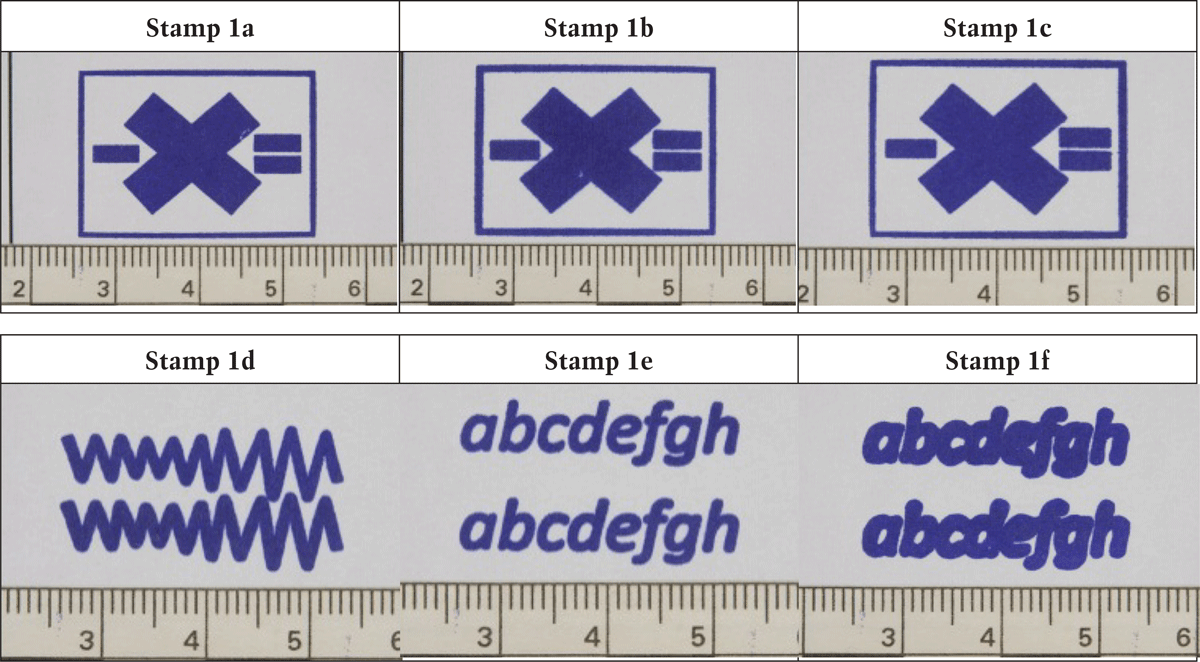
Figure 1
Stamps manufactured by Company A.
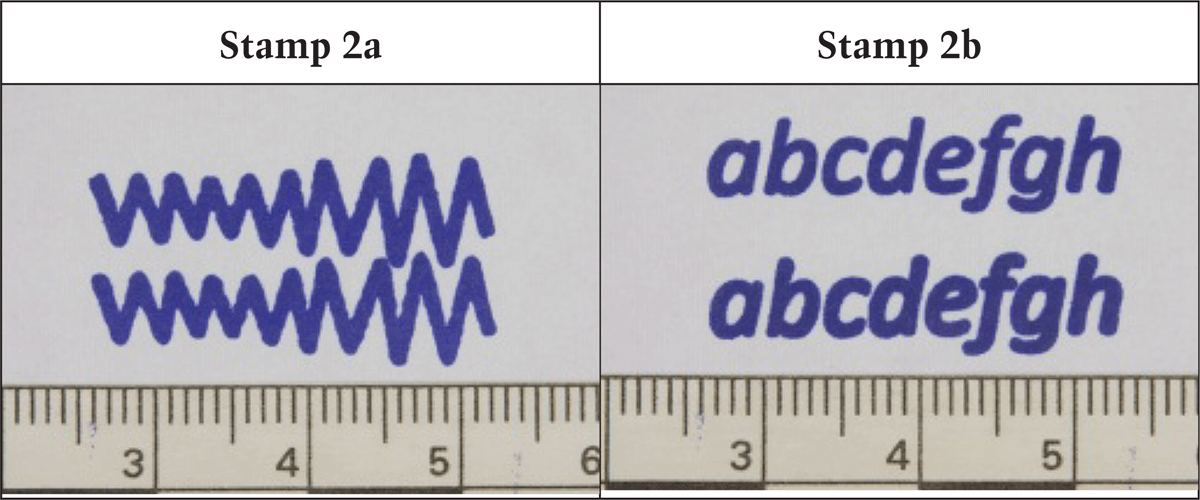
Figure 2
Stamps manufactured by Company B.
Ambient Environment
Stamp 1a was used to study the changes in the size of the stamp face upon usage under ambient environmental conditions. Stamp 1a was kept at room temperature (around 25°C and 65% relative humidity). On average 240 impressions were made each day until the ink in the stamp had depleted. In total, 8700 impressions were prepared for this study. The size of the stamp impressions was measured using the Annotation + Measurements function of the Video Spectral Comparator (VSC) 6000 (manufactured by Foster + Freeman).
Temperature Effect
Stamp 1b was used to study the changes in the size of the stamp face under a higher temperature. Stamp 1b was kept at room temperature when it was not used. Before use, Stamp 1b was placed firstly in a humidity chamber (around 50°C and 65% relative humidity) for 2 hours and then returned to room temperature to cool down for 1 hour prior to the impressions being made. This cycle was repeated two times a day with 120 impressions produced each time until the ink had depleted. A total of 6000 impressions were prepared. The size of the stamp impressions was measured using the VSC6000.
Humidity Effect
Stamp 1c was used to study the change in the size of the stamp face under high humidity. Stamp 1c was kept in a humidity chamber at around 30°C and 90% relative humidity (Note: the temperature of the humidity chamber could not be adjusted below 30°C). On average 240 impressions were made each day in two sittings of 120 impressions at a time until the ink had depleted. A total of 8100 impressions were prepared. The size of the stamp impressions was measured using the VSC6000.
Re-inking
The depleted Stamp 1c was re-inked by soaking it in an ink reservoir for 24 hours. The stamp was then left to stand at an ambient temperature until the ink ceased to leak from the stamp. The re-inked stamp (Stamp 1c) was then used to make stamp impressions until the size of the stamp was restored back to its initial size. On average 240 impressions were made each day (in two sittings of 120 impressions at a time) until the ink had depleted, with a total of 4500 impressions being prepared. The size of the stamp impressions was measured using the VSC6000.
Exposure to Sunlight
To determine the effects of exposing the stamp impressions to sunlight, five impressions were placed next to a window and five impressions were placed in a cabinet. Note all impressions were produced using Stamp 1a. The colour of the two groups of impressions was recorded by taking images under normal light using the VSC6000.
Duplicate Stamps
To determine if there were any differences between stamps produced using the same template, two examinations were undertaken. Firstly, impressions were compared using stamps that had been produced by stamps manufactured by the same company using the same template. The stamps used to produce these impressions were Stamps 1a-1c.
In the second examination, impressions were compared using stamps that had been produced using the same template, but from different manufacturers. Here Stamp 1d and Stamp 1e were manufactured by Company A and Stamps 2a and 2b by Company B. Please refer to Figures 1 and 2 for a pictorial description.
The comparison of the impressions was performed using image superimposition with Adobe Photoshop software. The positions of the two superimposed images were manually adjusted so that the best fit alignment was accomplished.
Smudging Effect
A smudged stamp impression was made with the Stamp 2b as shown in Figure 3. The smudged stamp impression was used as a template to manufacture Stamp 1f. The stamp impressions from Stamp 1f were compared with those prepared using Stamp 2b using image superimposition.
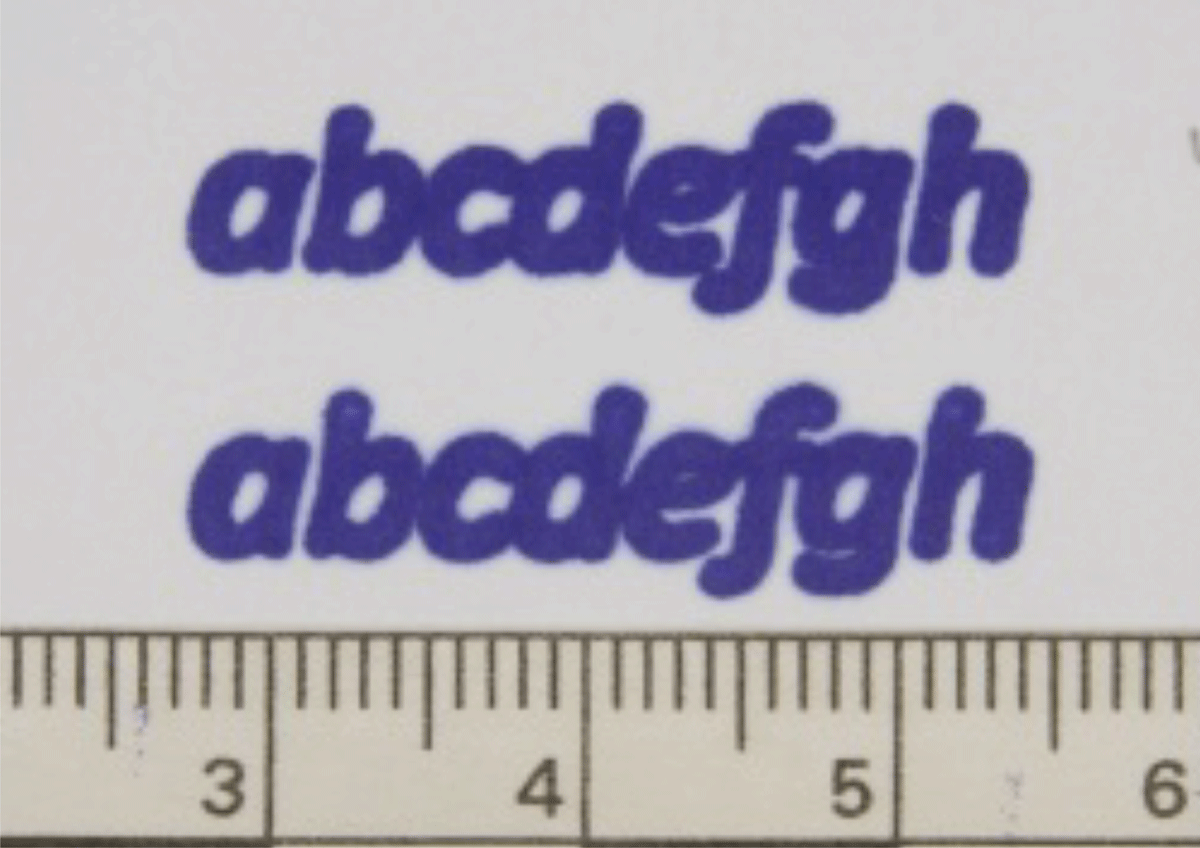
Figure 3
Smudged stamp impression of the Stamp 2b.
Results and Discussion
Ambient Environment
It is commonly known that a pre-inked stamp shrinks with usage. To study the shrinkage rates of pre-inked stamps due to the effects of high temperature and humidity, three pre-inked stamps were manufactured by the same manufacturer using the same template. Initial examinations showed that the three pre-inked stamps were indistinguishable in size, content and relative alignment, and therefore could be regarded as triplicates for the purposes of this study. Images of the stamps are shown in Figure 1 (1a–1c).
The shrinkage was initially examined under ambient environmental conditions (around 25°C and 65% relative humidity). For this particular study Stamp 1a was used and was found to shrink progressively until approximately 8000 stamps were made. The size of the stamp was reduced by approximately 7% (refer to the graph in Figure 4). The color of the impression was also very faint since the stamp had depleted of ink.
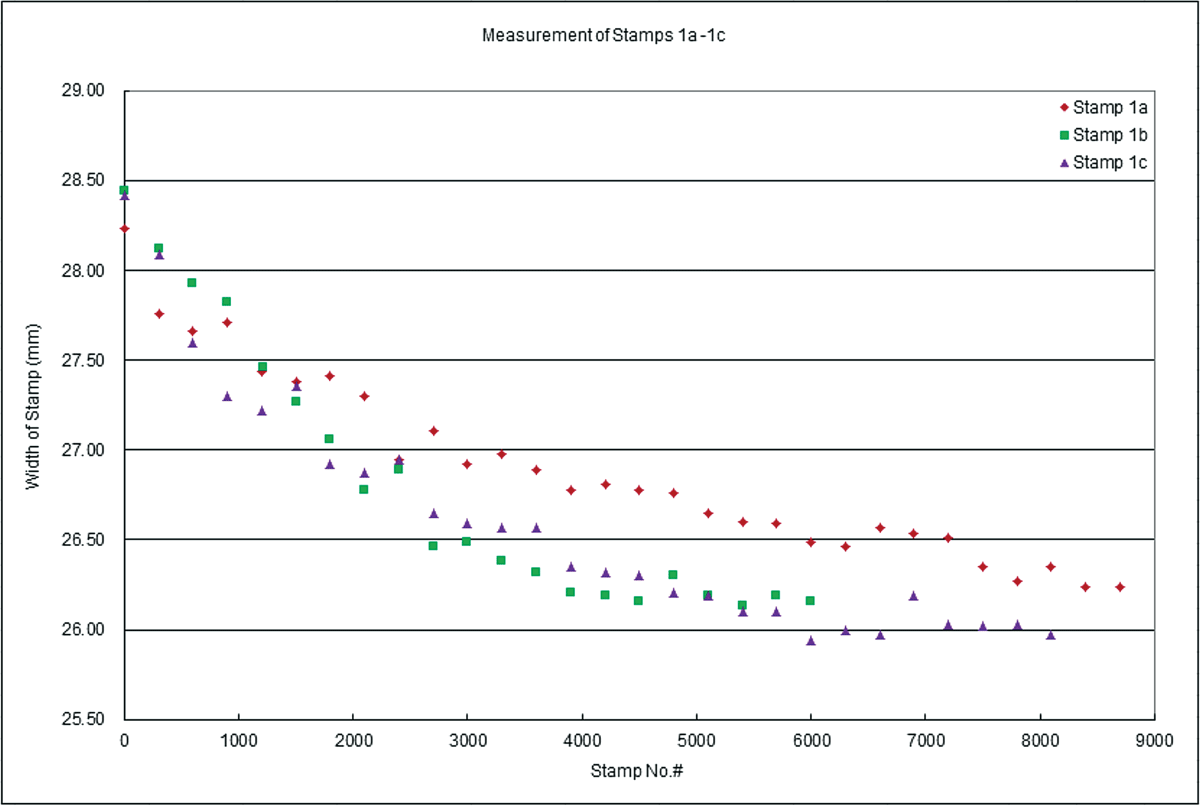
Figure 4
The size of the Stamps 1a, 1b and 1c relative to the number of stamp impressions made.
Temperature Effect
The second study (using Stamp 1b) assessed the effect of high temperature (around 50°C and 65% relative humidity) on the rate of shrinkage of pre-inked stamps. The results showed that the shrinkage occurred more rapidly with the size reducing by 8% after about 4000 impressions (refer to the chart in Figure 4). After the first 4000 impressions were made, the size of the stamp did not shrink further. The color of the stamp impressions was also very faint until a total of 6000 stamp impressions were made from Stamp 1b. This finding shows that an increase in the storage temperature of the pre-inked stamp increases the evaporation rate of the solvent in the pre-inked stamp, and therefore the rate of shrinkage. As a result, the storage condition under which the stamp is kept affects the rate of shrinkage.
Humidity Effect
The effect of high humidity (around 30°C and 90% relative humidity) on the rate of shrinkage was studied using Stamp 1c. Here the size of the impression reduced by 8% after approximately 6000 stamp impressions were made (refer to results chart in Figure 4). These results show that the rate of shrinkage increases moderately when the stamp was stored in high humidity. It was noted that due to the high humidity, the ink leakage was observed on the stamp face in the first few days, resulting in some ink loss. Therefore, high humidity can also increase the shrinkage rate of the stamp because the loss of ink increased the rate of the ink depletion. Furthermore, there was also a 5°C increase in temperature (due to the humidity chamber having a minimum temperature of 30°C). This increase in temperature likely also contributed to the rate of shrinkage observed. The results showed that the slight increase in temperature when combined with high humidity had less of an effect on shrinkage than storing the stamp in higher temperatures.
Re-inking
Stamp 1c was re-inked and the re-expansion recorded as 4.9%. The re-inked stamp was then used to make impressions until depleted and the shrinkage rate recorded. Refer to the plotted graph in Figure 5. Ink leakage was observed around the four corners of the stamp frame (not the stamp face). The impressions were also smudged, likely due to the expedite loss of ink when the stamp face touched the paper. After 300 stamp impressions were made, no more ink leakage was observed and the impression size had reduced significantly. After about 3000 stamp impressions were made, the size of the stamp had reverted back to about the same size as it was before reinking. It is noteworthy that the size of the stamp could expand by 4.9% after re-inking.
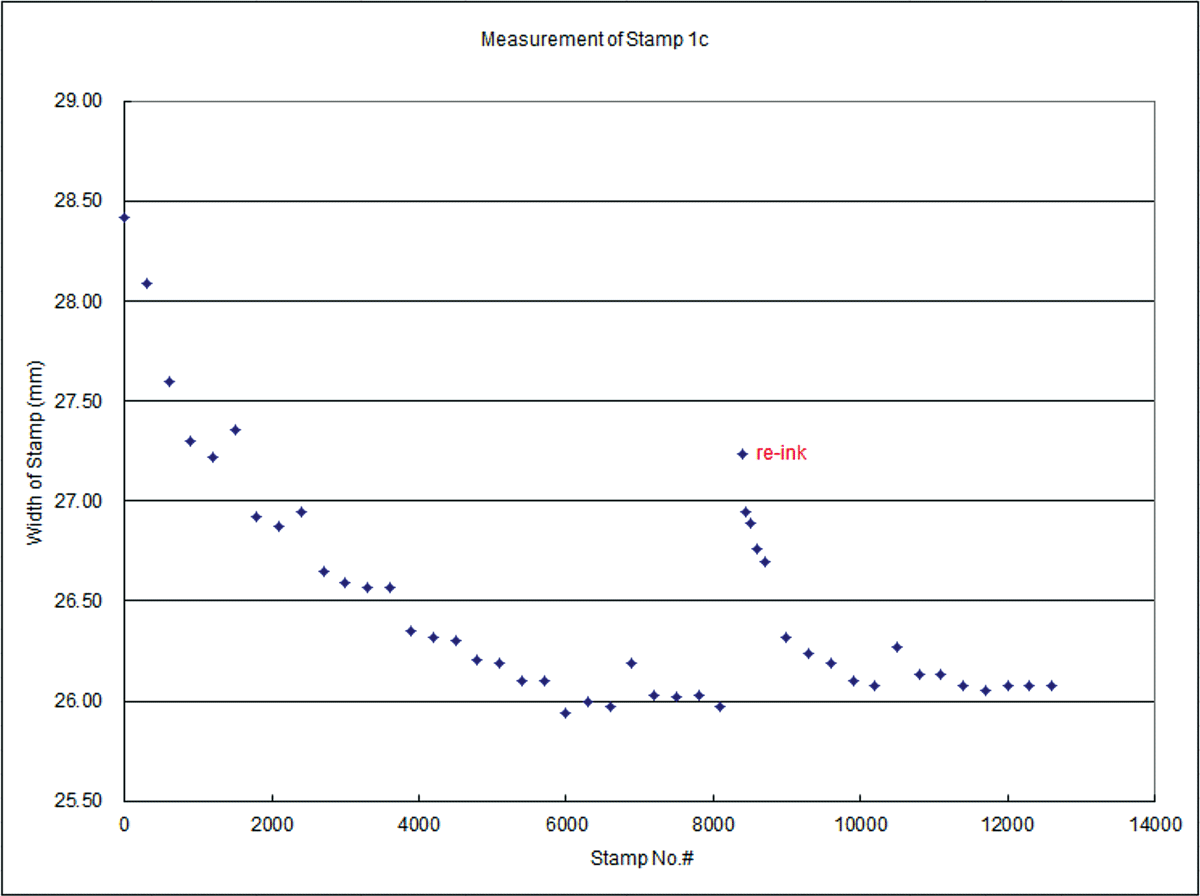
Figure 5
The size of Stamp 1c relative to the number of stamp impressions made after Stamp 1c was re-inked.
Although ink leakage was observed in the experiment, it could be avoided by careful manipulation of the stamp during the stamping process. The four corners could be covered so that the leakage of the ink from a re-inked stamp could be concealed. Even if a stamp was depleted after being used for a long time, the size of the stamp could be restored to close to its original size by re-inking.
A number of questioned stamp impressions may be submitted for a forensic examination to determine if they derived from the same stamp chop. Logically speaking, if a number of stamp impressions were made by the same stamp, those produced later should be smaller in size due to the shrinkage observed in this study. If control stamp impressions on official documents spanning a long period of time are submitted for examination, a shrinkage curve like the one in Figure 4 can be constructed. The approximate dates that the questioned stamp impressions were made can be determined from the shrinkage curve. The defect marks found on the questioned stamps should also be consistent with the defect marks found on the control stamp impressions made in the same period of time. It is similar to ink dating where the age of the ink can be estimated by measuring the ink components that change with age. In a stamp examination, the stamp size changes with its usage.
However, document examiners should take into account the possibility that the size of the stamp impressions may expand after re-inking. Examination of the appearance of the impressions, such as the color of the stamp impressions, can be crucial in determining the possibility of re-inking. Consideration should also be given to the likely increase in wear and tear defects due to prolonged usage of the stamp.
Exposure to Sunlight
Storage conditions also had an effect on the appearance of the stamp impressions. If the page containing the impression was kept out of sunlight (e.g. in a cabinet), very little difference in the coloration of the impression was observed.
However, if the stamp impressions were exposed to sunlight for a period of time, discoloration of the stamp impressions occurred.
Figures 6a and 6b show the appearance of stamp impressions of Stamps 1e and 2b after they were exposed to sunlight for about a month. Compared to the original stamp impressions in Figures 1e and 2b, the color changed from blue to greyish blue or purple. Stamps 1e and 2b were made by two different companies. Figures 7a and 7b show the stamp impressions of Stamp 1a after placed inside a cabinet (left) and exposed to sunlight (right) for about seven months respectively. The entire impression disappeared when exposed to sunlight for eight months and could not be detected by the VSC 6000. Therefore, the color of the impression may not be a useful indicator of stamp usage. An impression made by a fully inked stamp may change from a dark blue color to greyish blue/purple after being exposed to sunlight. However, this greyish blue/purple color is different from the color produced by an ink-depleted stamp which is pale blue.
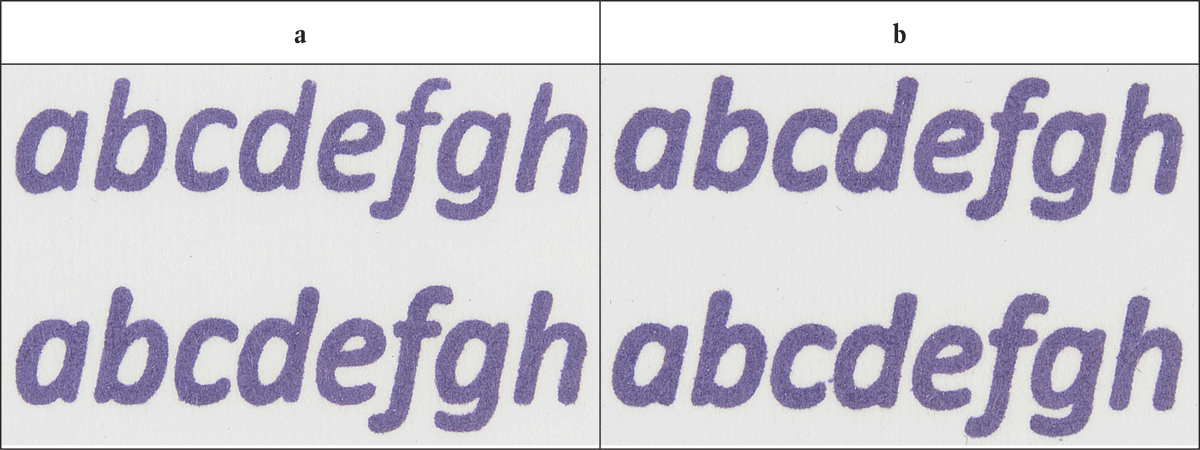
Figure 6
Stamp impressions of (a) the Stamp 1e and (b) the Stamp 2b after being exposed to daylight for about one month
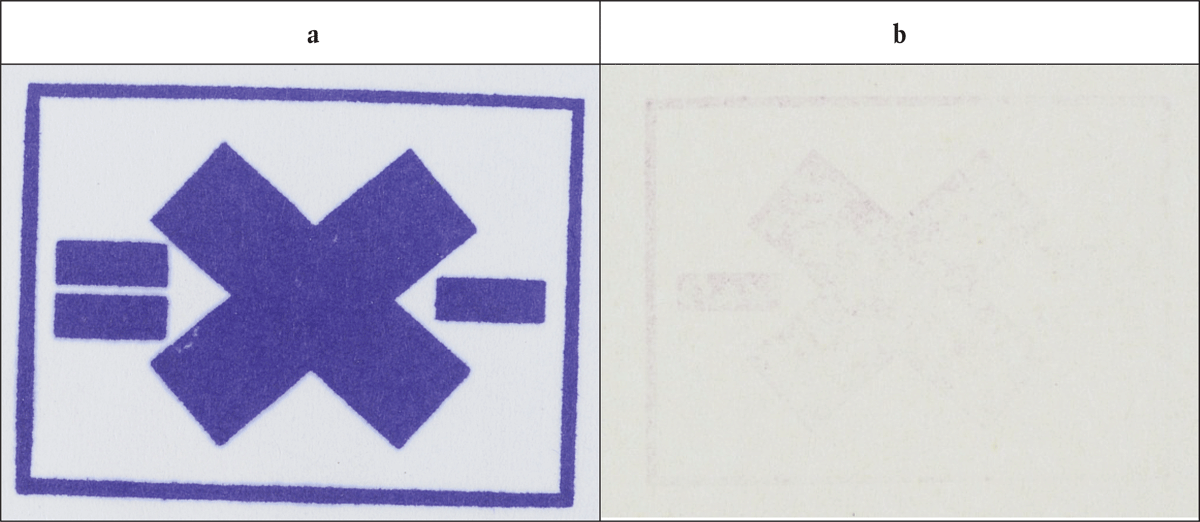
Figure 7
Stamp impressions of Stamp 1a after being (a) placed in a cabinet and (b) exposed to daylight, for about seven months.
A change in the appearance of the ink may be an indicator that the stamp has been re-inked. The refilling ink may be made from different chemical components or optical properties than the one originally used by the manufacturer of the stamp. Analysis of the ink using the VSC under various light sources may also help unveil whether reinking has occurred. Moreover, a difference in the ink components of the two impressions does not necessarily mean that the two impressions were made with different stamps.
The color of the stamp impression could be a misleading factor to judge the source of the stamp. It has also been suggested that a forger may change the color of a stamp so as to conceal the identity of the stamp (Moryan, 2002).
Duplicate stamps
Duplicate stamps manufactured by the same company (i.e., Stamps 1a – 1c) using the same template were not distinguishable from each other by size, content or relative alignment. However, in the case of Stamps 1a and 1b, defects were introduced onto the stamp face during the manufacturing process that could be observed in their stamp impressions. If these defects were not found on Stamps 1a and 1b, the three stamps would have been indistinguishable. Therefore, defects remain the most important factor in stamp identification.
However, if the physical stamps were not made available for examination, a conclusive result would not be possible. If only the impressions of Stamps 1a-1c were submitted for examination, a document examiner would be unlikely able to determine if the defects found on the stamp were: (i) transient defect marks; (ii) due to usage; or (iii) caused during the manufacturing process. Therefore, the availability of the stamp for examination is crucially important for stamp identification.
The possibility that the stamp impression was made with a duplicate of the stamp submitted for examination must always be considered in a stamp comparison examination. The document examiner can only rely on the presence of unique defects to give a definite opinion. The availability of the physical stamp assists the document examiner to draw a definite conclusion.
On the other hand, stamps manufactured by two different companies with the same template may be distinguishable from one another. Figures 1d and 2a show the stamp impressions produced by Company A and Company B respectively. Enlarged images of a section of the stamp impressions from Stamps 1d and 2a are shown in Figure 8. Here differences in the contour of the line edges can be seen, with Stamp 2a displaying a more ragged edge. However, to draw a definite conclusion based on the impressions only is difficult. The document examiner needs to consider the stamping conditions, such as whether the impression was made on an uneven surface, or stamped at a different angle or using a different force. Without knowledge of the stamping conditions, a document examiner is unlikely able to make a determination from an impression alone.
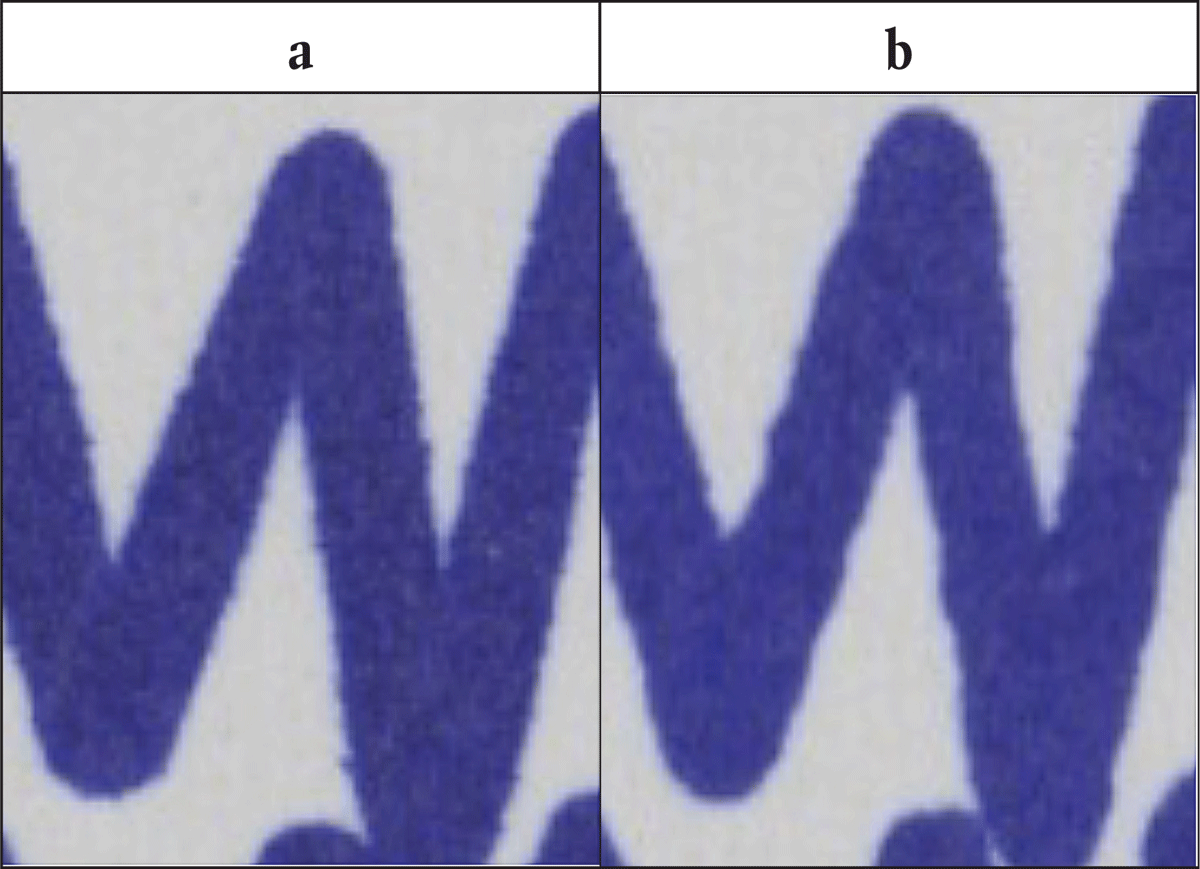
Figure 8
(a) and (b) Enlarged pictures of the Stamps 1d and 2a respectively.
Similarly, Stamps 1e and 2b were manufactured using the same template by two different companies. A superimposition of the two stamp impressions was performed as shown in Figure 9a. A careful examination revealed discrepancies in the lateral size of the two stamp impressions, but not in the vertical size (refer to Figures 9b and 9c). If the red impression was a size-reduced impression of the blue impression, one would question why the vertical size of the red impression was also not reduced. The two impressions (red and blue) did not fit comfortably with each other. Despite the inconsistency in the vertical and lateral reduction found between the two impressions, it is very difficult to draw a definite conclusion as to whether the two impressions were made with the same stamp or using different stamps. Again, this proves that the availability of the stamp for examination remains a crucial factor in determining the source of the impressions.
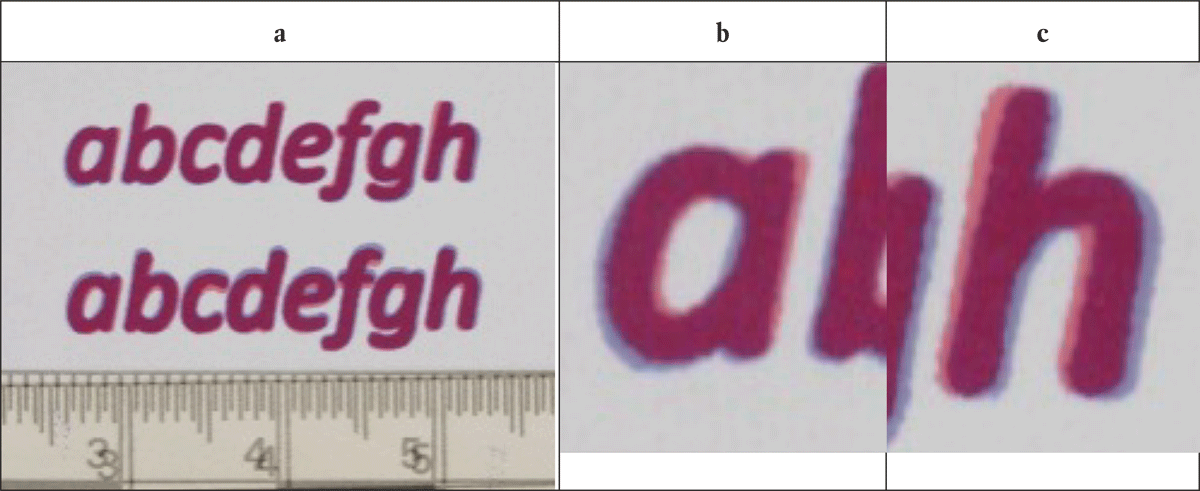
Figure 9
(a) Superimposition of stamp impressions 1e and 2b. (b) Enlarged picture of the lower left corner of the superimposition. (c) Enlarged picture of the upper right corner of the superimposition.
Smudging effect
Figure 3 shows a smudged impression of the Stamp 2b. This impression was used as a template to produce a duplicate stamp by a different company. Figure 1f shows the stamp impression made from the stamp produced from the smudged template. A superimposition of the stamp impressions 2b and 1f is shown in Figure 10. Since smudging masked the distinguishable features of the impressions, it is not possible to tell if the two impressions were made from two different stamps.
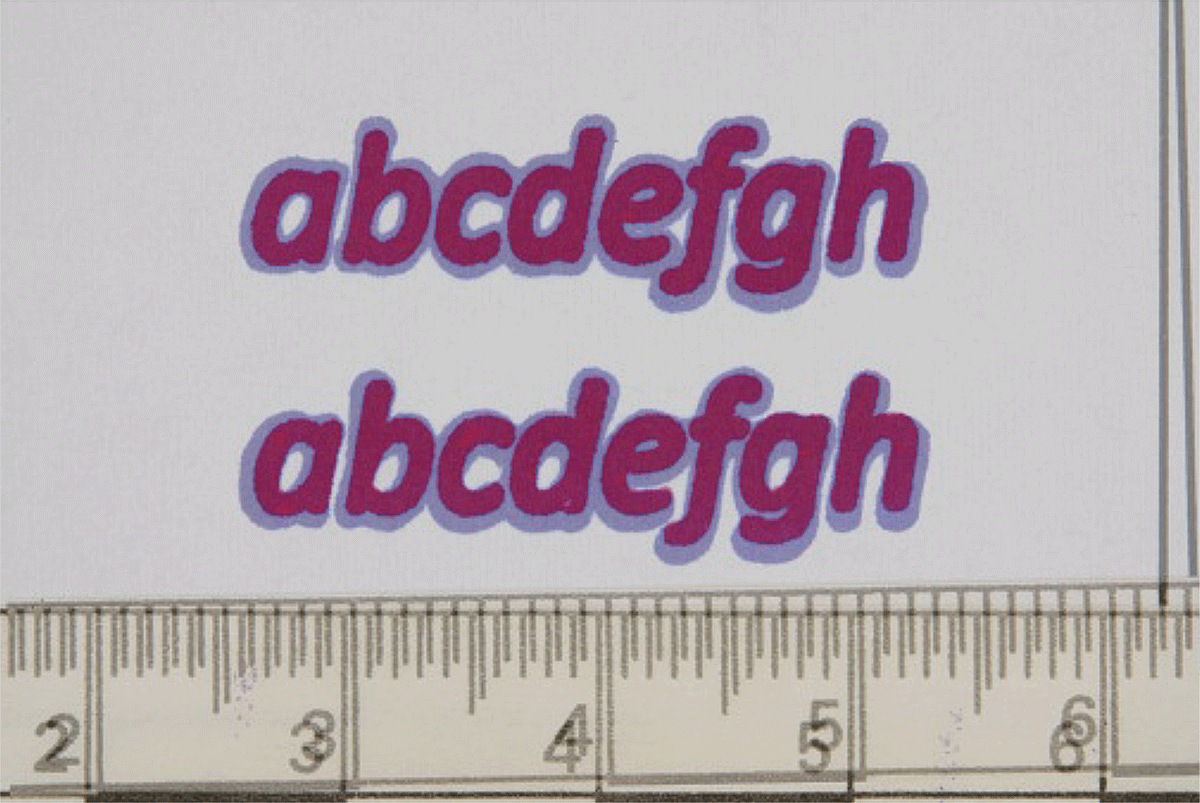
Figure 10
Superimposition of stamp impressions 2b and 1f.
When a smudged impression is submitted for examination, it is almost an impossible task to draw a definite conclusion unless defect marks are found on the impressions. It is noteworthy that the forger can use an impression of a stamp as a template to produce a second stamp. The defect marks present on the template could be introduced onto the second stamp. However, generally the second stamp is of a poorer quality and as a consequence, so is its impressions (Seiden, 1998). The situation becomes even more complicated if the forger retouches the areas containing the defect marks (that is, modifying the template before making the second stamp). The stamp produced from this modified template may bear some, but not all, of the defects present on the impression produced by the original stamp (Levinson & Perelman, 1983). During a stamp examination, document examiners must bear all these possibilities in mind before reaching their conclusions.
Conclusion
When assessing characteristics exhibited in questioned stamps, or their impressions, an examiner should consider the likely causes of any observed defects. The defects should be classified and any limitations to the examination caused by variations in quality and appearance of both the stamps and their impressions noted. For example, if access is not available to the physical stamp in question, the examiner’s capacity to properly assess any features observed will be limited. The presence of limiting factors will render drawing a definite conclusion impossible, and therefore, a qualified or inconclusive opinion can only be offered.
In this paper, the collection of stamp impressions prepared by pre-inked stamps in different storage conditions has provided valuable reference data on the degree and extent of shrinkage of pre-inked stamps under various conditions.
This study found that by increasing the storage temperature the pre-inked stamp will shrink at a faster rate. Humidity, on the other hand, seemed to have no appreciable effect on shrinkage. It was also observed that placing a document in direct sunlight caused the stamp impression to fade gradually over time. After an extended period (approximately eight months) the impression had completely disappeared, leaving no trace, even when examined by the VSC using optical enhancement techniques. Under these conditions, the dating of stamp impressions and hence the identification of the stamp could be affected to varying extents.
With the consideration of stamp shrinkage and re-inking, any appreciable differences in size and color of stamp impressions are not adequate to conclude that two impressions have originated from different stamps, and additional examinations are required. Furthermore, one should always be aware of the possibility of duplicate stamps as well as the smudging effect. It is also important to note that the depletion rate of the ink in the stamp may vary with different material used for the manufacture of the stamp ink.
To conclude, despite the presence of unique defects, the availability of the questioned stamp for examination remains the most important criterion for reaching a definite conclusion when undertaking a stamp comparison examination. Document examiners should make every effort and take precautions to ensure that all variables that could affect the accuracy of their examination are considered before forming opinions and drawing conclusions.
Acknowledgments
The authors wish to thank Dr. CM Lau, the Government Chemist of the Government Laboratory and Dr. FC Kwok, the Assistant Government Chemist of the Government Laboratory for their support and encouragement with this project.