
Reprinted by special permission of Northwestern University School of Law, originally published in American Journal of Police Science, Vol. 1, No. 4 (Jul.-Aug., 1930), pp 339-352.
It is doubtful if there exists another case where the “questioned documents” connected with it have so completely and quickly demonstrated the guilt of the criminals as that of the unbelievably brutal and diabolically clever murder of little Bobby Franks by Richard Loeb and Nathan Leopold.
A brief resumé will bring to mind the more important facts. On the afternoon of May 21, 1924, Bobby Franks was lured from his playground by two youths, driving a car rented specifically for the purpose, who kidnapped and killed him, and thrust his body beneath a culvert some miles from his home.
On the morning following the crime, Mr. Franks, the father of the boy, received through the mails, by special delivery, a typewritten letter, designated the “Ransom Letter” (Figure 1), enclosed in an envelope addressed in pen-printing (Figure 2). The letter informed him that his son had been kidnapped, and that he would be returned unharmed if a certain sum of money were forthcoming at a certain designated place, and at a certain specified time. The “future communication” mentioned in the ransom note was a telephone call in which Mr. Franks was instructed to board a train at a nearby station with the money demanded, where he would find another note giving specific directions for its disposal. (Figure 3.) He was complying with the instructions, actually leaving the house, when word reached him that the body of his son had been found and identified, and was even then at the morgue. The uselessness of further action on his part was apparent, and the “Train Letter” was carried on to New York, where it was found by car cleaners the next day.
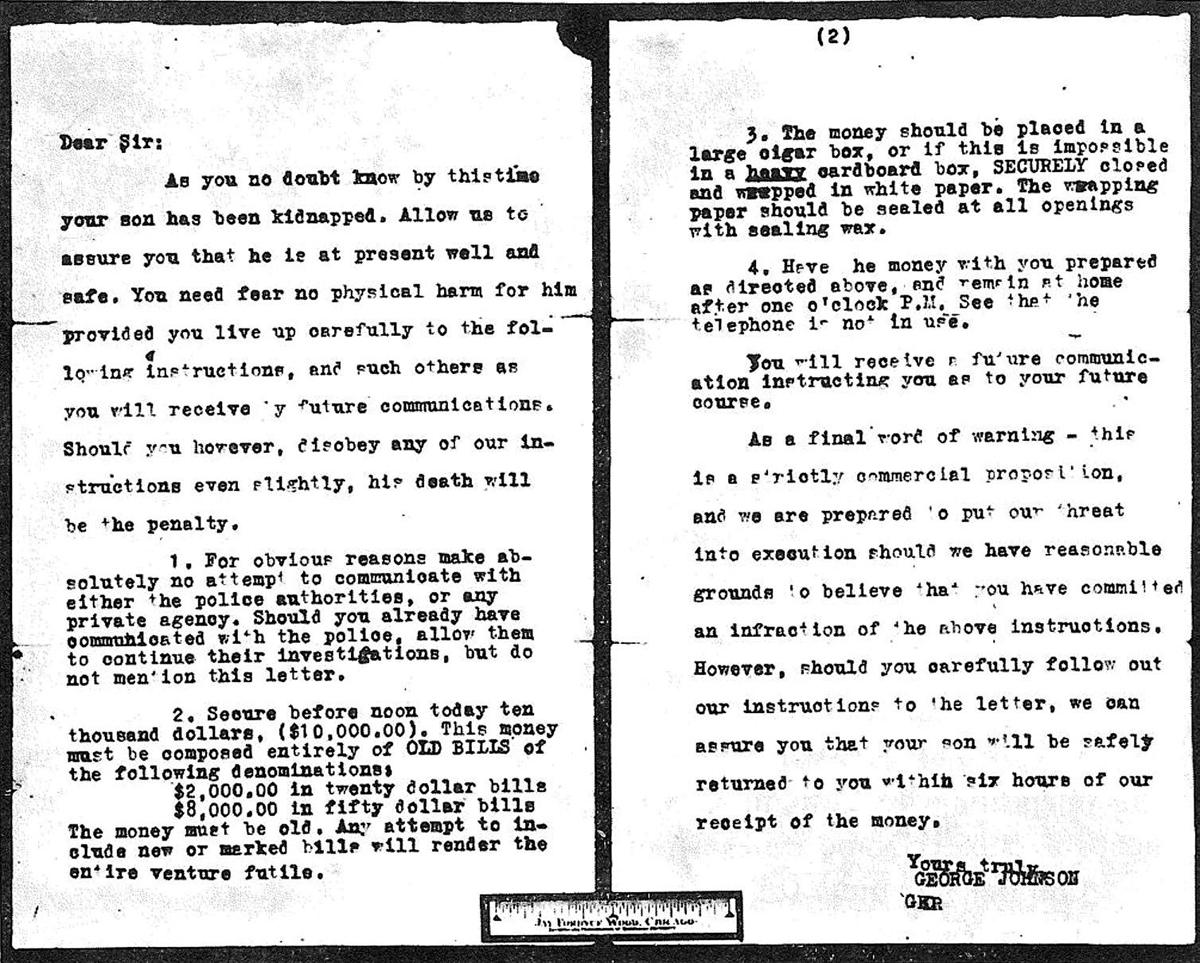
Figure 1
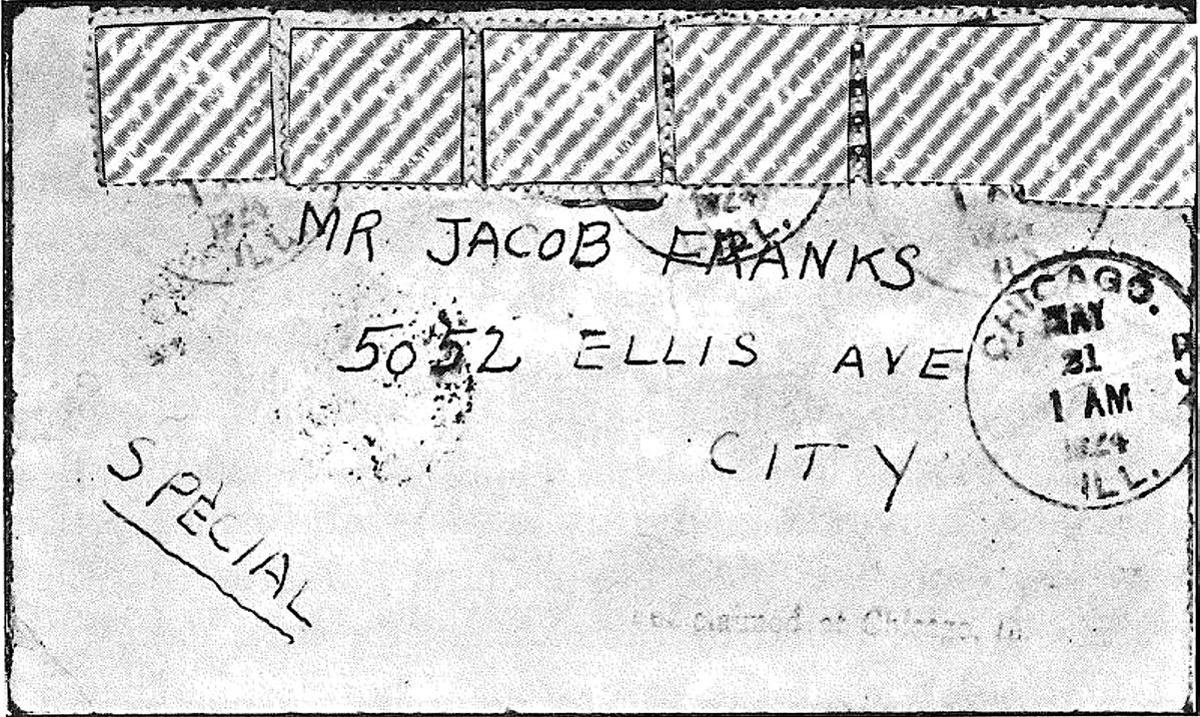
Figure 2
The pen printed envelope which carried the so-called “Ransom Letter” in the famous Leopold and Loeb case. The letter itself was typewritten and prepared some time previous to the killing ; but the uncertainty of the victim to be selected up until practically the moment of the tragedy necessitated an ink or pencil written envelope. This was printed by Leopold within the hour that the body was disposed of.
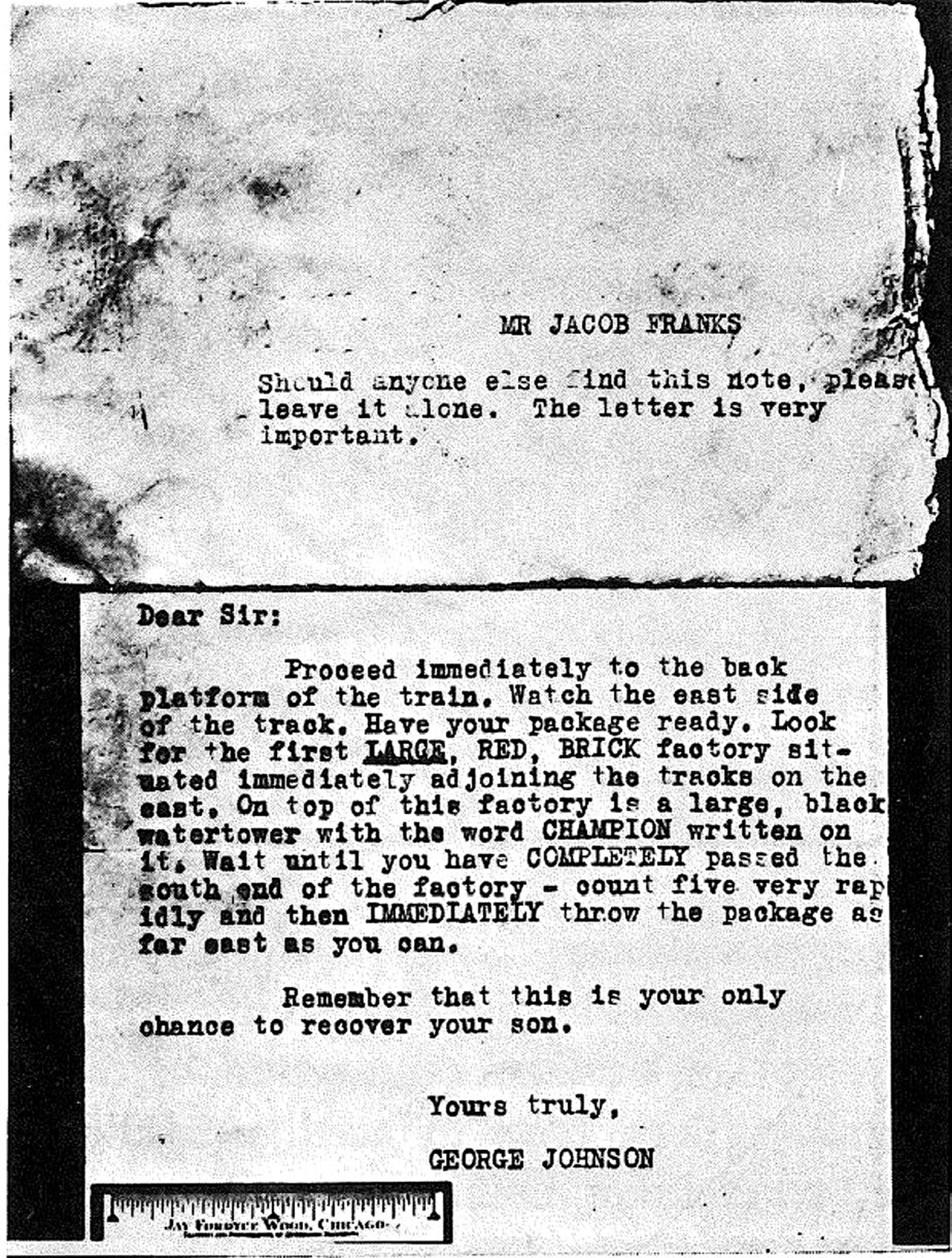
Figure 3
At first solution of the case seemed hopeless. Then a pair of eyeglasses was found in the approximate vicinity of the place where the body was discovered. The glasses had a distinctive patented frame which could come from but a single source in Chicago, and the prescription for the glasses themselves, indicated among others, Nathan Leopold. Although unable to identify the glasses positively, he readily admitted the possibility of their being his, and accounted perfectly for their presence at the place in a statement written and signed by himself, and corroborated by persons whose veracity was beyond all question. (Figure 4.)
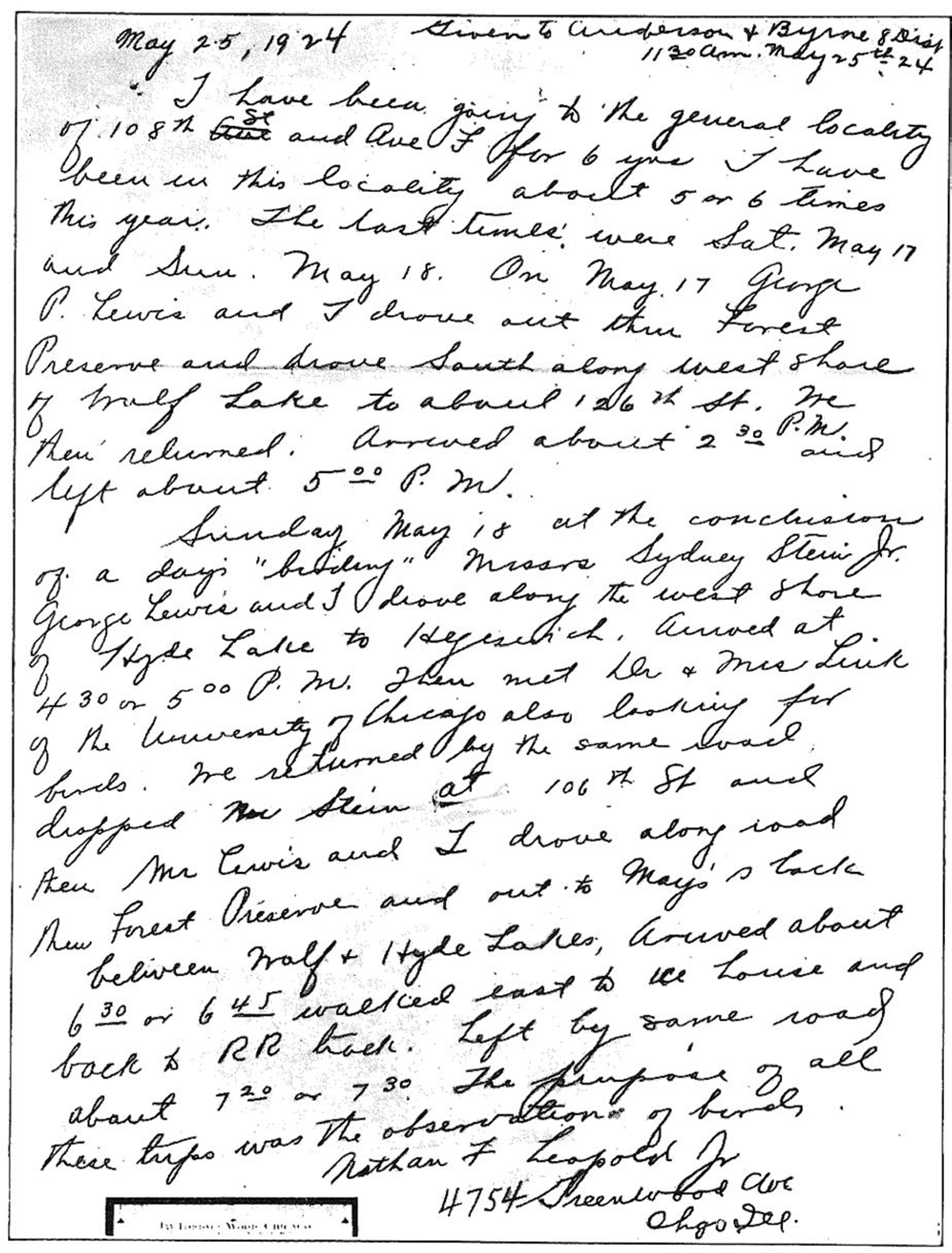
Figure 4
Loeb, in the preliminary stages of the investigation, was not implicated, except through his close association with Leopold generally, and his endeavor to corroborate the alibi offered by his friend. Although the boys were detained for questioning, the case against them on the evidence of the glasses was extremely tenuous, so much so that the State’s Attorney caused the detention to be at a loop hotel and not at the Criminal Courts Building. It seemed utterly unthinkable that two highly educated young men, honor graduates from their respective universities, and sons of respected and millionaire fathers, could be implicated in so fiendish a murder.
The special delivery letter was quickly identified as having been written on one of the early model 3-bank Underwood portable typewriters, and it became apparent at once that if either Leopold or Loeb were to be connected with the crime, one of them must have printed the envelope in which the “Ransom Letter” was delivered, and have had access to an Underwood machine of the type mentioned above. Upon inquiry, both boys evinced a readiness to print the questioned matter, whereupon Loeb was quickly and definitely eliminated as a possible writer, but Leopold was as quickly and definitely identified as, beyond all question, the writer of the envelope. He printed, from dictation, the specially prepared matter shown at Figure 5, and also, all from dictation, the address on the envelope, with extreme rapidity and freedom, approximately 50 times, reproducing each time all the individuality which appears in the address on the questioned envelope. He afterwards stated that while he was perfectly aware that cursive script handwriting could be quite positively identified, he had understood and believed that one’s writing characteristics and individuality were absent in pen printing, and he therefore had had no hesitation in complying with the request to print. But two of the many films illustrating his request printings of the envelope address are here shown, in Figures 6 and 7.
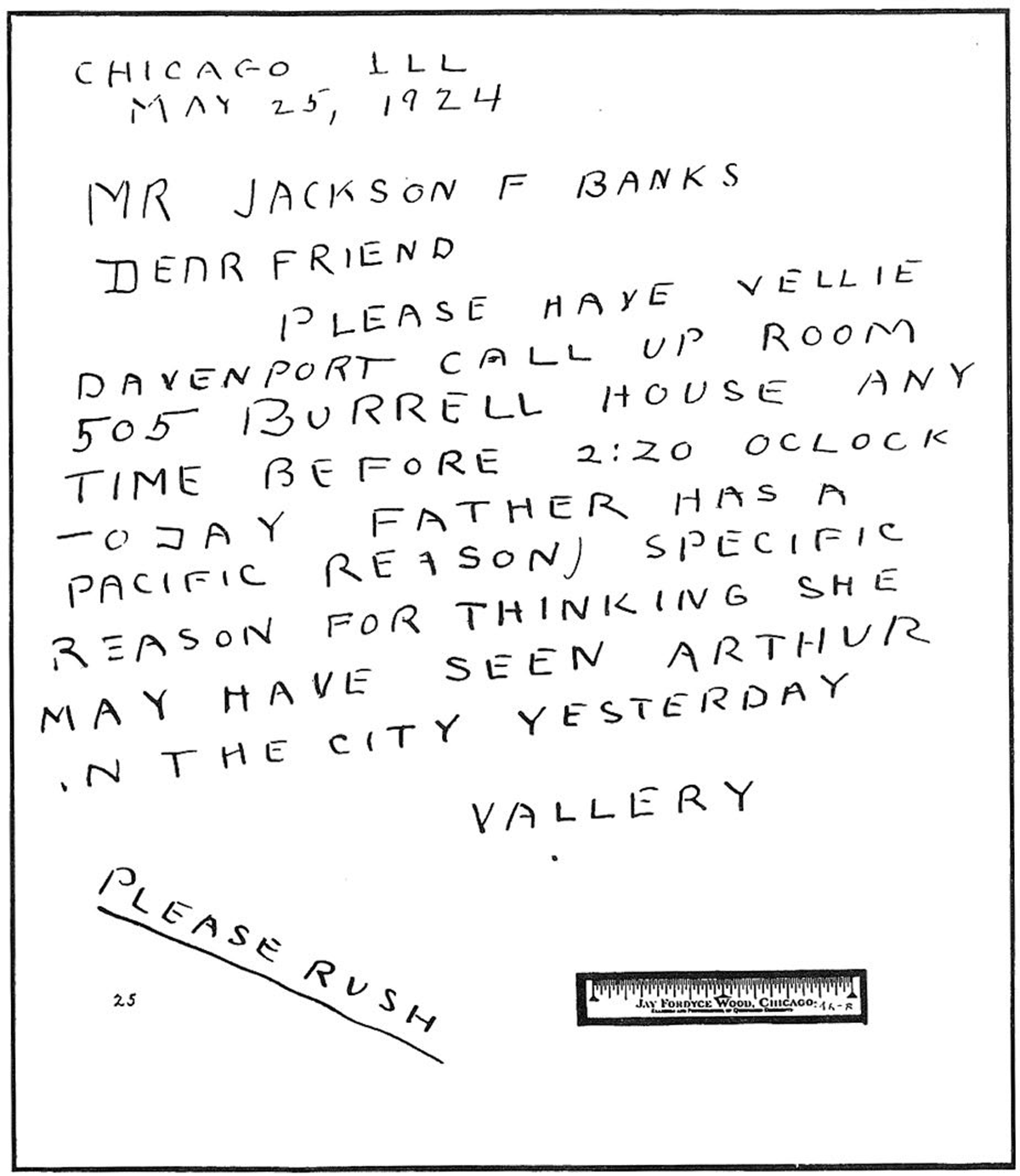
Figure 5
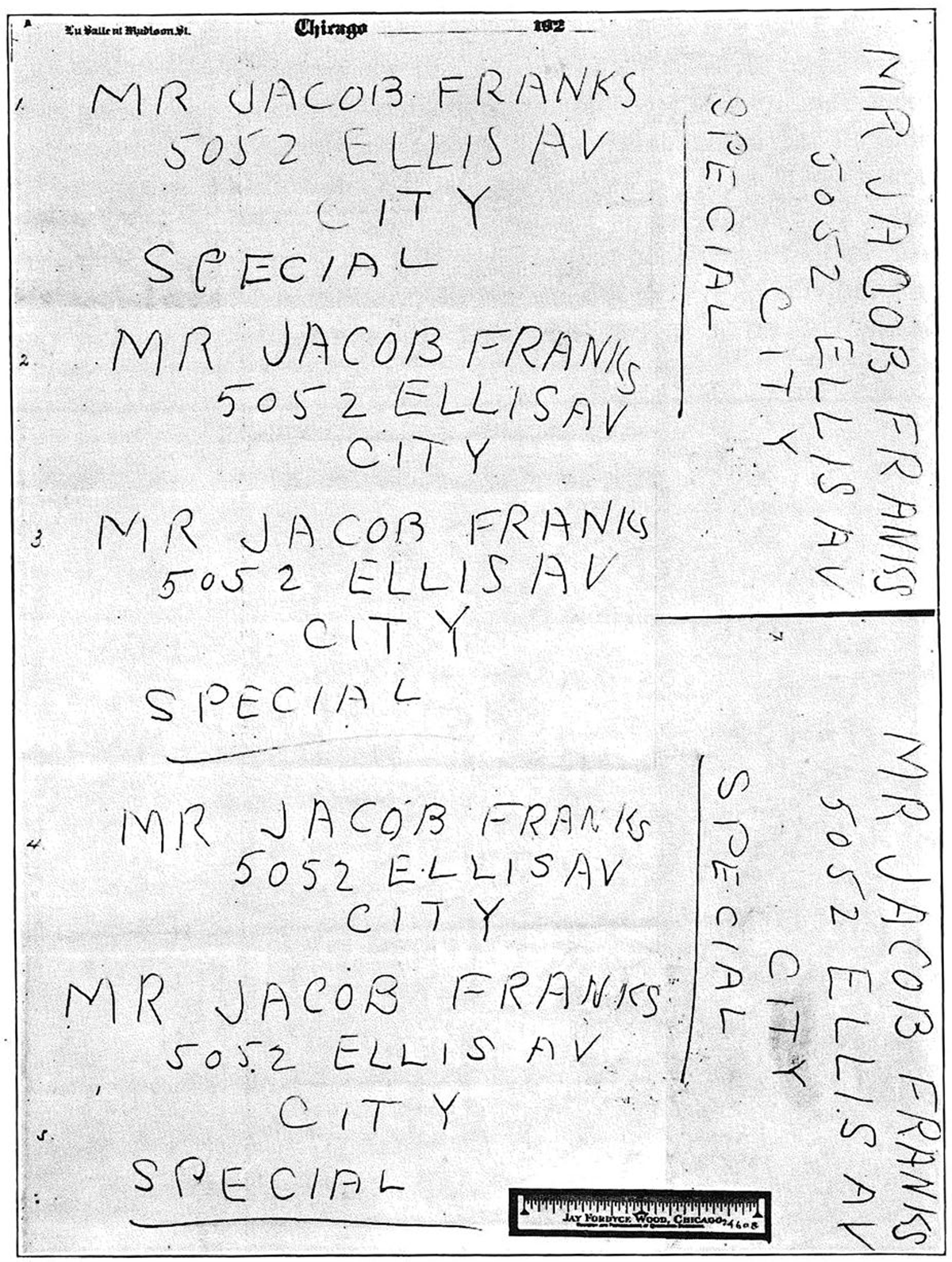
Figure 6
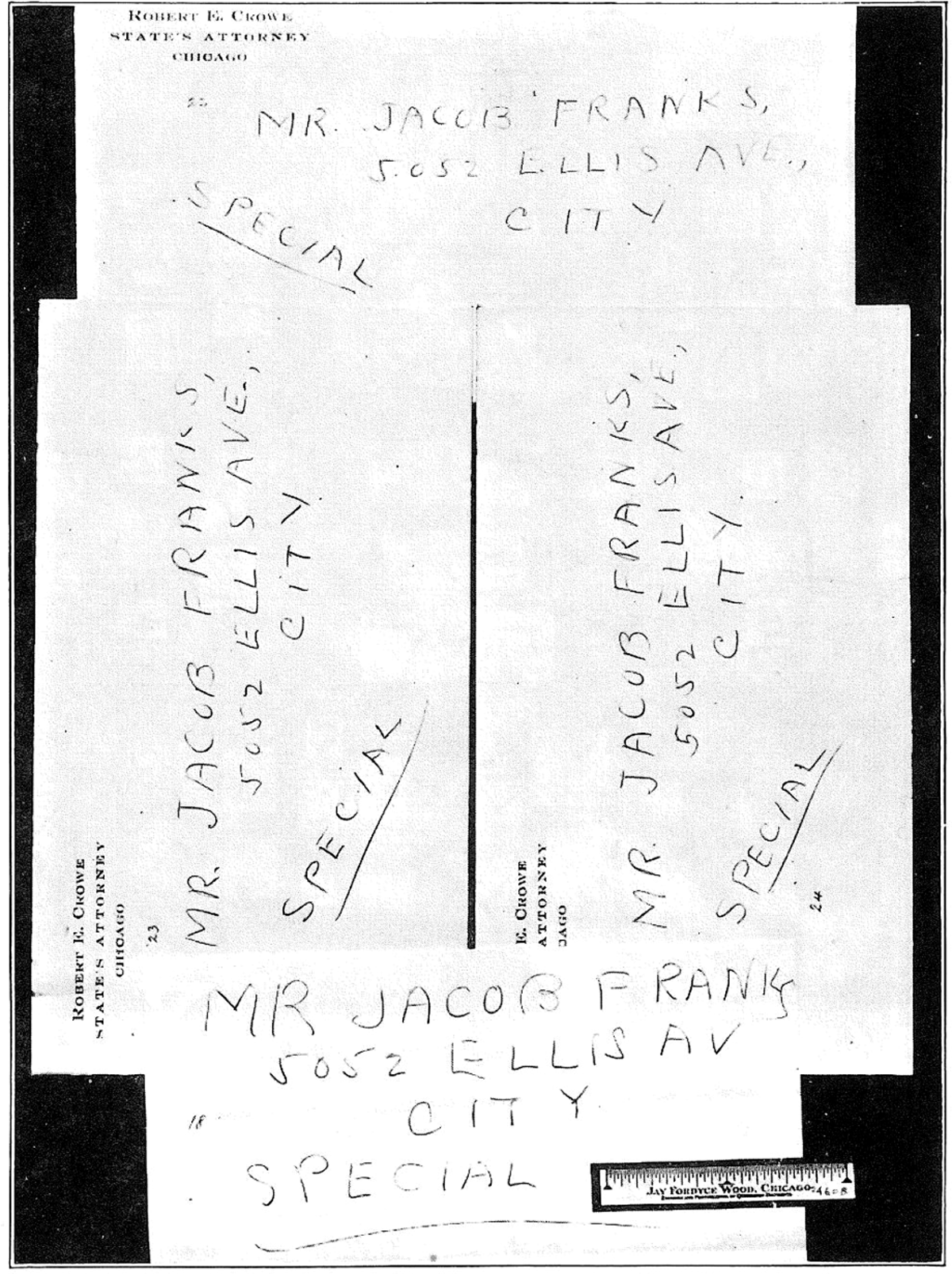
Figure 7
Most of them were printed upon letterheads of the La Salle Hotel, where the boys were preliminarily detained, but a few were done on envelopes furnished for the purpose as shown in Figure 7 as above. In the request printing of the envelopes, note the reproduction, not only of the individual characteristics concerning the letter forms and manner of making, but also the habit of placing the matter abnormally high up on the envelope, the general indentation of the lines, and particularly, the position of the word “Special” across the corner, diagonally, with an underscore. Habit!
Figure 8 shows a cut out print of various letters. The letters shown within the white lined squares or rectangles are cut from a print of the address on the questioned envelope, while the letters surrounding the white-lined squares are cut from prints of the request writing and all are rephotographed to show the writer’s identical divergencies from normal printed forms and his manner of making these.
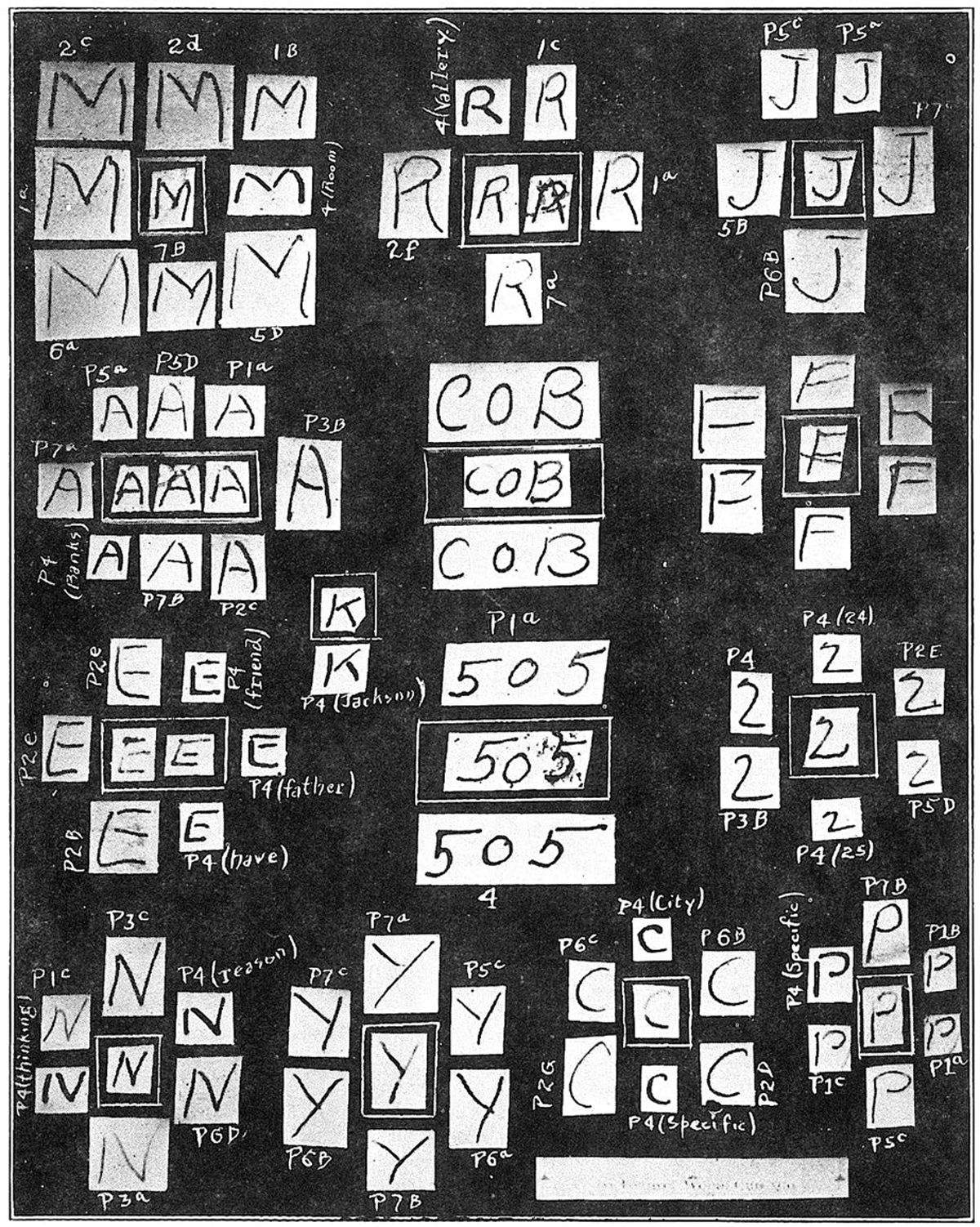
Figure 8
Figure 9 is a cut for comparison of the word “City” as it appears on the questioned envelope, with the request writing. The top line shows the word “City” taken from a print of the questioned envelope, while the lower lines are from his request writing. Note the unique and individual spacing of this word, always repeated, unconsciously, of course, “C it y.”
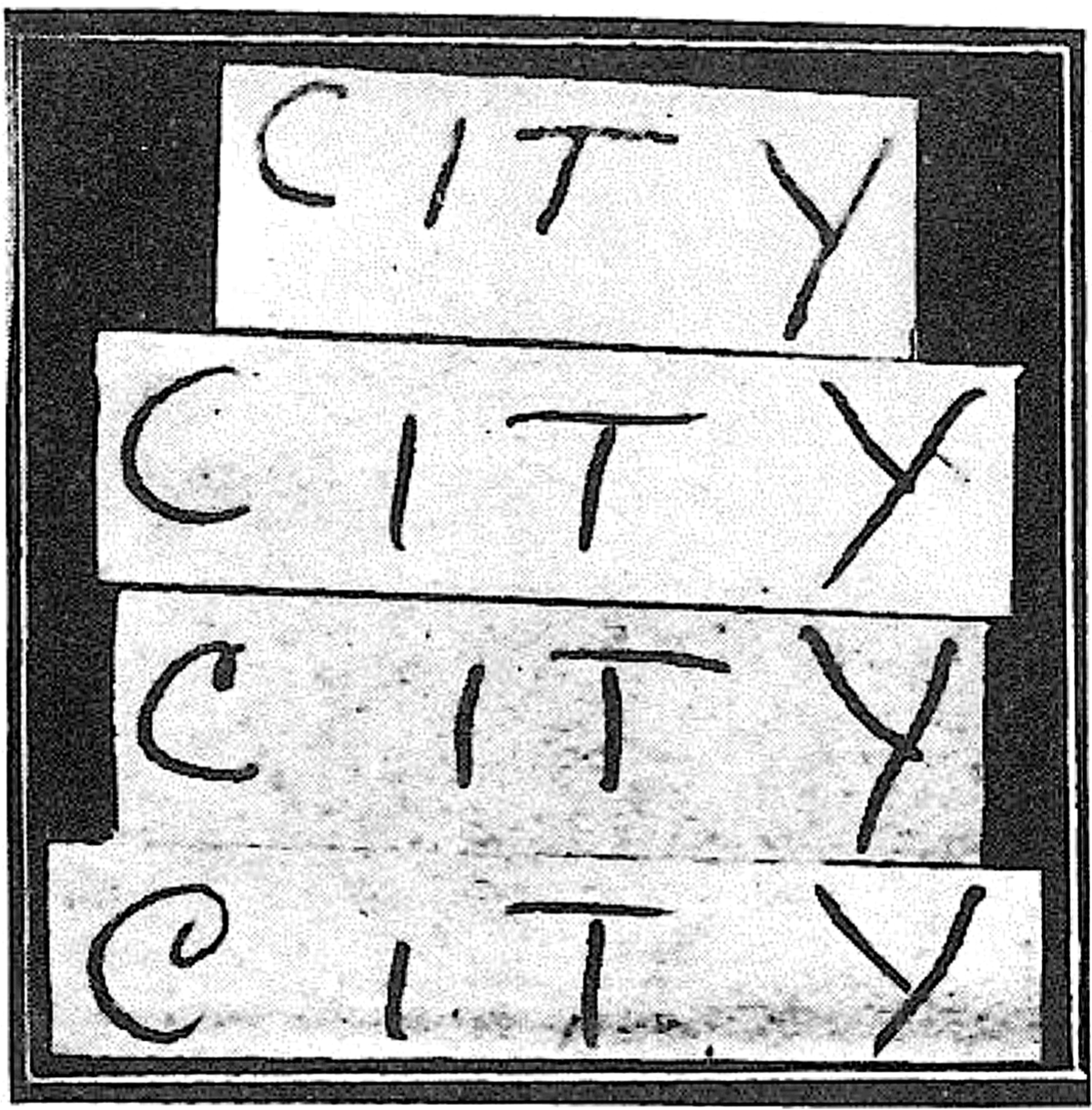
Figure 9
During the preliminary detention of the boys at the La Salle Hotel, another interesting link developed, connecting them with the commission of the crime through the matter of handwriting.
It appears that some two or three weeks prior to the murder, Leopold and Loeb, in order to establish residence for a fictitious individual in whose name the murder car could be rented, and at whom in case of necessity the finger of suspicion could be pointed as the perpetrator of the crime, registered and took a room at the Morrison Hotel under the name of Morton D. Ballard, 202 Elm Street, Peoria, Illinois; and left a suitcase in the room to indicate possession. They did not occupy the room, and after some days the floor maid reported this fact as a matter of routine to the house detective who, on examination, found nothing in the suitcase to identify the owner except a copy of “Madison’s Journal” from the library of the University of Chicago, with its accompanying library card indicating that the last signer for the book was one R. A. Loeb. It was apparently a matter of no consequence, and the suitcase was taken from the room and left at the baggage room of the hotel to be called for. The boys, returning after a few days and finding the suitcase had been removed, became alarmed and immediately left without attempting to identify or reclaim it, and it so remained at the time of their arrest. The house detective, seeing the name of Richard Loeb in the papers as a suspect, recalled the matter of the suitcase, card and book, and immediately reported it to the State’s Attorney as a possible clue. The registration card shown at Figure 10 was produced and it was again apparent, of course, that if it was in any way connected with the boys, one of them must have written it. Each being requested to write the name and address on the card, Leopold quickly eliminated himself as a possibility. The request writing by Loeb is shown at Figure 11. It commences with the slow and evidently intended disguise “Mort-”, but a realization of the futility of such an attempt is followed by the free, fluent reproduction of the entire written matter. Just how constant one’s handwriting characteristics and habits are, is clearly demonstrated by the juxtaposition comparison cut-out print of the words from the card and the request writing as shown at Figure 12.
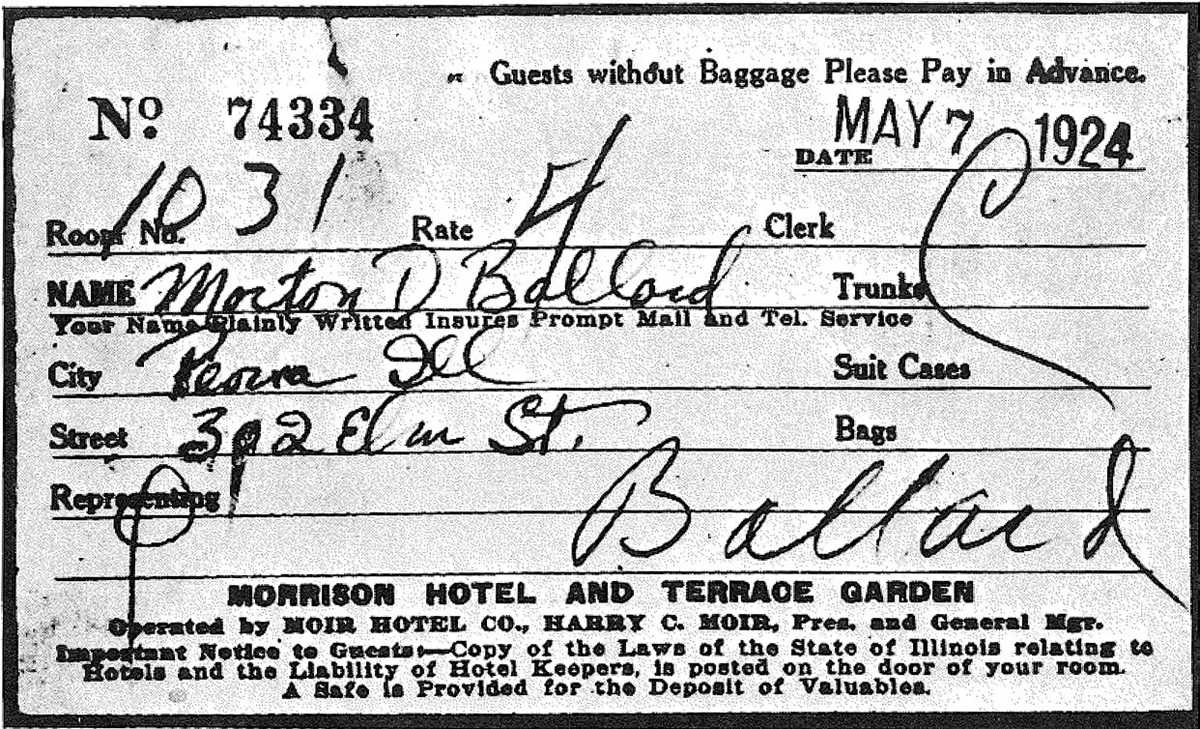
Figure 10
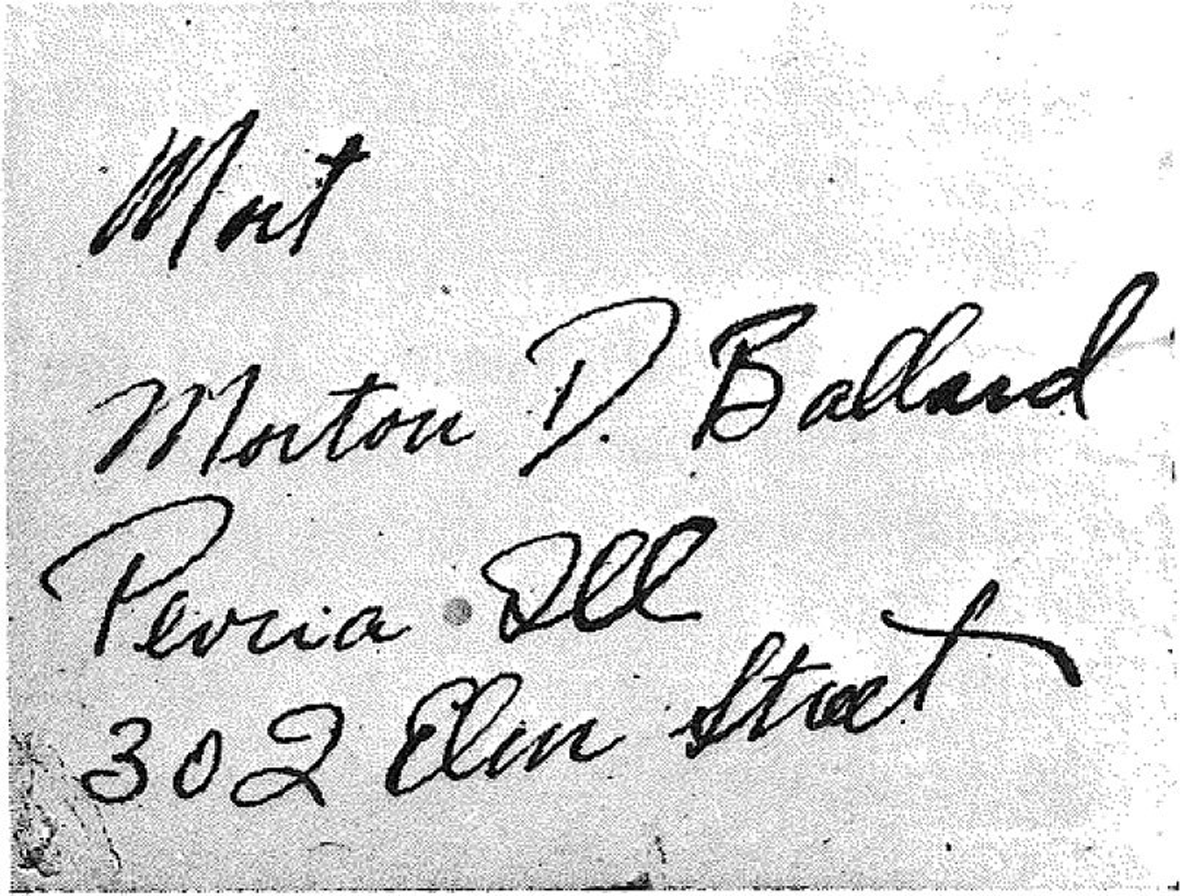
Figure 11
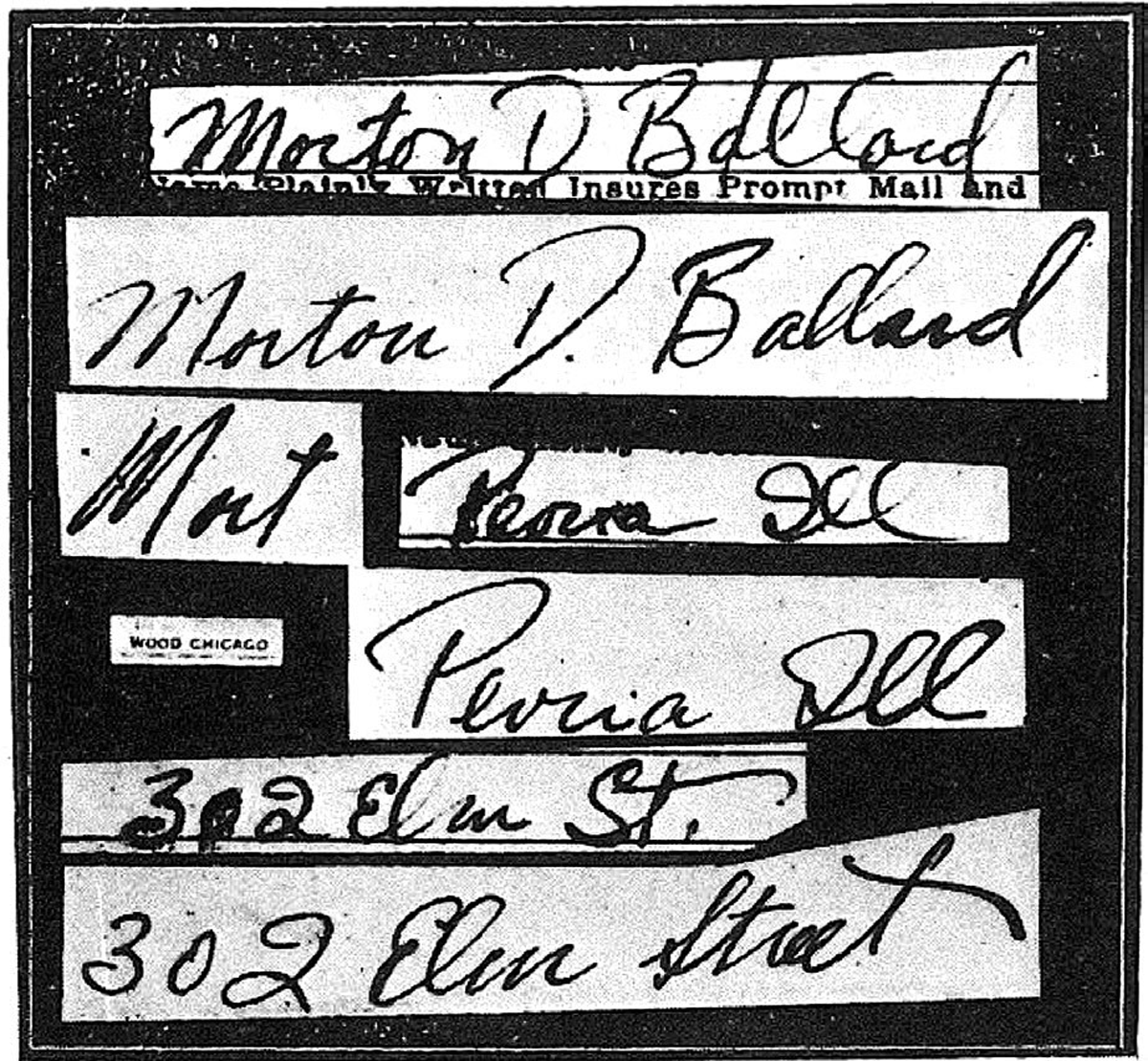
Figure 12
The library slip belonging with the volume of “Madison’s Journal” which led to the discovery of this feature of the proof against them is shown at Figure 13. The three superimposed signatures at the bottom are cut from some of the last checks drawn by Loeb on his account at the Hyde Park State Bank.
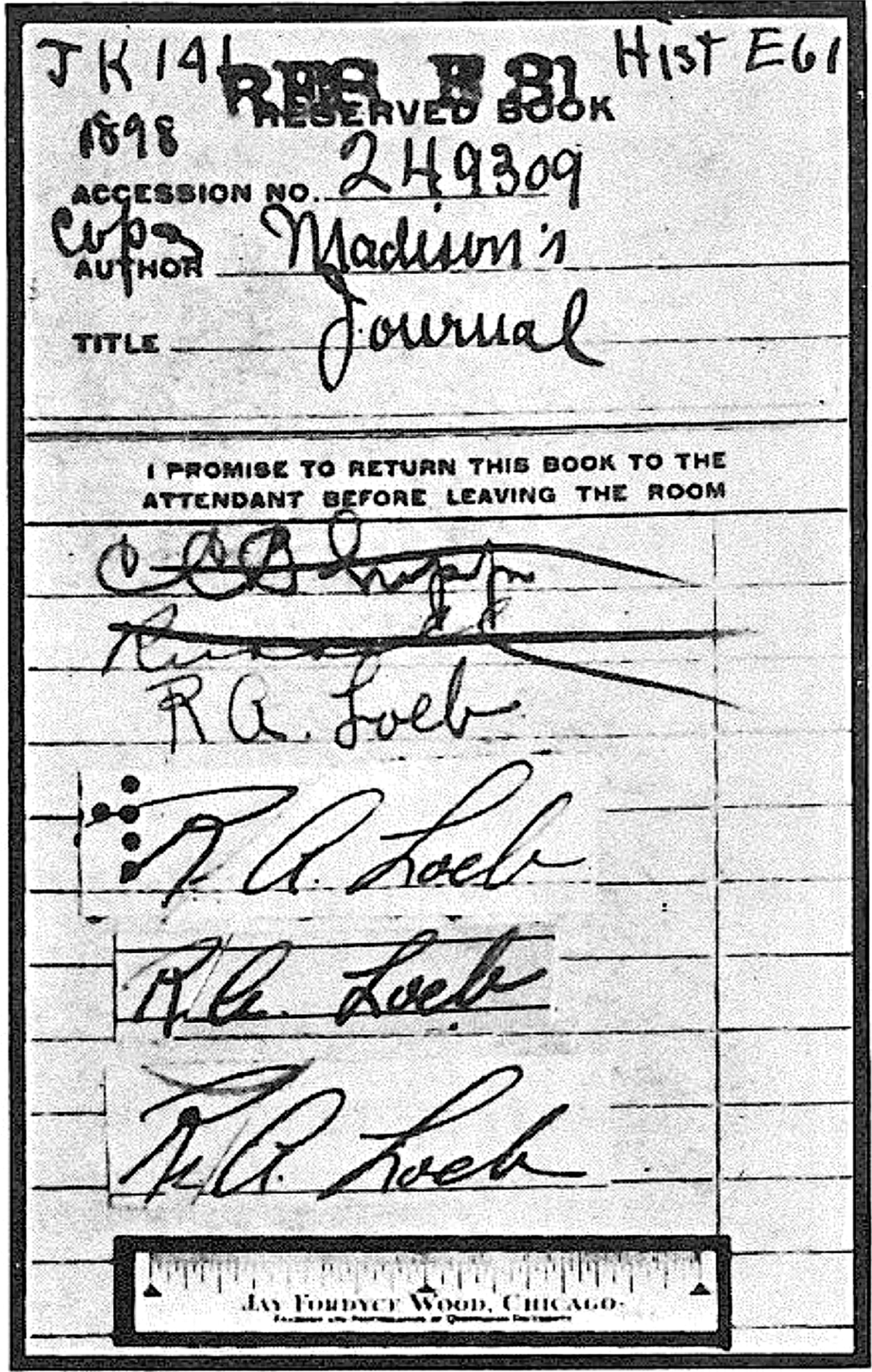
Figure 13
While the boys were still held at the La Salle Hotel, every effort was made to procure possible standards for comparison of the typewriting in the “Ransom” and “Train” letters. None was obtainable until a young Daily News reporter who had been assigned to the case procured and submitted certain “dope sheets,” or digests of principles in legal cases commonly exchanged among law students, which he had obtained from associates of Leopold in his law class at Chicago University. (Figure 14.)
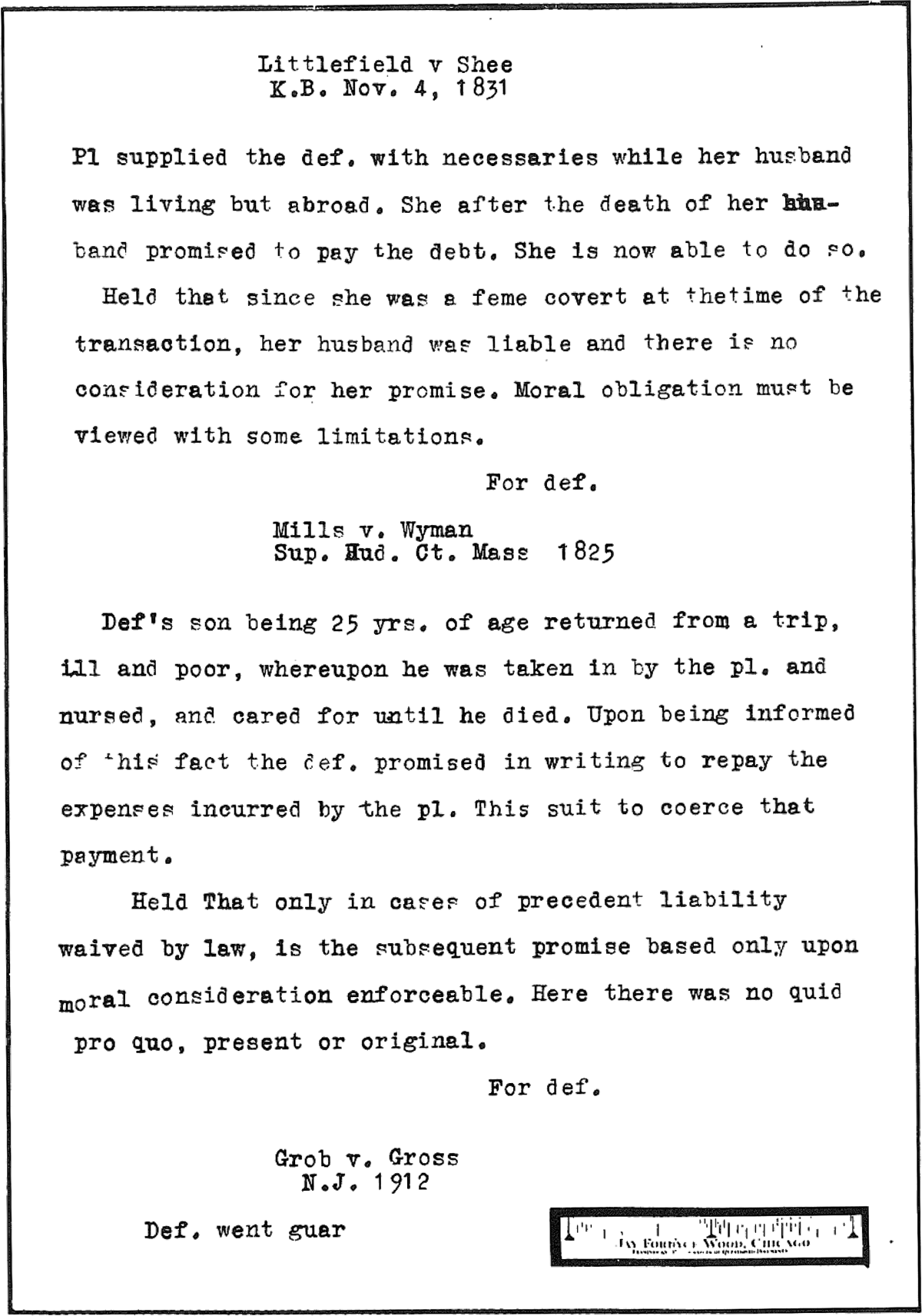
Figure 14
A comparison of the typing on these sheets with that on the questioned letters shows beyond all doubt the work of the identical machine. Figure 15 offers a few features of the machine’s individuality. The top line characters are cut from the “Ransom” letter (Figure 1 ; the middle line is from the “Train” letter (Figure 3) and the bottom line from the standard (Figure 14). Note that the tail of the “t” prints much lighter than the top; that the base serif or finishing stroke of the “i” is much heavier at the right end that at the left; that the bottom of the lower case “s” prints much lighter than the top of this letter; that the “d” prints very lightly at the lower right; that the “o” is out of horizontal align and noticeably lower than the base line of writing, and that the impression made by the “o” is heavy and uneven, printing more heavily at the upper right; also the fact that the “f” crossing prints heavily at the left and light at the right. There were very many divergencies of this character from the normal, which in summation removed every possible doubt that the questioned letters and the standards were the work of the identical typewriter.
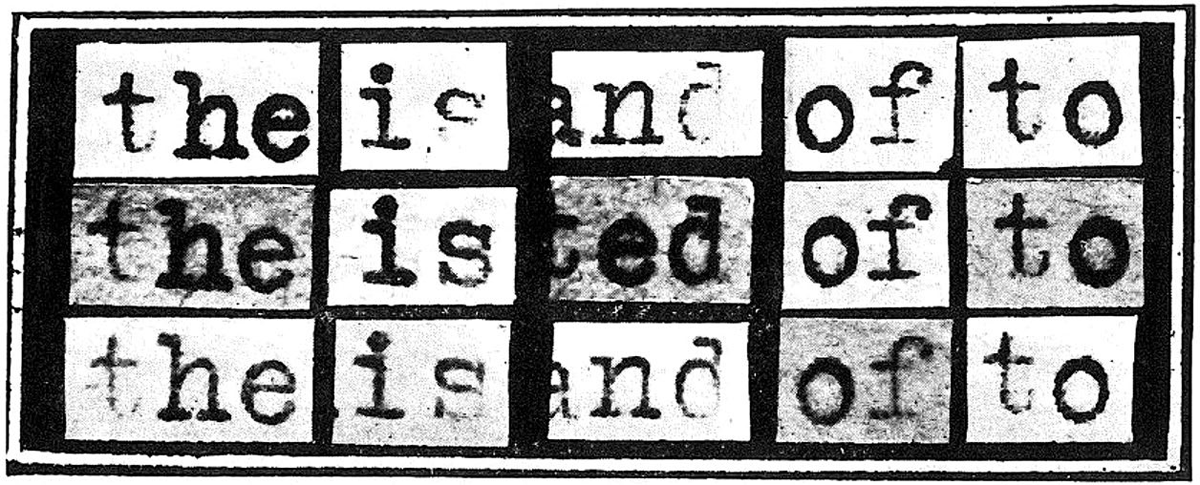
Figure 15
The confessions developed that the typewriter employed had been thrown from the bridge in Jackson Park into the lagoon, where some days later it was brought up by divers engaged for the purpose. Every letter had been twisted from the type bars and none was recovered.
Under the typewritten signature on the ransom letter appears to be the typewritten initials “GKR.” Shortly after the confessions, a young woman claiming to be a friend of Loeb’s called at the jail to see him. On giving her name it developed that her initials were “GKR,” and she was detained and examined at great length in an effort to obtain a possible explanation of the “GKR” on the ransom letter. She was unable to offer any explanation however. The explanation appears in the enlargement of the letters at Figure 16. An attempt had been made to write the signature “George Johnson” in its proper place on the letter, but at a point too low on the page to permit of writing. The machine had evidently balked in printing the first four letters and the page was removed and replaced in the writer, or the sheet readjusted and the name written out of its proper place in position as it now appears.
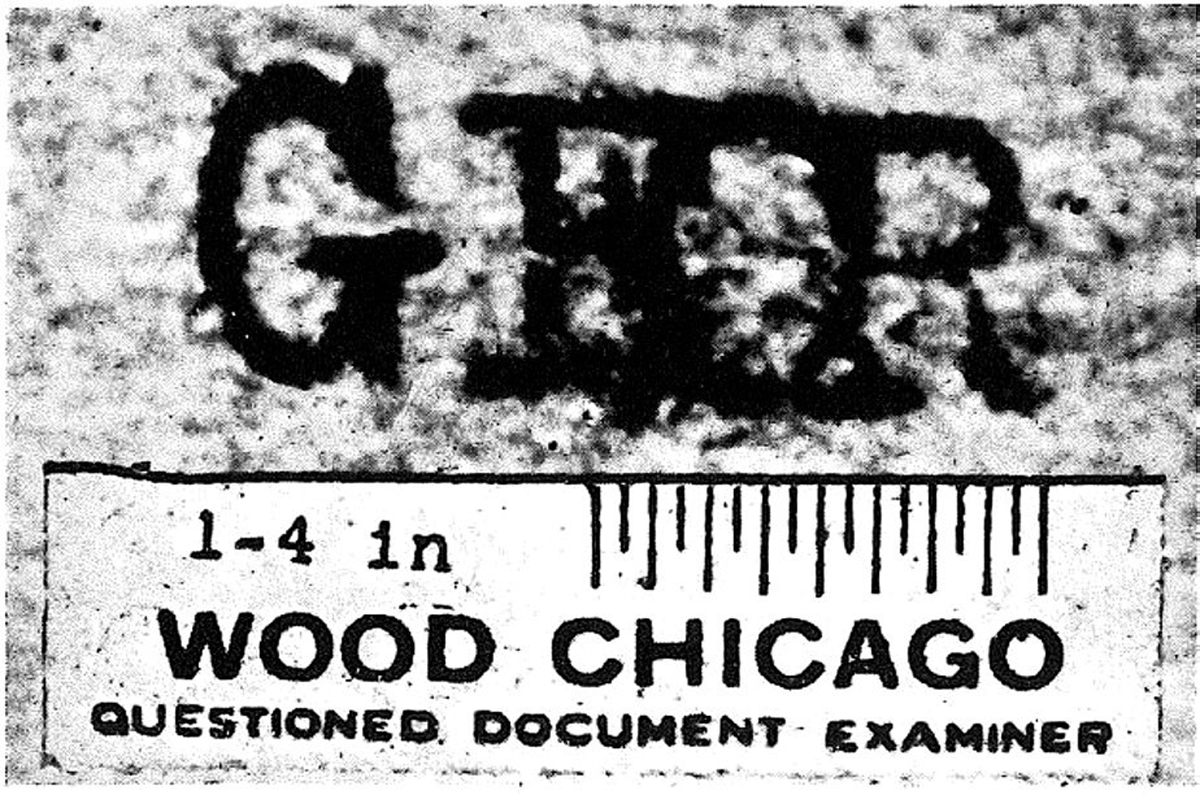
Figure 16
The proof above submitted concerning pen printing, handwriting and typewriting was so convincing and unescapable that the State’s Attorney ordered the boys removed to the Criminal Court’s Building where, on the night of their transfer, each boy acting for himself, and without the knowledge of the other, made a detailed confession.