
Jay Fordyce Wood was an early 20th Century document examiner who practiced in Portland, Oregon and Chicago. Born in Michigan around 18671868 (1, 2, 18), he worked as a stenographer in Chicago (1), and then as a court reporter and/or attorney in Portland, Oregon (2, 3). His interest in the field led him to study to became a document examiner in the mid ‘10’s (2), where he practiced first in Portland (4), and then later in Chicago (5, 6). He was one of the analysts invited by Albert S. Osborn to join the gathering that would later become the ASQDE (7). In the summer of 1924, Wood was one of nine “experts” consulted after the horrific kidnapping/murder of Bobby Franks by Nathan Leopold and Richard “Dickie” Loeb [Endnote]. The boys confessed shortly after coming under suspicion and pleaded “Not Guilty” at the trial; however Robert E. Crowe, the prosecutor, seeking to prosecute them to the full extent, had nonetheless required a full battery of document examinations. Wood was the first of two document examiners to testify in the “trial” (actually, a sentencing hearing), on 28 July 1924, the other being John Tyrrell of Milwaukee (10).
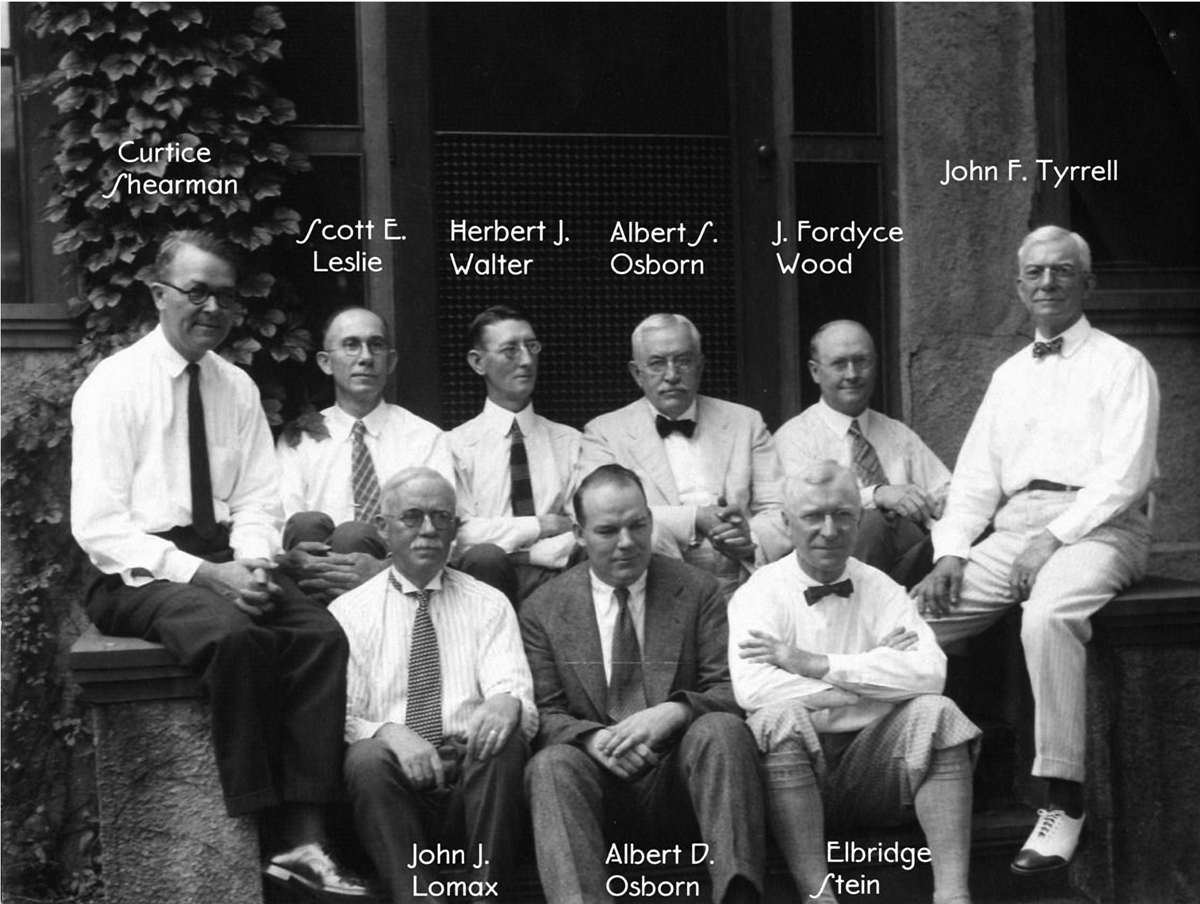
Figure 1
Gathering of early document examiners at the Osborn house, Montclair, New Jersey, 1926, participants labeled by the author. From the author’s collection, courtesy of Donald Doud.
As chronicled in papers of the day, Wood consulted in many cases in the Midwest during the ‘20s and early ‘30s (14, 15, 16, 17). When the Scientific Crime Detection Laboratory was begun at the Northwestern University in Evanston, Illinois in 1930, he was hired as the document examiner (14).
Wood published the article that follows in 1930 in the Journal of Police Science, the publishing organ of the SCD Laboratory, and it was illustrated with the charts he had made for the case. Many of the original illustrations, as well as other artifacts of the case are housed at Northwestern University. This author first learned of Wood after purchasing several books from Wood’s personal library at an antiquarian store in Evanston. When he was later doing research on Leopold-Loeb in 2004, the author consulted with the late Donald Doud of Milwaukee, a John Tyrrell protégé, and was given John Tyrrell’s files on the case (which included many photographs that had been taken by Wood).
Wood died from heart failure in August 1933, at age 66 (18). Had he lived, he might be better known today, for he was held in such regard by Albert S. Osborn, that it is possible that he may have been one of the experts consulted in the Bruno Hauptmann-Lindbergh Kidnapping case and trial of 1932-1935. At Wood’s death, Osborn wrote: [He was] “an outstanding and successful examiner of questioned documents,” [and] “due to his extended knowledge and his careful and complete advance preparation, he became a very formidable adverse witness. By his thorough and conscientious work in this somewhat unusual field he promoted the interests of justice.” (2)
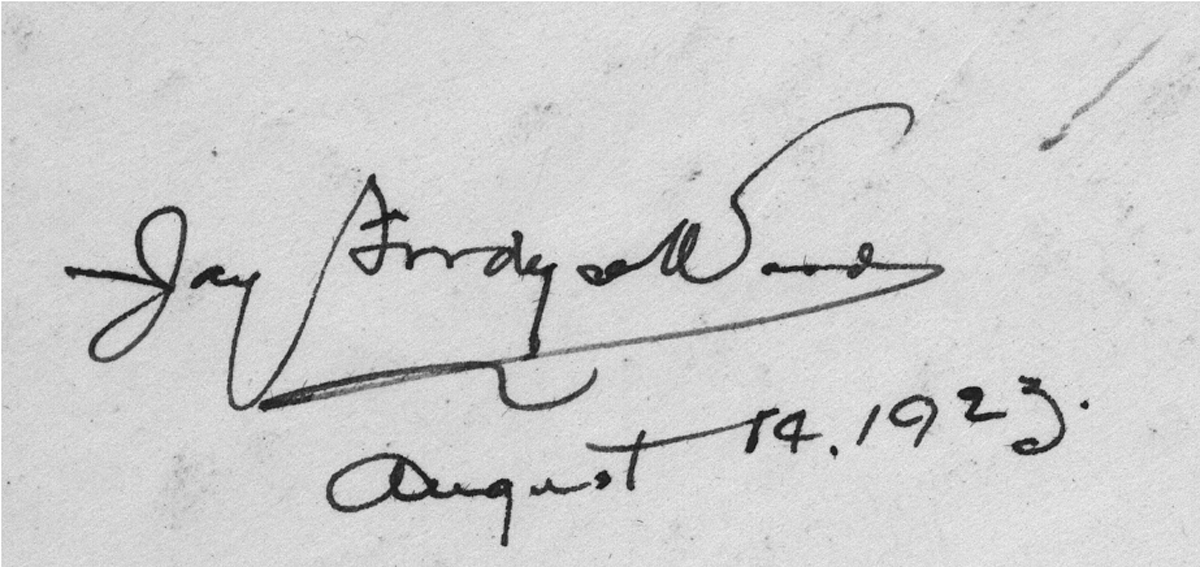
Figure 2
Wood’s signature in a book from his personal collection purchased by the author.
Endnote
The other “experts” listed in books or newspaper accounts as having some connection with the case, were, in alphabetical order:
John W. Culpeper, “typewriting expert called in by the state’s attorney, who said the first [ransom] letter demanding $10,000 was written on a portable Underwood machine.” (8); James Ennis, “handwriting expert” (9);
George W. McClellan, representative, Underwood Typewriter Company (10);
John W. Norkett, “typewriting expert, who identified the machine on which the… ransom letter was written” (11);
Howard Rounds, “handwriting expert… who said he had testified in the Loeb-Leopold Case,” [although to this author’s knowledge, this statement is incorrect] (12);
Fred G. Schuelke, assistant branch manager, Underwood Typewriter Company (10);
Hugh P. Sutton, “typewriting expert… [who] said it [the ransom note] had been written on an Underwood portable” (13); and
John Tyrrell, of Milwaukee (10). Only Tyrrell is known today primarily due to his participation in the 1935 trial of Bruno Richard Hauptmann.