
Introduction
Much has been written about the characteristics of unnaturally prepared writing; poor line quality, blunt endings, blunt beginnings, changes in letter form, etc. When writing has been determined to be unnaturally prepared the question then becomes whether it’s a simulation/forgery or a disguise. Osborn (1946) defines disguise as a class of writing “in which the writer seeks to hide his own personality without adopting that of another.” and forgery as writing “in which the attempt is made to discard one’s own writing habits and assume the exact writing personality of another.” Unfortunately, determining which is which is not that easy. Rile (1987) reported that “To a greater or lesser extent, almost all individuals have the ability to distort their handwriting or signature” and Foote (1998) reported that “Clearly, the majority of participants displayed some overlapping features between simulation and disguise, however no specific trends in features could be established to characterize each method”. Based on past research, it would appear that determining whether writing has been simulated by a different writer or disguised by the same writer is impossible.
While considering this dilemma two questions came to the authors of this paper concerning the disguise of one’s own writing: is an individual’s disguised writing a habitual pattern that contains individualizing characteristics similar to those seen in normal and natural writing and, if so, will those characteristics be repeated again and again? Additionally, would obtaining known disguised exemplars help the document examiner with his/ her comparisons when disguise is suspected?
The idea that disguised writing is unique and repeatable is not a new one. While working on the Lindbergh kidnapping case, Albert S. Osborn (1944) stated that Bruno Hauptman “was asked to write some of the same matter two or three times in order to see if he was disguising his writing and he was. Some of the repeated writing was disguised exactly like the Ransom Letters.” The Ransom letters were written in March and April of 1932 and the trial began in 1934. Approximately two years passed between the writing of the ransom letters and the collection of the known exemplars. Yet, when Mr. Hauptman disguised his known exemplars he used the same disguise he had used two years previously when he wrote the ransom letters.
Other research observed similar findings. In a presentation given by McKasson and Lesk (U. S. Postal Service, Chicago, circa 1975) it was stated that “In almost all instances wherein a successful disguise was used, the second attempt strongly resembled the first, even though the writings were executed up to six years apart.”
While by no means an exhaustive research list, these earlier findings do support the premise that disguised writing is individualized and will be repeated.
Methods and materials
This research is the third project conducted by the authors of this paper on the topic of disguised handwriting exploring the theory that disguised handwriting contains persistent individual, and identifiable, characteristics that will be repeated again and again. If this is true it is believed that disguised known exemplars will aid in the examination of a questioned document believed to be disguised.
The first paper was presented by Rigo Vargas at the annual meeting of The American Society of Questioned Document Examiners (ASQDE) in Baltimore, 2003, and the second by Marie E. Durina at the annual ASQDE meeting in Memphis, 2004. The latter was published in the ASQDE Journal in June 2005 (Durina 2005).
In the 2003 study, seven participants were asked to disguise their writing on a single check. They were told to write as if they were going to deny the check at a later date. Two weeks after preparing the “questioned” check, the participants were asked to provide ten known exemplars on blank check forms. The writers were told to write naturally. Two weeks after the natural knowns were collected, the volunteers were asked to provide ten disguised known exemplars on blank check forms. Again, the writers were told to write as if they were going to deny it at a later date.
The 2003 study involved a statistically insignificant sample size and produced results that were purely anecdotal. However, the results supported the hypothesis that when a writer is asked to disguise his or her handwriting multiple times, that individual will utilize the same disguising techniques again and again. The results also supported the notion that obtaining disguised known exemplars can aid in handwriting examinations. In the 2004 study, sixty-two participants were asked to partake in a two part study. Part one involved a three page document comprised of a brief questionnaire, inquiring about gender, age group, and education level, and two specimen checks. For the first check the participants were asked to “Sign your normal signature on the check using your own handwriting.” For the second check, the participants were asked to “Sign your name as if you plan to deny later that you were the one who signed it. You should try to disguise your writing.” One month later the participants were given a third check and told again to “Sign your name as if you plan to deny later that you were the one who signed it. You should try to disguise your writing.”
The 2004 study involved a significant sample size and produced some interesting results. The most important finding was the large number of participants who used the same technique(s) to disguise their signatures. As stated in the paper “an overwhelming majority (89% of the writers) did disguise their signatures the same way each time using the same strategies.” A few writers (3%) changed their method of disguise, however, still produced a second disguised signature very similar in appearance to their first disguise. Only 8% of the writers used a completely different disguise in their second set of known specimens.
Another interesting finding from this research concerned the methods of disguise most often used by the participants. The two most common techniques were change in speed (used by 64% of the writers) and change in letter formation or design (used by 52% of the writers).
The purpose of Durina’s 2004 study was “to discuss the various types of disguises used by writers and to determine whether those who disguise their signatures do so in the same manner each time.” However, the idea that disguised known exemplars could help in a handwriting examination was not lost on the author. She stated “Would it ever be plausible to request “deliberately disguised writings” from a subject?”
The goal of this study, conducted in 2013, was to attempt to validate the results of the two earlier papers on this topic and to attempt to determine if obtaining known disguised writing from subjects would be of potential use in real case work.
Three examiners from different states in the U.S. agreed to collect handwriting samples from as many individuals as possible.
The samples were collected in three parts:
Part one included a brief questionnaire and the questioned document, a sample check labeled “Q”. The participants were told what to write and instructed to disguise their writing. The participants could disguise their writing anyway they wanted. If they wished to practice first they were allowed to do so.
Part two involved the collection of naturally prepared writing samples one month after the questioned document was obtained. These samples were labeled “K1”. The participants were dictated the same information contained in the questioned check.
Part three involved the collection of disguised known exemplars approximately two weeks after the “K1” exemplars were obtained. These samples were labeled “K2”. Again the participants were dictated the same information contained in the questioned check. They were also told they could disguise their handwriting anyway they wanted.
NOTE: After the final exemplars were collected each participant was given a Final Survey inquiring if they remembered what type of disguise they used. If they remembered they were asked to list the disguises on the survey.
A total of fifty-six handwriting samples were collected by the examiners. Once organized, the samples were mailed to a different participating examiner, who would then perform the comparisons. Each participating examiner was instructed to fill out a Research Comparison Questions sheet during their examinations. The examiners were asked to compare the questioned check (Q) to the natural exemplars (K1) first and note the methods of disguise used by the writers. Next, the disguised specimens (K2) were included in the examination. The examiners were asked to answer the following questions. 1) Is the disguise in the “Q” consistent with the disguise in the “K2” exemplars? 2) Is the disguise in the “K2” exemplars consistent throughout? 3) Did the participant remember what type of disguise they used? If so check which ones on a list provided. Finally, the examiners were asked: 4) Did the disguised “K2” samples aid in the comparison?
Upon the conclusion of all examinations and comparisons, the completed Research Comparison Questions forms were faxed to one examiner for statistical calculations. See Appendix A.
The resulting data was separated into three categories: Method of Disguise, Repetition of Disguise, and Usefulness of Disguised Exemplars.
Results
The first set of results concerns the strategy used by the participants to disguise their writing. If the writer could not remember his/her disguise technique, it was determined by the examiner. As can be seen in Figure 1, the most utilized strategy for disguise involved distorting the lower case letters with 34% of the participants using this method. The next was a tie between changing the capital letters and writing in a more copy book style (approximately 30% for both), followed by altering the slant (29%), and another tie between “other” and switching between printed and cursive writing (both at 25%). For purposes of this study, the “other” category encompassed less frequently seen methods of disguise such as a change in spacing, alternating between text-based and stylized writing, changes in pressure, adding embellish ments, writing backwards, disconnecting the writing, and writing in a neater manner. Pen grip and writing position were the least utilized techniques with 1.79% and 3.57%, respectively. See Figure 1.
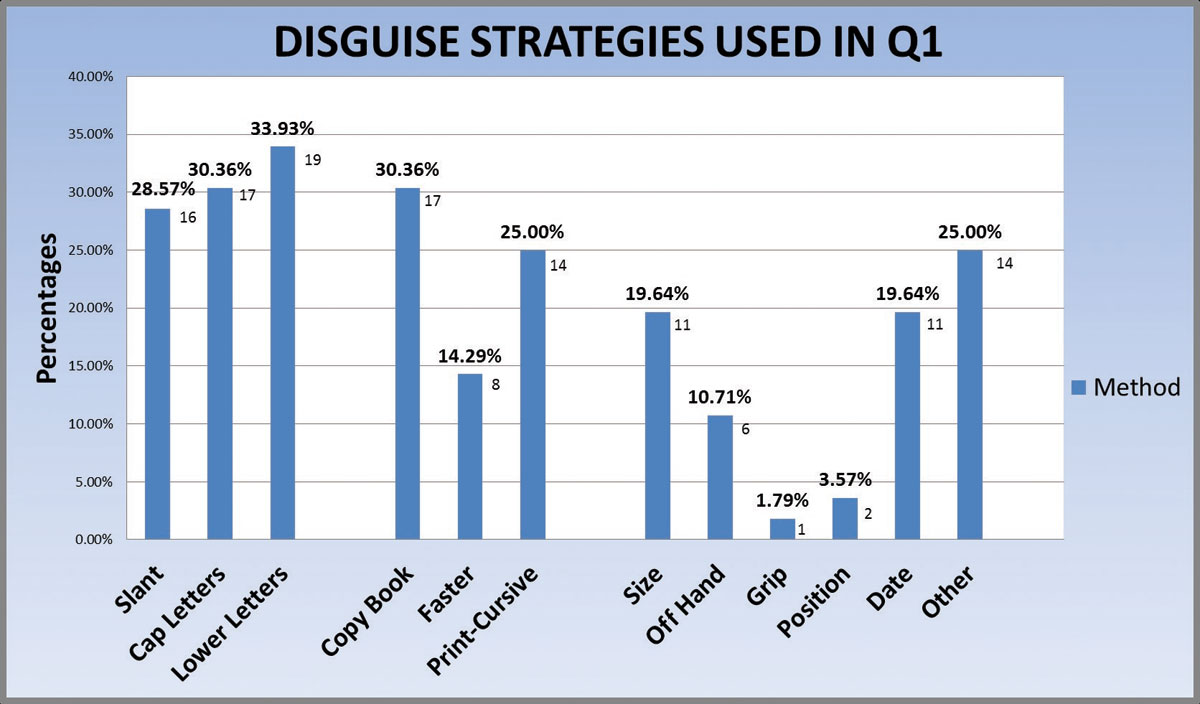
Figure 1
The second set of results determined whether the participants used the same disguise to write the “Q” as they did to write the “K2” exemplars. In this study 71% of the writers used the same disguise and 29% did not. It is important to note that while statistically significant, this is much lower than the 89% of writers who used the same disguise each time reported by Durina in the 2004 study. No clear reason for this difference could be suggested.
The final set of results concerned whether or not the disguised known exemplars were useful in the examination. It was found that in 87.5% of the examinations the disguised specimens helped in the comparison, whereas, in only 12.5% of the examinations the disguised specimens did not help.
Images of some signatures obtained in this study demonstrating the variability of disguise techniques used by some of the writers can be found in Appendix B at the end of this paper.
Discussion
This research was conducted on the premise that a person’s disguised writing is as individualized as his or her natural writing. It was theorized that a person would disguise his or her writing the same way whenever asked to do so, even at a much later time. It was also hypothesized that purposely distorted known exemplars would assist in the examination of a questioned document when the possibility of disguise could not be excluded.
Anecdotal evidence by McKasson and Lesk support the belief that individuals will disguise their writing the same way, even at a later date. Albert S. Osborn observed similar findings during his examinations of Bruno Hauptmann’s writing in the Lindberg Kidnapping case.
The goal during the experimental portion of this research was to be as precise and consistent as possible. However, as with most research projects, there were some limitations. The most significant potential for error was the unintended, yet possible, introduction of bias. When an author contacted the document examiners who would be performing the comparisons, that author told them the basis for the research and the expected results. By making the examiners privy to the overall goal of the research, confirmation bias may have been introduced. [Note: For this reason the data pertaining as to whether the disguise was successful was not included here.] Other inconsistencies included: collecting some of the K2 exemplars more than two weeks after the K1 exemplars, deciding that some of the participants could practice their disguise method after many of the samples were already collected from other participants who were not afforded this opportunity, and handing out Final Surveys to some participants after too long a time period had passed since the writers had prepared their last set of exemplars.
Future work on this subject should focus on better controlling the process in which the exemplars are collected. Every effort should be made to ensure the timeline for collecting samples is the same for each participant. In the future, comparisons performed by examiners should be blind, wherein the examiners would be supplied the materials, but would not be provided any contextual information about the research project.
Nevertheless, the study does provide some data to suggest that many writers tend to follow a habitual pattern when disguising their writing.
Conclusion
The results of this research support the results of the research conducted in 2003 and 2004. The findings in this study show that there is some variability in the popularity of the type of disguises used when compared with data from earlier studies. For example, Huber & Headrick (1999) reported a change in slant as the most frequent form of disguise, while Durina (2004) reported that change in writing speed was the most frequently used strategy for disguise.
Our results also show a decrease in the percentage of writers who disguised their writing in the same manner each time. However, overall results show that there is still a propensity for the majority of the writers to use the same manner of disguise on each different occasion. Most importantly, findings from our study support that it is extremely useful for forensic document examiners to obtain deliberately disguised known writing specimens from subjects whenever it is possible to do so. Forensic document examiners should continue to exercise caution when examining writing when the possibility exists that the writing may have been disguised. It is only by having deliberately disguised known writing specimens can a forensic document examiner definitively assess a writer’s true range of natural variation, determine that writer’s aptitude for introducing disguise in their writing, and hope to penetrate a disguise that may have otherwise been successful. For these reasons, if at all possible, it is advisable to obtain deliberately disguised handwriting specimens from a writer in cases where disguised writing is be suspected.
Appendices
Appendix A
Research Comparison Questions
Was the disguise successful? Are the results leaning away from the subject or inconclusive? Yes___No___
Is the disguise in the Q consistent with the disguise in the K2 knowns? Yes___ No___
Is the disguise in the K2 writing consistent throughout? Yes___ No___
Did the participant remember his/her method of disguise? Yes___ No___
What type(s) of disguise(s) was used?
Alter Slant ___
Alter Capital Letterforms ___
Alter Lower Case Letterforms ___
Copy Book (slow) ___
Illegible (fast) ___
Print vs. Cursive ___
Size (smaller vs. larger) ___
Off Hand ___
Instrument Grip (alter how the pen was held) ___
Writing Position (of hand or paper) ___
Other_____
Did the disguised knowns in K2 aid in the comparison? Yes___ No___
Appendix B
The following three pages contain signatures taken from the writing specimens. The samples were chosen as examples of comparisons made between the disguised signatures on the questioned documents to the corresponding natural/disguised known specimens.
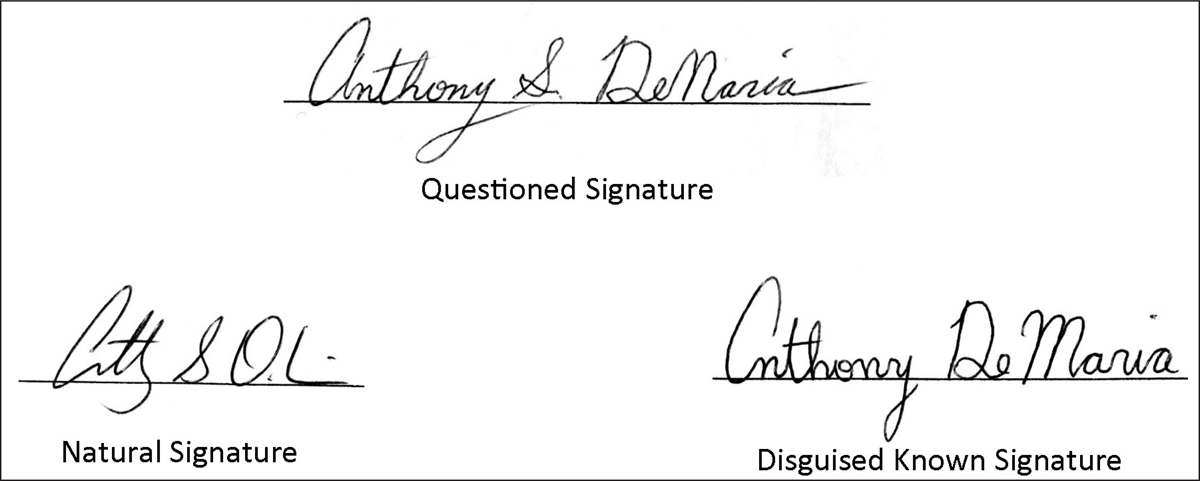
Figure 2
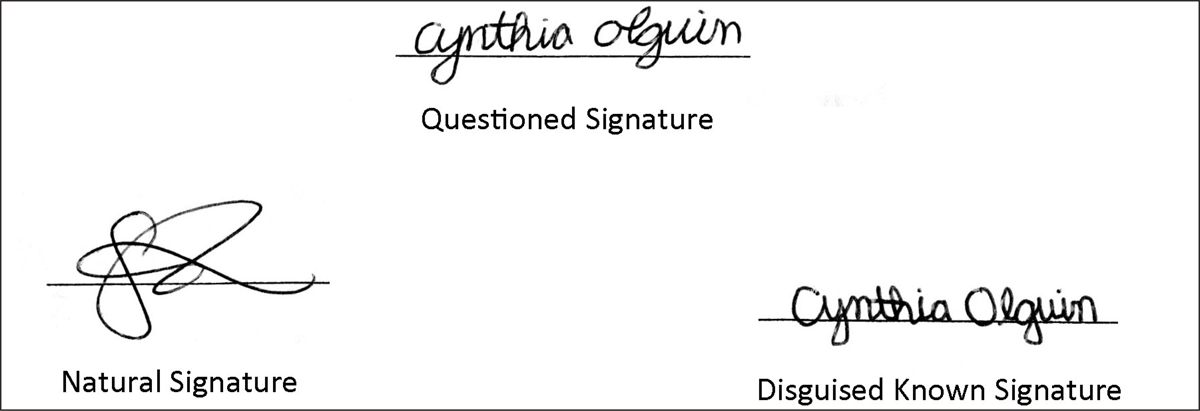
Figure 3
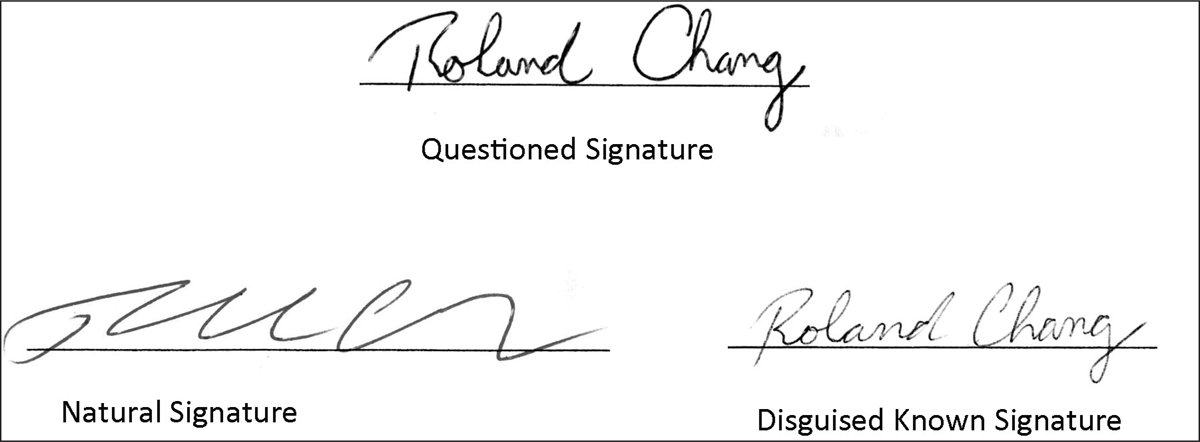
Figure 4
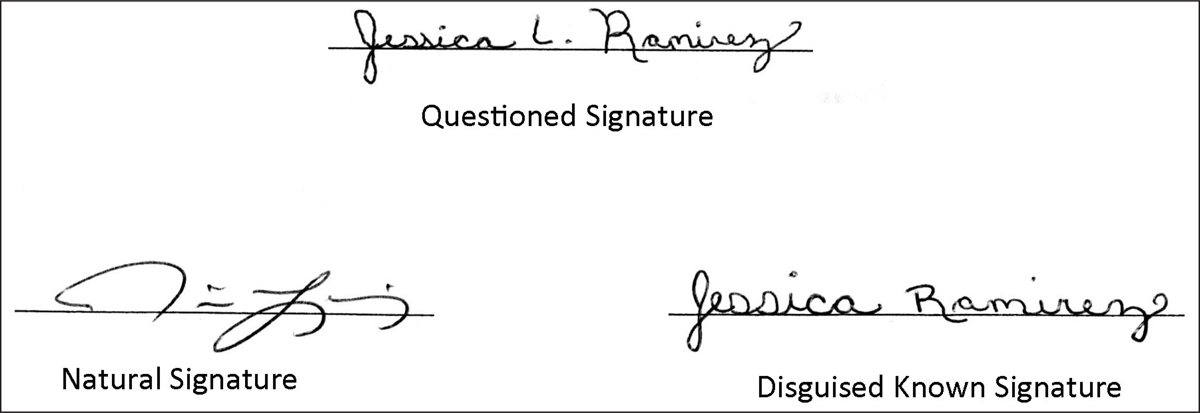
Figure 5
In the four images above the writers disguised their signatures by merely “writing” their names in a text-based manner instead of signing them in their natural stylized manner.
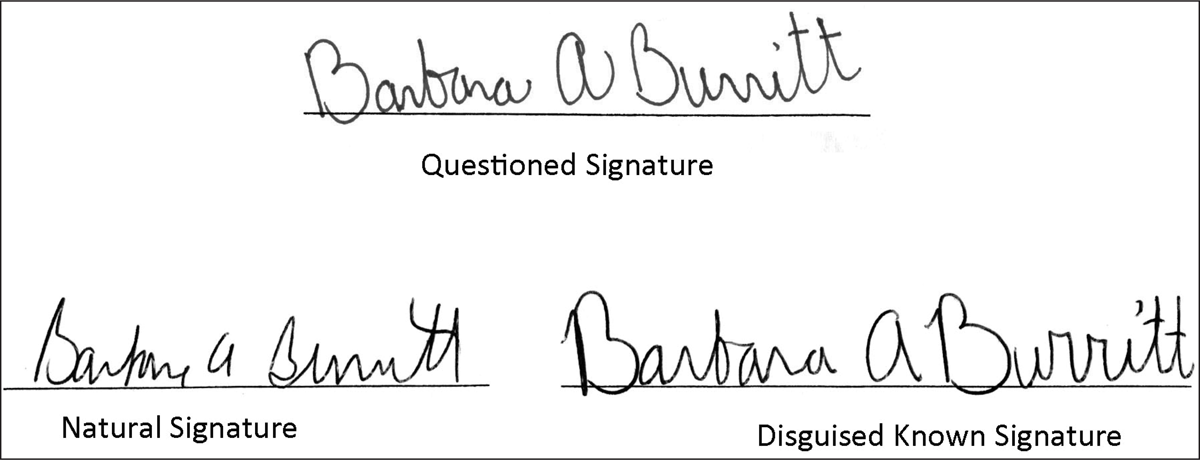
Figure 6
Unlike the previous examples, this participant truly attempted to alter her handwriting.