
Single-family homes as particular challenge
Lifestyles and human activities have led to the exceedance of seven of the nine planetary boundaries (Planetary Health Check 2025, 2025). Scientific evidence is mounting that technical approaches—efficiency and consistency—alone are unlikely to be enough to bend the curves to stay within planetary boundaries (SRU, 2024). Accordingly, sufficiency is gaining interest, approval, and implementation. The IPCC defines sufficiency as “[a] set of measures and daily practices that avoid demand for energy, materials, land and water while delivering human well-being for all within planetary boundaries” (IPCC, 2023, 2023, p. 29). But sufficiency is still underrepresented in political actions as it can be seen in National Energy and Climate Plans and Long-Term Strategies (Zell-Ziegler et al., 2021) —even though citizens call for it (Lage et al., 2023).
Due to its significant environmental impact (UNEP, 2025), the human right to adequate housing, and the simultaneous crisis situation in many countries (ART, 2025), the housing sector plays a central role in the debate on sufficiency (Best et al., 2022). Sufficiency measures in this field of action are the redevelopment of existing buildings, the reduction of per capita living space, low-tech and adaptable buildings, as well as a mindful user behaviour (Zimmermann and Firat, 2024). Particularly with regard to the first two building sufficiency targets, single-family homes (SFHs), and especially new construction of this type, have come under criticism (Bundesstiftung Baukultur, 2020; Kenkmann et al., 2023, 2019; UBA, 2023).
SFHs are particularly relevant as they make up a large proportion of the European and German building stock (eurostat, 2024). Of the around 20 million residential buildings in Germany in 2022, 15.7 million are single-family or two-family houses (with 18.3 million apartments) and 4.2 million are multi-family houses (MFHs)(with 24.8 million apartments)(Destatis, 2022a). Interestingly, this means that the number of SFH exceeds the number of families with minor children (8.4 million households)(Destatis, 2024). The average SFH is 125 m2 in size (Destatis, 2022b) and was built before 1979 (Blömer et al., 2024).
A total of around 0.7 million residential units are vacant in SFHs (Destatis, 2022c). Under-occupancy is even more widespread than complete vacancy. In total, there are around 11 million single- and two-person households in SFHs (Destatis, 2022b). Therefore, the number of those households also exceeds that of families. Contrary to what the term suggests, SFHs are predominantly occupied by people in the post-family phase (Zimmermann et al., 2025b). Often this is due to the so-called empty nest effect: Once their children have moved out, the parents stay in their familiar four walls. These now tend to be too large for the size of the remaining household (Bierwirth and Thomas, 2019). That’s why the living space per capita is very high in this population group (Kenkmann et al., 2023). After the children have moved out, inhabitants of SFHs typically have 5 rooms and 63 m2 of living space per capita at their disposal (Gabriel et al., in publication). This is significantly more than the average living space in Germany of 49 m2 per capita (UBA, 2025).
At the same time, many young families are urgently looking for affordable, fitting homes and are opting for the construction of new SFHs. Although the construction of new SFHs has tended to decline in recent years—the average rate in the last ten years was around 99,000 SFHs per year and 72,000 units in 2024—it still corresponds to a share of around 34% of the total construction of residential units (Destatis, 2026a). Thus, there is a Germany-wide discrepancy between the number of rooms per apartment and the number of people per household (simplified assumption that two-room apartments would be particularly suitable for two-person households): Many households are single households while at the same time many apartments or houses have 5 or more rooms (see Figure 1). Compared to other European countries, Germany is disproportionately focused on the construction of large apartments or houses instead of urgently needed 1–2 room apartments (Kholodilin and Kohl, 2026). At the same time, the average size of newly built SFHs is increasing while it is decreasing for apartments in MFHs—newly built single-family homes in 2024 averaged around 155 m2 (Kholodilin and Kohl, 2026).
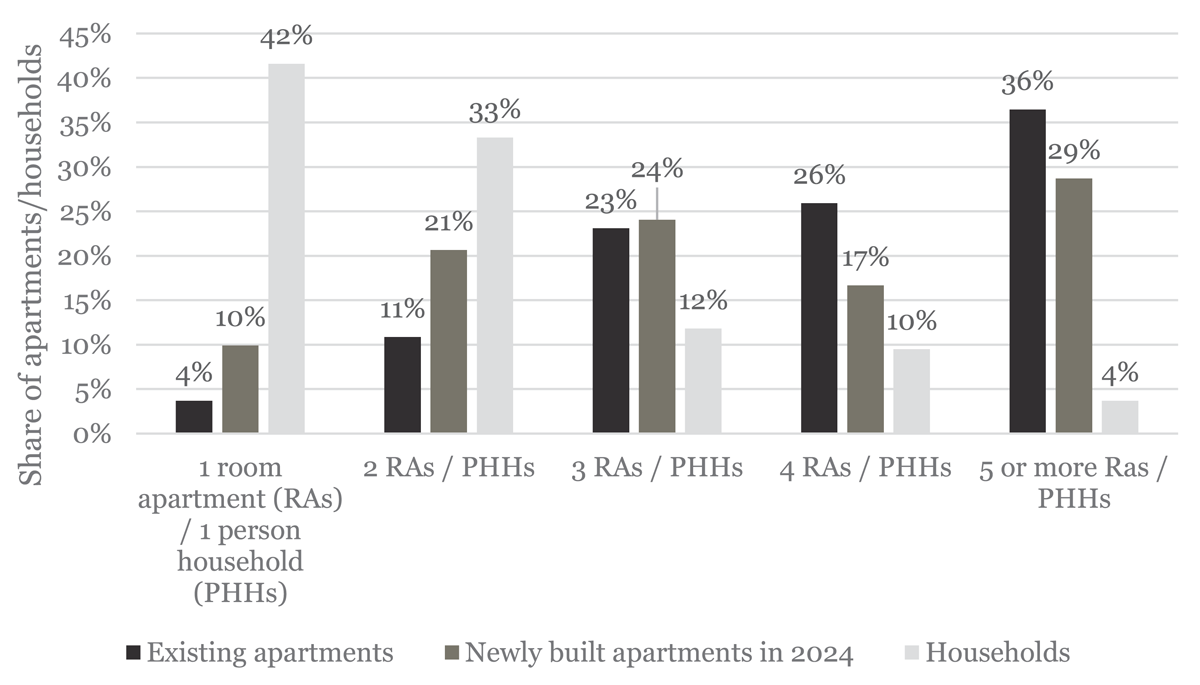
Figure 1
Distribution of households by household size and residential units by number of rooms in existing and new buildings in Germany. Own depiction based on (Destatis, 2022c, 2026a; Statistischen Ämter des Bundes und der Länder, 2022).
Although research on the transformation of SFH is on the rise (Bundesstiftung Baukultur, 2021; Engelke, 2025; Fuhrhop, 2023; Kenkmann et al., 2023; Loidl et al., 2025; Verband Wohneigentum, 2024; Voigtländer, 2023), the following research questions remain, which will be addressed in the subsequent chapters:
Research question: From a sustainability perspective, what are the specific challenges associated with SFH? (Chapter 3)
Research question: To what extent are today’s SFH residents willing to change, and what housing potential does this present? (Chapter 4)
Research question: What environmental savings result from a more efficient use of SFH? (Chapter 5)
Research question: What policy recommendations can be made? (Chapter 6)
Mixed-method approach based on two research projects
This contribution draws on two research projects dedicated to the sufficiency transformation of the SFH stock. Both examine (with different approaches) the future role of the SFH within sustainable urban development in Germany addressing the tension between environmental impacts, rising construction, purchase, and rental prices, changing housing needs, and widespread under-occupation. The projects empirically examine both the municipal and resident perspectives using qualitative and quantitative methods (e.g., interviews, surveys, focus groups).
“Sufficient Housing Culture”
In this recently completed project called “SuWoKu” (Gabriel et al., in publication) five research methods were combined to assess the three dimensions of a sufficient housing culture—needs-oriented, generation-appropriate, and environmentally friendly living:
13 guided expert interviews
3 focus groups with SFH residents in different regions (rural, small town, large city)
Representative online survey among 2,744 people over the age of 50 who live in owner-occupied SFHs. All the following SuWoKu figures presented in this article refer to respondents living in a 1–2-person household in a region with low vacancy.
2 focus groups with local policy-makers, administrators, and activists
Projections of housing potential based on data on building and household stock and environmental impacts based on life cycle assessments
Results from this project are presented in the chapters 3, 4 and 5.
“Single-Family Home: Quo Vadis?”
This completed study (Zimmermann et al., 2025a, 2025b) is primarily based on five municipal focus groups. The five different German municipalities represent a diverse range of situations regarding size, location, population dynamics, and housing market conditions. Using this format, various groups of stakeholders were interviewed together, including local government, the construction industry, and local residents. The participants discussed sufficiency options for SFHs with a view to potentialities, obstacles, and feasibility. In addition, two more focus groups with scientists and nationwide stakeholders from associations, advisory institutions, politics, and other areas were held. A total of 45 people took part in the project. Results from this project are presented in the chapters 4 and 6.
Identified issues of single-family homes
Through literature review and the empirical findings, the following challenges could be identified. For the sake of simplicity, these are structured according to the widely accepted three pillars of sustainability, although we are well aware that they are subject to criticism (Purvis et al., 2019): ecology (Chapter 3.1), society (Chapter 3.2), and economy (Chapter 3.3).
Ecological impacts
Regarding the environmental impact, the new construction of SFHs performs worst. Figure 2 summarizes the ecological impact per new built SFH in the three indicators greenhouse gas (GHG) emissions (whole life embodied carbon over 50 years), material consumption (for construction), and land use (for property and infrastructure).
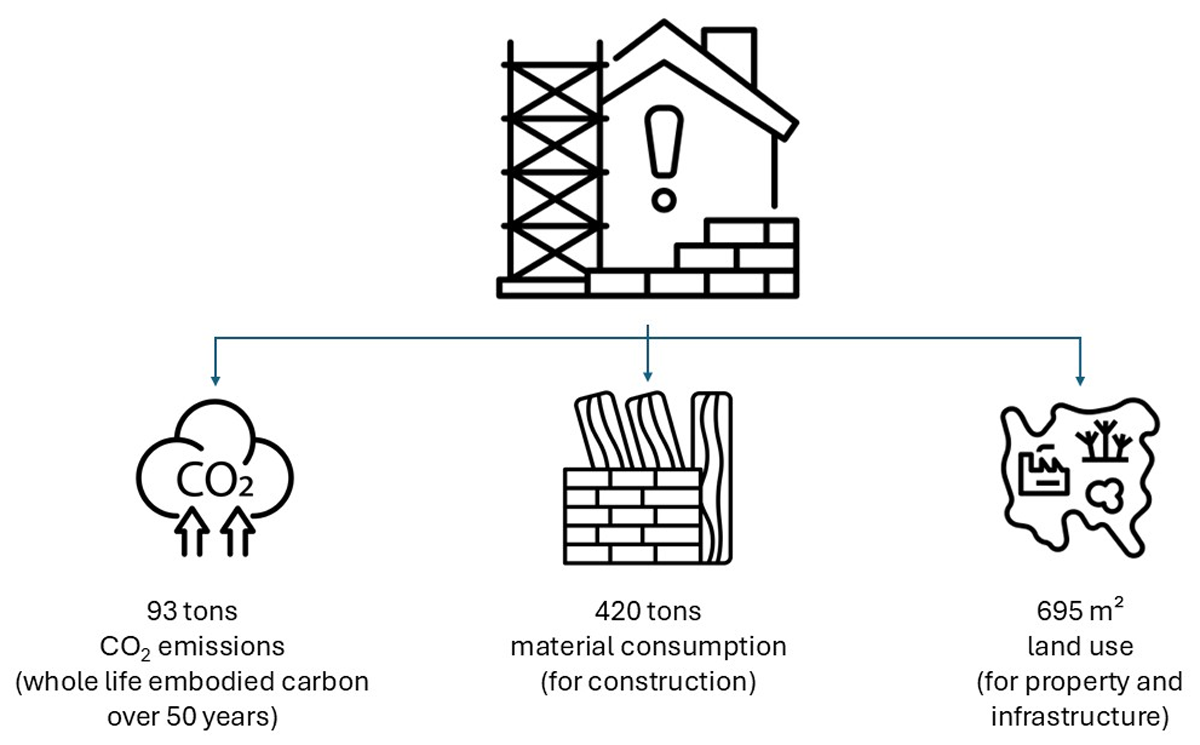
Figure 2
Environmental impact of the new construction of one average German SFH; own calculation and depiction based on Mahler et al. (2019) & Zimmermann et al. (2023).
Greenhouse gas emissions
Buildings are responsible for 34% of worldwide GHG emissions (UNEP, 2025). Zooming in on Germany, the figure is 30%, with around three-quarters attributable to building operations (heating, cooling, hot water, electricity) and around one quarter to the production of building materials (UBA, 2023). Depending on the scope, both Europe-wide (Ramboll et al., 2023) and Germany-specific (Agora Industrie et al., 2024) studies show higher whole-life embodied carbon emissions–GHG emissions related to production, construction, renovation, and End of Life over a lifecycle of 50 years (Ramboll et al., 2023)–from SFHs compared to apartments in MFHs. Mahler et al. (2019) come to a higher result for MFHs compared to SFHs in terms of square meters, but this is relativized on a per capita basis.
SFHs in Germany cause an average of 600 kg CO2 equivalents of whole-life embodied carbon emissions (GWPtotal) per m2 of living space (Mahler et al., 2019). Based on the above-mentioned average size and construction statistics, this amounts to around 93 tons per SFH and a share of around 4% of the GHG emissions of the industrial sector (to which emissions from the production of building materials are attributed).
In terms of building operation, SFHs (weather-adjusted) accounted for 53% of GHG emissions in the building sector in 2024 (ifeu, 2026). One reason for this high share are the poor energetic renovation conditions—62% of SFHs belong to the four lowest efficiency classes (Agora Energiewende et al., 2024). The high GHG emissions particularly apply to one- to two-person households (1–2 PHHs).
Resource demand
On average, around 420 tons of material are used to build an SFH today. This is significantly more resources than other options to create housing. The construction of one apartment in an MFH requires approximately 280 tons of material. Even less is required for the addition of another story (21 tons) or the division of an existing SFH into two residential units (18 tons) (Zimmermann et al., 2023).
Land use
SFHs consume more land than compact MFHs (or the use of the existing building stock). The land consumption of SFH neighbourhoods is up to seven times higher than that of dense MFH areas (UBA, 2023). On average, SFH plots are 487 m2 in size and require a further 208 m2 of land for infrastructure—in sum a total of 695 m2 per single-family home (Zimmermann et al., 2023). Extrapolated to the 72,000 SFHs built in 2024, this represents around 14 hectares of land use per day—which already corresponds to almost half of the target for reducing daily land consumption in the German sustainability strategy (Destatis, 2026b).
Societal problems
41% of the SFH residents surveyed feel that their living space is (somewhat) too large (Gabriel et al., in publication). Approximately 30 hours per month are invested in the maintenance of the house and property (Gabriel et al., in publication). SFHs are unnecessarily large for their ageing residents and often even represent a burden in terms of utility costs and the expense and effort required for maintenance. Emotional attachment to one’s own home, costs, effort, and inflexibility often stand in the way of a change in living situation (Zimmermann et al., 2025a). In view of demographic change, the lack of barrier-free access in most SFHs is also a problem (Kenkmann et al., 2023). Lack of diversity and isolation are also social challenges that affect many SFH neighbourhoods (Zimmermann et al., 2025a).
Many of the challenges are related to the typical and socially entrenched housing biography in SFHs. Usually, residents move into a newly built home in a suburban or rural location at the age of 37. They typically started a family in the years before moving in. By the parents’ age of 55, the children have moved out. This means that, typically, they have lived with their children in an SFH for 18 years (Gabriel et al., in publication).
Lack of affordability of new construction
Due to rising real estate prices (Destatis, 2026c), SFHs become less affordable. However, the empirical data is complex and ambiguous. In general, the situation has currently worsened but is still better than in the 1980s (Voigtländer, 2023). The current trend shows that using existing buildings is more economically advantageous than new construction (Zimmermann and Firat, 2024). This was confirmed in the focus groups in the municipalities, where demand for properties for the construction of new SFHs declined noticeably in view of price increases (especially in 2023 and 2024), while interest in purchasing existing SFHs rose. Although there are generally significant regional differences in the housing and real estate market, there is a certain distortion in the perception of housing costs in SFHs and its alternatives. There is a widespread misconception that living in a self-owned SFH (after paying off the loans) is virtually cost neutral. Any maintenance, renovation, and service costs are often ignored or considered insignificant. In contrast, rental prices for alternative forms of housing are considered very high in relation to the proceeds from a potential sale of the SFH. The example calculations for two very different municipalities (Freiburg and Wittenberge) show that, with an average sales revenue of an SFH (Immoscout24, 2025), it would be possible to rent an average 70 m2 apartment (for 2 people) in both cases over a period of more than 50 years (Zimmermann et al., 2025a).
From the perspective of municipal finances (development and follow-up costs for roads, sewer, water, and electricity per residential unit), compact buildings and existing structures are more affordable from a life-cycle perspective than new construction—even if parts of it are passed on to the SFH owners (see Figure 3).
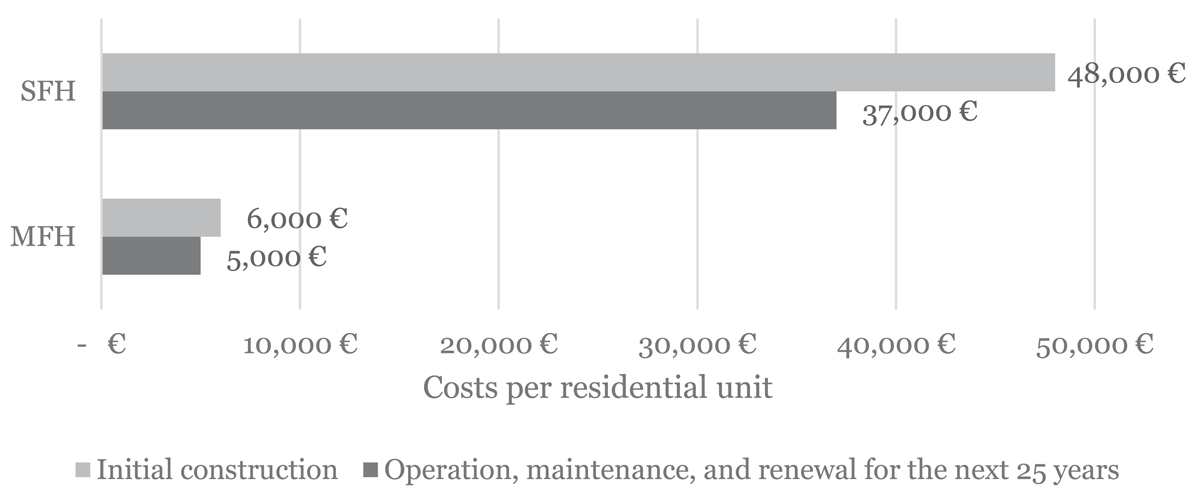
Figure 3
Municipal development and infrastructure costs per residential unit for SFHs and MFH apartments. Own representation based on cost data from the Federal Foundation for Building Culture (Bundesstiftung Baukultur, 2020), converted using the construction price index (BKI, 2026) to Q4/2025.
Willingness to change and resulting housing potential
This chapter examines how SFH residents could change their living situation to better fit their needs and to create more or new living space or distribute it more efficiently (Chapter 4.1), how willing people are to do so (Chapter 4.2), and what housing potential this could enable (Chapter 4.3).
For the purposes of this paper and the underlying projects, the forms of change in living situations refer only to selected measures relevant to SFH. Other measures related to sufficiency, such as flexibility or mindful user behaviour (Zimmermann and Firat, 2024), are also important but are not the focus of this study.
Housing potential is understood as the number of residential units that can be (re)created with the introduced forms of change in the living situation of SFH residents. This can resolve existing misallocations, create more dynamics in the housing market, and set chains of relocation in motion.
Forms of change in the living situation of SFH residents
Inspired by (Fuhrhop, 2023), three space-saving housing alternatives for empty-nest households in SFHs who are ready or interested in change can be derived (see Table 1). Moving to an MFH, conversion and renting out a new separate apartment, or shared living through partial rental of rooms enable an adjustment of apartment sizes and housing types appropriate to the stage of life.
Table 1
Forms of change in the living situation of SFH residents (Zimmermann et al., 2025a, p. 28, own translation).
| MOVING TO AN MFH | CONVERSION AND RENTING OUT SEPARATE APARTMENT | SHARED LIVING THROUGH PARTIAL RENTAL OF ROOMS | |
|---|---|---|---|
| Description | Current household moves to a smaller apartment in an MFH | Rebuilding of the SFH to create two separate residential units (e.g., a granny apartment) | Renting out individual rooms within the SFH that have not previously been used for living; part of the living space (e.g., kitchen) is shared |
| Impact on the housing market | Increasing availability of SFHs for sale or rent, allowing a family or shared living community to move in | Increasing availability of (small) apartments within the SFH | Increasing availability of single or several rooms within a shared SFH |
| Dealing with existing SFH |
| Remaining in the possession of the previous owners | Remaining in the possession of the previous owners |
| Necessary structural changes | None (if necessary, by new owners/inhabitants) |
| Minimal to none |
| Type of living space created | Entire SFH | Individual apartment in a single-family home | Individual rooms (shared apartment) |
| Time frame for implementation |
| Medium term | Short term |
| Legal form of new living situation (in SFH or MFH) |
|
| Rental |
Residents’ willingness to change
The approval rates for the three forms of hypothetical change in the living situation of SFH residents were determined through a representative survey.
A key quantitative result from the SuWoKu project is summarized in Figure 4. The respondents were asked to rate the three forms of change in the living situation—moving to an MFH, conversion and renting out, shared living through partial rental—as conceivable for themselves or not on a scale of 0–10. The forms of change were presented as hypothetical scenarios of living after the children moved out. The response options 8-10 were evaluated as agreement with “yes” and used for calculating the minimum approval rate. The response options 6–7 were categorized as “maybe”.
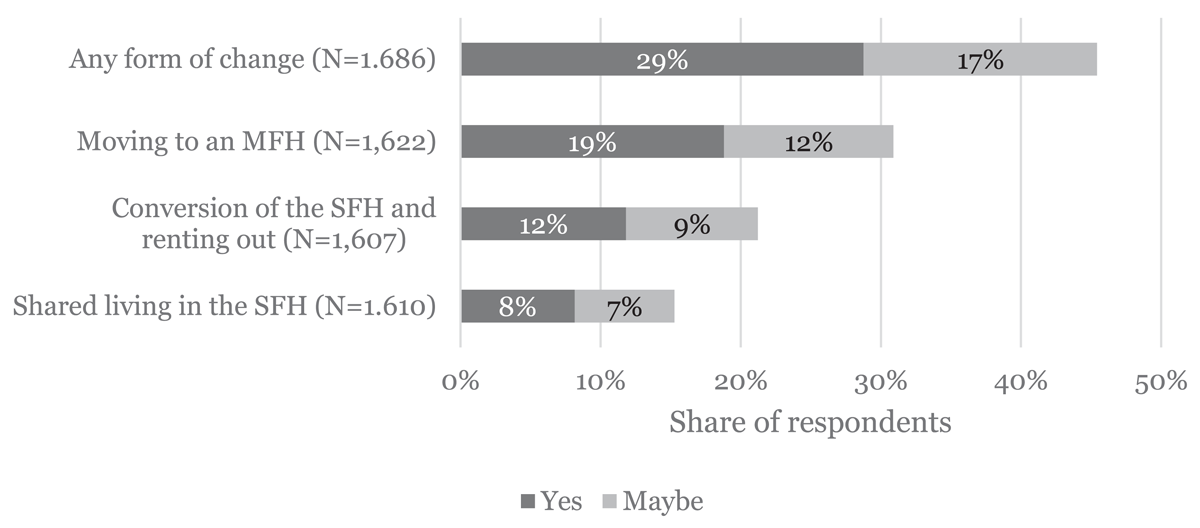
Figure 4
Willingness to change the living situation of SFH residents over the age of 50 in 1–2 person households in districts with a vacancy rate below 6% (Bader et al., 2026; Gabriel et al., in publication).
Almost half (45%) of the respondents are (somewhat) willing to change their living situation.1 Regarding the three options mentioned above, homeowners are more willing to move than to reconstruct and rent out a part of their SFH as a separate apartment.2 They are most sceptical about renting out individual rooms, i.e., forming a shared form of living. Thus, the social hurdle of sharing their living space with others appears more challenging than bearing the costs of converting the SFH or saying goodbye to the cherished SFH, despite the effort of moving. Accordingly, only 42% of underoccupied SFHs with an existing separate apartment have actually rented it out (Gabriel et al., in publication).
The survey provides additional details that can be used to narrow down potential target groups.
House owners with lower incomes tend to be more receptive to more sufficient forms of housing. This is not surprising, given the relatively higher burden of running and maintaining the SFH. One exception to this greater willingness to change among people with lower incomes is the conversion of their own home for division, if the conversion requires long-term refinancing.
Women and people with higher education are also more ready to change their living situation.
The relationships between age and readiness for change diverge: Owners over the age of 65 are more willing to move, while people between the ages of 50 and 65 are more willing to convert their own home.
The availability of affordable, barrier-free apartments in a central location with shopping, cultural and sports facilities, and healthcare has a positive influence on willingness to relocate. For the conversion of SFHs to be attractive, refinancing should not take longer than 10 years.
Housing potential
For these calculations, data from the German Federal Statistical Office on the building, housing, and household stock, as well as the results of the representative broad survey were used. The respondents’ approval rates for each form of change (proportion of those willing or interested in change) were extrapolated to the German population. Summing up the approval rates “maybe” and “yes” results in a bandwidth between minimum and maximum values in order to do justice to the heterogeneity and distribution of the survey results, as well as the (political or social) scope for shaping them. The sample was reduced to exclude all regions with a vacancy rate above 6%, as there might be insufficient demand or migration to these areas.
Housing potential is understood to be the number of households that can imagine the respective form of change. The number of households also corresponds to the number of residential units that would be created in the housing stock as a result. According to Table 1, these vary from entire SFHs (moving to an MFH), individual apartments in the SFH (conversion and renting out), and “individual rooms” (shared living). The theoretical housing potential consists of 8.7 million households (or residential units) who live alone or in pairs in SFHs in regions with low vacancy rates. Table 2 summarizes the calculations. When interpreting the results, it should be noted that the potential of the three options for action cannot simply be added together because some respondents could imagine more than one form of change.
Table 2
Housing potential of households in SFHs with one or two persons in regions with low vacancy rates (Destatis, 2022b, 2022c; Gabriel et al., in publication).
| POTENTIAL | EXTRAPOLATION OF THE SHARE OF RESPONDENTS WHO CAN IMAGINE … | MILLION HOUSEHOLDS (TOTAL = 8.7 m) | |
|---|---|---|---|
| YES | YES + MAYBE | ||
| Any form of change | … at least one form for change. | 2.5 m | 4.0 m |
| Moving to an MFH | … moving out of their SFH into an MFH. | 1.6 m | 2.7 m |
| Conversion of a SFH and renting out | … converting/splitting their SFH and renting out a new separate apartment. | 1.0 m | 1.9 m |
| Shared living in the SFH | … renting out individual rooms in their SFH. | 0.7 m | 1.3 m |
At least around 2.5 million households are considering one of the three scenarios for themselves, i.e., they are willing to make changes, which could create corresponding living space. There are very clear preferences regarding the three scenarios. Since moving seems to be the most attractive option for most people, this also offers the greatest potential for creating living space. Based on the assumptions made, around 1.6 million to 2.7 million SFHs are available. This means two things. On the one hand, the SFHs become available for those looking for an SFH, e.g., young families. On the other hand, suitable housing for the empty nest households that are moving out must also be available or created. The second-largest potential lies in the conversion and division of SFHs (1 million to 1.9 million). The lowest potential of the three scenarios for creating living space is offered by shared living in SFHs (0.7 million to 1.3 million). However, this option would not generate entire, independent apartments, but rather individual or, in some cases, several rooms.
Environmental savings
Leveraging the identified potential for living space in the existing SFH stock results in less negative impact on the environment, as fewer new buildings are needed to meet the housing demand (Bierwirth and Thomas, 2019; BPIE and Ramboll, 2024; Jonas Lage et al., 2025; Kenkmann et al., 2019; Zimmermann et al., 2023). The chapter on ecological impact illustrates at a general level that the high negative impact on the environment of today’s new SFHs can theoretically be avoided entirely. The savings potential for 2024 is therefore around 6.3 million tons of CO2 equivalents and 30 million tons of material consumption annually, as well as 14 hectares of land use per day.
Below are a few calculations that break down these maximum results in a more granular way. The embodied carbon emissions are used as the key indicator, as they are the main difference between different ways of creating living space if comparable energy standards are adopted. The impact on operating emissions is therefore not taken into account.
The three forms of change in the living situation of SFH residents are now analysed from a climate impact perspective (results see Figure 5):
Moving to an MFH: The current SFH household moves into a smaller apartment in a newly built MFH. This avoids the need to build a new SFH for the moving-in household, e.g., a family of four, moving into the existing SFH. No (major) modifications to the SFH are necessary.
Conversion: The current SFH will be structurally divided into two residential units, which will generate whole life embodied carbon emissions. The construction of an apartment in a newly built MFH will be avoided, which would have to be built for the people moving into the new separate apartment in the converted SFH.
Shared living: No major renovation work is necessary. The construction of new individual rooms in an MFH, e.g., a student residence, is avoided when young people move in through the “Homesharing” or “Housing for Help” model.
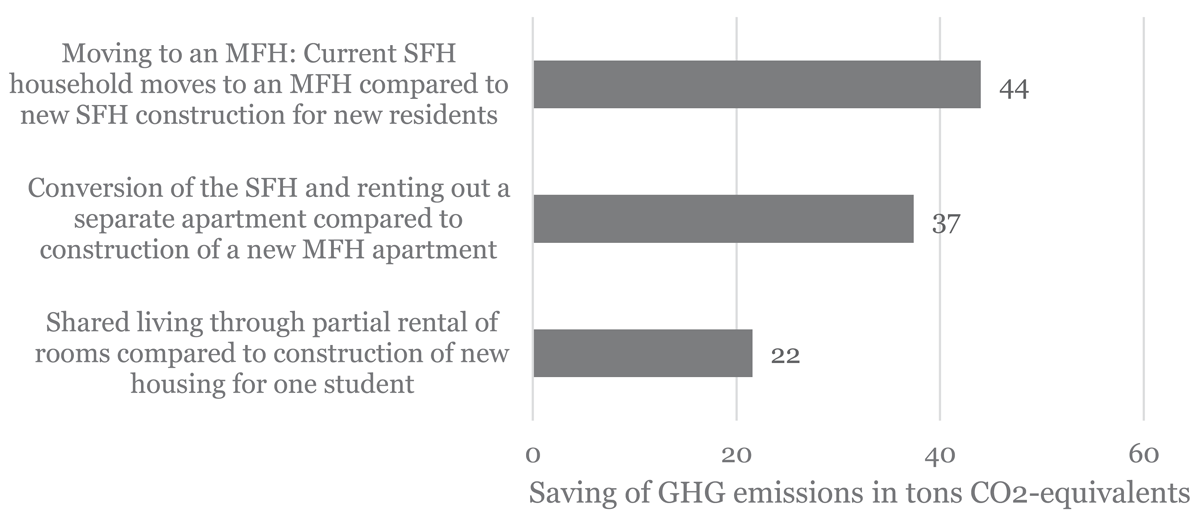
Figure 5
Results GHG calculations per SFH household changing its living situation; own calculation and depiction based on Mahler et al. (2019) & DGNB (2025).
The following whole life embodied carbon emissions can be calculated for the new buildings used for comparison based on literature values (Mahler et al., 2019). As mentioned above, the construction of a new SFH (155 m2, 600 kg/m2 GHG emissions) causes around 93 tons of CO2 equivalents. The construction of a new apartment (68 m2 for 2 people) in a MFH with 700 kg/m2 (Mahler et al., 2019) would result in around 48 tons of GHG emissions. When the inhabitants of the SFH move to an apartment in an MFH, the family moving in avoids building a new SFH (93 tons), but the former inhabitants need a new MFH apartment (48 tons), resulting in a difference of about 44 tons of CO2 equivalents.
The calculation for splitting an SFH is somewhat more complex. An approach based on Zimmermann (in progress) is used. The starting point is a comparison of renovations with new buildings, which, according to DGNB (2025), cause only one-third of the GHG emissions. It is also assumed that complete energy-efficient modernizations are more complex than simple conversions, which is why the lower limit (500 kg/m2) for new buildings from Mahler et al. (2019) serves as a basis and a further reduction of 10% is applied. It is assumed that an average free-standing SFH with 136 m2 is divided into two apartments of equal size (68 m2). The GHG emissions for the conversion are therefore 10 tons of CO2 equivalents. As this avoids the new construction of an MFH apartment (48 tons), the difference of about 37 tons of CO2 equivalents is avoided.
The construction of a new student apartment (31 m2, 700 kg/m2) would result in GHG emissions of around 22 tons of CO2 equivalents. It can be avoided by each student moving into rooms of an existing SFH.
Policy recommendations
Based on empirical surveys from focus groups and on a literature review, the following sub-chapters present proposals for political actors on how SFH residents could better adapt their living situation to their needs. The suggestions are based on the findings of the “SFH: Quo Vadis?” project which included a review of the literature, a survey of municipalities and research on best practices (Zimmermann et al., 2025a). Similar proposals for a more sufficiency-oriented policy mix in the building and housing sector are also suggested in other literature (Andert et al., 2025; Fuhrhop, 2023; Kenkmann et al., 2023; Loidl et al., 2025).
Before presenting the individual proposals, overarching qualitative findings will be presented here in the form of theses that can help to find effective narratives in political implementation and communication:
From the perspective of local authorities, a new approach to existing SFH housing and new buildings is primarily justified by economic necessities and demographic changes. Environmental protection can certainly be mentioned as an additional benefit, but it should not be the main focus.
Across society, intergenerational justice in the housing market, the shortcomings in care, “higher quality of life through community and age-appropriate living” (Andert, 2025), and “a guarantee for lifelong, affordable housing, a sense of community, a trustworthy and needs-oriented process design, and needs-oriented infrastructure” (Lage, 2025) are strong incentives for the transformation of SFH neighbourhoods.
Sufficient housing policy does not primarily mean generating more willingness or interest in change, but rather enabling those who can already imagine or desire a different way of living to do so. It is therefore less about persuasion and more about empowerment. As a result, the likelihood of imitation and thus cultural change increases.
A stronger focus on renovation and conversion rather than new construction is not an economic constraint, but opens new growth markets for planners, construction companies, the financial sector, and (digital) matching platforms.
In terms of terminology, circularity, mobilization of existing living space, or relocation chains seem to be more beneficial than sufficiency (ZiWoNu, in progress). The term “housing shortage” is also counterproductive, as it tends to reinforce a mindset focused on new construction.
Regarding the three sustainability strategies, playing them off against each other is likely to be counterproductive. Rather, sufficiency approaches could offer an opportunity to promote energy efficiency improvements or renewable energies, for example, if the creation of a new rentable residential unit during renovation enables faster or more reliable amortization.
The following policy recommendations cover the full range of policy options, from pull factors to push factors. All instruments certainly function to a certain extent on their own, but only unfold their full potential when combined.
Awareness raising
Resolving today’s areas of tension requires broad social awareness in both the short and long term. The current focus on new construction in public communication must be critically questioned, successful practical examples or best practices must be made better known, and a positive, motivating nationwide campaign is needed.
Consulting services
As a relatively simple and short-term measure, living space consumption should be integrated into the various established energy consulting tools, such as individual renovation passports.
The most effective measure appears to be the establishment of local consulting services in the form of municipal housing agencies. There, SFH residents can seek advice on all questions relating to a potential change in their living situation (with the aim of downsizing or improving accessibility). Municipalities, which are already in financial straits today, need support from the federal government for this. On the one hand, financial support and, on the other hand, structural support in the form of a supplementary nationwide housing agency that orchestrates or supplements municipal activities.
Building subsidies
It is essential to gradually reduce the misguided incentives created by the existing subsidies for new construction (of SFHs). To this end, stricter requirements must be introduced on the one hand, and less budget made available on the other. The funds thus freed up should be channelled into the renovation or conversion of existing buildings. For example, subsidies could be provided for the structural division of SFHs (“turn old into two”).
Fiscal instruments
In this area of policy, too, existing misguided incentives must be reduced by making municipal financing less dependent on new construction and growth. Other potential measures include vacancy taxes, re-letting premiums, tax exemptions for alternative forms of housing, and subsidies for downsizing.
Municipal planning processes
Municipalities can also promote the transformation of SFH stocks by incorporating the issue into municipal planning processes. The first step is to close data gaps, e.g., to record renovations and conversions, vacancies, and under-occupancy. The insights gained can be incorporated into integrated urban development concepts, integrated energy-efficient neighbourhood concepts, and municipal heating plans. Voluntary commitments to reduce land consumption by municipal councils, for example, by not designating new building land and focusing exclusively on inner-city development, would be an effective instrument, too. Finally, the systematic updating of zoning plans to open up opportunities for redensification in existing buildings and the use of concept award procedures for municipal land would be useful levers.
Regulatory framework
Finally, there are several regulatory improvements that could be made. These include, on the one hand, the conversion-friendly revision of design and parking space regulations as well as building codes. On the other hand, any relief on the housing market also helps empty nest households in SFHs to find alternative offers more easily. For this reason, housing protection laws or bans on misuse of property, as well as a right to exchange apartments—for example, as in Austria—also have indirect positive effects on the SFH segment.
Conclusion
Single-family homes, and especially their new construction, shake the three pillars of sustainability (ecology, society, and economy). They have a huge ecological footprint, are a major financial burden for both residents and municipalities, and, for some of their residents, are no longer fitting their needs. Residents who are open to change have three options for living in a more space-saving and needs-oriented way in the future: moving to a smaller apartment in an MFH, conversion of a SFH and renting out a separate apartment, or shared living in a SFH through partial rental of individual rooms. Although most of the target group of SFH residents are (currently) not willing to change, almost half of the respondents in under-occupied SFHs can imagine at least one of the three options for change. Accordingly, the potential for creating additional new living space in existing SFHs without resource-intensive new construction and therefore the potential to reduce environmental impacts, is also very high.
Politics can provide support at all levels. To ensure that sufficiency is perceived as a door opener rather than a showstopper, a number of aspects needs to be considered when designing the instruments and communicating them. Individual instruments alone will not be as effective in implementing sufficiency as a combination of different measures. Passive (information material) and active (counselling services) as well as short-term (empty nest specific) and long-term (including young families) awareness-raising are needed, as are economic support (subsidies for splitting SFHs) and regulatory relief (development plans). The coexistence of sufficient and counterproductive (e.g., new construction subsidies) regulations places a burden on municipal budgets, and the contradictions are likely to stand in the way of sending a broad signal. Therefore, non-sufficient instruments must be phased out. Sufficiency measures require an early, encouraging, non-patronizing, and positive awareness-raising approach. If these proposals are considered when implementing policy measures, demographic change and economic reality can open the door to the sufficient, efficient, and consistent socio-ecological transformation of the SFH stock.
Tools
DeepL Pro was used for translations from German (the original language of the two research projects) during the writing process for this article.
Additional File
The additional file for this article can be found as follows:
PowerPoint Slides
PowerPoint Slides relating to this article. DOI: https://doi.org/10.66506/essp.7-295-26.s1
Notes
[1] As mentioned above, the analysis includes only respondents living in 1–2 person households in SFHs located in regions with vacancy rates below 6%—where selling or renting out an SFH or parts of it would be easy.
[2] The housing association Verband Wohneigentum finds in a large survey (n = 930) among homeowners in 2024 a higher willingness to rent out than to move to a smaller apartment (Verband Wohneigentum, 2024). The agreement seems to depend on the effort for the conversion.
Data Accessibility Statement
No data beyond what is included in the respective final reports of the two research projects or in this article was published.
Authors Contributions
Patrick Zimmermann: Conceptualisation, methodology, formal analysis, visualisation, writing – original draft, writing – review and editing
Felix Bader: Conceptualisation, methodology, formal analysis, visualisation, writing – review and editing
Janika Gabriel: Writing – review and editing, supervision
Lars-Arvid Brischke: Supervision
eceee Paper ID
7-295-26