
Introduction: the blind spot in retrofit policy
Residential buildings account for a substantial share of final energy consumption and emissions in the European Union (EU) and the United Kingdom (UK). Given that up to 95% of buildings standing today will still exist in 2050 (Council of the European Union, 2021), renovating the existing housing stock is widely recognised as essential to achieving climate targets and decarbonising buildings.
To date, policy and government funding have largely focused on two directions for retrofit initiatives: building fabric improvements, such as insulation, airtightness, and windows, and green technologies, including space and water heating electrification, EV chargers, and solar panel installations. Yet one significant fossil fuel-based end use remains largely absent: cooking appliances. This means that homes undergoing major decarbonisation interventions may still be only partially electrified and stay connected to the gas grid. In contrast, removing gas boilers, hobs, and ovens at the same time and replacing them with electric alternatives offers households the opportunity to end their use of gas altogether.
Gas hobs and ovens remain widespread across the EU and the UK. About 32% of EU households, or roughly 67 million homes, still cook with gas. Prevalence varies significantly across countries, with Italy, Romania and the Netherlands leading the chart at 69%, 65% and 65% respectively (Hannah Blair et al., 2023a). High levels of gas cooking persist for several reasons, including familiarity with the technology, and high electricity costs (Hannah Blair and Sara Demartini, 2023). This highlights the need for explicit support for cooking upgrades within renovation and electrification strategies.
From a public health perspective, gas cooking is a significant but under-recognised source of indoor air pollution. From a climate perspective, a gradual phase-down of gas cookers has the potential to reduce up to 70 megatons (Mt) of carbon dioxide (CO2) emissions by 2050 in the EU and UK. In terms of energy use, induction technologies can be up to twice as efficient, significantly reducing cooking time. At the system level, continued reliance on gas solely for cooking sustains demand for gas infrastructure, slowing network decommissioning and locking in avoidable costs. At the household level, partial electrification results in ongoing payment of fixed gas network charges. Ultimately, electrifying a relatively small end-use appliance has disproportionate system and policy impacts.
This paper argues that cooking electrification represents a critical but overlooked component of whole-home decarbonisation. While the energy savings are smaller than those achieved through heating system upgrades, electrifying cooking is a necessary systems intervention to ensure the effectiveness, affordability, and equity of heat-led retrofit policies. This work outlines why government and financial support for cooking electrification is needed, identifies current policy gaps in the EU and UK, and explores how these can be addressed, drawing on a UK social housing pilot that demonstrates feasibility and strong resident acceptance. It concludes with lessons learned and actionable recommendations for both the EU and the UK.
Putting cooking on the retrofit agenda: the case for policy and financial support
If retrofit programmes are to deliver fully decarbonised homes, cooking technologies cannot be treated as a minor appliance choice. This section outlines why support for cooking electrification is needed, focusing on five key dimensions: system and infrastructure implications, energy efficiency, health and indoor air quality, consumer information, and market trends.
System and infrastructure implications
Continued use of gas for cooking has disproportionate system-level consequences as heating and hot water electrify. As households switch to heat pumps, overall gas demand decreases, yet gas networks continue to remain operational to serve a residual end use such as cooking. By sustaining residual gas demand, gas cooking also prolongs reliance on imported fossil fuels, weakening energy security objectives at a time when electrification is intended to reduce exposure to volatile international gas markets.
This dynamic dilutes the impact of public investment in heating decarbonisation: the gas system remains in place, delaying the benefits of network retirement. Moreover, as higher-income households move away from gas, network costs are spread across fewer users, increasing the per-capita burden on those who cannot afford the upfront cost of switching. Upgrading cooking appliances during heating retrofits would help address this affordability gap and ensure a more equitable transition. This would also improve efficiency for households by reducing disruption, avoiding repeated interventions, and minimising time spent accommodating multiple installation visits.
About a third of Europeans are tenants (RE/MAX Europe, 2025) and face an additional specific barrier. They have less control over their homes, which adds another layer of complexity. A 2023 CLASP survey found that 25% of respondents cited being “unable to switch if renting” as a barrier to electrification (Hannah Blair and Sara Demartini, 2023). In some cases, the tenants own the appliances, but the landlords are responsible for the gas piping and electricity wiring (UK). In other cases, the appliances are provided with the apartment (Romania). Residents may fear any upgrades would result in a rent increases or displacement, a phenomenon known as ‘renoviction’ (Marine Cornelis, 2023). As a result, key questions, including who is to bear the financial cost of disconnection from the gas network, often lack clear answers and remain unresolved.
Energy efficiency impacts
Gas cooking is significantly less energy efficient than modern electric alternatives. A large share of the heat produced by gas hobs is lost to the surrounding air, whereas induction transfers energy directly into cookware, reducing heat losses and significantly shortening cooking times. CLASP testing shows that induction can be almost twice as efficient as gas under comparable conditions (170 Wh/kg of water versus 354 Wh/kg), whereas current test methods under Ecodesign partially obscure this difference (Cristina Pricop, Nicole Kearney, and Marie Baton, forthcoming).
At the household level, cooking represents a relatively small share of total energy consumption (Eurostat, 2025). Nonetheless, switching to more energy-efficient technologies can still deliver tangible benefits, including significantly reduced cooking times. While these gains may appear modest at the individual level, when aggregated across households they translate into meaningful system-wide effects. Across the EU and UK, scenarios involving a phase-down of gas hobs from 2027 and a phase-out by 2030 could mean avoiding over 70 Mt of CO2 emissions by 2050 (Electrifying Cooking in Europe, 2025).
Health and indoor air quality
Gas hobs emit pollutants that directly affect indoor air quality and occupants’ health. Nitrogen dioxide (NO2) is a key concern, linked to a range of adverse health outcomes, including increased risk of premature mortality, cardiovascular and respiratory disease, asthma exacerbation, and wheezing in children (Juana Maria Delgado-Saborit et al., 2024). The severity of these impacts is reflected in the inclusion of NO2 among the pollutants in the World Health Organization’s (WHO) Air Quality Guidelines (AQG). It sets limit values that serve as a global guideline for public health, based on the best scientific evidence and apply to both indoor and outdoor environments. Electric cookers, by contrast, do not emit NO2. Replacing gas with electric cooking brings immediate health benefits by removing a key source of indoor air pollution and improving air quality.
To understand the scale of the impact from gas cooking in European homes, CLASP conducted a field study, collecting data from over 250 homes in seven European countries. It found that over 54% of European households using gas for cooking exceed the WHO’s AQG for NO2 (Nicole Kearney, 2023). A health impact assessment, based on data collected by CLASP, estimates that gas cooking is linked to approximatively 40,000 premature deaths and 77,000 years of life lost annually across the EU and UK combined (Juana Maria Delgado-Saborit et al., 2024).
Switching to electric cooking is the quickest and most direct way to eliminate NO2 pollution at its source. This recommendation is reflected in the fifth edition of the European Code Against Cancer (International Agency for Research on Cancer, World Health Organization, 2025). This highlights that cooking electrification is not simply an appliance upgrade, but a preventive public health intervention.
Gas cooking also conflicts with the EU’s electrification and broader efficiency goals. Energy efficient buildings are typically more airtight, reducing indoor-outdoor air exchange unless residents ventilate intentionally. However, in practice, effective ventilation requires proper use and maintenance, and is prone to user error. The CLASP field study also shows that households with cooker hoods, whether externally ducted or recirculating, did not experience significantly lower NO2 levels than those who reported having no ventilation hood. This underscores the need to align energy efficiency and electrification strategies. Retrofit programmes present a clear opportunity to improve indoor air quality by including the transition to electric cooking.
Consumer information
Surveys conducted across eight European countries show that people consistently rank energy use, energy efficiency, and indoor air quality among the top factors they consider when buying cooking appliances (Sara Demartini, 2024). Under the current EU and UK frameworks, none of this information is easily available for hobs. Despite serving the same function, gas and electric hobs are tested using different methodologies, with differences including different pot sizes for similar heat inputs and the inclusion of a simmering test applied only to electric hobs.
The data that informs efficiency calculations for hobs also skews the results. The Primary Energy Factor (PEF), incorporated into the Ecodesign test methods for hobs, describes the efficiency of converting primary energy sources (e.g. gas, solar power) to secondary energy carriers such as electricity. However, the current coefficient does not account for the rapid decarbonisation of Europe’s electricity supply. As a result, the efficiency calculations may overestimate the primary energy required for electricity. This can make gas and electric hobs appear similarly efficient on paper, despite significant differences in real-world performance. Once the PEF is updated, the efficiency advantages of electric hobs will become more apparent.
These inconsistencies in test methods and outdated calculation assumptions also prevent the development of a unified labelling system. Meanwhile, nearly all European consumers would welcome an energy efficiency label enabling direct comparison of the efficiency of hobs (Hannah Blair and Sara Demartini, 2023). An energy label can offer consumers the information they need to make informed purchasing decisions. In the absence of such a label, retrofit schemes can effectively shape default appliance choices and highlight the higher efficiency and additional user benefits of electric cooking.
Market trends
Compared with heating solutions, cooking appliances appear relatively inexpensive. This may partly explain why policy support has largely overlooked them, based on the assumption that once heating is electrified, cooking will follow. However, market data does not support this hypothesis: although electric hob sales have increased, gas hob sales have remained stable between 2015 and 2022 (Rocio Rodriguez Quintero et al., 2020). Moreover, industry forecasts also predict continued market growth for gas appliances, with sales expected to rise from 13 million units ($1.3 billion) in 2024 to 16 million units ($1.8 billion) by 2035 (IndexBox, 2025).
Market research conducted by CLASP in eight European countries (France, Italy, Poland, Romania, Slovakia, Spain, Sweden, United Kingdom) explored consumer perceptions of different cooking technologies (Sara Demartini, 2024). Although analyses show induction to be cheaper than gas in many instances when the total cost of ownership is considered (CLASP, 2024), many households still perceive induction appliances as more expensive to purchase, install, and operate (Figure 1).
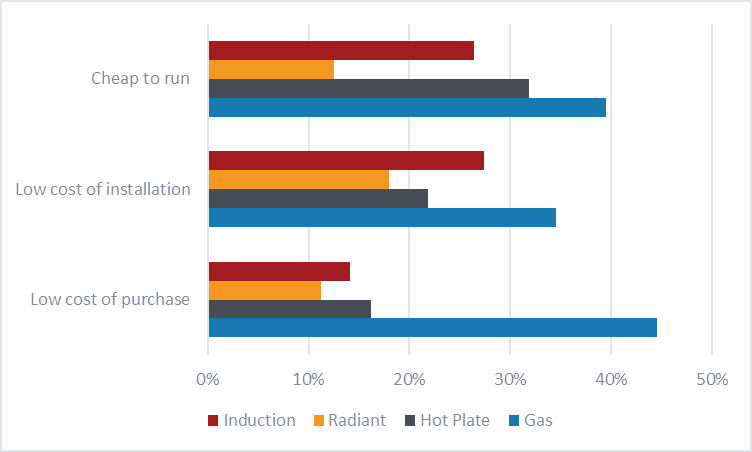
Figure 1
Consumer perceptions of the costs associated with different hob technologies.
Adoption of induction appliances is slowed down not only by cost, but also by familiarity with old technologies. A separate CLASP survey, conducted across four European countries (France, Romania, Spain, United Kingdom), revealed that being “used to cooking on gas”, together with concerns about “increased electricity bills” represent the main barriers to switching from gas to electric cooking appliances (Hannah Blair and Sara Demartini, 2023).
These findings suggest that the transition away from gas cooking is unlikely to occur automatically as part of broader electrification trends. Without targeted policy measures addressing costs, cost perceptions, and consumer habits, gas cooking appliances are likely to remain widespread in European households.
Taken together, these dynamics and effects show that electric cooking is not a marginal appliance upgrade, but a critical lever for equitable and cost-effective decarbonisation. Yet current policy frameworks do not reflect this reality, as the following review shows.
A policy review: whole-building decarbonisation without cooking electrification
Recognising the building sector as an important element at the intersection of climate and social policy, decision-makers across Europe have designed a number of dedicated decarbonisation policies with associated funding. These typically focus on measures to improve insulation and install efficient, decarbonised heating options, but rarely include cooking electrification among measures recommended or eligible for funding. The subsections below analyse the EU and UK policy landscape in more detail.
The UK context
The UK Government has committed to ambitious net-zero targets by 2050, requiring progressive decarbonisation of residential buildings. The recently published Warm Homes Plan, managed by the Department for Energy Security and Net Zero (DESNZ), intends to improve residential energy efficiency, as well as address fuel poverty, lower energy bills, improve public health, and tackle climate change and energy security (UK Government, 2026). To this end, grants will support upgrades such as solar panels and batteries, heat pumps powered by renewable energy, and improved building insulation.
The Warm Homes Plan assumes these grants will lead to fully electrified and decarbonised households. However, it omits support for cleaner cooking appliances, despite more than half of UK households still using gas cookers (Hannah Blair et al., 2023b). The plan lacks the funding mechanisms, technical support, and administrative pathways needed to enable complete gas removal, creating a gap between strategic ambition and operational delivery.
Another efficiency improvement instrument is the Energy Performance Certificate (EPC), which currently evaluates only “regulated” energy uses, including space heating, water heating, space cooling, ventilation and fixed lighting, but excludes cooking. This is important because improving EPC ratings has been an explicit objective of some funding schemes such as the Social Housing Fund or ECO4. Therefore, incorporating cooking into EPC assessments would broaden the range of eligible interventions.
By excluding cooking from both efficiency ratings and retrofit funding, the UK policy framework unintentionally undermines whole-home decarbonisation, especially in social housing where upfront costs are a bigger challenge and responsibilities are split between landlords and renters.
The EU context
The situation is similar at the EU level: major policy instruments aim to accelerate electrification, reduce energy demand and improve building performance, but they do not consider cooking electrification. The result is a policy blind spot that is replicated across Member States.
Renovation Wave Strategy
The European Commission published the Renovation Wave Strategy in 2020. Its goal was to renovate 35 million building units and double the EU’s annual renovation rate by 2030. It set out a vision for Europe’s building stock: “In 10 years, the buildings of Europe will look remarkably different. […] Fossil fuels will gradually disappear from heating and cooling” (European Commission, 2020). The Strategy provides the overarching policy framework guiding EU action on building decarbonisation, shaping legislative acts such as the Energy Performance of Buildings Directive (recast) and tools such as the EU EPC. Cooking electrification is not considered in the Renovation Wave, and this omission is carried through into many of the legislative acts and instruments it has influenced.
Energy Performance of Buildings Directive
The Energy Performance of Buildings Directive (EPBD) features instruments that support decarbonisation, such as the Renovation Passport, “a tailored roadmap for the deep renovation of a specific building in a maximum number of steps that will significantly improve its energy performance”, and the EU EPC (European Parliament and Council of the European Union, 2024). Cooking technologies are generally neither required nor recommended under these instruments. This omission creates a risk that buildings will reach the final stages of renovation with residual gas use that was never planned for or addressed.
The EPBD revision introduces provisions related to indoor environmental quality, including ventilation and pollutant exposure. However, while the directive defines “indoor environmental quality”, the concept remains broad, and its operationalisation, including specific standards and monitoring requirements, will largely be determined at national level. As detailed above, gas cooking is a significant source of indoor NO2. Meanwhile, the only pollutant that is specifically called out in the directive is particulate matter.
Replacing gas cooking with electric alternatives could be positioned as an energy efficiency measure and as an intervention aligned with indoor air quality objectives, but the current framework makes it less likely. By failing to explicitly link indoor air quality objectives to a major indoor combustion source such as gas hobs, the EPBD misses an opportunity to align health, efficiency, and electrification goals.
Energy Efficiency Directive
The Energy Efficiency Directive (EED) is the EU’s overarching framework for reducing energy consumption across all end-use sectors of the economy, including the residential sector (European Parliament and Council of the European Union, 2023). The directive’s provisions on consumer information and support under Article 22 require Member States to establish one-stop shops providing technical, administrative, and financial advice on energy efficiency to households. As with the Renovation Passport under the EPBD, one-stop shops are oriented around renovation pathways – insulation, heating systems, windows – and do not include guidance on cooking as part of a whole-home decarbonisation journey. As a result, households in social housing that engage with such a service are unlikely to be presented with the option to switch out their gas cooker as part of the transition and as a necessary step for full electrification.
Social Climate Fund and National Social Climate Plans
To support a fair and inclusive transition, funding instruments have been set up by the EU. The Social Climate Fund is a prime example. To benefit from the fund, Member States must develop National Social Climate Plans. While few plans have been formally submitted to date, Bulgaria’s plan explicitly includes efficient cooking appliances alongside efficient heating. This approach has received positive reactions, as seen in a dedicated social media post (Applia Bulgaria, 2025) from the appliance manufacturers’ association, APPLiA Bulgaria. This example suggests that including cooking appliances in electrification and efficiency measures can be seen by industry stakeholders as a reasonable and welcome policy direction, reinforcing the argument that the continued omission of cooking in other frameworks reflects a policy gap rather than a technical or market barrier.
Directive on common rules for the internal markets for renewable gas, natural gas and hydrogen
Directive (EU) 2024/1788 on common rules for the internal markets for renewable gas, natural gas and hydrogen, often referred to as the Gas Market Directive recast, forms part of the EU’s legislative framework to manage the transition away from fossil gas. In anticipation of declining demand, the directive introduces provisions requiring Member States and network operators to plan for the future of gas infrastructure, including the development of decommissioning plans when a substantial number of consumers disconnect from the network. The directive mandates coordination with existing decarbonisation instruments such as local heating and cooling plans. However, cooking is not addressed within these frameworks, and the planning architecture continues to reproduce the same delivery gap. Partial electrification of buildings, where heating systems are electrified, but cooking remains gas-based, prolongs gas network utilisation and delays decommissioning. In doing so, it risks creating stranded infrastructure and undermining the cost-effectiveness of the transition strategies envisioned by the directive.
European frameworks promote whole-building decarbonisation but leave residual fossil uses unaddressed, with cooking consistently omitted across both EU and UK policies. This persistent gap between strategic ambition and on-the-ground transformation becomes most visible at the stage of practical implementation, where unresolved end-uses complicate full decarbonisation. The Manchester pilot project helps illuminate this delivery gap.
Case study: Manchester Social Housing Retrofit Pilot
This case study examines whether cooking electrification can be practically, socially, and operationally integrated into heat-led retrofit programmes in social housing. It focuses on delivery feasibility, resident acceptance, and compatibility with existing retrofit cycles. It tests commonly cited barriers such as tenant resistance, technical complexity, and behavioural adaptation. The pilot was not designed to produce statistically representative results, but rather to generate implementation-relevant insights for policymakers considering the inclusion of cooking electrification in publicly funded retrofit schemes.
Scope and approach
In 2025, CLASP collaborated with Global Action Plan UK to pilot a small-scale household retrofit,1 exploring the process, challenges, and benefits of transitioning from gas to induction cookers in social housing (Global Action Plan and GAP, 2025). The pilot included the removal of gas cookers, installation of induction hobs and electric ovens, tenant engagement activities, and the development of information materials.
The pilot was delivered in ten social housing properties in Manchester that had already undergone air-source heat pump installations one to two years earlier, leaving gas cooking as the primary remaining fossil fuel end use. This context provided an opportunity to examine cooking electrification as the final step towards full household electrification.
Social housing was selected, as a primary focus of government-funded retrofit programmes which typically upgrade insulation and replace boilers with heat pumps. However, homes with gas cookers remain connected to the gas grid, meaning residents continue to face indoor air pollution from combustion and ongoing gas standing charges despite having electrified heating. Social housing also includes many of the most vulnerable households. While tenants benefit from lower-carbon heating, retaining gas for cooking limits the health and financial benefits of electrification. Prioritising social housing therefore supports a more equitable transition, ensuring low-income households benefit fully from clean, electric cooking.
Additionally, appliance ownership in social housing creates distinct implementation challenges. Tenants often own their cookers, while landlords are responsible for gas disconnections and electrical upgrades. This split responsibility requires coordination and clear processes during retrofit delivery.
Households were recruited in collaboration with the housing provider, with informed consent procedures and participation incentives reflecting the time required for installation and evaluation. Existing gas cookers were removed and replaced with electric ovens and induction hobs following a basic technical suitability assessment. No substantive constraints were identified in relation to electrical capacity, appliance dimensions, or gas disconnection. Installations were typically completed within one to two hours, indicating that cooking electrification can be accommodated within standard retrofit work packages without significantly extending visit duration. Induction-compatible cookware was provided and removed gas cookers were collected for recycling.
Baseline and endline evaluations combined household surveys and semi-structured interviews to capture changes in usability, satisfaction, perceived safety, and awareness of indoor air quality following the transition from gas to electric cooking. Indicative pre- and post-installation indoor air quality monitoring was conducted to provide contextual insight into changes in indoor air pollution, rather than robust quantitative impact estimates.
Key results
The pilot results challenge several common assumptions used to justify the exclusion of cooking from retrofit programmes, particularly regarding resident acceptance, usability, and delivery complexity.
Participating households reported consistently positive experiences, demonstrating that transitioning from gas to induction cooking is both acceptable and beneficial for residents in social housing. Initial concerns due to unfamiliarity with electric cooking technologies were common, stemming from lifelong use of gas appliances or negative experiences with older electric hobs. However, those concerns disappeared after the new induction units were installed and explained to residents.
Satisfaction with induction cooking was universal. Every participating household (100%) preferred their new induction hob to their previous gas hob, and 81% preferred their electric oven, with the remainder expressing no preference rather than favouring gas. The transition also proved easier than anticipated: 85% of households described the switch as easy or very easy, and subsequent interviews showed similarly positive responses, with 71% describing the change as very easy and the remainder reporting it as easy or neutral.
Perceptions of usability shifted over the course of the pilot. Prior to installation, only 10% of residents expected induction cooking would be easy to use, yet after the retrofit, 100% reported that it was easy, indicating rapid adaptation even among initially hesitant residents. Performance perceptions also improved substantially. While only 30% of participants initially expected induction to heat food quickly, 86% of participants reported positive experiences with heating speed after installation. Ease of cleaning was consistently highlighted as a major benefit, with all participating households reporting that induction hobs were easier to clean, a notable contrast to prior frustrations with gas burners and grates.
Safety was another key theme. All participants associated gas cooking with safety concerns – particularly relating to open flames and risks for children – while 57% reported that induction presented no safety issues at all. Many residents also appreciated the absence of combustion in the home, linking the change to a greater sense of household safety and comfort.
Awareness of the indoor air quality impacts of gas cooking rose from 40% before the retrofit to 100% afterward. Beyond convenience and performance, several residents with preexisting respiratory issues reported improvements in their health and wellbeing, including reduced symptoms, less chest tightness, and decreased reliance on inhalers. Although the pilot was not designed as a clinical study, these reflections provide meaningful insight into residents’ lived experiences of improved indoor air quality.
Taken together, the findings show unanimous preference for induction, rapid user adaptation, and a clear set of perceived benefits relating to speed, cleanliness, safety, and health. The results underline the substantial value of integrating electric cooking upgrades into wider home retrofit programmes and demonstrate that such interventions can deliver immediate and tangible benefits for residents while supporting broader decarbonisation objectives.
As a final project output, a local authority checklist was developed to provide practical guidance for local authorities and housing providers considering gas-to-electric cooker retrofits in social housing. The guidance emphasises the importance of project planning, stakeholder coordination, and risk management. In particular, it highlights the importance of early clarification of roles and responsibilities across housing providers, installers, and energy suppliers, and the need to build flexibility into timelines to address infrastructure, access, and supply-chain constraints. The checklist also stresses the significance of resident engagement, particularly in addressing concerns about electric cooking, supporting digital inclusion, and providing appropriate follow-up support.
Limitations
Representativeness: Although limited in scope and sample size, the pilot was sufficient to test delivery feasibility, resident acceptance, and integration with existing retrofit programmes, which are all key considerations for policy design. The findings should therefore be interpreted as implementation-relevant evidence rather than a representative impact evaluation. In addition, the households selected for the pilot had already undergone heating retrofits and were therefore already engaged in the energy transition process, which may have made them more receptive to further electrification measures than the average household.
Air quality measurements: Indoor air pollution is a complex issue influenced by many contributing factors. As this project was designed as a pilot rather than a scientific study, the main contributors to indoor air quality levels were considered where possible, but many additional variables were not controlled or measured.
Energy bill impacts: The pilot aimed to assess changes in household energy bill following the retrofit. However, constraints related to time, access to billing data, and resources for continued household engagement meant that the project team was unable to conduct a robust post-retrofit bills analysis during the project period.
Project costs: The costs of the pilot are not representative of those under large-scale deployment. Operating with a limited budget, the project team benefited from donated cookers and vouchers for new induction-compatible cookware. At scale, however, housing associations and local authorities could potentially reduce costs through bulk procurement and standardised delivery and installation processes.
Lessons learned
The Manchester gas-to-induction retrofit pilot produced several clear lessons about how cooking electrification can be effectively implemented within social housing settings. Overall, the project demonstrated that gas-to-induction retrofits in social housing are both feasible and highly valued by residents, also providing practical insights that can inform wider rollout across the EU and UK.
Takeaways from the pilot retrofit
Clear communication and support increase participation: Residents were more willing to transition away from gas cooking when the benefits of the retrofit were clearly communicated. Many participants were more familiar with gas cooking or had cultural cooking preferences, but became more receptive to participate once the project team explained the practical benefits of induction. In particular, explaining the financial implications of continued gas standing charges helped residents understand the benefits of fully disconnecting from the gas network. Removing financial and logistical barriers also played an important role. Covering all up-front costs (including compatible cookware) and providing practical support increased residents’ confidence in participating. Post-installation support further improved user experience, with demonstrations of the new induction controls which helped residents adapt, particularly those unfamiliar with touchscreen interfaces.
Coordination and preparation are critical: Robust preparation, communication, and coordination among residents, installers, delivery partners and the housing provider was essential to the smooth delivery of the pilot. Clear communication and coordination enabled installations to be completed quickly and efficiently. At the same time, small administrative issues, such as incomplete contact information or challenges in accessing shared utilities, showed how minor gaps in communication can slow implementation.
Recycling and disposal are manageable: The pilot also showed that recycling and disposal processes can be straightforward and sustainable. Gas cookers – composed primarily of metal – are relatively easy to recycle. Offering a convenient collection service ensured responsible disposal and reduced waste.
Repeatability & scalability beyond Manchester
Scaling the pilot requires building on lessons learned in Manchester and understanding how the enabling conditions identified can be replicated in diverse housing and governance contexts.
Despite the pilot’s success, discussions with local and national government stakeholders revealed that cooking electrification is not yet viewed as ready for integration into existing heating retrofit schemes. Policymakers indicated that a robust, more comprehensive business case is needed to justify action, including a transparent assessment of costs, operational requirements, and projected returns – including avoided gas standing charges, reduced health burdens, lower long-term network costs, and efficiency gains from bundling measures. Without quantified benefits and a clear model of associated financial payback, cooking electrification continues to be perceived as an appliance upgrade rather than a strategic enabler of full building decarbonisation. The absence of this evidence base remains one of the biggest obstacles to mainstreaming cooking electrification into retrofit and fuel poverty programmes.
The pilot also showed the effectiveness of health-focused engagement. Residents responded positively to conversations centred on indoor air quality, respiratory health, and child safety, particularly when the benefits of induction were explained clearly and common misconceptions about performance were addressed directly. Hands-on demonstrations further helped reduce uncertainty and build confidence in the technology. These engagement approaches can be adapted and scaled by local authorities, housing associations, and community groups to support wider uptake.
Cooking electrification can be integrated into existing retrofit cycles. A takeaway from the pilot was that cooker replacements would be easiest when combined with other planned works, such as heat pump installations, electrical inspections, or insulation upgrades. Bundling interventions in this way can reduce disruption for residents, minimise scheduling complexity, and eliminate duplicate contractor visits. Embedding cooking within whole-home retrofits will allow authorities and providers to deliver seamless interventions that maximise efficiency.
An equity-focused rollout, beginning with social housing, represents a practical entry point to funding holistic retrofits. Social housing providers often benefit from more centralised procurement and standardised retrofit processes, while social housing residents are more likely to experience higher exposure to indoor air pollution and greater financial vulnerability. Scaling the pilot model across social housing can deliver immediate health and affordability benefits while building institutional experience. Over time, similar approaches can be extended to the private rented sector through minimum standards, to owner-occupied homes through targeted incentive schemes, and to public and commercial buildings.
Overall, the Manchester pilot showed that gas-to-induction retrofits in social housing are technically viable, quick to deliver, and well received by residents. The case study offers a replicable foundation for delivering cooking retrofits at scale. It illustrates how these upgrades can be executed efficiently and why they should be integrated into wider decarbonisation programmes.
Policy implications for retrofit programme design
The Manchester pilot provides direct implementation evidence to inform the design of heat-led retrofit policies. First, it demonstrates that cooking electrification can be delivered quickly and without major technical barriers when bundled with existing retrofit interventions, supporting inclusion as a standard measure rather than an optional add-on. Second, the consistently high levels of tenant acceptance and preference for induction challenge assumptions that behavioural resistance limits feasibility in low-income or social housing contexts. Third, the pilot shows that leaving gas cooking unaddressed following heat pump installation prolongs dependence on the gas network without delivering commensurate benefits to households.
Taken together, these findings indicate that excluding cooking from retrofit programmes reflects institutional convention more than genuine delivery risk. Integrating cooking electrification into retrofit policy can strengthen the effectiveness, equity, and cost-efficiency of public decarbonisation investments.
The next section builds on these insights to set out the policy and programme changes needed to support full-scale deployment of cooking electrification.
Recommendations: integrating cooking electrification in UK and EU policies and projects
Delivering whole-home electrification requires closing the persistent policy gap around cooking. While heating and building fabric upgrades have become central pillars of EU and UK decarbonisation strategies, cooking electrification remains largely absent. The lessons from the Manchester pilot show that cooker replacement is technically straightforward, operationally manageable, and strongly supported by residents. Yet without explicit policy recognition and inclusion, it will continue to be overlooked. The following recommendations outline how governments can embed cooking electrification into mainstream retrofit delivery.
Fix the gap in policies and funding
The first step is to ensure that national and EU frameworks recognise cooking electrification as a core component of whole-home electrification. Cooking currently sits in a regulatory blind spot. Integrating it into building and energy efficiency policies, including the EPBD, the EED, and the UK Future Homes Standard would support broader policy objectives such as achieving zero-emission buildings, avoiding fossil fuel lock-in, improving indoor air quality, and reducing long-term system costs.
To operationalise this shift, governments should explicitly include electric cooking appliances as eligible measures within national renovation and retrofit schemes. Funding should cover not only the appliance itself, but also associated electrical upgrades and – where feasible – full gas disconnection. Given the relatively low cost of induction hobs compared with heating technologies, the additional budgetary burden would be modest while enabling significant household and system-wide benefits.
Cooking appliances should be upgraded alongside heating systems rather than treated as a later intervention. Delaying their inclusion in retrofit policies increases costs and reduces the likelihood of full gas network disconnection. Evidence from the Manchester pilot shows that cooking electrification can be integrated into retrofit works with minimal additional disruption or cost when delivered alongside heat pump installations, indicating that exclusion from funding schemes is not justified by delivery constraints. The case study also illustrates that addressing cooking separately after heating retrofits can leave households locked into continued gas use and standing charges, whereas simultaneous delivery enables full gas disengagement.
Whole-home renovation tools must also be updated to include cooking electrification. Renovation Passports and other assessment frameworks should document cooking technologies, the status of gas connections, and the conditions required to achieve full electrification. Without this information, buildings may undergo deep renovation yet retain residual fossil fuel use that complicates future gas network decommissioning.
Finally, cooking should be incorporated into Energy Performance Certificates (EPCs). The forthcoming Home Energy Model in the UK presents an opportunity to reflect real household energy use, including cooking, in EPC ratings. This is particularly important for fuel-poor households, for whom cooking costs represent a proportionally larger share of energy expenditure. Incorporating cooking within EPC frameworks would also broaden the range eligible interventions under schemes such as the Social Housing Fund and Local Authority Delivery programmes. Findings from the Manchester social housing pilot demonstrate that induction cooking is not only acceptable but preferred by social housing tenants following installation, challenging assumptions that switching cooking technologies would face resistance in rental housing or low-income contexts.
Increase public awareness and improve market transparency
Most households currently lack clear and accessible information needed to compare the efficiency, running costs, and emissions associated with hobs. Existing labelling frameworks should be updated to better reflect energy performance and indoor air quality impacts.
A mandatory emissions or air pollution warning on gas ovens – and the introduction of a harmonised label for hobs – would equip consumers with important information to inform purchasing decisions. Standardised efficiency and emissions information, enabled by common test methods and minimum performance standards, would also help manufacturers and retailers align with decarbonisation and public health priorities and shifting market expectations.
Public communication is equally important. Although awareness of outdoor air pollution is increasing, the risks associated with indoor sources such as gas hobs remain poorly understood. Government-backed indoor air quality campaigns, combined with positive stories from households that have transitioned to induction, could help address the familiarity bias that keeps many consumers attached to gas. With evidence showing that a majority of the public would reconsider their gas cooker if its health impacts were clear, improving public awareness is a vital enabler of voluntary uptake and broader market transformation.
Align building retrofits with the gas network transition
As heating electrification accelerates, continued reliance on gas for cooking risks delaying the timely decommissioning of gas networks. Retrofit planning must be coordinated with local gas phase-out strategies, area-based electrification programmes, and long-term planning responsibilities of network operators. Aligning building upgrades with gas decommissioning plans will reduce ongoing infrastructure costs and help ensure that low-income households are not left paying disproportionately high standing charges as the number of gas users declines. Including cooking in this planning architecture ensures that neighbourhood-level transitions do not stall unnecessarily.
By showing that cooking often remains the final barrier to full gas disconnection, even after heat-pump installation, the Manchester pilot highlights how partial electrification undermines the system-level objectives of heat-led retrofit programmes.
Recognise cooking electrification as a strategic enabler
Cooking electrification is more than a household convenience upgrade – it is a strategic enabler of safe, efficient, and complete home decarbonisation. Treating it as such would unlock multiple policy benefits: reducing dependence on fossil fuels, improving indoor air quality and public health, and lowering long-term infrastructure costs.
Recognising cooking electrification as a strategic enabler can also strengthen public and political support for heat pump deployment by reframing electrification as a whole-home improvement rather than a single technology replacement. While heat pumps primarily deliver long-term climate benefits, induction cooking provides immediate, visible gains, including improved indoor air quality, faster and safer cooking, and the opportunity to fully disconnect from the gas grid and remove the fixed gas standing charges. For low-income households in particular, these savings can translate into tangible financial benefits. Bundling cooking upgrades with heat pump retrofits reinforces the everyday value of electrification, helps address affordability concerns linked to residual gas use, and supports the social acceptability and durability of heat-led decarbonisation strategies.
A coherent retrofit strategy must therefore position cooking electrification as a prerequisite for whole-home decarbonisation, built into funding frameworks, planning tools, consumer information, and network transition strategies. Implementing these measures would close the longstanding policy gap, align retrofit delivery with climate and health objectives, and ensure that homes undergoing major upgrades become genuinely fossil-free.
Conclusion
Cooking electrification remains a neglected element of residential decarbonisation strategies, despite its multiple benefits. It improves efficiency, reduces exposure to indoor air pollution, and enables full disconnection from gas networks, avoiding long-term infrastructure lock-in. Without it, retrofit programmes risk delivering fragmented outcomes that undermine coordinated gas phase-out efforts and reduce the overall effectiveness of decarbonisation strategies.
The Manchester pilot demonstrates that cooking electrification is technically straightforward, well accepted by residents, and operationally feasible when integrated into broader retrofit activity.
As the EU and the UK move toward large-scale building decarbonisation, the question is no longer whether homes can be electrified, but whether retrofit programmes will deliver complete and coherent transitions. Recognising cooking as part of whole-home electrification may appear to be a relatively small intervention at household level, but it is an important step toward an efficient and orderly transition away from fossil gas. A widespread transition to cleaner electric cooking represents a critical and attainable win for people and the planet.
Additional File
The additional file for this article can be found as follows:
Conference poster
Whole-home electrification: Integrating cooking appliances into decarbonisation strategies. Poster presented at the eceee Summer Study 2026. DOI: https://doi.org/10.66506/essp.7-243-26.s1
Notes
Acknowledgements
The authors would like to thank Natalie Johnson from Global Action Plan (GAP) for her valuable input to this paper, and acknowledge GAP’s wider role in delivering and supporting the pilot project on which this analysis is based.
eceee paper ID
7-243-26