
Introduction
In both Europe and North America there is growing interest in installing residential heat pumps in order to save energy, reduce carbon emissions and improve comfort. By “heat pump” we include air-to-air and air-to-water products, including whole home and “mini-split” systems. Heat pump products are steadily improving, programs and policies promote their use, and market shares are growing. In the U.S., since 2020 heat pump shipments have exceeded gas and oil furnace shipments (AHRI 2026a). In 2025, 3.64 million heat pumps were shipped, and 3.25 million furnaces were shipped. Shipments of heat pumps declined 12% in 2025 due to economic conditions; central air conditioner shipments declined even more (26%) (AHRI 2026b). In 2020, about 13% of U.S. homes were heated with heat pumps (EIA 2023). In Canada, 9% of households used heat pumps as their primary heating system in 2023 (Zhang 2025). In Europe, approximately 2.31 million heat pumps were sold across 19 European countries in 2024, bringing the installed stock in those countries to about 25.5 million units, equivalent to roughly 12% of European households (EHPA 2025).
In this paper we summarize leading heat pump programs and policies in North America and Europe. We then examine differences between the two continents and look at lessons learned on one continent that might be useful on the other continent.
North America
In the U.S., much of the effort is at the state level, but there are also some federal programs. In Canada there are programs at the federal, provincial and local levels.
United States
As of 2020, 13% of U.S. housing units were heated with a heat pump in 2020 (EIA 2023). The top states for heat pump saturation in 2020 are all in the South and range from 23–46% saturation with South Carolina being highest followed by North Carolina, Alabama, Tennessee, Florida (Olano 2022). There are a few heat pump programs in these states, often operated by electric cooperatives that were formed many years ago to serve mostly rural areas. In addition, sales seem to be driven by modest incremental cost relative to central air conditioners and efforts by contractors to promote heat pumps.
Likewise, new construction data is also illuminating. Nationwide, 47% of new homes started in 2024 used a heat pump (air-source or ground-source) as their primary heating system. But the percentage varies from 7% in the North Central region near the Great Lakes to 82% in the South Atlantic, as shown in Figure 1 (Kuo 2025). The heat pump proportion is particularly high in the South Atlantic and East South Central regions where winters are mild, use of central air conditioning is widespread, and electricity prices are generally below the national average (Kuo 2025; EIA 2025).
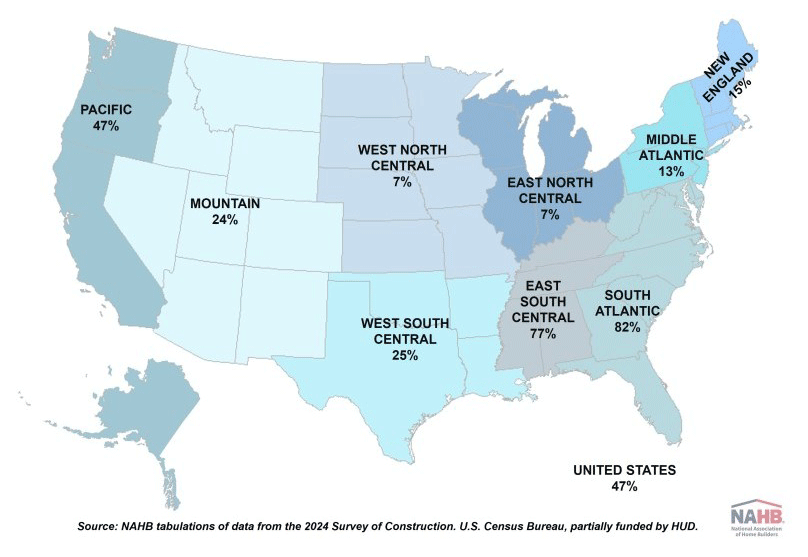
Figure 1
Share of new single-family homes started in 2024 with air or ground heat pumps. Source: Kuo 2025.
Two other points are worth noting about the southern U.S. First, use of electric resistance furnaces is extensive (often electric resistance coils in air conditioning systems), resulting in large energy use despite relatively warm climates. Large amounts of energy can be saved by installing heat pumps in new construction and when replacing heat pumps in existing housing. In fact, the state of Georgia building code prohibits electric resistance heat as the primary source of heat in residential new construction (Nadel, Amann and Chen 2025). Other southern states are considering similar steps.
Second, even in southern states, the temperature gets very cold every few years (e.g. below –10°C (15°F) and at these temperatures, heat pumps designed for use at cold temperatures can help to reduce peak electric demand, an important concern of electric utilities (Shirey et al. 2024).
State efforts
In the following sections we discuss three categories of state efforts:
Impactful programs in several small northern states.
Substantial programs in several large states.
Emerging efforts in an additional state.
Impactful programs in several small northern states
Probably the most impactful programs in North America are in Maine, Vermont and the Pacific Northwest (Washington, Oregon, Idaho and Montana). In these regions, despite their cold climate, heat pumps are 15–20% of annual space heating equipment sales. All have combined consumer incentives with aggressive programs to support trade allies (e.g. product distributors and contractors). For example, in Maine trade ally support includes a steady flow of online advertising and earned media, developing a searchable, online registry of heat pump installers, and extensive heat pump installation training programs including providing scholarships for training programs at community colleges (Nadel 2024).
In Maine, efforts have been aided by a statewide goal, established by the legislature, to install 100,000 heat pumps by 2025 (Maine has about 597,000 households; Census 2026). This goal was exceeded in 2023, and the state set a new goal of 175,000 additional heat pumps by 2027. As of late 2025, 143,000 heat pumps had been installed under this new target (Nadel 2024; Tilton 2025). Efforts in Maine are also aided by special heat pump electric rates offered by the state’s two major electric utilities. Under these rates, homes with heat pumps pay a higher fixed monthly charge but then are charged less per kWh, particularly during the winter (electricity use in Maine presently peaks in the summer) (Yim and Subramanian 2023).
In Vermont, heat pump sales are also aided by Vermont’s three-tier renewable portfolio standard. Tiers I and II apply centralize and distributed renewable electricity generation while tier III is a requirement for utilities to assist customers to reduce fossil fuel use. Under tier III, utilities must either procure additional renewable distributed generation eligible for tier II or acquire fossil-fuel savings from energy transformation projects that reduce fossil fuel consumed by a utility’s customers. Transformation projects include heat pumps, heat pump water heaters, electric vehicles and charging equipment, battery storage and custom projects. For tier III, the required amount of savings is 2% of a distribution utility’s annual retail sales in 2017, gradually increasing to 12% in 2032. In 2023, about 65% of the tier III savings were from heat pumps (Vermont DPS 2026).
To assist distribution utilities to meet their tier III requirements, Efficiency Vermont (a statewide “energy efficiency utility” financed primarily through electric and natural gas rates) administers a midstream heat pump program (rebates paid to contractors) on behalf of the electric distribution utilities. Efficiency Vermont also assists local contractors with training and technical assistance and helps administer supplemental incentives offered by some utilities (EV 2023).
In the Northwest, a regional group, the Northwest Energy Efficiency Alliance (NEEA), has been a leader on heat pump deployment. The Northwest has a high proportion of electric resistance heat (e.g. about 32% in Oregon, 46% in Washington; EIA 2023). NEEA, along with local utilities, have promoted mini-split heat pumps to displace some of this electric resistance heat, with NEEA leading regional market conditioning efforts and the utilities providing incentives. Complementary activities include extensive efforts to enlist and train local contractors as well as a variety of promotion and research efforts (Driscoll and Diamond 2024). A 2022 study on market influences on heat pump adoption in the Northwest credited incentives, contractor recommendations and consumer interest as the biggest drivers, while also noting the importance of contractor training, coordination of utility incentives, efforts to increase consumer and contractor awareness of heat pumps, and a desire for air conditioning driven by hotter summers (Kirszner, Hogan and Pitt, 2022). The Northwest states have among the lowest electric rates in the U.S. (hydropower is dominant) (EIA 2026), which improves heat pump economics.
In all three regions, heat pump incentives are modest (e.g., $1,000–2,000 per heat pump in Vermont varying by size, and $1,000 per outdoor unit in Maine (EV 2025, EMT 2026). The emphasis is on market development and not incentives. In all three regions sales are aided by rising temperatures and an increasing need for air conditioning. Except for Idaho, the majority of homes don’t have air conditioning in these states (EIA 2023) and installing heat pumps are a way to get air conditioning while also providing heating. Also, in all three regions, the initial program focus was on mini-split units that typically heat a single-room heaters without controls that integrate with a home’s main heating system. These units are easier to sell and install than whole home systems. But analysis of heating bills in several states found that these units generally only serve a minority of space heating loads (e.g., EMT 2023) and thus all three regions are now shifting their focus to whole home heat pumps. In Maine, after switching the emphasis to whole home systems, the number of rebates declined at first but by 2025 had recovered to previous levels (EMT 2026). In Maine and Vermont, the majority of homes are heated by fuel oil or propane. These fuels are expensive, meaning that the economics of electric heat pumps are often attractive to consumers (Nadel 2024).
Substantial programs in several large states
California, Massachusetts and New York are three high-population states that have substantial programs to promote heat pumps. All three states offer large incentives for heat pumps. For example, in Massachusetts whole-home heat pump rebates are capped at $8,500, but up to $16,000 for income qualified customers (Mass Save 2026). All three states provide extensive training and support for contractors and other trade allies, but because these states are so much larger than the states covered in the previous section, there are many contractors that have not yet been reached. Constraining progress, these three states have high electricity prices, which can make heat pump economics challenging. They also have higher air conditioner saturation rates than the states in the previous section, meaning that addition of air conditioning is not a large factor.
Despite these challenges, all three states have made significant progress. In California, heat pumps account for about 20% of equipment sales but in Massachusetts the figure was about 5% in 2023 (Nadel 2024). In New York, most of the state’s utilities have a common program called the Clean Heat program. In 2024, the program provided rebates for nearly 23,000 whole-home heat pumps, plus a modest amount of mini-splits, at a cost of about $253 million. A public utility serving part of the state rebated just over 10,000 additional heat pumps. Since 2020, the Clean Heat program has rebated 83,000 heat pumps at a cost of $1.06 billion (Central Hudson et al. 2025). New York has about 7.7 million households, (Census 2026). If we estimate that on average space heating systems need to be replaced after 20 years, the 33,000 heat pump rebates in 2024 represent about 8.6% of space heating system sales.
In recent years, the California legislature has allocated greenhouse gas and taxpayer funds for heat pumps and other electrification measures through the TECH (equipment) and BUILD (new construction) programs. Total funding for these programs is about $250 million. As of early 2026, nearly 50,000 heat pumps for space heating had been installed under TECH at a median cost of $19,500 per unit including electrical work (TECH Clean California 2026). TECH has also funded a variety of innovative programs to spur heat pump adoption such as financing pilots, a consumer-facing website for information and incentives (www.switchison.org), and data analysis to help target homes that can best benefit from electrification, such as homes with old and inefficient heating systems. They have found that: (a) homes in the top quartile of home air conditioning energy use have much better return on heat pump investments than other homes; and (b) that project cost decreases logarithmically with the number of enrolled contractors serving a county (Kisch 2024).
The Bay Area Air Quality Management District (BAAQMD) adopted amendments requiring the elimination of nitrogen oxide (NOx) emissions from new water heaters by 2027 and new furnaces by 2029 (Balaraman 2023). They are now developing some flexibility measures, focusing on low-income owners and homes with physical and electrical constraints. South Coast Air Quality Management District (Los Angeles area) is planning similar regulations as is the California Air Resources Board (CARB). These regulations will effectively ban new gas equipment. The CARB standard would apply statewide sales limits, beginning in 2030 and declining over time (J. Holtzman, Senior Associate, RMI, pers. comm. Feb. 2026).
Since 2022, the state building energy code (called Title 24) also encourages use of heat pumps in new buildings as well as for replacing systems in existing buildings. The code established a performance baseline assuming heat pump space and water heating in newly constructed homes; homes that do not install these systems need to make up the lost savings with other measures. The code also established electric-ready requirements for new homes. For the 2025 code, both the water heating and space heating systems in newly constructed single-family homes must generally be heat pump systems. Mixed-fuel systems can still be installed when meeting compliance using the Performance method (CEC 2025).
In Massachusetts, some state government funds were used to incentivize heat pump installations prior to 2020, but since then most of the funding for heat pump incentives has been from the utility-funded Mass Save program. Beginning in 2023, Mass Save has required that to receive a heat pump rebate, heat pumps must be installed by contractors with training and certification under the Mass Save Heat Pump Installer Network. For partial-use systems, integrated controls are required so that the heat pumps are used first and the backup system is used only when needed. Finally, “sufficient weatherization” is required to receive a whole-home rebate by satisfying at least one of the following requirements: (a) home was built during or after 2000, (b) a Home Energy Assessment report indicates less than $1,000 worth of weatherization recommended, or (c) weatherization recommendations made during or after 2013 have been completed. Heat pumps installed for whole-home heating and cooling that do not meet the weatherization requirement may be eligible for partial-use rebate amounts (Mass Save 2026). Utility regulators have also directed utilities to offer special rates for heat pump customers, along the lines of the rates described in the Maine section.
In New York, In January 2022, Governor Hochul announced a goal for the state to achieve 2 million “climate-friendly” homes by 2030, meaning homes that are either electrified or electrification ready, the latter meaning weatherized; N.Y. is emphasizing an “efficiency first” approach and operates a program called Comfort Home Program that offers incentives up to $3,000 for homeowners to install energy-efficient, pre-qualified packages—such as insulation, air sealing, and high-performance windows—to improve home comfort and reduce energy bills and help make homes ready for heat pumps (NYSERDA 2026). In recent years the state has amended its building code to prohibit fossil fuel equipment in new construction, starting in 2026 for small buildings and 2029 for larger ones, although the governor subsequently delayed the effective date until after a pending court case related to the code is resolved (Takemura 2025).
Emerging effort in Colorado
Colorado is a cold state that is at an early stage of their heat pump journey, spurred by a Clean Heat Standard (CHS) adopted in 2021. Their CHS calls for natural gas utilities to achieve a 22% reduction in emissions by 2030, relative to 2015 levels and a 41% reduction by 2035. The 2030 target was set by the legislature, which delegated subsequent targets to the Colorado Public Utilities Commission, which then set the 2035 target. Individual utilities file three-year plans for how they will make progress towards the target. Xcel, the state’s largest utility, proposed a plan to achieve about 25% of the planned emissions reductions from electrifying 200,000 customers with heat pumps and other electric appliances. The remaining reductions in their plan came from use of biogas, hydrogen blending, use of certified lower emissions gas, and carbon offsets. Environmental groups suggested a greater reliance on electrification in the 2020s and the Commission decision largely adopted the environmental group recommendations. Xcel has begun to implement its plan, and other utilities are filing their plans. Colorado has also begun winter power discounts for homes with heat pumps (Fickling et al. 2023; WRA 2024; Colorado DORA 2025; Paris 2026).
Federal tax credits and incentives
While much of the program and policy activity is at the state level, two federal policies assist by helping to fund heat pumps nationwide. Many states promote these federal programs as a complement to their local efforts. Without state promotion, the federal programs generally have only modest impacts.
Federal tax credits for efficient new homes and for energy retrofits to existing homes were first enacted by Congress in 2005 and have been amended several times since then. The most recent amendments were in the Inflation Reduction Act (IRA) of 2022. In this latest iteration, tax credits were available for 30% of equipment cost up to $2,000 for very high efficiency heat pumps (e.g., COP of 1.75 when tested at –15°C). In 2023, over 300,000 heat pump tax credits were claimed (Ungar and Nadel 2025). As part of the Trump administration One Big Beautiful Bill of 2025, this tax credit was ended effective Dec. 31, 2025.
For new homes, the 2022 law established a $2,500 tax credit for new homes that are ENERGY STAR certified and $5,000 for homes certified under the U.S. Department of Energy (DOE) Zero Energy Ready Homes program. Under both programs generally ENERGY STAR certified heat pumps or furnaces are all but required (lower efficiencies can be installed if other improvements are made to the home to offset the extra energy use). In 2024, nearly 350,000 new homes qualified for tax credits (Ungar and Nadel 2025). As part of the Trump administration One Big Beautiful Bill of 2025, this tax credit ends effective June 30, 2026.
Federal Home Energy Rebates were adopted as part of the Inflation Reduction Act of 2022, one of President Biden’s big initiatives. One provision in the bill appropriated about $9 billion for home rebates, with programs to be administered by states. This includes two programs – “Homes,” for whole-home retrofits, and Home Electrification and Appliance Rebates (HEAR) for electric equipment including heat pumps, heat pump water heaters, electric dryers and ovens. Under HEAR, the maximum heat pump rebate is 80% of project cost up to $8,000 for low and moderate income households (income up to 80% of area median income) and 50% of project cost up to $4,000 for middle and upper income households. Additional incentives are available for upgrades to wiring and electric service. All of these incentives are per home or apartment; multifamily buildings are eligible. As of September 2025, three states plus the District of Columbia are running their Home Energy Rebate programs, nine states have pilot or phased launch programs operating, 36 states are waiting for their implementation plans to be approved, and two states elected not to participate (NHT 2025). All of the approvals were by the Biden administration; the Trump administration is revising program rules and has said they plan to resume approvals soon.
Canada
In Canada, there are a few national programs, many provincial programs, and a few local programs that promote heat pumps.
At the federal level, for several years Canada had a Greener Homes program that began in 2021 and provided grants (up to $5,000 per home) and zero interest loans (up to $40,000 per home) for energy efficiency improvements, including heat pumps. The grants program exhausted its $2.6 billion (Canadian) budget in 2024 and was not renewed. The loan exhausted its $3.2 billion budget in 2025. Under these programs over 280,000 heat pumps were installed. The program required participants to pay for the efficiency improvements up front and then wait for their grant and loan. It primarily served upper income households who had the cashflow to wait for reimbursement. In late-2025 a moderate income program called Greener Homes Affordability was announced, that will directly install efficiency measures including heat pumps. The program is being run by each province, with the first program (for Manitoba) starting in early 2026 (Thompson 2025; NRCan 2026; S. Riddell, Policy Research Associate, Efficiency Canada, pers. comm., Feb. 2026).
The Oil to Heat Pump program is a related program that provides incentives of $10,000 to replace oil-fired heating systems with heat pumps (oil heat is common in Eastern and Northern Canada). Many provinces add their own incentives so that heat pumps are free or nearly free to consumers. Payment is upon approval, not upon installation. As of January 2026, more than 28,000 heat pumps have been installed. Heat pump sales have been particularly strong in the maritime provinces (far Eastern Canada) where oil heat is common (NRCan 2026; B. Haley, Senior Director of Policy Strategy, Efficiency Canada, pers. comm., Feb. 2026).
At the provincial level, most provinces are served by province-wide public utilities and these often run energy efficiency programs, including for heat pumps. In Ontario, funding comes from the provincial Independent Electricity System Operator (IESO). The Ontario program is typical and provides an incentive up to $7,500 per heat pump that replaces electric resistance, oil, propane or wood heat and up to $3,000 per heat pump for replacing natural gas heating. Both of these incentives vary with the heating capacity of the system (Home Renovation Savings 2026).
Quebec has a unique partnership between the electric and gas utilities under which a special very low electric rate is provided for gas customers that install hybrid heat pumps. A separate meter is installed for the heat pump and the low electric rate only applies when the outdoor temperature is above –12° or –15°C (depending on the region). Below this temperature the electric rate becomes very high, with the intent that the household uses a backup gas system during these cold periods. The program is targeting about 100,000 participants in its initial phase (Hydro Quebec 2026; Seguin and Bigouret 2023).
Another unique policy is in British Columbia where the province has proposed a new minimum efficiency standard for heating systems of 100%. Complying systems will include electric and gas heat pumps as well as hybrid electric/gas systems with a weighted efficiency over 100% (Clean BC 2023).
At the local level, a few programs and policies are worth noting. Toronto, Ontario, as well as several other cities, offer Property Assessed Clean Energy (PACE) loans for purchases of heat pumps as well as other efficiency improvements. The loan payments are put on the property tax, which both lowers the interest rate and means that when a property is sold the loan conveys with the property. In Toronto the loan is for 5–20 years and the interest rate varies between 3.23% and 4.73%, depending on the loan term (Toronto 2026). In Vancouver, British Columbia, the city government has enacted an ordinance that for 1- and 2-family homes requires a heat pump instead of an air conditioner when a new system is being installed, and requires that a heat pump and heat pump water heater be installed during major renovations (where major means a renovation cost over $200,000) (Vancouver 2026).
Europe
Europe has been at the forefront of heat pump deployment for more than a decade. While starting from a smaller installed base in the early 2010s than China or North America, Europe has achieved higher penetration rates in several countries where the majority of single-family homes now use heat pumps such as in Norway, Finland, and Sweden (Rosenow et al. 2022) and has developed a comprehensive policy architecture that combines financial incentives, carbon pricing, regulatory standards, market development efforts, and increasingly explicit fossil fuel phase-out policies (Braungardt et al. 2023).
In 2024, as noted earlier, approximately 2.31 million heat pumps were sold across 19 European countries, bringing the installed stock in those countries to about 25.5 million units, equivalent to roughly 12% of European households (EHPA 2025). Although 2024 marked a slowdown relative to the record year of 2022, Europe remains the global policy leader in integrating heat pumps into broader climate, energy security, and industrial strategies.
European deployment is shaped by a multilevel governance structure. The European Union sets climate targets, building standards frameworks, and energy market rules, while member states design and implement most financial incentives and regulatory measures. This combination has produced substantial policy diversity across countries, but also increasing convergence toward electrification of heat.
Market trends
The European heat pump market expanded steadily from 2012 through 2021, peaked in 2022, and then declined in 2023–2024. The 2024 total of 2.31 million units represents a 22% drop compared to 2023 levels (EHPA 2025). The 2022 peak was strongly linked to Russia’s invasion of Ukraine, dramatic increases in natural gas prices, emergency government support schemes, and heightened energy security concerns.
The subsequent slowdown reflects reductions or redesign of subsidy programs, lower gas prices, macroeconomic weakness and cost-of-living pressures and persistent misinformation about heat pump performance.
However, even after the decline, 2024 sales remain well above pre-2020 levels.
Unlike North America, where heat pumps are more successful in warmer states, Europe’s highest penetration rates are found in cold-climate countries (see Figure 2) (Rosenow et al. 2022). This pattern demonstrates that cold climate performance is not a structural barrier. In fact, these markets often expanded first in response to oil price volatility and strategic decisions to reduce oil heating.
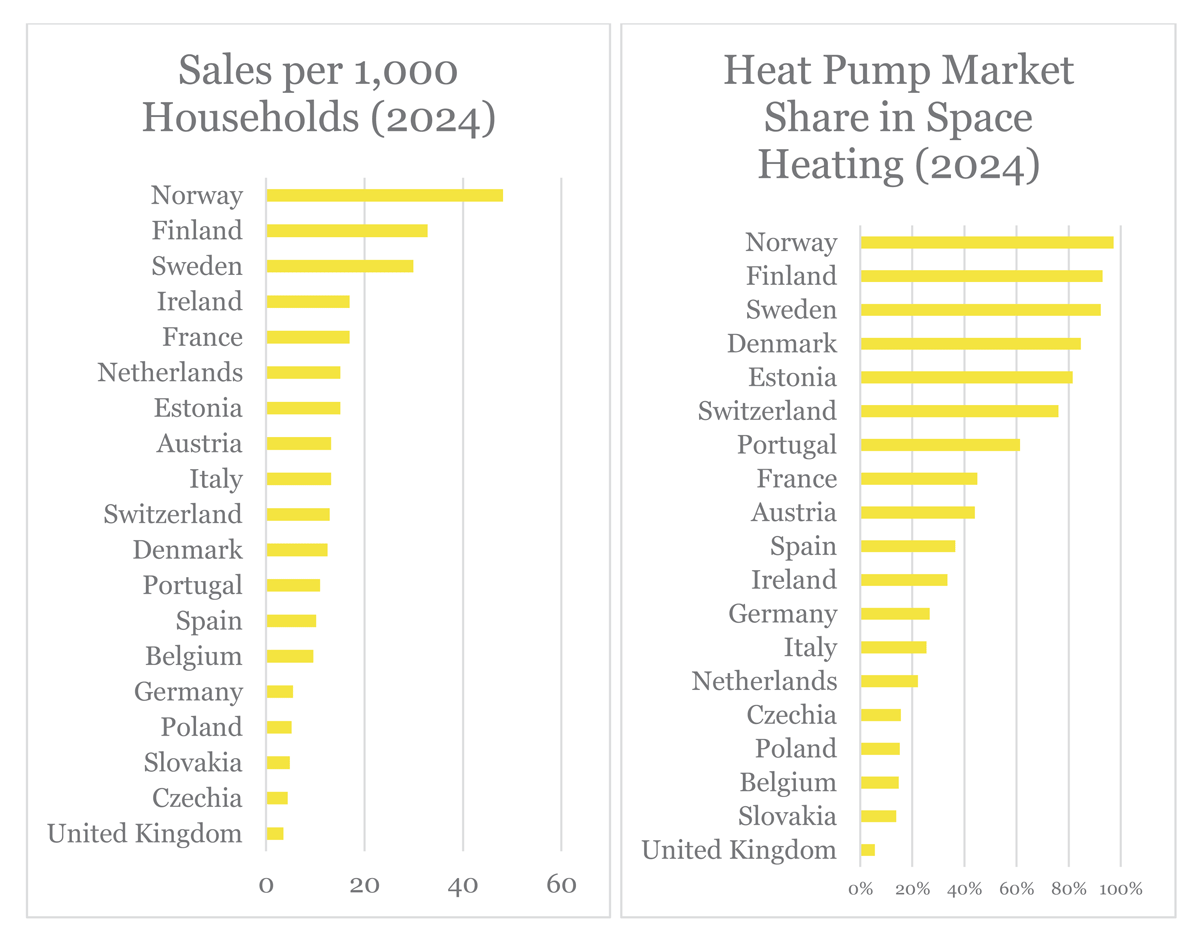
Figure 2
Sales and market share of heat pumps in European countries. Source: EHPA (2025).
The Nordic countries’ leadership reflects more than climate suitability. These markets historically relied on oil and electric resistance heating rather than natural gas infrastructure. The absence (or limited penetration) of gas distribution networks reduced fossil fuel lock-in and made electrification structurally easier. In addition, high fossil fuel taxes, early carbon pricing, strong district heating competition, and public trust in energy policy institutions all contributed to sustained uptake (see e.g. Rosenow et al. 2022; Johansson 2021). This contrasts with gas-dominated markets such as Germany, the Netherlands (prior to reforms), and the UK, where incumbent infrastructure and regulatory structures slowed transition.
Market composition differs across Europe. In Nordic countries, air-to-air heat pumps (often supplementing electric resistance or oil heating) played a large early role. In central Europe, air-to-water systems replacing gas or oil boilers dominate. Ground-source systems have higher shares in Sweden, Finland, and Switzerland due to favorable geology and long-standing installer expertise.
Despite strong recent growth, Europe remains below trajectories consistent with net-zero pathways. At current global growth rates, deployment would fall short of the levels required under the IEA’s net-zero scenario (Rosenow et al. 2022), underscoring the need for continued policy reinforcement (the same is true for North America).
Financial incentives and capital cost support
Most European countries offer substantial capital subsidies for heat pumps. Finland (Hannon 2015), Norway (Bjørnstad 2012), and Sweden (Johansson 2021) the countries with the highest penetration of heat pumps in the world, used subsidies early on but those have been scaled back as the market transitioned to heat pumps which now make up close to 100% of all heating system sales.
Germany has a long-standing tradition of grant-funding for low carbon heating (Nast 2010). The Federal Funding for Efficient Buildings (BEG) program provides grants that can cover 30–70% of eligible project costs, with higher rates for low-income households and for replacing oil systems. France’s MaPrimeRénov’ offers income-differentiated grants, with higher support for lower-income households. Italy’s “Superbonus” temporarily covered up to 110% of eligible renovation costs, triggering a dramatic but fiscally expensive surge in installations. In the UK a succession of funding schemes has evolved into the Boiler Upgrade Scheme offering £7,500 of grant support for a heat pump installation (Rosenow et al. 2025). The UK government’s Warm Homes Plan (2025) further commits to expanding support for low-income households and social housing renovations.
Because heat pumps often have higher upfront costs than fossil-fuel alternatives, especially when replacing legacy systems, capital support has been central to market expansion. Many programs distinguish between simple boiler replacements and deeper renovations, often pairing heat pump incentives with insulation and envelope upgrades.
Low-interest loan programs are also common, including Germany’s KfW loans and green mortgage products in several countries. These instruments spread capital costs over time and can reduce the fiscal burden of high grant rates. Several countries have also applied reduced value-added tax (VAT) rates on heat pump equipment and installation services, further lowering the upfront cost burden for consumers.
Energy pricing and carbon signals
Relative fuel prices play a decisive role in European heat pump economics. Several countries have implemented explicit carbon pricing on heating fuels, including Sweden’s long-standing carbon tax and Germany’s national emissions trading system for buildings and transport.
A persistent barrier in several European countries has been the historical loading of electricity bills with renewable energy levies, network charges, and policy costs. Because heat pumps run on electricity, this structure can undermine operating cost competitiveness even when carbon pricing increases fossil fuel prices. Recent reforms in Germany, Denmark, and the Netherlands signal growing recognition that electrification requires structural tariff reform. The electricity-to-gas price ratio may ultimately be more influential than upfront incentives in sustaining long-term market growth.
As noted in Rosenow et al. (2023), the combination of carbon pricing and electricity levy reform can significantly improve the business case for electrification.
Gas price shocks in 2022–2023 further shifted operating economics in favor of heat pumps. However, reliance on market price volatility alone is insufficient to sustain long-term market growth; stable and predictable price signals are critical.
Regulatory frameworks and fossil fuel phase-outs
Europe has increasingly supplemented financial incentives with regulatory measures.
At the EU level, the Energy Performance of Buildings Directive (EPBD) establishes minimum performance standards and requires member states to develop renovation strategies. Recent revisions introduce zero-emission building concepts and stronger renovation obligations which benefit heat pump deployment. Other EU-level instruments—including the revised Energy Efficiency Directive, the Energy Taxation Directive, and the EU Taxonomy Regulation—provide complementary frameworks that incentivise electrification and reduce barriers to low-carbon heating.
Several countries have adopted fossil heating phase-out policies (Braungardt et al. 2023). Norway effectively banned oil boilers in buildings. The Netherlands prohibited natural gas connections in newly built homes beginning in 2018, going beyond EPBD requirements. Germany introduced requirements that new heating systems contain a high share of renewable energy, steering the market toward heat pumps and hybrid systems, but this policy has been significantly altered now with very weak requirements only for a small share of so-called green gases (biomethane and hydrogen) to be used. The United Kingdom has announced phase-out dates for fossil fuel heating in new homes.
Hybrid systems remain permitted in some countries as transitional options. However, clear long-term regulatory direction has proven important in shaping investment decisions by manufacturers, installers, and households. Advance announcement of regulatory timelines allows supply chains to prepare and reduces policy uncertainty.
Workforce development and market conditioning
Installer capacity and quality assurance are critical constraints in several European markets. Experience in Sweden illustrates how high training standards, technical norms, and consumer protection mechanisms helped transform heat pumps from a niche product into a mainstream heating technology (UKERC 2016).
Many countries now operate national training initiatives to expand installer capacity. Certification schemes, equipment standards, and consumer complaint mechanisms help maintain system quality and protect household investments. Industry associations play a central coordinating role in disseminating technical guidance and market data.
Public information campaigns and advisory services also support consumer confidence, particularly in markets transitioning away from gas-dominated heating systems.
Europe’s emphasis on domestic manufacturing has intensified following global supply chain disruptions during the pandemic. With approximately 73% of heat pumps sold in Europe produced domestically (EHPA 2025), industrial policy has become intertwined with climate strategy. Expansion of European compressor manufacturing, refrigerant supply chains, and component standardization reduces dependence on Asian imports. North America is beginning to adopt similar strategies under industrial policy frameworks, but Europe’s integration of industrial and climate objectives has been more explicit.
Equity and distributional design
European programs increasingly incorporate equity considerations. France and Germany differentiate grant levels by income. Several countries combine heat pump support with broader social housing renovation programs. Targeted incentives aim to prevent low-income households from being locked into fossil heating systems and to ensure equitable access to clean energy alternatives.
Given the higher upfront costs of electrification, distributional design has become a central policy issue. Countries with income-tiered incentives or direct support mechanisms have been more successful in broadening access beyond higher-income early adopters. For instance, France’s MaPrimeRénov’ covers up to 90% of eligible costs for the lowest-income households, compared to around 40% for higher-income groups.
Energy security and industrial policy
Following Russia’s invasion of Ukraine, heat pumps were framed not only as a climate solution but also as a tool for energy security. The European Commission’s REPowerEU plan set ambitious installation targets and encouraged member states to streamline permitting and scale up training. The plan set a target of 10 million additional heat pump installations by 2027; while deployment accelerated in 2022–2023, progress has since slowed and the target is unlikely to be met at current rates (EHPA 2025).
Heat pump manufacturing has also gained prominence within European industrial policy. Several manufacturers announced new or expanded production facilities to meet growing demand and reduce reliance on imported equipment.
Summary of the European approach
Europe’s experience suggests that rapid heat pump expansion is driven by a comprehensive policy mix rather than a single instrument. Successful markets combine:
initial capital subsidies,
carbon pricing and energy tax reform,
regulatory phase-out signals,
workforce development and certification,
consumer protection and communication, and
alignment with broader climate and energy security objectives.
Comparing approaches
On both continents, efforts mix training, incentives, and policy, sometimes taking a multi-pronged market transformation approach to address barriers. In Europe the incentives come more from governments, in the U.S. they are more from utilities, with Canada in-between. On both continents, incentives are higher or special programs undertaken to aid heat pump purchases by low and moderate-income families. Fossil fuel phase-out regulations and building codes have been strong drivers in the Netherlands, France, Austria, Ireland, and Denmark, among others (Braungardt et al. 2023). In North America, regulations are starting to be a driver in California, Colorado, Massachusetts, New York and British Columbia. On both continents, there is a move to improve heat pump economics by reforming rates. This has taken place in Maine, Massachusetts, Colorado, Minnesota, Germany, Denmark, the Netherlands, the UK, Sweden, Finland, and Norway. In the Nordic countries, Germany, Maine, Vermont, New York and Massachusetts, displacing oil heat has been a driver. In the U.S., this has been for economic reasons; in Europe security is also a major driver, particularly since the outbreak of the Ukraine war. In the northern U.S. and Canada, the need for air conditioning to address warmer temperatures has been a driver. This has not yet had a major impact on heat pump installations in Europe but is changing as the summers get hotter.
Within both continents, there are significant differences in heat pump market shares between states and countries, due to economics and policies. Local electric and gas prices have helped drive heat pump economics and market share, as has happened in the Southeast U.S. and the Nordic countries in Europe. Policies have been particularly strong in some North American states and provinces (e.g., Maine and British Columbia) and in some European countries (e.g. Norway, Finland and Sweden).
One big difference has been the impact of carbon pricing in Europe, such as in Sweden and Germany. There are forms of carbon pricing in Canada and some U.S. states (Nadel, Gaede and Haley 2021). The revenues have helped fund heat pump programs, but the carbon prices have not been significant enough to be a major driver of heat pump economics. Taxes on heat pump purchases have been an issue in Europe but not in North America because taxes on purchases are lower.
Compared to North America, European policy relies more heavily on national government funding, carbon pricing, and explicit fossil fuel phase-out regulations. However, as in leading U.S. states, durable market growth depends on combining financial incentives with supply-chain development and clear long-term policy direction.
One striking feature of the European market is its sensitivity to policy design and macroeconomic conditions. The rapid expansion in 2022 followed by contraction in 2023–2024 suggests that heat pump markets remain partially policy-dependent rather than fully self-sustaining. Sudden changes in subsidy structures—particularly in Germany and Italy—created uncertainty that dampened consumer demand. This volatility underscores the importance of stable, multi-year program frameworks rather than short-term stimulus measures. Compared to leading U.S. states, where utility-funded incentives tend to be more gradual and programmatic, several European markets have experienced sharper boom–bust cycles tied to national budget decisions.
Learning from each other
Based on the differences between the two continents, North America could potentially learn from the substantial government funding in Europe, from European carbon pricing (particularly in Sweden) and from regulatory actions taken, such as in the Netherlands. Europe could potentially learn from North American utilities, where utilities are major implementers of energy efficiency programs. Both continents could benefit by examining some of the details in programs and policies on the other continent. Such steps could enrich heat pump programs and policies, helping to spur greater heat pump sales and market share for both new construction and existing buildings. At the same time, the experience on both continents highlights the importance of policy stability: sudden changes to subsidy structures, as seen in several European countries, can dampen consumer demand and set back market progress.
Additional File
The additional file for this article can be found as follows:
PowerPoint Slides
PowerPoint Slides relating to this article. DOI: https://eceeeproceedings.org/articles/53/files/6a5dfba06ae08.pptx
eceee paper ID
7-009-26