
Introduction
Energy sector in Europe is witnessing a major drive for its transition to meet multiple challenges which include energy security and resilience due to recent geo-political developments and due to continued interest in mitigating climate change. Energy community (EC) that aims to engage citizens in energy sector is one instrument to decentralize energy production and distribution at community level. An EC is built on the principles of open and voluntary participation, wherein typically an association of members produce, consume, store and/or sell energy within the community.
The interest on EC is attributed to the adoption of European Union’s “Clean Energy for All Europeans” Package in 2019, which provided legal enabling framework that support energy communities. European Union directive 2018/2001/EU which is part of this package introduces two types of energy community: Renewable Energy Community (REC) and Citizens Energy Community (CEC). REC manages energy from renewable sources in several forms while CEC deals with electricity produced from renewable and fossil sources. Though there are a few differences between CEC and REC, this paper uses EC to express collectively both REC and CEC. EU has recently started several initiatives to facilitate ECs. For example, the “Citizen Energy Advisory Hub” initiated in 2025 provide technical assistance to citizens initiatives, developing resources and providing networking opportunities. Another initiative “European Energy Communities Facility” is a project launched in 2024 to support through grants to at least 140 energy communities in developing business plan and capacity building programme. EU’s action plan for affordable energy also highlights the importance to strengthen energy communities to facilitate local initiatives to invest in clean energy projects (EU, 2025a). Energy Communities Repository (2024) presents five building blocks for member countries for developing policies and legal frameworks. These building blocks are (i) clear definition for energy communities, (ii) access to information, awareness raising, (iii) access to financial support, (iv) minimal regulatory framework for undertaking the pilots, (v) registration and monitoring framework.
ECs are expanding across the member countries and as of 2025 more than 8,000 ECs are operational in EU member countries (EU, 2025b), which is a four-fold increase from the 2020 (Tarpani et al., 2022). Participation in ECs in-terms of total population of Europe is still low, could be 1–2%. For example, REScoop.eu European federation of energy communities has a network of 2,500 energy communities representing over 2 million citizens (https://www.rescoop.eu). More efforts are needed to make EC mainstream. Nevertheless, as per an estimation, over 260 million Europeans are expected to join the energy market as prosumers by 2050 (Cunha et al., 2021). Currently, a few countries in Europe are leaders in terms of number of energy communities and Denmark is one country which has the highest number of energy communities as compared to its population (Tarpani et al., 2022). The relatively higher popularity of energy communities in Denmark may be partly attributed to the country’s history of cooperative ownership in the energy sector (Neij et al., 2025). In addition, Denmark has introduced regulatory instruments such as Electricity Supply Act No. 984/2021 (updated 1248/2023) and Renewable Energy Act No. 1791/2021 (updated 1031/2024) that could facilitate ECs. Further, the local collective tariffing introduced in 2023 allow for locally “tailored” tariffs for energy communities, reducing the economic impact of using the collective grid.
The energy system in Sweden, unlike in Demark, is traditionally a centralized structure and has relatively fewer number of ECs. As per a report by Swedish Energy Agency (2024), there were 140 active community energy initiatives in Sweden. However, Sweden does not have a uniformly accepted definition for ECs which makes it difficult to categorize on what constitutes an EC (Swedish Energy Agency, 2024). A few publications have investigated the challenges for ECs in Sweden (Palm, 2021; Magnusson and Palm, 2019). Nevertheless, there have been a few recent developments on energy communities discourses in Sweden, such as the proposed new laws on the electricity system that will facilitate energy sharing (Regeringskansliet, 2026). This paper provides an overview of the latest situation of ECs in Sweden and specifically the study focuses on a case area in northern Sweden.1 This paper uses the MultiLevel Perspective (MLP) framework to explore challenges and opportunities for energy communities in northern Sweden. This study focuses on PV installation as an EC intervention in Stöcke which is a neighbourhood in Västerbotten, northern Sweden. However, the discussion is relevant to other sparsely populated areas in the arctic.
Energy communities in Sweden
Sweden has the aim to become climate neutral by 2045 and several municipalities in Sweden has much more ambitions climate neutral target. For example, 48 Swedish municipalities have joined the Climate-neutral cities by 2030, an initiative under Viable Cities. As in other member countries, ECs could play an important role in Sweden for a sustainable energy transition especially in the context of energy security. In practice for an ECs to be successfully operational, the energy community should be economically viable and the members participating in ECs should be able to realize tangible benefits such as reduction in their energy cost (Vardanyan, 2025).
Sweden has a few operational ECs, and more are in the pipeline both in mainland and in islands such as in Gotland. Further, there are examples of both “bottom up” and “top-down” organizational approaches for setting ECs. Two examples of EC that has contrasting organizational approach is Hammarby Sjöstad in Stockholm which is a private economic housing association and share electricity virtually (Danielsson et al., 2024), while Tamarinden is led by Örebro municipality in collaboration with other actors with the aim to have physical energy sharing (Källmén and Johansson, 2023).
Sweden is considered as one of the laggards in Europe establishing framework for ECs (Tarpani et al., 2022). Lack of national regulations is highlighted as one of the main barriers for adoption of ECs in Sweden (Palm, 2021). Sweden currently does not have regulations concerning ECs. The Swedish Bill 2021/22:153 that came into effect in 2022 state that the EC as described in the electricity market directive and the revised renewable energy directive is already existing in Sweden and there are no obstacles for forming ECs. Accordingly, no new legislation is needed to implement directives on ECs in Sweden (Regeringen, 2022). Nevertheless, the bill state that there may be reasons to return to this issue in the future, if positive aspects of energy communities could justify the changes in certain regulations.
A few amendments on electricity regulations came in place during the last 5 years that may facilitate ECs in Sweden. For example, sharing of energy among the community members are one of the important elements in ECs and in Sweden until 2021 electricity was not allowed to be shared between residential buildings. In January 2022 a decree amended the situation and allowed sharing of electricity between buildings provided the buildings are within the same property or neighbouring properties. Similarly, an exemption in Section 22c of the Ordinance (2007:215) was introduced where in network concession is not required for underground cables that are laid between an electricity production facility or an energy storage facility and nearby buildings for sharing the electricity. Further, an amendment proposed to the Electricity Act (1997:857) took away the requirement that a micro-producer must be a net user of electricity to be exempt from the network fee for electricity fed to the grid (Regeringen, 2022).
For an organization that want to build and operate a grid, especially a high voltage line in Sweden, need to obtain permission called “concession” from the government which is regulated by the Electricity Act (1997:857). The application for concession is evaluated by Swedish Energy Markets Inspectorate (Energimarknadsinspektion or Ei), and the concession holder has several obligation including the operation and maintaining the safety of the system. ECs typically may not have the expertise to manage such a system. However, a few special cases do not require this permission, and a grid of this kind is called an IKN grid (abbreviation for non-concessional grid – icke konsessionspliktigt nät in Swedish) and EC can use such grids. A non-concession grid needs to meet three requirements: Internal, Not too widespread and well defined. The requirements can be found in their entirety in the act (2007:215). The Tax Law Council (Skatterättsnämnden) in March 2024 ruled that solar installation in multiple properties that are connected via IKN grid is considered as separate unit thereby it is not subjected to energy tax provided the installation remain below 500 KW.
In Sweden three possible ways of sharing electricity exist: Local net, complementary local net and Virtual net. However, as per the legislation only distribution system operator is allowed to operate local net (≤40 kV). Complementary net is a parallel low-voltage DC/AC network that an energy community can use to share the electricity produced by the community. Though private parties are allowed to operate the complementary net, it is subject to certain limitations. Members are relieved from grid fees and taxes on the electricity distributed via the complimentary grid. This is mostly suitable in urban areas where distances between facilities are less. However, due to the high cost involved in construction of supplementary grids, this may not be viable solution for small ECs in sparsely populated regions. Finally, in a virtual grid, electricity is shared in the original grid owned by a power company but with net metering of the whole community. Net metering is however not always possible as there are no laws to support this. Virtual sharing requires fewer resources as compared to complimentary grid and as per Ei is a good option for ECs (Husblad et al., 2020).
Energy communities in the north of Sweden
The average annual per-capita electricity consumption in the north of Sweden such as in Västerbotten county is 24 MWh. The high per-capita electricity consumption is attributed to the power intensive industries in the north of Sweden. Further, the electricity consumption in the north is expected to increase significantly in the future due to addition of steel plants, CCS, increase in electric cars and buses. For example, as per an ambitious future scenario for achieving climate goals, the share of electricity consumption in the total supplied energy in Umeå is expected to increase from 26% to 67% by 2040 (Umeå municipality, 2024). Energy communities through localised production of electricity could provide flexibility solutions to meet the growing electricity demand in northern Sweden.
Northen Sweden and similar high latitude regions that are sparsely populated has unique challenges of long heating periods. The high latitude also causes relatively a smaller number of sunshine hours as compared regions in south. The mismatch of the solar radiation and energy demand makes the technologies such as solar PVs, a common technology intervention among ECs, less cost attractive. Figure 1 shows the annual global solar radiation in W/m2 in a city in the north and one in the south of Sweden.
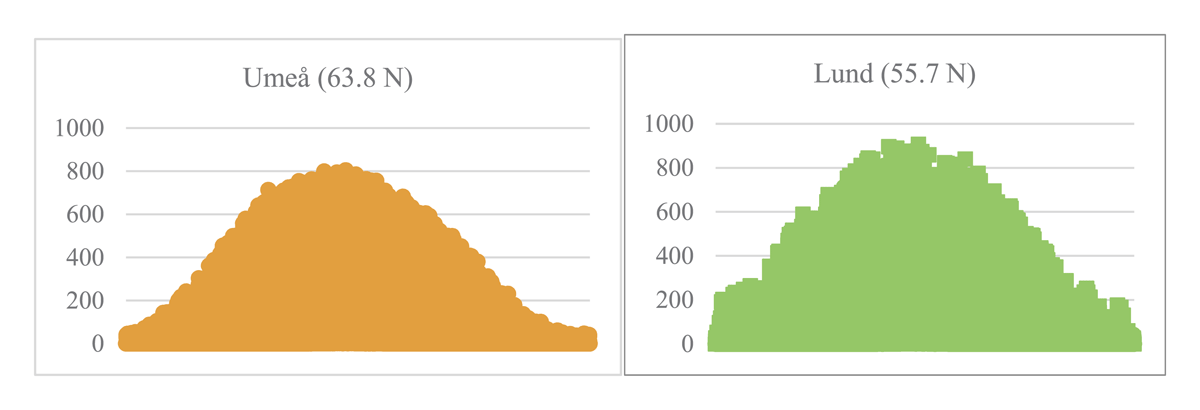
Figure 1
Global solar radiation W/m2 for 2024 (SMHI, 2026).
The average annual global solar radiation for Umeå and Lund (in south Sweden) during 2024 was 107.9 W/m2 and 119.8 W/m2, respectively. The difference of solar radiation in those two locations was approximately 10%. Solar panels that track sun results in better output, however, due to simplicity and higher reliability, fixed-tilt systems are recommended in high latitude regions that has frequent freeze-thaw cycle (IEA, 2026). This could result in comparatively less energy output from PVs. Similarly, increased transportation cost could increase the installation cost of solar PVs in high latitude regions. There are other factors that affect the performance of solar panels in high latitude such as snow drifting, cracking of cells due to snow load, shading losses (refer IEA, 2026 for further reading).
Further, the north of Sweden, which is bestowed with an abundance of hydropower, has lower electricity prices as compared to south or central Sweden. Figure 2 provides a comparison of flexible electricity prices for apartments in north and south Sweden.
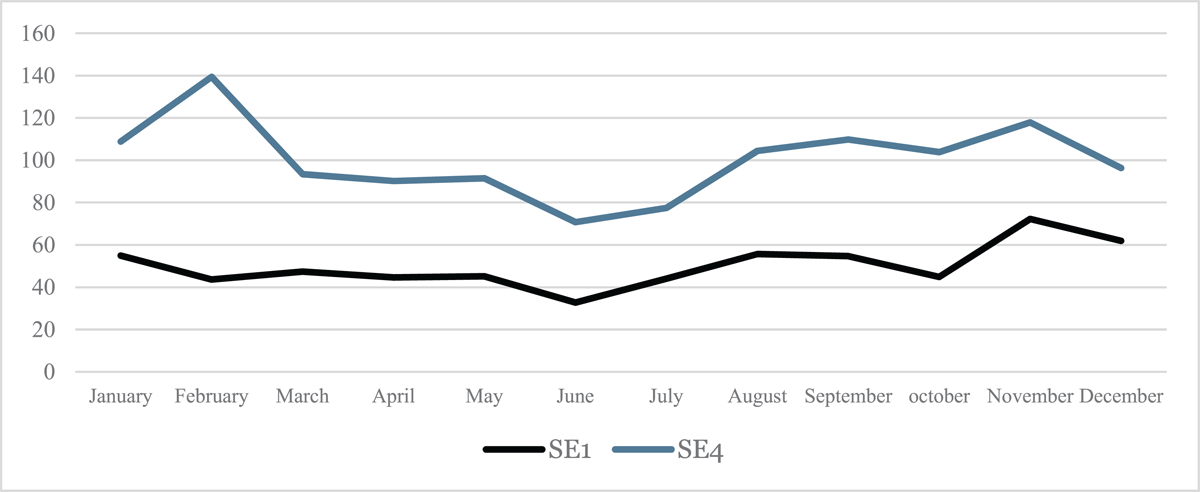
Figure 2
Average flexible electricity price (öre/kWh) for apartments in northern Sweden (SE1) and south Sweden (SCB, 2026).
Method
This study adopts an exploratory research design based on analysis of secondary data. The analysis is structured using the MultiLevel Perspective (MLP) framework (Geels, 2002) to examine how ECs emerge and interact with regulatory, institutional, and technical conditions with a specific focus on northern Sweden. In this framework ECs are considered as proponent of decentralized energy production and utilization.
Geels (2002) highlighted three layers for the socio-technical transition; the macro layer, meso layer and micro layer. The macro layer which is called as landscape event are those that lead to the conditions for an energy transition. This could be in addition to the climate change issue, concerns on energy security and growing demand from public on democratic participation in energy governance. The meso or the middle layer is the existing socio-technical regime which is the established configuration on energy production, transmission and distribution that involve organizations such as energy utilities and grid operators. Finally, at the micro level niche innovation such as ECs, solar and wind communities operate.
Stöcke – a case from northern Sweden
Currently there are only a limited number of functional ECs in northern Sweden. One example is the Solel i Näversjön (Solar electricity in Näversjön) a solar community that produce electricity from solar park. Nevertheless, several communities in northern Sweden have shown ambition towards ECs which include Tavelsjö in Umeå and Skråmträsk in Skelleteå. The study focus is a community in Stöcke in Västerbotten in Sweden.
Stöcke is a village located 10 km from Umeå and has nearly 700 citizens. Due to the need for travelling to Umeå for sports and other leisure activities, the “Mötesplats Stöcke” project was initiated. The project was originally started by the local community. The collaboration with the organization Coompanion in 2017 led to the formation of an economic association. The project evolved from a sport centre to an activity center with a gym, restaurant, meeting rooms, and consumer store. Investment for the construction of the activity facility was sponsored by the people who live in the village and different standalone businesses. The facility, managed by an economic association, 1,800 m2 roof with approximately 1,000 m2 in the south direction. Another roof that Mötesplats Stöcke owns is the barn next to the facility which has 300 m2 distributed 50/50 in west and east. The activity center has a roof with 5 ° inclination, and the barn has 45 ° of inclination. The community members are exploring the possibility to operate an ECs and the technology intervention that the members are interested is PVs on the roof top of Stöcke Mötesplats. The available roofs correspond to a production of 0.15 MWh solar power (Burman et al., 2024).
Multi-level perspective (MLP) on energy communities in a Swedish context
Landscape developments
The land-scale event especially due to the current geopolitical situation has created a renewed interest in energy security and energy preparedness. The Russia–Ukraine conflict has exposed European vulnerability to fossil fuel dependency and created an unprecedent political urgency to ensure energy security (Goldthau and Youngs, 2023). The energy security concerns for Europe have been exacerbated by the volatile pricing of fossil fuels in 2026 due to the geopolitical situation in the Gulf regions. This situation could also contribute to additional resolve in Europe to reduce the dependency of imported fossil fuels. These recent developments related to the uncertainty in the fossil fuels along with the climate change issues could be considered as a land-scape development for energy transition in Europe. ECs that use local energy production could play an important role. Several new and amended EU directives, attributed to the landscape development, are introduced that could facilitate ECs in member countries.
According to EU directive 2024/1711 the customers that include all households, small and medium sized enterprises have the right to participate in energy sharing (EU, 2024). In line with this directive, Swedish government proposes new laws on the electricity system to facilitate the energy sharing (Regeringskansliet, 2026). The proposed new rules will come into force from 1 January 2027 and among others it states that the electricity users in the same bidding zone will be able to share renewable electricity via the public grid and the electricity supplier must deduct the shared electricity from the user’s total electricity consumption (Regeringskansliet, 2026).
The new European directive 2023/2413 to enhance the deployment rate of renewable energy has raised the binding 2030 renewable energy target from 40% to 42.5% (European Union, 2023). This new directive may have less direct influence for Sweden as the share of renewable energy in Sweden’s energy mix is already higher than this target. Nevertheless, the directive shows urgency to reduce fossil fuel consumption at the European level. Moreover, the directive stipulates the permit-granting procedure for the installation of solar energy equipment with a capacity of 100 kW or less shall not exceed one month and could facilitate faster implementation for small ECs in Sweden that use solar installations. In addition, European Commission is in the process of preparing a renewable energy framework for the next decade for securing reliable, affordable and “homegrown” energy that can contribute to EU’s climate targets. This framework is also expected to facilitate ECs. Another recent initiative by EU as a direct consequence of the landscape development of Russia-Ukraine conflict is the REPowerEU framework aimed to rapidly reduce EU’s dependence on Russian fossil fuels (Kuzemko et ai., 2022). REPowerEU framework envisages faster permitting for renewable energy projects and large scale-up deployment of renewable energy projects (European Commission, 2022a), which could facilitate ECs that use renewable energy. For example, EU Solar Energy Strategy adopted as part of REPowerEU aims to enhance the solar PV capacity by almost 600 GW by 2030 (European Commission, 2022b). Similarly, EUs directives that direct member countries to open electricity market to citizen participation (RED II) is conducive for ECs. Decentralized energy production by ECs could be a beneficiary of these legislatives that were taken place due to the landscape development.
Existing Regime
The existing regime often resists changes especially disruptive changes due to reasons such as path dependency, lock-in, risk aversion, established standards and routines (Verbong and Geels, 2010). Nevertheless, within the context of the electricity production and consumption, the existing regime especially the grid operators may have to look for solutions outside their comfort zones if they face grid capacity constraints. For example, many regions in Sweden are facing grid capacity constraints and the situation could be exacerbated in future due to enhanced electrification driven by climate and energy security reasons and consumers such as data centres. Verbong and Geels (2010) suggested three pathways for the future of electricity sector: Transformation, Reconfiguration and De-alignment and re-alignment. Energy community position could be similar to the De-alignment and re-alignment of electricity sector where existing regime is disrupted and several niche innovations could emerge (Verbong and Geels,2010; Geels et al., 2016).
ECs could use local grids which are classified as an IKN, which relieves them of the requirement of concession for sharing electricity. If such a grid is used, the produced solar electricity would not transmit outside of the community, and accordingly the energy tax and net fees would not apply (Nordqvist and Thörnell, 2023). In that way, it would get access to some of the benefits that individual solar power owners enjoy. It is then possible to have one single input from the PV park and share the electricity between members of the community. On the contrary, this solution is complicated and will need much higher investments, as it implies the purchase or construction of a new power grid, along with needed control and transformation infrastructure.
Another alternative is to construct a complementary grid to the existing one which is possible with current legislation. This means constructing low-voltage power lines between facilities in the community, enabling the sharing of produced energy while still connected to the main grid and being possible to classify as non-concessional. If the IKN is not connected to the national grid, such a system does not entail net fees. The main drawback for such a project is that the IKN law requires the cables of the complementary grid to be underground, which would be costly for a community in the countryside with long distances between facilities (Nordqvist and Thörnell, 2023). In the context of forming an EC in connection with Stöcke Mötesplats, a complementary grid could be less attractive as the village is widespread.
The hypothesis that de-alignment and re-alignment will cause existing regimes to fall apart may not be exactly relevant with ECs as it could co-exist and complement the existing regime which is the existing distribution system operator. This is because the utilities can have a few benefits from ECs such as enhancing grid flexibility through local production, storage, and decreased grid losses while ECs could utilize the utilities’ grid for distributing the electricity produced by ECs. A few electricity network companies raised concerns on certain safety aspects related to parallel electricity network by ECs (Regeringen, 2022). Accordingly, an option for EC in Stöcke is to have a virtual grid wherein “sharing” of electricity is carried out through the concessional grid that could be similar to that of “Austerland Energi” which has desire to implement it as community-owned PV park in the island Gotland. The logistics that are in place now do not prohibit the usage of the communal power grid, but the associated taxes may make it less viable. In “Austerland Energi”, the electricity produced is transferred via the existing power grid. The produced electricity is calculated to 50% be sold to the energy company and the remaining 50% to be used as a deduction from the electricity used by the community during the production period. This framework provides a guaranteed income to the investors. Accordingly, ECs in Stöcke may engage with the regional energy company Umeå Energi for a mutually beneficial deal.
Energy communities as Niche
Energy communities originate as niche innovations and require support and therefore require supportive environments that enable experimentation, learning, and development. Fuchs and Wassermann (2009) argue that successful innovation in energy sector depends on political support and strong advocacy coalition. As of now, ECs in northern Sweden does not have a strong political support nor a strong advocacy coalition. For example, Umeå municipality has an un-biased approach towards ECs wherein they are supportive to ECs if it contributes to overall energy system aligned with optimizing overall energy system. Similarly, though organizations such as Coompanion and HSB which is Sweden’s largest federation of cooperative housing are supportive towards ECs, there are no strong advocacy coalition for ECs in Sweden and as Magnusson and Palm (2019) highlighted the support structure for energy community initiatives in Sweden are limited.
Use of the existing grid would probably be the most realistic way of establishing an EC in Stöcke. The profitability however depends on the agreements with relevant stakeholders especially the utility company. In UE’s opinion, a solar cooperative would be a better approach for forming an EC in Stöcke (Burman et al., 2024). In that case, the EC and its members could continue to be its customer of UE while selling its produced energy from the PV facility/park. The village/cooperative would be responsive for operation and maintenance. The maintenance for PV’s is however relatively simple and is a service that can be rented out. The feasibility of this option depends on whether ECs can have a mutually beneficial agreement with energy companies, for example UE may be interested in collaborating with ECs if ECs are able to contribute to addressing the energy peaks in the system (Burman et al., 2024). These aspects need to be studied and after which a business model needs to be worked out. Solel i Näversjön in Jämtland which is a northern region where a solar community has cooperated with the local energy company could be one example. Solel i Näversjö is a cooperative which operate on share owned model where members buy shares based on their electricity use. There are three main actors in this constellation: Solel i Näversjö, regional utility, Jämtkraft AB and ETC EL, the electricity trading company (Envall, Andersson & Wangel, 2023). The association leases a local transmission cable, from Jämtkraft AB by paying a fee, that connects the solar park to a local substation. The cooperative has a contract with the electricity trading company wherein the cooperative sells the electricity produced by the solar park at a low price and then buy back from the trading company at the same price (Envall, Andersson & Wangel, 2023). More such projects that demonstrate the viability of the business model should be available in public domain so that potential ECs can learn from such experiences.
In addition to the regulatory and financial issues, EC projects that operate as niches may face additional challenges such as higher transaction costs due to need for co-ordinating several members in ECs and often collective decision making and dependence on external experts (Krug et al., 2022). Institutional support would be important to steer the ECs. Professional consultants are expensive for ECs that typically start with limited capital (Neij et al., 2025). Currently organizations like Coompanion (https://coompanion.se/) which is a cooperative could support the ECs, for example, they are involved in discussion with communities such as Skråmträsk in Skellefteå. Coompanion could advice communities on establishing ECs and they have developed two business models for cooperatives. There are websites that provide information and tools related to energy communities such as that in https://www.sverigesenergigemenskaper.se/. However, organizations such as Coompanion may have resource constraint to be involved deeply in multiple ECs initiative and hence this calls for more systemic support if more ECs need to successfully operational in the north of Sweden. Similarly, municipality energy advisers (energi- och klimatrådgivare) funded by the government via Swedish Energy Agency could support ECs by providing impartial and free advice on matters related to energy aspects. However, municipality energy advisers also face resource constraints that could limit their role outside their mandates.
Discussion
Rogers (2003) define innovation as a technology, idea process or practice perceived as new. Energy communities as a concept can be considered as a socio-technical innovation in northern Swedish context, as it is still in its early stage of adoption. Nevertheless, mainly driven by the macro landscape development that include energy security concerns, ECs are gaining interest across Sweden. Energy utility companies in the north, that form the major existing regime, are positive towards energy communities as reflected in energy utility Skellefteå Kraft AB website that provide information about the energy community. Similarly, energy preparedness is high on the agenda of several municipalities in the north. These aspects provide conducive conditions for the development of energy communities (ECs) operating as niche innovations within the socio-technical system. However, there are several barriers that need to be addressed before we see more ECs in northern Sweden.
Virtual net looks to be a way forward for electricity sharing, at least in the short term. Umeå Energi AB(UE), one of the major grid owners and the power supplier in Västerbotten, are of the opinion that EC should use the power grids already available instead of constructing new local ones (Burman et al., 2024). According to UE, it is technically feasible if a community wishes to construct an isolated local grid (IKN), however, it may pose practical difficulties, as it would imply that the cooperative assumes the role of a grid owner, along with the associated regulatory obligations and operational responsibilities (Burman et al., 2024). Electricity sharing by communities through Virtual net could reduce the losses in the system as electricity need not have to be transported over long distance (Windon, 2023). Currently, there is a lack of legislation that enables virtual sharing of electricity in Sweden. However, from 1 January 2027 the new rule that allows sharing of renewable electricity via the public grid will come in force. However, Virtual sharing faces some economic challenges that makes such an option financially less attractive. In an EC the shared electricity passes through the electricity meter when it is shared between members then additional fees such as energy tax, VAT and network fee are added to the shared electricity among the community members (Swedish Energy Agency, 2024). Reducing these taxes for virtual sharing of electricity could incentivise ECs. At the same time, ECs that relay on solar and wind electricity may cause grid instabilities and the grid operators may not be willing to take associated risks without addressing such concerns.
As per the report by Swedish Energy Agency (2024), the solutions should not contradict the existing consumer law, for example the customer should have the opportunity to buy electricity from any supplier and members should be able to leave the energy community and this option may make formation ECs vulnerable, especially among small communities as there may need a minimum number of members for it be economically viable.
The Energy Markets Inspectorate suggest that ECs should be organised as economic associations (ekonomiska föreningar). A crucial part of ensuring a successful economic association is the careful design of bylaws. The bylaws should be able to address various aspect such as whether share in the energy park be included in the property and what would be the consequence of ownership changes. There are challenges associated with ECs organized as economic associations, primarily related to “parallel tax” where it must follow the general framework law for economic association and the general tax rule for juridical persons. A good knowledge on both is needed for EC to operate such an association which is likely to increase the administration cost. A viable governance model for successful operation of ECs is needed, and further studies are needed in this direction within the context of the north of Sweden.
Niche innovations are often associated with uncertainties which makes it more difficult to secure external funding (Fuchs and Wassermann, 2009), which is the case for ECs in Sweden. As per Compile – a Horizon 2020 project – traditional banks seldom provide small and medium loans less than 500,000 Euros/1 million Euros due to concern on profitability of such projects. EC projects that involve small communities such as in Stöcke may face challenges to raise the desired capital. However, there are examples in Europe that address issues on raising the capital such as Scotland’s Community and Renewable Energy Scheme (CARES) that provide grants to support feasibility study for communities who are interested in renewable energy production (refer Energy communities repository, 2024 for examples to reduce the financial barrier across Europe).
Swedish Energy Market Inspectorate report highlighted that several consulting bodies believed that citizen participation in ECs is hampered due to lack of benefits in associating with ECs (Palm, 2021). For example, a private person can avail a tax reduction when they buy solar installation (which is reduced to 15% in 2025 from the previous 20%). In addition, a private person can avail 30% tax reduction on labour charges (ROT-avdrag) for installation. No such incentives are applicable for the ECs. Further, the tax-reduction of micro-production of renewable electricity (fuse no more than 100 ampers) which is SEK 0.6/sold kWh electricity subject to a maximum of SEK 18,000/year was abolished from 1 January 2026. Though neither of these policy changes directly affect ECs, they indicate a broader trend of the government progressively reducing the financial support for small-scale renewable electricity generation. Accordingly, it may be challenging for ECs to avail favourable financial policy instruments which ECs advocates argue for. This would provide additional challenges for ECs that plan to use PVs in northern Sweden, wherein both electricity price and sunshine hours (Figure 2) are lower than other regions in Sweden. Institutional support for developing legitimate and viable business models is needed to support ECs in northern Sweden.
Swedish Energy Agency wants to promote the formation of energy communities and aims to increase the knowledge on the benefits and barriers of energy communities. In 2025 Swedish Energy Agency has called application for funding support under the theme “Energy communities and energy sharing” with a total budget of approximately SEK 30 million (Swedish Energy Agency, 2025). The maximum project duration is 18 months. 19 project received support to develop solutions for energy communities and energy sharing. These projects aim to address multiple socio-technical issues related to energy communities such as power quality aspects of micro-grids, how virtual sharing of solar power can work in practice, how energy communities can create social benefits and be inclusive. For ECs to gather momentum in northern Sweden requires institutional and financial support along with introduction of suitable regulatory instruments. The 19 projects mentioned earlier which is initiated by Swedish Energy Agency is soon expected to bring forth a rich source of information on energy communities in Swedish context.
Conclusion
This study discusses possibilities of ECs in northern Sweden, using the MultiLevel Perspective as a theoretical framework. The study is based on existing literature. ECs in Sweden generally operate as nichelevel initiatives whose development is constrained by regimelevel factors, including electricity taxation and grid regulation. Nevertheless, at the landscape level, increasing policy attention to energy security and citizen participation creates pressures for regulatory change as reflected in forthcoming legislation on electricity sharing.
Context-specific factors in northern Sweden, including lower electricity prices, reduced solar irradiation, and prolonged heating demands – further exacerbate existing regulatory barriers and hinder the economic viability of PV-based ECs. While different organisational and technical configurations are possible, including virtual and complementary grid arrangements, their applicability remains dependent on regulatory interpretation and transaction costs. From a policy perspective, the results highlight the need for clearer regulatory guidance, more favourable tax treatment of shared renewable electricity, and institutional support tailored to sparsely populated regions in northern Sweden. Several projects are currently supported by Swedish Energy Agency under the theme “Energy communities and energy sharing” and future research could build on this work by incorporating empirical data from emerging energy community projects in highlatitude regions that include how social, institutional and technical aspects interact.
Additional File
The additional file for this article can be found as follows:
PowerPoint Slides
PowerPoint slides relating to this article. DOI: https://doi.org/10.66506/essp.5-236-26.s1
Notes
Author Contributions
Gireesh Nair: Conceptualization, Methodology, Writing – original draft. Erik Eklund: Writing – review & editing. Thomas Olofsson: Writing – review & editing.
eceee paper ID
5-236-26