
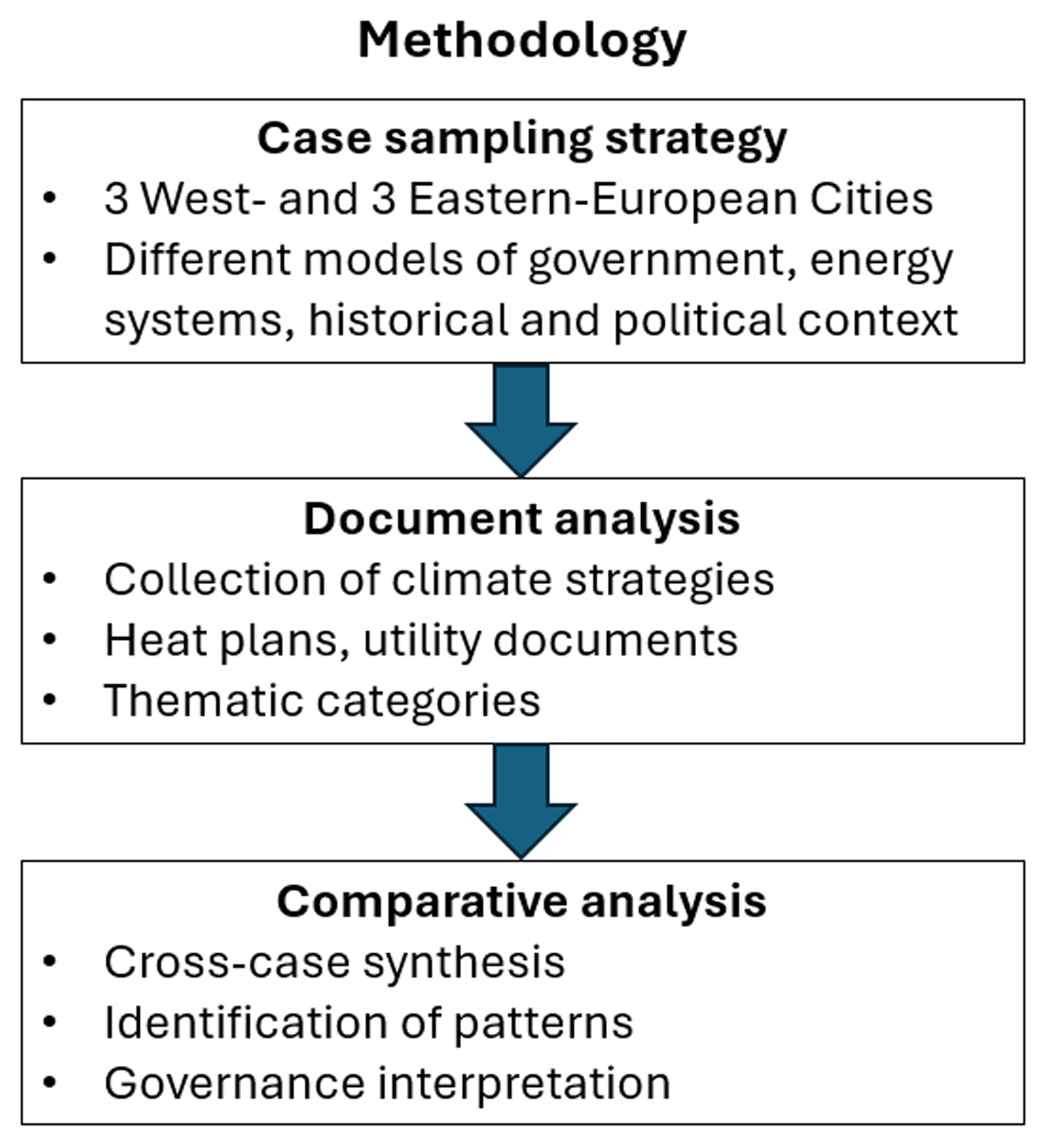
Figure 1
Methodology of the paper (own illustration).
Table 1
Key characteristics of Barcelona’s heating system infrastructure and gas transition.
| CATEGORY | BARCELONA |
|---|---|
| Climate target1 | –45% GHG emissions per capita by 2030 (vs. 2005); climate neutrality by 2050 |
| Heating system structure2 | Predominantly decentralised individual systems |
| Role of natural gas3 | Mainly domestic hot water and cooking; limited role in space heating; gas network available |
| District heating (DH)4 | No city-wide DH; decentralised District heating and cooling (DHC) networks (Districlima, Zona Franca) |
| Renewable/recovered heat5 | Waste heat plant; residual cold from LNG regasification |
| Heat pumps6 | No data for Barcelona; For Spain: Widespread use of reversible air-conditioning systems with a growing but still uneven uptake of aerothermal heat pumps. |
| Gas phase-out approach7 | No explicit gas phase-out strategy; gas use indirectly reduced via electrification and efficiency measures |
| Gas network governance8 | Privately operated; nationally regulated |
| Municipal heat planning9 | Plan Clima 2018–2030 (no gas phase-out timeline) |
| Key transition barriers10 | Ageing building stock; low renovation rates |
Table 2
Key characteristics of Budapest’s heating system infrastructure and gas transition.
| CATEGORY | BUDAPEST |
|---|---|
| Climate target11 | –80% GHG emissions by 2050 with offsetting of remaining emissions |
| Heating system structure12 | large DH network combined with widespread individual gas boilers |
| Role of natural gas13 | Dominant heating fuel, especially in single-family homes and many multi-family buildings |
| District heating14 | Large, city-wide DH system |
| Renewable/recovered heat15 | Emerging geothermal projects (e.g. Zugló); pilot-scale wastewater heat recovery |
| Heat pumps16 | Very limited deployment; mainly pilot projects and small-scale applications |
| Gas phase-out approach17 | No gas phase-out strategy; gas framed as unavoidable transitional fuel |
| Gas network governance18 | State-owned (MVM Group); nationally regulated |
| Municipal heat planning19 | Sustainable Energy and Climate Plan (SECAP); no municipal gas phase-out timeline |
| Key transition barriers20 | Fossil lock-in of DH generation; ageing building stock; low renovation rates |
Table 3
Key characteristics of Copenhagen’s heating system infrastructure and gas transition.
| CATEGORY | COPENHAGEN |
|---|---|
| Climate target21 | Climate neutrality by 2025 (an 80% reduction in emissions was achieved between 2012 and 2025); climate positivity by 2035 |
| Heating system structure22 | Highly centralised, collective heat supply |
| Role of natural gas23 | Marginal for space heating; limited to cooking and small commercial uses |
| District heating24 | >98% of buildings connected; world’s largest urban DH network |
| Renewable/recovered heat25 | Waste-to-energy, industrial & wastewater heat, geothermal energy, large-scale heat pumps |
| Heat pumps26 | Large-scale heat pumps integrated into DH; limited relevance at individual building level |
| Gas phase-out approach27 | No network shutdown; defossilisation via biogas (>70% in 2023, 100% by 2025) |
| Gas network governance28 | State-owned distribution; city gas |
| Municipal heat planning29 | Mandatory heat planning since 1979; Climate Plan 2021–2025 |
| Key transition barriers30 | Permitting for large heat pumps and geothermal projects; long-term biomass sustainability; long investment cycles in DH infrastructure |
Table 4
Key characteristics of Ljubljana’s heating system infrastructure and gas transition.
| CATEGORY | LJUBLJANA |
|---|---|
| Climate target31 | Climate neutrality by 2030 |
| Heating system structure32 | Strong DH and widespread individual systems |
| Role of natural gas33 | Transitional fuel in DH (~60% of DH output); important in individual heating (~10% of total household energy use) |
| District heating34 | Nearly 50% of apartments connected; operated by municipally owned Energetika Ljubljana |
| Renewable/recovered heat35 | Planned 100 MW biomass plant; early-stage wastewater heat, geothermal energy and large heat pumps |
| Heat pumps36 | Limited deployment; mainly in renovated buildings and pilot projects |
| Gas phase-out approach37 | No municipal gas phase-out timeline; gas framed as transitional fuel |
| Gas network governance38 | Gas market and tariffs regulated nationally; local distribution operated by municipal utility |
| Municipal heat planning39 | Climate Neutrality Action Plan 2030 |
| Key transition barriers40 | Ageing building stock; high renovation costs; lack of national gas phase-out strategy |
Table 5
Key characteristics of Mannheim’s heating system infrastructure and gas transition.
| CATEGORY | MANNHEIM |
|---|---|
| Climate target41 | Climate neutrality by 2030; largely decarbonised heat supply by ~2040 |
| Heating system structure42 | District-heating-dominated system with remaining decentralised gas heating |
| Role of natural gas43 | Still significant in individual buildings (~27% of apartments); declining role in DH |
| District heating44 | One of Germany’s largest DH systems, operated by MVV; backbone of future heat supply |
| Renewable/recovered heat45 | Industrial waste heat, waste-to-energy, wastewater heat; large river-water heat pumps |
| Heat pumps46 | Large-scale river-water heat pumps central to DH decarbonisation; limited building-level uptake |
| Gas phase-out approach47 | Intention to decommission gas grid; target year 2035 |
| Gas network governance48 | Municipally influenced (MVV Netze), but regulated under federal energy law |
| Municipal heat planning49 | Municipal Heat Plan (2024); Climate Action Plan 2030 |
| Key transition barriers50 | High renovation needs; high conversion costs; regulatory dependence on federal level |
Table 6
Key characteristics of Warsaw’s heating system infrastructure and gas transition.
| CATEGORY | WARSAW |
|---|---|
| Climate target51 | –40% GHG emissions by 2030; climate neutrality by 2050 |
| Heating system structure52 | District-heating-dominated system with fossil-based generation |
| Role of natural gas53 | Important as coal replacement; widespread in individual heating |
| District heating54 | ~80% coverage; one of Europe’s largest DH networks |
| Renewable/recovered heat55 | Pilot waste-heat projects (metro, wastewater, data centres) |
| Heat pumps56 | Growing nationally, but limited urban uptake due to building constraints |
| Gas phase-out approach57 | No gas phase-out; gas framed as transitional fuel |
| Gas network governance58 | Nationally regulated; operated by PSG/ORLEN |
| Municipal heat planning59 | Green City Climate Action Plan; coal phase-out focus |
| Key transition barriers60 | Coal legacy; continued gas prioritisation; low renovation rates |
Table 7
Comparative overview of municipal gas phase-out pathways.
| CITY | ROLE OF GAS | GAS PHASE-OUT FRAMING | MUNICIPAL INFLUENCE | DOMINANT CHALLENGES | TRANSITION TYPE |
|---|---|---|---|---|---|
| Budapest | Dominant | No gas phase-out strategy | Low | National control; fossil DH | Fossil infrastructure lock-in |
| Barcelona | Persistent + decentralised | No explicit phase-out | Low-medium | governance limits | Incremental, sectoral transition |
| Copenhagen | Marginal | Explicit defossilisation(biogas + DH) | High | Biomass sustainability | Advanced DH decarbonisation |
| Ljubljana | Central (DH + individual) | Gas as transitional fuel | Medium | Gas in DH; financing | Transitional fuel consolidation |
| Mannheim | Declining but persistent | Strategic aspiration (non-binding exit) | High | Renovation pace; national regulation | Aspirational infrastructure transition |
| Warsaw | Central (DH + individual) | Gas as transitional fuel | Low | Coal legacy; national regulation | Coal-to-gas lock-in |