
Introduction
Reaching the European Union’s greenhouse gas (GHG) emissions objectives (European Commission, 2021) necessitate coordinated efforts across multiple governance levels and sectors, and regional and local authorities play an essential position in enforcing their implementation, as they are closer to the citizens and local realities (Melica, et al., 2018). Yet, several barriers are still hindering local authorities; two main difficulties are the complexity of a holistic energy transition and the policy design challenges.
At municipal and regional levels exist a multitude of policy plans implementing social/technical energy policies and strategies, focusing on energy poverty, transport and mobility, housing, and social building plans. Critically, social and energy dimensions are not separate concerns: energy poverty and social vulnerability are disproportionately concentrated in poorly insulated, energy-inefficient buildings, making social energy policy one of the most direct levers available to local authorities for delivering energy efficiency gains at the household and community level (Gouveia, et al., 2019).
Addressing social barriers is therefore inseparable from achieving the EU’s energy efficiency targets; social aspects must therefore be duly considered in energy policymaking and reflected in related plans. These local plans need to be realistic, achievable, and coherent with each other within the local political frame, considering the needs and problems of all concerned actors (government, society, academic research and business) while being coherent with the wider national and further European policy frameworks.
The ENTRACK project, co-funded under the EU LIFE Clean Energy Transition programme, aims to accelerate the transition to a climate-neutral society and include social and human dimensions of a just and fair transition into the broader decarbonisation context, by increasing the energy policy capacities of eight Mediterranean rural municipalities in Greece, Italy, Portugal, and Spain, with a ready-to-use and replicable policy co-design methodology, based on the creation and running of Municipality–Region Partnerships (MRPs).
Butler et al. (2018) state that alternative governance processes are needed to deliver the scale of transformation necessary to meet climate change targets, significantly reduce energy demand, and address issues of energy vulnerability. ENTRACK studies the possibility to further develop social energy policies, which sit at the intersection of energy systems and social welfare, addressing how energy access, affordability, consumption, and transition are experienced differently across social groups. These policies can influence energy demand by shaping the conditions under which households adopt or fail to adopt efficiency measures; they also address structural demand-side barriers that purely technical policies cannot reach. Hence, ENTRACK places itself as an empirical application of this governance process rethinking, bringing it into a rural Mediterranean context where the gap between top-down policy design and local lived experience is particularly acute.
Based on the axiom that bottom-up approaches, built on participatory citizen activities and policy actors at the municipal level will support the design of more just social energy policies, the following research question can be formulated:
What do taxonomy analysis, ethnographic research, self-evaluation and co-design activities reveal about the barriers to and opportunities for social energy policy development in rural Mediterranean municipalities?
This paper first describes the methodology developed to analyse energy-related social and policy dynamics in rural Mediterranean areas that will contribute to depict their social energy policy context. Then, main findings from policy identification and mapping are presented, followed by key insights from ethnographic research, policymakers’ self-assessments, results of co-creation activities and concluding with a discussion on the relevance of self-evaluation and the role of communities in the rural context.
Methodology
The rationale behind ENTRACK’s approach is to connect high-level policy design with aspirations and needs from target areas’ citizens, who are rarely consulted on social energy planning matters, to develop social energy policies in rural Mediterranean areas. To maximise their reach, studies more easily focus on urban, more densely populated areas and even there, consultative processes are mostly held as tokens, in a box-ticking exercise.
To palliate this lack of citizen involvement resulting in a lack of granular, citizen-level information, ENTRACK chose to adopt a two-step evaluation process:
Establish a taxonomy of energy and climate policies to determine the existing policy dynamics in target areas and beyond;
An ethnographic approach, described hereafter; the concept of Climate Explorers – recruited to perform the field research – is among the recommended methods identified to involve vulnerable groups in the energy transition process (Just Transition Platform Working Groups, 2023).
First, the taxonomy establishes the policy landscape (what already exists at EU, national, regional, local level) and reveals potential structural gaps. Meanwhile, the ethnographic research with Climate Explorers establishes the citizen-level reality on the ground (what people experience, need, and perceive). The self-evaluation then bridges the two, asking policymakers to confront the gap between what policies intend and what citizens experience, thus structuring co-design activities in MRPs that use input from previous activities to collectively develop new or revised social energy policies.
To reinforce and possibly replicate its action, ENTRACK also developed a Training Platform (ENTRACK, 2025) and will soon deliver a modelling tool, both intended for local authorities’ staff; for reasons of conciseness and scope, these activities are not included to this paper.
Taxonomy of EU social energy policies
Despite increased shares of renewables in energy consumption amongst EU countries, southern Mediterranean countries remain in the trail of Nordic and Baltic countries, with only Portugal breaking into the top ten countries with the highest share in the EU (ranking sixth), Greece ranking twelfth, Spain thirteenth and Italy seventeenth of the EU 27. There are significant gaps between the share in the leading country (Sweden), with a 66% share of renewables in energy consumption, with Portugal at 34.7%, Greece at 22.7%, Spain at 22.1%, and Italy at 19.1% (EUROSTAT, 2024). These gaps are an important reflection when considering established links between economic prosperity and uptake of renewable energy (IEA, 2024) and economic instability in the southern Mediterranean. Specifically, this region was severely affected by the eurozone crisis, reductions in tourism during the COVID pandemic and is currently struggling through the energy crisis (Morillas, et al., 2022) (Sorgi, 2024).
Considering these challenges, the EU has established multiple policies integrating various sectors, such as the social and energy sectors, ensuring that the transition to a low-carbon economy is inclusive and equitable.
These policies having been transposed in each studied country, ENTRACK’s mapping exercise visually translates the governance environment that shapes concrete energy, climate and social action; on each map (available on the dedicated page on ENTRACK’s website1), the main policy areas covered are: Sustainable development, Energy, Environment & climate change, Social, Economy & territorial cohesion and Social/Energy, last of which covers policies identifying issues at the crux of the social and energy policy domains as their main scope, e.g., energy poverty. In total, 40 policies were mapped, see Figure 1 in the Taxonomy results section.
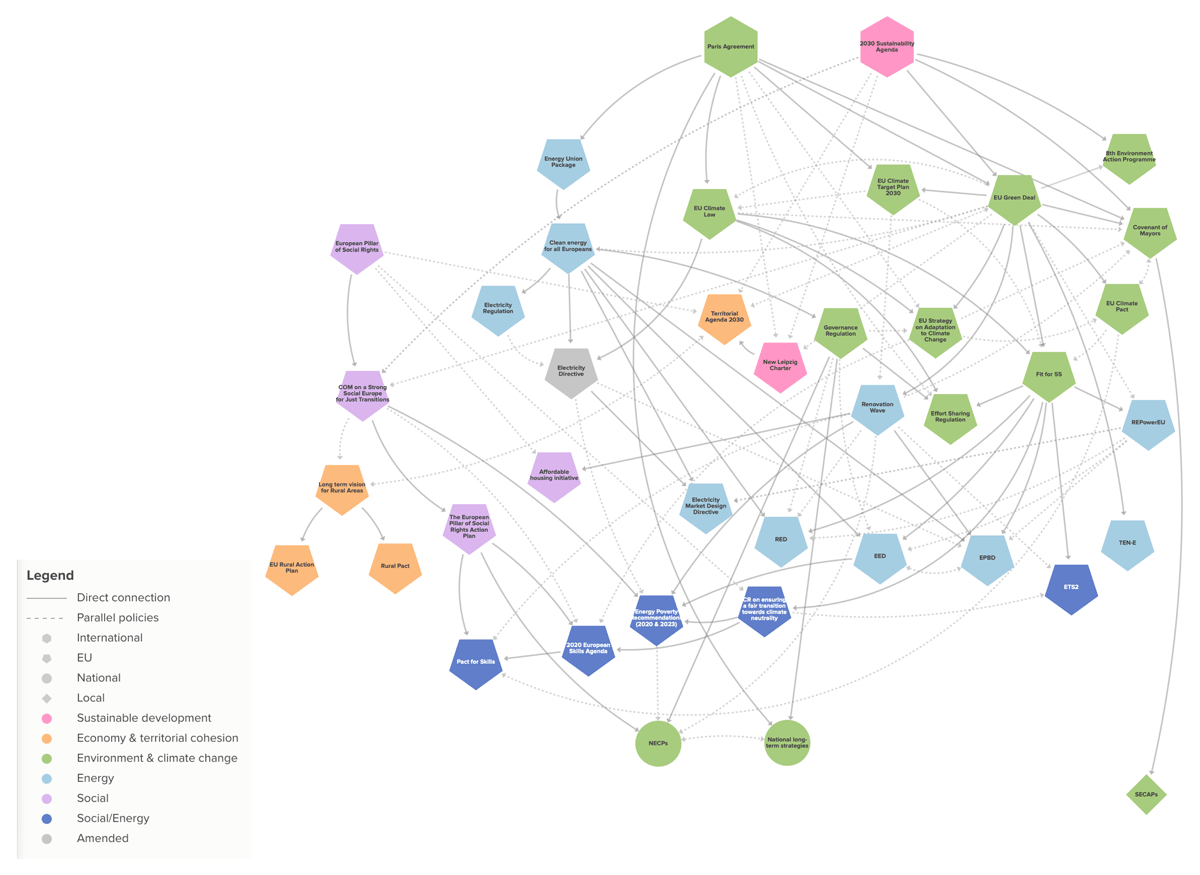
Figure 1
Overview of ENTRACK’s EU policy map (Castro, et al., 2024). Full interactive version accessible via the dedicated page on ENTRACK’s website.
Ethnography with climate explorers
Ethnography is a research method rooted in cultural anthropology, focused on understanding behaviours and beliefs by immersing in people’s daily lives and exploring the motivations and practices that shape their decisions.
Energy consumption choices are influenced by more than just cost or efficiency; they are impacted by social, generational, emotional, and moral factors. By promoting open discussions and challenging assumptions, ethnography encourages participants to reflect on their choices and critically assess the norms influencing energy use. Ethnographic interviews can reveal factors that either enable or hinder sustainable energy practices.
From a methodological standpoint, this fieldwork was distinct in that it was conducted by non-professional researchers, Climate Explorers, trained by the Kilowatt team in foundational ethnographic techniques, engaged directly with community members, establishing relationships and exploring the underlying motivations for energy-related decisions.
While cultural anthropology offers academic references on similar themes like sustainability and clean energy practices, ENTRACK’s report on Perceptions, Needs and Priorities of Citizens concerning the Energy Transitions (Benaglia, et al., 2024) focus remains on practical application.
In line with the core ethnographic principle of valuing others’ perspectives, every individual in the community who was willing to respond to questions about their lived experiences and potential visions regarding sustainability and clean energy was considered a potential interviewee. The aim was not to filter participants for statistical representativeness, such as by demographic criteria, but rather to capture the diverse range of experiences within these communities. The fundamental requirement for participating in the project as an interviewee was to have some meaningful connection to the community in question, without the strict condition of being native to that place. This open and inclusive approach aimed to gather a broad spectrum of perspectives by valuing diverse experiences and backgrounds within the community. Inclusivity here means welcoming both long-term residents and those who contribute to the community in other ways – such as workers, seasonal inhabitants, or recent settlers – thus ensuring that the gathered insights reflect a fuller range of relationships to local energy practices and sustainability concerns.
Local policymakers’ self-evaluation
Developed to enable policymakers to self-assess the effectiveness of existing social energy policies, the self-evaluation integrated top-down perceptions of policymakers with bottom-up perceptions of citizens, allowing a direct comparison between intended policy impacts and the experiences of local communities. This dual perspective aimed not only to inform targeted personnel about the impacts perceived from below but also to prompt critical reflection on potential gaps or weaknesses in policy design and implementation.
The methodology was structured in three sequential steps.
In the first step, policymakers reflected on citizens’ experiences a short questionnaire (Ragazzo, 2025) addressing perceived obstacles, awareness of local initiatives, incentives, participation in community projects, and expectations for future changes in energy practices.
The second step involved a structured self-assessment of existing social energy plans using a subset of indicators – strategic dimension, territorial focus, governance, intersectoral integration, and monitoring – from the SAT4TER tool (Joint Research Centre, 2024), originally designed for local and regional authorities under the EU Cohesion Policy. Policymakers evaluated the strategic dimension, territorial focus, governance, cross-sectoral integration, and monitoring of their plans by expressing their level of agreement with specific statements.
In the third step, a second questionnaire (Ragazzo, 2025) was administered to identify knowledge and capacity gaps among policymakers; it included multiple-choice and open-ended questions to assess both technical knowledge and practical competencies in drafting, implementing, and monitoring social energy policies.
Municipality–region partnership
To support and pilot the codesigning methodology, a mixed public/private stakeholders’ group has been in each country, the Municipality-Region Partnership (MRP), counting on the participation of up to 25 different stakeholders in collaboration between the piloting municipalities and the project partners.
The MRP’s role is twofold: (i) foster the capacity of co-designing, promoting a collective learning process among all stakeholders and providing the working environment for the actual codesigning of social energy policies and (ii) validate ENTRACK results, facilitate and enhance the dialogue within the region.
MRP participants are also included in the ENTRACK Community of Practice activities described in the next section. A European dimension of the MRP was also ensured, opening the possibility to meet MRPs in other pilot regions.
Community of practice
Communities of Practice (CoP) are designed as a space to share best practices on just energy transition in rural communities with the aim to create shared knowledge over time. It is an adequate tool to foster collaboration among key stakeholders in a specific field, in this case regarding climate and energy, empowering them to expand their knowledge on sustainable energy planning. Tackling complex issues within these fields is easier and successful when there is a shared approach to work and learn creatively together for future actions.
In each partner country, national CoPs’ target stakeholders are administration representatives from all governance levels, experts and academics, sister projects, civil society and private sector through business associations. Each country also has its own LinkedIn group where information and updates according to each context are shared, thus allowing CoP members to reach even more people and expand the impact of the work carried out. A CoP was also established at EU level, hosted by the Rural Pact Community (Rural Pact Community Platform, 2026).
Social energy policy landscape – taxonomy findings
Under supervision of the Center for Environmental and Sustainability Research & CHANGE from NOVA University, Lisbon, ENTRACK identified and mapped policies to develop a Taxonomy of social energy plans (Castro, et al., 2024), strategies and policies from EU level down to municipal level, which reveals their key features.
A strong top-down policy structure
Across all four Southern Mediterranean countries, social energy-related policies are shaped primarily through a top-down logic beginning with international frameworks such as the Paris Agreement and the UN 2030 Sustainable Development Agenda. These foundational agreements directly drive the creation of national climate laws – Portugal’s Basic Climate Law, Spain’s Climate Change and Energy Transition Law, Italy’s national climate and energy strategies, and Greece’s National Climate Law all explicitly trace their lineage back to these global commitments. These upstream policies not only guide overarching strategic directions but also define mandatory national planning instruments, such as National Energy and Climate Plans (NECPs), long-term strategies, and adaptation frameworks.
This top-down structure extends to regional and local levels but with decreasing influence the further down it goes. While national policies frequently reference EU directives and international obligations, regional and local policies rarely exert reciprocal influence on national or EU frameworks. This is true even in countries with strong regional identities – Spain being a notable example, where Catalonia’s advanced regional policy architecture still largely adapts rather than shapes national policy. Across all cases, the dominance of top-down transmission also contrasts with EU-level rhetoric advocating citizen-led energy transitions, signalling a structural gap between policy design and local democratic engagement.
Environment and climate change policies are the most frequent
In all four countries examined, environment and climate change policies constitute the largest share of all policies mapped. This reflects the broad and cross-cutting nature of climate governance, which covers emissions reductions, adaptation, biodiversity, land-use, and resilience. This policy category consistently feeds into or “causes” policies across other sectors, including energy, economy, territorial cohesion, and even emerging social-energy domains. For example, Portugal’s Carbon Neutrality Roadmap and Basic Climate Law both drive sectoral policies on energy efficiency and housing renovation, while similar patterns appear in Spain, Italy, and Greece through their NECPs, adaptation plans, and national long-term strategies.
The dominance of climate policies also reflects the political urgency introduced by EU-level commitments, particularly the European Green Deal and associated Fit for 55 package. These frameworks create cascading obligations for Member States, making climate action the primary backbone of national policy ecosystems. Consequently, social, territorial, and energy policies often follow from environmental objectives rather than emerging independently. This top-heavy climate focus helps explain why social and social energy policy categories remain smaller in number and why local-level policies, which often deal with implementation rather than strategic direction, appear comparatively underdeveloped.
Social energy policies exist, but mostly at national level
While all four countries have begun to develop policies that bridge social and energy domains – such as energy poverty strategies or just transition measures – these remain overwhelmingly national in scale. Portugal has a single national-level social energy policy (ELPPE), so does Greece, Spain has three, and Italy has none. No country has substantial regional or local policies dedicated to social-energy topics, even though issues such as energy poverty, renovation of poorly performing buildings, and community energy schemes are most acutely felt at local scales.
This pattern reflects both the novelty of the social-energy concept and the complexity of integrating social protections with technical energy goals. Social-energy topics often sit at the intersection of welfare, housing, energy regulation, and municipal planning – domains historically governed separately. As a result, national frameworks tend to provide general strategic direction (e.g., reducing energy poverty, protecting vulnerable consumers, ensuring a fair transition), while concrete implementation tools at regional and municipal levels are still developing or missing entirely.
This represents a significant gap in all four countries with direct consequences for energy efficiency delivery: the households hardest to reach for efficiency upgrades – those living in poorly performing buildings and facing financial or informational barriers – are precisely the households that a territorial social energy policy would target. Without stronger territorialisation of social-energy policy, the energy efficiency potential embedded in vulnerable and low-income housing stock risks remaining untapped, undermining both equity and climate objectives.
Direct policy connections outnumber parallel policies
All five policy maps (EU + four countries) show that direct connections, meaning clear cause/effect or transposition relationships, significantly outnumber parallel connections, which represent related but not causally linked policies (Castro, et al., 2024). This pattern suggests that policy ecosystems are primarily structured around sequential, mandated pathways: EU directives trigger national strategies, which then require regional or local action plans. Examples include the Governance Regulation’s requirement for national NECPs or the Renovation Wave’s influence on national building renovation strategies and energy poverty frameworks.
Parallel policies, while fewer, cluster in sectors with high activity and complexity – especially environment & climate change and energy. These parallel relations indicate thematic overlap between policies that target similar goals or populations but were not designed to directly succeed one another. Although parallel policies may reflect comprehensive attention to important issues, they also risk redundancy, fragmentation, and inefficient resource use. Conversely, strong chains of direct relationships imply clearer policy trajectories but may still produce duplication when multiple downstream policies emerge from a single upstream instrument. Overall, the prevalence of direct connections highlights intentional sequencing, but it does not necessarily guarantee coherent or streamlined policy mixes.
Weak local and regional policy integration
The analysis reveals significant disparities and gaps in how deeply policies penetrate regional and local governance levels. Portugal and Spain present the most complete multi-level architectures, involving NUTS II, NUTS III, and municipal policies. However, even in these cases, local-level influence remains limited; local plans tend to implement rather than shape national frameworks. In contrast, Italy’s policy mapping outcomes include no local policies, while Greece solely includes one, demonstrating minimal integration of local governments into the strategic policy landscape. Greece also lacks NUTS III representation, underscoring structural barriers to multilevel coordination.
This weak integration is particularly problematic for social-energy issues, since challenges such as energy poverty, building quality, and community energy initiatives depend heavily on local conditions. (Castro, et al., 2024) stresses that local authorities are closest to citizens and essential for the EU’s vision of “citizen-led” transitions, yet current governance structures still centralise most strategic functions at national level. Without stronger territorialisation, policies risk remaining abstract and disconnected from practical realities on the ground – an obstacle for effective implementation and equitable outcomes. Strengthening vertical coordination becomes essential for the next phase of energy transition governance.
Country-specific features
Greece’s policy map2 reflects a well-rounded approach to sustainable development, climate resilience, and the energy transition, with an alignment between key national policies and international climate commitments. However, the lack of integration between national, regional, and local policies, the limited connection between policies in the transport and energy sectors, and the fact that certain sectors, such as social energy and social, are underrepresented weakens the framework’s ability to deliver a just and inclusive energy transition.
Italy’s policy map3 illustrates a comprehensive approach to sustainable development, environmental protection, and the energy transition. While the interconnectedness of key national policies provides a strong foundation for achieving long-term climate goals, the lack of integration between some policies poses challenges to the overall effectiveness of Italy’s sustainability efforts. Notably, Italy is the only out of the four countries with no dedicated social energy policy at any governance level. This absence is not only an equity gap but also a structural barrier to energy efficiency progress: without policies that specifically address the social dimensions of energy use, Italy lacks the instruments needed to mobilise energy efficiency improvements among vulnerable households, who are among the least likely to benefit from market-driven or purely technical interventions.
Portugal’s policy framework4 showcases a strong commitment to addressing climate, energy, and social challenges through interconnected strategies. Its strengths lie in its comprehensive approach to decarbonisation, climate adaptation, energy efficiency, and social inclusion. To ensure a more equitable energy transition, regional and local policy integration and targeted measures remain crucial for delivering the full benefits of these strategies across the country.
Spain’s policy landscape5 is marked by a comprehensive and ambitious framework addressing various aspects of sustainability, the energy transition, and social equity, however it is not without its challenges. The integration of social considerations, mainly through the Just Transition Strategy – only of the four studied countries – is a notable strength. Still, the effectiveness of these policies could be significantly enhanced through better integration and coordination across different sectors.
While the taxonomy reveals what policies exist at each governance level, it does not capture how those policies are experienced by the citizens they are designed to serve. The following section addresses this gap through ethnographic findings.
Perceptions and energy practices – ethnographic findings
Economic barriers, such as the high cost of renewable technologies and energy efficiency improvements, remain a significant obstacle to adopting clean energy practices, even where subsidies are available. Many of the barriers citizens described – financial constraints, lack of accessible information, and bureaucratic hurdles in accessing subsidies – are the same barriers that prevent households from undertaking energy efficiency measures such as building insulation, window replacement, or the installation of more efficient heating and cooling systems. Rising energy costs prompted behavioural shifts, yet frustration with the complexity of accessing support programmes discouraged many from pursuing efficiency upgrades that would reduce their long-term energy expenditure; this feeling was also expressed in semi-structured interviews with local societal actors in each Mediterranean pilot (Viero & Fracassi, 2024). These findings confirm that social energy policies, insofar as they lower financial and informational barriers, are a necessary precondition for unlocking energy efficiency improvements at household level in rural Mediterranean areas.
It is noteworthy that the analysis from the citizens’ perspective already mirrors the overall stakeholders’ analysis, highlighting a shared recognition of these challenges across different groups and diverse contexts.
Limited public transportation and infrastructure, especially in rural and coastal areas, were frequently cited as challenges, forcing reliance on private cars or scooters. Territorial vulnerability thus played a significant role in shaping people’s concerns, sustainability is depicted as heavily constrained by financial and infrastructural factors, particularly in already socio-economically disadvantaged regions.
Generational differences also surfaced, with younger people generally more open to sustainable practices than older generations. There was a consistent call for better education and public awareness campaigns about clean energy, alongside a desire for systemic changes to make sustainability more accessible; intergenerational knowledge-sharing emerged as a valuable dynamic.
Respondents often expressed scepticism toward government initiatives and corporate accountability, feeling that large polluters avoid responsibility while individuals bear the burden of change. The gap observed between individual and government levels highlights the potential for community-based initiatives as a space for experimentation and action.
The responses to future-oriented questions expressed feelings like hope, concern, guilt, and frustration; while there is widespread awareness of the potential for devastating environmental impacts, changing entrenched habits and mindsets remains challenging. Moreover, many interviewees struggled to envision concrete proposals, particularly at the community level.
Finally, several interviewees acknowledged that engaging with sustainability – whether by becoming informed, questioning habits, making changes, or investing money – is ultimately a choice often linked to privilege. In other words, sustainable practices depend not only on economic but also on cultural capital. Institutions need to recognize this dynamic and ensure that interventions address various forms of vulnerability, both financial and social.
Together with the taxonomy findings, these citizen-level insights formed the input to the policymaker self-evaluation process, which in turn shaped the co-design processes examined in the next section.
Self-assessment and co-design results
This section displays co-design activities in each the four participating countries, based on the self-assessment activity that synthesised results from the taxonomy and the ethnography to asking policymakers to confront the gap between what policies intend and what citizens experience (Ragazzo, 2025).
Greece
In the Greek context, municipalities like pilots Avdera and Topeiros frequently function with both limited staff and financial resources, while participatory energy governance is not yet institutionalized. MRP meetings progressively saw a shift in emphasis toward operational steps, such as providing updates on project activities, getting ready for group actions and preparing the creation of a Social Energy Community; this structure was appropriate, as enhancing capacity was necessary before proceeding with implementation.
The knowledge-exchange-oriented CoP sessions focused on the ENTRACK methodological approach, energy communities, energy poverty and energy transition measures. Participants highlighted common issues like inadequate infrastructure, local government readiness, complicated regulations and a lack of technical knowledge.
The co-design process started within the MRP context. Participants decided to work toward creating the framework for a Social Energy Community, since there was no comparable programme in the two municipalities at the time.
The need for more methodically integrated energy equity into local social policies was later highlighted when examining how energy-related assistance is currently incorporated into municipal services, and cooperatively mapped organisations that support and include vulnerable groups. This need exposed the existence of support systems but also their fragmentation and lack of coordination.
The co-design process is currently moving forward with the co-creation of the governance structure and sustainability plan for the Social Energy Community, as well as the involvement of identified organisations and a collective review of local energy needs.
Overall, the ENTRACK approach has improved local actors’ cooperation, increased municipal capacity and established energy justice as an achievable goal of governance. The emerging Social Energy Community framework also holds direct potential for energy efficiency gains: by pooling resources and enabling collective investment in shared renewable generation and energy-efficient infrastructure, community energy structures can reduce per-household energy consumption in ways that individual action cannot. This work is significant for the institutionalisation of cooperative energy planning in the upcoming years, as well as for better funding opportunities, increased citizen engagement and the creation of a replicable participatory model for Greek rural municipalities looking to implement a fair and energy-efficient transition.
Italy
Through co-design activities, participants had the opportunity to become more aware of the needs and perceptions of citizens; namely, the difficulty to implement sustainable actions and access information about initiatives promoted by the two municipalities Piano di Sorrento and Vico Equense.
Discussions revealed lack of socio-energy policy planning and of communication regarding those plans towards citizens, mostly due to a shortage of funding and specific expertise required to envision and structure long-term strategies.
The first MRP meeting included a general analysis and measures/indicators regarding energy poverty diagnosis in the pilot municipalities. The following three meetings provided an in-depth exploration of the main socio-energy measures: one-stop shops, renewable energy communities, and funding schemes. These meetings addressed the different aspects of each measure and how they could be integrated into policy plans.
The final output of these three meetings is an updated energy poverty diagnosis and guidelines on integrating the social dimension by topic.
Knowing that both municipalities are undertaking the process to prepare their SECAP, decision-makers of both municipalities expressed their intention to focus the co-design process of ENTRACK on a specific measure: establish a Social Renewable Energy Community (REC), based on the following facts:
The REC is conceived as an initiative that, through a participatory approach, addresses both energy aspects and social aspects, by creating a community composed of various actors (citizens, associations, businesses, local authorities) sharing their renewable electricity production and consumption. Beyond their social role, solidarity-based renewable energy communities can also improve energy efficiency by raising self-consumption, encouraging more attentive household energy use, reducing network demand (Garavaso, et al., 2021), and enabling collective investment in building retrofits and equipment upgrades, which are particularly relevant for the vulnerable households the REC is designed to include.
The establishment of a solidarity-based REC will be included in the energy and social planning of both municipalities, as they could access incentives and have shown particular interest in this type of tool to include vulnerable people in their strategic planning; both municipalities will consider in their next SECAP drafting.
The primary outcome of ENTRACK approach’s application in the two municipality is the enhanced dialogue and decision-making facilitated by the MRP process, which shall then be seconded by the establishment of one or two solidarity-based RECs; these will serve as a tool to engage all actors in the initiative and, in particular, to support vulnerable people within the two municipalities.
The quality of the outcome will be ensured thanks to the active participation of the MRP members, whose role is to strengthen co-design capacities and provide the working environment for the effective co-design of the REC.
Portugal
Co-design activities fostered discussion of central barriers to citizen implementation of sustainable energy practices identified during ethnographic interviews and later explored in the self-assessment activity: social inequality, information and awareness, bureaucratic processes, financial barriers. MRP meetings have increased awareness of barriers among local actors in the Portuguese ENTRACK rural pilot areas.
Portuguese MRP meetings focused on co-design, aiming to gather input for developing new social/energy plans while supporting specific actions on critical areas identified for more inclusive and socially aware energy and climate transitions in the pilot regions. These MRP activities were intended to provide thematic recommendations for future SECAPs; MRP sessions’ topics covered a breadth of issues, from energy efficiency one-stop shops to energy poverty diagnoses, the establishment of renewable energy communities at local and rural scales, and local funding schemes for energy efficiency improvement.
Enriched with new, updated knowledge, MRP members expressed their willingness to develop local renewable energy communities, together with energy poverty diagnosis and vulnerable consumers identification, perception of the impacts of large-scale solar installations on the local area.
The outcomes of this co-design process are anticipated to comprehensively inform different facets of the SECAPs. Furthermore, with some gaps in local actors’ knowledge of social energy planning revealed through the Portuguese self-assessment activity, it is anticipated that the involvement of these actors in co-design exercises will be informative for practitioners operating in the Portuguese pilot areas, serving in some cases as capacity-building sessions.
The topic areas promoted through the Portuguese co-design activities are clearly linked to the barriers identified in the pilots, which the MRP and co-design outcomes contribute to overcome.
Spain
The self-assessment activity aimed to raise awareness among local decision-makers about how citizens perceive existing social energy policies and to identify knowledge and capacity gaps in drafting, implementing, and monitoring these plans. Based on Climate Explorers’ ethnographic research, the process compared citizens’ perceptions with those of policymakers, evaluated existing plans – mainly SECAPs – and explored training needs to strengthen policy co-design.
In both pilots Sant Quirze de Besora and Gombrèn, the main barriers identified were the high upfront costs of sustainable energy measures and complex bureaucratic procedures. Municipal representatives largely agreed with citizens’ views, while also highlighting their limited influence over structural funding and subsidy schemes.
Although both municipalities have promoted incentives, such as tax reductions for solar PV, support for local energy communities, sustainable mobility initiatives, and energy upgrades in public buildings, citizen participation remains limited. The SECAPs were perceived as having weak strategic grounding, insufficient territorial adaptation, and a limited transversal integration of social vulnerability.
MRP sessions carried out with Sant Quirze de Besora and Gombrèn have progressed in parallel with the online CoP sessions organised in Spain. The MRP sessions brought together local, county-level, and provincial actors from the Diputacions of Barcelona and Girona. The initial session introduced the project and methodology. In a subsequent session, the importance of co-design was presented, and each mayor identified energy-related actions from their SECAP that had already been implemented and those they wished to prioritise but had not yet been able to carry out.
In Sant Quirze de Besora, it was agreed to co-design two priority actions: shared electric mobility and residential energy retrofitting. In Gombrèn, energy retrofitting was also prioritised, alongside the potential development of a biomass-based district heating network, which would simultaneously reduce reliance on fossil fuels and improve the energy efficiency of heating provision at community scale. To date, two co-design sessions have been held for these actions: one with citizens to gather perceptions and ensure their views inform the technical design process, and another with local and regional technical staff.
In parallel, four national CoP sessions have been organised online in Spain, first presenting project results and practical examples of co-design in local energy transitions. Then, given the strong interest in the topic, focus was set on rural energy communities, exploring their challenges and opportunities. A specific session addressed district heating networks, including both biomass and geothermal solutions, aligning with Gombrèn’s interest in exploring such infrastructure. The last session focused on integrating energy poverty analysis into SECAPs, drawing on existing Covenant of Mayors indicators.
Discussion
The findings presented in this paper respond to a question that sits at the intersection of energy governance, social policy, and participatory planning: how can rural local authorities be supported in co-designing social energy policies that address both social equity and energy efficiency objectives? Taken together, the four complementary methods deployed in ENTRACK – taxonomy analysis, ethnographic research, policymaker self-evaluation, and co-design activities – produce an understanding of the barriers and opportunities for social energy policy development that no single method could have generated alone.
Social energy policies as a governance gap with direct efficiency consequences
The taxonomy analysis reveals that social energy policies, understood as policies that sit at the intersection of energy systems and social welfare, remain overwhelmingly national in scale in the three countries they are present. Below the national level, the policy landscape thins considerably: local and regional authorities are expected to implement what national and EU frameworks prescribe, but they are rarely equipped – institutionally, financially, or methodologically – to do so in ways that reflect the specific social and territorial conditions of their communities. Italy’s complete absence of dedicated social energy policies at any sub-national level, and Greece’s minimal regional integration, are the starkest illustrations of this gap, but the pattern is general.
This governance gap has direct consequences for energy efficiency. As Butler et al. (2018) argue, energy demand governance cannot be reduced to “energy” policy alone: the choices, practices, and constraints that shape how households use energy are embedded in social relations, institutional arrangements, and everyday life in ways that technical efficiency programmes rarely reach. The taxonomy findings corroborate this argument empirically: the countries and governance levels where social energy policies are weakest are precisely those where the households with the greatest efficiency improvement potential – low-income, fuel-poor, living in poorly performing buildings – are least likely to be reached by existing instruments. Without policies that address the social dimensions of energy use, the energy efficiency potential embedded in vulnerable and low-income housing stock risks remaining untapped, regardless of the ambition of national or EU-level targets.
This finding aligns with broader critiques of top-down energy governance (Butler et al., 2018; Melica et al., 2018), which have noted a persistent structural gap between the EU’s rhetorical commitment to citizen-led energy transitions and the governance architectures that actually exist at local level. ENTRACK’s taxonomy makes this gap visible and measurable across four national contexts, providing an empirical foundation that is often missing from more theoretical treatments of the issue.
Relevance of policymakers’ self-evaluation in the planning process
The self-evaluation activity occupies a strategically important position in the overall methodology; by confronting policymakers with the gap between their own framings of policy effectiveness and the experiences of the citizens those policies were designed to serve, it introduced a form of critical reflexivity into the planning process that is rarely present in conventional policy cycles.
By reversing the original citizen-focused questions and posing them to policymakers, the activity encouraged perspective-taking, fostering empathy and reflection on how policies were experienced on the ground. This process also allowed a systematic comparison between top-down and bottom-up understandings of the same issues, highlighting discrepancies and potential blind spots in communication, engagement, or implementation strategies.
In Spain, for instance, the self-evaluation revealed that both municipalities perceived their SECAPs as having weak strategic grounding, insufficient territorial adaptation, and limited integration of social vulnerability – an assessment that aligned closely with the citizen experiences captured through ethnography. In Portugal, gaps in local actors’ knowledge of social energy planning were surfaced, and MRP co-design sessions subsequently functioned partly as capacity-building encounters, filling the knowledge gaps the self-evaluation had identified. Across all pilots, the activity produced actionable insights that shaped subsequent co-design priorities rather than simply describing a static context.
This dynamic is consistent with the kind of governance rethinking advocated by Butler et al. (2018), who argue that effective energy demand governance requires institutional actors to engage with the social and cultural dimensions of energy use rather than treating demand as a technical variable to be managed. The self-evaluation methodology operationalises this argument at local authority level, creating a structured occasion for policymakers to encounter the social reality of energy demand in their own communities.
Crucial role of communities in the rural context
By collecting the views from local people, including those belonging to vulnerable groups that might not participate in regular public consultation activities, ethnographic research performed by Climate Explorers allowed ENTRACK partners and pilots to see the identified problems from a new perspective. Under this new light, dynamic and structured local communities, such as Renewable Energy Communities, appeared as a pivotal factor in the success of social/energy policies’ design and implementation.
In all pilots, strengthening the role of local communities in the sustainability transition is perceived as a lever to foster shared responsibility, mutual learning, and a supportive environment for adopting sustainable practices. Social pressure could have a positive effect if nurtured in a community context; in such a setting, social influence could motivate individuals to adopt more sustainable behaviours, creating a ripple effect of change.
Encouraging exchanges within communities can contribute to create a more integrated approach to sustainability, leveraging both innovation and experience; intergenerational dialogue can help communities adopt cleaner energy practices more effectively, with social pressure playing a constructive role in driving change.
Some aspects of the economic and infrastructural barriers can be more effectively addressed at the community level through shared resources and collective investments; local energy cooperatives or community-based solar projects could reduce the high initial costs that individuals face when adopting clean energy technologies. These initiatives can also contribute to alleviate the sense of isolation expressed by some respondents, fostering a sense of collective ownership over the sustainability transition. Local governments, in collaboration with civil society organisations, have a key role to play in supporting these initiatives, providing not only financial incentives but also the necessary infrastructure and educational programs to empower communities.
The inherent complexity and contradictions within communities can be balanced with a public communication that conveys imaginative yet achievable solutions, while avoiding becoming inaccessible, rhetorical, or limited to those already engaged. Despite the acknowledgment among people in Greece, Italy, Portugal, and Spain that dealing with sustainability and clean energy is complex and requires time and effort, creating these community spaces would ensure that change feels inclusive, achievable, and grounded in real possibilities.
Beyond their governance and social cohesion value, community-based structures also emerge from the ENTRACK pilots as a practical pathway to energy efficiency outcomes that are difficult to achieve through top-down or market-driven approaches alone. The financial barriers to household energy efficiency improvements – insulation, renovation, efficient appliances – are well documented, but social barriers are equally significant: lack of trusted information, limited awareness of available support, and the sense that change is both costly and individually burdensome. Communities of Practice, RECs, and MRP structures address precisely these barriers, creating the conditions of trust, shared knowledge, and collective investment that make energy efficiency improvements accessible to vulnerable groups. Co-designed social energy policies that embed energy efficiency objectives – not as technical add-ons but as outcomes that community members themselves identify as priorities – are therefore likely to be more effective, durable, and equitable than efficiency programmes that bypass the social dimension entirely.
In this respect, the ENTRACK experience adds empirical weight to calls for a more socially embedded approach to energy demand governance (Butler, et al., 2018), demonstrating in four distinct national contexts that participatory, community-anchored processes are not merely procedurally legitimate but can be substantively productive in terms of the policy outputs they can generate.
Conclusion
This paper set out to investigate what a combination of taxonomy analysis, ethnographic research, policymaker self-evaluation, and co-design activities can reveal about the barriers to and opportunities for social energy policy development in rural Mediterranean municipalities. The findings from ENTRACK’s four pilot areas in Greece, Italy, Portugal, and Spain lead to think that barriers are simultaneously structural, social, and institutional; as such, assessing through a single method or at any single governance level would draw an incomplete picture. ENTRACK’s methodology provides empirical evidence that the governance architectures currently in place in covered countries are structurally misaligned with the insight argued by Butler et al. (2018) that energy demand governance cannot be reduced to “technical-only” energy policy.
Several limitations of this research should be acknowledged. The rural Mediterranean context, while internally diverse, limits the direct transferability of findings to other geographic or climatic contexts. The co-design processes reported here are ongoing; whether the policies co-designed through ENTRACK are ultimately adopted and implemented, and whether they deliver measurable energy efficiency and social outcomes, remains to be assessed through longitudinal follow-up. Additionally, the modelling tool under development within ENTRACK – which will enable local authorities to quantify the efficiency impacts of co-designed policy scenarios – falls outside the scope of this paper but will be an important next step in substantiating the quantitative dimension of the approach.
For policymakers at local, regional, and national level, the central implication of this research is that the territorialisation of social energy policy is not merely a governance improvement – it is a prerequisite for delivering energy efficiency at scale in rural areas. The ENTRACK project suggests that social energy policies are more likely to achieve the just, inclusive, and efficient energy transition that EU frameworks call for if they are embedded at regional and local level, designed with the active participation of communities and co-designed with policymakers who have had the opportunity to confront the gap between policy intent and citizen reality. Supporting local authorities to develop this capacity is not a secondary concern; it is foundational.
Additional File
The additional file for this article can be found as follows:
PowerPoint Slides
PowerPoint Slides relating to this article. DOI: https://doi.org/10.66506/essp.3-173-26.s1
Notes
Acknowledgements
ENTRACK was co-funded by the LIFE Clean Energy Transition programme. Views and opinions expressed are however those of the author(s) only and do not necessarily reflect those of the European Union or the European Climate, Infrastructure, and Environment executive agency (CINEA).
Neither the European Union nor the European Climate, Infrastructure, and Environment executive agency can be held responsible for them.
eceee paper ID
3-173-26