
Table 1
The Sufficiency–Prosumerism–Flexibility Nexus: Key Dimensions and Interactions.
| DIMENSION | ENERGY SUFFICIENCY | PROSUMERISM | DEMAND FLEXIBILITY | JUSTICE IMPLICATION |
|---|---|---|---|---|
| Primary mechanism | Reduce absolute demand | Distributed generation & active participation | Shift timing/magnitude of consumption | Access & capabilities |
| Key enablers | Regulation, social norms, urban planning | Distributed renewables, storage, cooperatives | Smart meters, aggregators, VPPs, V2G | Inclusive design & safeguards |
| Risk without justice lens | Energy poverty deepened if poorly targeted | Rebound effects; widening inequality | Flexibility burden on vulnerable households | Distributional harm |
| Synergy with others | Reduces scale of prosumer & flexibility need | Provides distributed flexibility assets | Enables sustainable prosumer revenue streams | Mutual reinforcement when aligned |
| Policy levers | Progressive tariffs, building codes, Ecodesign | RECs/CECs, virtual net metering, one-stop shops | ToU pricing, social tariffs, aggregation frameworks | Co-design, governance, equity audits |
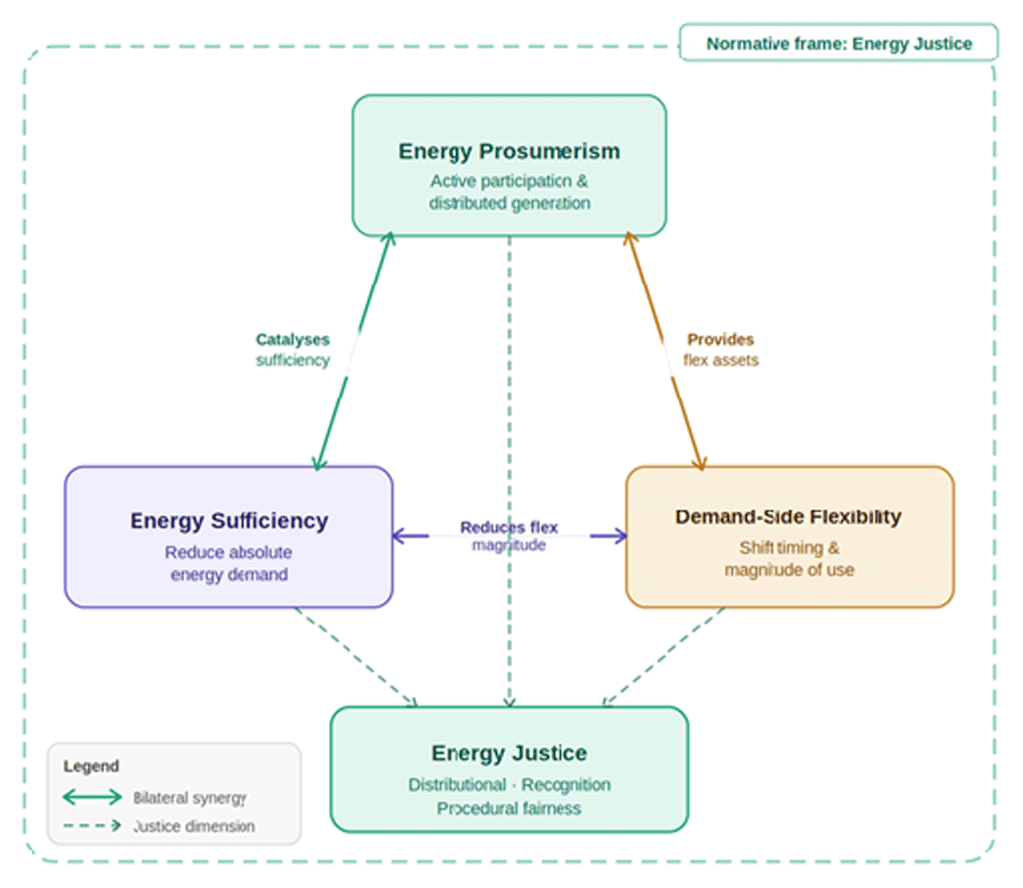
Figure 1
Integrated conceptual nexus framework of sufficiency, flexibility and energy justice.