
Table 1.
Studies were selected based on predefined inclusion and exclusion criteria
| Inclusion Criteria | Exclusion criteria |
|---|---|
| ● Adult patients (≥18 years of age) | ● Patients who underwent cardiac surgery |
| ● Patients resuscitated from in-hospital or out-of-hospital cardiac arrest | ● Publications such as letters, opinions, case reports, case series, review articles, meta-analyses |
| ● Enrolled patients receiving ECPR with or without emergency coronary angiography (CAG) or percutaneous coronary intervention (PCI) | ● Studies conducted on pediatric populations, pregnancy, presumed pregnancy, or patients with a pulse (e.g., cardiogenic shock) |
| ● Studies published between January 2015 and December 2024 | ● Patients with Do Not Resuscitate (DNR) status |
| ● Studies reporting at least one timing data point from: No Flow Duration (NFD) or Low Flow Duration (LFD) or CA-to-ECMO Duration | ● Cardiac arrest of traumatic origin |
| ● Studies reporting at least one of the following outcomes: hospital length of stay (LOS) / survival / neurological outcomes | ● Studies using definitions of timing predictors and outcomes different from those established in this study |
| ● Studies using the Cerebral Performance Category (CPC) scale as criteria for favorable / unfavorable neurological outcomes | ● Studies that do not clearly describe their timing parameter definitions |
| ● Studies published in English as full-text articles in indexed journals |
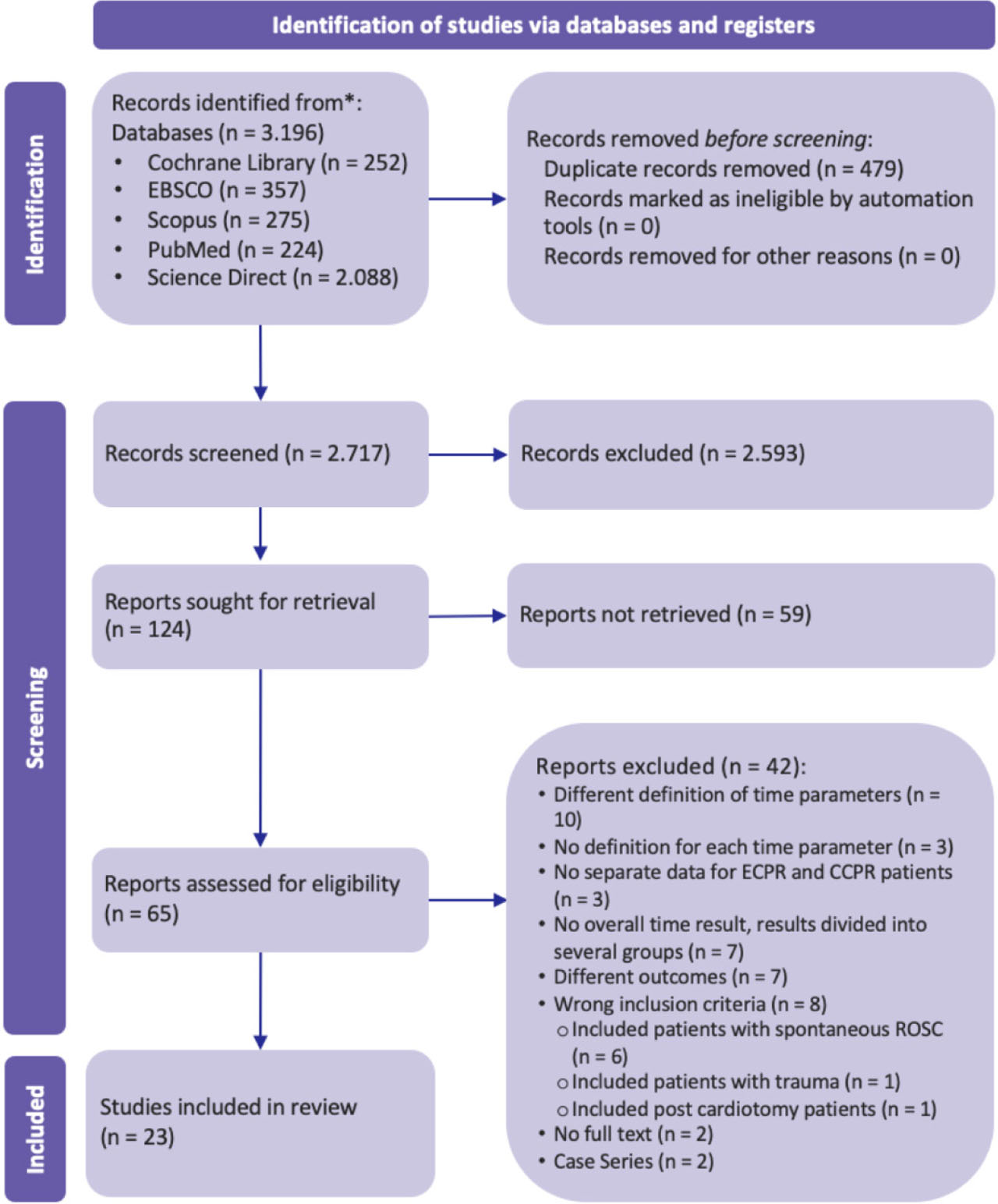
Figure 1.
PRISMA 2020 flow diagram for new systematic reviews, which included searches of databases, registers, and other sources.
Table 2.
Study Characteristics
| No | First Author | Year | Country | Study Design | Setting (SC/MC) | Sample Size, n | CA Location, n (%) |
|---|---|---|---|---|---|---|---|
| 1 | Cesana* [46] | 2017 | Italy | retrospective study | SC | 63 | IHCA 17 (27); OHCA 46 (73) |
| 2 | Dennis* [47] | 2017 | Australia | retrospective analysis study | MC | 37 | IHCA 25 (76); OHCA 12 (24) |
| 3 | Elmelliti [60] | 2023 | Qatar | retrospective cohort study | SC | 48 | IHCA 11 (22.9); OHCA 37 (77.1) |
| 4 | Fjølner* [20] | 2017 | Denmark | retrospective cohort study | SC | 21 | OHCA 21 (100) |
| 5 | Fu [61] | 2024 | Taiwan | retrospective cohort study | SC | 14 | OHCA 14 (100) |
| 6 | Gaisendrees [62] | 2024 | Germany | retrospective cohort study | SC | 157 | IHCA 66 (42); OHCA 91 (58) |
| 7 | Higashi [42] | 2020 | Japan | retrospective observational study | SC | 117 | IHCA 117 (100) |
| 8 | Murakami* [33] | 2020 | Japan | retrospective observational study | SC | 85 | OHCA 85 (100) |
| 9 | Ng [63] | 2022 | Hong Kong | retrospective study | SC | 102 | IHCA 54 (52.9); OHCA 48 (47.1) |
| 10 | Otani* [34] | 2018 | Japan | retrospective analysis study | SC | 135 | OHCA 135 (100) |
| 11 | Podell [21] | 2022 | USA | prospective observational study | SC | 57 | IHCA 52 (91); OHCA 5 (9) |
| 12 | Ryu [64] | 2019 | South Korea | retrospective observational study | SC | 274 | IHCA 250 (91.24); OHCA 24 (8.76) |
| 13 | Shih* [35] | 2024 | Taiwan | retrospective cohort study | SC | 85 | OHCA 85 (100) |
| 14 | Stub [65] (CHEER) | 2015 | Australia | prospective, observational trial | SC | 26 | IHCA 15 (57.7); OHCA 11 (42.3) |
| 15 | Takahagi* [37] | 2022 | Japan | retrospective consecutive study | SC | 39 | OHCA 39 (100) |
| 16 | Ubben* [23] (INCEPTION-trial) | 2023 | Netherlands | pre-planned, per-protocol, randomized controlled trial | MC | 33 | OHCA 33 (100) |
| 17 | Vahedian-Azimi [66] | 2024 | Qatar | retrospective observational study | SC | 48 | IHCA 11 (22.9); OHCA 37 (77.1) |
| 18 | Wengenmayer [43] | 2017 | Germany | retrospective registry data analysis | SC | 133 | IHCA 74 (55.6); OHCA 59 (44.4) |
| 19 | Yu [67] | 2019 | Taiwan | prospective observational study | SC | 482 | IHCA 377 (78.2); OHCA 105 (21.8) |
| 20 | Yukawa* [31] | 2017 | Japan | retrospective study | SC | 79 | OHCA 79 (100) |
| 21 | Puolakka [68] | 2023 | Finland | retrospective observational cohort study | SC | 37 | OHCA 37 (100) |
| 22 | Ellouze [69] | 2017 | France | retrospective observational study | SC | 65 | IHCA 43 (66.2); OHCA 22 (33.8) |
| 23 | Rob* [22] (Prague OHCA trial) | 2022 | Czech Republic | randomized controlled trial | SC | 92 | OHCA 92 (100) |
Table 3.
Population Characteristics
| No | First Author | Age, year ** | Male* | Comorbidities* | Cardiac Etiology* | Shockable Initial Rhythm* |
|---|---|---|---|---|---|---|
| 1 | Cesana [46] | 59±10 | 55 (87.3) | HTN 31 (49); DM 8 (13); Dyslipidemia 5 (9); CKD 2 (3); CAD 8 (13) | 63 (100) | 41 (65.1) |
| 2 | Dennis [47] | 54 (47–58) | 27 (73) | HTN 18 (49); DM 12 (32); Dyslipidemia 14 (38); CAD 9 (24) | 14 (37.8) | 19 (51.35) |
| 3 | Elmelliti [60] | 41.88±11.5 | 36 (75) | HTN 7 (14.6); DM 10 (20.8); Dyslipidemia 3 (6.3); CAD 6 (12.5); HF 1 (2.1) | 21 (43.8) | 16 (33.3) |
| 4 | Fjølner [20] | 56 (19–73) | 12 (57) | NR | 18 (85.7) | 9 (43) |
| 5 | Fu [61] | 54 (46.5–61.8) | 13 (92.9) | NR | NR | 11 (78.6) |
| 6 | Gaisendrees [62] | 55.7±12.8 | 126 (80.3) | NR | NR | 93 (59.5) |
| 7 | Higashi [42] | 66 (46–75) | 77 (65.8) | NR | 80 (68.4) | 29 (25.7) |
| 8 | Murakami [33] | 56.7±11.6 | 70 (82.4) | NR | 61 (71.7) | 70 (82.4) |
| 9 | Ng [63] | 54 (45–61) | 73 (71.6) | NR | 74 (72.5) | 53 (52) |
| 10 | Otani [34] | 65 (50–72) | 115 (85) | NR | 92 (68.1) | 87 (64) |
| 11 | Podell [21] | 57 (IQR:18) | 37 (65) | NR | NR | 21 (36.8) |
| 12 | Ryu [64] | 62.7 (47–74) | 174 (63.5) | HTN 123 (44.9); DM 90 (32.8); Dyslipidemia 32 (11.6); CKD 40 (14.6); CAD 39 (14.2) | 114 (41.6) | 79 (28.83) |
| 13 | Shih [35] | 56 (45–64) | 71 (83.5) | HTN 25 (29.4); DM 23 (27.1); CAD 14 (16.5); CHF 2 (2.4); CVA 4 (4.7); CKD 6 (7.1); Cancer 1 (1.2) | NR | 74 (87.1) |
| 14 | Stub [65] | 52 (38–60) | 20 (76.9) | HTN 11 (42); DM 2 (8); Dyslipidemia 11 (42) CHF 5 (19); CAD 4 (15) | 22 (84.6) | 19 (73.07) |
| 15 | Takahagi [37] | 66 (48–72) | 26 (66.7) | NR | 14 (35.6) | 0 |
| 16 | Ubben [23] | 55.0±11.0 | 30 (91) | ACS 5 (18); CAD 4 (14); HF 1 (3); CVA 2 (7); DM 4 (14); HTN 11 (55); Dyslipidemia 5 (28) | 25 (75.7) | 33 (100) |
| 17 | Vahedian-Azimi [66] | 41.88±11.5 | 36 (75) | HTN 7 (14.6); DM 10 (20.8); Dyslipidemia 3 (6.3); CAD 6 (12.5); HF 1 (2.1) | 21 (43.8) | 16 (33.3) |
| 18 | Wengenmayer [43] | 58.7±2.6 | 99 (74.4) | NR | NR | 76 (57.1) |
| 19 | Yu [67] | 56.4±15.1 | 368 (76.3) | DM 176 (36.5); CAD 190 (39.4); CKD 71 (14.7) | 268 (55.6) | NR |
| 20 | Yukawa [31] | 59 (48.5–64.5) | 65 (82.3) | NR | 31 (39.2) | 58 (73.4) |
| 21 | Puolakka [68] | 51.9±12.1 | 34 (91.9) | NR | NR | 29 (78.4) |
| 22 | Ellouze [69] | 56 (43–65) | 45 (69.2) | NR | 48 (73.9) | 22 (33.8) |
| 23 | Rob* [22] | 58.5 (45–65) | 76 (82.6) | HTN 38 (46.3); DM 13 (16.3); COPD 2 (2.5); CKD 2 (2.5); CAD 15 (18.8); HF 9 (11.1) | NR | 57 (61.9) |
Table 4.
Timing and Outcomes of Both OHCA & IHCA groups
| No | First Author | Sample Size (n) | Timing | Outcomes | |||||
|---|---|---|---|---|---|---|---|---|---|
| No-flow duration, min ** | Low-flow duration, min** | CA-to-ECMO, min** | Favorable outcome* | Survival at 30 days* | Survival at discharge* | Hospital LOS, day** | |||
| 1 | Ryu [64] | 274 | NR | 32.2 (13.0–57.0) | NR | 78 (28.5%) | NR | 95 (34.7%) | NR |
| 2 | Siao [36] | 20 | 1 – 5 | 34.25 (15–226) | NR | 8 (40%) | NR | 10 (50%) | NR |
| 3 | Yu [67] | 482 | NR | 40.8 ± 21.4 | NR | 126 (26.1%) | NR | 143 (29.6%) | NR |
| 4 | Gaisendrees [62] | 157 | 3.25 ± 4.9 | 56.08 ± 28.0 | NR | NR | NR | 39 (24.8%) | 11.4 ± 19.5 |
| 5 | Wengenmayer [43] | 133 | 2.6 ± 0.8 | 59.6 ± 5.0 | NR | NR | NR | 19 (14.3%) | NR |
| 6 | Vahedian-Azimi [66] | 48 | 6.31 ± 3.37 | 39.5 ± 19.63 | 45.81 ± 20.23 | 9 (18.8%) | 14 (29.2%) | NR | 4 (1–12) |
| 7 | Cesana [46] | 63 | 3.0 ± 4.0 | 56.0 ± 24.0 | 58.0 ± 25.0 | 12 (19.04%) | NR | 13 (21%) | 68.0 ± 33.0 |
| 8 | Ng [63] | 102 | 0 (0–1) | 52 (40–73) | 56 (41–74) | 19 (18.6%) | 25 (24.5%) | 33 (32.4%) | 7 (2–30) |
| 9 | Ellouze [69] | 65 | 0 (0–0) | 70 (45–110) | NR | 15 (23.1%) | NR | 16 (24.6%) | NR |
| 10 | Podell [21] | 57 | NR | NR | 31 (23) | 23 (40.3%) | NR | 26 (45.6%) | 22.0 ± 18.52 |
| 11 | Dennis [47] | 37 | NR | NR | 45 (30–70) | 13 (35.2%) | NR | 13 (35.2%) | 11 (2–34) |
| 12 | Elmelliti [60] | 48 | NR | NR | 45 (30–59.5) | 10 (20.8%) | NR | 10 (20.8%) | 4 (1–12) |
| 13 | Stub [65] | 26 | NR | NR | 56 (40–85) | 14 (54%) | NR | 14 (54%) | NR |
Table 5.
Timing and outcomes of OHCA only group
| No | First Author | Sample Size (n) | Timing | Outcomes | |||||
|---|---|---|---|---|---|---|---|---|---|
| No-flow duration, min ** | Low-flow duration, min** | CA-to-ECMO, min** | Favourable outcome* | Survival at 30 days* | Survival at discharge* | Hospital LOS, day** | |||
| 1 | Otani [34] | 135 | NR | 47 (41–57) | NR | 22 (16.3%) | NR | 34 (25%) | NR |
| 2 | Gaisendrees [62] | 91 | 4.3 ± 5.2 | 63.6 ± 25.1 | NR | NR | NR | 21 (23.1%) | 6.7 ± 16.2 |
| 3 | Wengenmayer [43] | 59 | 5.4 ± 1.5 | 72.2 ± 7.4 | NR | NR | NR | 5 (8.5%) | NR |
| 4 | Murakami [33] | 85 | 4.6 ± 5.6 | 49.6 ± 13.4 | 54.2±14.6 | 14 (16%) | NR | NR | NR |
| 5 | Ellouze | 22 | 0 (0–5) | 90 (66–138) | NR | 6 (27.3%) | NR | 6 (27.3%) | NR |
| 6 | Fjølner [20] | 21 | NR | NR | 121 (55–192) | 7 (33.3%) | NR | 7 (33.3%) | NR |
| 7 | Fu [61] | 14 | NR | NR | 48.5 (43.8–56.2) | 4 (28%) | NR | 5 (35%) | NR |
| 8 | Dennis [47] | 12 | NR | NR | 63 (45–77) | 5 (41%) | NR | 5 (41%) | NR |
| 9 | Shih [35] | 85 | NR | NR | 92.0 (76.0–118. 0) | 15 (17.6%) | NR | 25 (29.4%) | NR |
| 10 | Takahagi [37] | 39 | NR | NR | 44 (35–55) | 4 (10.3%) | 7 (18%) | NR | NR |
| 11 | Ubben [23] | 33 | NR | NR | 69 (60–77) | 5 (15%) | 5 (15%) | 5 (15%) | 2 (2–15) |
| 12 | Yukawa [31] | 79 | NR | NR | 45.0 (40.0–56.5) | 11 (13.9%) | NR | NR | NR |
| 13 | Puolakka [68] | 37 | NR | NR | 84 (61–105) | 11 (29.7%) | NR | 13 (35.1%) | NR |
| 14 | Rob [22] | 92 | NR | NR | 61 (55–70) | 20 (21.7%) | NR | NR | NR |
Table 6.
Timing and outcomes of IHCA only group
| No | First Author | Sample Size (n) | Timing | Outcomes | |||||
|---|---|---|---|---|---|---|---|---|---|
| No-flow duration, min** | Low-flow duration, min** | CA-to-ECMO, min** | Favourable outcome* | Survival at 30 days* | Survival at discharge* | Hospital LOS, day** | |||
| 1 | Higashi [42] | 117 | 0 | 27 (19–40) | NR | 37 (31.9%) | NR | 45 (38.8%) | 10 (4–19) |
| 2 | Gaisendrees [62] | 66 | 0 | 41.1 ± 27.4 | NR | 18 (27.27%) | NR | NR | 15.6 ± 7.7 |
| 3 | Wengenmayer [43] | 74 | 0.3 ± 0.3 | 49.6 ± 5.9 | NR | NR | NR | 14 (18.9%) | NR |
| 4 | Ellouze [69] | 43 | 0 | 60 (45–89) | NR | 9 (20.9%) | NR | 10 (23.3%) | NR |
| 5 | Dennis [47] | 25 | NR | NR | 40 (30–55) | 8 (33%) | NR | 8 (33%) | NR |
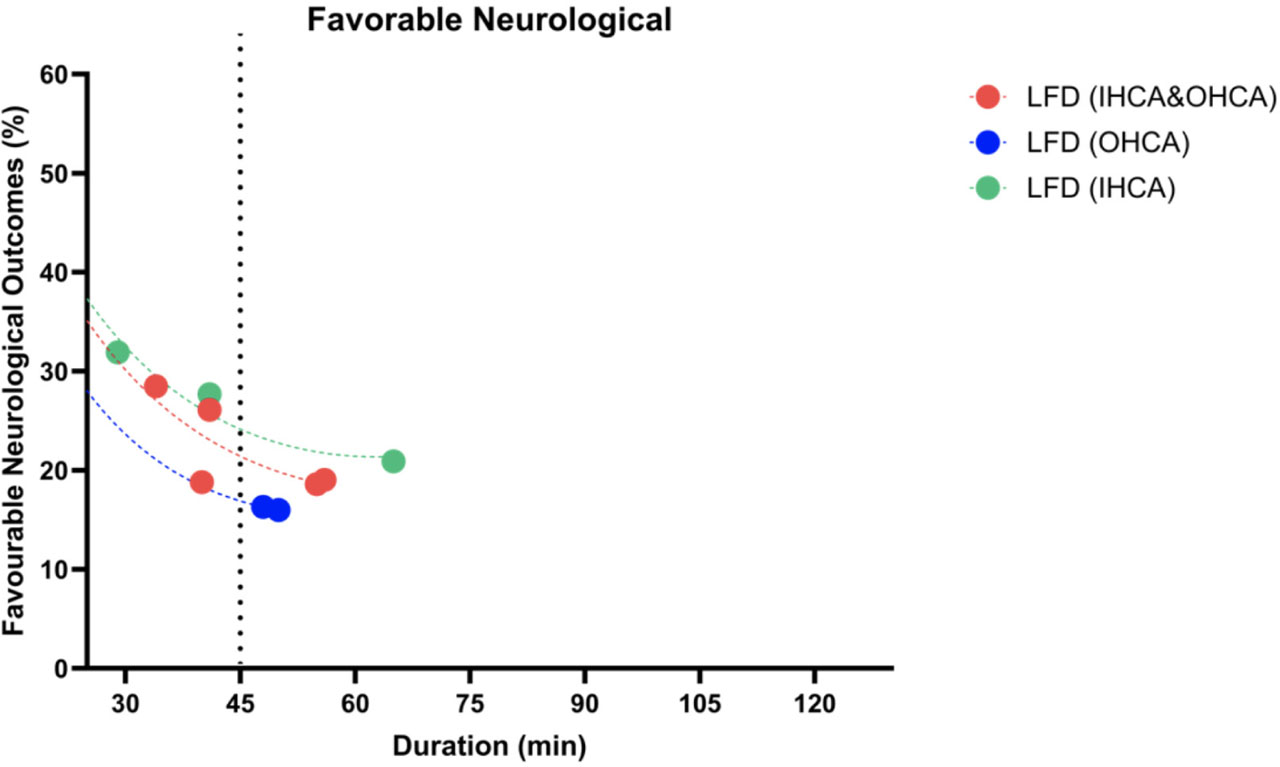
Figure 2.
Relation between LFD and Neurological Outcomes
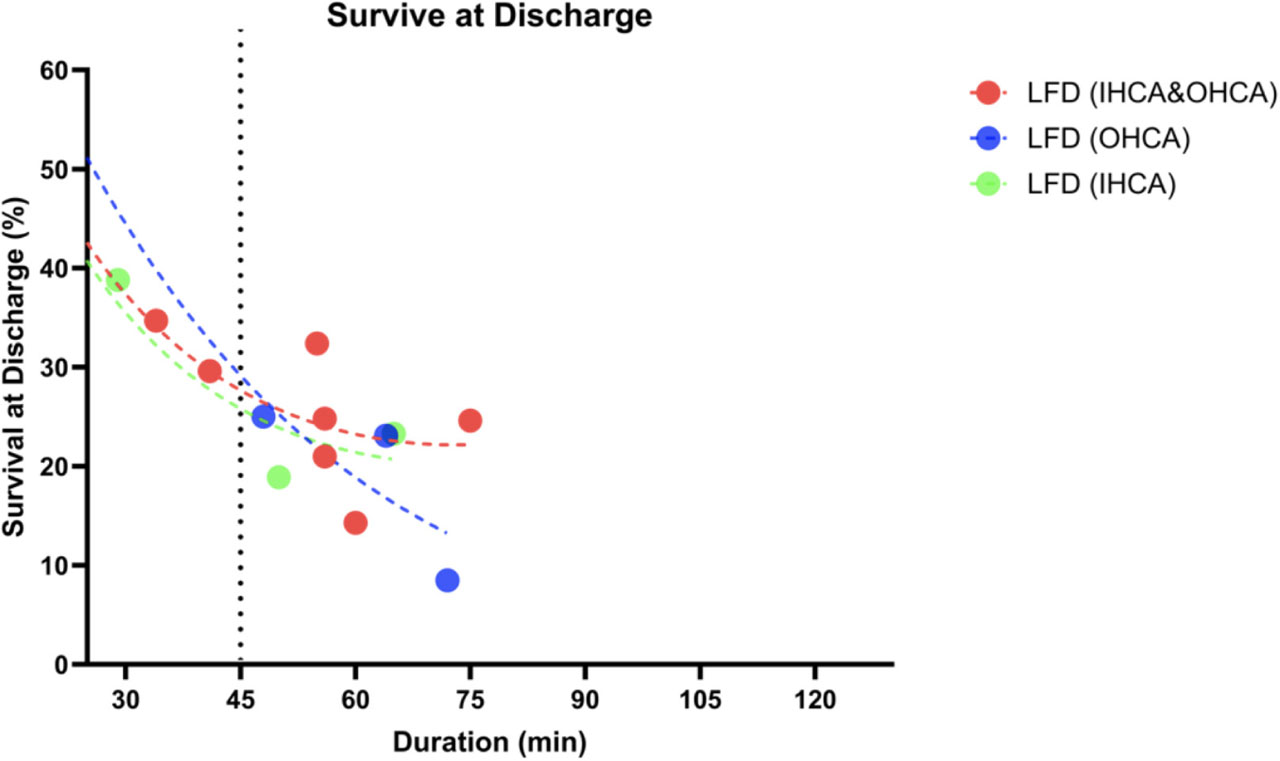
Figure 3.
Relation between LFD and Survival at Discharge
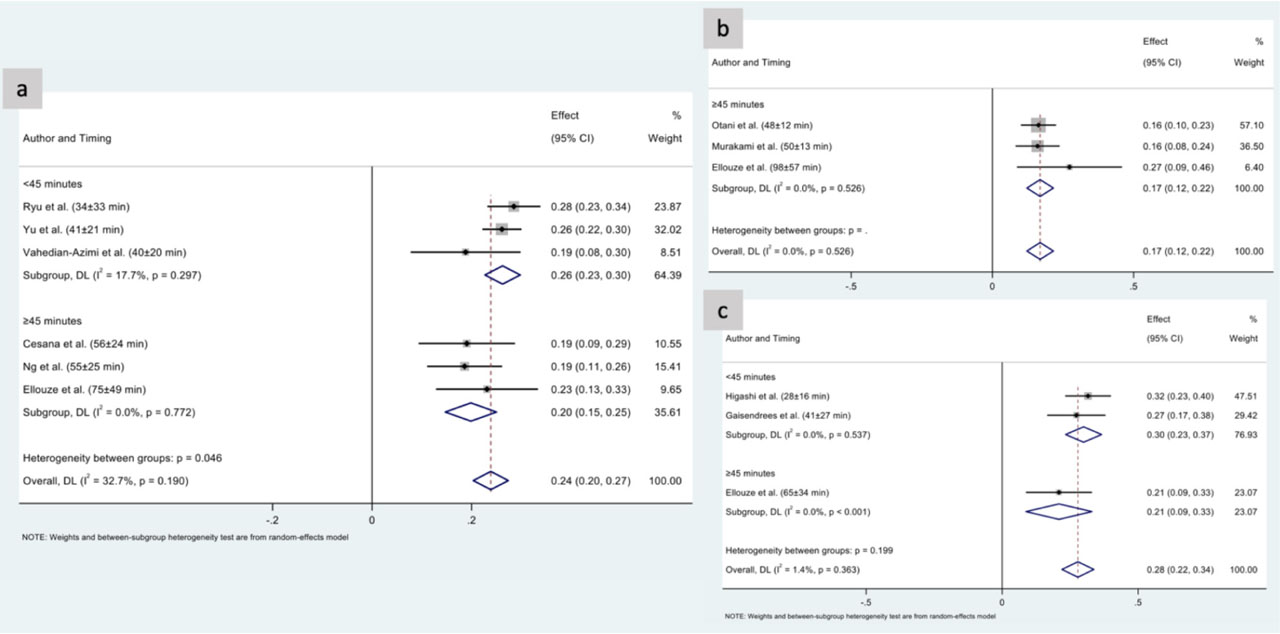
Figure 4.
Forrest Plot of correlation between LFD with Neurological Outcomes in a) Both Groups; b) OHCA only patients, and c) IHCA only patients
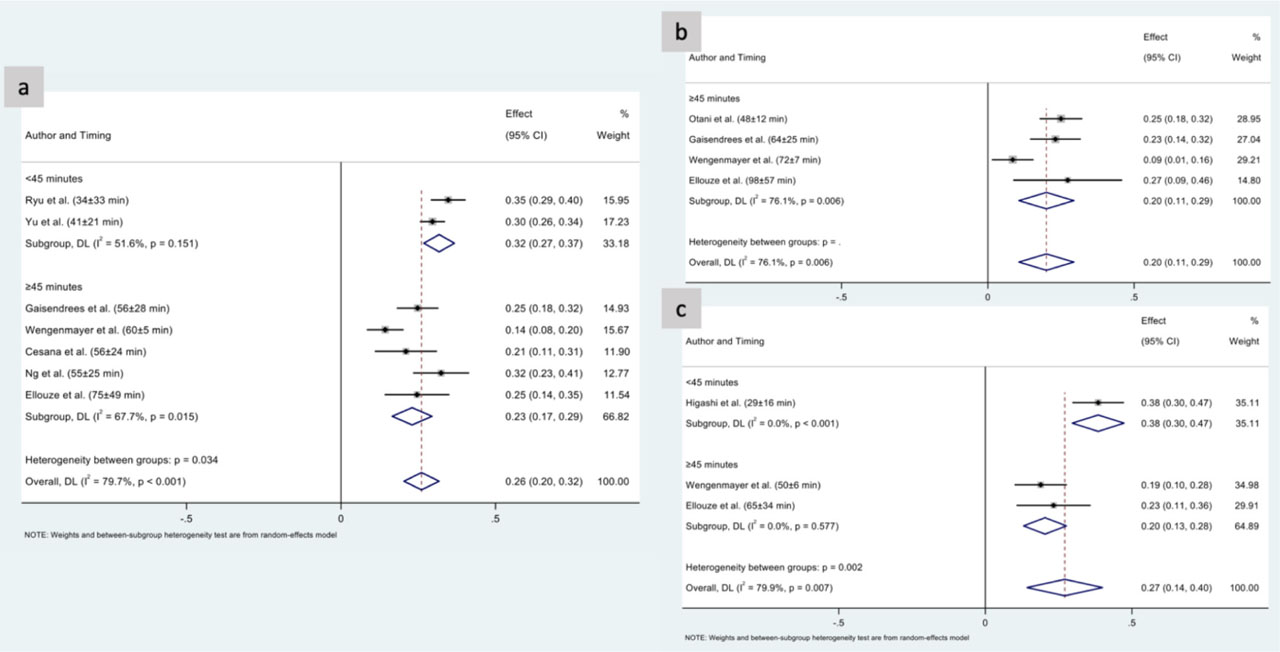
Figure 5.
Forrest Plot of correlation between LFD with Survival at Discharge in a) Both Groups; b) OHCA only patients, and c) IHCA only patients
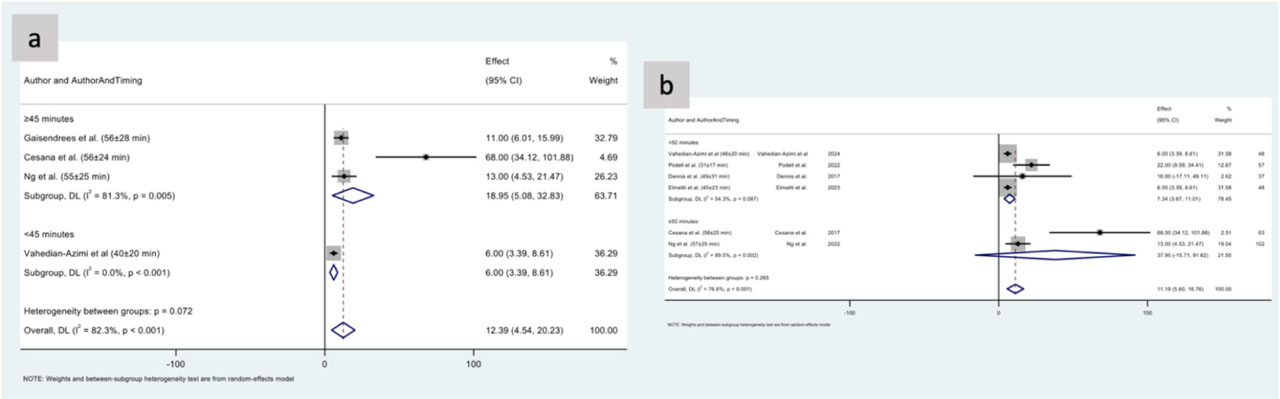
Figure 6.
Forrest Plot of correlation between a) LFD; b) CA-to-ECMO with Hospital Length of Stay in Both Groups
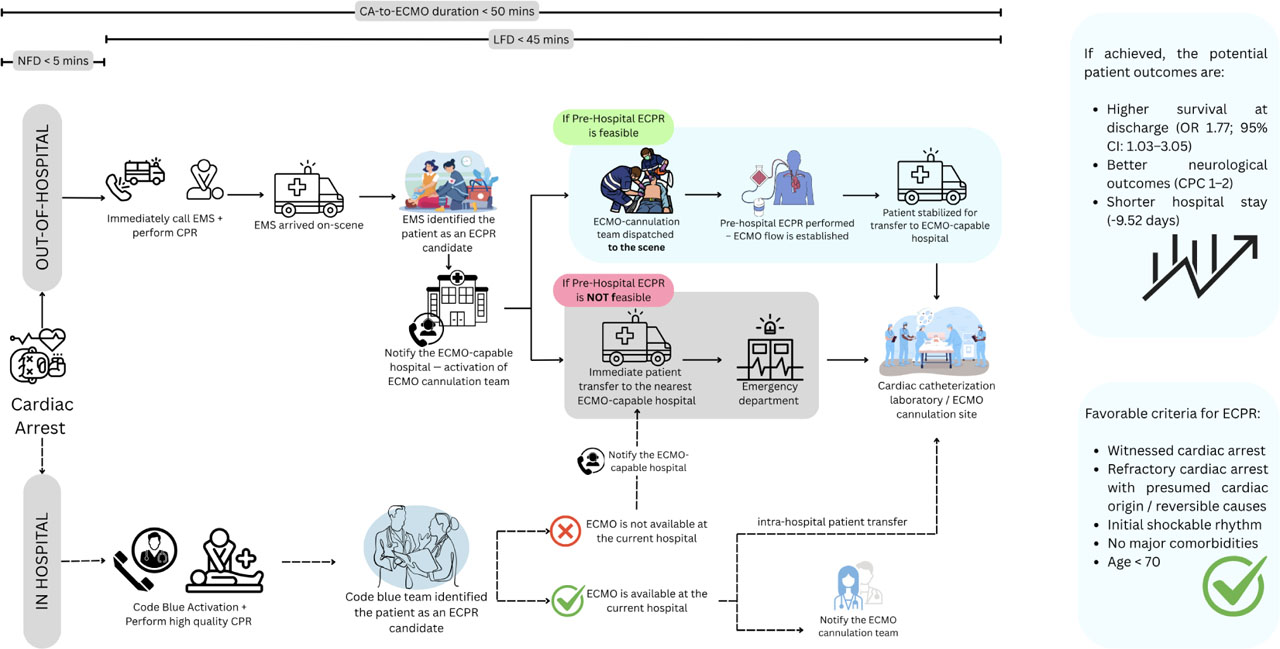
Figure 7.
Illustration of ECPR program for in- and out-of-hospital cardiac arrest