
Introduction
Fiction is often viewed as entertainment. However, recent psychological research suggests that fiction is more than mere entertainment, as it can enhance skills for understanding and navigating social worlds (for overviews, see Dodell-Feder & Tamir, 2018; Mumper & Gerrig, 2017; Wimmer et al., 2024). Notably, evidence for these social-cognitive benefits has emerged across a range of cultural contexts, pointing to the broad and potentially universal relevance of fiction (e.g., Tohidi & Castano, under review). Understanding why fiction might influence social cognition requires considering what distinguishes fiction from other forms of narrative. Fiction is often understood as a form of communication in which the author signals that parts of the story are intentionally made up (Zetterberg Gjerlevsen, 2016). Rather than being just internal imagination, fiction is a shared and recognizable invitation to engage with events and characters that are not literally real. This deliberate cueing helps readers enter an imaginative space while still understanding that the narrative does not describe actual facts. At its core, fiction is often anthropocentric, featuring human or human-like characters who pursue goals, possess intentions, and engage in complex interactions—elements that mirror real-world social dynamics (Mar, 2018; Mar & Oatley, 2008). In this way, the behaviors and mental states of fictional characters function as proxies for real social agents that allow readers to practice social reasoning and perspective taking within a simulated environment (Oatley, 2002, 2016). This engagement prompts readers to deploy mentalizing skills, interpreting subtle cues about characters’ inner states (Mar & Oatley, 2008). These cues, in turn, trigger mental simulation, wherein readers vividly rehearse social experiences (Mar, 2018; Oatley, 1999, 2016). Through exposure to such simulations, individuals refine the skills required for navigating social worlds—abilities collectively known as social cognition (Fiske & Taylor, 2017; Mar, 2018; Oatley, 1999, 2016).
Recent research has examined how reading fiction may support social cognition, and an expanding body of work has specifically investigated its effects on theory of mind. Theory of mind (ToM) is the capacity to understand mental states in oneself and in others, including knowing that other people may have thoughts that differ from one’s own (Premack & Woodruff, 1978; Happé & Frith, 1995). This capacity is often characterized as comprising two related but distinct components: affective ToM, which involves recognizing and interpreting others’ emotions, and cognitive ToM, which involves inferring others’ thoughts, intentions, and beliefs (e.g., Sebastian et al., 2011).
Research on the short-term effects of fiction reading on ToM has become increasingly complex, shaped by both promising findings and counterevidence. Early experimental work suggested that reading brief passages of literary fiction—relative to genre fiction—enhanced immediate ToM performance (Kidd & Castano, 2013). Subsequent attempts to replicate this effect have produced mixed results. One failed replication was conducted in Japan (Takahashi et al., 2023), a substantially different cultural context that limits direct comparability. This study also used a pre–post design in which the Reading the Mind in the Eyes Test (RMET) was divided into two sets—a procedure that is problematic given the scale’s low internal consistency. Two additional studies reported non-replications in more similar cultural contexts (Samur et al., 2018; Panero et al., 2016; but see Kidd & Castano, 2017).
At the same time, several studies have replicated the effect across a range of close-replication paradigms (Black & Barnes, 2015a; Kidd & Castano, 2013, 2019; Kidd et al., 2016; Pino & Mazza, 2016; Rusli et al., 2025; van Kuijk et al., 2018; Wulandini et al., 2017), as well as in research using narrative materials in other media (Black & Barnes, 2015b; Castano, 2021). In one case, the effect emerged only among individuals who reported high levels of transportation into the narrative (Schwerin & Lenhart, 2022). van Kuijk et al. (2018) conducted a p-curve analysis of the initial findings and concluded that the evidential value was low; nevertheless, they successfully replicated the original effects using two distinct ToM measures. Regardless of ongoing debates about the robustness of short-term effects, conceptually similar patterns have been observed in studies that, following earlier work by Mar and colleagues (2006, 2009), assessed naturalistic exposure to fiction rather than experimentally manipulating it.
Growing interest has also turned toward the idea that short-term ToM effects might not arise uniformly from fiction reading, but instead depend on specific moderating conditions. Certain qualities of a narrative—such as its chosen point of view or the degree to which readers must actively adopt characters’ perspectives—could influence the cognitive demands involved in monitoring mental states (Jacobs, 2015; van Krieken et al., 2017; Ditman et al., 2010). At the same time, readers’ own characteristics, including levels of emotional sensitivity, and trait alexithymia, may shape the extent to which they engage with fictional characters (e.g., Samur et al., 2021).
Given the mixed state of the literature, the present study concentrates on the conditions under which short-term changes in ToM might occur, rather than assuming that such effects are stable or consistently reproducible. The study examines alexithymia as a reader-level trait and narrative point of view as a textual property to determine whether these factors interact to influence identification, transportation, and subsequent ToM outcomes. This framework shows the broader shift in the field toward pinpointing the circumstances under which fiction can shape social cognition—and the individuals for whom such influences are most likely.
Transportation and Identification
A key aspect of engaging with fiction is narrative transportation (hereafter referred to as transportation), an immersive state shaped by storytelling techniques and individual differences (Samur et al., 2021; van Krieken et al., 2017). Transportation describes the experience of being “lost” in a story, a concept recognized in both literary theory and psychological research (Gerrig, 1993; Nell, 1988). Green and Brock (2000) define it as a mental state where attention, emotion, and imagery converge, leading to deep engagement with the narrative. Transportation can reduce self-awareness, minimize counterarguing, and foster emotional and cognitive changes (Fitzgerald & Green, 2021; Green & Appel, 2024). While transportation is often studied as a mediator or moderator of narrative effects (e.g., Bal & Veltkamp, 2013; Schwerin & Lenhart, 2022; Wimmer et al., 2021), an alternative perspective views it as an outcome influenced by narrative, contextual, and individual factors (Samur et al., 2021). This approach shifts the focus to exploring the conditions and factors that promote or hinder transportation into fiction (e.g., van Krieken et al., 2017).
In addition to transportation, identification is another key phenomenological experience of reading fiction. Identification is the psychological alignment with characters, particularly the extent to which a reader feels as if they become the character while reading (Cohen, 2001). This process involves role-taking, in which readers temporarily set aside their own goals and adopt those of the protagonist (Oatley, 1994). Conceptually and empirically, identification is linked to ToM because it requires simulating a character’s beliefs, desires, and emotions (e.g., Broom et al., 2021). Prior research highlights that transportation and identification share important cognitive, emotional, and attentional shifts away from the self toward the narrative (Calarco et al., 2017; Green & Appel, 2024; Moyer-Gusé, 2008; Sestir & Green, 2010; Tal-Or & Cohen, 2010, 2016).
How Narrative Points of View Shaped Readers’ Experience of Fictions
The influence of fiction on ToM, transportation, and identification depends on various factors, including textual elements and individual differences. Among textual elements, the narrative point of view (PoV) plays a crucial role (see van Krieken et al., 2017). Narrative PoV is typically divided into two dimensions: voice (who narrates the story) and focalization (i.e., through whose consciousness the story is filtered; Brooks & Warren, 1972; Wimmer et al., 2021). Voice distinguishes between first- and third-person narration, often showed by pronoun use, whereas focalization refers to the extent to which readers access characters’ inner thoughts and experiences (Wimmer et al., 2021). This study focuses solely on the voice dimension (e.g., Genette, 1980)—hereafter referred to as narrative PoV—while excluding focalization to simplify the research design and statistical analysis. Understanding how different narrative PoVs affect readers’ responses to fiction is key to exploring the broader impact of fiction (Brunyé et al., 2009; Brunyé et al., 2011; Ditman et al., 2010; van Krieken et al., 2017).
In fictional narratives written from a first-person PoV, the narrator is a character within the story and refers to themselves using pronouns such as ‘I’ and ‘me.’ This point of view allows readers to experience the narrative through the character’s subjective viewpoint, often the protagonist’s (Oatley, 1999; Sanders & Redeker, 1996). A first-person PoV creates “a personal relationship with the reader which inevitably tends to bias the reader in favor of the narrator/character” (Leech & Short, 2007, p. 213). This alignment promotes identification and enables readers to vicariously share the character’s experiences, a process called experience-taking (Kaufman & Libby, 2012).
In contrast, third-person PoV employs pronouns such as “he,” “she,” or “they” and positions the narrator outside the story’s characters, separate from the narrative (Graesser et al., 2002). This point of view positions the reader as an external observer, promoting detached engagement (Brunyé et al., 2009). As Graesser et al. (2002, p. 237) noted, third-person PoV “maintains functional separation among the various agents,” limiting the reader’s immersive connection with any single character. Although third-person PoV is narrated from outside the story’s characters, it is not necessarily outside the story world. There are two main types of third-person narration: omniscient, where the narrator has access to the thoughts and experiences of all characters, and limited, where the story is filtered through the internal perspective of one character at a time. This study focuses on the limited third-person point of view.
Empirical evidence on the effects of third-person PoV remains limited and somewhat inconsistent (e.g., Christy, 2018; Hakemulder & Koopman, 2010). In contrast, first-person PoV has been more consistently linked to positive narrative outcomes. These include stronger character identification and greater immersion in the story world (Chen & Bell, 2022; de Graaf et al., 2012; Igartua & Rodríguez-Contreras, 2020; Igartua et al., 2021). For example, psycho-narration and first-person narration appear to enhance readers’ tendency to adopt the protagonist’s perspective, whereas free indirect discourse, a form of third-person point of view, does not have the same effect (Salem et al., 2017). In support of this distinction, Hartung et al. (2016) reported that stories written in first-person PoV elicited greater narrative immersion, transportation, and mental imagery during reading than third-person narratives did. Similarly, other studies have shown that first-person PoV produces stronger transportation into the story world than third-person narratives do (Kim & Shapiro, 2016) and increases the reader’s sense of togetherness with the main character (Kim et al., 2020). A recent meta-analysis of 16 studies confirmed that first-person PoV leads to greater character identification than third-person PoV does (Chen & Bell, 2022). This finding is supported by neuropsychological evidence showing that first-person PoV activates brain regions associated with ToM (Boccia et al., 2017). It has been argued that the mechanism behind the outcomes is that first-person PoV facilitates embodied cognition, allowing readers to vividly simulate the narrator’s subjective experiences (e.g., Brunyé et al., 2009).
Taken together, theoretical and empirical evidence suggests that engaging with a character’s subjective perspective, particularly from a first-person point of view, enhances transportation and identification by fostering greater immersion in the narrative and stronger alignment with the character’s thoughts and emotions. In contrast, the third-person point of view encourages a more detached, observer-like stance, which may reduce immersion and character engagement.
Trait Alexithymia
In addition to textual elements, individual differences are likely to influence how readers engage with stories and the resulting fiction-based effects. One individual factor largely overlooked in this context is alexithymia. Alexithymia is a multidimensional personality trait characterized by difficulties in identifying, verbalizing, and reflecting on one’s own emotions, along with a tendency toward externally oriented thinking (Bagby et al., 1994; Bagby et al., 2020; Nemiah, 1977; Sifneos, 1973). The term derives from ancient Greek, meaning “no words for emotions,” and is often described as a form of emotional agnosia or “emotional blindness.” A growing body of research consistently shows that high levels of alexithymia are associated with impairments in both the cognitive and affective components of social cognition skills. These include difficulties in theory of mind, empathy, and recognizing others’ emotions (Bird et al., 2010; Butera et al., 2022; Demers & Koven, 2015; Di Tella et al., 2020; Goerlich-Dobre et al., 2015; Jakobson & Pearson, 2021; Martínez-Velázquez et al., 2020; Oakley et al., 2016; Sunahara et al., 2022; Yang et al., 2020).
Given the evidence linking alexithymia to impairments in social cognition, accurately classifying individuals by their level of alexithymia is crucial for both theoretical and methodological reasons. Establishing reliable cutoff scores enables researchers to clearly distinguish between individuals with high and low alexithymia and to examine how these differences affect psychological outcomes such as transportation and theory of mind. To classify high alexithymia, a total score of 61 or higher on the 20-item Toronto Alexithymia Scale (TAS-20; Bagby & Taylor, 1997) is recommended. This cutoff is commonly applied in empirical studies to identify individuals with high alexithymia (Coll et al., 2019; Gleichgerrcht & Decety, 2013; Martinez-Sanchez et al., 2017; Williams & Gotham, 2021).
Low alexithymia is often defined via strict cutoffs as well (Alkan Härtwig et al., 2020; Moriguchi et al., 2007; Moriguchi et al., 2009; Moriguchi et al., 2006). For example, Moriguchi et al. (2006) employed an extreme-group design, selecting participants with TAS-20 scores above 60 for high alexithymia and below 39 for low alexithymia, and reported that high alexithymia individuals performed worse on ToM and empathy measures (also, see Moriguchi et al., 2007; Moriguchi et al., 2009); similarly, Alkan Härtwig et al. (2020) recruited participants with TAS-20 scores below 40 to represent individuals with extremely low alexithymia.
Reading Fiction and Trait Alexithymia
Reading fiction requires both cognitive and emotional engagement, including the ability to adopt characters’ perspectives, empathize with their emotions, and become immersed in their actions (e.g., Green & Brock, 2000; Mar, 2018; Mar & Oatley, 2008). Cognitive theorists argue that ToM drives engagement with fiction, as readers constantly infer and track characters’ mental states (Zunshine, 2006, 2022). However, the extent to which alexithymia influences these psychological effects of fiction remains largely unexplored. Initial findings by Samur et al. (2017) suggest that individuals with higher levels of alexithymia show reduced reading engagement and lower tendencies to read. Across two independent studies, those with higher alexithymia reported reading less frequently. This pattern held for both fiction and nonfiction and remained significant after controlling for age, gender, and education (Samur et al., 2017). Furthermore, mediation analyses revealed that the relationship between alexithymia and reduced reading was not direct. Instead, negative attitudes toward reading and diminished mentalizing ability explain the reduced level of engagement (Samur et al., 2017). In other words, people with high alexithymia tended to have less favorable views of reading and a lower capacity to understand others’ mental states, both of which contributed to less engagement with fiction.
Castano et al. (2025) reanalyzed Samur et al.’s data and reported a more nuanced pattern. They reported that greater exposure to literary fiction (vs. popular fiction) significantly predicted lower alexithymia scores. Since literary fiction typically demands stronger ToM ability (Castano, 2024; Kidd & Castano, 2013), individuals with high alexithymia may find these texts less accessible or rewarding. As a result, they might avoid literary fiction, leading to reduced exposure that could further reinforce their sociocognitive deficits over time. This suggests a possible bidirectional relationship between literary reading habits and alexithymia.
Similarly, Samur et al. (2021) examined how narrative PoV (first-person vs. third-person) and alexithymia influence narrative engagement. They reported that first-person narratives elicited greater engagement than third-person narratives did. Additionally, alexithymia was negatively associated with engagement, with individuals high in alexithymia reporting lower levels of engagement. Notably, affective alexithymia interacted with narrative PoV: first-person stories increased engagement among readers low in affective alexithymia, whereas those high in affective alexithymia showed no such benefit. These findings suggest that impairments in the affective dimension of alexithymia may limit the ability to gain from narrative engagement.
On the basis of these results, individuals with lower alexithymia are more likely to read fiction and benefit from it (also, see Castano et al., 2025; Samur et al., 2017). They may be more easily transported into narratives and experience greater improvements in ToM, particularly when first-person stories are read. To investigate alexithymia’s moderating role, stringent criteria were applied to identify participants with distinctly high and low alexithymia scores, maximizing group contrast and allowing examination of how alexithymia moderates the effects of narrative points of view on fiction outcomes.
Current Study
The current study presents the effects of narrative points of view on theory of mind, transportation, and identification and further examines whether these effects are moderated by trait alexithymia. While prior research has shown that individuals with lower levels of alexithymia engage more deeply with narratives (Castano et al., 2025; Samur et al., 2017; Samur et al., 2021), the current study examines fiction outcomes via an extreme-group design. The extreme-groups approach has strong precedent in the literature (Gleichgerrcht & Decety, 2013; Moriguchi et al., 2007; Moriguchi et al., 2009; Moriguchi et al., 2006; Parker et al., 2003) and ensures that each group clearly reflects the construct of interest. The strength of extreme-group designs lies in enhancing the likelihood of detecting relationships by focusing on the most informative parts of the distribution, especially when resources are constrained, and the research goal is relationship detection rather than precise population-level effect estimation (Fisher et al., 2020; Preacher, 2015). In addition to enhancing statistical power, the extreme-group approach can increase the detectability of linear relationships, particularly in studies with small sample sizes or limited resources (e.g., Preacher, 2015). Furthermore, previous investigations have not experimentally examined how trait alexithymia is associated with ToM following the reading of short stories, nor have they clearly specified the type of third-person PoV employed. The present study seeks to address these gaps.
This study examines whether narrative points of view (first-person vs. third-person) differentially affect ToM performance, transportation, and identification across groups with high and low levels of alexithymia. It is hypothesized that reading fiction from a first-person point of view (vs. a third-person point of view) will lead to higher theory of mind scores (H1), greater transportation (H2), and stronger identification with characters (H3). Furthermore, there will be an interaction between narrative point of view and trait alexithymia on predicting ToM, transportation, and identification. Specifically, individuals with low alexithymia will show greater ToM following a first-person narrative than individuals with high alexithymia (H4), and there will be an interaction between narrative point of view and trait alexithymia on transportation and identification. Individuals with low alexithymia will report greater transportation (H4) and identification (H5) in the first-person narrative condition than those with high alexithymia. This approach aligns with calls to link textual features to psychological mechanisms, such as transportation and social cognition outcomes (van Krieken et al., 2017; Wimmer et al., 2021). It also accounts for individual differences in reader characteristics.
Method
Data for the present study were drawn from the author’s MA thesis, which included a broader set of measures than those analyzed here. In the full dataset, participants completed additional questionnaires. These instruments were collected for exploratory purposes in the thesis but were not part of the theoretical model or hypotheses guiding the current analysis. Measures, their order of administration, and full materials are documented in detail in the project’s openly accessible OSF repository (here: https://osf.io/a9tfs/overview?view_only=8651445991b846d99e2779c5936e8d2e). The present report focuses only on the variables relevant to the stated research questions, but complete documentation is provided to support reproducibility and future replication efforts.
Participants
An a-priori power analysis was conducted in G*Power (Faul et al., 2007) for both an independent samples t-test (two-tailed) and a moderated regression model with two main effects and one interaction term. Given the lack of reliable effect-size estimates for the interaction, power planning used Cohen’s (1988) conventions only as an approximate reference for a medium-sized effect and .80 power. Based on these assumptions, the target sample size was set at 140 participants. However, owing to limitations in time and resources, the final sample fell short of this target. A final sample of 119 participants aged 18–35 years (Mage = 21.74, SDage = 3.34, 87% female) was included in the analyses. The inclusion criterion was the absence of self-reported neurological or psychiatric disorders. Participants were recruited through a combination of online advertisements on university-affiliated social media platforms and student groups, as well as through in-person recruitment on the main campuses of Allameh Tabataba’i University. All participants were university students enrolled in a variety of programs. Because the university’s academic programs are largely concentrated in the humanities and social sciences, the student population includes a higher proportion of women than men, and this demographic pattern is represented in the sample. Participation was voluntary, and no monetary compensation was offered due to lack of funding. Students at this institution frequently volunteer for on-campus research as part of broader community engagement efforts and to gain firsthand experience with psychological research methods. All participants provided informed consent after being briefed on the study procedures, the confidentiality of their data, and their right to withdraw at any time. The study protocol was approved by the Allameh Tabataba’i University Ethics Committee (IR.ATU.REC.1402.048).
Measures
Trait alexithymia. Varying levels of trait alexithymia were measured via the self-reported Persian version of the 20-item Toronto Alexithymia Scale (TAS-20, Besharat, 2007). The participants rated each item on a 5-point Likert scale ranging from 1 (strongly disagree) to 5 (strongly agree). Sample items include “I am often confused about what emotion I am feeling” and “It is difficult for me to find the right words for my feelings.” Total scores range from 20 to 80, with higher scores indicating greater levels of alexithymia. Besharat (2007) reported a Cronbach’s alpha of .85 for the Persian version.
ToM accuracy. ToM was assessed via the shortened version of the Yoni ToM task, which consists of 48 items (Isernia et al., 2022). This computer-based task evaluates both the cognitive and the affective aspects of ToM, including simple and complex components. In this study, total ToM accuracy was examined as a whole, without separating its constituent dimensions. The total accuracy was calculated by summing the correct responses across both the affective and the cognitive items. The task includes 42 mental items (21 cognitive, 21 affective) and 6 control stimuli, all presented with a cartoon character named “Yoni,” which directs attention to different areas of the screen. The participants interpreted Yoni’s gaze and facial expressions on the basis of prompts such as “Yoni is thinking about …” or “Yoni likes…” and selected the correct response by clicking one of four images in the screen corners using their dominant hand. Correct responses receive a score of 1, and incorrect responses receive 0. The participants completed the task at their own pace. At the time of the study, this task was novel in Persian-language research. It was translated into Persian by the researcher and programmed via PsychoPy (Peirce et al., 2019). Back-translation was not performed, as the study did not aim to provide normative data or undertake a full validation of the task.
Transportation. Transportation was measured via the 12-item self-report scale developed by Green and Brock (2000). This scale measures the extent to which participants become transported into the narrative. The participants rated each item on a 7-point Likert scale ranging from 1 (not at all) to 7 (very much). Sample items include “I was mentally involved in the narrative while reading it” and “While I was reading the narrative, I could easily picture the events in it taking place.” The scale’s total score ranges from 12–84, with higher scores indicating greater transportation into the fictional world. This study is the first to use this scale in Persian-language research. It was translated into Persian with the assistance of an associate professor and reviewed by an assistant professor at Allameh Tabataba’i University, both bilingual in English and Persian. The transportation scale was not back-translated because the translation process involved expert review to ensure conceptual equivalence.
Identification. Identification was measured via the 10-item self-report scale of Cohen (2001). This scale measures the extent to which participants engage with the emotions, goals, and perspectives of fictional characters. The participants rated each item on a 7-point Likert scale ranging from 1 (not at all) to 7 (very much). Sample items include “I think I have a good understanding of the main character” and “I tend to understand the reasons why the main character does what he or she does.” The theoretical range of the scale is from 10–70, with higher scores indicating greater identification with the characters. This scale was first used in Persian-language research in this study. It was translated into Persian with an associate professor’s assistance and reviewed by an assistant professor at Allameh Tabataba’i University, both bilingual in English and Persian.
Demographics. The participants self-reported their age, gender (male or female), and any neurological or psychiatric disorders.
Text Stimuli
The short story selected for this study was Anton Chekhov’s Misery (see the repository for the procedure and pilot study used to select the short story). Misery is originally narrated in limited third-person PoV. It tells the story of Iona Potapov, a sledge driver mourning the recent death of his son. In an attempt to ease his grief, Iona tries to share his sorrow with his passengers, but they remain absorbed in their own concerns and refuse to listen. Ultimately, his only companion in mourning is his loyal horse. The story was translated into Persian by Seroj Stepanian. To examine the effects of narrative PoV, this study manipulated the grammatical pronouns in the original text. A first-person version was created by replacing third-person pronouns (e.g., ‘s/he’ with ‘I,’ ‘they’ with ‘we’) while keeping the content nearly identical. The original version contained 2241 words, and the manipulated version had 2137 words. This approach allowed a direct comparison of PoV effects without significantly altering the story’s length or content.
Design and Procedure
The study consisted of two phases. In Phase 1, the TAS-20 was administered to 970 participants (Mage = 21.19, SDage = 3.38, 81.92% f) to determine eligibility. To maximize between-group variance, participants scoring ≤36 (low alexithymia) or ≥61 (high alexithymia) were selected, whereas those with moderate scores were excluded from the analysis. After the eligible participants were identified, they were categorized into low- and high- alexithymia groups. The participants were then randomly assigned to read the short story presented either from the first- or third-person point of view. In the lab, participants read under the researcher’s attention to ensure focused attention, eliminating the need for additional reading questions. Following the reading task, the participants completed the Yoni task, transportation scale, and identification scale in a randomized order. Demographic data were collected via Google Forms at the end of the session. The entire experimental procedure lasted approximately 20 minutes, after which the participants were thanked for their participation.
Results
Assumption Check
Prior to conducting the main analyses, the assumption of normality was assessed via the Shapiro–Wilk test across variables. ToM accuracy (W = 0.91, p < .001), alexithymia scores (W = 0.81, p < .001), and identification (W = 0.92, p < .001) violated the normality assumption. To correct this, a Box–Cox transformation was applied to adjust the score (Box & Cox, 1964). The Box–Cox transformation was chosen for its flexibility in handling nonnormal distributions compared with simpler transformations (e.g., log, see Osborne, 2010). After transformation, the distributions of the variables approximated normality more closely, as showed by the nonsignificant Shapiro–Wilk test results (ToM accuracy: W = 0.98, p = .24; transportation: W = 0.99, p = .71; identification: W = 0.99, p = .89).
Descriptive Statistics and t-tests Results
All analyses were conducted on transformed variables via R (version 4.4.1). Descriptive statistics and independent samples t-tests examined group differences, and Table 1 shows these results along with internal consistency estimates for all measures. A total of 119 participants were included, with roughly equal numbers assigned to the high (n = 59) and low (n = 60) alexithymia groups, as well as to the first-person (n = 59) and third-person (n = 60) narrative conditions. The high alexithymia group had a mean age of 20.88 years (SD = 2.62, 95% CI [20.20, 21.56]), whereas the low alexithymia group had a mean age of 22.60 years (SD = 3.75, 95% CI [21.63, 23.57]). The scores for identification, transportation, and ToM accuracy were broadly comparable across both alexithymia levels and narrative PoV conditions, showing only minor variation without systematic group differences. Figure 1 illustrates the mean ToM scores across PoV and alexithymia levels.
Table 1
Descriptive Statistics of the Sample.
| MEASURE | FULL SAMPLE (n = 119) | HIGH ALEXITHYMIA (n = 59) | LOW ALEXITHYMIA (n = 60) | FIRST-PERSON POV (n = 59) | THIRD-PERSON POV (n = 60) | CRONBACH’S α |
|---|---|---|---|---|---|---|
| Gender (female) | 104 (87%) | 51 (86%) | 53 (88%) | 48 (81%) | 56 (93%) | |
| Age | M = 21.74, SD = 3.34, 95% CI [21.14, 22.35] | M = 20.88, SD = 2.62, 95% CI [20.20, 21.56] | M = 22.60, SD = 3.75, 95% CI [21.63, 23.57] | M = 21.91, SD = 3.20, 95% CI [21.08, 22.75] | M = 21.58, SD = 3.49, 95% CI [20.68, 22.48] | |
| Identification | M = 51.32, SD = 10.63, 95% CI [49.39, 53.25] | M = 51.43, SD = 10.59, 95% CI [48.67, 54.19] | M = 51.21, SD = 10.76, 95% CI [48.43, 53.99] | M = 51.97, SD = 7.87, 95% CI [49.92, 54.02] | M = 50.68, SD = 12.82, 95% CI [47.37, 53.99] | .88 |
| Transportation | M = 54.79, SD = 9.58, 95% CI [53.05, 56.53] | M = 54.25, SD = 9.26, 95% CI [51.83, 56.66] | M = 55.33, SD = 9.94, 95% CI [52.76, 57.90] | M = 55.81, SD = 8.39, 95% CI [53.62, 58.00] | M = 53.80, SD = 10.60, 95% CI [51.06, 56.54] | .71 |
| Alexithymia | M = 48.13, SD = 16.69, 95% CI [45.08, 51.17] | M = 61.37, SD = 11.05, 95% CI [58.46, 64.27] | M = 35.33, SD = 9.79, 95% CI [32.80, 37.86] | M = 48.87, SD = 16.58, 95% CI [44.51, 53.23] | M = 47.41, SD = 16.91, 95% CI [43.04, 51.78] | .93 |
| ToM Accuracy | M = 34.13, SD = 6.09, 95% CI [33.02, 35.23] | M = 33.55, SD = 5.24, 95% CI [32.18, 34.92] | M = 34.69, SD = 6.82, 95% CI [32.93, 36.46] | M = 34.45, SD = 6.17, 95% CI [32.84, 36.06] | M = 33.81, SD = 6.05, 95% CI [32.25, 35.37] | .86 |
| Affective ToM | M = 16.31, SD = 3.49, 95% CI [15.67, 16.94] | M = 16.00, SD = 3.37, 95% CI [15.11, 16.88] | M = 16.61, SD = 3.61, 95% CI [15.68, 17.55] | M = 16.16, SD = 3.90, 95% CI [15.15, 17.18] | M = 16.45, SD = 3.07, 95% CI [15.65, 17.24] | .76 |
| Cognitive ToM | M = 17.72, SD = 3.44, 95% CI [17.09, 18.34] | M = 17.81, SD = 3.44, 95% CI [16.91, 18.71] | M = 17.63, SD = 3.47, 95% CI [16.73, 18.53] | M = 18.05, SD = 3.37, 95% CI [17.17, 18.92] | M = 17.40, SD = 3.51, 95% CI [16.49, 18.30] | .81 |
[i] Note. ToM = Theory of Mind; Identification scale total score ranges from 10 to 70; Transportation scale total score ranges from 12 to 84. Alexithymia scale total score ranges from 20 to 80. ToM accuracy scores range from 0 to 48; Affective and Cognitive ToM sub-scores each range from 0 to 21.
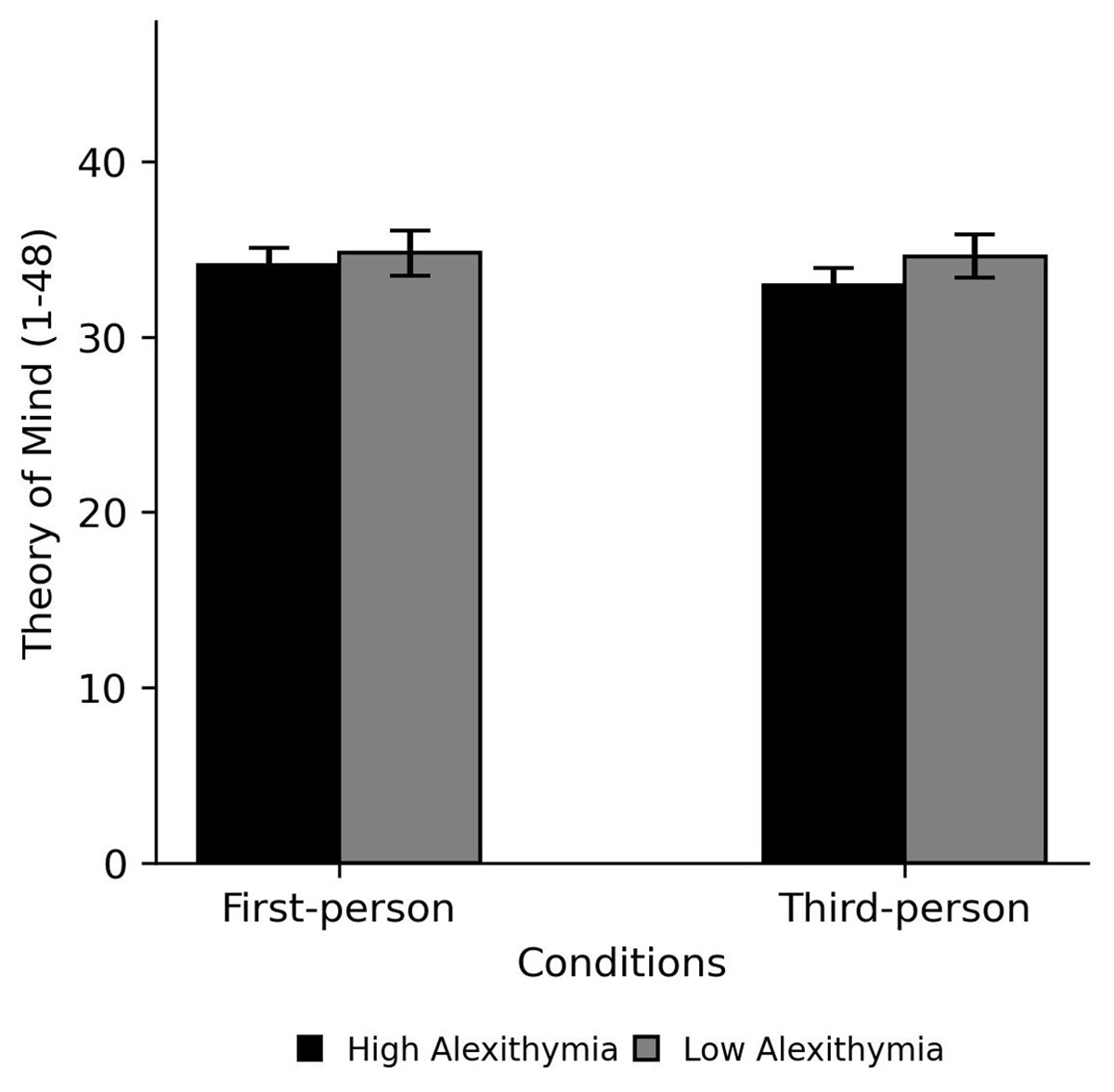
Figure 1
Mean ToM Scores by Narrative PoV and Alexithymia Levels.
Effects of narrative point of view and trait alexithymia on theory of mind performance in the Yoni task.
Independent samples t-tests were conducted to test the effects of narrative PoV on ToM accuracy, transportation, and identification. Across all three measures, participants in the first-person PoV condition had slightly higher mean scores than those in the third-person condition did (see Table 1). However, none of these outcomes reached statistical significance (ToM accuracy: t(116.84) = 0.57, p = .57, Cohen’s d = –0.18, 95% CI [–1.58, 2.85]; transportation: t(111.89) = 1.15, p = .25, Cohen’s d = –0.11, 95% CI [–1.46, 5.49]; identification: t(98.21) = 0.66, p = .50, Cohen’s d = 0.02, 95% CI [–2.57, 5.16]).
As the reviewer suggested, exploratory analyses examined whether alexithymia groups differed in ToM accuracy, transportation, and identification. The participants in the low alexithymia group scored slightly higher on ToM accuracy and transportation than did those in the high alexithymia group, but the differences were not statistically significant (ToM accuracy: t(110.55) = –1.03, p = .30, Cohen’s d = –0.18, 95% CI [–3.36, 1.06]; transportation: t(116.67) = –0.61, p = .54, Cohen’s d = –0.11, 95% CI [–4.57, 2.41]). Finally, identification scores were nearly identical across groups, with the high alexithymia group showing a marginally higher mean (M = 51.44 vs. M = 51.21), a difference that was negligible and nonsignificant, t(117) = 0.11, p = .90, Cohen’s d = –0.02, 95% CI [–3.65, 4.10].
Results of Regression Analyses
To test whether narrative PoV, alexithymia, and their interaction predict ToM accuracy, transportation, and identification, three regression models were constructed (see Table 2). Unstandardized coefficients were reported, as they are less biased in extreme-group designs (Preacher et al., 2005). For ToM accuracy (Model 1), neither PoV nor alexithymia significantly predicted performance. The PoV × alexithymia interaction was also nonsignificant. A similar pattern emerged for transportation (Model 2) and identification (Model 3). Neither PoV nor alexithymia significantly predicted transportation scores. The interaction term was likewise nonsignificant.
Table 2
Unstandardized Regression Coefficients Predicting Outcome Variables.
| MEASURE | MODEL 1 | MODEL 2 | MODEL 3 | MODEL 4 | MODEL 5 | |||||
|---|---|---|---|---|---|---|---|---|---|---|
| b (SE) | t (p) | b (SE) | t (p) | b (SE) | t (p) | b (SE) | t (p) | b (SE) | t (p) | |
| Intercept | 34.58 (0.80) | 42.82 (<.001) | 55.81 (1.27) | 43.80 (<.001) | 51.85 (1.41) | 36.69 (<.001) | 16.32 (0.45) | 36.23 (<.001) | 18.09 (0.48) | 38.03 (<.001) |
| PoV | –0.78 (1.13) | –0.69 (.48) | –2.02 (1.78) | –1.13 (.26) | –1.11 (1.98) | –0.56 (.57) | 0.16 (0.63) | 0.25 (.802) | –0.44 (0.67) | –0.65 (.514) |
| Alexithymia | –0.02 (0.04) | –0.52 (.60) | 0.01 (0.07) | 0.23 (.82) | 0.01 (0.08) | 0.15 (.88) | –0.01 (0.03) | –0.55 (.585) | –0.00 (0.03) | –0.15 (.883) |
| PoV × Alexithymia | 0.007 (0.06) | 0.10 (.91) | –0.03 (0.10) | –0.30 (.76) | 0.05 (0.11) | 0.44 (.65) | 0.01 (0.04) | 0.24 (.808) | –0.03 (0.04) | –0.69 (.493) |
[i] Note. PoV = Point of View; Model 1: PoV × alexithymia predicting ToM; Model 2: PoV × alexithymia predicting transportation; Model 3: PoV × alexithymia predicting identification; Model 4: PoV × alexithymia predicting Affective ToM; Model 5: PoV × alexithymia predicting Cognitive ToM.
Supplementary Analysis
To further explore potential differences across ToM domains, separate indices of affective and cognitive ToM from the Yoni Task were analyzed. Each index was calculated by summing the corresponding simple and complex components (see Table 1 for internal consistency estimates). Independent samples t-tests compared first-person and third-person PoV groups on both dimensions. Although participants in the first-person condition scored slightly higher on affective and cognitive ToM than those in the third-person condition, neither difference was statistically significant (affective ToM: t(112.48) = –0.35, p = .72, Cohen’s d = –0.19, 95% CI [–1.46, 1.02]; cognitive ToM: t(111.85) = 0.51, p = .61, Cohen’s d = 0.01, 95% CI [–0.97, 1.65]). Next, moderated regression analyses tested whether trait alexithymia influenced the association between PoV and ToM outcomes. For both affective and cognitive ToM (Models 4 and 5, respectively, in Table 2), neither PoV nor alexithymia emerged as significant predictors, and the interaction terms were also nonsignificant.
Bayesian Analysis
As recommended by the reviewer, Bayesian analyses were conducted to directly compare the likelihood of null vs. alternative hypotheses regarding the effects of PoV and alexithymia. Informed priors were used for the model intercepts based on observed sample means and standard deviations for each dependent variable. Weakly informative priors were applied to regression coefficients and interaction terms used matching weakly informative priors. Bayes Factors (BF10) were computed using bridge sampling to compare the full interaction model against reduced models. Across all outcomes, the reduced models were consistently favored over the full interaction models. Specifically, there was no evidence that alexithymia, PoV, or their interaction contributed meaningfully to participants’ identification, transportation, or their ToM abilities. This also applied to both affective and cognitive components of ToM. Table 3 summarizes the results.
Table 3
Bayesian Model Comparison Results Across Outcomes.
| OUTCOME VARIABLE | BF (INTERACTION) | BF (PoV) | BF (ALEXITHYMIA) |
|---|---|---|---|
| ToM Accuracy | 0.23 | 0.09 | 0.04 |
| Identification | 0.31 | 0.3 | 0.1 |
| Transportation | 0.31 | 0.26 | 0.09 |
| Affective ToM | 0.16 | 0.04 | 0.02 |
| Cognitive ToM | 0.17 | 0.06 | 0.02 |
[i] Note. PoV = point of view; BF = Bayes factor comparing full interaction model with reduced model. BF < 1 indicates evidence in favor of the reduced model (i.e., no effect). Interpretation of Bayes factors follows Jeffreys’ (1961) classification, where values between 0.10 and 0.33 indicate moderate evidence in favor of the null hypothesis, and values below 0.10 indicate strong evidence supporting the null hypothesis.
Discussion
This study aimed to examine the main effects of narrative points of view on theory of mind, transportation, and identification. It also explored whether these effects were moderated by extreme levels of trait alexithymia. The hypotheses predicted that first-person narratives would result in greater ToM accuracy (H1), greater transportation (H2), and greater identification (H3) than third-person narratives would. Although first-person PoV produced slightly higher mean scores for ToM accuracy, transportation, and identification, these differences were small and not statistically significant. This suggests that the narrative point of view alone did not have a significant impact on participants’ theory of mind ability, transportation, or identification in the present sample. For exploratory purposes, an analysis was also conducted to examine differences between the high and low alexithymia groups. Across all three measures (i.e., ToM accuracy, transportation, and identification), differences were minimal and not statistically significant. These results suggest that, in this sample, alexithymia did not have a meaningful effect on theory of mind, transportation, or identification. The slight differences in means were inconsistent in direction and likely reflected normal variation rather than systematic effects. This finding implies that other individual differences or narrative features may play a more substantial role in shaping these outcomes.
Furthermore, moderated regression analyses were conducted to test whether alexithymia moderated the effect of PoV on ToM accuracy (H4), transportation (H5), and identification (H6). Across all three models, the coefficients for narrative point of view were consistently negative, suggesting that third-person PoV may have led to slightly lower outcomes relative to first-person narratives. However, these effects were small in magnitude (Bs ranged from –0.78 to –2.02) and not statistically distinguishable from zero. Similarly, the coefficients for alexithymia were close to zero in all the models which shows that individual differences in alexithymia did not meaningfully predict ToM, transportation, or identification. Importantly, the PoV—alexithymia interaction was also negligible across outcomes (Bs between –0.03 and 0.05) which shows that the relationship between PoV and narrative outcomes was not moderated by alexithymia. Following Preacher et al. (2005), the analysis focused on unstandardized effect size estimates to interpret group differences because drawing conclusions from standardized effect sizes (e.g., R² or ΔR²) is strongly discouraged when using data from extreme group sampling (see Preacher et al., 2005). This caution is supported by empirical evidence showing that analyzing extreme groups or oversampling individuals with extreme scores can substantially inflate standardized effect size estimates (see Preacher et al., 2005).
The supplementary analyses provided further evidence that narrative PoV did not influence different ToM domains. When affective and cognitive components of ToM were examined separately, no significant group differences emerged between first-person and third-person conditions. Both dimensions showed negligible effect sizes and wide confidence intervals, which shows that any potential PoV effect on theory of mind was likely minimal. In addition, across moderated regression models, alexithymia did not predict affective or cognitive ToM, nor did it interact with PoV.
To evaluate whether narrative point of view, alexithymia, or their interaction contributed to variation in the outcomes, Bayesian model comparison analyses were conducted to contrast full effect models against reduced (null) models. Bayes Factors provided moderate to strong evidence for reduced models. In particular, the Bayesian analyses showed that the narrative point of view manipulation (first- vs. third-person) and/or trait alexithymia did not meaningfully influence identification, transportation, or theory of mind performance. Moreover, narrative point of view may not reliably increase narrative engagement or social-cognitive inference unless it produces a strong sense of self–other merging, a threshold that may be difficult to achieve without more immersive media or highly personalized content (Slater, 2017). All in All, the data suggest that both PoV and alexithymia exerted little to no influence on the outcome variables in this study’s sample.
Given the research design and the use of an extreme groups approach, the results should be interpreted with caution. The participants were intentionally selected from the low and high ends of the alexithymia spectrum (score ≤36 and ≥61 on the TAS-20) to maximize psychological contrast and increase sensitivity to potential effects. Furthermore, the current findings may be due to the exclusion of focalization or limited exposure duration and should therefore be interpreted with caution. One factor is that the study isolated PoV as the sole narrative variable, excluding focalization. By focusing only on grammatical pronouns (first-person vs. third-person), the study may have overlooked the role of the internal perspective in enhancing ToM and transportation. Narratology has long held that representing a character’s interiority through focalization enhances reader empathy and identification (Leech & Short, 2007; Stanzel, 1981). Empirical studies support this view, showing that access to a character’s internal states increases reader identification and emotional engagement (van Peer & Vander Maat, 2001; Wimmer et al., 2022). Since focalization determines readers’ access to characters’ subjective experiences, its exclusion from this study’s design may have weakened potential effects. Additionally, the study did not consider other important textual features, such as genre or emotional content. Future research should explore how these factors interact with PoV to influence outcomes such as ToM and transportation.
The second explanation relates to the duration of fiction exposure. The short duration of fiction exposure (a single reading of a 2241-word story) may have limited the study’s ability to detect effects. While several studies have reported short-term benefits of fiction reading for social cognition, including ToM (Black & Barnes, 2015a; Kidd & Castano, 2013; van Kuijk et al., 2018), these findings remain inconsistent and contribute to ongoing debate (Camerer et al., 2018; Quinlan et al., 2022). This debate may partly stem from how narrative effects develop over time. Appel and Richter (2007) proposed that the impact of narratives may require a period of incubation, which is consistent with what is commonly called the sleeper effect. Mar’s (2018) SPaCEN framework further posits that sustained engagement with fiction, rather than brief exposure, drives social-cognitive development. Future research should employ longer or repeated exposures to narrative texts to capture potential delayed effects.
The results of the present study were found to diverge from some of the findings reported by Samur et al. (2021). First, no significant differences were observed in engagement between first-person and third-person PoV. Second, alexithymia was not found to be significantly associated with lower levels of narrative engagement. However, in line with Samur et al., no interaction was observed between total alexithymia scores and narrative perspective on engagement. Notably, Samur et al. reported that individuals with low affective (but not cognitive) alexithymia reported greater engagement when reading first-person stories than when reading third-person stories. The discrepancies between the current study and that of Samur et al. are likely explained by methodological differences. In the present study, a stringent extreme-groups approach was applied, in which participants with distinctly low and high alexithymia scores were selected to maximize between-subject variance, whereas alexithymia was treated as a continuous measure in the earlier study. This methodological difference may have reduced the sensitivity to more subtle interaction effects in their study. Furthermore, variations in the type of textual stimuli employed may also have contributed to the inconsistent findings. The extreme-group design also maximized between-subject variance but may have obscured nuanced effects of alexithymia. Individuals with high alexithymia exhibit deficits in emotional processing and mentalizing (e.g., Bird et al., 2010), which may reduce their ability to engage with subtle narrative cues, particularly in third-person PoV narratives that require inferring mental states from an external perspective (Samur et al., 2021; also, see Castano et al., 2025). Conversely, individuals with low alexithymia may have been less sensitive to PoV differences because of their already strong mentalizing abilities (Moriguchi et al., 2006). This suggests that alexithymia’s moderating role may depend on narrative complexity or emotional intensity, which were not manipulated here.
These findings suggest that the effects of narrative PoV and alexithymia on ToM, transportation, and identification are complex and may not be readily detectable following short-term exposure. Methodological choices, such as the use of the extreme-groups approach, the exclusion of focalization, and reliance on brief exposure paradigms, are likely to have contributed to the null results. Additionally, the role of alexithymia as a moderator remains unclear, calling for further research with larger, more diverse samples and longitudinal designs that account for sustained engagement with narrative fiction.
Future studies should incorporate multiple narrative elements, including focal, genre, and emotional content, to better understand how these factors interact with individual differences to shape cognitive and emotional responses to stories over time. Given the limited research on the interaction between narrative PoV and alexithymia, future work should seek to clarify the mechanisms through which PoV may influence ToM. It remains an open question whether PoV enhances ToM by promoting character identification, supporting perspective-taking, or reducing cognitive load—and whether these processes vary on the basis of an individual’s capacity for emotional insight.
Limitations
Several limitations should be considered. The use of an extreme-group design increased the study’s sensitivity to differences in alexithymia, allowing clearer detection of contrasts between high- and low-alexithymia participants. However, this approach may limit the generalizability of the findings, as it exacerbates group differences relative to the continuous distribution of alexithymia in the general population and could distort estimates of population-level effects (Preacher et al., 2005). The reliability of extreme scores is often lower than that of mid-range scores, as extremes are more susceptible to regression toward the mean (Preacher, 2015). Furthermore, because data were collected primarily from Allameh Tabataba’i University campuses and the sample contained a disproportionately high number of female participants, the findings may not generalize to broader or more diverse populations. As a result, the generalizability of the present data is limited. Additionally, the study did not assess individual differences in genre preferences, which is known to influence engagement with and responses to narrative texts (e.g., Turner & Felisberti, 2018). Another limitation is that participants were exposed to only a single text. Consequently, it remains unclear whether the observed effects of narrative point of view and alexithymia on theory of mind and engagement would generalize across different types of stories, genres, or lengths. Finally, the study assessed short-term priming effects. This limitation may have constrained the ability to capture more sustained or cumulative effects of narrative engagement on ToM, which are increasingly recognized as critical in social-cognitive development (Mar, 2018; Appel & Richter, 2007).
Conclusion
The present study investigated the effects of narrative points of view on theory of mind, transportation, and identification and further examined whether these effects were moderated by alexithymia. Using an extreme group design—selecting participants from the highest and lowest ends of the alexithymia spectrum—it aimed to enhance psychological contrast and provide an initial test of theoretically grounded interaction effects. Despite the null results, this study contributes to the literature by testing the understudied interaction between alexithymia and narrative PoV. This suggests that the effects of the narrative point of view on theory of mind, transportation, and identification are not straightforward and may depend on additional factors, such as focalization, exposure duration, or narrative content. These findings underscore the need for more nuanced experimental designs to disentangle the mechanisms underlying fiction’s social-cognitive benefits.
Data Accessibility Statement
Data and materials are available via OSF: https://osf.io/a9tfs/overview?view_only=8651445991b846d99e2779c5936e8d2e.
Acknowledgements
I thank all the participants who took part in both parts of the study. This article is based on the author’s Master’s thesis, supervised by Dr. Khatereh Borhani. I gratefully acknowledge Dr. Borhani’s supervision during the thesis work. I also thank the reviewers for carefully reading the manuscript and providing constructive feedback. I take full responsibility for any errors or omissions in this article. I also warmly thank Dr. Mehdi Dastjerdi Kazemi and Dr. Soudabeh Shokrollahzadeh for their help in refining the translation of the scales into Persian.
Competing Interests
The author has no competing interests to declare.