
Publisher’s Note: A correction article relating to this paper has been published and can be found at https://ssol-journal.com/articles/10.61645/ssol.231.
1. Introduction
Narrative persuasion research has shaped empirical literary studies by exploring how reading influences beliefs and attitudes. However, most studies focus on relatively simple topics, such as health risks, social stereotypes, or advertising effects (e.g., Fitzgerald & Green, 2017; Strange & Leung, 1999). Literature, on the other hand, is often associated with engaging readers with more existential, cultural, and complex moral questions, portraying the human condition through narrative. It is often seen as a space to explore vulnerability, responsibility, and limited agency, not through abstract rules and principles, but through imaginative engagement with others’ inner lives (de Beauvoir, 1947/2018; Bloom, 1994; Felski, 2008; Hakemulder, 2000; Nussbaum 2001; Todorov, 1998/2014). Thus, there is a discrepancy between the rich claims of literary theorists and the relatively mundane changes typically studied in narrative persuasion research. To help bridge this gap, we focus on a specific, complex emotional experience: the experience of moral residue (MR), that is, the experience of holding oneself responsible for perceived failures–and standing behind doing so–even when others would be wrong to hold one responsible (Tessman, 2024). More specifically, we explore how this phenomenon is recognized and understood by professionals in the medical field, which is rife with situations of MR.
A second observation in the field of narrative persuasion is the presence of several distinct strands of research, each with its own terminology. Researchers focus on different mechanisms: transportation, self-referencing, and identification. While they are generally aware of each other’s work, comparisons between these mechanisms are rare (cf. Chen et al., 2016; Cohen et al., 2019; Coplan, 2004; De Graaf, 2023; Dunlop et al., 2010; Tchernev et al., 2021). To our knowledge, no study has yet compared the relative impact of all three mechanisms. This comparison is especially important for the empirical study of literature, as it may reveal how these mechanisms relate to key literary variables, such as differences in reader responses to fiction and nonfiction. This leads to what we believe is the third contribution of our study to the field.
The role of fictionality in narrative impact has been speculated about since Aristotle’s Poetics and remains a central theoretical assumption in literary theory (Alber, 2015), medical humanities (Miksanek, 2024), and psychology (Keltner & Stamkou, 2024; Oatley, 1999). This is the case, moreover, even though some attempts have failed to capture fiction’s effectiveness in comparison to nonfiction (e.g., Green et al., 2012; Strange & Leung, 1999), and with only little evidence that fictionality is a factor to consider (e.g., Altmann et al., 2014), and some even suggesting the opposite (Chlebuch et al., 2020). Given that the theoretical roots lie in literary studies, it could be argued that research needs to pertain to texts that are rich in literary qualities and themes; also, it may be that the underlying mechanisms operate in various combinations, not in just one, but a combination of two or three. Thus, a study that considers various mechanisms simultaneously might be more successful in identifying the effects of fictionality.
In sum, the present study aims to address these gaps by: (1) examining a more complex, and for the literary domain more relevant, impact on readers; (2) comparing the three mechanisms most commonly explored in existing research; and (3) conducting this comparison under two conditions—fiction and nonfiction.
1.1. Moral residue
This study focuses on the phenomenon of MR and explores whether narratives can be an effective instrument for enhancing healthcare professionals’ awareness of MR, particularly their perceived susceptibility to it. We focus on the healthcare context because this study is part of a larger interdisciplinary project (University of Oslo, 2022) aimed at helping healthcare professionals navigate situations of MR. Moreover, we suggest that the phenomenon of MR may offer a lens through which to consider aspects of the human condition more generally (i.e., even though we do not claim that our results generalize beyond the healthcare context), since it captures the moral complexity of our responsibility practices. Because this study aims to explore more complex forms of understanding than the belief changes typically examined in narrative persuasion research, we first explain the phenomenon, rooted in moral philosophy, before using these reflections to develop a new measure later on in the article.
The understanding of MR that we embrace traces back to Bernard Williams’ (1981) classic discussion of a lorry driver who faultlessly strikes and kills a child. Williams observes that such a driver will likely feel an anguished sense of responsibility for the child’s death, which Williams calls “agent-regret,” even though they were not at fault. These feelings constitute a “moral remainder” (Williams, 1973) in the sense that they suggest that something is left over, morally speaking, after considerations of what other people could hold one responsible for have been exhausted. Marcus (1980) builds on Williams’ account but shifts to the language of “residue” and, specifically, the residual guilt that one might feel after navigating a challenging moral situation, even if one’s actions were beyond reproach.
We define situations of MR as situations that leave one with a moral remainder in Williams’ sense, and in which this remainder manifests in terms of certain negative self-directed emotions, including the guilt/self-blame that Marcus emphasizes and what Tessman (2024) calls “an anguished sense of responsibility”. Situations of MR are therefore situations in which others would be wrong to hold an agent responsible, but the agent nonetheless holds themself responsible through feelings of guilt/self-blame or an otherwise anguished sense of responsibility.
This understanding of MR is importantly different from that which is more frequently adopted in the healthcare literature. Building on Jameton’s (1984) definition of “moral distress” as the kind of distress that arises when a healthcare professional “knows the right thing to do, but institutional constraints make it nearly impossible to pursue the right course of action” (p. 6), Webster and Baylis (2000) define MR in terms of the downstream effects of moral distress, which are residual in the sense that they are lasting. Although this understanding of MR has gained uptake in the healthcare literature (see, for example, Epstein & Hamric, 2009), the understanding that traces back to Williams provides a better test case for assessing the lofty claims of literary theorists, as the asymmetric responsibility responses that characterize the relevant situations prompt questions about the limits of moral responsibility (Brown & Solbakk, in prep., argue for the more general merits of this approach in a paper that is also part of the same project). More specifically, Williams (1981) emphasizes that onlookers may look poorly upon an agent who fails to hold themself responsible in situations of MR, suggesting that an agent can be right to hold themself responsible in such situations. However, this is in tension with the conventional view that one cannot be morally responsible for what is beyond one’s control, posing a philosophical puzzle that readers must confront (for recent discussions of this puzzle, see Kamtekar & Nichols, 2019; Mackenzie, 2017; Sussman, 2018).
We resolve this tension by granting that others would be wrong to hold an agent responsible for what is beyond their control, but maintaining that one can nonetheless be right to hold oneself responsible in such situations (see Tessman, 2024, and Brown & Tessman, in prep., which is part of the same project as the current study). The view, in short, is that one can treat oneself, but not others, unfairly without running afoul of moral standards. Thus, when an agent has adopted their own, more stringent–even impossible–standards, and when the agent falls short of these standards but not interpersonal standards, the agent is, in a sense, right to blame themself or feel an anguished sense of responsibility even though others would be wrong to hold the agent responsible (Brown & Tessman, in prep.; Tessman, 2024).
We speculate that people are prone to adopt their own, more stringent standards when they care deeply about others who depend on them. For instance, parents frequently adopt such standards in relation to their children, and do not let themselves off the hook, accordingly, when something bad happens to their children, even if they took all reasonable precautions to avoid the bad outcome. Moreover, these conditions are frequently met in the healthcare context, as doctors, nurses, and other healthcare professionals tend to care deeply about their patients, who of course depend on these professionals, sometimes utterly. That healthcare professionals sometimes develop stringent, even impossible standards in relation to their patients is vividly illustrated by former doctor Adam Kay’s reflections on a caesarian that went badly wrong because of complications that he could not have anticipated:
Officially, I hadn’t been negligent and nobody suggested otherwise. […] All my peers would have done exactly the same things and had exactly the same outcome. But this wasn’t good enough for me. I know that if I’d been better–super-diligent, super-observant, super-something– […] I might have saved the baby’s life, saved the mother from permanent compromise. That ‘might have’ was inescapable. (2017, p. 258)
Kay’s reflections suggest that he holds himself to the super-human standard of meeting his patients’ needs full stop, even while recognizing that others do not hold him to this (over)demanding standard. We believe that this experience is common among healthcare professionals, and given that less than 50% of all adverse events in healthcare can be predicted and prevented (De Vries et al., 2008; Rafter et al., 2015), such professionals are at perpetual risk of falling short of the demanding standards to which they hold themselves.
1.2. Moral imagination
One characteristic feature of literary communication, it is assumed, is moral imagination (Nussbaum, 1995; cf. Hakemulder, 2000), the ability to empathize with others by imaginatively entering their experiences, perspectives, and emotions. Nussbaum argues that literature, particularly novels, fosters this capacity by allowing readers to engage with complex characters and moral dilemmas in ways that cultivate empathy, ethical sensitivity, and a deeper understanding of human vulnerability. Becoming aware of our shared humanity may therefore extend or bring to light aspects of the self and enhance readers’ awareness of their susceptibility to complex experiences like MR.
Some studies have provided evidence of narratives’ power to influence aspects of one’s self-concept (Gabriel & Young, 2011; Hakemulder, 2000; Kaufman & Libby, 2012; Richter et al., 2014; Sestir & Green, 2010), showing how readers can explore different self-concepts following the examples of the protagonists. Furthermore, a variety of studies have demonstrated that narratives can influence people’s perception of their susceptibility to a range of experiences (Chen et al., 2016, 2017; De Graaf, 2023; Dunlop et al., 2010; Greene & Brinn, 2003; Van Leeuwen et al., 2017). Based on the Health Belief Model (Becker, 1974), perceived susceptibility is a health-related attitude that refers to the extent to which individuals believe they are at risk of developing a particular condition. Empirical research in narrative health communication has demonstrated that stories can heighten people’s awareness of their susceptibility to risks such as caffeine overdose (Chen et al., 2016), skin cancer (Dunlop et al., 2010), and the negative health effects of binge drinking (Van Leeuwen et al., 2017), among others. Other studies have examined similar effects outside of the field of health communication. For instance, Gregory et al.’s study (1982) examined the effect of imagining living through certain scenarios, finding that it led participants to believe that there is a higher likelihood of experiencing these imagined scenarios in real life. Although these studies have provided important insights, particularly in the field of health communication, they primarily demonstrate relatively simple effects that are quite distant from the type of impact that theorists like Nussbaum envisioned. Therefore, we aim to bridge this gap by developing a framework to investigate how reading shapes our understanding of the more complicated and philosophically deep phenomenon of MR, which we take to reflect an important facet of the human condition.
A concept connected to this framework originates from the theory of possible selves (Markus & Nurius, 1986), according to which individuals’ self-concepts include not only perceptions of their present or past selves but also their future selves–namely, fears and hopes about who they might become (Markus & Nurius, 1986). As Markus and Nurius (1986) explain, the possible selves one creates are influenced by the person’s sociocultural and historical contexts and the media content they are exposed to. Therefore, the characters as portrayed in narratives can also influence the creation of possible selves, offering supplementary sources beyond one’s social environment (Green et al., 2004). Indeed, empirical studies have provided evidence of the impact of narratives on the activation of possible selves (Hakemulder, 2000; Loi et al., 2023; Martínez & Herman, 2020). Considering this, our study connects work on perceived susceptibility from the field of health communication to work on the impact of narratives on the activation of possible selves, suggesting that perceived susceptibility can be expressed as an activation of a possible self. Conceptualizing perceived susceptibility in this way allows us to explore the impact of narratives on perceived susceptibility to MR (PSMR), understood as the activation of a possible self who has adopted and fallen short of their own, more stringent standards, making it right for them to hold themself responsible in situations of MR.
Although the topic we focus on is considerably more complex than the changes in attitude or behaviour that narrative persuasion studies target, it may still be the case that the types of narrative engagement that are assumed to be responsible for such changes are the same.
1.3. The three likely mechanisms: Transportation, Identification and Self-referencing
Following Gerrig’s (1993) description, Green and Brock (2000) define transportation as “a distinct mental process, an integrative melding of attention, imagery, and feelings” whereby “all mental systems and capabilities become focused on events occurring in the narrative” (p. 701). A variety of different conceptions of transportation have also been developed (e.g., absorption, narrative engagement), representing different degrees to which readers can become immersed in a story, linked with different measurements, namely the Transportation Scale (Green & Brock, 2000), the Story World Absorption Scale (SWAS – Kuijpers et al., 2014), and the Narrative Engagement Scale (Busselle & Bilandzic, 2009), with each measurement representing a combination of factors.
Regarding specifically the relationship between transportation and feared possible selves, Loi et al. (2023) found a positive correlation between transportation and the activation of feared possible selves. They suggested that, due to the negative valence of the feared possible selves, readers may be less inclined to activate them, but transportation to the story world can offer a “protective distance” from the actual world, increasing the possibility of activating them (Loi et al., 2023, p. 59). Similarly, Dunlop et al. (2010) found that participants who were transported into a relevant story reported a stronger perceived risk of skin cancer, providing empirical evidence of the impact of transportation on the activation of feared possible selves (i.e., the possible self that has skin cancer). In a similar vein, Gebbers et al. (2017) used a short narrative film and measured audience’s transportation as well as perceived risk severity of drinking while driving, finding a positive association between the two.
Other studies have focused on the role of identification. For example, Hakemulder (2000) suggested that identification with a story’s character can be “an opportunity to explore ‘possible selves’” (p. 150), noting that readers can experiment with new roles as exemplified by the story’s protagonists, and in this way, uncover the possible selves they fear becoming (Hakemulder, 2000, p. 150). Green (2006) has also provided similar arguments, noting that through identification, characters can offer “templates” for possible selves (Green, 2006, p. 167). Although closely related to transportation, identification is a distinct phenomenon. As stated by Tal-Or and Cohen (2010), transportation refers to the experience offered by a narrative in its totality, while identification represents readers’ relationship with a specific character (p. 404). The most widely used conceptualisation of identification is that offered by Cohen (2001), who describes it as “an imaginative process through which an audience member assumes the identity, goals, and perspective of a character” (p. 261). In his attempt to operationalise this concept, he suggested four dimensions of identification: empathy (i.e., feeling with the character), perspective taking (i.e., sharing the perspective of the character), a motivational dimension (i.e., internalising and sharing the character’s goals), and absorption (i.e., loss of self-awareness; Cohen, 2001, p. 256).
Regarding empirical evidence of the impact of identification on perceived susceptibility, Chen et al. (2016) demonstrated that identification with a protagonist of a health narrative can heighten perceived susceptibility to caffeine overdose. Similarly, De Graaf (2023) showed that identification led to higher perceived susceptibility to skin cancer after reading a relevant short story. However, these studies utilised different measures to assess identification, each reflecting slightly distinct interpretations of the concept. This discrepancy reveals the need for clearer evidence regarding the role of identification as described initially by Cohen (2001), targeting the cognitive, affective and perceptual dimensions and exploring the readers’ experiences of assuming the thoughts, beliefs, goals, feelings, and perceptions of a story character (Cohen, 2001).
Lastly, the concept of self-referencing has also been used to explain the power of narratives to activate possible selves. Self-referencing describes the phenomenon where information processing involves connecting the story’s information to one’s own experiences (Burnkrant & Unnava, 1989, 1995); the narrative prompts readers to recollect their individual experiences, thereby facilitating an association between the information encapsulated in the narrative and their personal lives (Kreuter et al., 1999; Kreuter & Wray, 2003), which can lead to story-consistent beliefs and attitudes (Burnkrant & Unnava, 1989). One study has revealed that self-referencing has a positive effect on perceived susceptibility, leading participants to feel more susceptible to caffeine overdose after reading a narrative relevant to that topic (Chen et al., 2016). Similarly, self-referencing proved to be a positive predictor of perceived susceptibility to skin cancer when reading a narrative, an effect that was not present when participants read a non-narrative text (Dunlop et al., 2010; see also De Graaf, 2023).
These mechanisms describe three different ways that readers can engage with narratives. However, some studies have shown that these three mechanisms, although distinct, can sometimes correlate. For instance, Tchernev et al. (2021) found that self-referencing is positively correlated with transportation. Additionally, mediation studies showed that self-referencing mediated the effects of transportation (Dunlop et al., 2010) and identification on perceived susceptibility (Chen et al., 2016). In a similar vein, De Graaf (2023) demonstrated that the more readers identified with a character, the more they experienced self-referencing, and vice versa. Studies have indeed suggested that identification can co-occur with self-referencing (Cohen et al., 2019; Coplan, 2004; De Graaf, 2023), with the reader keeping some sense of themselves while identifying with the narrative’s character. Other studies have offered a possible explanation of this correlation, proposing that when a reader imagines a character’s experiences, it evokes relevant personal memories (McDonald et al., 2015; Seilman & Larsen, 1989).
However, the evidence regarding the impact of identification on perceived susceptibility is not clear, due to the variety of different measurements used to assess identification. Additionally, these three mechanisms have not been compared altogether concerning their effects on perceived susceptibility, and this will be one of the objectives of the present study.
1.4. The role of fiction
Texts can vary on manifold dimensions such as literariness, point of view (first versus third person), narrativity (narrative versus expository), and fictionality (fiction versus nonfiction), impacting readers’ perceptions (see Hinyard & Kreuter, 2007, for a review). In particular, fiction has long been considered a powerful narrative element. Aristotle argued in Poetics (trans. 1970) that history portrays what has happened, while poetry (fiction) dramatizes the possible and is of universal value. Contemporary philosophers argue that fiction enables perspective-taking and cultivates narrative imagination (Nussbaum, 2010; Solbakk, 2021), exposes readers to experiences they would not otherwise encounter (Tooby & Cosmides, 2001), and increases emotional engagement and insight about others and the self (Oatley, 1999, 2002). Empirical studies have explored fictionality as a factor that can influence the persuasive power of a text (Green & Brock, 2000; Strange & Leung, 1999). In an fMRI study, Altmann et al. (2014) showed that brain activation was different for people who read texts labelled as fiction compared to people who read the same texts labelled as nonfiction, suggesting that readers of fiction-labelled stories can create more imaginative constructions of hypothetical scenarios compared to readers who believed the stories were non-fiction. Similarly, presenting a text as fiction may lead to less suspicion and wariness, creating a “safe environment” (Solbakk, 2006) or a “safe zone” for readers to engage with the characters, update their self-concept, and experience related effects (Keen, 2007). It can therefore be expected that reading fiction-labelled stories can activate readers’ imagination about what may or may not happen to them, and thus activate possible selves, while nonfiction labelled stories may direct their focus on updating real-world knowledge.
In the present context, a study conducted by Appel and Maleckar (2012) offers a relevant point of reference. They investigated the effect of paratextual framing (labelling a text as either fiction, non-fiction, or fake) on persuasion. While no direct differences in belief change were found across these conditions, they did observe a mediation effect: texts labelled as fiction led to greater persuasion than those labelled as fake, mediated by higher levels of narrative transportation. These findings suggest that the (perceived) genre of a text can influence how readers process a narrative, which in turn may shape persuasive impact on real-world beliefs, and potentially also the more complex outcomes, such as those examined in the present study.
It is important to note, however, that various attempts to establish the different effects of fiction and nonfiction have failed. Strange and Leung (1999), for instance, found that there is no difference between fiction and non-fiction in influencing perceptions of social problems. Green et al. (2012) found that labelling as fact or fiction did not make a difference for level of emotional response. There is a disconnect, then, between how fictionality is theorized to influence readers’ experiences and empirical data about those experiences. The present study aims to contribute to clarifying this state of affairs.
1.5. The present study
The main objective of this study is to explore whether and, eventually, in what ways and to what extent narratives can affect healthcare professionals’ PSMR with the aim of recognising, realising and navigating such experiences in their lives. Although MR can be experienced by any moral agent and is pervasive in other environments as well (see, for instance, Batavia et al., 2020), this study focuses on healthcare professionals, specifically nurses and doctors, since the healthcare context is replete with such situations.
The study builds upon the theory of possible selves and the evidence of the impact of literary narratives on the activation of feared possible selves. For the purpose of this study, we introduce the term “anguished possible self”: the possible self that experiences MR and the anguished sense of responsibility that partially constitutes it. Studies in health communication have utilised the theory of possible selves and the notion of perceived susceptibility to examine how individuals may activate a feared possible self, such as being a cancer patient, and hence perceive themselves as susceptible to cancer, prompting actions such as booking screening appointments and seeking treatments (Green, 2006). However, this study’s focus is not on activating a feared possible self that might lead healthcare professionals to avoid adopting the stringent standards that would make them vulnerable to experiencing MR. Rather, the focus is on activating a possible self that has adopted and subsequently failed with respect to such standards in order to demystify situations of MR when they (inevitably) arise. In other words, whereas activating such a possible self involves acknowledging one’s vulnerability to certain forms of moral failure (i.e., those which characterize situations of MR), this vulnerability is the byproduct of stringent standards that the possible self endorses; thus, the relevant possible self is not straightforwardly feared but is, in a word, anguished.
In sum, the present study aims to investigate the impact of reading literary narratives on PSMR among healthcare professionals. Additionally, it will examine the effect of fiction versus nonfiction paratexts on PSMR. Finally, we will compare the potential mediating role of the three aforementioned mechanisms: transportation, identification, and self-referencing.
The main hypothesis of this study is
(H1) that reading a literary narrative portraying an MR experience will increase healthcare professionals’ PSMR, as expressed by the activation of readers’ anguished possible selves.
Furthermore, we will investigate the influence of fiction versus nonfiction paratexts on PSMR. Previous research has suggested that when reading fiction, people treat the text with less suspicion (cf. Green et al.’s (2002) argument about the suspension of disbelief in reading fiction) and are more inclined to engage with the characters and explore and reflect on their own emotions (Keen, 2007; Oatley, 1999, 2002). On the other hand, nonfiction paratext may render a text more trustworthy, which may lead readers to realise that if something has happened to another real human being, it may also happen to them. Therefore, a set of competing hypotheses are proposed regarding the role of the paratext:
(H2a) fiction-labelled literary narratives will lead to higher PSMR compared to nonfiction-labelled literary narratives, and
(H2b) nonfiction-labelled literary narratives will lead to higher PSMR compared to fiction-labelled literary narratives.
Lastly, this study aims to explore
(RQ) whether and to what degree identification, transportation, and self-referencing, as described above, can mediate the effects of nonfiction and fiction-labelled narratives on readers’ PSMR.
3. Methods
A preregistered online study (#182095 | AsPredicted) was carried out to develop a new scale that measures PSMR (AsPredicted, 2024). In addition, using a between-subject design we explored the impact of reading a narrative on PSMR and tested the effect of fiction versus nonfiction paratexts on PSMR. Furthermore, mediation analyses examined whether transportation, identification, and self-referencing mediated the potential effect of fiction versus nonfiction paratexts on PSMR.
2.1. Participants
Participants were recruited to take part in the main study in return for £9/hour via the online crowd-sourcing platform Prolific. A total of 745 healthcare professionals from various parts of the world participated, all of whom were fluent in English. Of these, 328 participants were excluded from the study for several reasons: 17 were rejected because they answered more than one comprehension question incorrectly, 190 were rejected because they could not recall whether the text was labelled as fiction or nonfiction, 60 were rejected because they had read the story before, and 60 were rejected because they deemed the protagonist straightforwardly blameworthy (i.e., they believed that others would be right to blame the protagonist; thus, from their perspective, the story did not describe a situation of MR) (for details, see Manipulation checks below). Additionally, one participant was excluded because their responses to the open-ended question suggested the use of AI tools.
These exclusions resulted in a final count of 417 participants. The participants’ ages ranged from 19 to 77, with a mean of 35.91 and a standard deviation of 12.01. Of the participants, 284 were female and 131 were male, while two participants preferred not to disclose their gender. The sample consisted of 274 nurses and 143 doctors.
The data from all 417 participants were used to develop the scale of PSMR. However, when investigating the impact of narrative reading on PSMR, only 65 participants per condition (fiction-labelled group, nonfiction-labelled group, and control group) were randomly selected. Additionally, in order to test the impact of the mediators, 176 participants per experimental condition (fiction-labelled condition and nonfiction-labelled condition) were tested.
These sample sizes were determined based on two power analyses. First, to examine the impact of reading a narrative on PSMR, the software G*Power (Faul et al., 2007) was used. This power analysis estimated that 195 participants (65 participants per condition) were needed to achieve a power of 80% in order to estimate a medium sized effect, with a standardized mean difference of 0.5.
Second, to examine the impact of fiction versus nonfiction paratexts and the mediating power of transportation, identification, and self-referencing, the sample size was determined using the Monte Carlo Power Analysis for Indirect Effects application (Schoemann et al., 2017). This power analysis estimated that 352 participants (176 per condition) were needed to achieve a power of 80% for the following standardized coefficients: β = .15 for the effect of paratext on the mediators, β = .25 for the effect of the mediators on PSMR, and β = .20 for the direct effect of paratext.
These effect sizes were determined based on previous studies that investigated the impact of paratextual information about fictionality on identification (Hanauer, 2018), as well as the impact of transportation, identification, and self-referencing on perceived susceptibility (Chen et al., 2016; De Graaf, 2023) and feared possible selves (Loi et al., 2023).
All participants were informed about their rights and gave written, online consent before the start of the study. The study was formally recognised by the Royal Netherlands Academy of Arts and Sciences (KNAW) for meeting ethical standards and guidelines (ref.: FAO/AKo/843).
2.2. Design
Our study employs two designs. First, a three-factor between-subjects design was used to test the impact of narrative reading. The first group read a text that was labelled as fiction, whereas the second group read the same text labelled as non-fiction. The third group served as the control condition and was not exposed to any text. Secondly, a two-factor between-subjects design was employed to assess the impact of fiction versus nonfiction paratexts and the role of the mediators, using only the first two groups.
2.3. Material
Participants read a short excerpt from the novel The Children Act by Ian McEwan (2014a). The excerpt is part of the first chapter of the book and is 1682 words in total. It focuses on a judge specialized in Family Law and describes a case she had at work involving conjoined twins, Matthew and Mark. The twins share a single torso and will both die if not separated. Surgical separation of them would likely save Mark but result in Matthew’s death. The judge, Fiona, grapples with the legal and moral complexities of the situation and ultimately rules in favour of separating the twins to save Mark. She justifies her decision by invoking the “doctrine of necessity”, stating that the surgery aims to save Mark rather than intentionally kill Matthew. However, this decision leaves Fiona with an anguished sense of responsibility for Matthew’s death, which leads her to question the randomness and cruelty of life’s circumstances and causes her to become squeamish about human bodies, which affects her intimacy with her husband.
This text was chosen based on a review of a list of novels and short stories that depict situations of MR (Fialho, 2025). The selected excerpt needed to satisfy the following criteria: 1) it should describe a case of MR and 2) its aftermath, 3) it should be a literary narrative, 4) it should be a relatively short excerpt that can be read independently, and 5) it should be realistic enough to be portrayed as both fiction and non-fiction.
This excerpt met these criteria since it gave a detailed description of a case of MR. It clearly suggests that Fiona chose the lesser of two evils in a situation where she had to choose, such that participants are likely to agree that others would be wrong to see Fiona as having morally failed and hold her responsible accordingly. Nonetheless, Fiona sees herself as having morally failed and holds herself responsible: “She was the one who had dispatched a child from the world, argued him out of existence in thirty-four elegant pages. Never mind that with his bloated head and squeezing heart he was doomed to die” (McEwan, 2014a, p. 31). The text therefore exhibits the asymmetry between self- and other-responsibility responses that characterises situations of MR. The excerpt also describes the impact the case had on the protagonist:
For a while, the case had left her numb, caring less, feeling less, going about her business, telling no one. But she became squeamish about bodies, barely able to look at her own or Jack’s [her husband’s] without feeling repelled. […] For a while, some part of her had gone cold, along with poor Matthew. […] The feeling had passed, but it left scar tissue in the memory, even after seven weeks and a day. (McEwan, 2014a, pp. 30–31)
The excerpt was also an appropriate narrative to be presented as non-fiction since, as noted by the author, it was inspired by real cases and judgments as provided to him by an appeal court judge (McEwan, 2014b). Additionally, a convenience sample of 4 people was asked to read the excerpt and assess whether it could be an excerpt from a non-fiction book. In response to this question, they all answered positively.
2.4. Measures
PSMR was measured using a scale that was developed for the purposes of this study. Details about its conception and development can be found in the Online Supplemental Materials.
Transportation was measured using the transportation subscale of the Story World Absorption Scale (Kuijpers et al., 2014). This subscale consists of 5 items (e.g., “When I was reading the story, it sometimes seemed as if I were in the story world too”; “When reading the story, there were moments in which I felt that the story world overlapped with my own world”). While previous studies have used the Transportation Scale (Green & Brock, 2000), we decided not to use it here because we needed a scale that exclusively assesses transportation, while the Transportation Scale also includes items relevant to other constructs, such as imagery and emotional engagement.
Identification was measured using the Identification Scale developed by Cohen (2001) and adapted for reading a story instead of viewing a program. However, two items of this scale were not included, as they measure absorption instead of identification and can therefore be confounded with the measurement of transportation (i.e., “while reading the story, I felt as if I was part of the action”, and “while reading the story, I forgot myself and was fully absorbed”). This way, the present study can focus on the initial conceptualization of identification, as described above, without including other dimensions. This leads to an identification measurement with a total of 8 items (e.g., “I was able to understand the events in the story in a manner similar to that in which the protagonist of the story understood them”; “I think I have a good understanding of the protagonist of the story”).
Self-referencing was measured with 3 questions, adapted from Burnkrant and Unnava (1989): “The story seemed to be written with me in mind”, “The story seemed to relate to me personally”, “The story made me think about my personal experiences”. These scales were all measured on a 7-point Likert scale ranging from –3 (completely disagree) to 3 (completely agree).
Control variables
Profession (doctors versus nurses) may influence the way and the degree to which healthcare professionals perceive themselves as susceptible to MR. Additionally, Loi et al.’s study (2023) showed that age can influence the activation of possible selves. For this reason, these factors were added as covariates. Prior experience with MR was also added as a covariate, as it can be expected that individuals who have previously experienced MR will feel more susceptible to it. Specifically regarding the mediation analyses, three additional covariates were added to the questionnaires: perceived similarity with the protagonist, perceived realism, and tendency to rationalize. Studies have suggested that perceived realism can positively impact transportation (Green, 2004), perceived similarity with the protagonist can affect identification (Tal-Or & Cohen, 2015) and self-referencing (De Graaf, 2014), while qualitative findings revealed that healthcare professionals tend to use rationalization strategies to avoid MR-related negative emotions (De Snoo-Trimp et al., in prep.; this paper is part of the same project as the present study). Therefore, to rule out the influence of these factors, they were included as covariates as well.
Specifically, perceived similarity was measured with the Attitude Homophily scale developed by McCroskey et al. (2006), which included fifteen items and was adapted for the story we used (e.g., “Fiona thinks like me”). Perceived realism was measured with an adaptation of the Perceived Plausibility Subscale of the Perceived Reality Scale developed by Elliott et al. (1983) and following the example of Green’s (2004) study, four items judged to be most relevant to the narrative were used, including questions about the realism and believability of characters, setting, and other aspects of the communication (e.g., “People in this narrative are like people you or I might actually know”). Prior experience with MR was measured with an adaptation of the PSMR scale from the present study. Four items were used, one for each of the four main emotional responses (e.g., “I rightly felt responsible for what had happened, even though it would have been unreasonable if others held me responsible”). Participants’ tendency to rationalize was measured with two items from The Defense Style Questionnaire (Andrews et al., 1993) (i.e., “I am able to find good reasons for everything I do” and “there are always good reasons when things don’t work out for me”). The above scales were measured using a 7-point Likert scale ranging from strongly disagree to strongly agree.
Age was measured with a direct question asking participants to type their age. Participants were also asked about their profession (doctor or nurse), their specialty (e.g., paediatric doctor, nurse practitioner), and their gender.
Manipulation checks
To assess participants’ attentiveness while reading the story, we formulated three basic comprehension questions, each with three response options. Participants who answered more than one question incorrectly were excluded from the analysis. Additionally, we assessed participants’ familiarity with the story by asking whether they had previously read it, with response options including “yes”, “no”, and “maybe/not sure”. Participants who answered “yes” or “maybe/not sure” were excluded from the analysis.
To evaluate the success of the manipulation, we devised a question to ensure that participants remembered whether what they read was fiction or nonfiction. Participants who provided incorrect answers were excluded from the analysis.
Lastly, to assess whether participants regarded the story as a case of straightforward blameworthiness rather than MR, they were asked if they considered the protagonist to be blameworthy for the death of Matthew. As mentioned above, participants who answered “yes” were excluded from the analysis.
2.5. Procedure
The study was conducted online using the survey software Qualtrics. Participants were randomly assigned to one of the three groups. They were told that we were interested in their emotional responses in the workplace, without mentioning our specific interest in MR. After providing informed consent, one group was told that they were to read a fiction excerpt, and the second group was told that they would read a non-fiction excerpt. After reading the excerpt, participants completed the manipulation checks. Next, they completed the scales regarding the reading experience with the Transportation scale, the Identification scale, the Self-Referencing scale, the Perceived Similarity scale, and the Perceived Realism scale in a random order. Next, they completed the PSMR scale. The emotional responses of this scale also appeared in a random order. Participants then completed the Prior Experience with MR scale and the Rationalisation scale. Following these scales, the participants of the two experimental groups were asked to respond to this open question: “Can you imagine yourself experiencing emotions relevant to what the story’s protagonist experienced? Please elaborate.” In addition, participants provided information regarding their profession, medical specialization, age, and gender. Participants in the control group only completed the PSMR scale, the Prior Experience with MR scale, and the demographic questions. Finally, participants were debriefed and asked whether they wanted to add any comments about the study.
2.6. Data analysis
The data were analyzed using RStudio (version 4.3.2). Initially, an Exploratory Factor Analysis (EFA) was carried out for the PSMR items using the psych (Revelle, 2024) and GPArotation (Bernaards & Jennrich, 2005) packages. The purpose of the EFA was to identify items that define different dimensions and obtain a smaller number of items for future use of the scale. After the EFA, an Analysis of Covariance (ANCOVA) was conducted to analyze the differences in PSMR scores between the three groups. Age, profession, and prior experience with MR were included as covariates using the psych package.
The next step was the mediation analysis. Three separate mediation analyses were performed to explore the mediation of identification, transportation, and self-referencing, while controlling for perceived similarity, perceived realism, prior experience with MR, tendency to rationalize, age, and profession. The psych (Revelle, 2024) and lavaan (Rosseel, 2012) packages were used for this analysis.
2.7. Results
Exploratory Factor Analysis
Details on the exploratory factor analysis can be found in the Online Supplemental Materials. The list of the final items retained in the PSMR scale are provided in Table 1.
Table 1
The Final Items Retained on the PSMR Scale.
| CODE | ITEM |
|---|---|
| Responsibility (α = .89) | |
| R1 | I rightly feel responsible, even though others could not reasonably hold me responsible. |
| R3 | I rightly feel responsible, even though the situation was out of my hands. |
| R5 | I rightly feel responsible and I resist others’ efforts to convince me that I should not feel this way. |
| R8 | I rightly feel responsible, even though I question whether I should feel this way. |
| Failure (α = .92) | |
| F1 | I rightly feel like a failure, even though others could not reasonably consider me a failure. |
| F3 | I rightly feel like a failure, even though the situation was out of my hands. |
| F5 | I rightly feel like a failure and I resist others’ efforts to convince me that I should not feel this way. |
| F8 | I rightly feel like a failure, even though I question whether I should feel this way. |
| Regret (α = .92) | |
| RG1 | I rightly regret my actions, even though others could not reasonably consider my actions regrettable. |
| RG3 | I rightly regret my actions, even though the situation was out of my hands. |
| RG5 | I rightly regret my actions and I resist others’ efforts to convince me that I should not feel this way. |
| RG8 | I rightly regret my actions even though I question whether I should feel this way. |
Checks prior to Analysis of Covariance and Mediation Analyses
The mediating variables, the control variables, and the dependent variable (i.e., PSMR and its subscales after the PCA) were examined for normality and reliability (see Table 2). Overall, the mean values and standard deviations of the variables are satisfactory. Additionally, the skewness values for all variables of interest were acceptable, with skewness < |1|. All scales were found to have acceptable reliabilities (.68 < α < .96), except for the rationalization scale (α = .55). However, tendency to rationalize was included as a covariate to account for potential individual differences in rationalization tendencies, as it was essential to isolate their potential influence on PSMR.
Table 2
Descriptive Statistics of Dependant Variables, Mediating Variables and Covariates.
| VARIABLE | M | SD | Min | Max | Skew. | Kurt. | α |
|---|---|---|---|---|---|---|---|
| PSMR | 0.54 | 1.24 | –3.00 | 3.00 | –0.45 | –0.12 | .93 |
| Responsibility subscale | 0.95 | 1.25 | –3.00 | 3.00 | –0.86 | 0.76 | .89 |
| Failure subscale | 0.26 | 1.61 | –3.00 | 3.00 | –0.44 | –0.85 | .92 |
| Regret subscale | 0.41 | 1.52 | –3.00 | 3.00 | –0.53 | –0.52 | .92 |
| Past experience with MR | 0.76 | 1.37 | –3.00 | 3.00 | –0.62 | –0.16 | .89 |
| Identification | 1.62 | 0.80 | –3.00 | 3.00 | –0.81 | 2.50 | .88 |
| Transportation | 0.50 | 1.33 | –3.00 | 3.00 | –0.48 | –0.20 | .88 |
| Self-referencing | –0.37 | 1.54 | –3.00 | 3.00 | 0.17 | –0.83 | .87 |
| Perceived realism | 1.72 | 0.85 | –1.50 | 3.00 | –0.76 | 0.46 | .68 |
| Perceived similarity | 0.84 | 1.05 | –2.33 | 3.00 | –0.67 | 0.43 | .96 |
| Rationalization | 1.06 | 1.04 | –2.50 | 3.00 | –0.51 | 0.19 | .55 |
| Age | 35.91 | 12.01 | 19.00 | 77.00 | 1.05 | 0.46 | n/a |
Descriptive statistics are also provided for each condition separately in Table 3, while Table 4 includes an overview of the correlations among all variables.
Table 3
Descriptive Statistics for each Condition Separately.
| CONDITION | VARIABLE | N | M | SD |
|---|---|---|---|---|
| Fiction | PSMR | 176 | 0.55 | 1.22 |
| Responsibility subscale | 176 | 0.95 | 1.19 | |
| Failure subscale | 176 | 0.25 | 1.63 | |
| Regret subscale | 176 | 0.44 | 1.55 | |
| Identification | 176 | 1.67 | 0.84 | |
| Transportation | 176 | 0.66 | 1.37 | |
| Self-referencing | 176 | –0.24 | 1.51 | |
| Perceived realism | 176 | 1.74 | 0.86 | |
| Perceived similarity | 176 | 0.82 | 1.08 | |
| Past MR experience | 176 | 0.74 | 1.31 | |
| Rationalization | 176 | 1.13 | 0.98 | |
| Age | 176 | 35.18 | 12.19 | |
| Nonfiction | PSMR | 176 | 0.57 | 1.27 |
| Responsibility subscale | 176 | 0.97 | 1.31 | |
| Failure subscale | 176 | 0.31 | 1.58 | |
| Regret subscale | 176 | 0.43 | 1.52 | |
| Identification | 176 | 1.58 | 0.77 | |
| Transportation | 176 | 0.34 | 1.26 | |
| Self-referencing | 176 | –0.50 | 1.56 | |
| Perceived realism | 176 | 1.69 | 0.84 | |
| Perceived similarity | 176 | 0.85 | 1.02 | |
| Past MR experience | 176 | 0.80 | 1.41 | |
| Rationalization | 176 | 0.98 | 1.08 | |
| Age | 176 | 35.65 | 11.79 | |
| Control | PSMR | 65 | 0.43 | 1.23 |
| Responsibility subscale | 65 | 0.90 | 1.25 | |
| Failure subscale | 65 | 0.13 | 1.65 | |
| Regret subscale | 65 | 0.28 | 1.44 | |
| Past MR experience | 65 | 0.70 | 1.46 | |
| Age | 65 | 38.55 | 11.90 |
Table 4
Zero-order Pearson Correlations between all Variables.
| VARIABLE | 1 | 2 | 3 | 4 | 5 | 6 | 7 | 8 | 9 | 10 | 11 | 12 |
|---|---|---|---|---|---|---|---|---|---|---|---|---|
| 1. PSMR | — | |||||||||||
| 2. Responsibility | .79** | — | ||||||||||
| 3. Failure | .89** | .56** | — | |||||||||
| 4. Regret | .86** | .51** | .66** | — | ||||||||
| 5. Past MR experience | .73** | .59** | .66** | .60** | — | |||||||
| 6. Identification | .15** | .25** | .02 | .14* | .13* | — | ||||||
| 7. Transportation | .17** | .26** | .05 | .15** | .09 | .53** | — | |||||
| 8. Self-referencing | .16** | .20** | .07 | .15** | .12* | .40** | .59** | — | ||||
| 9. Perceived realism | .11* | .19** | .09 | .03 | .07 | .51** | .27** | .23** | — | |||
| 10. Perceived similarity | .15** | .20** | .06 | .14** | .16** | .64** | .33** | .34** | .44** | — | ||
| 11. Rationalization | .06 | .14** | –.01 | .04 | .01 | .27** | .25** | .21** | .12* | .13* | — | |
| 12. Age | –.10* | –.02 | –.12* | –.09 | –.11* | .01 | –.01 | –.02 | .14** | .05 | .03 | — |
[i] *p < .05. **p < .01.
Analysis of Covariance
A Type III Analysis of Covariance (ANCOVA) was conducted to examine the effect of condition (fiction, nonfiction, control) on PSMR, while controlling for age, profession (nurse versus doctor), and past experiences with MR. The results of the ANCOVA indicated that condition did not have a significant effect on PSMR, F(2, 189) = 0.73, p = .48. Neither age nor profession had significant effects on PSMR, F(1, 189) = 0.02, p = .90 and F(1, 189) = 0.09, p = .77, respectively. However, past experiences had a significant effect on PSMR, b = 0.67, SE = 0.05, F(1, 189) = 203.19, p < .001, ηp2 = .52 indicating that greater past experiences are associated with higher PSMR scores.
The interaction between the condition and the covariate past experience with MR proved to be significant, F(2, 183) = 3.05, p = .05, suggesting that the homogeneity of regression slopes was violated for the covariate of past experience with MR. For this reason, a robust ANCOVA was performed for the inclusion of this covariate, which revealed that there is no difference between conditions once the p-values were adjusted for multiple comparisons using the Bonferroni method.
Type III Analysis of Covariance (ANCOVA) was also performed for each of the subscales separately. The condition did not have a statistically significant effect on the responsibility, failure, and regret subscales (F(2, 189) = 0.83, p = .44; F(2, 189) = 0.11, p = .90; and F(2, 189) = 0.61, p = .55, respectively). The covariate past experience with MR showed again a highly significant effect on the responsibility, failure, and regret subscales (b = 0.57, SE = 0.05, F(1, 189) = 113.26, p < .001, ηp2 = .37; b = 0.81, SE = 0.07, F(1, 189) = 147.41, p < .001, ηp2 = .44; and b = 0.63, SE = 0.07, F(1, 189) = 81.13, p < .001, ηp2 = .30, respectively). Neither age nor profession was a significant covariate, ps > .05. Regarding the regret subscale a significant interaction was found between the condition and the covariate past experience with MR, F(2, 185) = 3.27, p = .04, and thus, the assumption of homogeneity of regression slopes was violated. Therefore, a robust ANCOVA was conducted to account for this interaction. The analysis revealed no significant differences between conditions after adjusting p-values for multiple comparisons using the Bonferroni method.
In summary, the reading experience—whether reading a fiction-labelled story, a nonfiction-labelled story, or no reading—did not impact total PSMR or any of the three subscales of PSMR. Past experience with MR was shown to predict PSMR and each of its subscales. Neither profession (doctors versus nurses) nor age predicted PSMR.
Mediation analyses
To test whether and to what degree the effect of fiction and nonfiction labelling on PSMR is mediated by identification, transportation, and self-referencing, one mediation model was constructed for each of the three mediators. Each model included six control variables: perceived similarity with the protagonist, perceived realism, tendency to rationalize, past experience with MR, age, and profession. Although the study was pre-registered to include the variable of professional specialization, this variable was excluded from the analysis because of the variety of specialities reported by participants.
Bivariate correlations were computed and examined for each mediator. All significant correlations were below .70, indicating a low likelihood of multicollinearity (Fidell & Tabachnick, 2003; Kline, 2005). Therefore, path modelling was conducted without making any adjustments to the variables.
Due to concerns about violations of the assumption of normality, a bootstrapping procedure (Preacher & Hayes, 2008) was employed to estimate standard errors and confidence intervals. A total of 2,000 bootstrap samples were generated, following recommendations for robust parameter estimation (Efron & Tibshirani, 1993). The use of bootstrapping helps to provide more reliable estimates when the assumption of normality is questionable (Hayes, 2009). Below are the results of each mediation analysis.
First, regarding the mediation of identification, the direct effect of condition on PSMR was not significant (b = 0.002, z = 0.02, p = .98). The same was the case regarding the path from condition to identification (b = –0.06, z = –1.00, p = .32), and the path from identification to PSMR (b = 0.01, z = 0.18, p = .86). Similarly, the indirect effect of condition on PSMR via identification was not significant (b = –0.001, z = –0.13, p = .90), nor was the total effect of condition on PSMR (b = 0.001, z = 0.01, p = .99).
Among the control variables, past experience with MR had a significant positive effect on PSMR, b = 0.66, z = 16.57, p < .001, β = .71. This suggests that past experience with MR is a strong predictor of PSMR. The effects of perceived similarity with the protagonist, perceived realism, tendency to rationalize, age, and profession on PSMR were not significant (p > .05).
Regarding the mediation of transportation, the direct effect of condition on PSMR was not significant (b = 0.03, z = 0.32, p = .75). However, the path from condition to transportation was significant (b = –0.28, z = –2.17, p = .03, β = –.11), suggesting condition predicted transportation, with participants in the nonfiction condition scoring higher on the transportation scale. The path from transportation to PSMR was also significant, (b = 0.10, z = 2.51, p = .01, β = .10), showing that transportation significantly predicts PSMR. The indirect effect of condition on PSMR via transportation was not significant, b = –0.03, z = –1.59, p = .11. The total effect of condition on PSMR (direct and indirect effects) was also not significant, b = 0.001, z = 0.01, p = .99.
As seen in the analysis of the mediation of identification, past experience with MR had a significant positive effect on PSMR, but this was not the case regarding the other covariates.
Finally, regarding the mediation of self-referencing, the direct effect of condition on PSMR was not significant (b = 0.01, z = 0.15, p = .88). This was also the case regarding the path from condition to self-referencing (b = –0.24, z = –1.57, p = .12) and the path from self-referencing to PSMR (b = 0.05, z = 1.64, p = .10). The indirect effect of condition on PSMR via self-referencing was not significant (b = –0.01, z = –1.09, p = .28) and the total effect of condition on PSMR was also not significant (b = 0.001, z = 0.01, p = .99). A summary of the three mediation analyses can be seen in Figure 1.
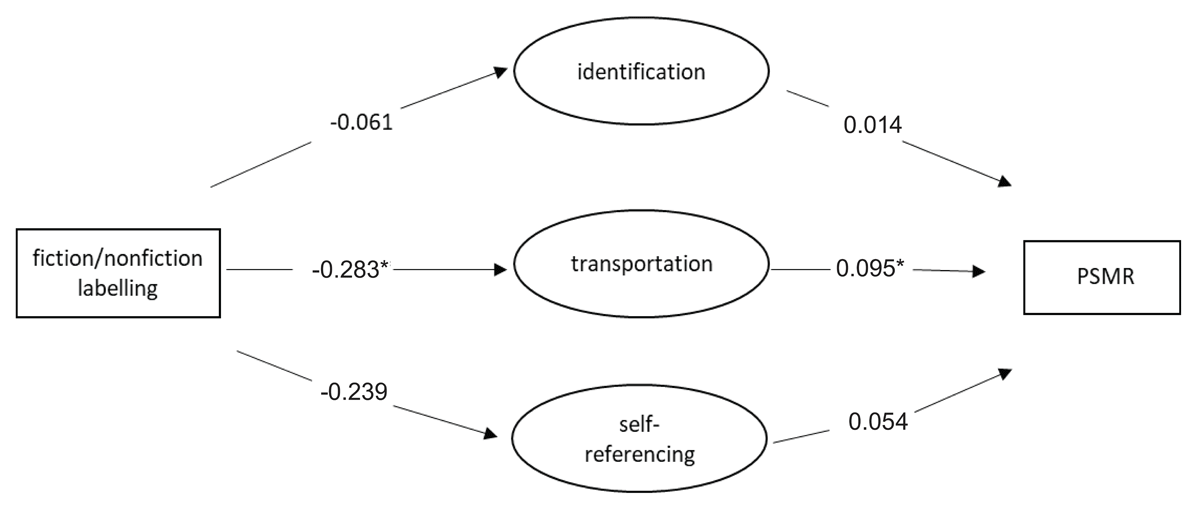
Figure 1
The three mediation analyses. The covariates have been omitted from the graph to improve clarity. * p < .05.
Furthermore, three mediation analyses were conducted for each subscale separately to investigate the mediation of identification, transportation, and self-referencing on feelings of responsibility, failure, and regret. No significant total or indirect effects were found, however, in certain cases, there were significant direct effects of the mediators on the different subscales. These results can be found in Table 5. In summary, it is evident that identification impacted only the failure subscale, with higher identification leading to lower scores on that subscale. Transportation showed a significant relationship with the responsibility and regret subscales, indicating that higher transportation resulted in higher scores on these two subscales. However, transportation did not affect the failure subscale. Finally, self-referencing had no impact on any of the three subscales.
Table 5
The Effect of the Three Mediators on the Three Subscales of PSMR.
| MEDIATOR | SUBSCALE | b | SE | Z | p | β |
|---|---|---|---|---|---|---|
| Identification | Responsibility | 0.163 | 0.095 | 1.720 | .085 | .105 |
| Failure | –0.237 | 0.103 | –2.302 | .021 | –.118 | |
| Regret | 0.115 | 0.111 | 1.036 | .300 | .060 | |
| Transportation | Responsibility | 0.159 | 0.048 | 3.353 | .001 | .169 |
| Failure | –0.003 | 0.052 | –0.052 | .958 | –.002 | |
| Regret | 0.129 | 0.061 | 2.126 | .033 | .112 | |
| Self-referencing | Responsibility | 0.072 | 0.041 | 1.753 | .080 | .088 |
| Failure | 0.005 | 0.048 | 0.106 | .915 | .005 | |
| Regret | 0.084 | 0.049 | 1.718 | .086 | .084 |
3. Discussion
The present interdisciplinary study combined research paradigms from literary studies, psychology, ethics, and medical humanities to investigate the potential of literary narratives to shape healthcare professionals’ self-perceptions regarding MR. By integrating these various perspectives, we aimed to bridge empirical and conceptual approaches to better understand how readers engage with narratives that depict ethically complex situations. The main hypothesis was that reading a literary narrative portraying an experience of MR would increase healthcare professionals’ PSMR. Apart from the social relevance of this question, our theoretical interest was whether claims in literary theory about how readers are affected in their understanding of more complex, multifaceted phenomena (as opposed to more simple changes in beliefs or attitudes) would hold. To meet these aims, we developed and validated a new measure (PSMR).
The results, however, indicated a lack of significant differences in PSMR scores between the control and experimental conditions. This suggests that merely reading a narrative might not be a strong enough experience to influence healthcare professionals’ PSMR. This finding contrasts with previous research in health communication, which found that reading a narrative with a relevant theme can increase perceived susceptibility to health risks such as caffeine overdose (Chen et al., 2016) and skin cancer (Dunlop et al., 2010). One possible explanation of this contrast is that attitudes about ethical matters such as PSMR are more difficult to influence than straightforwardly factual attitudes such as perceived susceptibility to cancer. Alternatively, PSMR’s complexity may have made it more difficult for readers to draw conclusions about their future selves on the basis of a narrative. Finally, previous studies tested patients or students, whereas the current study recruited healthcare professionals, who may be affected differently than those with more limited knowledge of medicine and medical ethics.
In addition to testing the hypothesis, the study addressed the broader research question of how fictionality and various forms of narrative engagement influence readers’ susceptibility to MR. Specifically, it explored the extent to which fiction versus nonfiction paratexts and transportation, identification, and self-referencing affect PSMR. We found that fictionality did not matter, but that transportation has potential for increasing PSMR. This raises questions about why the manipulation of perceived fictionality did not work as predicted. One possible explanation is that the manipulation was too subtle, or that healthcare professionals approach narratives as potentially realistic due to their professional experience. Additionally, MR may be so personally and emotionally complex that it is less susceptible to brief experimental manipulations.
Although nonfiction labelling did not influence all engagement mechanisms, it did lead to significantly higher transportation, contradicting Altmann et al. (2014), who found greater imaginative processing under fiction labels. This finding suggests that nonfiction paratext may reduce the perceived distance between the reader and the story, making the story world more relevant and accessible. Existing theories have primarily treated transportation as a response to fiction (Gerrig, 1993; Green, 2004), but our results suggest that nonfiction narratives can be just as, or more, immersive. However, this result was observed only in relation to the experiences of healthcare professionals. Therefore, we suggest that further research is required to explore this idea
Transportation not only increased under nonfiction labelling but also predicted PSMR. This aligns with previous findings linking transportation to the activation of possible selves (Loi et al., 2023). Additionally, the findings distinguished the effects of transportation, identification, and self-referencing, showing that these mechanisms do not influence outcomes in the same way. In what is, as far as we know, the first study to include all three responses, we found that transportation is the most likely vehicle for persuasion, even for the more complex construct we examined in this experiment. Finally, the study developed the PSMR scale, theoretically grounded in philosophical work on MR (Brown & Tessman, in prep.; Tessman, 2024) and qualitative data (De Snoo-Trimp et al., in prep.). This scale enables the empirical study of a concept that has thus far remained largely theoretical. As part of the broader project, we plan to explore how our new measure relates to other variables (e.g., perceived isolation, Neff, 2003; Raes et al., 2011; tolerance of ambiguity, McLain, 2009; tolerance of uncertainty, Carleton et al., 2007), and demographic factors. We will also examine how the subscales may be influenced by different conditions, and how they may connect to the way participants formulate their reflections on situations involving MR.
Beyond these theoretical insights, the findings may have potential societal implications. The concept of “anguished possible selves” introduced in this study may help healthcare educators and institutions better understand the emotional and ethical dimensions of professional identity formation. By highlighting how narratives can make future moral challenges more tangible, this study exemplifies the value of literature as a pedagogical tool in ethics education and reflective practice, in medicine but maybe also in other professions (e.g., the military, or law and law enforcement).
3.1. Future research directions
Following the findings of this study, several directions can be suggested for future research. First, the PSMR scale can be further validated through different manipulations and interventions, including the exploration of its potential relationship with related phenomena such as moral distress and feelings of isolation, and its application in contexts beyond healthcare. Second, future studies should employ more narratives to determine whether varying materials may induce stronger effects. For example, it might be that narratives of MR more directly aligned to the healthcare context will result in a higher impact with regard to MR awareness. Additionally, the present study revealed that mere exposure to a narrative may not provide an intense enough experience to impact healthcare professionals’ perceptions of susceptibility to MR. Therefore, a stronger impact may be achieved through more elaborate interventions, such as activities, discussions, and reflections relevant to the reading experience. Part of these additional activities could involve priming relevant experiences from participants’ lives and helping them overcome possible tendencies to push away such painful memories. Furthermore, some individuals may be more receptive to reflections on the human condition. Consequently, the impact of reading narratives on PSMR may be moderated by personality variables such as need for cognition or the search for meaning in life. Future studies should therefore consider including these variables in their models. Finally, the concept of transportation needs further exploration to assess whether nonfiction labelling can foster stronger scores and whether this impact is consistent across different reading materials.
Conclusion
This study explored how literature can deepen readers’ awareness of complex phenomena—phenomena that are often central to literary texts and the concerns of literary theory—and that we propose can be understood as part of a broader understanding of the human condition. By empirically investigating the specific case of moral residue in a healthcare context, the study expands the scope of narrative impact research, which typically focuses on single dimensions. It highlights literature’s potential to help readers recognize the moral challenges they may face in their future professional lives.
Data Accessibility Statement
All data, analysis code, and supplementary materials documenting the development of the PSMR scale are available at https://osf.io/5eu87/?view_only=8a2cd36d896249759388b124ecdc9a13. The project was preregistered at https://aspredicted.org/3p6f-74mw.pdf.
Acknowledgements
This study is funded by the European Union (ERC, MORE, project number: 101054147). Views and opinions expressed are however those of the author(s) only and do not necessarily reflect those of the European Union or the European Research Council Executive Agency. Neither the European Union nor the granting authority can be held responsible for them.
Competing interests
FH is a member of the editorial board for SSOL, which is on a voluntary basis. All other authors have no competing interests.
Author contributions
NA: Conceptualization, Data Curation, Formal Analysis, Investigation, Methodology, Project Administration, Visualization, Writing – Original Draft Preparation, Writing – Review & Editing. CB: Conceptualization, Methodology, Writing – Original Draft Preparation, Writing – Review & Editing. FH: Conceptualization, Methodology, Writing – Original Draft Preparation, Writing – Review & Editing. JHS: Conceptualization, Methodology, Writing – Review & Editing.