
Introduction
Arts-based research (ABR) is an increasingly important paradigm that extends the repertoire of possible ways of understanding human experience (Barone & Eisner, 2012; McNiff, 2008). The perspective taken here, both methodologically and conceptually, is to see ABR along a continuum of possible research approaches that extends through qualitative and quantitative research. Each of these approaches has its own values, limitations and specific applications. The current study investigates the ABR method of poetic inquiry and utilizes quantitative methods to explore two central issues: What are the writing processes through which poetic inquiry facilitates a process of self-discovery and to what degree does the quality of the arts-based product influence these self-understandings? The choice was made that an empirical methodology is best suited to provide the appropriate rigor to support claims about the processes involved in poetic inquiry. Overall, this article aims to situate poetic inquiry within its historical roots, explicate the method itself and then provide reliable evidence on the way this approach achieves its stated objectives.
Phenomenological Sources
Poetic inquiry is a term used to group a range of different ways of using poetry writing for research purposes. Whether this form of research is used for individuals or groups, the core argument for poetry writing as a research method is that it allows the writer and poetry reading audience to achieve some degree of insight into personal experience (Hanauer, 2010, 2021; Prendergast, 2009). From a methodological perspective poetic inquiry sits between techniques found in the discipline of creative writing and the research aims of phenomenology (Hanauer, 2021). Phenomenology developed within the philosophical orientation of Husserl positions the main object of inquiry for research to be the ways in which an individual’s consciousness experiences phenomena in the world (Giorgi et al., 2017). Over the years, the methods of achieving this objective have changed and developed even within the periods of Husserl’s own work. Early approaches, as outlined by Husserl, involved the individual delimiting their personal beliefs and assumptions – termed epoché (suspension of judgement) – in a series of iterations until the essence of the phenomenon in consciousness is explicated (Hopkins, 2010). This method aimed to enable the possibility of observing one’s experience beyond pre-existing beliefs and personally and socially mediated interpretations (Butler, 2016). As argued by Findlay (2012) Husserl recognized the difficulty of this process and assumed that some degree of residue from the a priori consciousness would remain.
Subsequent philosophers such as Heidegger and Gadamer questioned an individual’s ability to bracket one’s assumptions and beliefs proposing that one could never overcome the situatedness of one’s being in the world (Horrigan-Kelly et al., 2016; van Manen, 2007). Utilizing a hermeneutic approach, these philosophers proposed that the experience of the world was an active interpretive act and as such the processes of understanding the world need to be in themselves explicated. Instead of bracketing, it was proposed that the assumptions be explicated by the individual and then revised in a series of cycles that move from a holistic understanding of experience to an analysis of the components of this experience (van Manen, 2007).
This phenomenological-hermeneutic research agenda was later critiqued and further developed by qualitative researchers in the 21st century. A range of different approaches such as Lifeworld research (Ashworth, 2015), Interpretive Phenomenological Analysis (Smith et al., 2009), Post-Intentional Phenomenology (Vagle, 2014) and Micro-Phenomenology (Petitmengin, 2006) or Neurophenomenology (Petitmengin, 2017) were proposed and developed. Methodologically all these versions of phenomenology involve a transition from the explication of an abstracted essence of an experience to providing a socially and historically contextualized understanding of personal experience (Eatough & Smith, 2017). The methodological practices of reflection, reliving and direct questioning were developed for the qualitative phenomenological interview to achieve this situated understanding in which a participant has the “felt-sense” of an experience (Steenberg, 2019, p. 204).
Like phenomenology, the arts-based, poetry writing researcher is interested in expressing, investigating, explicating, understanding and learning from personal lived experience (Elbelazi & Alharbi, 2019; Hanauer, 2012, 2020; Iida, 2018; Lapidus et al., 2013; Liao, 2018; Park, 2013). Poetic research writing, as a phenomenological research method, involves directing a writer-researcher to produce “individual, subjective, emotional, linguistically-negotiated understanding of personal experience” which constitutes “a deliberative account of the writer’s autobiographical experience” (Hanauer, 2010, p. 137). Poetic inquiry claims to facilitate a process of self-understanding in which a writer-researcher gains deeper understanding of their own socially and historically situated experience through writing (Hanauer, 2021).
Poetic Inquiry
Poetic inquiry is a member of a family of ABR methods that involve poetry writing. The earliest documented usage of this research approach can be found in the work of Muriel Rukeyser who in 1938 wrote up her ethnographic interview data on West Virginian miners who were dying of lung cancer as a long poem (Kaufman & Herzog, 2005). Rukeyser had social-activist aims in presenting her research in poetic form in that she wanted to generate understanding and empathy towards the dying victims of extreme corporate exploitation and apathy. Towards the end of the 20th century, this approach of collecting qualitative data and then rewriting it as a poem was also conducted by Laurel Richardson (1990, 1997, 2003). Richardson’s work, constituted within a poststructuralist, feminist critique of research, wished to move away from the objectification of participants and rather generate empathy towards the people who were interviewed and their life experiences. Both Rukeyser and Richardson used the forms of poetry to infuse their research outcomes with feeling in an attempt to engage audiences with the lives of the people they studied.
From the beginning of the 21st century, in line with arts-based approaches to research, investigators began to use poetry writing not as a way of representing qualitative data that had been collected using more standard techniques of research, but rather as a method of data elicitation in itself (Barone & Eisner, 2012; McNiff, 2008, 2013). Researchers such as Langer and Furman (2004), Hanauer (2010) and Iida (2018) all utilized poetry writing as the mode of eliciting data from participants. This can take different forms. Prendergast (2009), in her introduction to an edited collection of poetic inquiries, proposes that poetic research can be divided into three forms: Vox Theoria – poetry written as a way of understanding existing disciplinary research; Vox Autobiographia/Autoethnographia – poetry written based upon a researcher’s field notes, journals, or other forms of autobiographical writing; and Vox Participare – poems written by participants or about participants. Hanauer (2021) offers his own taxonomy of poetry writing research consisting of three usages of poetry for research purposes: Poetic Inquiry where a group of participants are directed through a writing protocol to write poetry about their own personal experiences (Gallardo et al., 2009; Hanauer, 2010; Iida, 2018; Prendergast et al., 2009); Poetic Ethnography in which a poem is written using a participant’s words after a careful life interview technique is used to elicit the participant’s life experience of interest to the study (Elbelazi, 2017; Hanauer, 2012, 2013, 2014); Poetic Autoethnography in which the researcher-poet explores and explicates their own life experiences (Elbelazi & Alharbi, 2019; Hanauer, 2012, 2020; Iida, 2018).
While there are differences among these uses of poetry writing as a research method, there are some basic shared components. First the object of inquiry is the subjective consciousness of a personal experience and the way of accessing this consciousness is through a poetry writing process. Second, in line with current empirical understandings of the poetry writing process (Hanauer, 2010, 2023; Liu et al, 2015; Peskin & Ellenbogen, 2019; Schwartz, 1983), poetry writing is a two stage, recursive movement involving a free-flowing memory elicitation/automatic text generation stage followed by a cognitively engaged, revision/rewriting stage. These two stages of poetry writing are assumed to be recursive, moving from generating to repeatedly revising during a poetry writing process. In accordance with this model, the methodology that is employed, whether it is for the individual poet-researcher writing about their own experience, the participant who is interviewed and then has their interview written up as a poem, or for groups following a poetry writing protocol, involves a stage at which experience is elicited in writing and a stage in which revision is conducted. Finally, all the approaches specified above assume that poetry writing as a research method is designed to facilitate a process of self-discovery. It is this self-discovery that emerges through the protocols of poetic inquiry that support its claims as a research method.
The Writing Processes of Self-Discovery
Since self-discovery is central to the claims of ABR poetry writing, it is worth considering the research on writing for self-discovery. There are two bodies of scholarship that investigate this function of writing. Within the expressive writing for well-being paradigm (Pennebaker & Beale, 1986), there is extensive empirical data that writing can have a role in facilitating a process of self-understanding and self-discovery (Frattaroli, 2006; Hanauer, 2010; Kállay, 2015; Lepore & Kliewer, 2013; Pennebaker & Chung, 2007). The method of expressive writing involves an intervention in which every evening a participant writes about their “deepest thoughts and feelings” for four days without consideration of the structural aspects of writing (Pennebaker & Beale, 1986). In a large number of studies, a series of positive psychological and physical outcomes were found for this writing intervention. These include a reduction in hospital visits, physical ailments, breathing issues, fatigue and pain (Danoff-Burg et al., 2006; Hockemeyer & Smyth, 2002; McGuire et al., 2005; Norman et al., 2004; Rosenberg et al., 2002); and decreases in psychological distress, anxiety, depression suicidal thoughts and levels of grief (Antal & Range, 2005; Graf et al., 2008; Nishith et al., 2002; Range & Jenkins, 2010). This impressive set of outcomes is assumed to be the result of the ability of writing to allow the expression and disclosure of repressed thoughts (Lepore & Smyth, 2002), the ability of writing to lead to increased insight into personal experience (Pennebaker, 1993) and the way in which writing about an experience can provide a sense of control over that experience (Lepore et al., 2002).
While the research on expressive writing has established a value for writing and self-discovery and offered some broad theoretical explanation of how it might work, it has not really explained how self-discovery is enacted in writing. Research within the context of psycholinguistic, Composition studies has attempted to model this more specifically. Early scholarship on the writing process considered discovery to be the result from the cognitively engaging, rhetorical problem-solving aspects of writing (Bereiter & Scardamalia, 1987; Flower & Hayes, 1980; Galbraith, 2009). Specifically, the position proposed was that discovery emerged when expert readers were faced with a rhetorical task that required a solution. Flower and Hayes (1980) in their influential process model of writing situated discovery in the Revising component of writing and in relation to the processes of reformulation and revision. The Flower and Hayes model specifies that during revision, alternative ideas and enhanced clarity emerge concerning the topic of writing. Bereiter and Scardamalia (1987) in their two-process models of writing (Knowledge-Telling and Knowledge-Transforming) similarly situate the discovery process in the revision and problem-solving aspects of writing. In their description of the writing process, the evaluation of the writing content, the reformation of ideas and the revision of the text directed a process of discovery. For both Flower and Hayes (1980) and Bereiter and Scardamalia (1987), discovery was solely situated in the cognitively engaged processes of revision and rewriting and not in the early stages of text generation.
A more recent model of writing, termed the dual-process model of discovery, has proposed that discovery is situated both in the generation processes and in the revision stages of writing (Galbraith, 1999, 2009; Galbraith & Baaijen, 2015). These researchers propose that there are two psychological mechanisms through which discovery occurs: the verbal reconstitution of episodic and autobiographical memories termed Knowledge Constituting; and the revision of generated text termed Knowledge Transforming. For the first mechanism, discovery emerges from the verbalization of existing memories that had not been fully expressed up until the point of writing. Through fast, relatively effortless, bursts of writing, episodic memory is expressed as generated text. The emergent text reconstitutes the sensory and non-verbal memory trace of an experience and thus facilitates a process of discovery. The second mechanism reflects the earlier research on the role of rhetorical problem solving. Through slow, effortful and cognitively engaged processes of evaluation, revision and manipulation of ideas, discoveries about the topic of the writing are made.
Recent research has investigated the hypotheses of the dual-process model of discovery in relation to poetic inquiry (Hanauer, 2022). The point of connection between the model proposed by Galbraith and Baaijen (2015) and poetic inquiry is the overlap between the processes of discovery in writing and the stages of writing in poetic inquiry. Empirical descriptions of poetry writing specify a two-stage process involving a generation stage and a revision stage (Hanauer, 2010, 2021, 2022; Liu et al, 2015; Peskin & Ellenbogen, 2019; Schwartz, 1983). Basically, these stages are parallel to the Knowledge Constituting and Knowledge Transforming mechanisms for facilitating discovery described in the dual-process model of discovery (Galbraith, 1999, 2009; Galbraith & Baaijen, 2015). Initial results on the processes of discovery in poetic inquiry suggest that poetic inquiry does indeed elicit high levels of cognitive insight and emotional clarity and that this result is only situated in the generation, Knowledge Constituting stage of poetry writing (Hanauer, 2022). The second poetry revision, Knowledge Transforming stage was found to reduce both cognitive insight and emotional clarity. As such, current research suggests that poetic inquiry can facilitate discovery through the psychological process of fast, relatively effortless reconstitution of episodic memory expression and not the actual writing and revision of a poem.
Research Overview and Questions
Existing prior research on the processes of discovery in poetic inquiry can be summarized as follows:
The protocol of poetic inquiry as enacted in Hanauer (2022) elicits high levels of cognitive insight and emotional clarity concerning a personal experience.
It is the initial process of memory elicitation in Hanauer’s (2022) poetic inquiry protocol that elicits these high levels of cognitive insight and emotional clarity.
The second poetic inquiry stage of poetic image generation and revision as enacted in Hanauer’s (2022) poetic inquiry protocol reduces cognitive insight and emotional clarity.
In line with the scientific principle that replicability is an important aspect of the rigor in scientific research, the current study replicates the Hanauer (2022) study. The current study revisits the two-stage process of Hanauer’s (2022) poetic inquiry protocol using the same measures of self-discovery (cognitive insight and emotional clarity) and analyses whether the same pattern of results in which it is only the memory elicitation stage of poetry writing that facilitates discovery are replicated. The current study also goes beyond prior research by considering the quality of the actual art product of the ABR poetic inquiry as a potential factor leading to discovery. The core idea here is that if the claim of poetic inquiry (or any other method of ABR) is that it is the production of an artistic artifact that facilitates self-discovery, then it is possible that the quality of the art has an influence with lower quality products not having the ability to fulfill the research aims of ABR.
This issue of quality has been raised in prior scholarship with several researchers specifying the importance of the quality of the artistic output for a study to actually be an ABR. Morris and Paris (2022) quote Chilton and Leavy’s (2014) criteria for establishing the value of an ABR study including “Aesthetic power: the quality of the artistic output to communicate meaning” (p. 101). For ABR to work, the aesthetic quality of the artistic output needs to be established. Other ABR researchers such as Lafrenière and Cox (2012) and Finley (2008) have similarly argued that the artistic output in ABR must have the quality to communicate with a broad audience. Specifically, in relation to ABR uses of poetry, Lafrenière and Cox (2012) have pointed out that since novices are participating in the artistic production of ABR, there is a degree of skepticism over their ability to actually produce a poem. As such they specify that within ABR, artistic criteria specific to the art form need to be assessed.
The current study addresses two main research questions:
What are the writing processes through which poetic inquiry facilitates a process of self-discovery?
To what extent does the memory elicitation (Knowledge Constituting) writing process elicit high levels of insight and emotional clarity?
To what extent does the poetic image revision (Knowledge Transforming) writing process elicit high levels of insight and emotional clarity?
Do insight and emotional clarity increase at the poetic image revision (Knowledge Transforming) stage following a memory elicitation (Knowledge Constituting) stage?
Does the quality of the arts-based product influence self-discovery?
Are there differences in the degree of insight and emotional clarity for participants who produced different levels of poetic image quality?
Methodology
Participants
Data was collected from the online participant resource Amazon MTurk. Amazon MTurk workers were paid $1.00 for participation in the survey. Participation was limited to adult, first language English speakers residing in the USA. 455 responses were recorded on the Amazon MTurk site. Each response was quality checked to make sure that the complete set of tasks was completed and that the respondent provided a personal experience and a poetic image as specified in the prompts. Of the 455 responses only 60 participants fulfilled the full requirements. Rejected responses either failed to do the complete set of tasks or the responses were generated by a computer bot or ChatGPT. Of the 60 accepted responses 34 were men and 26 were women. Ages ranged from 18–65 with a mean age of 28.3 and a standard deviation of 1.22. 56 of the participants were employed, 3 were unemployed and 1 was retired. 54 of the respondents had a college level education and 6 had completed high-school. 27 different states across the US were represented in this data set. All data was collected in accordance with the ethical requirements of the Indiana University of Pennsylvania IRB (#22-187).
Measurement Instruments
The same measures of self-discovery that were used in the Hanauer (2022) study, were employed in the current study. Self-discovery can be defined in relation to increases in cognitive and emotional understandings. The Grant et al. (2002) insight scales that were adapted for the Hanauer (2022) study were used in this study. The cognitive insight scales consist of the following items:
I have a clear idea about why I behaved the way I did in this experience
I understand this experience
I can make sense of this experience
In addition, Gratz and Roemer’s (2004) emotional clarity scales that were adapted and used in the Hanauer (2022) study were used in this study. The emotional clarity scales consist of the following items:
I know exactly how I am feeling about this event
I am clear about my feelings about this event
I have difficulty making sense out of my feelings about this event
I have no idea how I am feeling about this event
I am confused about how I feel about this event
Both sets of scales were psychometrically validated for dimensionality and reliability before usage in the Hanauer (2022) study. Reliability was calculated for the cognitive insight scales (Cronbach’s Apha = 0.861) and emotional clarity scales (Cronbach’s Alpha = 0.83). Based on this analysis, these measures were considered to be reliable. All items were measured using 7-point, agreement-disagreement scales (1 = Strong Disagree; 7 = Strongly Agree) using a matrix-style format in the online Qualtrics survey service.
The emotional clarity scales and the cognitive insight scales both measure the degree to which a participant senses that they have an understanding and have made some degree of “sense” from their described experience (Park, 2010). Emotional clarity and cognitive insight have been distinguished as separate options for meaning making in terms of personal experience, with cognition focusing more on the processing of information and emotional processing focusing on feeling and defining one’s automatic emotional responses (Kennedy-Moore & Watson, 2001; Park, 2010).
Procedure
The overall design for this study followed the guidelines of Hanauer’s (2022) study. The same protocol for poetic inquiry and measures of self-discovery were used here. Figure 1 schematically presents the overview of implementation of the poetic inquiry protocol and the data collection process. As can be seen in Figure 1, the poetic inquiry process was conducted in two stages and self-discovery data was collected after each stage. The first stage involved a significant memory elicitation and note-taking task. The specific prompt used was as follows:
Please think of a significant moment from your life. Choose a moment that you still remember vividly and a moment that in some way changed your life. Close your eyes and relive that moment. Make sure you feel it, see it, smell it, hear, it and taste it. Slowly relive in your mind the whole of the experience. In the space below, write out as many notes as you can about this life changing memory. If necessary close your eyes again and write out more notes. Your notes do not have to be coherent.
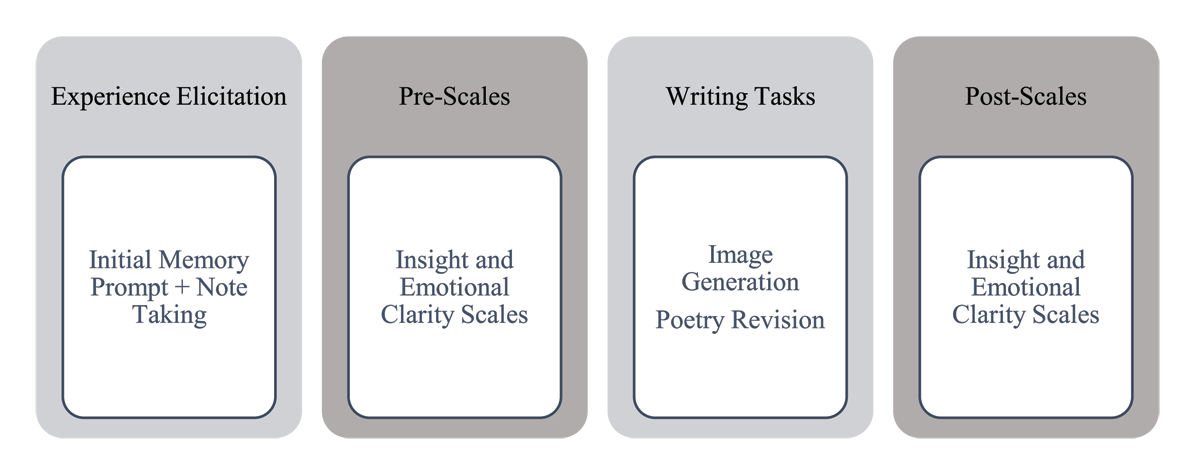
Figure 1
Schematic Overview of the Study Design.
The second stage involved a poetic image generation and revision task. The specific prompt used was as follows:
Think very carefully about the significant experience you have just chosen. What do you think is the central moment of this experience? Try to pinpoint the central feeling that accompanies this significant moment. Try to find a scene, object or action that summarizes the meaning of this event for you. In the space below, write a succinct, focused, sensory poetic description. Describe just one thing—the most important image of that whole experience. Look at the image you wrote. Think carefully about the words you chose for this description. Ask yourself about the associations of each word and the meanings that it creates. Revise your poem and write it again as a poem.
Following each stage of the poetic inquiry protocol, the insight and emotional clarity scales were presented to the participants. There was a difference in the current protocol to that of the Hanauer (2022) study. In that study, only 3 minutes was allotted for each stage on writing. However, in the current study, timing was not controlled and participants could take as much or as little time as they desired to complete each stage of writing.
The full process of the study was conducted in one sitting through a Qualtrics survey. A description of the study was posted on the Amazon MTurk webpage and members were invited to participate. Following consent to participate, members were directed to a Qualtrics survey. Upon completion of the consent, participants were directed through the two-stage writing and scale response process. All data was collected and downloaded from the Qualtrics survey service. Once responses had been vetted for the human completion of both tasks, participants were paid $1.00 for their work. The average time of completion was 14.3 minutes (M = 860 seconds; SD = 96 seconds).
Analysis
The current study involved the evaluation of the levels of cognitive insight and emotional clarity that were elicited during the completion of the two-stage poetic inquiry writing protocol used in this study. As a first stage, descriptive statistics were analyzed at each stage of the process. In order to simplify the degree of emotional clarity elicited, the three negatively worded items were reversed so that higher values reflected higher levels of emotional clarity. Secondly, in order to consider whether the second stage of writing enhanced the processes of self-discovery, a repeated measures (Stage 1 – Experience Elicitation; Stage 2 – Poetic Image Generation and Revision) comparative analysis was conducted. An evaluation of the normality of the variables revealed that they were not normally distributed. Accordingly, the non-parametric, repeated measures Friedman test was used to compare differences between the initial and second stage of the writing in relation to levels of cognitive insight and emotional clarity.
The current study was also interested in whether there were differences in the degree of insight and emotional clarity for participants who produced different levels of poetic image quality. In order to conduct this comparative analysis, it was necessary first to analyze the quality of the poetic images. The quality of the poetic image was analyzed using a rubric with three criteria (specificity, relatedness and depth of sensory information) and a simple 1–3 point rating system. Figure 2 presents the rubric that was used and the adjacent rating system. The process of using the rubric involved rating each of the three criteria (specificity, relatedness and depth of sensory information) 1 to 3 and then counting the total score for that image. The final quality of each poetic image was defined according to total final score. Poetic images with a rating of 1–5 were considered low quality; a rating of 6–7 was considered mid quality; and a rating of 8–9 was considered high quality. Table 1 presents examples of poetic images, their ratings and associated level of quality.
Table 1
Examples of poetic images with the criteria ratings and overall quality status.
| POETIC IMAGE QUALITY | RATING | POETIC IMAGE EXAMPLE | CONTEXT OF IMAGE |
|---|---|---|---|
| High | Specific 3 Relatedness 3 Sensory Depth 3 TOTAL 9 | “Numbness. She sits on the bottom step, alert, awake, but not able to move. I can only stand by, help where I can. I am part of the wallpaper.” | Sudden paralysis of life partner |
| Mid | Specific 2 Relatedness 3 Sensory Depth 1 TOTAL 6 | “Five horses running” | Growing up in poverty |
| Low | Specific 1 Relatedness 2 Sensory Depth 1 TOTAL 4 | “Feeling happy to ride a car and I love driving” | Driving alone for the first time |
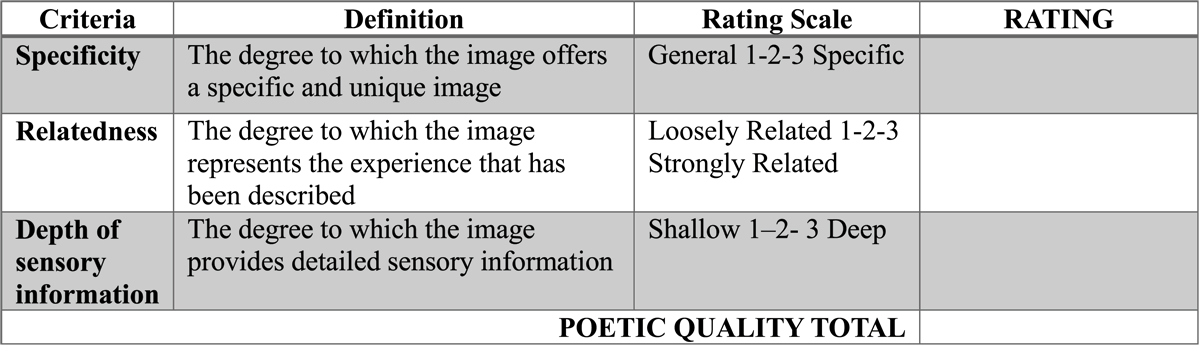
Figure 2
Rating Scale for Evaluation of Poetic Image Quality.
In order to ensure the validity of the evaluation, all poetic images were read in relation to the elicited experience presented by each participant in the first stage of writing. This was to ensure that the generated image emerged from the freewriting concerning the chosen experience. All the poetic images were rated by two raters working independently. Overall, there was 89% agreement between reviewers using this rating rubric. All disagreements between raters were resolved through discussion.
Once quality had been established for each poetic image, comparative analyses were conducted comparing the three levels of poetic image quality (low, mid and high) at the elicitation and revision stages of poetic inquiry writing. The non-parametric, Kruskal-Wallis H-test followed by pairwise Dwass-Steel-Critchlow-Fligner comparisons were used to establish systematic differences and to consider where any differences were situated.
The final analysis that was conducted explored the relationship between the word counts, time spent at each stage of the writing process and the analysis of the quality of the poetic image. Word counts and time spent on tasks were calculated for each participant’s response at each stage of writing. Spearman Rho rank order correlations were calculated to consider any associations between these variables. All analyses were conducted with SPSS V.28.
Results
Table 2 presents the mean and medians for each of the two stages of the poetic inquiry protocol. Both the cognitive insight and emotional clarity scales had 7-point scales with higher values representing increased levels of self-discovery. As seen in Table 2, the median scores for both measures and at both stages of writing were high with a median rating of 6 for cognitive insight at both time points and a median rating of 5 for emotional clarity at the elicitation stage and 4.75 for the revision stage. This descriptive data suggests that the poetic inquiry writing task elicits mid to high levels of self-discovery.
Table 2
Mean, Standard Deviation, Median and IQR for the Measures of Emotional Clarity and Cognitive Insight for Two Stages of the Poetic Inquiry Protocol (n = 60).
| WRITING STAGE | EMOTIONAL CLARITY | COGNITIVE INSIGHT | ||
|---|---|---|---|---|
| MEAN | MEDIAN | MEAN | MEDIAN | |
| Stage 1: Elicitation | 5.21 (1.22) | 5 (1.92) | 6.01 (0.75) | 6 (1) |
| Stage 2: Image Generation and Revision | 5.13 (1.24) | 4.75 (2.19) | 6.01 (0.74) | 6 (1) |
As reported above, prior research using this protocol and measures had shown a decrease in self-discovery at the second stage of writing (Hanauer, 2022). As seen in Table 2, the descriptive statistics suggests that there are no differences in the ratings for the two stages and on both measures. In order to evaluate these claims, non-parametric, repeated measures Friedman tests were conducted to compare the differences among repeated measures. The results indicated that for both measures, there was no significant difference in the data [Cognitive Insight: χ2 (1) = 0.00, p = .1; Emotional Clarity: χ2 (1) = 0.22, p = .64). The current analysis does not show any systematic increases or decreases in levels of self-discovery between the two stages of poetic inquiry writing.
In order to evaluate whether the quality level of the produced poetic images influenced self-discovery, comparative analyses were conducted. Table 3 presents the descriptive data for three levels of poetic image quality for both measures at two different time points in the poetic inquiry writing protocol. A cursory analysis of Table 3 suggests that participants who produced low quality poetic images had lower levels of emotional clarity at the revision stage and the elicitation stage of the poetic inquiry writing protocol. For the measure of cognitive insight, there does not seem to be a difference between the levels of poetic image quality for both stages of the poetic writing inquiry protocol. In order to evaluate these impressions, non-parametric, Kruskal-Wallis H-tests were conducted comparing three levels of poetic image (Low, Mid, and High) for cognitive insight and emotional clarity at two time points (Elicitation Stage and Poetic Image Generation and Revision Stage).
Table 3
Mean, Standard Deviation, Median and IQR for the Measures of Emotional Clarity and Cognitive Insight for Three Levels of Poetic Image Quality at Two Stages of the Poetic Inquiry Protocol (n = 60).
| WRITING STAGE | Poetic IMAGE QUALITY LEVEL | EMOTIONAL CLARITY | COGNITIVE INSIGHT | ||
|---|---|---|---|---|---|
| MEAN | MEDIAN | MEAN | MEDIAN | ||
| Stage 1: Elicitation | Low (n = 26) | 4.71 (1) | 4.46 (1.10) | 5.92 (0.74) | 6 (0.67) |
| Mid (n = 11) | 5.71 (1.49) | 6 (2.58) | 6.18 (0.7) | 6 (1.33) | |
| High (n = 23) | 5.54 (1.13) | 6 (1.33) | 6.03 (0.8) | 5.67 (1.33) | |
| Stage 2: Image Generation and Revision | Low (n = 26) | 4.55 (0.99) | 4.21 (0.58) | 6.01 (0.72) | 6 (0.92) |
| Mid (n = 11) | 5.61 (1.49) | 6 (2.63) | 6.12 (0.78) | 6 (1.33) | |
| High (n = 23) | 5.57 (1.12) | 5.92 (1.17) | 5.94 (0.78) | 6 (1) | |
For the measure of emotional clarity at both the elicitation and revision stages the Kruskal-Wallis H test indicated that there was a significant difference in the distribution of scores between the three poetic image quality levels [Elicitation Stage: H(2) = 7.6, p = 0.02; Poetic Image Generation and Revision Stage: H(2) = 8.65, p = 0.01]. In order to evaluate the source of the difference between the levels of poetic image quality, pairwise Dwass-Steel-Critchlow-Fligner comparisons were conducted. For both stages of the poetic inquiry writing protocol, the significant differences were situated between the Low and the High-quality groups [Elicitation Stage: W = 3.38. p = 0.04; Poetic Image Generation and Revision Stage; W = 3.86, p = 0.02].
For the measure of cognitive insight, at both the elicitation and revision stages the Kruskal-Wallis H test indicated that there was not a significant difference in the distribution of scores between the three poetic image quality levels [Elicitation Stage: H(2) = 0.52, p = 0.77; Poetic Image Generation and Revision Stage: H(2) = 0.3, p = 0.86]. The current analysis suggests that the quality of the poetic image does have an influence on self-discovery, but only in relation to the emotional clarity and not in relation to cognitive insight.
The final analysis involved the calculation of Spearman Rho correlations for poetic image quality, word count and time writing at two stages of the poetic writing protocol. As can be seen in Table 4, there was a significant positive relationship between word count and poetic image quality [Elicitation stage rs(58) = .32, p < .02); Image generation and revision stage rs(58) = .46, p < .001]. For the time on task variable, there was a significant negative correlation between the amount of time spent completing the elicitation writing task [rs(58) = –.38, p < .008] but no significant association for time on task and the quality of the poetic image during the image generation and revision stage of writing. The data suggests that faster writing speeds and higher word counts during the elicitation stage are associated with higher quality images. In addition, more revision (as seen in higher word counts) at the image generation and revision stage was also associated with higher quality images.
Table 4
Spearman Rho Correlations and Significance Levels for Poetic Image Quality, Word Count and Time Writing at Two Stages of the Poetic Writing Protocol (n = 60).
| OUTCOME MEASURE | STAGE 1: ELICITATION | STAGE 2: IMAGE GENERATION AND REVISION | ||
|---|---|---|---|---|
| WORD COUNT | TIME | WORD COUNT | TIME | |
| Poetic Image Quality | .32* | –.38** | .46*** | –.01 |
[i] * p < .05; ** p < .01; ***p < .001.
Discussion
The current study aimed to address the claims that through poetic inquiry, a researcher-poet would increase their levels of self-understanding about personal experiences. The current study which replicates prior research by Hanauer (2022) offers some evidence with which to support this claim. As seen in both the current and prior study, the result of the poetic inquiry protocol involves mid to high levels of cognitive insight and emotional clarity. As seen in prior research, the current data suggests that it is the initial elicitation stage which produces these levels of self-discovery. In relation to the scholarship on writing, this suggests that it is a process of Knowledge Constitution which leads to self-discovery. The psychological mechanism of knowledge constitution involves the verbalization and writing down of sensory and non-verbal information stored in episodic and implicit memory. It can be hypothesized that the verbalization of these trace memories provides the experience of self-discovery about personal experience for the participant. The Hanauer (2010) poetic inquiry protocol with its associated prompts used in this and prior studies seems to direct a process of this kind and facilitate self-discovery.
As opposed to prior studies, the second stage of the poetic inquiry protocol does not in the current study reduce levels of self-discovery. As seen in the repeated measures analyses presented, there was no significant difference between the first or second stage on the measure of cognitive insight or the measure of emotional clarity. This result does not change the original conclusions of prior research that it is the first stage of the poetic inquiry protocol that leads to mid-to-high levels of self-discovery. However, it is important to note the divergence from prior research. The second stage maintains the levels of self-discovery elicited in the first stage of the protocol.
This divergence from prior results in the second stage, might result from the time on task differences between this and the Hanauer (2022) study. In that study, writing times for the elicitation and image generation and revision stages were limited to 3 minutes for each stage. In the current study, the average writing time was 14.3 minutes, which is more than twice as long. Revision within the writing process is considered to take more time and cognitive engagement to be successful (Bereiter & Scardamalia, 1987; Flower & Hayes, 1980; Galbraith, 2009). One option for understanding the current results, which did not involve a decrease in self-discovery at the second stage of writing, is that the writers had more time to conduct this stage. This increased processing time may have facilitated the maintenance of high self-discovery levels.
In relation to the second stage of poetic inquiry, the current study explored the role of the quality of the poetic image produced on self-discovery. Results present initial evidence that the quality of the poetic image does have an influence on self-discovery. At the second stage of poetic inquiry, researcher-poets who had higher quality images also had higher levels of emotional clarity. In the current study, the quality of the poetic image included three criteria: the uniqueness and specificity of the image, the degree to which this image related to the elicited experience and thirdly the depth of sensory information. In other words, a higher quality image had the features of being unique, highly related to the elicited experience and rich in sensory information. We can assume that participants who produced images of this quality also felt their experiences more explicitly and that this translated into higher emotional clarity ratings. This result is interesting in that the quality of the product influenced levels of self-discovery.
The correlational data presented above offers further clarification on the writing processes and the way they contribute to the quality of the images that are produced. Freewriting, as manifest in the poetic writing protocol used here, is based on the assumption of automatic, uninhibited, associative writing during the elicitation stage. This type of writing directs the transfer of stored memorial sensory data concerning an experience into written data. The correlational data shows a pattern in which there is a negative correlation between the length of time writing and the quality of the image, and a positive relation between how much is written and the quality of the image. In other words, faster times and more writing during the elicitation stage were associated with higher quality images.
The image generation and revision stage is based on the assumption that the writer will be cognitively engaged with the revision process. The current data partially supports this in showing the more writing that was done was positively associated with higher quality poetic images. However, no association was found for length of time and the quality of the image. Overall, the word count and time on task data underpin the assumptions of the dual-process model of discovery through poetry writing (Galbraith, 1999, 2009; Galbraith & Baaijen, 2015; Hanauer, 2022). When this is combined with prior results, it suggests a path to higher quality writing and increased emotional understanding.
In relation to the role of artistic quality in ABR, an important consideration of the current replication of the Hanauer (2022) study is that the people who participated in the poetic inquiry protocol used here were drawn from a broad spectrum of society. The Hanauer (2022) study was done with students learning how to write in the Composition classroom. As seen in the current analysis of the quality of the poetic images produced, there was some variation between participants. But more than half the participants (n = 34) produced mid and high-quality images and benefitted from increased levels of emotional clarity. This suggests that a clear ABR protocol can be used with a wide range of people. However, the results also suggest that those ABR researchers such as Morris and Paris (2022), Chilton and Leavy (2014), Lafrenière and Cox (2012), and Finley (2008), who have recommended that the quality of the ABR art product be considered, were correct in their recommendation. The results of participation in an ABR process in the current study seem to be different depending on the quality of the artistic product.
The results in relation to the quality of the produced poetic image also offer some additional explanations of the relations between the two stages of the Hanauer (2010) poetic inquiry protocol. As seen in the results section, there was a significant difference in the level of emotional clarity for participants who produced higher quality images at the initial elicitation stage of the protocol and not just at the second stage of poetic image generation and revision. In other words, before the poetic image was written, the participants who ultimately produced higher quality poetic images had increased emotional clarity. This would suggest that their initial elicitation process facilitated the process of writing a better-quality image and that this supported the sustained higher level of emotional clarity. From the correlational data, we also know that when the elicitation stage has reduced times and more writing (a fast-writing process), the quality of the poetic image also improves. This is an interesting result in that it reinforces once again the importance of the first stage of this writing protocol and how it is conducted.
Limitations
As with all studies, the current investigation has limitations. The two most important limitations of the current study are that only one specific poetic inquiry protocol was studied in the manuscript and the number of participants was relatively small (n = 60). As such, the results presented here need to be seen as provisional. Far larger samples and a much wider set of poetic inquiry protocols need to be evaluated before more substantive claims can be made about the ability of poetic inquiry to direct processes of self-discovery.
Conclusions
This manuscript describes an empirical study of the ability of a specific poetic inquiry protocol to lead to a process of self-discovery and considers the role of the quality of the art product in this process. Overall, the results of this study suggest that participation in poetic inquiry can lead to self-discovery, that increased self-understanding is primarily facilitated through a knowledge-constituting writing process and that the quality of the product does influence the level of emotional clarity one has about personal experiences. The paper replicates prior results and lends some empirical support to the claims of a specific ABR poetic inquiry protocol.
Beyond the bounds of the specific protocol considered here, the paper also demonstrates the integration of different psychological research methods in studying the claims and uses of an ABR method. This cross-method approach may offer a road map for ways in which ABR can support its claims with methods more broadly recognized by other psychological researchers. It is the hope of the author of this manuscript that this usage of empirical, quantitative methods to study an ABR research protocol may encourage others to look at ways ABR methods work with the required rigor (whether qualitative or quantitative) that can substantiate the importance of this approach for a broad range of psychological and sociological researchers.
Competing Interests
The author has no competing interests to declare.