
Table 1
Description of Plot Units per Story.
| PLOT UNIT | HAPPY-ENDING STORY “NOAH’S BEES” | TRAGEDY “THE CLASS IDIOT” | THRILLER STORY “GUYS THAT MAKE YOU LOOK THE OTHER WAY” |
|---|---|---|---|
Introduction
| The year is 2046. Lissa is a scientist who works at the plantation ‘Green Delta’ that was built to cultivate plants for diverse climatic environments. In 2025 a huge storm had decimated the unknown country’s population and resources. After that, the seasons of the northern hemisphere started to shift. Lissa’s job is to mathematically predict these changes. Her colleague, Noah, and his bee population that pollinates the plants depend on her calculations. | A person narrates about a school trip in tenth grade to a youth hostel in a small village in South Tyrol (with games, barbecues, and secretly smoking cigarettes and having drinks). The class hikes into a canyon. They arrive at a lovely place in nature and take a break to eat. Their teacher reads and the ‘class idiot’ goes to collect rocks. | The protagonist awakes in a tramway car in the middle of the night. He had celebrated his promotion at a work party, fallen asleep and had missed his stop. The terminal stop is ahead and he is alone in the tramway car. The protagonist monologizes about having proven his mother wrong, who thinks of him as a no-good. When the tram stops, he goes to the door and pushes the ‘open’ button. |
Complication
| Noah calls a staff meeting to discuss the problem that this year’s spring will already begin while his bees are still hibernating. When they wake later, they will likely starve and die, and the crop and people will suffer the consequences of the late pollination. After some brainstorming, a colleague suggests to awaken the bees artificially. | The protagonist describes the ‘class idiot’ with autistic features. He recounts how the ‘idiot’ ate all the leftovers at breakfast. The other kids were disgusted and made fun of him, but the ‘idiot’ did not understand them. The protagonist once tried to connect with him, but the ‘idiot’ did not care. The class watches him pick up rocks from a river. | The door does not open. A brute looking man enters the tramway car at the other end. The protagonist tries to talk to him, but the man only insults him and pulls out a hammer. The protagonist is in disbelief and hopes for it to be a joke. The man approaches him. The protagonist threatens to call the police, but the man knocks his phone out of his hand. The protagonist tries to run away. |
Climax
| Lissa has to calculate an accurate date for the beginning of spring with only a few days tolerance. Her calculations do not match those of the calculation software. When asked about this, she admits that she corrects the programs values by intuition and chance (using a dice and deciding to subtract or add this number according to her instinct). | One kid starts to bully the ‘class idiot’, picks up a rock and throws it into his direction. Some other kids laugh and join in. The ‘idiot’ laughs. More kids throw more rocks at him. The protagonist is paralyzed by his feeling of danger, but does nothing as the situation exacerbates. A rock hits the ‘idiot’ in the head and he falls over. | The man laughs and follows him. He hits the protagonists arm with his hammer. He screams in pain, trips over and falls to the floor. As he tries to stand up, the man hits his ankle, and comes close. He explains that there are no witnesses and the police will never know it was him. The man grabs his hair and pulls his head up to hit him. |
End
| Noah has started the artificial awakening process and Lissa waits. After a while, the bees start to move and fly. A leap in time reveals the success of the mission. Noah leaves for another research station and entrusts his local bee population in Lissa’s care. | The teacher lies her book aside and helps the ‘idiot’ up. She looks at his head, decides that it is not a big deal, and gives the class a reprimanding look. They pack up and leave the canyon. No one mentions the happenings further. In the evening, the ‘idiot’ eats the leftovers and laughs. | A bearded man hits the man’s head with a bottle and he goes down. As the man tries to get up and takes his hammer, the bearded man stabs him with the broken bottleneck. The protagonists awakes under a reeking rag. The bearded man is a homeless person that witnessed the attack, sent his friend to call the police and helped the protagonist. He thanks him for not looking the other way. |
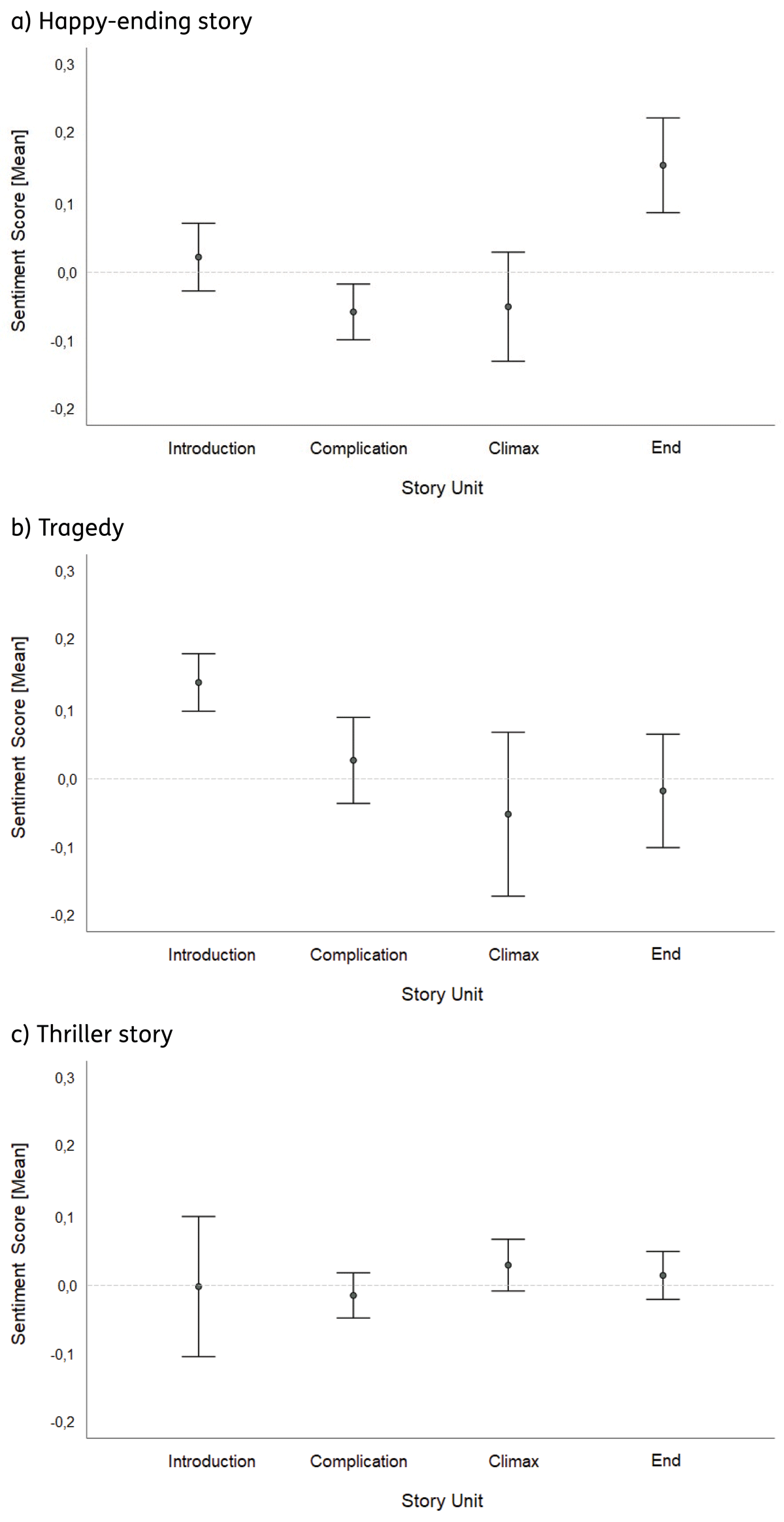
Figure 1
Sentiment Scores of Each Genre Story.
Note: Error bars represent the standard error of the mean; dotted line marks neutral valence; happy-ending story, N = 111; tragedy, N = 50; thriller story, N = 106.
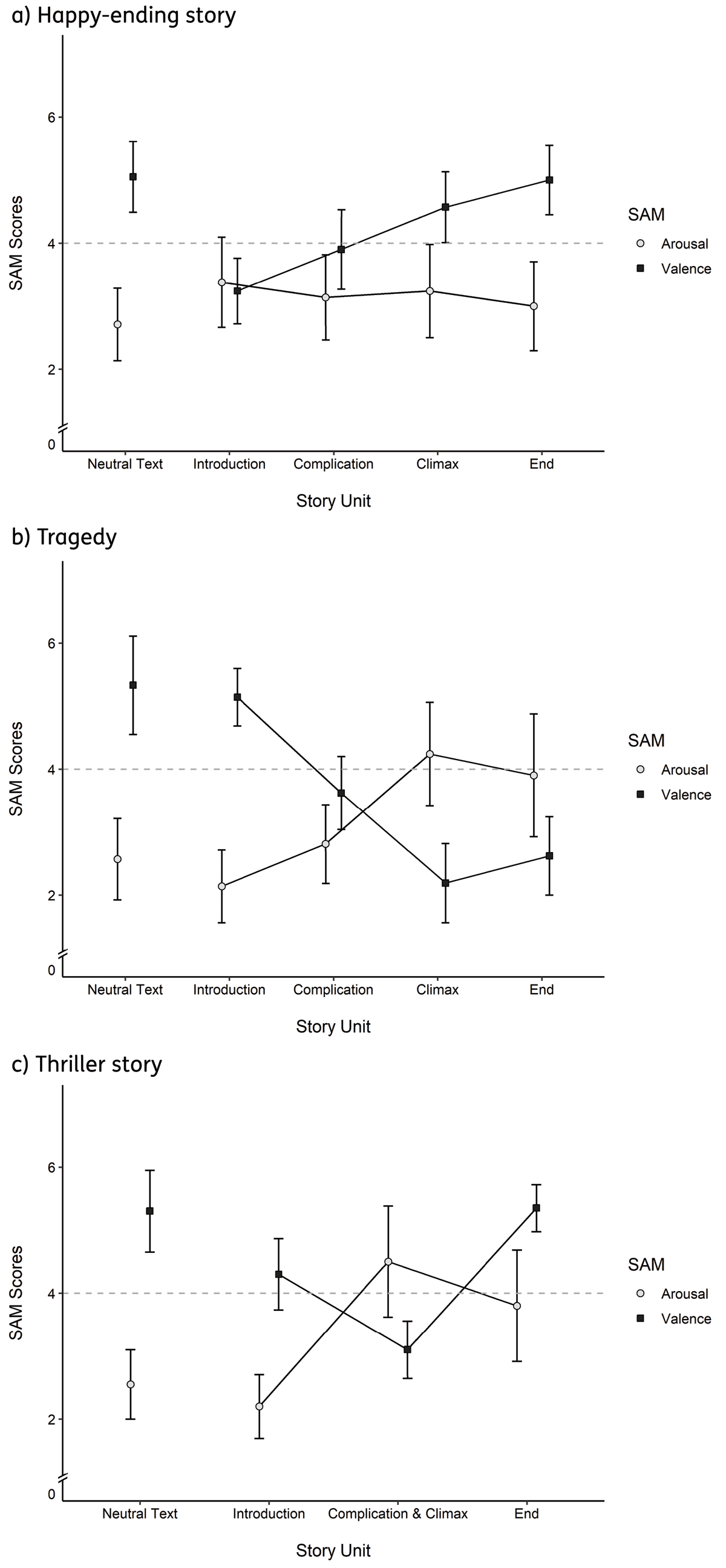
Figure 2
Subjective Valence and Arousal Scores of Each Genre.
Note: Error bars represent the standard error of the mean; dotted line marks neutral valence; happy-ending story, n = 21; tragedy, n = 20; thriller story, n = 20.
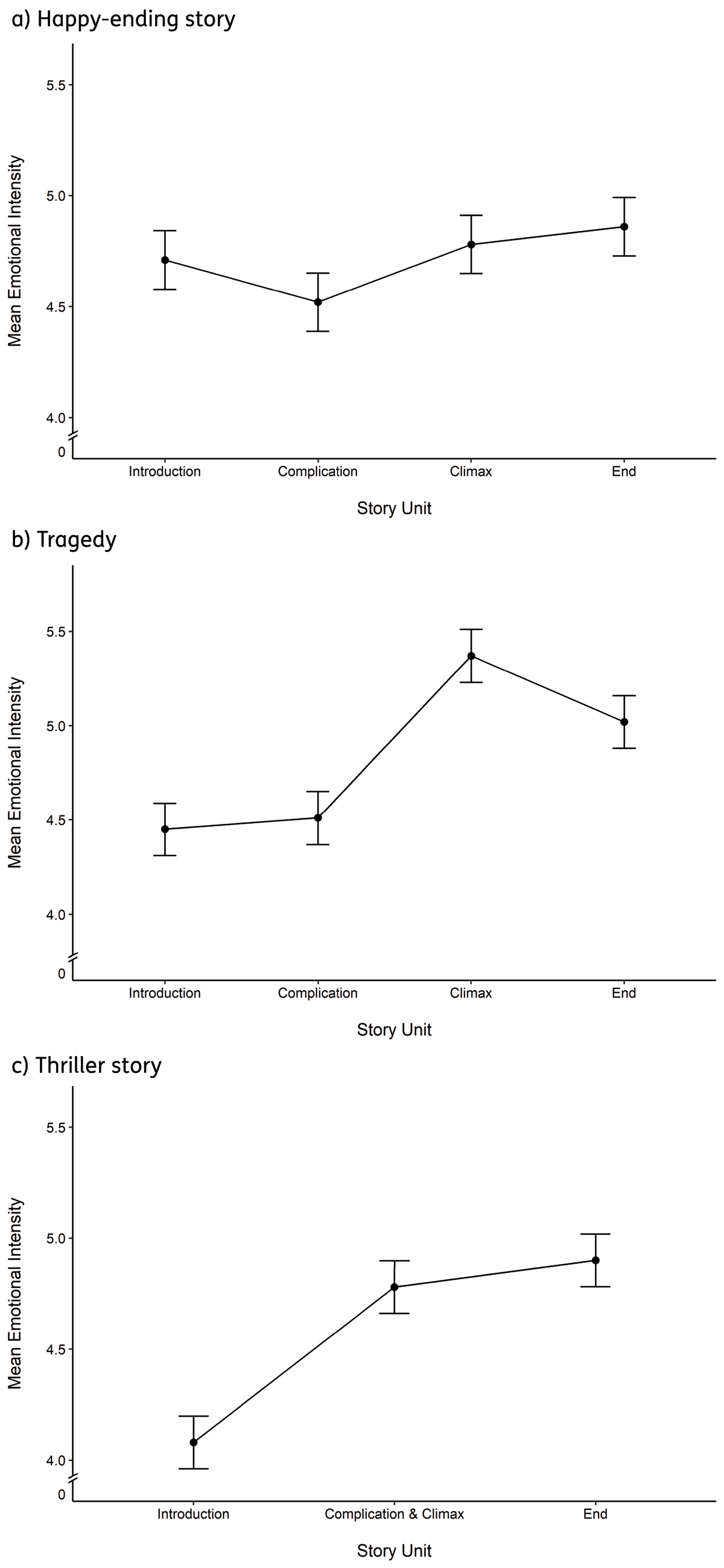
Figure 3
Emotional Intensity Scores of Each Genre.
Note: Error bars represent the standard error of the mean; happy-ending story, n = 20; tragedy, n = 21; thriller story, n = 20.
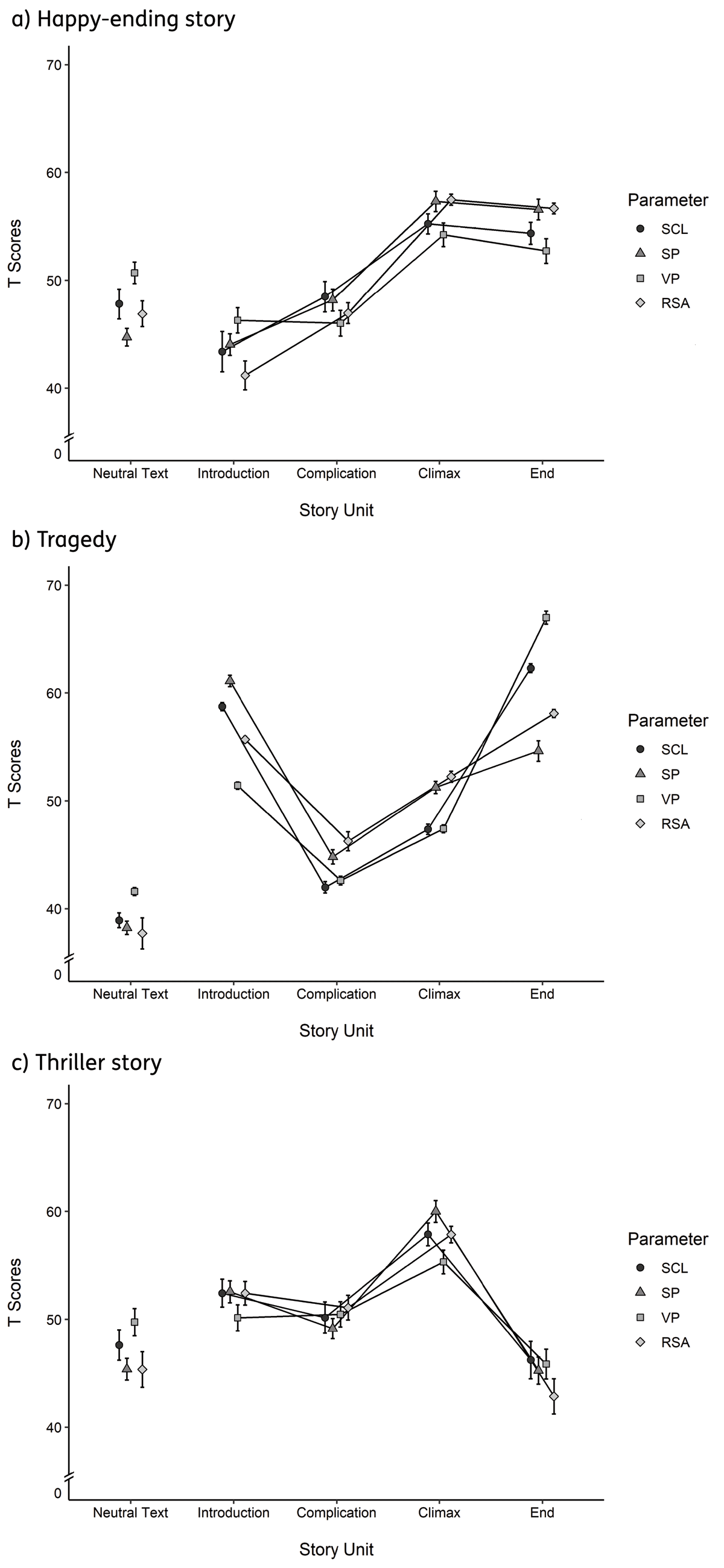
Figure 4
T Scores of Psychophysiological Measures of Each Genre.
Note: Mean T scores of parameter change per second, error bars represent the standard error of the mean; SCL: skin conductance level, SP: sympathetic power, VP: vagal power, RSA: respiratory sinus arrythmia; happy-ending story, SCL: n = 13; SPR & VPR: n = 19; RSAN: n = 17; tragedy, SCL: n = 17; SPR & VPR: n = 21; RSAN: n = 18; thriller story, SCL: n = 10; SPR & VPR: n = 16; RSAN: n = 12.
Table 2
Means and Standard Errors of Suspense Ratings per Story Unit and Genre.
| GENRE | ||||
|---|---|---|---|---|
| HAPPY-ENDING STORY | TRAGEDY | THRILLER STORY | ||
| M (SE), nk | M (SE), nk | M (SE), nk | ||
| Story Unit | Introduction | 4.80 (0.36), n = 10 | 5.00 (0.31), n = 7 | 2.00 (NA), n = 1 |
| Complication | 4.43 (0.48), n = 7 | 5.00 (0.00), n = 4 | 5.79 (0.24), n = 14 | |
| Climax | 4.78 (0.32), n = 9 | 4.80 (0.58), n = 5 | ||
| End | 4.00 (2.00), n = 2 | 4.50 (0.50), n = 2 | 4.75 (0.48), n = 4 | |
[i] Note: Happy-ending story, n = 20; tragedy, n = 21; thriller story, n = 20. nk represent total numbers of emotion ratings per story unit.
Table 3
Changes of Psychophysiological Measures Between Each Story Unit and Genre.
| HAPPY-ENDING STORY | ||||||||||
|---|---|---|---|---|---|---|---|---|---|---|
| INTRODUCTION – COMPLICATION | COMPLICATION – CLIMAX | CLIMAX – END | ||||||||
| t VALUE | d | t VALUE | d | t VALUE | d | |||||
| Sympathetic Activation | SCL | t(34) = 1.89 | n.s. | t(33.7) = 7.04 | 2.76 | *** | t(33.1) = –0.72 | n.s. | ||
| Sympathetic Power | t(53.4) = 3.40 | 0.86 | ** | t(53.3) = 7.73 | 1.95 | *** | t(53) = –0.64 | n.s. | ||
| Vagal Activation | Vagal Power | t(53.4) = 0.10 | n.s. | t(53.3) = 6.83 | 1.73 | *** | t(53) = –1.33 | n.s. | ||
| RSA | t(51.6) = 2.38 | 2.10 | * | t(64) = 4.64 | 2.10 | *** | t(49.1) = 1.49 | n.s. | ||
| TRAGEDY | ||||||||||
| INTRODUCTION – COMPLICATION | COMPLICATION – CLIMAX | CLIMAX – END | ||||||||
| t VALUE | d | t VALUE | d | t VALUE | d | |||||
| Sympathetic Activation | SCL | t(43.6) = –14.07 | –4.80 | *** | t(45.7) = 4.93 | 1.69 | *** | t(44.3) = 12.55 | 4.29 | *** |
| Sympathetic Power | t(60) = –8.99 | –2.32 | *** | t(60) = 3.56 | 0.92 | ** | t(60) = 1.86 | n.s. | ||
| Vagal Activation | Vagal Power | t(60) = –7.53 | –1.95 | *** | t(60) = 4.09 | 1.06 | *** | t(60) = 16.72 | 4.32 | *** |
| RSA | t(64.5) = –4.29 | –2.45 | *** | t(60.9) = 3.31 | 1.10 | ** | t(64.6) = 4.68 | 2.91 | *** | |
| THRILLER STORY | ||||||||||
| INTRODUCTION – COMPLICATION | COMPLICATION – CLIMAX | CLIMAX – END | ||||||||
| t VALUE | d | t VALUE | d | t VALUE | d | |||||
| Sympathetic Activation | SCL | t(35) = –2.14 | –0.96 | * | t(27) = 7.28 | 3.25 | *** | t(27) = –11.00 | –4.92 | *** |
| Sympathetic Power | t(45) = –3.24 | –0.74 | ** | t(45) = 10.28 | 2.35 | *** | t(45) = –13.97 | –3.19 | *** | |
| Vagal Activation | Vagal Power | t(45) = 0.28 | n.s. | t(45) = 4.37 | 1.00 | *** | t(45) = –8.53 | –1.95 | *** | |
| RSA | t(32.6) = –2.02 | n.s. | t(32.1) = 6.33 | 1.81 | *** | t(32.4) = –9.74 | –2.78 | *** | ||
[i] Note: Valence shifts are marked in grey, positive values indicate increases.