
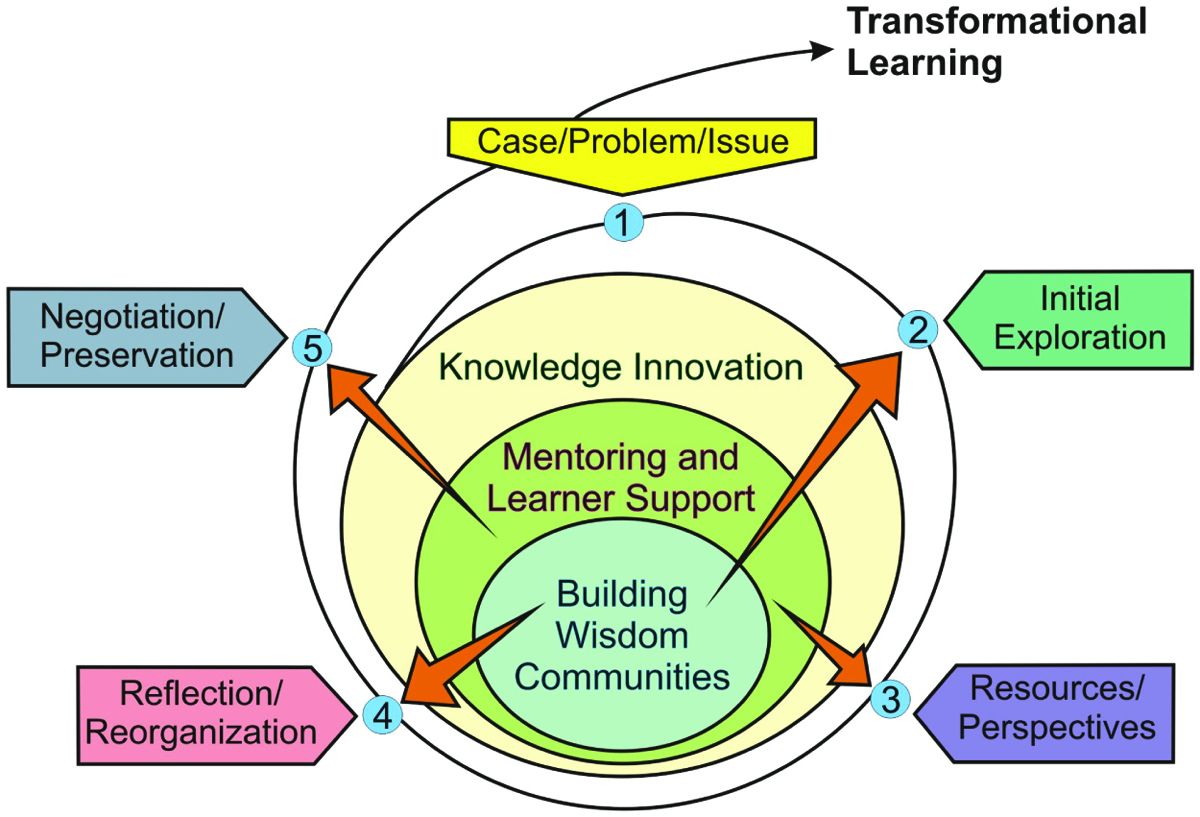
Figure 1
WisCom model with “Cycle of Inquiry” module design (Adapted with permission from Gunawardena et al., 2006)
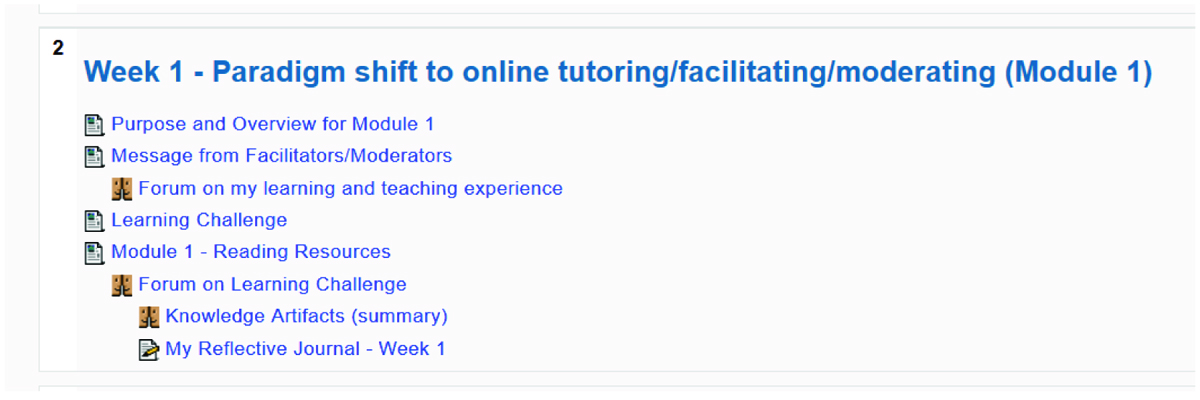
Figure 2
IScreen capture of a sample module
Table 1
Overview of the modules of the online course
| Module No. | Title | e-activities | Assignment |
|---|---|---|---|
| Pre-course activities | Forum Pre course self-reflection instrument Reflective Journal | Individual | |
| 1 | Paradigm shift to online tutoring/facilitating/moderating | Forum Reflective Journal | - |
| 2 | The role of an online tutor mentor and necessary skills and qualifications | Chat Forum Quiz Reflective Journal | - |
| 3 | Building an online learning community and creating the social environment | Reflective Journal | Individual |
| 4 | Facilitating Interaction | Reflective Journal | Individual – 3 |
| 5 | Collaborative learning and team building online | Reflective Journal | Individual |
| 6 | Facilitating knowledge construction | Forum Reflective Journal | |
| 7 | e-Mentoring | Forum WIKI Pre and Post questionnaire on cross cultural e-mentoring Reflective Journal Mid course self-reflection instrument | Group |
| 8 | Providing Learner Support | Reflective Journal | Individual |
| 9 | Orienting students to online learning | Quiz Reflective Journal | |
| 10 | Assessing Learning & Providing Feedback | Forum Reflective Journal | individual |
| 11 | Conducting Practical Course Components at a Distance and Virtual Labs | Online simulation Forum Reflective Journal | - |
| 12 | Cultural Issues Related to Learning and Communication | Forum Quiz Reflective Journal | Individual and Group |
| 13 | Ethics of Online Learning | Forum Reflective Journal | |
| 14 | Monitoring and Evaluating Tutors/Mentors | Forum Reflective Journal Final course self-reflection instrument |
Table 2
Course Achievements and Pedagogical Aspects
| Theme | Supportive quotations |
|---|---|
| Overall satisfaction (100%) | I would say all. The content helped me to expand my knowledge of what online learning entails, the role of mentors and what we need to support learners in an online environment. The challenges and obstacles faced, helped me to understand things from the student’s perspective, as well as gain insight and understanding on how to handle issues andproblems as a tutor in the online environment (Mid course self-reflection, Sri Lankan Female 1). This is probably the last week of the course and time to say goodbye to each other. I am not writing “ Goodbye” in its true sense, this is just coming out of scheduled online activities, otherwise it is actually start of friendship of a new inter country Community. We will cherish the memories of this period for long time and will remain in touch with each other...In other words it is beginning of the new “Online” Culture (Last week entries of the Reflective Journal – Pakistani Female 1). |
| Instructional design of the course (100%) | I like the use of three orientation modes of each module i.e. Purpose of the course, tutor’s message and the learning challenge. Instead of mixing up all three in one document it is a nice way of explaining expected outcomes and experiences designed in each module (Mid course self-reflection – Pakistani Female 2). |
Table 3
Issues Faced by Participants and OUSL Academics
| Theme | Supportive quotations |
|---|---|
| Lack of Peer support for group tasks | It is not easy to produce a group work in online as some students pay less attention to the target and do what they want even under good online background. Some are not collaborative and aim mostly their individual targets. Some are difficult to negotiate (Final course self-reflection – Sri Lankan Female 2). A bit frustrated again since the only group member who is at least a little responsive, just directly wrote to the moderator and then only just responded to what was said by the moderator, ignoring that this is a group activity and we all need to be involved (Journal Reflections week 3 – Sri Lankan female 1) Our e-mentoring sessions were not very useful in getting a true sense of online collaboration – (Final course self-reflection – Sri Lankan Male 1). |
| Workload | I think the workload is high. It was difficult to manage 3 modules in one week with other commitments in work place and home (Final course self-reflection – Sri Lankan Female 2). Online learning means a lot of commitment and planning. I didn’t realize how time consuming it can be (Mid course self-reflection – Mauritius Female 1). |
| Difficulty in navigating multi structures | Many activities going simultaneously made me feel uneasy (Mid course self-reflection, Pakistani Female 2) |
| Social Presence | I would like to see photographs of OUSLEL team especially X … who was constantly with us throughout the course. Seeing and believing is different than just believing without seeing… (Final course self-reflection – Pakistani Female 1). |
| Less sensitive to Plagiarism and copyright laws | Only a handful of group members brought original thinking to the activities. Most were content with copying something directly from the web. Rather than collaborating, it was a task of gluing together individual write-ups (or content pilfered from the web) – (Final course self-reflection – Sri Lankan Male 1). |