
Table 1
OER initiatives in India
| OER initiatives | Website |
|---|---|
| CSIR explorations- Open Access Repository of Indian theses | http://eprints.csirexplorations.com/ |
| Digital library of India-digital collection of freely accessible rare books collected from different libraries of India | http://www.dli.ernet.in/ |
| Indian National, Digital library in Engineering, sciences, and technology (INDEST)-Consortium for e resources of engineering and technological institutions | http://paniit.iitd.ac.in/indest/ |
| Kalasampada-Digital library: Resources of Indian cultural heritage | http://ignca.nic.in/dgt_0001.htm |
| Vidyanidhi-Indian digital library of electronic theses | http://eprints.uni-mysore.ac.in |
| Vigyan Prasar Digital Library- Digital library contains digital version of significant scientific works | http://www.vigyanprasar.gov.in/digilib/ |
| CEC Learning Object repository- The econtent and unique learning object repositories of providing higher education | http://cec.nic.in/e-content/Pages/default.aspx |
| E gyankosh- National depository of digital learning resources | http://egyankosh.ac.in/ |
| National Programme on technology enhanced learning (NPTEL)- E learning platform for various courses | https://onlinecourses.nptel.ac.in/explorer |
| Eklavya- E learning portal | http://ekalavya.org/elearn/EkalavyaUser/Index.aspx |
| E-Grid- An online learning network | http://econtent.nielit.gov.in/rs/start.php |
| Brrihaspati- Open platform for learning | http://digitallearning.eletsonline.com/2008/04/brihaspati-e-learning-platform/ |
| ShodhGanga- Repository of PhD theses | http://shodhganga.inflibnet.ac.in/ |
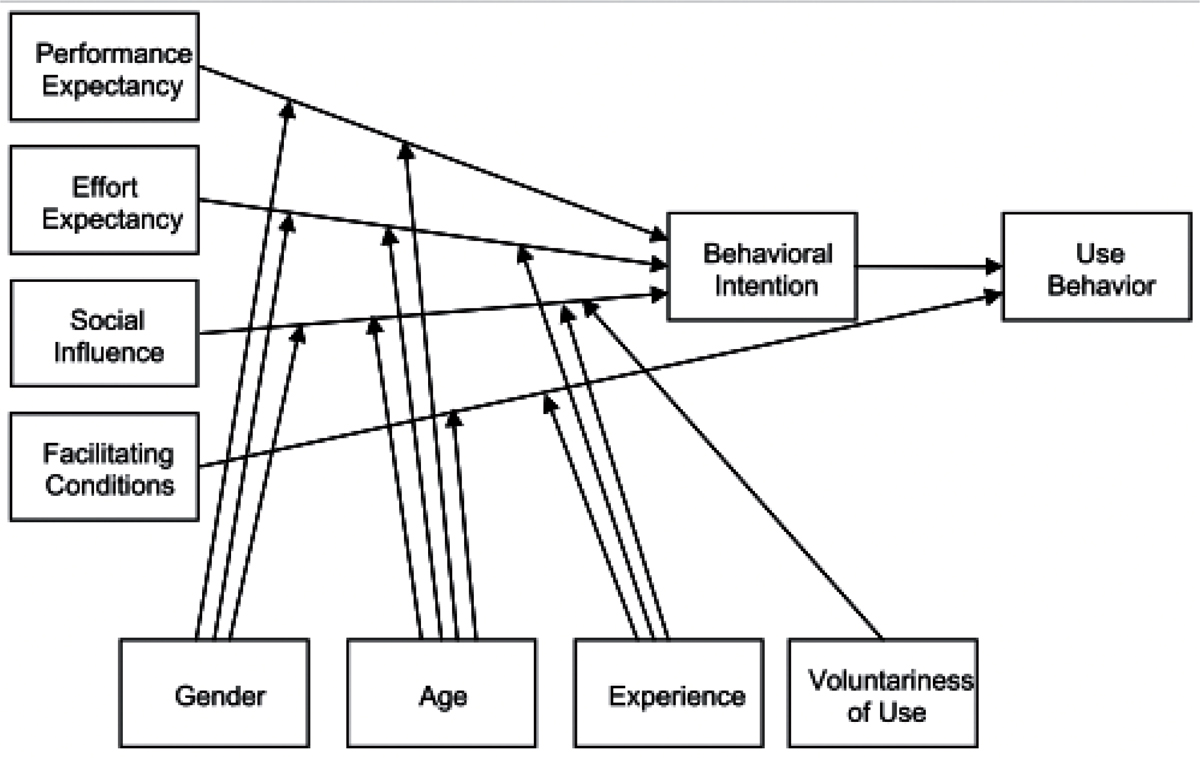
Figure 1
The UTAUT model
Source: Venkatesh et al. (2003)
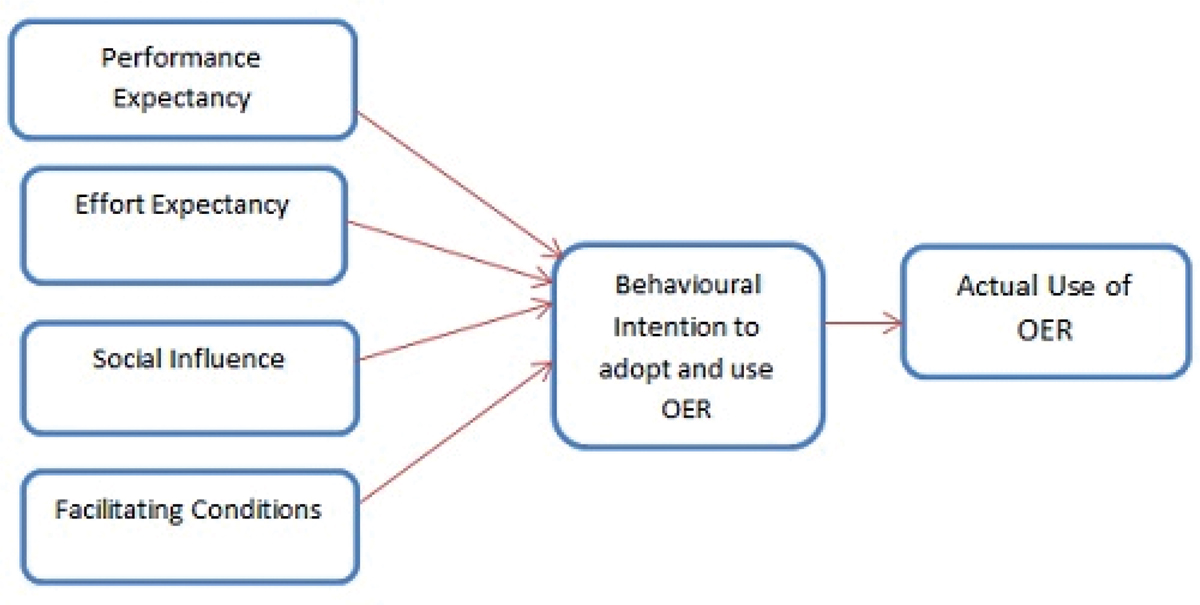
Figure 2
Research model for acceptance and usability of OER in India
Adapted from: Mtebe and Raisamo (2014)
Table 2
UTAUT Constructs
| Core constructs | Definition |
|---|---|
| Performance Expectancy | The degree to which an individual believes that using the system will help him or attain gains in job performance. |
| Effort Expectancy | The degree of ease associated with the use of the system. |
| Social Influence | The degree to which an individual perceives that important other believe he or she should use the new system. |
| Facilitating Conditions | The degree to which an individual believes that an organizational and technical infrastructure exists to support use of the system. |
Table 3
UTAUT Constructs and Hypotheses
| Core Constructs | Hypotheses |
|---|---|
| Performance Expectancy (PE) | H1: PE has a positive impact on BI to use OER |
| Effort Expectancy (EE) | H2: EE has a positive impact on BI to use OER |
| Social Influence (SI) | H3: SI has a positive impact on BI to use OER |
| Facilitating Conditions (FC) | H4: FC has a positive impact on BI to use OER |
Table 4
The UTAUT Constructs and Items
| Construct | Item Code | Item |
|---|---|---|
| Performance Expectancy (PE) | PE1 | OER is useful in courses |
| PE2 | Using OER will enable to accomplices course development activities quickly | |
| PE3 | Using OER would increase learning outcome of students | |
| PE4 | OER use will allow to have access to more information | |
| Effort Expectancy (EE) | EE1 | Interaction with OER is clear |
| EE2 | Easy for using and integrating OER in courses | |
| EE3 | OER is easy to use | |
| EE4 | Learning to use OER is easy | |
| Social Influence (SI) | SI1 | People who influence my behaviour think that I should use OER |
| SI2 | People who are important think that I should use and integrate OER into my courses | |
| SI3 | University staff are supportive in integrating OER in my course | |
| SI4 | University will support the use of OER in teaching and learning | |
| Facilitating Condition (FC) | FC1 | I have the resources necessary to access OER |
| FC2 | I have the knowledge necessary to use and integrate OER in my course | |
| FC3 | OER is similar to other course content I use for teaching | |
| FC4 | Help will be available when I get problem in using and integrating OER in my course |
Table 5
Descriptive analysis
| ||
| B. Response on Basics about OER | ||
| Questions | Yes (percentage) | No (percentage) |
| Are you aware of the concept of OER? | 188 (93.1%) | 14 (6.9%) |
| Will you share your courses as OER? | 174 (86.1%) | 28 (13.9%) |
| Have you ever used OER? | 40 (19.8%) | 162 (80.2%) |
Table 6
Pearson’s Correlations among four constructs and BI
| BI | PE | EE | SI | FC | ||
|---|---|---|---|---|---|---|
| BI | Pearson Correlation | 1 | .687** | .698** | .157* | .460** |
| N | 202 | 202 | 202 | 202 | 202 | |
| PE | Pearson Correlation | .687** | 1 | .844** | .085 | .532** |
| N | 202 | 202 | 202 | 202 | 202 | |
| EE | Pearson Correlation | .698** | .844** | 1 | .226** | .726** |
| N | 202 | 202 | 202 | 202 | 202 | |
| SI | Pearson Correlation | .157* | .085 | .226** | 1 | .236** |
| N | 202 | 202 | 202 | 202 | 202 | |
| FC | Pearson Correlation | .460** | .532** | .726** | .236** | 1 |
| N | 202 | 202 | 202 | 202 | 202 | |
Table 8
Regression coefficients
| Model | Unstandardized Coefficients | Standardized Coefficients | t | Sig. | ||
|---|---|---|---|---|---|---|
| B | Std. Error | Beta | ||||
| 1 | (Constant) | 1.233 | .334 | 3.698 | .000 | |
| PE | .259 | .072 | .342 | 3.581 | .000 | |
| EE | .427 | .116 | .434 | 3.682 | .000 | |
| SI | .061 | .075 | .042 | .803 | .423 | |
| FC | -.063 | .098 | -.047 | -.643 | .521 | |
Table 9
Confirmation of Hypotheses
| Hypothesis | Regression result | Confirmation |
|---|---|---|
| H1 : PE | Highly significant (β = .342, P < .001) | Yes |
| H2 : EE | Highly significant (β = .434, P < .001) | Yes |
| H3: SI | Not significant (β = .042, p < .423 | No |
| H4: FC | Not significant (β = -.047, p < .521) | No |
Table 10
Not using OER: Key Factors
| Factors | Major Reasons as opined by respondents |
|---|---|
| a. Awareness and training |
|
| b. Infrastructure |
|
| c. Policy, attitude and management |
|
| d. Plagiarism and copyright |
|